"d037b61901c110d2"{"id":"1002685","slug":"palace-hall","title":"Palace Hall","category":"Historical","engine":"5.0+","assetVersion":"","engineVersion":"Engine Version: 5.0+","tag":"Historical","accent":"blue","visual":"mech","summary":"Explore the Victorian architecture, modular prop systems, and dual lighting setups built for the Palace Hall environment in Unreal Engine.","platform":"Unreal Engine","indexPolicy":"index","publishedAt":"2026-11-16T22:36:38.314Z","updatedAt":"2026-11-16T22:36:38.314Z","sourceNotes":[],"fileContents":[],"compatibility":["Unreal Engine","Engine Version: 5.0+"],"featuredImage":{"alt":"Palace Hall","src":"/wp-content/uploads/published/2026/11/3db2de920509-9b4cb230-c38a-43f1-bf93-821773a0a3a3-9e3dfe8334.webp"},"fileSizeBytes":1883139053,"hasDownloadLink":true,"downloads":0,"terms":[{"taxonomy":"category","slug":"historical","name":"Historical"}],"galleryImages":[{"src":"/wp-content/uploads/published/2026/11/914063a8416a-c17d6024-3819-461d-b212-099a81588905-2d694c984a.webp","alt":"Palace Hall"},{"src":"/wp-content/uploads/published/2026/11/f5233fd8ffdd-8baba9e3-e892-450d-a5ad-87dcad30868a-61fed64830.webp","alt":"Palace Hall"},{"src":"/wp-content/uploads/published/2026/11/6e9e630f5ccb-7e943c8f-a599-4b2b-a515-1b823e60d6cf-958a8a6a7e.webp","alt":"Palace Hall"},{"src":"/wp-content/uploads/published/2026/11/23867e6e9747-70fdd26b-de5d-497c-a199-04493c3522cb-64938ba402.webp","alt":"Palace Hall"},{"src":"/wp-content/uploads/published/2026/11/35355f55afbc-ca7e4a2e-e4d0-47df-b2b8-0c2a7a6adafe-576abf2a1e.webp","alt":"Palace Hall"},{"src":"/wp-content/uploads/published/2026/11/de9d495e1517-5408a9cc-35c0-456e-88dc-cb2e4ac9f6c1-ae80b9dddf.webp","alt":"Palace Hall"},{"src":"/wp-content/uploads/published/2026/11/07474e4639bb-28b8d0b9-8c18-4240-aa0d-8fa89f26de59-d4da25ac77.webp","alt":"Palace Hall"},{"src":"/wp-content/uploads/published/2026/11/e8d48c6f632e-81fdebaf-2eb9-4e18-9452-db7ca05aedf9-70ca23e491.webp","alt":"Palace Hall"},{"src":"/wp-content/uploads/published/2026/11/e54f24bde725-391be59f-f986-4f55-865e-37a94c5ba188-1ee5dcd2d1.webp","alt":"Palace Hall"},{"src":"/wp-content/uploads/published/2026/11/ce0239ff9453-475ff7b2-57eb-4328-9ab8-4a3d7773d8dc-6cb0212416.webp","alt":"Palace Hall"}],"accessPanel":{"kind":"resource","title":"Get this resource","eyebrow":"Free resource","message":"Download this resource in your browser.","fileName":"Content.7z","safetyNote":"Resources are manually reviewed before listing to improve quality and reduce obvious risks.","actionLabel":"Get this resource","resourceType":"Resource archive","versions":[]},"contentHtml":"\u003cp\u003eModular architectural structures, gilded interior trim, and historic props establish the foundational identity of Palace Hall. Tailored around a Victorian aesthetic, the asset package unites realistic environmental construction with an ornate, classical visual theme. The primary assets function as a coordinated kit, providing developers and environment artists with the foundational elements required to construct expansive interior halls, formal corridors, and luxurious stately rooms suited for historical settings and exploration-focused gaming.\u003c/p\u003e \u003ch2\u003eArchitectural Modules and Victorian Styling in Palace Hall\u003c/h2\u003e\n\u003cp\u003eThe visual direction of Palace Hall centers on an elegant, luxurious Victorian mood characterized by ornate detailing and gilded architectural surfaces. The included assets emphasize realistic proportions and classic architectural conventions, presenting high ceilings, decorative paneling, structural columns, and tailored interior props. Because the environment relies on modular construction, individual architectural components can be recombined to expand the room into sprawling galleries or condense it into intimate private chambers.\u003c/p\u003e \u003cp\u003eWorking with modular elements allows level designers to adjust the footprint of the hall without breaking the coherence of the Victorian aesthetic. Walls, floor sections, and decorative trims align systematically, giving creators the freedom to design complex floor plans tailored to specific camera angles or gameplay trajectories. The ornate trim work and gilded accents reflect a sense of historical grandeur, establishing an immediate atmosphere of wealth, power, and prestige suitable for period dramas, fantasy nobility settings, or mystery adventures.\u003c/p\u003e \u003cp\u003eThe environmental props provided within the collection reinforce the feeling of an authentic inhabited space rather than an empty structural shell. Placed alongside the primary architectural framing, these detailed elements punctuate the room, creating distinct focal points that encourage spatial exploration. Whether used to populate a lavish reception area or an abandoned ancestral estate, the props integrate directly into the surrounding modular geometry to preserve aesthetic consistency across the entire level.\u003c/p\u003e \u003ch2\u003eEnvironment Design and Exploration Across the Palace Hall Space\u003c/h2\u003e\n\u003cp\u003eDesigning interactive levels with Palace Hall involves balancing spatial grandeur with navigable pathways. The classic layout of a Victorian palace relies on broad sightlines and ceremonial entry points, offering adventure games a natural framework for atmospheric pacing. Players navigating through the hall encounter distinct architectural zones defined by gilded boundaries, tall walls, and symmetrical arrangements that guide attention toward key points of interest.\u003c/p\u003e \u003cp\u003eThe detailed environment supports immersive world-building by grounding the player in a believable, realistic historical space. In narrative or adventure projects, the physical scale of the architecture can communicate the history of a location before any dialogue or text appears. The contrast between wide-open hall floors and intricately structured perimeter walls helps level designers control pacing, offering clear boundaries while sustaining the visual depth necessary for realistic rendering.\u003c/p\u003e \u003cp\u003eBecause the environment is explicitly tagged for gaming, exploration, and adventure, the assets serve practical level design needs alongside aesthetic ones. Corridors can branch off from the main hall to structure multi-room levels, while the repeating architectural cadence provides natural cover points, sightline blockers, and framing devices for cinematics. The gilded surfaces catch light in ways that can be used intentionally to draw players toward exits, interactive props, or narrative milestones.\u003c/p\u003e \u003ch2\u003eConfiguring Baked Lighting in the Palace Hall Demo\u003c/h2\u003e\n\u003cp\u003eTo accommodate diverse rendering pipelines and performance targets, the package supplies multiple pre-configured maps. The first of these, Level_PalaceHall_Demo.umap, is authored specifically for static baked lighting rather than dynamic calculations. Using this level requires an intentional adjustment of project settings to ensure that indirect illumination and surface reflections display properly as authored.\u003c/p\u003e \u003cp\u003eWhen loading Level_PalaceHall_Demo.umap, the project configuration must be adjusted by setting Global Illumination to None and setting reflections to Screen Space. These adjustments prevent dynamic global illumination systems from overriding the precomputed lightmaps, preserving the specific soft shadow gradients, contact occlusion, and indirect light bounces generated during the bake. Running this level without making those project adjustments can lead to mismatched reflections or inaccurate lighting responses across the ornate Victorian surfaces.\u003c/p\u003e \u003cp\u003eStatic lighting setups remain a valuable option for productions targeting strict performance budgets or hardware platforms where dynamic global illumination is impractical. By relying on pre-calculated lightmaps, Level_PalaceHall_Demo.umap delivers stable, high-fidelity light interaction across the detailed props, gilded moldings, and architecture with zero runtime illumination overhead. The baked light accentuates the depth of the classical molding and ensures that shadows across intricate trims remain crisp and visually stable during gameplay.\u003c/p\u003e \u003ch2\u003eLumen Illumination and Sky Atmosphere Integration\u003c/h2\u003e\n\u003cp\u003eFor modern real-time workflows, the package includes Level_PalaceHall_Demo_WithLumen.umap, a dedicated level assembled to harness dynamic rendering capabilities. Unlike the static baked setup, this level requires project settings where both Global Illumination and Reflections are configured to Lumen. This configuration allows the environment to compute complex multi-bounce indirect lighting and detailed specular reflections dynamically across every gilded and polished surface.\u003c/p\u003e \u003cp\u003eIn addition to real-time global illumination, Level_PalaceHall_Demo_WithLumen.umap incorporates a Sky Atmosphere component paired with customized light settings. The sky atmosphere system works together with dynamic directional and ambient light sources, casting realistic exterior light through the hall's windows and openings. Light bounces realistically off the ornate walls and gilded features, adjusting immediately if lights are moved, tinted, or toggled during runtime.\u003c/p\u003e \u003cp\u003eThe Lumen workflow provides distinct advantages for productions that incorporate dynamic time-of-day changes or interactive light sources such as torches and chandeliers. Reflections on gilded frames, glossy floor tiles, and polished architectural trim update in real time, grounding moving characters and dynamic objects within the scene. Having both static and Lumen levels readily available enables artists to benchmark both approaches side-by-side and select the lighting workflow that aligns with their project's technical framework.\u003c/p\u003e \u003ch2\u003eEngine Migration and Light GUID Updates Across Unreal 5.4 and 5.5\u003c/h2\u003e\n\u003cp\u003eTechnical changes between engine versions often impact lighting systems, and Palace Hall accounts for architectural changes introduced between Unreal Engine 5.4 and Unreal Engine 5.5. Specifically, shifts in the internal light GUID format across those versions necessitated updates to maintain level integrity. To resolve compatibility issues with lighting data, an update featuring rebuilt lighting was finalized and submitted on September 28, 2026, targeted for Unreal Engine 5.5 and subsequent versions.\u003c/p\u003e \u003cp\u003eWithin this update, Level_PalaceHall_Demo.umap received completely rebuilt static lighting to account for the altered GUID requirements, ensuring that lightmaps link correctly without generating invalid references or unbuilt lighting warnings in newer engine builds. Simultaneously, Level_PalaceHall_Demo_WithLumen.umap received its integrated sky atmosphere component alongside fine-tuned lighting settings to optimize dynamic exposure and bounce intensity.\u003c/p\u003e \u003cp\u003eThese version-specific revisions ensure that whether a project operates within Unreal Engine 5.4 or moves forward to Unreal Engine 5.5 and later releases, the demonstration maps function properly out of the box. Level designers can open either map, apply the recommended project-level global illumination and reflection settings, and immediately begin integrating the modular palace structures into their games, architectural visualizations, or cinematic sequences.\u003c/p\u003e\n\n\u003ch2\u003eMore From The Same Workflow\u003c/h2\u003e\n\u003cul\u003e\n\u003cli\u003e\u003ca href=\"https://3dcghub.com/stone-palace/\" rel=\"noopener noreferrer\"\u003eStone Palace\u003c/a\u003e\u003c/li\u003e\n\u003cli\u003e\u003ca href=\"https://3dcghub.com/middle-eastern-town-gigapack-w-level-pcg-met-palace-bazaar-city/\" rel=\"noopener noreferrer\"\u003eMiddle Eastern Town Gigapack w/ Level PCG ( MET, Palace, Bazaar, City)\u003c/a\u003e\u003c/li\u003e\n\u003cli\u003e\u003ca href=\"https://3dcghub.com/nordic-medieval-tavern/\" rel=\"noopener noreferrer\"\u003eNordic Medieval Tavern\u003c/a\u003e\u003c/li\u003e\n\u003cli\u003e\u003ca href=\"https://3dcghub.com/the-grand-egyptian-temple-egyptian-temple-ancient-exterior-interior-temple/\" rel=\"noopener noreferrer\"\u003eThe Grand Egyptian Temple ( Egyptian Temple Ancient Exterior Interior Temple )\u003c/a\u003e\u003c/li\u003e\n\u003cli\u003e\u003ca href=\"https://3dcghub.com/ancient-constructions-and-platforms/\" rel=\"noopener noreferrer\"\u003eAncient Constructions and Platforms\u003c/a\u003e\u003c/li\u003e\n\u003c/ul\u003e","contentTextLength":8641,"navigation":{"current":4,"total":4611,"previous":{"id":"1002686","slug":"platformer-stylized-cube-world-vol-1","title":"PLATFORMER - Stylized Cube World Vol.1","category":"Fantasy","platform":"Unreal Engine","updatedAt":"2026-11-16T22:37:54.454Z"},"next":{"id":"1002684","slug":"museum-environment-kit","title":"Museum Environment Kit","category":"Historical","platform":"Unreal Engine","updatedAt":"2026-11-16T22:35:37.511Z"}},"relatedResources":[{"id":"1001558","slug":"stone-palace","title":"Stone Palace","category":"Historical","engine":"5.2+","assetVersion":"","engineVersion":"Engine Version: 5.2+","tag":"Historical","accent":"blue","visual":"mech","summary":"Construct grand historical and fantasy environments using modular stone building components, pillars, statues, and foliage for immersive levels.","platform":"Unreal Engine","indexPolicy":"index","publishedAt":"2026-10-10T03:49:25.404Z","updatedAt":"2026-10-10T03:49:25.404Z","sourceNotes":[],"fileContents":[],"compatibility":["Unreal Engine","Engine Version: 5.2+"],"featuredImage":{"alt":"Stone Palace","src":"/wp-content/uploads/published/2026/10/a8d7b05b4ede-b9923cd5-4086-4fd5-9fb8-6364e48407ab-31f98fbf86.webp"},"fileSizeBytes":2472657378,"hasDownloadLink":true,"downloads":0},{"id":"1000285","slug":"middle-eastern-town-gigapack-w-level-pcg-met-palace-bazaar-city","title":"Middle Eastern Town Gigapack w/ Level PCG ( MET, Palace, Bazaar, City)","category":"Historical","engine":"5.6+","assetVersion":"","engineVersion":"Engine Version: 5.6+","tag":"Historical","accent":"blue","visual":"city","summary":"A comprehensive Unreal Engine 5 environment pack featuring over 1,000 modular meshes, procedural foliage, and tools for building historical desert cities.","platform":"Unreal Engine","indexPolicy":"index","publishedAt":"2026-07-03T16:58:55.632Z","updatedAt":"2026-07-03T16:58:55.632Z","sourceNotes":[],"fileContents":[],"compatibility":["Unreal Engine","Engine Version: 5.6+"],"featuredImage":{"alt":"Middle Eastern Town Gigapack w/ Level PCG ( MET, Palace, Bazaar, City)","src":"/wp-content/uploads/published/2026/07/f1526e76e49f-f10078a8-6c9d-469c-b94e-a9f1d375aebc-06f70fe46a.webp"},"fileSizeBytes":33619984143,"hasDownloadLink":true,"downloads":4},{"id":"8416","slug":"nordic-medieval-tavern","title":"Nordic Medieval Tavern","category":"Historical","engine":"5.1+","assetVersion":"Engine version: 5.1+","engineVersion":"5.1","tag":"Historical","accent":"blue","visual":"city","summary":"Build a stunning and immersive historical environment with this comprehensive Nordic Medieval Tavern asset pack. It features over 200 high-quality meshes optimized for AAA game development.","platform":"Unreal Engine","indexPolicy":"noindex","publishedAt":"2026-02-23T17:13:53.000Z","updatedAt":"2026-04-19T15:55:28.000Z","sourceNotes":[],"fileContents":[],"compatibility":["Unreal Engine","Engine version: 5.1+"],"featuredImage":{"alt":"Nordic Medieval Tavern","src":"https://3dcghub.com/wp-content/uploads/2026/02/c3e8a50b-8677-490b-b297-414f99939a84.webp"},"fileSizeBytes":6349218696,"hasDownloadLink":true,"downloads":1}]}
Resource screenshots
1 / 10
Historical
Palace Hall
Explore the Victorian architecture, modular prop systems, and dual lighting setups built for the Palace Hall environment in Unreal Engine.
Modular architectural structures, gilded interior trim, and historic props establish the foundational identity of Palace Hall. Tailored around a Victorian aesthetic, the asset package unites realistic environmental construction with an ornate, classical visual theme. The primary assets function as a coordinated kit, providing developers and environment artists with the foundational elements required to construct expansive interior halls, formal corridors, and luxurious stately rooms suited for historical settings and exploration-focused gaming.
Architectural Modules and Victorian Styling in Palace Hall
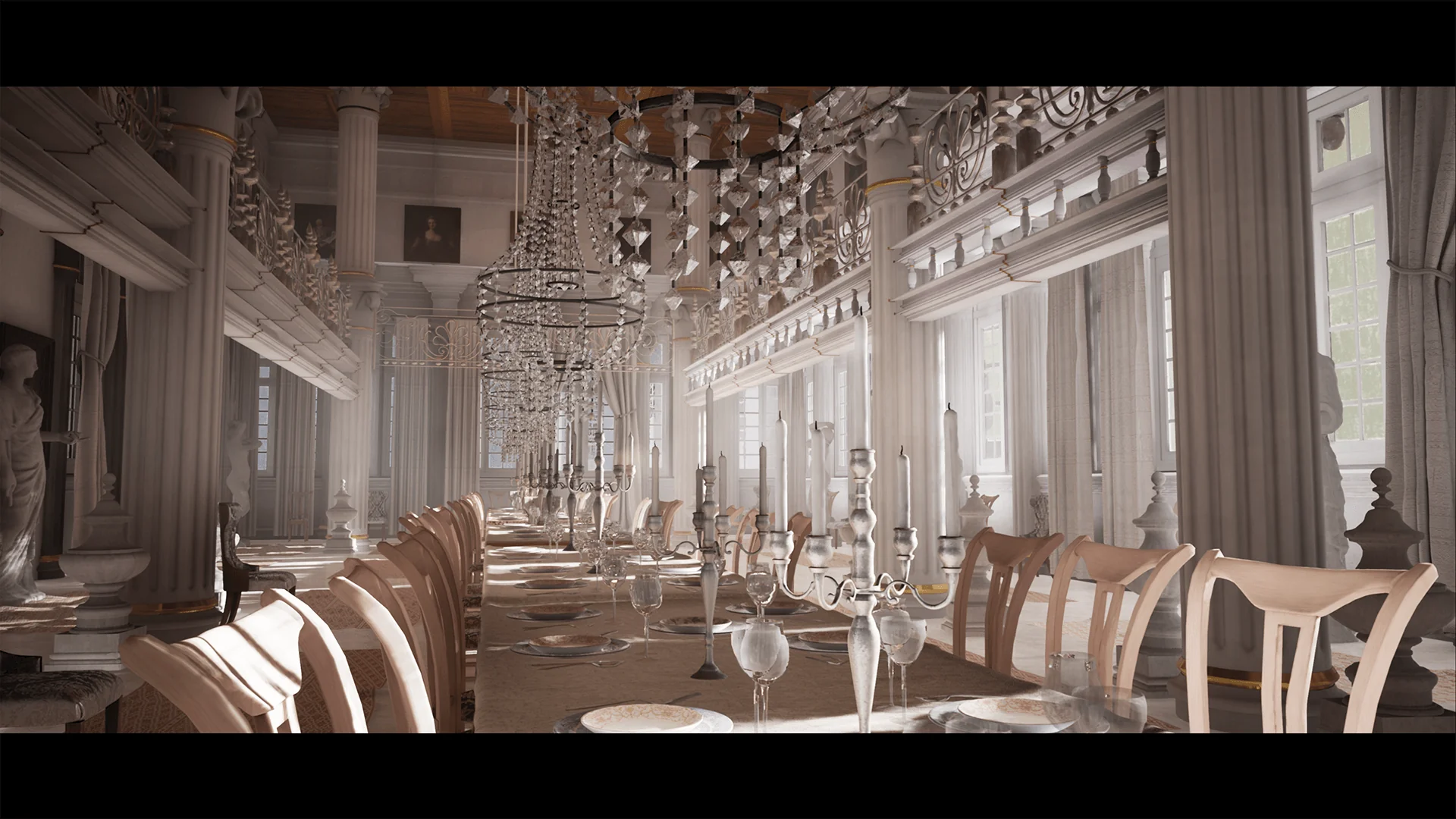
The visual direction of Palace Hall centers on an elegant, luxurious Victorian mood characterized by ornate detailing and gilded architectural surfaces. The included assets emphasize realistic proportions and classic architectural conventions, presenting high ceilings, decorative paneling, structural columns, and tailored interior props. Because the environment relies on modular construction, individual architectural components can be recombined to expand the room into sprawling galleries or condense it into intimate private chambers.
Working with modular elements allows level designers to adjust the footprint of the hall without breaking the coherence of the Victorian aesthetic. Walls, floor sections, and decorative trims align systematically, giving creators the freedom to design complex floor plans tailored to specific camera angles or gameplay trajectories. The ornate trim work and gilded accents reflect a sense of historical grandeur, establishing an immediate atmosphere of wealth, power, and prestige suitable for period dramas, fantasy nobility settings, or mystery adventures.
The environmental props provided within the collection reinforce the feeling of an authentic inhabited space rather than an empty structural shell. Placed alongside the primary architectural framing, these detailed elements punctuate the room, creating distinct focal points that encourage spatial exploration. Whether used to populate a lavish reception area or an abandoned ancestral estate, the props integrate directly into the surrounding modular geometry to preserve aesthetic consistency across the entire level.
Environment Design and Exploration Across the Palace Hall Space
Designing interactive levels with Palace Hall involves balancing spatial grandeur with navigable pathways. The classic layout of a Victorian palace relies on broad sightlines and ceremonial entry points, offering adventure games a natural framework for atmospheric pacing. Players navigating through the hall encounter distinct architectural zones defined by gilded boundaries, tall walls, and symmetrical arrangements that guide attention toward key points of interest.
The detailed environment supports immersive world-building by grounding the player in a believable, realistic historical space. In narrative or adventure projects, the physical scale of the architecture can communicate the history of a location before any dialogue or text appears. The contrast between wide-open hall floors and intricately structured perimeter walls helps level designers control pacing, offering clear boundaries while sustaining the visual depth necessary for realistic rendering.
Because the environment is explicitly tagged for gaming, exploration, and adventure, the assets serve practical level design needs alongside aesthetic ones. Corridors can branch off from the main hall to structure multi-room levels, while the repeating architectural cadence provides natural cover points, sightline blockers, and framing devices for cinematics. The gilded surfaces catch light in ways that can be used intentionally to draw players toward exits, interactive props, or narrative milestones.
Configuring Baked Lighting in the Palace Hall Demo
To accommodate diverse rendering pipelines and performance targets, the package supplies multiple pre-configured maps. The first of these, Level_PalaceHall_Demo.umap, is authored specifically for static baked lighting rather than dynamic calculations. Using this level requires an intentional adjustment of project settings to ensure that indirect illumination and surface reflections display properly as authored.
When loading Level_PalaceHall_Demo.umap, the project configuration must be adjusted by setting Global Illumination to None and setting reflections to Screen Space. These adjustments prevent dynamic global illumination systems from overriding the precomputed lightmaps, preserving the specific soft shadow gradients, contact occlusion, and indirect light bounces generated during the bake. Running this level without making those project adjustments can lead to mismatched reflections or inaccurate lighting responses across the ornate Victorian surfaces.
Static lighting setups remain a valuable option for productions targeting strict performance budgets or hardware platforms where dynamic global illumination is impractical. By relying on pre-calculated lightmaps, Level_PalaceHall_Demo.umap delivers stable, high-fidelity light interaction across the detailed props, gilded moldings, and architecture with zero runtime illumination overhead. The baked light accentuates the depth of the classical molding and ensures that shadows across intricate trims remain crisp and visually stable during gameplay.
Lumen Illumination and Sky Atmosphere Integration
For modern real-time workflows, the package includes Level_PalaceHall_Demo_WithLumen.umap, a dedicated level assembled to harness dynamic rendering capabilities. Unlike the static baked setup, this level requires project settings where both Global Illumination and Reflections are configured to Lumen. This configuration allows the environment to compute complex multi-bounce indirect lighting and detailed specular reflections dynamically across every gilded and polished surface.
In addition to real-time global illumination, Level_PalaceHall_Demo_WithLumen.umap incorporates a Sky Atmosphere component paired with customized light settings. The sky atmosphere system works together with dynamic directional and ambient light sources, casting realistic exterior light through the hall's windows and openings. Light bounces realistically off the ornate walls and gilded features, adjusting immediately if lights are moved, tinted, or toggled during runtime.
The Lumen workflow provides distinct advantages for productions that incorporate dynamic time-of-day changes or interactive light sources such as torches and chandeliers. Reflections on gilded frames, glossy floor tiles, and polished architectural trim update in real time, grounding moving characters and dynamic objects within the scene. Having both static and Lumen levels readily available enables artists to benchmark both approaches side-by-side and select the lighting workflow that aligns with their project's technical framework.
Engine Migration and Light GUID Updates Across Unreal 5.4 and 5.5
Technical changes between engine versions often impact lighting systems, and Palace Hall accounts for architectural changes introduced between Unreal Engine 5.4 and Unreal Engine 5.5. Specifically, shifts in the internal light GUID format across those versions necessitated updates to maintain level integrity. To resolve compatibility issues with lighting data, an update featuring rebuilt lighting was finalized and submitted on September 28, 2026, targeted for Unreal Engine 5.5 and subsequent versions.
Within this update, Level_PalaceHall_Demo.umap received completely rebuilt static lighting to account for the altered GUID requirements, ensuring that lightmaps link correctly without generating invalid references or unbuilt lighting warnings in newer engine builds. Simultaneously, Level_PalaceHall_Demo_WithLumen.umap received its integrated sky atmosphere component alongside fine-tuned lighting settings to optimize dynamic exposure and bounce intensity.
These version-specific revisions ensure that whether a project operates within Unreal Engine 5.4 or moves forward to Unreal Engine 5.5 and later releases, the demonstration maps function properly out of the box. Level designers can open either map, apply the recommended project-level global illumination and reflection settings, and immediately begin integrating the modular palace structures into their games, architectural visualizations, or cinematic sequences.
 Historical
 Historical
 Historical