"d037b61901c110d2"{"id":"1002686","slug":"platformer-stylized-cube-world-vol-1","title":"PLATFORMER - Stylized Cube World Vol.1","category":"Fantasy","engine":"5.0+","assetVersion":"","engineVersion":"Engine Version: 5.0+","tag":"Fantasy","accent":"blue","visual":"mech","summary":"Examine the modular assets, PBR materials, interactive props, and demo maps included in PLATFORMER - Stylized Cube World Vol.1 for level building.","platform":"Unreal Engine","indexPolicy":"index","publishedAt":"2026-11-16T22:37:54.454Z","updatedAt":"2026-11-16T22:37:54.454Z","sourceNotes":[],"fileContents":[],"compatibility":["Unreal Engine","Engine Version: 5.0+"],"featuredImage":{"alt":"PLATFORMER - Stylized Cube World Vol.1","src":"/wp-content/uploads/published/2026/11/fa55e4dec10f-993fcd0b-2ca7-4c65-9a85-3956de115c19-0f8fa8b598.webp"},"fileSizeBytes":396987921,"hasDownloadLink":true,"downloads":0,"terms":[{"taxonomy":"category","slug":"fantasy","name":"Fantasy"}],"galleryImages":[{"src":"/wp-content/uploads/published/2026/11/1366868358c0-5a0e6a4d-1f87-47c7-a48d-a4b9f9fa6526-4313d31249.webp","alt":"PLATFORMER - Stylized Cube World Vol.1"},{"src":"/wp-content/uploads/published/2026/11/70d86a99fb92-dbbda54f-750b-4ee6-9009-38dfd61682ae-80052f0bcc.webp","alt":"PLATFORMER - Stylized Cube World Vol.1"},{"src":"/wp-content/uploads/published/2026/11/d9b8cb73e5d6-dd635fb3-f32c-4f49-94f6-3aad28894e41-8c5104ceb9.webp","alt":"PLATFORMER - Stylized Cube World Vol.1"},{"src":"/wp-content/uploads/published/2026/11/5bf73d2ea0e9-bd0b5272-6249-4b0f-a675-95d9f331f018-1212f52a7d.webp","alt":"PLATFORMER - Stylized Cube World Vol.1"},{"src":"/wp-content/uploads/published/2026/11/590cf68f83d3-beb2b749-ca2d-419e-a720-bf54897f6205-9b844725bc.webp","alt":"PLATFORMER - Stylized Cube World Vol.1"},{"src":"/wp-content/uploads/published/2026/11/ee85d19d48e3-3f5bab6c-a977-4520-ab82-7242c9cbd0f1-dfcebad152.webp","alt":"PLATFORMER - Stylized Cube World Vol.1"},{"src":"/wp-content/uploads/published/2026/11/875a15d78788-e929f79a-09d3-4a53-b7d3-416a65f98495-69e649dd0b.webp","alt":"PLATFORMER - Stylized Cube World Vol.1"},{"src":"/wp-content/uploads/published/2026/11/7546327ff807-e1e33ab5-bd8b-4d82-a33d-e08554a8c659-38995d8018.webp","alt":"PLATFORMER - Stylized Cube World Vol.1"},{"src":"/wp-content/uploads/published/2026/11/61fe31c27562-7cf83d64-4d3c-4ffd-a27d-a1b42b6570b0-06ec6745aa.webp","alt":"PLATFORMER - Stylized Cube World Vol.1"},{"src":"/wp-content/uploads/published/2026/11/1f28b7756b4e-af2cc2a9-8d87-4510-808d-a4d66e60f43d-753ba1cdee.webp","alt":"PLATFORMER - Stylized Cube World Vol.1"}],"accessPanel":{"kind":"resource","title":"Get this resource","eyebrow":"Free resource","message":"Download this resource in your browser.","fileName":"Content.7z","safetyNote":"Resources are manually reviewed before listing to improve quality and reduce obvious risks.","actionLabel":"Get this resource","resourceType":"Resource archive","versions":[]},"contentHtml":"\u003cp\u003eConstructing readable, responsive layouts for obstacle-driven games requires an art kit that balances clear spatial boundaries with visual polish. PLATFORMER - Stylized Cube World Vol.1 provides a complete environment framework focused on cubic architecture and vibrant scene dressing. Rooted in a stylized PBR workflow, the package gathers more than 100 individual 3D models alongside preconfigured functional elements, targeted directly at developers staging levels for top-down, isometric, roller, and traditional 3D platformers. Any animated characters seen in demonstration previews serve strictly as scale and presentation references; the focus of the package rests entirely on the modular stages, interactive markers, and environmental pieces that form the playable world.\u003c/p\u003e \u003ch2\u003eFoundations of the Stylized Cube World\u003c/h2\u003e \u003cp\u003eThe core geometry of this collection utilizes standardized modular blocks and specialized structural components. At the center of the package are versatile platform meshes, moving platforms, and modular foundations that allow level creators to map out jumping routes, elevated arenas, and floating puzzles without manual geometry slicing. These surfaces are complemented by water meshes, dynamic cloud shapes, and localized fog elements, giving creators the components required to anchor floating sky islands or sunken liquid hazards.\u003c/p\u003e \u003cp\u003eBecause the set adheres to a stylized PBR workflow, surface materials respond accurately to scene lighting while retaining clean, bold shapes and readable silhouettes. This balance ensures that complex verticality remains visually coherent from multiple camera vantage points. Surfaces retain their tactile material definition under direct sunlight or ambient stage bounce without visual clutter obscuring crucial jump landings or perimeter drops. The package exists as part of a wider Platformer Stylized Series, standing alongside parallel releases such as the PLATFORMER - Simple Cube World Vol.1, which serves projects prioritizing an alternate, non-PBR simple art style.\u003c/p\u003e \u003ch2\u003eInteractive Mechanics Across Platformer Obstacles and PowerUps\u003c/h2\u003e \u003cp\u003eMoving beyond basic terrain, the package supplies a complete vocabulary of gameplay items to establish progression, danger, and player routing. Level pacing relies heavily on distinct hazard indicators, which are fulfilled by the collection's specialized obstacle meshes. Developers can plant standard ground Spikes to deny straightforward footholds or erect imposing Pillar Spikes to create rhythmic vertical hazards and timing traps across narrow walkways.\u003c/p\u003e \u003cp\u003eTo guide the player and reward navigation, the asset library incorporates an extensive array of power-ups, pick-ups, and waypoint markers:\u003c/p\u003e\n\u003cul\u003e \u003cli\u003e\u003cstrong\u003eCollectibles and Milestones:\u003c/strong\u003e Classic high-value targets including Coins, Gems, Stars, and Keys provide immediate incentives for exploration, path deviation, and locked-gate mechanics.\u003c/li\u003e \u003cli\u003e\u003cstrong\u003eNavigation and Kinematics:\u003c/strong\u003e Jump Pads offer instant vertical launch points, Step Boost items accelerate forward trajectory, and directional Arrow indicators help direct player focus along high-speed corridors.\u003c/li\u003e \u003cli\u003e\u003cstrong\u003eLevel Progression Markers:\u003c/strong\u003e Dedicated Goal and Checkpoint props establish clear stage terminals and respawn locations without requiring external asset supplementation.\u003c/li\u003e \u003cli\u003e\u003cstrong\u003eReward Containers:\u003c/strong\u003e Treasure Chest meshes function as primary prize nodes for hidden alcoves or conquered challenge zones.\u003c/li\u003e\n\u003c/ul\u003e \u003cp\u003eThese components allow level designers to instantly draft test courses that communicate mechanics without placeholder primitives. The distinct geometry of items like the Jump Pad or Pillar Spike instantly signals mechanical behavior to the player, maintaining clear readability whether viewed up close in a third-person chase perspective or from the pulled-back vantage point of a mobile top-down runner.\u003c/p\u003e \u003ch2\u003eEnvironmental Props, Vegetation, and Atmospheric Particles\u003c/h2\u003e \u003cp\u003eA playable blockout requires organic elements and structural dressing to transition from an abstract graybox into a believable fantasy setting. The kit delivers a suite of architectural and utility props to detail pathways and break up geometric monotony. Builders can assemble elevated pathways and crossings using the Wooden Bridge, demarcate boundaries with sectional Fences, and construct vertical access routes using modular Ladders. Storage and breakable dressing can be deployed through Wooden Crates and Metal Crates, while navigational Signboards and defensive Towers add narrative context to outpost stations or dungeon entrances.\u003c/p\u003e \u003cp\u003eOrganic dressing balances the sharp cubic edges of the hard-surface assets. The package includes an extensive vegetation library featuring varied trees, plants, bushes, individual flowers, and grass tufts. Fallen logs, harvested lumber piles, and whimsical mushroom clusters enable developers to populate forest floors, cavern undercrofts, and riverbanks with natural variety. These models maintain the same chunky, stylized proportions as the structural blocks, preserving a unified aesthetic across both organic and constructed terrain.\u003c/p\u003e \u003cp\u003eEnvironmental dynamics are expanded further through dedicated particle systems and atmospheric assets. Included systems generate subtle Dust, thick Smoke, and swirling Wind currents, injecting physical energy into otherwise static levels. When integrated alongside the bundled cloud formations and fog assets, these effects transform simple obstacle courses into atmospheric sky realms, misty canyons, or wind-swept mountain crags.\u003c/p\u003e \u003ch2\u003eBlueprint Systems, Material Variations, and Layout Demonstrations\u003c/h2\u003e \u003cp\u003eEfficiency in level development depends not only on raw mesh assets but also on setup convenience. To accelerate production implementation, the package incorporates 10 pre-assembled Blueprint items. These nodes pre-wire assets into functional game-ready items, reducing the need to manually attach components, align collision hulls, or configure basic interactive structures from scratch. Whether managing moving platform routes or setting up interactive prop states, these Blueprint configurations serve as immediate building blocks for game logic.\u003c/p\u003e \u003cp\u003eVisual variety across multiple levels is supported through a wide assortment of textures and material color variations. By adjusting material assignments, creators can alter biome aesthetics across the same set of 100+ models, shifting from lush green meadow tops to arid stone plateaus or subterranean ruins without altering underlying layouts. This flexibility makes the pack especially relevant for gameready mobile titles, where memory constraints encourage heavy reuse of base meshes across varied thematic chapters.\u003c/p\u003e \u003cp\u003eTo showcase how these disparate pieces unite into functional level designs, the release supplies six fully realized demo scenes along with a dedicated overview map. The overview map indexes the entire library of platforms, props, obstacles, and foliage in an organized layout for immediate inspection and asset picking. The six demonstration scenes present distinct, fully populated environments, illustrating effective camera framing for top-down, isometric, and horizontal platformer perspectives. These maps demonstrate practical combinations of props, vertical jump timing, and particle layering, offering concrete templates for building original levels.\u003c/p\u003e\n\n\u003ch2\u003eRelated Resources Worth Checking\u003c/h2\u003e\n\u003cul\u003e\n\u003cli\u003e\u003ca href=\"https://3dcghub.com/dreamscape-stylized-environment-tower-stylized-nature-open-world-fantasy/\" rel=\"noopener noreferrer\"\u003eDreamscape: Stylized Environment Tower - Stylized Nature Open World Fantasy\u003c/a\u003e\u003c/li\u003e\n\u003cli\u003e\u003ca href=\"https://3dcghub.com/fantasy-medieval-kingdom-stylized-castle-town-village-dungeon-kingdom/\" rel=\"noopener noreferrer\"\u003eFantasy Medieval Kingdom (Stylized Castle, Town, Village, Dungeon, Kingdom)\u003c/a\u003e\u003c/li\u003e\n\u003cli\u003e\u003ca href=\"https://3dcghub.com/stylized-azure-hillside-stylized-hillside-azure-hilltop-stylized-hill-azure/\" rel=\"noopener noreferrer\"\u003eStylized Azure Hillside ( Stylized Hillside Azure Hilltop Stylized Hill Azure )\u003c/a\u003e\u003c/li\u003e\n\u003cli\u003e\u003ca href=\"https://3dcghub.com/isometric-world-sky-temple/\" rel=\"noopener noreferrer\"\u003eIsometric World : Sky Temple\u003c/a\u003e\u003c/li\u003e\n\u003cli\u003e\u003ca href=\"https://3dcghub.com/stylized-mega-pack-stylized-nature-environment/\" rel=\"noopener noreferrer\"\u003eStylized MEGA PACK | Stylized Nature Environment\u003c/a\u003e\u003c/li\u003e\n\u003c/ul\u003e","contentTextLength":7588,"navigation":{"current":3,"total":4611,"previous":{"id":"1002687","slug":"platformer-8-underworld-low-poly-3d-models-pack","title":"Platformer 8 Underworld - Low Poly 3D Models Pack","category":"Dungeon","platform":"Unreal Engine","updatedAt":"2026-11-16T22:38:43.033Z"},"next":{"id":"1002685","slug":"palace-hall","title":"Palace Hall","category":"Historical","platform":"Unreal Engine","updatedAt":"2026-11-16T22:36:38.314Z"}},"relatedResources":[{"id":"7924","slug":"dreamscape-stylized-environment-tower-stylized-nature-open-world-fantasy","title":"Dreamscape: Stylized Environment Tower - Stylized Nature Open World Fantasy","category":"Fantasy","engine":"4.26+,5.0+","assetVersion":"Engine version: 4.26+,5.0+","engineVersion":"","tag":"Fantasy","accent":"blue","visual":"city","summary":"Build stunning stylized worlds with this massive collection of over 150 assets. It includes a modular tower, optimized foliage, and advanced landscape materials for next-gen performance.","platform":"Unreal Engine","indexPolicy":"noindex","publishedAt":"2026-02-22T15:54:58.000Z","updatedAt":"2026-04-19T15:55:52.000Z","sourceNotes":[],"fileContents":[],"compatibility":["Unreal Engine","Engine version: 4.26+,5.0+"],"featuredImage":{"alt":"Dreamscape: Stylized Environment Tower - Stylized Nature Open World Fantasy","src":"https://3dcghub.com/wp-content/uploads/2026/02/1ac90b59-2d5e-4d76-ae3a-f80afa26032b.webp"},"fileSizeBytes":1647145963,"hasDownloadLink":true,"downloads":6},{"id":"1001086","slug":"fantasy-medieval-kingdom-stylized-castle-town-village-dungeon-kingdom","title":"Fantasy Medieval Kingdom (Stylized Castle, Town, Village, Dungeon, Kingdom)","category":"Fantasy","engine":"5.0+","assetVersion":"","engineVersion":"Engine Version: 5.0+","tag":"Fantasy","accent":"blue","visual":"mech","summary":"Fully playable 2x2 km stylized medieval open world with castle city, village, magic forest, dungeons, docks, underwater zones, modular buildings, and full inter","platform":"Unreal Engine","indexPolicy":"index","publishedAt":"2026-09-04T16:54:26.409Z","updatedAt":"2026-09-04T16:54:26.409Z","sourceNotes":[],"fileContents":[],"compatibility":["Unreal Engine","Engine Version: 5.0+"],"featuredImage":{"alt":"Fantasy Medieval Kingdom (Stylized Castle, Town, Village, Dungeon, Kingdom)","src":"/wp-content/uploads/published/2026/09/a67503d4b022-dd68fe93-0fdf-41df-bcd0-363d13ef92f5-d48693974f.webp"},"fileSizeBytes":2716630656,"hasDownloadLink":true,"downloads":7},{"id":"7997","slug":"stylized-azure-hillside-stylized-hillside-azure-hilltop-stylized-hill-azure","title":"Stylized Azure Hillside ( Stylized Hillside Azure Hilltop Stylized Hill Azure )","category":"Fantasy","engine":"5.1+","assetVersion":"Engine version: 5.1+","engineVersion":"","tag":"Fantasy","accent":"blue","visual":"city","summary":"Transform your game world with the Stylized Azure Hillside pack. This collection features 93 optimized assets designed for creating vibrant, fantasy-themed landscapes and modular villages.","platform":"Unreal Engine","indexPolicy":"noindex","publishedAt":"2026-02-22T16:20:10.000Z","updatedAt":"2026-04-19T15:55:51.000Z","sourceNotes":[],"fileContents":[],"compatibility":["Unreal Engine","Engine version: 5.1+"],"featuredImage":{"alt":"Stylized Azure Hillside ( Stylized Hillside Azure Hilltop Stylized Hill Azure )","src":"https://3dcghub.com/wp-content/uploads/2026/02/4403b927-4bf6-4699-9f2c-ac16e0c084ab.webp"},"fileSizeBytes":444595864,"hasDownloadLink":true,"downloads":0}]}
Resource screenshots
1 / 10
Fantasy
PLATFORMER - Stylized Cube World Vol.1
Examine the modular assets, PBR materials, interactive props, and demo maps included in PLATFORMER - Stylized Cube World Vol.1 for level building.
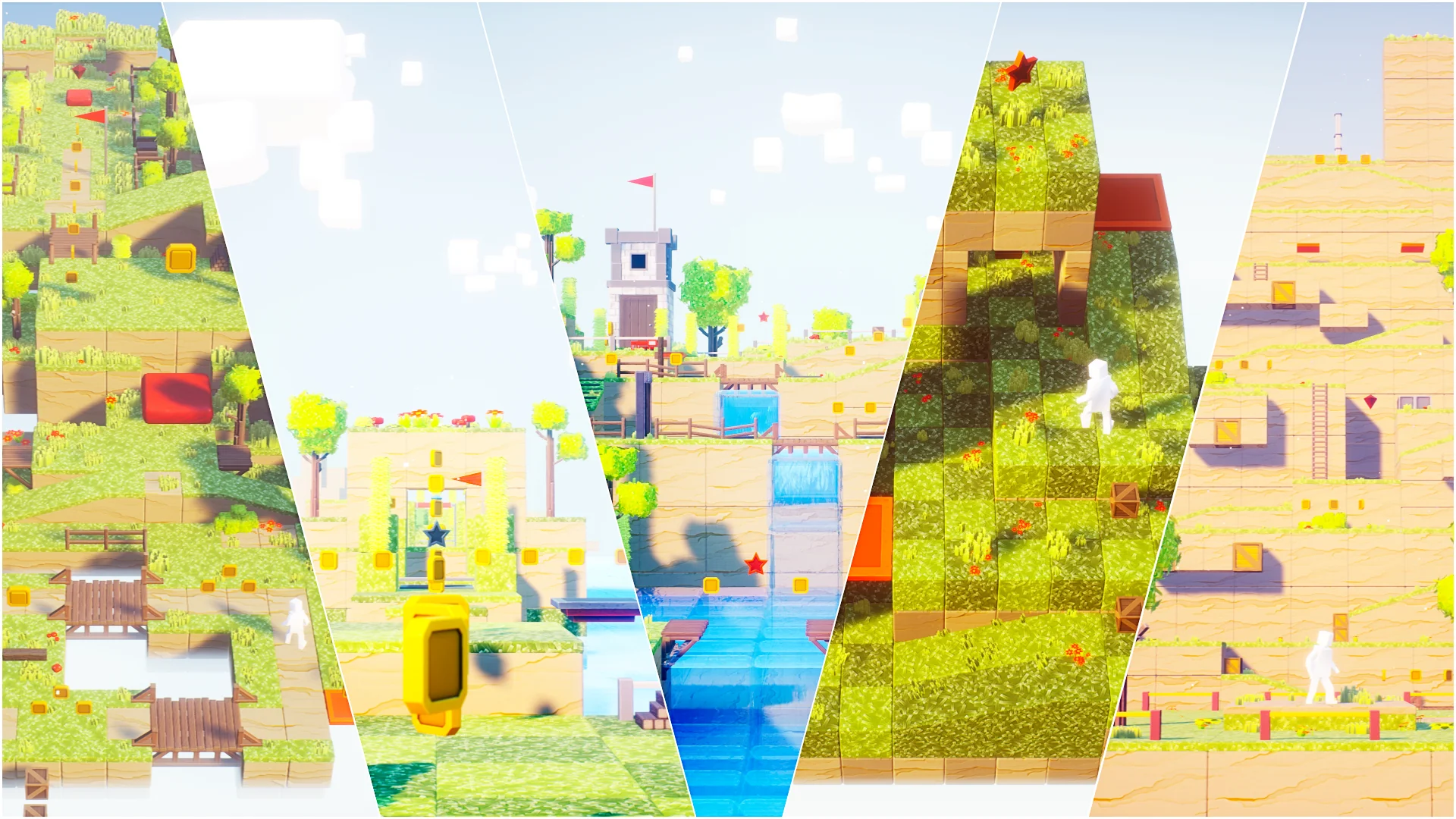
Constructing readable, responsive layouts for obstacle-driven games requires an art kit that balances clear spatial boundaries with visual polish. PLATFORMER - Stylized Cube World Vol.1 provides a complete environment framework focused on cubic architecture and vibrant scene dressing. Rooted in a stylized PBR workflow, the package gathers more than 100 individual 3D models alongside preconfigured functional elements, targeted directly at developers staging levels for top-down, isometric, roller, and traditional 3D platformers. Any animated characters seen in demonstration previews serve strictly as scale and presentation references; the focus of the package rests entirely on the modular stages, interactive markers, and environmental pieces that form the playable world.
Foundations of the Stylized Cube World
The core geometry of this collection utilizes standardized modular blocks and specialized structural components. At the center of the package are versatile platform meshes, moving platforms, and modular foundations that allow level creators to map out jumping routes, elevated arenas, and floating puzzles without manual geometry slicing. These surfaces are complemented by water meshes, dynamic cloud shapes, and localized fog elements, giving creators the components required to anchor floating sky islands or sunken liquid hazards.
Because the set adheres to a stylized PBR workflow, surface materials respond accurately to scene lighting while retaining clean, bold shapes and readable silhouettes. This balance ensures that complex verticality remains visually coherent from multiple camera vantage points. Surfaces retain their tactile material definition under direct sunlight or ambient stage bounce without visual clutter obscuring crucial jump landings or perimeter drops. The package exists as part of a wider Platformer Stylized Series, standing alongside parallel releases such as the PLATFORMER - Simple Cube World Vol.1, which serves projects prioritizing an alternate, non-PBR simple art style.
Interactive Mechanics Across Platformer Obstacles and PowerUps
Moving beyond basic terrain, the package supplies a complete vocabulary of gameplay items to establish progression, danger, and player routing. Level pacing relies heavily on distinct hazard indicators, which are fulfilled by the collection's specialized obstacle meshes. Developers can plant standard ground Spikes to deny straightforward footholds or erect imposing Pillar Spikes to create rhythmic vertical hazards and timing traps across narrow walkways.
To guide the player and reward navigation, the asset library incorporates an extensive array of power-ups, pick-ups, and waypoint markers:
Collectibles and Milestones: Classic high-value targets including Coins, Gems, Stars, and Keys provide immediate incentives for exploration, path deviation, and locked-gate mechanics.
Navigation and Kinematics: Jump Pads offer instant vertical launch points, Step Boost items accelerate forward trajectory, and directional Arrow indicators help direct player focus along high-speed corridors.
Level Progression Markers: Dedicated Goal and Checkpoint props establish clear stage terminals and respawn locations without requiring external asset supplementation.
Reward Containers: Treasure Chest meshes function as primary prize nodes for hidden alcoves or conquered challenge zones.
These components allow level designers to instantly draft test courses that communicate mechanics without placeholder primitives. The distinct geometry of items like the Jump Pad or Pillar Spike instantly signals mechanical behavior to the player, maintaining clear readability whether viewed up close in a third-person chase perspective or from the pulled-back vantage point of a mobile top-down runner.
Environmental Props, Vegetation, and Atmospheric Particles
A playable blockout requires organic elements and structural dressing to transition from an abstract graybox into a believable fantasy setting. The kit delivers a suite of architectural and utility props to detail pathways and break up geometric monotony. Builders can assemble elevated pathways and crossings using the Wooden Bridge, demarcate boundaries with sectional Fences, and construct vertical access routes using modular Ladders. Storage and breakable dressing can be deployed through Wooden Crates and Metal Crates, while navigational Signboards and defensive Towers add narrative context to outpost stations or dungeon entrances.
Organic dressing balances the sharp cubic edges of the hard-surface assets. The package includes an extensive vegetation library featuring varied trees, plants, bushes, individual flowers, and grass tufts. Fallen logs, harvested lumber piles, and whimsical mushroom clusters enable developers to populate forest floors, cavern undercrofts, and riverbanks with natural variety. These models maintain the same chunky, stylized proportions as the structural blocks, preserving a unified aesthetic across both organic and constructed terrain.
Environmental dynamics are expanded further through dedicated particle systems and atmospheric assets. Included systems generate subtle Dust, thick Smoke, and swirling Wind currents, injecting physical energy into otherwise static levels. When integrated alongside the bundled cloud formations and fog assets, these effects transform simple obstacle courses into atmospheric sky realms, misty canyons, or wind-swept mountain crags.
Blueprint Systems, Material Variations, and Layout Demonstrations
Efficiency in level development depends not only on raw mesh assets but also on setup convenience. To accelerate production implementation, the package incorporates 10 pre-assembled Blueprint items. These nodes pre-wire assets into functional game-ready items, reducing the need to manually attach components, align collision hulls, or configure basic interactive structures from scratch. Whether managing moving platform routes or setting up interactive prop states, these Blueprint configurations serve as immediate building blocks for game logic.
Visual variety across multiple levels is supported through a wide assortment of textures and material color variations. By adjusting material assignments, creators can alter biome aesthetics across the same set of 100+ models, shifting from lush green meadow tops to arid stone plateaus or subterranean ruins without altering underlying layouts. This flexibility makes the pack especially relevant for gameready mobile titles, where memory constraints encourage heavy reuse of base meshes across varied thematic chapters.
To showcase how these disparate pieces unite into functional level designs, the release supplies six fully realized demo scenes along with a dedicated overview map. The overview map indexes the entire library of platforms, props, obstacles, and foliage in an organized layout for immediate inspection and asset picking. The six demonstration scenes present distinct, fully populated environments, illustrating effective camera framing for top-down, isometric, and horizontal platformer perspectives. These maps demonstrate practical combinations of props, vertical jump timing, and particle layering, offering concrete templates for building original levels.
 Fantasy
 Fantasy
 Fantasy