"c14ff6bd758dadb1"{"id":"1001086","slug":"fantasy-medieval-kingdom-stylized-castle-town-village-dungeon-kingdom","title":"Fantasy Medieval Kingdom (Stylized Castle, Town, Village, Dungeon, Kingdom)","category":"Fantasy","engine":"5.0+","assetVersion":"","engineVersion":"Engine Version: 5.0+","tag":"Fantasy","accent":"blue","visual":"mech","summary":"Fully playable 2x2 km stylized medieval open world with castle city, village, magic forest, dungeons, docks, underwater zones, modular buildings, and full inter","platform":"Unreal Engine","publishedAt":"2026-09-04T16:54:26.409Z","updatedAt":"2026-09-04T16:54:26.409Z","sourceNotes":[],"fileContents":[],"compatibility":["Unreal Engine","Engine Version: 5.0+"],"featuredImage":{"alt":"Fantasy Medieval Kingdom (Stylized Castle, Town, Village, Dungeon, Kingdom)","src":"/wp-content/uploads/published/2026/09/a67503d4b022-dd68fe93-0fdf-41df-bcd0-363d13ef92f5-d48693974f.webp"},"hasDownloadLink":true,"downloads":6,"terms":[{"taxonomy":"category","slug":"fantasy","name":"Fantasy"}],"galleryImages":[{"src":"/wp-content/uploads/published/2026/09/7f82f5366046-87b76806-131f-41a4-9190-925f1b9739ac-deecef34b0.webp","alt":"Fantasy Medieval Kingdom (Stylized Castle, Town, Village, Dungeon, Kingdom)"},{"src":"/wp-content/uploads/published/2026/09/7be8a876d921-b13b2a79-7efc-43b8-bed5-9543f5f020dc-9f12d0ce5a.webp","alt":"Fantasy Medieval Kingdom (Stylized Castle, Town, Village, Dungeon, Kingdom)"},{"src":"/wp-content/uploads/published/2026/09/fa6785e1eced-da8a6a91-e621-4a28-83b4-e5eb870e85d9-f3504ade33.webp","alt":"Fantasy Medieval Kingdom (Stylized Castle, Town, Village, Dungeon, Kingdom)"},{"src":"/wp-content/uploads/published/2026/09/7769ebe631d9-c9b8188e-dc7c-4595-a8b6-99eba6c9f19f-1bc4a0ab95.webp","alt":"Fantasy Medieval Kingdom (Stylized Castle, Town, Village, Dungeon, Kingdom)"},{"src":"/wp-content/uploads/published/2026/09/53c73b8ae9ad-f94908ff-5190-4332-a799-8c69f4eb4889-d03fc1bb7e.webp","alt":"Fantasy Medieval Kingdom (Stylized Castle, Town, Village, Dungeon, Kingdom)"},{"src":"/wp-content/uploads/published/2026/09/370c2e92c46b-044e0895-ede0-415d-8989-bad8c4a86f14-a6f818dfe7.webp","alt":"Fantasy Medieval Kingdom (Stylized Castle, Town, Village, Dungeon, Kingdom)"},{"src":"/wp-content/uploads/published/2026/09/1c918efeafd0-617261c8-75f8-46cd-a6fe-7d255d3cc3b9-15979288e9.webp","alt":"Fantasy Medieval Kingdom (Stylized Castle, Town, Village, Dungeon, Kingdom)"},{"src":"/wp-content/uploads/published/2026/09/fa17a7c418e5-56d1a4d8-9e41-4f7e-94bc-b221a5d52138-fb6ad51159.webp","alt":"Fantasy Medieval Kingdom (Stylized Castle, Town, Village, Dungeon, Kingdom)"},{"src":"/wp-content/uploads/published/2026/09/8b7cecda30e4-1999eb77-fe49-46a7-8541-e04f7f3e7d3a-51c358866e.webp","alt":"Fantasy Medieval Kingdom (Stylized Castle, Town, Village, Dungeon, Kingdom)"},{"src":"/wp-content/uploads/published/2026/09/6d0380f53521-4e4d7747-835d-49df-a924-75e5cc734d6c-e9f22e0a7a.webp","alt":"Fantasy Medieval Kingdom (Stylized Castle, Town, Village, Dungeon, Kingdom)"}],"accessPanel":{"kind":"resource","title":"Download this resource","eyebrow":"Free Download","message":"Log in or create a free account to start your download.","fileName":"Fantasy Stylized Megapack.7z","safetyNote":"Resources are manually reviewed before listing to improve quality and reduce obvious risks.","actionLabel":"Download Free","resourceType":"Resource archive"},"contentHtml":"\u003cp\u003eFantasy Medieval Kingdom (Stylized Castle, Town, Village, Dungeon, Kingdom) bundles six months of environment work into a single 2x2 km Unreal Engine map. Rather than a collection of separate prop packs, it arrives as a fully playable open world with several biomes already connected: a main city and town, a village, a magic forest, dungeons, docks, an underwater world, a dead forest, and a church. The developer combined earlier stylized packs into one continuous scene, so the level works both as a ready-made game stage and as a foundation for a larger project.\u003c/p\u003e \u003ch2\u003eA Stylized Castle, Town, and Village in One Scene\u003c/h2\u003e\n\u003cp\u003eAt first glance, Fantasy Medieval Kingdom reads like a location list from an RPG. The main city and town act as the populated core, with a smaller village and a church nearby. Flanking the built-up areas are two very different natural zones: a magic forest and a dead forest. The docks push the map toward the water, and an underwater world sits below the surface. Between these spaces, dungeons add underground progression. Each biome keeps a distinct silhouette, yet because they all live in the same level, the art direction stays consistent across every transition.\u003c/p\u003e\n\u003cp\u003eOver 600 unique meshes populate the kingdom. The environment also uses hundreds of materials and textures, plus dozens of VFX. Some pieces are exclusive to this pack, including a life tree VFX setup and underwater shaders. For a team working on a stylized castle or medieval adventure, the map can serve as a definitive reference for scale, color, and layout of a fantasy kingdom.\u003c/p\u003e \u003ch2\u003eModular Building Pieces and the Numerical Grid\u003c/h2\u003e\n\u003cp\u003eEvery building in the scene is modular. Structures are assembled from individual pieces that fit a numerical grid, so they can be rearranged into custom houses, dungeons, watch towers, or larger compounds. The existing layout is therefore not a fixed ceiling; the same modular kit can be used to create new construction while retaining the world's visual language.\u003c/p\u003e\n\u003cp\u003eThe pack goes further by including full interiors for every structure in the scene. All houses, huts, and watch towers are enterable, and the interior spaces are built so a character can walk through them. Even the large tree has an interior. That decision saves a real chunk of level-building work: a walkable town usually needs interior shells for every doorway, but here those rooms are already modeled and placed. Exterior and interior gameplay can flow without asking the player to stop at a blocked entrance.\u003c/p\u003e \u003ch2\u003eDungeons, Docks, Underwater Areas, and the Dead Forest\u003c/h2\u003e\n\u003cp\u003eWhat makes this open world stand out is how many different play spaces it covers. Dungeons give you contained, underground encounters; the docks open onto water; and the underwater world is an actual explorable area rather than backdrop. The dead forest creates a darker overworld route, while the magic forest covers the more enchanted side of the kingdom. This spread gives a project a wide storytelling range without requiring separate assets from multiple packs.\u003c/p\u003e\n\u003cp\u003eBecause the terrain covers 2 square kilometers, there is plenty of room to add new locations. The map is large enough to act as an overworld hub. A game might start a player in the stylized village, lead them through the magic forest, drop them into a dungeon, and then release them near the docks — all inside one loadable level. The multiple biomes also provide distinct backdrops for cutscenes, quest hubs, and environmental storytelling.\u003c/p\u003e \u003ch2\u003eHow This 2x2 km Open World Performs and Streams\u003c/h2\u003e\n\u003cp\u003eWith more than twenty thousand actors on scene, optimization was a concern from the start. The developer reports that the editor runs around 60-100 FPS on an RTX 3080, and the packaged version is about 30-40% faster. High-end hardware is recommended for Epic settings, but those numbers show the pack was built for real-time use rather than still-image marketing shots.\u003c/p\u003e\n\u003cp\u003eThe map makes use of UE5's world partition panel. In practice, this means the level can be loaded in chunks, keeping the editing experience responsive. The setup instructions also ask users to enable the Water and Landmass plugins. Loading the map from the world partition panel rather than opening a fully loaded level is part of the intended workflow. That partition-aware structure carries over into production: you can focus on a village or a dungeon while the editor only streams the surrounding area.\u003c/p\u003e \u003ch2\u003eWhere Fantasy Medieval Kingdom Fits in a Production Pipeline\u003c/h2\u003e\n\u003cp\u003eBecause the level arrives fully connected, the quickest use is as a stage for gameplay, cinematics, or style exploration. But the modular pieces mean it is equally practical to carve out a district, clear it, and rebuild it into your own layout. The VFX library can be applied to other stylized projects, not just this specific map, so it is not a one-scene investment.\u003c/p\u003e\n\u003cp\u003eFor developers making a stylized medieval open world, this pack also acts as a visual benchmark. It shows how a castle town, village, and supporting biomes can be organized in a 2x2 km area, and it demonstrates an asset density that still holds a playable framerate. Teams that need a fully traversable fantasy kingdom with interiors already in place can treat this as the starting point rather than building one from an empty landscape.\u003c/p\u003e\n\n\u003ch2\u003eMore From The Same Workflow\u003c/h2\u003e\n\u003cul\u003e\n\u003cli\u003e\u003ca href=\"https://3dcghub.com/stylized-mega-pack-stylized-nature-environment/\" title=\"Stylized MEGA PACK | Stylized Nature Environment\"\u003eStylized MEGA PACK | Stylized Nature Environment\u003c/a\u003e\u003c/li\u003e\n\u003cli\u003e\u003ca href=\"https://3dcghub.com/stylized-winter-city-environment/\" title=\"Stylized winter city environment\"\u003eStylized winter city environment\u003c/a\u003e\u003c/li\u003e\n\u003cli\u003e\u003ca href=\"https://3dcghub.com/stylized-log-cabin/\" title=\"Stylized Log Cabin\"\u003eStylized Log Cabin\u003c/a\u003e\u003c/li\u003e\n\u003cli\u003e\u003ca href=\"https://3dcghub.com/fantasy-forest-environment/\" title=\"Fantasy Forest Environment\"\u003eFantasy Forest Environment\u003c/a\u003e\u003c/li\u003e\n\u003cli\u003e\u003ca href=\"https://3dcghub.com/dreamscape-stylized-environment-tower-stylized-nature-open-world-fantasy/\" title=\"Dreamscape: Stylized Environment Tower - Stylized Nature Open World Fantasy\"\u003eDreamscape: Stylized Environment Tower - Stylized Nature Open World Fantasy\u003c/a\u003e\u003c/li\u003e\n\u003c/ul\u003e","contentTextLength":5484,"navigation":{"current":743,"total":3719,"previous":{"id":"1001087","slug":"zhang-jia-jie-mountain","title":"Zhang Jia Jie Mountain","category":"Cities","platform":"Unreal Engine","updatedAt":"2026-09-04T17:01:18.256Z"},"next":{"id":"1001085","slug":"event-queue","title":"Event Queue","category":"Gameplay Features","platform":"Unreal Engine","updatedAt":"2026-09-04T16:43:38.218Z"}},"relatedResources":[{"id":"1001164","slug":"castle-grimguard-night-day","title":"Castle Grimguard (Night/Day)","category":"Fantasy","engine":"5.1+","assetVersion":"","engineVersion":"Engine Version: 5.1+","tag":"Fantasy","accent":"blue","visual":"mech","summary":"Explore Castle Grimguard for Unreal Engine 5, featuring 528 modular meshes, 4K textures, Nanite and Lumen support, and nested Dekogon foliage packs.","platform":"Unreal Engine","publishedAt":"2026-09-16T02:48:23.211Z","updatedAt":"2026-09-16T02:48:23.211Z","sourceNotes":[],"fileContents":[],"compatibility":["Unreal Engine","Engine Version: 5.1+"],"featuredImage":{"alt":"Castle Grimguard (Night/Day)","src":"/wp-content/uploads/published/2026/09/7a63864e2e1e-a8f5b3ee-e04b-453f-ab77-2365f115f2ea-07864c2557.webp"},"hasDownloadLink":true,"downloads":1},{"id":"1000345","slug":"stylized-mega-pack-stylized-nature-environment","title":"Stylized MEGA PACK | Stylized Nature Environment","category":"Fantasy","engine":"5.2+","assetVersion":"","engineVersion":"Engine Version: 5.2+","tag":"Fantasy","accent":"blue","visual":"city","summary":"A comprehensive stylized environment bundle featuring smart landscape materials, runtime virtual textures, dynamic weather systems, and spline-based water.","platform":"Unreal Engine","publishedAt":"2026-07-05T08:59:40.841Z","updatedAt":"2026-07-05T08:59:40.841Z","sourceNotes":[],"fileContents":[],"compatibility":["Unreal Engine","Engine Version: 5.2+"],"featuredImage":{"alt":"Stylized MEGA PACK | Stylized Nature Environment","src":"/wp-content/uploads/published/2026/07/c2b098ccfb71-3a4254a7-55b6-4b8e-b479-601a5bfc7543-ddc7259327.webp"},"hasDownloadLink":true,"downloads":17},{"id":"8028","slug":"stylized-winter-city-environment","title":"Stylized winter city environment","category":"Fantasy","engine":"5.1+","assetVersion":"Engine version: 5.1+","engineVersion":"5.1","tag":"Fantasy","accent":"blue","visual":"city","summary":"Transform your game project into a festive wonderland with this modular asset pack. It features everything from cozy city buildings to snowy nature elements like pine trees and cliffs.","platform":"Unreal Engine","publishedAt":"2026-02-22T16:30:30.000Z","updatedAt":"2026-04-19T15:55:37.000Z","sourceNotes":[],"fileContents":[],"compatibility":["Unreal Engine","Engine version: 5.1+"],"featuredImage":{"alt":"Stylized winter city environment","src":"https://3dcghub.com/wp-content/uploads/2026/02/f411d73d-37a1-4e68-83ed-478899a94098.webp"},"hasDownloadLink":true,"downloads":0}]}
Fantasy
Fantasy Medieval Kingdom (Stylized Castle, Town, Village, Dungeon, Kingdom)
Fully playable 2x2 km stylized medieval open world with castle city, village, magic forest, dungeons, docks, underwater zones, modular buildings, and full inter
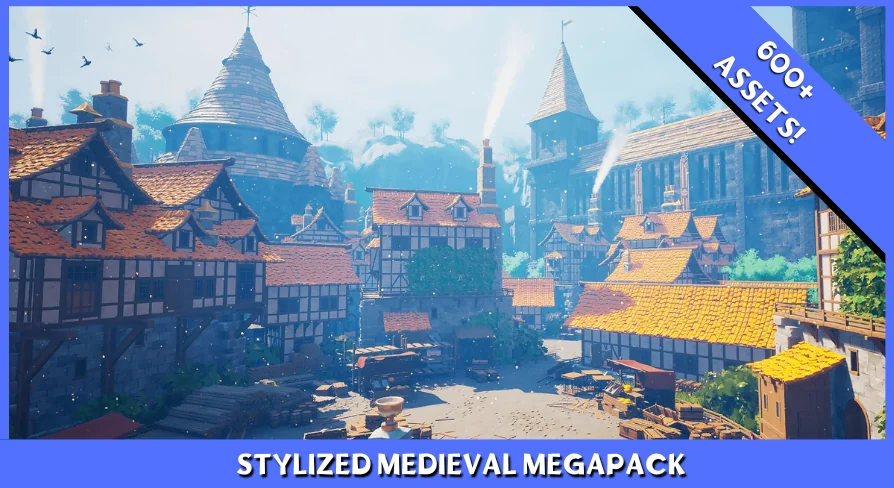
Fantasy Medieval Kingdom (Stylized Castle, Town, Village, Dungeon, Kingdom) bundles six months of environment work into a single 2x2 km Unreal Engine map. Rather than a collection of separate prop packs, it arrives as a fully playable open world with several biomes already connected: a main city and town, a village, a magic forest, dungeons, docks, an underwater world, a dead forest, and a church. The developer combined earlier stylized packs into one continuous scene, so the level works both as a ready-made game stage and as a foundation for a larger project.
A Stylized Castle, Town, and Village in One Scene
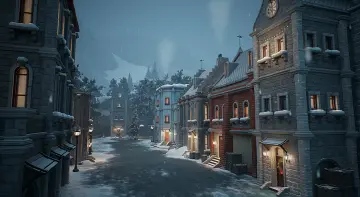
At first glance, Fantasy Medieval Kingdom reads like a location list from an RPG. The main city and town act as the populated core, with a smaller village and a church nearby. Flanking the built-up areas are two very different natural zones: a magic forest and a dead forest. The docks push the map toward the water, and an underwater world sits below the surface. Between these spaces, dungeons add underground progression. Each biome keeps a distinct silhouette, yet because they all live in the same level, the art direction stays consistent across every transition.
Over 600 unique meshes populate the kingdom. The environment also uses hundreds of materials and textures, plus dozens of VFX. Some pieces are exclusive to this pack, including a life tree VFX setup and underwater shaders. For a team working on a stylized castle or medieval adventure, the map can serve as a definitive reference for scale, color, and layout of a fantasy kingdom.
Modular Building Pieces and the Numerical Grid
Every building in the scene is modular. Structures are assembled from individual pieces that fit a numerical grid, so they can be rearranged into custom houses, dungeons, watch towers, or larger compounds. The existing layout is therefore not a fixed ceiling; the same modular kit can be used to create new construction while retaining the world's visual language.
The pack goes further by including full interiors for every structure in the scene. All houses, huts, and watch towers are enterable, and the interior spaces are built so a character can walk through them. Even the large tree has an interior. That decision saves a real chunk of level-building work: a walkable town usually needs interior shells for every doorway, but here those rooms are already modeled and placed. Exterior and interior gameplay can flow without asking the player to stop at a blocked entrance.
Dungeons, Docks, Underwater Areas, and the Dead Forest
What makes this open world stand out is how many different play spaces it covers. Dungeons give you contained, underground encounters; the docks open onto water; and the underwater world is an actual explorable area rather than backdrop. The dead forest creates a darker overworld route, while the magic forest covers the more enchanted side of the kingdom. This spread gives a project a wide storytelling range without requiring separate assets from multiple packs.
Because the terrain covers 2 square kilometers, there is plenty of room to add new locations. The map is large enough to act as an overworld hub. A game might start a player in the stylized village, lead them through the magic forest, drop them into a dungeon, and then release them near the docks — all inside one loadable level. The multiple biomes also provide distinct backdrops for cutscenes, quest hubs, and environmental storytelling.
How This 2x2 km Open World Performs and Streams
With more than twenty thousand actors on scene, optimization was a concern from the start. The developer reports that the editor runs around 60-100 FPS on an RTX 3080, and the packaged version is about 30-40% faster. High-end hardware is recommended for Epic settings, but those numbers show the pack was built for real-time use rather than still-image marketing shots.
The map makes use of UE5's world partition panel. In practice, this means the level can be loaded in chunks, keeping the editing experience responsive. The setup instructions also ask users to enable the Water and Landmass plugins. Loading the map from the world partition panel rather than opening a fully loaded level is part of the intended workflow. That partition-aware structure carries over into production: you can focus on a village or a dungeon while the editor only streams the surrounding area.
Where Fantasy Medieval Kingdom Fits in a Production Pipeline
Because the level arrives fully connected, the quickest use is as a stage for gameplay, cinematics, or style exploration. But the modular pieces mean it is equally practical to carve out a district, clear it, and rebuild it into your own layout. The VFX library can be applied to other stylized projects, not just this specific map, so it is not a one-scene investment.
For developers making a stylized medieval open world, this pack also acts as a visual benchmark. It shows how a castle town, village, and supporting biomes can be organized in a 2x2 km area, and it demonstrates an asset density that still holds a playable framerate. Teams that need a fully traversable fantasy kingdom with interiors already in place can treat this as the starting point rather than building one from an empty landscape.
 Fantasy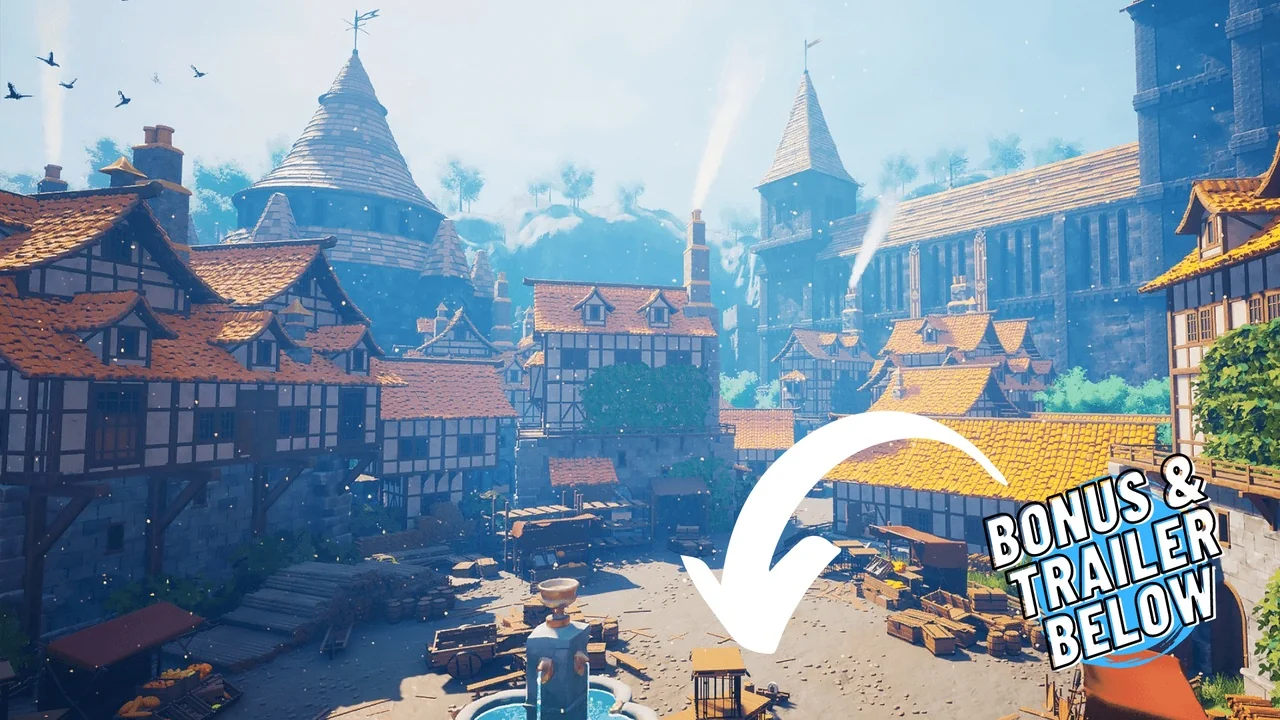
 Fantasy
 Fantasy
 Fantasy