"d037b61901c110d2"{"id":"1002683","slug":"modular-old-town","title":"Modular Old Town","category":"Historical","engine":"5.2+","assetVersion":"","engineVersion":"Engine Version: 5.2+","tag":"Historical","accent":"blue","visual":"mech","summary":"Construct Mediterranean streets and settlements in Unreal Engine with Modular Old Town, featuring grid-snapped architecture, Nanite, and Lumen.","platform":"Unreal Engine","indexPolicy":"index","publishedAt":"2026-11-16T22:34:23.630Z","updatedAt":"2026-11-16T22:34:23.630Z","sourceNotes":[],"fileContents":[],"compatibility":["Unreal Engine","Engine Version: 5.2+"],"featuredImage":{"alt":"Modular Old Town","src":"/wp-content/uploads/published/2026/11/551937ee732e-cc209912-46d0-4047-ac66-7bead8d55b97-702f9f70dc.webp"},"hasDownloadLink":true,"downloads":0,"terms":[{"taxonomy":"category","slug":"historical","name":"Historical"}],"galleryImages":[{"src":"/wp-content/uploads/published/2026/11/a7cb3a57e513-0d15a5be-5731-4666-a9ff-10dbcc60805e-d0e4d6b107.webp","alt":"Modular Old Town"},{"src":"/wp-content/uploads/published/2026/11/3966998ca963-8901c2c6-14a8-4805-9925-1241f1f6d291-d99f038324.webp","alt":"Modular Old Town"},{"src":"/wp-content/uploads/published/2026/11/9d7294584f83-c27ea036-0250-4e04-83b9-05b7c5add8b4-29fabd7718.webp","alt":"Modular Old Town"},{"src":"/wp-content/uploads/published/2026/11/750b41536b44-ed8746b2-7c58-4c62-8b11-db6163314007-f122243ae5.webp","alt":"Modular Old Town"},{"src":"/wp-content/uploads/published/2026/11/48b3f8a692c9-e8f1547b-fe40-4ccf-9fc9-26f7ee4c1d44-31fea94a7b.webp","alt":"Modular Old Town"},{"src":"/wp-content/uploads/published/2026/11/f454a42336f7-30dcf864-bbab-4ab4-b17d-9d30033d995d-0c740d7f6a.webp","alt":"Modular Old Town"},{"src":"/wp-content/uploads/published/2026/11/97f1fc37d4c8-d74b847a-c7e1-4ae2-a35e-7dc47a250b30-1ecdde02e9.webp","alt":"Modular Old Town"}],"accessPanel":{"kind":"resource","title":"Get this resource","eyebrow":"Free resource","message":"Download this resource in your browser.","fileName":"Content.7z","safetyNote":"Resources are manually reviewed before listing to improve quality and reduce obvious risks.","actionLabel":"Get this resource","resourceType":"Resource archive","versions":[]},"contentHtml":"\u003cp\u003eConstructing believable historical settlements often presents spatial challenges when modular structural assets fail to align cleanly, forcing level artists and environment designers to spend development time resolving seam misalignments and scale mismatches. Without a consistent modular standard, building out expansive Mediterranean streets and town squares can quickly become an exercise in patching gaps rather than crafting compelling spaces. Modular Old Town addresses this architectural friction by anchoring Mediterranean township aesthetics to the Unreal Engine Grid system. By supplying modular wall variations, multi-pitch roofs, and dedicated street dressing, the kit enables the construction of cohesive Roman and Italian-style urban districts where building footprints snap together predictably.\u003c/p\u003e \u003ch2\u003eAssembling Layouts with Modular Old Town Wall and Roof Pieces\u003c/h2\u003e\n\u003cp\u003eThe core structural framework relies on interchangeable wall meshes paired with distinct roof styles featuring either two or four slopes. These wall variations and roof pitches allow developers to establish organic architectural rhythm across an entire level, avoiding the repetitive silhouettes often seen when using uniform modular sets. Whether designing small coastal outposts or dense historical city centers, the components assemble into distinct structures while maintaining visual harmony.\u003c/p\u003e\n\u003cp\u003eUsing these foundational pieces, developers can assemble a wide range of building footprints, moving between straightforward square structures, elongated rectangular homes, courtyard-focused U-shaped blocks, and fully enclosed O-shaped compounds. These structural options allow environment artists to craft diverse building heights and varied rooflines across a single district, establishing the dense, clustered silhouette typical of realistic Mediterranean towns. The modularity ensures that street alignments remain clean, whether laying down a straight thoroughfare or forming tightly packed alleyways that bend around central courtyards. Because the pieces conform directly to standard grid measurements, creating multi-tier buildings and varied facades does not require custom boolean operations or manual vertex shifting.\u003c/p\u003e \u003ch2\u003eConstructing Courtyards, Bazaars, and Town Marketplaces\u003c/h2\u003e\n\u003cp\u003eOpen community spaces define traditional southern European settlements, serving as focal points where dense street systems open into commercial activity. The U-shaped and O-shaped building footprints naturally produce protected plazas, central courtyards, and secluded alleys, giving level designers clear structural perimeters to frame gathering spaces and trade districts.\u003c/p\u003e\n\u003cp\u003eTo flesh out these spaces, the collection includes marketplace props and street props that populate the open spaces created by architectural clusters. Dressing an open plaza with stalls, thematic trade props, and surface decals turns empty stone courtyards into active bazaars and market squares. These dressing elements break up repeating ground textures and delineate natural footpaths between buildings, guiding players smoothly through urban districts and neighborhood hubs. The combination of modular stone walls and marketplace props enables the creation of lively commercial lanes, quiet residential pathways, and expansive town squares that mirror the layout of historic settlements found across Italy and the broader Mediterranean basin.\u003c/p\u003e \u003ch2\u003eInterior Spaces and Operable Architecture Across the Town\u003c/h2\u003e\n\u003cp\u003eExploration in realistic urban levels frequently demands seamless passage between bright outdoor avenues and indoor domestic spaces. Rather than restricting gameplay entirely to exterior facades, the kit provides dedicated interior spaces for each house. These interior rooms are constructed with a lower density of detail than the exterior facades, striking a functional balance that provides spatial context indoors without incurring unnecessary performance costs across extensive urban scenes.\u003c/p\u003e\n\u003cp\u003eFunctional transitions between exterior avenues and interior rooms are handled by operable doors and operable window shutters. Having interactive doors and shutters gives developers the ability to adjust lines of sight, construct stealth routes, or provide defensible cover within domestic quarters. Players can look out from upper-floor windows through opened shutters onto the streets below, or secure entrances to create secluded rooms. This structural continuity between indoor and outdoor environments ensures that the buildings serve as active gameplay zones rather than static background scenery.\u003c/p\u003e \u003ch2\u003eBlending Street Dressing, Decals, and Surrounding Cliffs\u003c/h2\u003e\n\u003cp\u003eCoastal and hillside Mediterranean settlements rarely sit on completely flat ground, requiring natural terrain features to blend structures smoothly into the surrounding topography. To achieve an authentic sense of place, urban architecture must interact believably with rocks, inclines, and wild vegetation found in regional landscapes.\u003c/p\u003e\n\u003cp\u003eTo ground architectural meshes into the terrain, the asset library includes rugged cliffs, standalone rocks, and landscape plants. Combining these organic assets with ground decals allows level designers to nest stone foundations into natural embankments, hillsides, and coastal bluffs. Placing regional vegetation and rock formations against exterior walls softens hard geometric edges, making the town feel organically embedded in its physical geography rather than floating on artificial terrain. Decals further integrate the modular structures into the environment by introducing localized wear, staining, and surface variation across roadways, plaza floors, and structural foundations.\u003c/p\u003e \u003ch2\u003eUnreal Engine Grid Alignment, Nanite Detail, and Lumen Lighting\u003c/h2\u003e\n\u003cp\u003ePrecision assembly across large architectural levels requires strict conformity to engine-level placement standards. Every modular mesh in the package aligns directly with the Unreal Engine Grid system, eliminating spacing errors during rapid level layout and ensuring that walls, roofs, and doorways snap together cleanly on standard coordinate increments.\u003c/p\u003e\n\u003cp\u003ePhotorealistic visual output is driven by high-resolution PBR assets configured for modern engine features, taking full advantage of Nanite for dense geometric detail and Lumen for dynamic global illumination and reflections. Nanite geometry preserves crisp architectural bevels, stone surfaces, and natural cliff contours without demanding manual LOD creation. Lumen calculates real-time light bounces as sunlight filters down narrow alleyways, penetrates through operable window shutters, and illuminates interior rooms. For artists seeking technical guidance, performance notes are included in the documentation to assist with optimization, while an Old Town example map illustrates how all modular pieces, props, decals, landscape elements, and lighting systems function together in a complete real-time scene.\u003c/p\u003e\n\n\u003ch2\u003eRelated Resources Worth Checking\u003c/h2\u003e\n\u003cul\u003e\n\u003cli\u003e\u003ca href=\"https://3dcghub.com/middle-eastern-town-gigapack-w-level-pcg-met-palace-bazaar-city/\" rel=\"noopener noreferrer\"\u003eMiddle Eastern Town Gigapack w/ Level PCG ( MET, Palace, Bazaar, City)\u003c/a\u003e\u003c/li\u003e\n\u003cli\u003e\u003ca href=\"https://3dcghub.com/crystals-and-crafting-environment-house-crafting-medieval-medieval-3d-old-3d/\" rel=\"noopener noreferrer\"\u003eCrystals and Crafting Environment ( House Crafting Medieval Medieval 3D Old 3D )\u003c/a\u003e\u003c/li\u003e\n\u003cli\u003e\u003ca href=\"https://3dcghub.com/ghost-town-vol-1-176-modular-old-cabin-assets-for-ue5/\" rel=\"noopener noreferrer\"\u003eGhost Town VOL.1 - Old Cabins\u003c/a\u003e\u003c/li\u003e\n\u003cli\u003e\u003ca href=\"https://3dcghub.com/roman-street-environment-roman-street-street-ancient-historical-vintage-3d/\" rel=\"noopener noreferrer\"\u003eRoman Street Environment ( Roman Street Street Ancient Historical Vintage 3D )\u003c/a\u003e\u003c/li\u003e\n\u003cli\u003e\u003ca href=\"https://3dcghub.com/asian-canal-environment-asian-canal-environment-asian-ancient-bridge-old-3d/\" rel=\"noopener noreferrer\"\u003eAsian Canal Environment (Asian Canal Environment Asian Ancient Bridge Old 3D )\u003c/a\u003e\u003c/li\u003e\n\u003c/ul\u003e","contentTextLength":7232,"navigation":{"current":6,"total":4611,"previous":{"id":"1002684","slug":"museum-environment-kit","title":"Museum Environment Kit","category":"Historical","platform":"Unreal Engine","updatedAt":"2026-11-16T22:35:37.511Z"},"next":{"id":"1002682","slug":"modular-gothic-temple-medieval-winter-snow","title":"Modular Gothic Temple (medieval/winter/snow)","category":"Fantasy","platform":"Unreal Engine","updatedAt":"2026-11-16T22:33:11.443Z"}},"relatedResources":[{"id":"1000285","slug":"middle-eastern-town-gigapack-w-level-pcg-met-palace-bazaar-city","title":"Middle Eastern Town Gigapack w/ Level PCG ( MET, Palace, Bazaar, City)","category":"Historical","engine":"5.6+","assetVersion":"","engineVersion":"Engine Version: 5.6+","tag":"Historical","accent":"blue","visual":"city","summary":"A comprehensive Unreal Engine 5 environment pack featuring over 1,000 modular meshes, procedural foliage, and tools for building historical desert cities.","platform":"Unreal Engine","indexPolicy":"index","publishedAt":"2026-07-03T16:58:55.632Z","updatedAt":"2026-07-03T16:58:55.632Z","sourceNotes":[],"fileContents":[],"compatibility":["Unreal Engine","Engine Version: 5.6+"],"featuredImage":{"alt":"Middle Eastern Town Gigapack w/ Level PCG ( MET, Palace, Bazaar, City)","src":"/wp-content/uploads/published/2026/07/f1526e76e49f-f10078a8-6c9d-469c-b94e-a9f1d375aebc-06f70fe46a.webp"},"fileSizeBytes":33619984143,"hasDownloadLink":true,"downloads":4},{"id":"1000047","slug":"crystals-and-crafting-environment-house-crafting-medieval-medieval-3d-old-3d","title":"Crystals and Crafting Environment ( House Crafting Medieval Medieval 3D Old 3D )","category":"Towns \u0026 Villages","engine":"5.2+","assetVersion":"","engineVersion":"5.2+","tag":"Towns \u0026 Villages","accent":"blue","visual":"city","summary":"A medieval crafting environment pack with 161 unique meshes, a preassembled scene, Lumen support, and ULAT for modular building and scene layout.","platform":"Unreal Engine","indexPolicy":"index","publishedAt":"2026-05-22T10:59:33.907Z","updatedAt":"2026-05-22T10:59:33.907Z","sourceNotes":[],"fileContents":[],"compatibility":["Unreal Engine","Engine version: 5.2+"],"featuredImage":{"alt":"Crystals and Crafting Environment ( House Crafting Medieval Medieval 3D Old 3D )","src":"/wp-content/uploads/published/2026/05/a5a86124fbd3-3f730657-8b59-49b4-ac32-f72a9c8550be-48006828dc.webp"},"fileSizeBytes":9156833050,"hasDownloadLink":true,"downloads":0},{"id":"1117","slug":"ghost-town-vol-1-176-modular-old-cabin-assets-for-ue5","title":"Ghost Town VOL.1 - Old Cabins","category":"Buildings \u0026 Architecture","engine":"5.1+","assetVersion":"Engine version: 5.1+","engineVersion":"5.1","tag":"Buildings","accent":"blue","visual":"luts","summary":"Create hauntingly realistic environments with Ghost Town VOL.1. This pack features 176 modular meshes for Unreal Engine 5.4, including cabins, sheds, and fences","platform":"Unreal Engine","indexPolicy":"noindex","publishedAt":"2026-02-06T16:30:57.000Z","updatedAt":"2026-04-19T15:58:13.000Z","sourceNotes":[],"fileContents":[],"compatibility":["Unreal Engine","Engine version: 5.1+"],"featuredImage":{"alt":"Ghost Town VOL.1 - Old Cabins","src":"https://3dcghub.com/wp-content/uploads/2026/02/7b4261f5-d729-42b3-868e-8bedf666c1d7.jpg"},"fileSizeBytes":1560554664,"hasDownloadLink":true,"downloads":0}]}
Resource screenshots
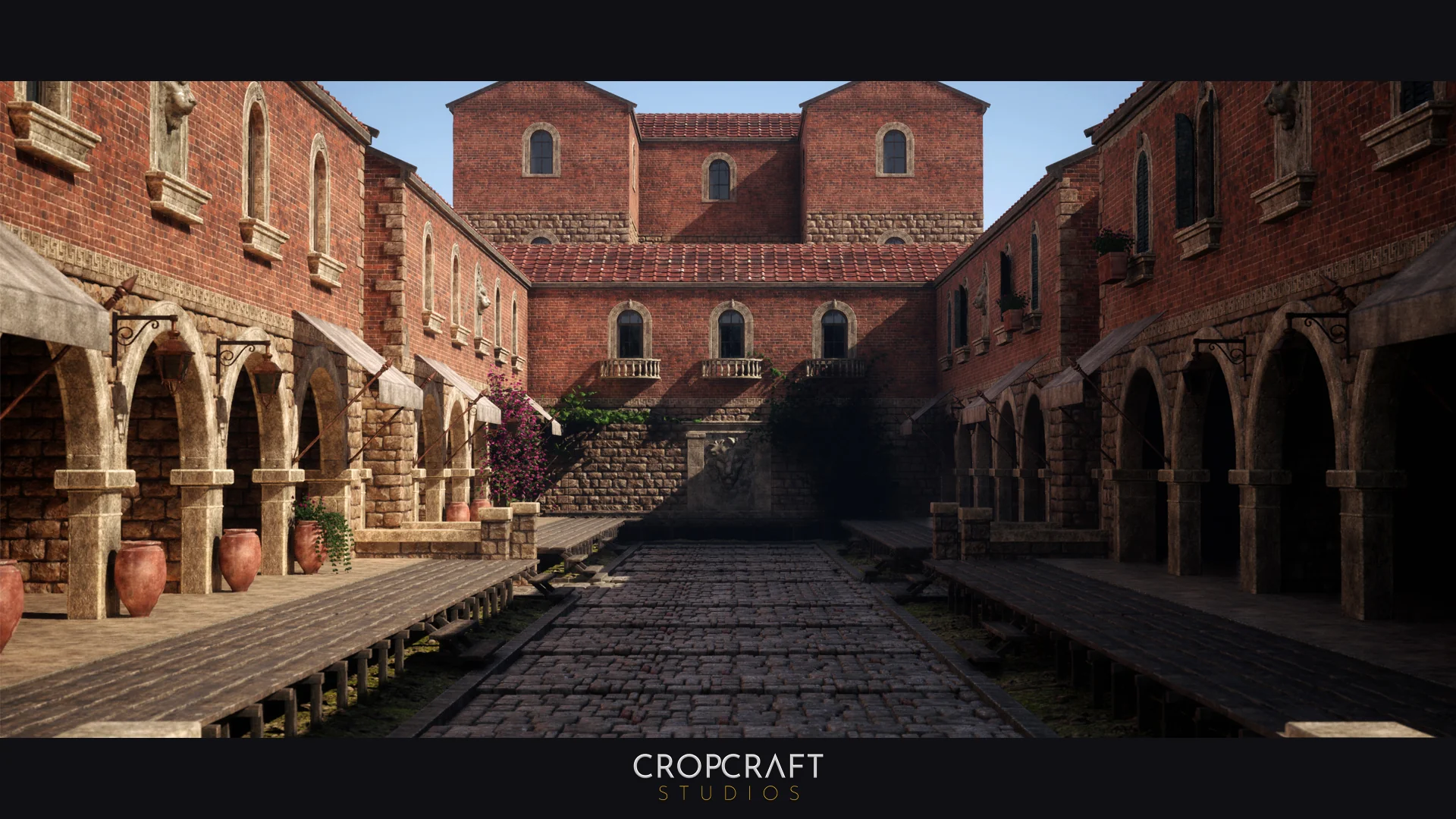
1 / 7
Historical
Modular Old Town
Construct Mediterranean streets and settlements in Unreal Engine with Modular Old Town, featuring grid-snapped architecture, Nanite, and Lumen.
Constructing believable historical settlements often presents spatial challenges when modular structural assets fail to align cleanly, forcing level artists and environment designers to spend development time resolving seam misalignments and scale mismatches. Without a consistent modular standard, building out expansive Mediterranean streets and town squares can quickly become an exercise in patching gaps rather than crafting compelling spaces. Modular Old Town addresses this architectural friction by anchoring Mediterranean township aesthetics to the Unreal Engine Grid system. By supplying modular wall variations, multi-pitch roofs, and dedicated street dressing, the kit enables the construction of cohesive Roman and Italian-style urban districts where building footprints snap together predictably.
Assembling Layouts with Modular Old Town Wall and Roof Pieces
The core structural framework relies on interchangeable wall meshes paired with distinct roof styles featuring either two or four slopes. These wall variations and roof pitches allow developers to establish organic architectural rhythm across an entire level, avoiding the repetitive silhouettes often seen when using uniform modular sets. Whether designing small coastal outposts or dense historical city centers, the components assemble into distinct structures while maintaining visual harmony.
Using these foundational pieces, developers can assemble a wide range of building footprints, moving between straightforward square structures, elongated rectangular homes, courtyard-focused U-shaped blocks, and fully enclosed O-shaped compounds. These structural options allow environment artists to craft diverse building heights and varied rooflines across a single district, establishing the dense, clustered silhouette typical of realistic Mediterranean towns. The modularity ensures that street alignments remain clean, whether laying down a straight thoroughfare or forming tightly packed alleyways that bend around central courtyards. Because the pieces conform directly to standard grid measurements, creating multi-tier buildings and varied facades does not require custom boolean operations or manual vertex shifting.
Constructing Courtyards, Bazaars, and Town Marketplaces
Open community spaces define traditional southern European settlements, serving as focal points where dense street systems open into commercial activity. The U-shaped and O-shaped building footprints naturally produce protected plazas, central courtyards, and secluded alleys, giving level designers clear structural perimeters to frame gathering spaces and trade districts.
To flesh out these spaces, the collection includes marketplace props and street props that populate the open spaces created by architectural clusters. Dressing an open plaza with stalls, thematic trade props, and surface decals turns empty stone courtyards into active bazaars and market squares. These dressing elements break up repeating ground textures and delineate natural footpaths between buildings, guiding players smoothly through urban districts and neighborhood hubs. The combination of modular stone walls and marketplace props enables the creation of lively commercial lanes, quiet residential pathways, and expansive town squares that mirror the layout of historic settlements found across Italy and the broader Mediterranean basin.
Interior Spaces and Operable Architecture Across the Town
Exploration in realistic urban levels frequently demands seamless passage between bright outdoor avenues and indoor domestic spaces. Rather than restricting gameplay entirely to exterior facades, the kit provides dedicated interior spaces for each house. These interior rooms are constructed with a lower density of detail than the exterior facades, striking a functional balance that provides spatial context indoors without incurring unnecessary performance costs across extensive urban scenes.
Functional transitions between exterior avenues and interior rooms are handled by operable doors and operable window shutters. Having interactive doors and shutters gives developers the ability to adjust lines of sight, construct stealth routes, or provide defensible cover within domestic quarters. Players can look out from upper-floor windows through opened shutters onto the streets below, or secure entrances to create secluded rooms. This structural continuity between indoor and outdoor environments ensures that the buildings serve as active gameplay zones rather than static background scenery.
Blending Street Dressing, Decals, and Surrounding Cliffs
Coastal and hillside Mediterranean settlements rarely sit on completely flat ground, requiring natural terrain features to blend structures smoothly into the surrounding topography. To achieve an authentic sense of place, urban architecture must interact believably with rocks, inclines, and wild vegetation found in regional landscapes.
To ground architectural meshes into the terrain, the asset library includes rugged cliffs, standalone rocks, and landscape plants. Combining these organic assets with ground decals allows level designers to nest stone foundations into natural embankments, hillsides, and coastal bluffs. Placing regional vegetation and rock formations against exterior walls softens hard geometric edges, making the town feel organically embedded in its physical geography rather than floating on artificial terrain. Decals further integrate the modular structures into the environment by introducing localized wear, staining, and surface variation across roadways, plaza floors, and structural foundations.
Unreal Engine Grid Alignment, Nanite Detail, and Lumen Lighting
Precision assembly across large architectural levels requires strict conformity to engine-level placement standards. Every modular mesh in the package aligns directly with the Unreal Engine Grid system, eliminating spacing errors during rapid level layout and ensuring that walls, roofs, and doorways snap together cleanly on standard coordinate increments.
Photorealistic visual output is driven by high-resolution PBR assets configured for modern engine features, taking full advantage of Nanite for dense geometric detail and Lumen for dynamic global illumination and reflections. Nanite geometry preserves crisp architectural bevels, stone surfaces, and natural cliff contours without demanding manual LOD creation. Lumen calculates real-time light bounces as sunlight filters down narrow alleyways, penetrates through operable window shutters, and illuminates interior rooms. For artists seeking technical guidance, performance notes are included in the documentation to assist with optimization, while an Old Town example map illustrates how all modular pieces, props, decals, landscape elements, and lighting systems function together in a complete real-time scene.
 Historical
 Towns & Villages
 Buildings