"4481da9c895ef786"{"id":"1001305","slug":"pawnshop-system","title":"Pawnshop System","category":"Gameplay Features","engine":"5.0+","assetVersion":"","engineVersion":"Engine Version: 5.0+","tag":"Gameplay Features","accent":"blue","visual":"mech","summary":"Explore the Pawnshop System mechanics, covering interactive shopkeeper trading, scrollable inventory, physical cash loops, and ATM banking.","platform":"Unreal Engine","publishedAt":"2026-10-02T06:19:35.935Z","updatedAt":"2026-10-02T06:19:35.935Z","sourceNotes":[],"fileContents":[],"compatibility":["Unreal Engine","Engine Version: 5.0+"],"featuredImage":{"alt":"Pawnshop System","src":"/wp-content/uploads/published/2026/10/e352621da4aa-7a59cc2b-4082-4c34-b972-400682a443f4-bd5c698f69.webp"},"hasDownloadLink":true,"downloads":0,"terms":[{"taxonomy":"category","slug":"gameplay-features","name":"Gameplay Features"}],"galleryImages":[{"src":"/wp-content/uploads/published/2026/10/3163ea24f5d1-a053c936-e6d9-451c-8eb8-d7a4b2fd1280-e2cc4dea2e.webp","alt":"Pawnshop System"},{"src":"/wp-content/uploads/published/2026/10/94462a665495-990092ae-8f7e-4fef-937c-428bcc9a9924-6834b991a2.webp","alt":"Pawnshop System"},{"src":"/wp-content/uploads/published/2026/10/34e03480d6cc-17433f94-0eff-4fe5-854a-cd3e2fe508ef-e20cba2c73.webp","alt":"Pawnshop System"},{"src":"/wp-content/uploads/published/2026/10/2ebc77a3c0d2-02b5c1c5-5123-49fc-acff-60a1d0a75fde-e4b04b59e9.webp","alt":"Pawnshop System"},{"src":"/wp-content/uploads/published/2026/10/7b3d05e1fe8f-e5120a43-341d-4856-8d08-eac4541b33f1-eac3833f67.webp","alt":"Pawnshop System"},{"src":"/wp-content/uploads/published/2026/10/ca83902c2fa4-358d1384-637d-4aff-aaaa-533ad724c12e-a973d27ed6.webp","alt":"Pawnshop System"},{"src":"/wp-content/uploads/published/2026/10/46420ffa2b53-a9250018-942e-49e0-b742-5e24b7060cb1-15e27a7261.webp","alt":"Pawnshop System"},{"src":"/wp-content/uploads/published/2026/10/af2fea6cbea2-c0b0a4cd-1ba9-4f73-824e-e5cce3f4ff4d-387222caf1.webp","alt":"Pawnshop System"}],"accessPanel":{"kind":"resource","title":"Download this resource","eyebrow":"Free Download","message":"Log in or create a free account to start your download.","fileName":"PawnShopSystem.7z","safetyNote":"Resources are manually reviewed before listing to improve quality and reduce obvious risks.","actionLabel":"Download Free","resourceType":"Resource archive"},"contentHtml":"\u003cp\u003eCreating a grounded, living world often comes down to how believably characters interact with material goods and money. Urban back alleys, crime-ridden districts, and survival settlements thrive when players have a dedicated place to unload scavenged valuables for hard cash. Pawnshop System supplies the full infrastructure required to establish these street-level exchanges. Instead of abstracting commerce behind disconnected pause menus, the framework grounds trading directly in the game space through physical interactions, storefront mechanics, and currency handling.\u003c/p\u003e \u003ch2\u003eCataloging Valuables: Showcase Items and Scrollable Menus\u003c/h2\u003e\n\u003cp\u003eAt the center of any pawn business is the merchandise brought through the door. Pawnshop System includes preset showcase items, specifically jewelry and paintings, which illustrate how commercial properties function within the architecture. Every item carries editable values that govern its commercial worth, giving designers clear leverage over price balance, economy scaling, and item tiers.\u003c/p\u003e \u003cp\u003eProjects rarely remain limited to a handful of items, which is why the underlying catalog can be expanded without artificial caps. Developers can define unlimited item types to match the narrative context of their world, whether that means antique relics, collected electronics, or rare curiosities. Expanding an item roster often runs into interface constraints, but the framework mitigates clutter by housing inventory entries within a responsive, scrollable menu system. Players can navigate extensive inventories without visual truncation or interface clipping, ensuring that large item pools remain readable during both fast sales and deliberate trading sessions.\u003c/p\u003e \u003ch2\u003eConfiguring the Interactive Shopkeeper and Bulk Sales\u003c/h2\u003e\n\u003cp\u003eTransactions inside the system are anchored to an interactive shopkeeper entity. Rather than serving as a static dialogue trigger, the merchant actor features configurable behavior and inventory settings that can be tailored to distinct gameplay scenarios. A merchant operating in an upscale retail district might manage different pricing tolerances or inventory capacities than a backstreet fence dealing in illicit or damaged goods.\u003c/p\u003e \u003cp\u003ePlayer convenience during trade is addressed through granular selling options. Players who wish to offload their entire inventory after an extended scavenging run can execute bulk sales to clear out stock immediately. Conversely, those balancing specific item weights, values, or mission requirements can inspect and sell items individually. The merchant logic handles both transaction flows smoothly, updating inventories on both sides of the counter while maintaining proper tracking.\u003c/p\u003e \u003cp\u003eCharacter integration is kept straightforward, with explicit compatibility for Character Creator System. This allows developers using standardized character pipelines to assign custom NPC appearances, rigs, and clothing setups directly to the shopkeeper role without having to rebuild the underlying interactive framework.\u003c/p\u003e \u003ch2\u003eThe Physical Cash Loop and ATM Banking Mechanics\u003c/h2\u003e\n\u003cp\u003eRather than quietly incrementing a digital currency variable upon completing a sale, the shopkeeper rewards players with tangible, physical cash directly in the world. This deliberate mechanical choice creates tension and tangible reward, driving players away from pure menu management and into physical interaction loops.\u003c/p\u003e \u003cp\u003eCarrying large quantities of loose currency introduces clear gameplay stakes. To secure their profits, players must navigate toward the integrated ATM system. The ATM feature acts as a complete financial terminal where characters can:\u003c/p\u003e\n\u003cul\u003e \u003cli\u003eDeposit physical bills gathered from storefront deals into a persistent balance\u003c/li\u003e \u003cli\u003eWithdraw bank funds when liquidity is required for outside purchases\u003c/li\u003e \u003cli\u003eTrack their historical deposits and withdrawals through a dedicated transaction ledger\u003c/li\u003e\n\u003c/ul\u003e \u003cp\u003eThe logging system powering the ATM is built for modular reuse. While configured by default for basic banking operations, the underlying log logic can be extended to capture specialized transaction types, supporting custom fees, external merchant logs, or broader multi-branch banking systems across a sprawling map.\u003c/p\u003e \u003ch2\u003eEnvironmental Immersion and Dual-Input Navigation\u003c/h2\u003e\n\u003cp\u003eAtmosphere relies heavily on how players cross the boundary between the outside world and the shop interior. To bridge this gap, the system incorporates a physics-based door that reacts dynamically to movement. This removes the rigid, canned animations common in storefront entries, allowing players to push open doors naturally as they carry goods inside to trade.\u003c/p\u003e \u003cp\u003eInteraction across all menus, the ATM terminal, and merchant interfaces is built with dual-input parity. The user interface responds natively to both keyboard and gamepad controls. Navigating menus with analog sticks or directional pads feels as responsive as keyboard input, preventing the friction that often arises when PC-centric inventory schemes are ported directly to controller layouts.\u003c/p\u003e \u003ch2\u003eA Modular Foundation for Economy-Driven Frameworks\u003c/h2\u003e\n\u003cp\u003eThe entire loop—scavenging valuables, stashing them in the base inventory, crossing through the physics-driven storefront, bargaining with the shopkeeper, collecting physical notes, and securing funds in an ATM—functions as a self-sustaining gameplay progression. Built as a flexible template, Pawnshop System provides the core structural components needed to support economy-heavy genres, from survival titles and RPGs to urban life simulators seeking an integrated trading and banking baseline.\u003c/p\u003e\n\n\u003ch2\u003eMore From The Same Workflow\u003c/h2\u003e\n\u003cul\u003e\n\u003cli\u003e\u003ca href=\"https://3dcghub.com/advanced-grid-inventory-system/\" title=\"Advanced Grid Inventory System\"\u003eAdvanced Grid Inventory System\u003c/a\u003e\u003c/li\u003e\n\u003cli\u003e\u003ca href=\"https://3dcghub.com/action-adventure-movement-system/\" title=\"Action-Adventure Movement System\"\u003eAction-Adventure Movement System\u003c/a\u003e\u003c/li\u003e\n\u003cli\u003e\u003ca href=\"https://3dcghub.com/inventory-system/\" title=\"Inventory System\"\u003eInventory System\u003c/a\u003e\u003c/li\u003e\n\u003cli\u003e\u003ca href=\"https://3dcghub.com/inventory-system-pro/\" title=\"Inventory System Pro\"\u003eInventory System Pro\u003c/a\u003e\u003c/li\u003e\n\u003cli\u003e\u003ca href=\"https://3dcghub.com/advanced-ladder-climbing-system/\" title=\"Advanced Ladder Climbing System\"\u003eAdvanced Ladder Climbing System\u003c/a\u003e\u003c/li\u003e\n\u003c/ul\u003e","contentTextLength":5676,"navigation":{"current":33,"total":3269,"previous":{"id":"1001306","slug":"ultimate-interaction-manager","title":"Ultimate Interaction Manager","category":"Gameplay Features","platform":"Unreal Engine","updatedAt":"2026-10-02T06:20:16.462Z"},"next":{"id":"1001304","slug":"newtonian-falling-and-momentum-damage-system","title":"Newtonian Falling and Momentum Damage System","category":"Gameplay Features","platform":"Unreal Engine","updatedAt":"2026-10-02T06:19:02.535Z"}},"relatedResources":[{"id":"1001297","slug":"advanced-grid-inventory-system","title":"Advanced Grid Inventory System","category":"Gameplay Features","engine":"5.3+","assetVersion":"","engineVersion":"Engine Version: 5.3+","tag":"Gameplay Features","accent":"blue","visual":"mech","summary":"Explore the Advanced Grid Inventory System, featuring replicated online Blueprint architecture, AGIS_Concepts documentation, and thumbnail generator support.","platform":"Unreal Engine","publishedAt":"2026-10-02T05:59:13.116Z","updatedAt":"2026-10-02T05:59:13.116Z","sourceNotes":[],"fileContents":[],"compatibility":["Unreal Engine","Engine Version: 5.3+"],"featuredImage":{"alt":"Advanced Grid Inventory System","src":"/wp-content/uploads/published/2026/10/bcf827f64dee-dfe1d14a-861c-486b-b4dd-df1ea83de3a7-865c48df7f.webp"},"hasDownloadLink":true,"downloads":0},{"id":"1001307","slug":"ultimate-spell-system","title":"Ultimate Spell System","category":"Gameplay Features","engine":"5.1+","assetVersion":"","engineVersion":"Engine Version: 5.1+","tag":"Gameplay Features","accent":"blue","visual":"mech","summary":"Explore the Ultimate Spell System, an advanced magic framework featuring Niagara integration, multiplayer support, mana, shields, and spellbook mechanics.","platform":"Unreal Engine","publishedAt":"2026-10-02T06:21:12.194Z","updatedAt":"2026-10-02T06:21:12.194Z","sourceNotes":[],"fileContents":[],"compatibility":["Unreal Engine","Engine Version: 5.1+"],"featuredImage":{"alt":"Ultimate Spell System","src":"/wp-content/uploads/published/2026/10/b765acfa374d-8db4a436-8f55-46de-a8d5-84bd16177dcd-b3cdaaff6f.webp"},"hasDownloadLink":true,"downloads":0},{"id":"1001032","slug":"action-adventure-movement-system","title":"Action-Adventure Movement System","category":"Gameplay Features","engine":"5.3+","assetVersion":"Asset Version: 1.3.3","engineVersion":"Engine Version: 5.3+","tag":"Gameplay Features","accent":"blue","visual":"mech","summary":"A 100% Blueprint Unreal Engine framework with 475+ animations covering parkour, climbing, swimming, grappling, ropes, rail grinding, interactions, and multiplay","platform":"Unreal Engine","publishedAt":"2026-08-23T13:56:31.671Z","updatedAt":"2026-08-23T13:56:31.671Z","sourceNotes":[],"fileContents":[],"compatibility":["Unreal Engine","Asset Version: 1.3.3","Engine Version: 5.3+"],"featuredImage":{"alt":"Action-Adventure Movement System","src":"/wp-content/uploads/published/2026/08/f6ca4747d539-f55a9c3a-5939-4fc7-b9c9-20258a3197bf-86a0ba7a37.webp"},"hasDownloadLink":true,"downloads":11}]}
Gameplay Features
Pawnshop System
Explore the Pawnshop System mechanics, covering interactive shopkeeper trading, scrollable inventory, physical cash loops, and ATM banking.
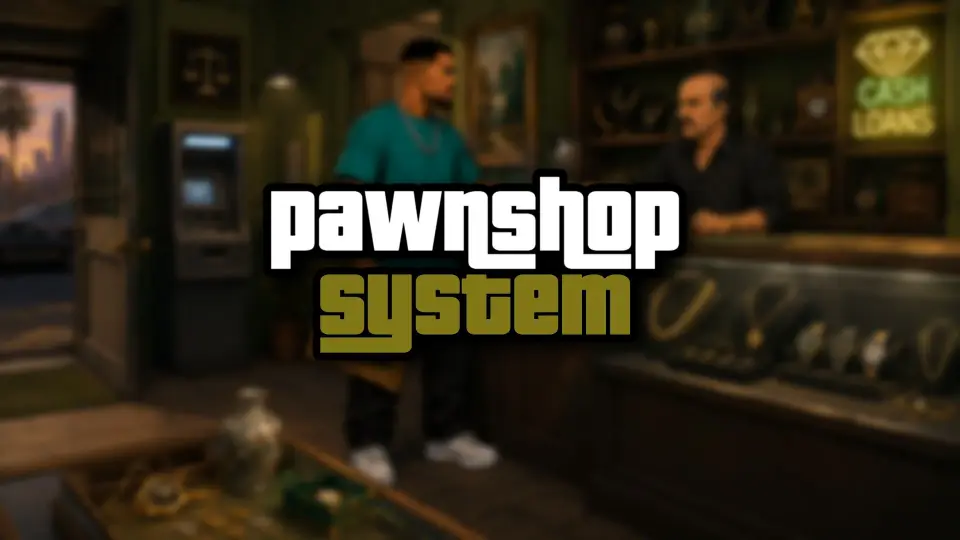
Creating a grounded, living world often comes down to how believably characters interact with material goods and money. Urban back alleys, crime-ridden districts, and survival settlements thrive when players have a dedicated place to unload scavenged valuables for hard cash. Pawnshop System supplies the full infrastructure required to establish these street-level exchanges. Instead of abstracting commerce behind disconnected pause menus, the framework grounds trading directly in the game space through physical interactions, storefront mechanics, and currency handling.
Cataloging Valuables: Showcase Items and Scrollable Menus
At the center of any pawn business is the merchandise brought through the door. Pawnshop System includes preset showcase items, specifically jewelry and paintings, which illustrate how commercial properties function within the architecture. Every item carries editable values that govern its commercial worth, giving designers clear leverage over price balance, economy scaling, and item tiers.
Projects rarely remain limited to a handful of items, which is why the underlying catalog can be expanded without artificial caps. Developers can define unlimited item types to match the narrative context of their world, whether that means antique relics, collected electronics, or rare curiosities. Expanding an item roster often runs into interface constraints, but the framework mitigates clutter by housing inventory entries within a responsive, scrollable menu system. Players can navigate extensive inventories without visual truncation or interface clipping, ensuring that large item pools remain readable during both fast sales and deliberate trading sessions.
Configuring the Interactive Shopkeeper and Bulk Sales
Transactions inside the system are anchored to an interactive shopkeeper entity. Rather than serving as a static dialogue trigger, the merchant actor features configurable behavior and inventory settings that can be tailored to distinct gameplay scenarios. A merchant operating in an upscale retail district might manage different pricing tolerances or inventory capacities than a backstreet fence dealing in illicit or damaged goods.
Player convenience during trade is addressed through granular selling options. Players who wish to offload their entire inventory after an extended scavenging run can execute bulk sales to clear out stock immediately. Conversely, those balancing specific item weights, values, or mission requirements can inspect and sell items individually. The merchant logic handles both transaction flows smoothly, updating inventories on both sides of the counter while maintaining proper tracking.
Character integration is kept straightforward, with explicit compatibility for Character Creator System. This allows developers using standardized character pipelines to assign custom NPC appearances, rigs, and clothing setups directly to the shopkeeper role without having to rebuild the underlying interactive framework.
The Physical Cash Loop and ATM Banking Mechanics
Rather than quietly incrementing a digital currency variable upon completing a sale, the shopkeeper rewards players with tangible, physical cash directly in the world. This deliberate mechanical choice creates tension and tangible reward, driving players away from pure menu management and into physical interaction loops.
Carrying large quantities of loose currency introduces clear gameplay stakes. To secure their profits, players must navigate toward the integrated ATM system. The ATM feature acts as a complete financial terminal where characters can:
Deposit physical bills gathered from storefront deals into a persistent balance
Withdraw bank funds when liquidity is required for outside purchases
Track their historical deposits and withdrawals through a dedicated transaction ledger
The logging system powering the ATM is built for modular reuse. While configured by default for basic banking operations, the underlying log logic can be extended to capture specialized transaction types, supporting custom fees, external merchant logs, or broader multi-branch banking systems across a sprawling map.
Environmental Immersion and Dual-Input Navigation
Atmosphere relies heavily on how players cross the boundary between the outside world and the shop interior. To bridge this gap, the system incorporates a physics-based door that reacts dynamically to movement. This removes the rigid, canned animations common in storefront entries, allowing players to push open doors naturally as they carry goods inside to trade.
Interaction across all menus, the ATM terminal, and merchant interfaces is built with dual-input parity. The user interface responds natively to both keyboard and gamepad controls. Navigating menus with analog sticks or directional pads feels as responsive as keyboard input, preventing the friction that often arises when PC-centric inventory schemes are ported directly to controller layouts.
A Modular Foundation for Economy-Driven Frameworks
The entire loop—scavenging valuables, stashing them in the base inventory, crossing through the physics-driven storefront, bargaining with the shopkeeper, collecting physical notes, and securing funds in an ATM—functions as a self-sustaining gameplay progression. Built as a flexible template, Pawnshop System provides the core structural components needed to support economy-heavy genres, from survival titles and RPGs to urban life simulators seeking an integrated trading and banking baseline.
 Gameplay Features
 Gameplay Features
 Gameplay Features
 Gameplay Features