"4481da9c895ef786"{"id":"1001304","slug":"newtonian-falling-and-momentum-damage-system","title":"Newtonian Falling and Momentum Damage System","category":"Gameplay Features","engine":"5.0+","assetVersion":"","engineVersion":"Engine Version: 5.0+","tag":"Gameplay Features","accent":"blue","visual":"mech","summary":"A 100% Blueprint fall and momentum damage system for any character or controller, featuring height checks and G-force deceleration calculations.","platform":"Unreal Engine","publishedAt":"2026-10-02T06:19:02.535Z","updatedAt":"2026-10-02T06:19:02.535Z","sourceNotes":[],"fileContents":[],"compatibility":["Unreal Engine","Engine Version: 5.0+"],"featuredImage":{"alt":"Newtonian Falling and Momentum Damage System","src":"/wp-content/uploads/published/2026/10/db680b6ef917-35863eca-d63d-4370-a07d-63f7120f4385-2653676f0a.webp"},"hasDownloadLink":true,"downloads":0,"terms":[{"taxonomy":"category","slug":"gameplay-features","name":"Gameplay Features"}],"galleryImages":[{"src":"/wp-content/uploads/published/2026/10/fabdee0eeccc-4f543656-0346-47d6-842c-57f33d7c60f9-4a9df09644.webp","alt":"Newtonian Falling and Momentum Damage System"},{"src":"/wp-content/uploads/published/2026/10/4cf6496010d0-be7629d6-e361-4f40-8c19-ea19271f49a1-94f2d90eac.webp","alt":"Newtonian Falling and Momentum Damage System"},{"src":"/wp-content/uploads/published/2026/10/ef4c5e510db2-5aba8d96-561d-49a2-ae29-7d93c37eaf1f-d2cc9d6097.webp","alt":"Newtonian Falling and Momentum Damage System"},{"src":"/wp-content/uploads/published/2026/10/bce8cc1052cc-b3b3928c-a6d9-483c-b84b-d3d250ddc935-a6c0733e0c.webp","alt":"Newtonian Falling and Momentum Damage System"},{"src":"/wp-content/uploads/published/2026/10/0f54286c3068-f63de594-db3c-479c-b0ba-576ad576d577-624b910c41.webp","alt":"Newtonian Falling and Momentum Damage System"}],"accessPanel":{"kind":"resource","title":"Download this resource","eyebrow":"Free Download","message":"Log in or create a free account to start your download.","fileName":"Content.7z","safetyNote":"Resources are manually reviewed before listing to improve quality and reduce obvious risks.","actionLabel":"Download Free","resourceType":"Resource archive"},"contentHtml":"\u003ch2\u003eImplementing the Drag and Drop Blueprint Component\u003c/h2\u003e\n\u003cp\u003eIntegrating impact calculations into player movement usually requires untangling character movement logic, velocity vectors, and landing states. The Newtonian Falling and Momentum Damage System bypasses complex rewiring by providing a 100% Blueprint-powered architecture designed to function as a drag-and-drop component. It connects directly to any character or controller setup without requiring custom engine modifications or C++ compilation.\u003c/p\u003e\n\u003cp\u003eBecause the logic is fully modular and Blueprint-native, developers can attach the system to varied character pawns, whether building an arcade platformer, a physics-heavy sandbox, or an action game with high-velocity movement. The component architecture cleanly decouples health-reduction logic from core movement code. Once added to a controller or pawn, the system immediately begins monitoring positional updates, velocity adjustments, and landing events to determine whether incoming forces warrant health reduction.\u003c/p\u003e \u003ch2\u003eHeight Calculations in the Simple Damage System\u003c/h2\u003e\n\u003cp\u003eFor projects that prioritize straightforward, deterministic mechanics over complex physics, the asset contains a Simple Damage System. This framework relies on classic fall-height evaluation. It tracks the distance between the apex of a character's jump or fall and the final point of ground contact, applying health penalties once specific altitude thresholds are crossed.\u003c/p\u003e\n\u003cp\u003eThis traditional method is exceptionally easy to configure and balance. When game rules demand predictable results—such as an exact amount of health lost after dropping from a two-story ledge—the height-based approach provides consistent, repeatable numbers. However, because it relies strictly on vertical distance rather than actual physical forces, it remains limited when handling fluid movement mechanics. It cannot naturally distinguish between a hard landing on stone and a soft entry into water, nor can it dynamically account for horizontal momentum or redirected velocities.\u003c/p\u003e \u003ch2\u003eCalculating G-Forces in the Advanced Momentum Based Damage System\u003c/h2\u003e\n\u003cp\u003eProjects requiring dynamic and physically grounded responses can deploy the Advanced Momentum Based Damage System. This is the primary recommended implementation within the asset. Rather than merely observing the elevation drop between two coordinates, this system measures real-time changes in player acceleration to calculate the exact G-forces experienced by the character upon impact.\u003c/p\u003e\n\u003cp\u003eUnder this calculation model, damage is not applied simply because a character was moving quickly. Instead, the logic activates when sudden deceleration causes the calculated G-forces to exceed a user-defined threshold. If the character encounters an abrupt stop that spikes acceleration beyond the safety margin, the system computes the exact excess force above that threshold and converts it into proportionate damage. Rapid deceleration from a high-speed fall generates substantial damage, while a gradual slowdown avoids penalizing the character entirely.\u003c/p\u003e \u003ch2\u003eHandling Deceleration: Water Volumes, Jump Pads, and Wall Impacts\u003c/h2\u003e\n\u003cp\u003eBy shifting the focus from static height to active G-forces, the advanced momentum system resolves several long-standing issues common to standard platforming and action movement:\u003c/p\u003e\n\u003cul\u003e \u003cli\u003e\u003cstrong\u003eWater Volumes:\u003c/strong\u003e In traditional height-based setups, landing in water from a great height often triggers instant death or inappropriate damage because the absolute fall distance was large. Under the advanced momentum calculations, fluid drag slows the player down gradually, keeping deceleration under the G-force threshold and cushioning the impact naturally.\u003c/li\u003e \u003cli\u003e\u003cstrong\u003eJump Pads and Launchers:\u003c/strong\u003e Mechanics that propel players into the air at extreme velocities can inadvertently trigger damage routines in basic systems. Because this package evaluates rapid deceleration rather than raw launch speed, characters can be thrown across environments or caught by bounce pads safely, provided the landing mechanic mitigates sudden deceleration spikes.\u003c/li\u003e \u003cli\u003e\u003cstrong\u003eWall Impacts and Slams:\u003c/strong\u003e Traditional falling damage only accounts for vertical downward motion. The advanced system tracks momentum in all directions. If an external gameplay event throws a character into a solid wall, the rapid lateral deceleration calculates the G-force of the impact and damages the pawn realistically upon striking the surface.\u003c/li\u003e\n\u003c/ul\u003e \u003ch2\u003eIntegration Workflow and Quest Map Pro Compatibility\u003c/h2\u003e\n\u003cp\u003eConfiguring the system involves tuning thresholds to match the desired balance between unforgiving realism and forgiving arcade movement. To guide this process, the resource provides both a Release Trailer and a Feature Overview and Documentation Video, demonstrating how G-force limits, fall-height parameters, and pawn health connections interact in live scenarios.\u003c/p\u003e\n\u003cp\u003eThe package maintains broad modularity across interface and gameplay tools, featuring documented compatibility with Quest Map Pro - Compass, World Map and Mini Map. Because the underlying logic operates as a clean Blueprint component focused exclusively on deceleration and health response, developers can run it alongside navigation overlays and complex UI frameworks without input or rendering interference.\u003c/p\u003e\n\n\u003ch2\u003eContinue Browsing Similar Packs\u003c/h2\u003e\n\u003cul\u003e\n\u003cli\u003e\u003ca href=\"https://3dcghub.com/simple-screen-damage-indicator/\" title=\"Simple Screen Damage Indicator\"\u003eSimple Screen Damage Indicator\u003c/a\u003e\u003c/li\u003e\n\u003cli\u003e\u003ca href=\"https://3dcghub.com/grappling-hook-system-with-physics/\" title=\"Grappling Hook System (with Physics)\"\u003eGrappling Hook System (with Physics)\u003c/a\u003e\u003c/li\u003e\n\u003cli\u003e\u003ca href=\"https://3dcghub.com/ai-shooter/\" title=\"AI Shooter\"\u003eAI Shooter\u003c/a\u003e\u003c/li\u003e\n\u003cli\u003e\u003ca href=\"https://3dcghub.com/hyper-time-manager-system-v4/\" title=\"Hyper Time Manager System v4\"\u003eHyper Time Manager System v4\u003c/a\u003e\u003c/li\u003e\n\u003cli\u003e\u003ca href=\"https://3dcghub.com/basic-locomotion-system-replicated/\" title=\"Basic Locomotion System (REPLICATED)\"\u003eBasic Locomotion System (REPLICATED)\u003c/a\u003e\u003c/li\u003e\n\u003c/ul\u003e","contentTextLength":5377,"navigation":{"current":34,"total":3269,"previous":{"id":"1001305","slug":"pawnshop-system","title":"Pawnshop System","category":"Gameplay Features","platform":"Unreal Engine","updatedAt":"2026-10-02T06:19:35.935Z"},"next":{"id":"1001302","slug":"inventory-system","title":"Inventory System","category":"Gameplay Features","platform":"Unreal Engine","updatedAt":"2026-10-02T06:05:08.067Z"}},"relatedResources":[{"id":"1000775","slug":"simple-screen-damage-indicator","title":"Simple Screen Damage Indicator","category":"Gameplay Features","engine":"5.4+","assetVersion":"","engineVersion":"Engine Version: 5.4+","tag":"Gameplay Features","accent":"blue","visual":"mech","summary":"A 100% Blueprint visual feedback system displaying a blood splatter overlay on hazard damage. Built for single-player prototyping with local multiplayer UI rend","platform":"Unreal Engine","publishedAt":"2026-07-28T18:07:04.744Z","updatedAt":"2026-07-28T18:07:04.744Z","sourceNotes":[],"fileContents":[],"compatibility":["Unreal Engine","Engine Version: 5.4+"],"featuredImage":{"alt":"Simple Screen Damage Indicator","src":"/wp-content/uploads/published/2026/07/5369eff53b58-641db878-ef1c-4892-ab16-112ae9023f3c-f070c8732a.webp"},"hasDownloadLink":true,"downloads":1},{"id":"1001095","slug":"grappling-hook-system-with-physics","title":"Grappling Hook System (with Physics)","category":"Gameplay Features","engine":"5.4+","assetVersion":"","engineVersion":"Engine Version: 5.4+","tag":"Gameplay Features","accent":"blue","visual":"mech","summary":"Physics-driven grappling hook system with real-time rope tension, momentum, and natural swinging. Designed for superhero, sci-fi, and parkour action.","platform":"Unreal Engine","publishedAt":"2026-09-06T01:52:41.055Z","updatedAt":"2026-09-06T01:52:41.055Z","sourceNotes":[],"fileContents":[],"compatibility":["Unreal Engine","Engine Version: 5.4+"],"featuredImage":{"alt":"Grappling Hook System (with Physics)","src":"/wp-content/uploads/published/2026/09/1ab657b886ce-a0ff8ce0-97c5-4815-a8c9-0a2e67e6be1f-74e36077e2.webp"},"hasDownloadLink":true,"downloads":0},{"id":"1000936","slug":"ai-shooter","title":"AI Shooter","category":"Gameplay Features","engine":"5.3+","assetVersion":"","engineVersion":"Engine Version: 5.3+","tag":"Gameplay Features","accent":"blue","visual":"mech","summary":"AI Shooter is a starter pack for shooting-game AI, covering patrolling, flanking, cover seeking, sight, hearing, damage, and touch behaviors.","platform":"Unreal Engine","publishedAt":"2026-08-10T02:47:39.341Z","updatedAt":"2026-08-10T02:47:39.341Z","sourceNotes":[],"fileContents":[],"compatibility":["Unreal Engine","Engine Version: 5.3+"],"featuredImage":{"alt":"AI Shooter","src":"/wp-content/uploads/published/2026/08/4b2c0a56342a-043d1833-9b88-46a2-9b9f-3c2f0a0dc80a-2bfb059ea5.webp"},"hasDownloadLink":true,"downloads":1}]}
Gameplay Features
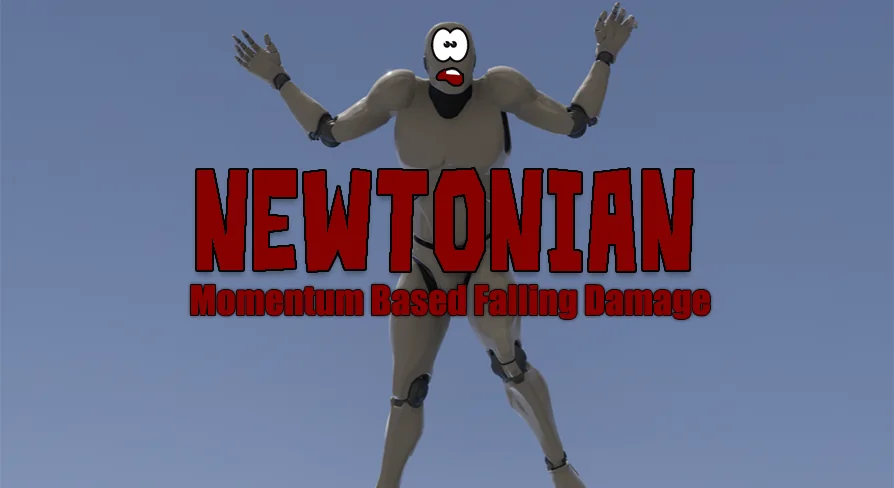
Newtonian Falling and Momentum Damage System
A 100% Blueprint fall and momentum damage system for any character or controller, featuring height checks and G-force deceleration calculations.
Implementing the Drag and Drop Blueprint Component
Integrating impact calculations into player movement usually requires untangling character movement logic, velocity vectors, and landing states. The Newtonian Falling and Momentum Damage System bypasses complex rewiring by providing a 100% Blueprint-powered architecture designed to function as a drag-and-drop component. It connects directly to any character or controller setup without requiring custom engine modifications or C++ compilation.
Because the logic is fully modular and Blueprint-native, developers can attach the system to varied character pawns, whether building an arcade platformer, a physics-heavy sandbox, or an action game with high-velocity movement. The component architecture cleanly decouples health-reduction logic from core movement code. Once added to a controller or pawn, the system immediately begins monitoring positional updates, velocity adjustments, and landing events to determine whether incoming forces warrant health reduction.
Height Calculations in the Simple Damage System
For projects that prioritize straightforward, deterministic mechanics over complex physics, the asset contains a Simple Damage System. This framework relies on classic fall-height evaluation. It tracks the distance between the apex of a character's jump or fall and the final point of ground contact, applying health penalties once specific altitude thresholds are crossed.
This traditional method is exceptionally easy to configure and balance. When game rules demand predictable results—such as an exact amount of health lost after dropping from a two-story ledge—the height-based approach provides consistent, repeatable numbers. However, because it relies strictly on vertical distance rather than actual physical forces, it remains limited when handling fluid movement mechanics. It cannot naturally distinguish between a hard landing on stone and a soft entry into water, nor can it dynamically account for horizontal momentum or redirected velocities.
Calculating G-Forces in the Advanced Momentum Based Damage System
Projects requiring dynamic and physically grounded responses can deploy the Advanced Momentum Based Damage System. This is the primary recommended implementation within the asset. Rather than merely observing the elevation drop between two coordinates, this system measures real-time changes in player acceleration to calculate the exact G-forces experienced by the character upon impact.
Under this calculation model, damage is not applied simply because a character was moving quickly. Instead, the logic activates when sudden deceleration causes the calculated G-forces to exceed a user-defined threshold. If the character encounters an abrupt stop that spikes acceleration beyond the safety margin, the system computes the exact excess force above that threshold and converts it into proportionate damage. Rapid deceleration from a high-speed fall generates substantial damage, while a gradual slowdown avoids penalizing the character entirely.
Handling Deceleration: Water Volumes, Jump Pads, and Wall Impacts
By shifting the focus from static height to active G-forces, the advanced momentum system resolves several long-standing issues common to standard platforming and action movement:
Water Volumes: In traditional height-based setups, landing in water from a great height often triggers instant death or inappropriate damage because the absolute fall distance was large. Under the advanced momentum calculations, fluid drag slows the player down gradually, keeping deceleration under the G-force threshold and cushioning the impact naturally.
Jump Pads and Launchers: Mechanics that propel players into the air at extreme velocities can inadvertently trigger damage routines in basic systems. Because this package evaluates rapid deceleration rather than raw launch speed, characters can be thrown across environments or caught by bounce pads safely, provided the landing mechanic mitigates sudden deceleration spikes.
Wall Impacts and Slams: Traditional falling damage only accounts for vertical downward motion. The advanced system tracks momentum in all directions. If an external gameplay event throws a character into a solid wall, the rapid lateral deceleration calculates the G-force of the impact and damages the pawn realistically upon striking the surface.
Integration Workflow and Quest Map Pro Compatibility
Configuring the system involves tuning thresholds to match the desired balance between unforgiving realism and forgiving arcade movement. To guide this process, the resource provides both a Release Trailer and a Feature Overview and Documentation Video, demonstrating how G-force limits, fall-height parameters, and pawn health connections interact in live scenarios.
The package maintains broad modularity across interface and gameplay tools, featuring documented compatibility with Quest Map Pro - Compass, World Map and Mini Map. Because the underlying logic operates as a clean Blueprint component focused exclusively on deceleration and health response, developers can run it alongside navigation overlays and complex UI frameworks without input or rendering interference.
 Gameplay Features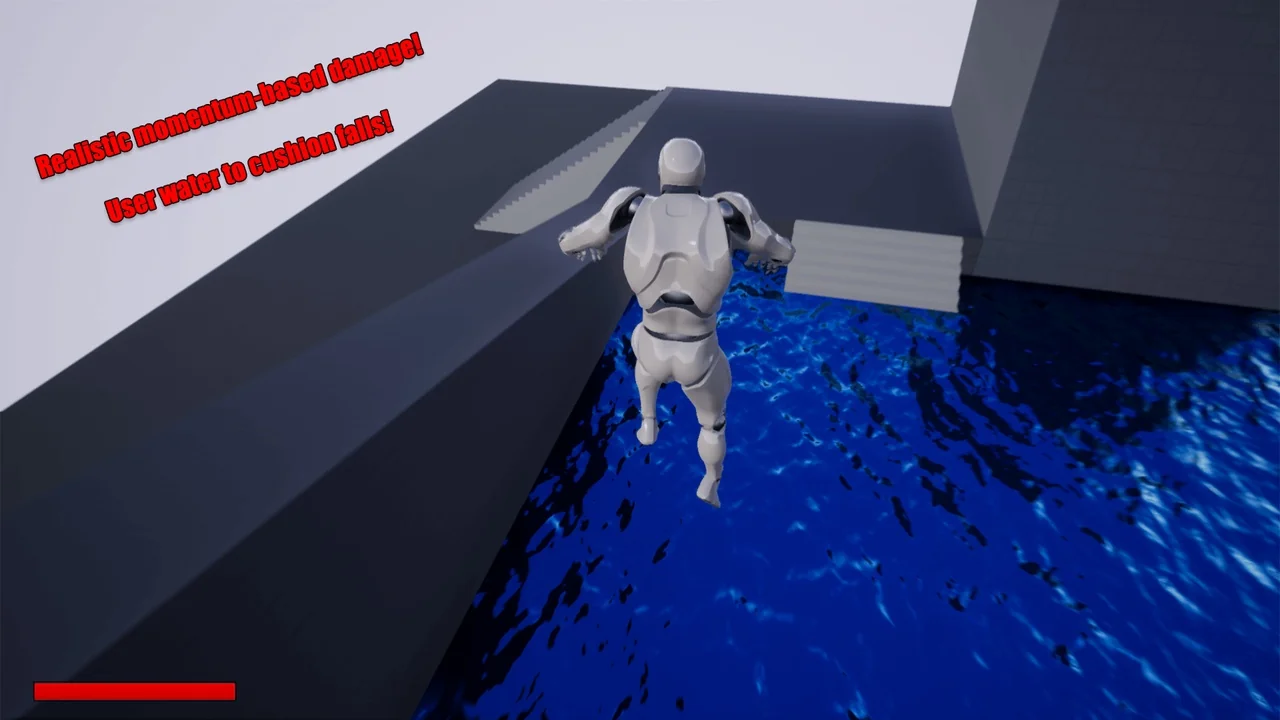
 Gameplay Features
 Gameplay Features
 Gameplay Features