"1062d43bc714d570"{"id":"1001005","slug":"orc-warrior","title":"Orc Warrior","category":"Creatures \u0026 Monsters","engine":"4.26+,5.0+","assetVersion":"","engineVersion":"Engine Version: 4.26+,5.0+","tag":"Creatures","accent":"blue","visual":"character","summary":"A rigged low-poly orc with a weapon, 11 animations, a control rig, plus 4096x4096 Color, Normal, and AORM textures for real-time fantasy work.","platform":"Unreal Engine","publishedAt":"2026-08-22T10:59:41.214Z","updatedAt":"2026-08-22T10:59:41.214Z","sourceNotes":[],"fileContents":[],"compatibility":["Unreal Engine","Engine Version: 4.26+,5.0+"],"featuredImage":{"alt":"Orc Warrior","src":"/wp-content/uploads/published/2026/08/07a81bcdb165-a721db55-38ea-4d04-a1d7-b62b48c726b0-dc71636e7b.webp"},"hasDownloadLink":true,"downloads":2,"terms":[{"taxonomy":"category","slug":"creatures-and-monsters","name":"Creatures \u0026 Monsters"}],"galleryImages":[{"src":"/wp-content/uploads/published/2026/08/c7f5dc3b7fd4-89976b57-8a83-4c2b-8b41-aa3a0e754b78-8b93a2dc92.webp","alt":"Orc Warrior"},{"src":"/wp-content/uploads/published/2026/08/f6cf2c41dc8d-94888b59-ed1f-4bd6-b3aa-d612647680ed-0fd0a8e12c.webp","alt":"Orc Warrior"},{"src":"/wp-content/uploads/published/2026/08/11ae7fd2be3a-622adc9e-900a-4b68-9d54-6678f8a51721-e0f20c60a4.webp","alt":"Orc Warrior"},{"src":"/wp-content/uploads/published/2026/08/f39b5ac0f3e3-22dc53cd-f035-4e7c-ba28-17594f4f185d-e7fe0ee8c9.webp","alt":"Orc Warrior"},{"src":"/wp-content/uploads/published/2026/08/1e18d6d01996-b3932892-40f7-40ae-8ed5-2af11d92bfad-0d95f59ef6.webp","alt":"Orc Warrior"},{"src":"/wp-content/uploads/published/2026/08/5f30963467dd-5dfa8cab-057e-446a-8f91-3ad42a71a4dd-8d24a0bb2d.webp","alt":"Orc Warrior"},{"src":"/wp-content/uploads/published/2026/08/a26284eba97a-26af2881-a425-4e54-8a3d-868af13d0de5-f91f90a7fc.webp","alt":"Orc Warrior"},{"src":"/wp-content/uploads/published/2026/08/b32bad742291-a1068e70-f667-4af8-af6d-d4b01b11fb39-edbe4c3a87.webp","alt":"Orc Warrior"}],"accessPanel":{"kind":"resource","title":"Download this resource","eyebrow":"Free Download","message":"Log in or create a free account to start your download.","fileName":"Content.7z","safetyNote":"Resources are manually reviewed before listing to improve quality and reduce obvious risks.","actionLabel":"Download Free","resourceType":"Resource archive"},"contentHtml":"\u003ch2\u003eOrc, Weapon, Eleven Animations, and a Control Rig in One Package\u003c/h2\u003e\n\u003cp\u003eThe Orc Warrior asset comes as an all-in-one character setup. Inside the package are the orc model, a weapon, eleven animation clips, and a control rig. That list alone separates it from a static mesh drop. The asset tags include both rigged and animated, which means the skeleton is included and the model already has motion clips attached. So the character does not need to be skinned or bound from scratch; its animation set is packed alongside the same rig that ships with the package.\u003c/p\u003e\n\u003cp\u003eFor teams that work in real-time, this structure is practical. The rigged tag removes the need to build or edit a skeleton. The animated tag confirms that the asset is not defined by a single bind pose, but by a set of motions that can be played immediately. The control rig then sits on top of that skeleton, giving animators a way to adjust poses without digging into raw bone channels. The weapon occupies its own spot in the contents list, so the character is not just a body; it is a combat-ready unit.\u003c/p\u003e\n\u003ch2\u003eColor, Normal, and AORM Texture Maps at 4096 x 4096\u003c/h2\u003e\n\u003cp\u003eSurface quality is handled by three texture maps: Color, Normal, and AORM. Each one is stored at a 4096 by 4096 pixel resolution. That resolution is high enough for close camera work in cinematics or gameplay, while still being understandable as a standard texture budget for a centerpiece character. The normal map carries fine surface detail, the color map provides albedo and tinted tone, and the AORM map combines ambient occlusion, roughness, and metallic data into a single texture.\u003c/p\u003e\n\u003cp\u003eWorking with a combined AORM map reduces the number of individual texture samples inside a material. It is a compact way to feed a standard PBR shader and keeps the material graph simple. For a lowpoly character, where geometry is limited, these textures carry most of the visual weight. Metal surfaces read as shiny and hard, leather stays non-metallic with soft roughness, cloth has a different reflectance falloff, and organic skin gets a curated response from the same combined map. The 4096 resolution lets these different material sections maintain crisp boundaries when viewed close up.\u003c/p\u003e\n\u003ch2\u003eControl Rig and Animation Blueprint for Real-Time Posing\u003c/h2\u003e\n\u003cp\u003eBeyond the eleven clips, the control rig gives you a direct manipulation layer over the skeleton. Instead of editing raw bone keys, you interact with controls suited to the orc's proportions. This makes pose adjustments and animation tweaks faster. The asset marker for animation blueprint points to an Unreal Engine workflow where the character is meant to connect to an animation graph. In practice, that means the orc can be driven by state machines and blend logic, not just by manually playing individual clips.\u003c/p\u003e\n\u003cp\u003eBecause the character is tagged humanoid, its skeleton follows a human-standard bone layout. That opens the door to retargeting and sharing animations across humanoid characters. The control rig and animation blueprint work together to take the orc beyond a static list of clips. You can layer locomotion, combat transitions, and even custom moves on top of the existing eleven animations. The control rig is particularly useful when a shot demands a pose that is not already in the animation set, or when a blend needs help at the contact point.\u003c/p\u003e\n\u003ch2\u003eReading the Tag List: Stylized, Lowpoly, and Humanoid\u003c/h2\u003e\n\u003cp\u003eThe tag list paints a specific visual picture. Both cartoon and realistic appear, with stylized connecting them. The orc is not a photorealistic scan, nor is it a broad cartoon. It falls into a middle range where stylized proportions and textures still respect real-world material behavior. Lowpoly signals optimized geometry. Combined with the 4096 textures, it becomes a character that is light on render load but strong in surface detail.\u003c/p\u003e\n\u003cp\u003eThere are also material tags: metal, leather, cloth, and organic. These mirror the different surfaces of a fantasy warrior. Armor pieces read as metal, belts and straps as leather, tattered garments or tabs as cloth, and the orc's own skin and any natural appendages as organic. Tags such as fantasy, man, male, creature, and orc all narrow the narrative role. When a project needs a male orc fighter with mixed-material styling, this tag set lines up with that brief from the start.\u003c/p\u003e\n\u003ch2\u003eFitting the Orc Warrior Into a Fantasy Production\u003c/h2\u003e\n\u003cp\u003eThis asset is practically built to drop into a real-time fantasy project. The combination of model, weapon, animations, and control rig lets a team move past the early setup phase. Import the mesh, connect the animation blueprint, assign the texture set, and the orc is ready to stand in a level or appear in a cutscene. The weapon is included, so the warrior is never presented empty-handed. The animation set offers a starting range of movement, while the control rig covers the need to extend beyond that range.\u003c/p\u003e\n\u003cp\u003eIn a larger pipeline, this type of package is valuable because it removes dependencies. A character artist does not need to create an orc model from scratch, an animator does not need to build every clip, and a technical animator does not need to wire up a control rig from zero. The package includes all those pieces in a single import. For teams that want a stylized fantasy orc without building the character on their own, the Orc Warrior supplies the core requirements in one asset. The remaining work is about making the character perform the way the project needs, which is exactly the kind of work a control rig makes easier.\u003c/p\u003e\n\n\u003ch2\u003eMore From The Same Workflow\u003c/h2\u003e\n\u003cul\u003e\n\u003cli\u003e\u003ca href=\"https://3dcghub.com/monsters-wraith/\" title=\"Monsters - Wraith\"\u003eMonsters - Wraith\u003c/a\u003e\u003c/li\u003e\n\u003cli\u003e\u003ca href=\"https://3dcghub.com/demon-7/\" title=\"Demon 7\"\u003eDemon 7\u003c/a\u003e\u003c/li\u003e\n\u003cli\u003e\u003ca href=\"https://3dcghub.com/ocean-monster-fish-pack-part-2-underwater-creatures-fish-low-poly-11/\" title=\"Ocean Monster Fish Pack - Part 2 - Underwater Creatures - Fish low poly - #11\"\u003eOcean Monster Fish Pack - Part 2 - Underwater Creatures - Fish low poly - #11\u003c/a\u003e\u003c/li\u003e\n\u003cli\u003e\u003ca href=\"https://3dcghub.com/stylized-halloween-pack-2/\" title=\"Stylized Halloween Pack #2\"\u003eStylized Halloween Pack #2\u003c/a\u003e\u003c/li\u003e\n\u003cli\u003e\u003ca href=\"https://3dcghub.com/undead-knight/\" title=\"Undead Knight\"\u003eUndead Knight\u003c/a\u003e\u003c/li\u003e\n\u003c/ul\u003e","contentTextLength":5669,"navigation":{"current":492,"total":3379,"previous":{"id":"1001006","slug":"ork-rogue-2","title":"Ork Rogue","category":"Creatures \u0026 Monsters","platform":"Unreal Engine","updatedAt":"2026-08-22T11:04:26.209Z"},"next":{"id":"1001004","slug":"next-gen-destruction-toolkit","title":"Next Gen Destruction Toolkit","category":"Gameplay Features","platform":"Unreal Engine","updatedAt":"2026-08-22T10:54:47.045Z"}},"relatedResources":[{"id":"1001006","slug":"ork-rogue-2","title":"Ork Rogue","category":"Creatures \u0026 Monsters","engine":"4.26+,5.0+","assetVersion":"","engineVersion":"Engine Version: 4.26+,5.0+","tag":"Creatures","accent":"blue","visual":"character","summary":"Ork Rogue is a ready-made lowpoly orc with a blueprint-connected weapon, 4096 to 512 UV sets, and poly counts suited for game projects.","platform":"Unreal Engine","publishedAt":"2026-08-22T11:04:26.209Z","updatedAt":"2026-08-22T11:04:26.209Z","sourceNotes":[],"fileContents":[],"compatibility":["Unreal Engine","Engine Version: 4.26+,5.0+"],"featuredImage":{"alt":"Ork Rogue","src":"/wp-content/uploads/published/2026/08/e1b3f07042d3-d3ef89db-f3ec-4c73-bddf-edba852e9eb8-e4e0eed622.webp"},"hasDownloadLink":true,"downloads":0},{"id":"1000198","slug":"monsters-wraith","title":"Monsters - Wraith","category":"Creatures \u0026 Monsters","engine":"4.26+,5.0+","assetVersion":"","engineVersion":"Engine Version: 4.26+,5.0+","tag":"Creatures","accent":"blue","visual":"character","summary":"Monsters - Wraith brings a fully rigged horror character with 15 animations, retargeting support, 4K PBR textures, and three LOD stages.","platform":"Unreal Engine","publishedAt":"2026-06-23T11:17:03.690Z","updatedAt":"2026-06-23T11:17:03.690Z","sourceNotes":[],"fileContents":[],"compatibility":["Unreal Engine","Engine Version: 4.26+,5.0+"],"featuredImage":{"alt":"Monsters - Wraith","src":"/wp-content/uploads/published/2026/06/634d5e446402-356eea60-c9a0-47fa-a911-4eeaa36c9538-45f0eb0911.webp"},"hasDownloadLink":true,"downloads":2},{"id":"1000084","slug":"ocean-monster-fish-pack-part-2-underwater-creatures-fish-low-poly-11","title":"Ocean Monster Fish Pack - Part 2 - Underwater Creatures - Fish low poly - #11","category":"Creatures \u0026 Monsters","engine":"Engine Version: 4.26+,5.0+","assetVersion":"Engine Version: 4.26+,5.0+","engineVersion":"","tag":"Creatures","accent":"blue","visual":"character","summary":"Five low poly underwater predators with 4K PBR textures and creature-specific animation sets for Unreal Engine 4.18+ and Unity 2019+.","platform":"Unreal Engine","publishedAt":"2026-06-05T16:10:19.047Z","updatedAt":"2026-06-05T16:10:19.047Z","sourceNotes":[],"fileContents":[],"compatibility":["Unreal Engine","Engine Version: 4.26+,5.0+"],"featuredImage":{"alt":"Ocean Monster Fish Pack - Part 2 - Underwater Creatures - Fish low poly - #11","src":"/wp-content/uploads/published/2026/06/b6571f02d880-f5259706-5176-48e5-9a7a-2b0dce6d60c0-f35957ada4.webp"},"hasDownloadLink":true,"downloads":0}]}
Creatures
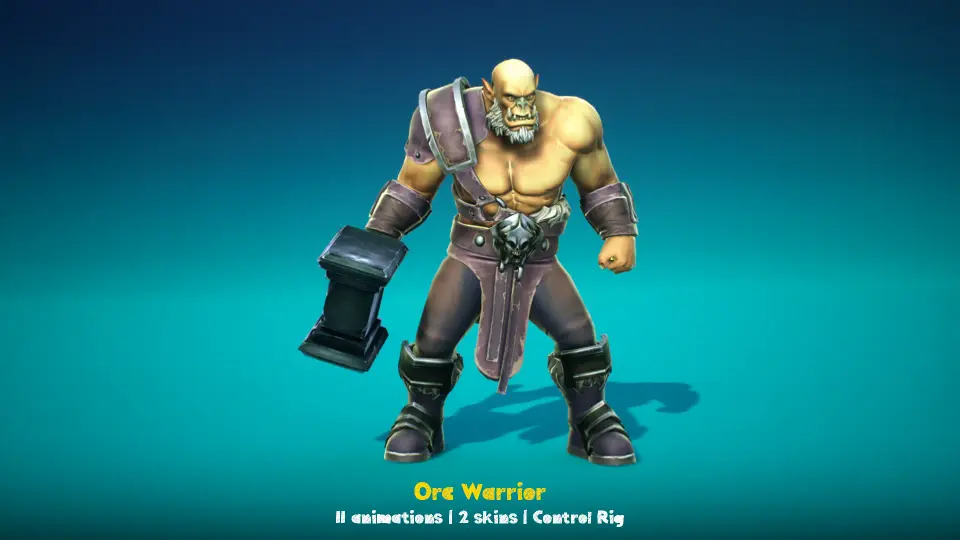
Orc Warrior
A rigged low-poly orc with a weapon, 11 animations, a control rig, plus 4096x4096 Color, Normal, and AORM textures for real-time fantasy work.
Orc, Weapon, Eleven Animations, and a Control Rig in One Package
The Orc Warrior asset comes as an all-in-one character setup. Inside the package are the orc model, a weapon, eleven animation clips, and a control rig. That list alone separates it from a static mesh drop. The asset tags include both rigged and animated, which means the skeleton is included and the model already has motion clips attached. So the character does not need to be skinned or bound from scratch; its animation set is packed alongside the same rig that ships with the package.
For teams that work in real-time, this structure is practical. The rigged tag removes the need to build or edit a skeleton. The animated tag confirms that the asset is not defined by a single bind pose, but by a set of motions that can be played immediately. The control rig then sits on top of that skeleton, giving animators a way to adjust poses without digging into raw bone channels. The weapon occupies its own spot in the contents list, so the character is not just a body; it is a combat-ready unit.
Color, Normal, and AORM Texture Maps at 4096 x 4096
Surface quality is handled by three texture maps: Color, Normal, and AORM. Each one is stored at a 4096 by 4096 pixel resolution. That resolution is high enough for close camera work in cinematics or gameplay, while still being understandable as a standard texture budget for a centerpiece character. The normal map carries fine surface detail, the color map provides albedo and tinted tone, and the AORM map combines ambient occlusion, roughness, and metallic data into a single texture.
Working with a combined AORM map reduces the number of individual texture samples inside a material. It is a compact way to feed a standard PBR shader and keeps the material graph simple. For a lowpoly character, where geometry is limited, these textures carry most of the visual weight. Metal surfaces read as shiny and hard, leather stays non-metallic with soft roughness, cloth has a different reflectance falloff, and organic skin gets a curated response from the same combined map. The 4096 resolution lets these different material sections maintain crisp boundaries when viewed close up.
Control Rig and Animation Blueprint for Real-Time Posing
Beyond the eleven clips, the control rig gives you a direct manipulation layer over the skeleton. Instead of editing raw bone keys, you interact with controls suited to the orc's proportions. This makes pose adjustments and animation tweaks faster. The asset marker for animation blueprint points to an Unreal Engine workflow where the character is meant to connect to an animation graph. In practice, that means the orc can be driven by state machines and blend logic, not just by manually playing individual clips.
Because the character is tagged humanoid, its skeleton follows a human-standard bone layout. That opens the door to retargeting and sharing animations across humanoid characters. The control rig and animation blueprint work together to take the orc beyond a static list of clips. You can layer locomotion, combat transitions, and even custom moves on top of the existing eleven animations. The control rig is particularly useful when a shot demands a pose that is not already in the animation set, or when a blend needs help at the contact point.
Reading the Tag List: Stylized, Lowpoly, and Humanoid
The tag list paints a specific visual picture. Both cartoon and realistic appear, with stylized connecting them. The orc is not a photorealistic scan, nor is it a broad cartoon. It falls into a middle range where stylized proportions and textures still respect real-world material behavior. Lowpoly signals optimized geometry. Combined with the 4096 textures, it becomes a character that is light on render load but strong in surface detail.
There are also material tags: metal, leather, cloth, and organic. These mirror the different surfaces of a fantasy warrior. Armor pieces read as metal, belts and straps as leather, tattered garments or tabs as cloth, and the orc's own skin and any natural appendages as organic. Tags such as fantasy, man, male, creature, and orc all narrow the narrative role. When a project needs a male orc fighter with mixed-material styling, this tag set lines up with that brief from the start.
Fitting the Orc Warrior Into a Fantasy Production
This asset is practically built to drop into a real-time fantasy project. The combination of model, weapon, animations, and control rig lets a team move past the early setup phase. Import the mesh, connect the animation blueprint, assign the texture set, and the orc is ready to stand in a level or appear in a cutscene. The weapon is included, so the warrior is never presented empty-handed. The animation set offers a starting range of movement, while the control rig covers the need to extend beyond that range.
In a larger pipeline, this type of package is valuable because it removes dependencies. A character artist does not need to create an orc model from scratch, an animator does not need to build every clip, and a technical animator does not need to wire up a control rig from zero. The package includes all those pieces in a single import. For teams that want a stylized fantasy orc without building the character on their own, the Orc Warrior supplies the core requirements in one asset. The remaining work is about making the character perform the way the project needs, which is exactly the kind of work a control rig makes easier.
 Creatures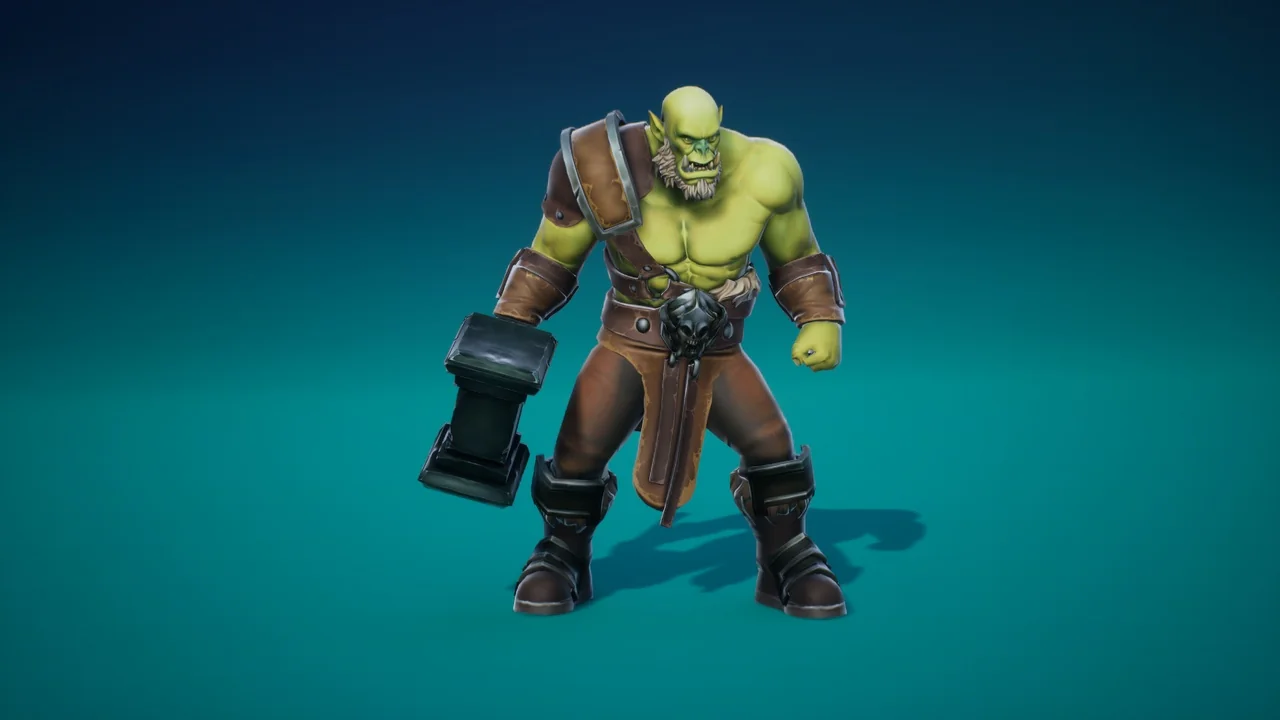
 Creatures
 Creatures
 Creatures