"fb5ea1e7d1b41445"{"id":"1002410","slug":"orc-warlock-modular","title":"Orc Warlock (Modular)","category":"Creatures \u0026 Monsters","engine":"4.18+,5.0+","assetVersion":"","engineVersion":"Engine Version: 4.18+,5.0+","tag":"Creatures","accent":"blue","visual":"character","summary":"Modular Orc Warlock 3D character featuring 4K PBR textures, 9 texture sets, facial blendshapes, dynamic bones, and cloth simulation settings.","platform":"Unreal Engine","indexPolicy":"index","publishedAt":"2026-11-10T12:07:32.680Z","updatedAt":"2026-11-10T12:07:32.680Z","sourceNotes":[],"fileContents":[],"compatibility":["Unreal Engine","Engine Version: 4.18+,5.0+"],"featuredImage":{"alt":"Orc Warlock (Modular)","src":"/wp-content/uploads/published/2026/11/ab393dc06201-809dce1d-d4c7-40a4-8ce3-bd687327bc09-5c75a6b4b4.webp"},"hasDownloadLink":true,"downloads":0,"terms":[{"taxonomy":"category","slug":"creatures-and-monsters","name":"Creatures \u0026 Monsters"}],"galleryImages":[{"src":"/wp-content/uploads/published/2026/11/308ba87faba0-f113b278-4237-46b1-a92d-05a80f97c1e6-866991a49a.webp","alt":"Orc Warlock (Modular)"},{"src":"/wp-content/uploads/published/2026/11/8532920fa67c-99bd9584-ad46-47ed-bee8-e96df91550d3-d5f7f817b3.webp","alt":"Orc Warlock (Modular)"},{"src":"/wp-content/uploads/published/2026/11/e60c601cc4f7-987e259f-f36f-43c1-bb7b-e1ac70d7fce4-1a08d50dd2.webp","alt":"Orc Warlock (Modular)"},{"src":"/wp-content/uploads/published/2026/11/c07d05dc1ef9-52105e13-1269-4bf6-9e8c-d348c8b539ea-73b33f2789.webp","alt":"Orc Warlock (Modular)"},{"src":"/wp-content/uploads/published/2026/11/252c7477f02b-a30acb73-c505-4657-bcaa-a0505692f653-46ff15b7d6.webp","alt":"Orc Warlock (Modular)"},{"src":"/wp-content/uploads/published/2026/11/13644f7a9a7f-84343322-cf3b-4bdf-8074-4448ccffd0dd-03753a4be9.webp","alt":"Orc Warlock (Modular)"},{"src":"/wp-content/uploads/published/2026/11/fd2f833c1210-8c979074-67e6-4b48-b6f7-e272dcbbf5df-c71cfca31e.webp","alt":"Orc Warlock (Modular)"},{"src":"/wp-content/uploads/published/2026/11/b69cae0736ba-31fd6f5d-9ea2-45b7-80ef-2fd3717022dc-4e7aec95e9.webp","alt":"Orc Warlock (Modular)"},{"src":"/wp-content/uploads/published/2026/11/cbc8f69cce46-fbd00fa3-93e6-4d2d-86ef-60bc7d104839-3b2da4304f.webp","alt":"Orc Warlock (Modular)"},{"src":"/wp-content/uploads/published/2026/11/6af1d7b465a0-85808a6d-c096-4323-9557-29a7d478c2a3-1b227e5963.webp","alt":"Orc Warlock (Modular)"}],"accessPanel":{"kind":"resource","title":"Get this resource","eyebrow":"Free resource","message":"Download this resource in your browser.","fileName":"Content.7z","safetyNote":"Resources are manually reviewed before listing to improve quality and reduce obvious risks.","actionLabel":"Get this resource","resourceType":"Resource archive","versions":[]},"contentHtml":"\u003ch2\u003eStaging the Orc Warlock Across Dark Fantasy and Horror Encounters\u003c/h2\u003e\u003cp\u003eGrim fantasy dungeons, ritualistic altars, and treacherous battlegrounds call for adversaries that convey magical menace through heavy physical presence. A corrupt spellcaster commanding dark arcana requires visual indicators of both brutish power and sorcerous ritual. Projects staging brutal boss encounters, grim dark fantasy role-playing campaigns, or medieval monster hunts often struggle to balance hulking monstrous anatomy with the intricate ornaments worn by a witch or mage. The Orc Warlock addresses this intersection by combining the muscular, beast-like proportions of an ogre, troll, or berserker with the accoutrements of a death-attuned warlock wielding a scythe.\u003c/p\u003e\u003cp\u003eThe character fits into diverse encounter roles. Set him up as a solitary dungeon boss summoning dark forces, an elite caster anchoring an offensive squad of goblins and orcs, or a specialized spellcasting champion in a tactical medieval battler. His scythe weapon and worn ritual gear signal melee lethality alongside magical prowess, making him an imposing presence when confronting players in close quarters or casting spells from ritual circles.\u003c/p\u003e\u003ch2\u003eModular Equipment Progression and Armor Stripping\u003c/h2\u003e\u003cp\u003eA primary demand in modern role-playing and action games is visual character progression. The model is built with complete modularity, permitting developers to strip away or layer individual components depending on the context of an encounter. In progression-heavy titles, the warlock can start in a stripped-down form and gradually gain equipment as he levels up. You can toggle off garments, accessories, weapons, and hair to represent different stages of power or distinct combat roles.\u003c/p\u003e\u003cp\u003eThis modular breakdown allows the base mesh to serve as a naked ritualist or basic cultist early on, later transforming into an elite horned and armored sorcerer adorned with heavy chains and bone trophies. Because each component—from cloth wraps to hanging talismans—can be attached or detached independently, a single asset can generate an entire cabal of varied orcish casters rather than a repeated clone army across different levels of a campaign.\u003c/p\u003e\u003ch2\u003eFacial Morph Targets for Dialogue and Live Face Mockup\u003c/h2\u003e\u003cp\u003eBeyond standard combat encounters, contemporary narrative titles demand expressive performance during spoken dialogue and story cinematics. The head mesh includes integrated morph targets and blendshapes specifically dedicated to facial expressions. These blendshapes allow the model to move smoothly from neutral sneers to expressive, ritualistic incantations or dialogue during cutscenes.\u003c/p\u003e\u003cp\u003eTechnical workflows can harness these morph targets directly for real-time face mockup during live stream setups or drive them through conversation animation sequences in Unreal Engine. This level of expressive facial control elevates the monster from an anonymous obstacle into a primary antagonist capable of holding conversations, reacting to player choices, and casting spells with believable mouth and brow motion.\u003c/p\u003e\u003ch2\u003eOrc Warlock Bone Hierarchy and Cloth Simulation Settings\u003c/h2\u003e\u003cp\u003eTo bring weight to the character's clothing and horrific talismans, the skeleton incorporates dedicated secondary bones made for secondary physics and chained ornaments. Rather than rigging all accessories to standard human joints, the rig features explicit nodes:\u003c/p\u003e\u003cul\u003e\u003cli\u003eBelt_Skull and Belt_Skull1 for waist-bound trophies\u003c/li\u003e\u003cli\u003eChain_Belt_Lt, Chain_Belt_Lt1, Chain_Belt_Up, Chain_Belt_Up1, Chain_Belt_Rt, and Chain_Belt_Rt1 for the heavy waist links\u003c/li\u003e\u003cli\u003eSkull and Skull1 for secondary bone relics\u003c/li\u003e\u003cli\u003eChain_Spin_Lt, Chain_Spin_Lt1, Chain_Spin_Lt2, Chain_Spin_Rt, Chain_Spin_Rt1, and Chain_Spin_Rt2 for dynamic spinal linkages\u003c/li\u003e\u003c/ul\u003e\u003cp\u003eThese additional chains and skull bones allow items suspended from the back, spine, and waistline to swing naturally during heavy motion, combat swings, and animation blueprint transitions.\u003c/p\u003e\u003cp\u003eWhen utilizing cloth simulation in Unreal Engine 5, developers encountering performance hitches or stuttering brakes must adjust one specific parameter: reducing the Self Collision Thickness value inside the cloth simulation properties. While Unreal Engine 4 handles the cloth simulation profile without this friction, Unreal Engine 5's cloth solver requires lowering this thickness setting to eliminate simulation slowdowns while maintaining fluid movement on flowing robes and waist garments.\u003c/p\u003e\u003ch2\u003eTexture Layering, Tattoos, and 4K Surface Shading\u003c/h2\u003e\u003cp\u003eVisually, the character is mapped across nine separate texture sets: Body, Head, Hair, Eyes, Weapons, Cloth, and Accessories. Every set uses a PBR Metallic/Roughness workflow, authored in clean 4K resolution across normal, metallic, roughness, and albedo maps. This nine-fold division means fine skin folds, weapon edge wear, hair strands, and accessory carvings preserve high visual fidelity even in extreme close-up shots.\u003c/p\u003e\u003cp\u003eThe master materials provide built-in controls for color adjustments across garments and surfaces, allowing quick visual distinctions between ranks. Both the body and head materials include integrated tattoo layers, adding tribal and demonic patterning across the skin. To accommodate modular layering and hide underlying geometry when heavy armor or robes are equipped, the body material also incorporates a transparency map, preventing mesh clipping without demanding complex manual mesh cutting.\u003c/p\u003e\u003ch2\u003eEngine Performance, Polycounts, and Animation Reconfiguration\u003c/h2\u003e\u003cp\u003eOn the technical side, the base asset sits at LOD 0 with 38,759 faces, 41,427 vertices, and 78,457 triangles. This polygon density delivers sharp muscular definition, jagged bone silhouettes, and crisp cloth draping suitable for current-gen action and RPG pipelines. Reconfiguring animations is straightforward within Unreal Engine, working cleanly with Epic Skeleton animation pipelines and animation blueprints. Because the rig matches standard animation expectations, developers can readily repurpose walk cycles, spellcasting stances, and combat loops onto the warlock.\u003c/p\u003e\u003cp\u003eFor productions building out broader tribal encampments, the asset directly complements companion archetypes from the Orcs, Ogres \u0026 Goblins collection, such as the Orc Fury, Orc Tank, and Orc Hunter. Together, these complementary models share design motifs and visual scales, letting teams populate entire dungeon raids with specialized warrior, berserker, defender, and caster units.\u003c/p\u003e\u003ch2\u003ePractical Takeaways for Production Teams\u003c/h2\u003e\u003cp\u003eDevelopers assembling third-person action games, tactical strategy titles, or story-driven dungeon crawlers gain an asset capable of serving as a field boss, dark sorcerer, or customizable protagonist. Its combination of modular equipment layers, full 4K PBR sets, facial blendshapes for live mockup, and dedicated chain bones provides the practical flexibility needed for dynamic combat and scripted cutscenes alike.\u003c/p\u003e\n\n\u003ch2\u003eContinue Browsing Similar Packs\u003c/h2\u003e\n\u003cul\u003e\n\u003cli\u003e\u003ca href=\"https://3dcghub.com/orc-collection/\" rel=\"noopener noreferrer\"\u003eOrc Collection\u003c/a\u003e\u003c/li\u003e\n\u003cli\u003e\u003ca href=\"https://3dcghub.com/orc-warrior/\" rel=\"noopener noreferrer\"\u003eOrc Warrior\u003c/a\u003e\u003c/li\u003e\n\u003cli\u003e\u003ca href=\"https://3dcghub.com/ocean-monster-fish-pack-part-1-fish-low-poly-model-0/\" rel=\"noopener noreferrer\"\u003eOcean Monster Fish Pack - Part 1 - Fish low poly model - #0\u003c/a\u003e\u003c/li\u003e\n\u003cli\u003e\u003ca href=\"https://3dcghub.com/monsters-wraith/\" rel=\"noopener noreferrer\"\u003eMonsters - Wraith\u003c/a\u003e\u003c/li\u003e\n\u003cli\u003e\u003ca href=\"https://3dcghub.com/otherside-beast/\" rel=\"noopener noreferrer\"\u003eOtherside beast\u003c/a\u003e\u003c/li\u003e\n\u003c/ul\u003e","contentTextLength":7010,"navigation":{"current":9,"total":4340,"previous":{"id":"1002411","slug":"spaceknight","title":"SpaceKnight","category":"Characters \u0026 Creatures","platform":"Unreal Engine","updatedAt":"2026-11-10T12:08:58.510Z"},"next":{"id":"1002409","slug":"gym-bundle-boys-and-girls","title":"Gym Bundle: Boys and Girls","category":"Humans","platform":"Unreal Engine","updatedAt":"2026-11-10T12:06:07.966Z"}},"relatedResources":[{"id":"1001541","slug":"orc-collection","title":"Orc Collection","category":"Creatures \u0026 Monsters","engine":"4.18+,5.0+","assetVersion":"","engineVersion":"Engine Version: 4.18+,5.0+","tag":"Creatures","accent":"blue","visual":"character","summary":"A technical breakdown of the Orc Collection featuring five modular character models, Epic Skeleton rigs, texture setups, and engine cloth configurations.","platform":"Unreal Engine","indexPolicy":"index","publishedAt":"2026-10-09T17:34:05.651Z","updatedAt":"2026-10-09T17:34:05.651Z","sourceNotes":[],"fileContents":[],"compatibility":["Unreal Engine","Engine Version: 4.18+,5.0+"],"featuredImage":{"alt":"Orc Collection","src":"/wp-content/uploads/published/2026/10/9ff3bb5a9361-628d553e-be49-4cb9-9960-86f1d5ed21f2-13ae042025.webp"},"hasDownloadLink":true,"downloads":0},{"id":"1001005","slug":"orc-warrior","title":"Orc Warrior","category":"Creatures \u0026 Monsters","engine":"4.26+,5.0+","assetVersion":"","engineVersion":"Engine Version: 4.26+,5.0+","tag":"Creatures","accent":"blue","visual":"character","summary":"A rigged low-poly orc with a weapon, 11 animations, a control rig, plus 4096x4096 Color, Normal, and AORM textures for real-time fantasy work.","platform":"Unreal Engine","indexPolicy":"index","publishedAt":"2026-08-22T10:59:41.214Z","updatedAt":"2026-08-22T10:59:41.214Z","sourceNotes":[],"fileContents":[],"compatibility":["Unreal Engine","Engine Version: 4.26+,5.0+"],"featuredImage":{"alt":"Orc Warrior","src":"/wp-content/uploads/published/2026/08/07a81bcdb165-a721db55-38ea-4d04-a1d7-b62b48c726b0-dc71636e7b.webp"},"hasDownloadLink":true,"downloads":2},{"id":"1001825","slug":"ocean-monster-fish-pack-part-1-fish-low-poly-model-0","title":"Ocean Monster Fish Pack - Part 1 - Fish low poly model - #0","category":"Creatures \u0026 Monsters","engine":"4.18+,5.0+","assetVersion":"","engineVersion":"Engine Version: 4.18+,5.0+","tag":"Creatures","accent":"blue","visual":"character","summary":"Examine the low poly Ocean Monster Fish Pack featuring five animated, rigged marine creatures with 4K PBR textures across Unreal Engine and Unity.","platform":"Unreal Engine","indexPolicy":"index","publishedAt":"2026-10-21T08:18:12.289Z","updatedAt":"2026-10-21T08:18:12.289Z","sourceNotes":[],"fileContents":[],"compatibility":["Unreal Engine","Engine Version: 4.18+,5.0+"],"featuredImage":{"alt":"Ocean Monster Fish Pack - Part 1 - Fish low poly model - #0","src":"/wp-content/uploads/published/2026/10/307594b28609-aedf553b-e9ec-4960-a36d-06dec6ccf525-52826cf4ae.webp"},"hasDownloadLink":true,"downloads":0}]}
Creatures
Orc Warlock (Modular)
Modular Orc Warlock 3D character featuring 4K PBR textures, 9 texture sets, facial blendshapes, dynamic bones, and cloth simulation settings.
Staging the Orc Warlock Across Dark Fantasy and Horror Encounters
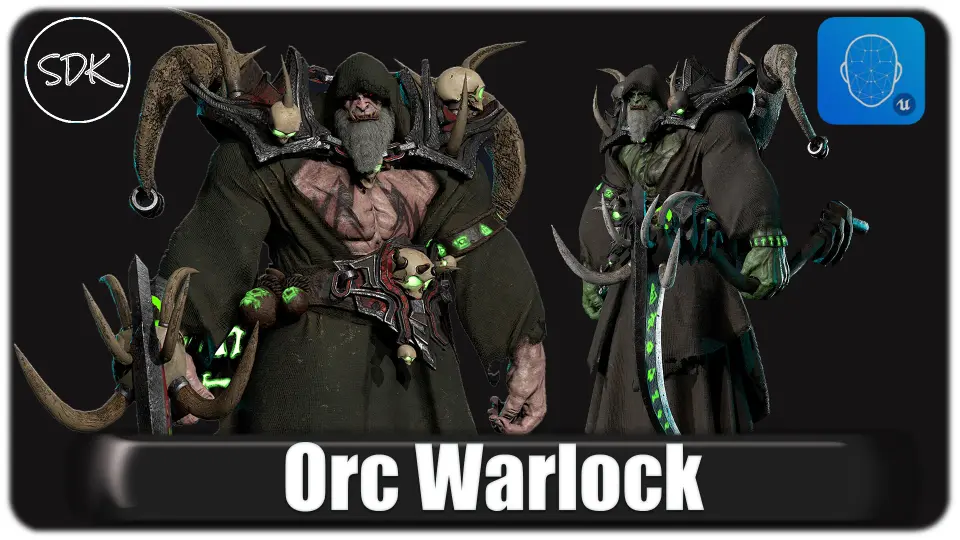
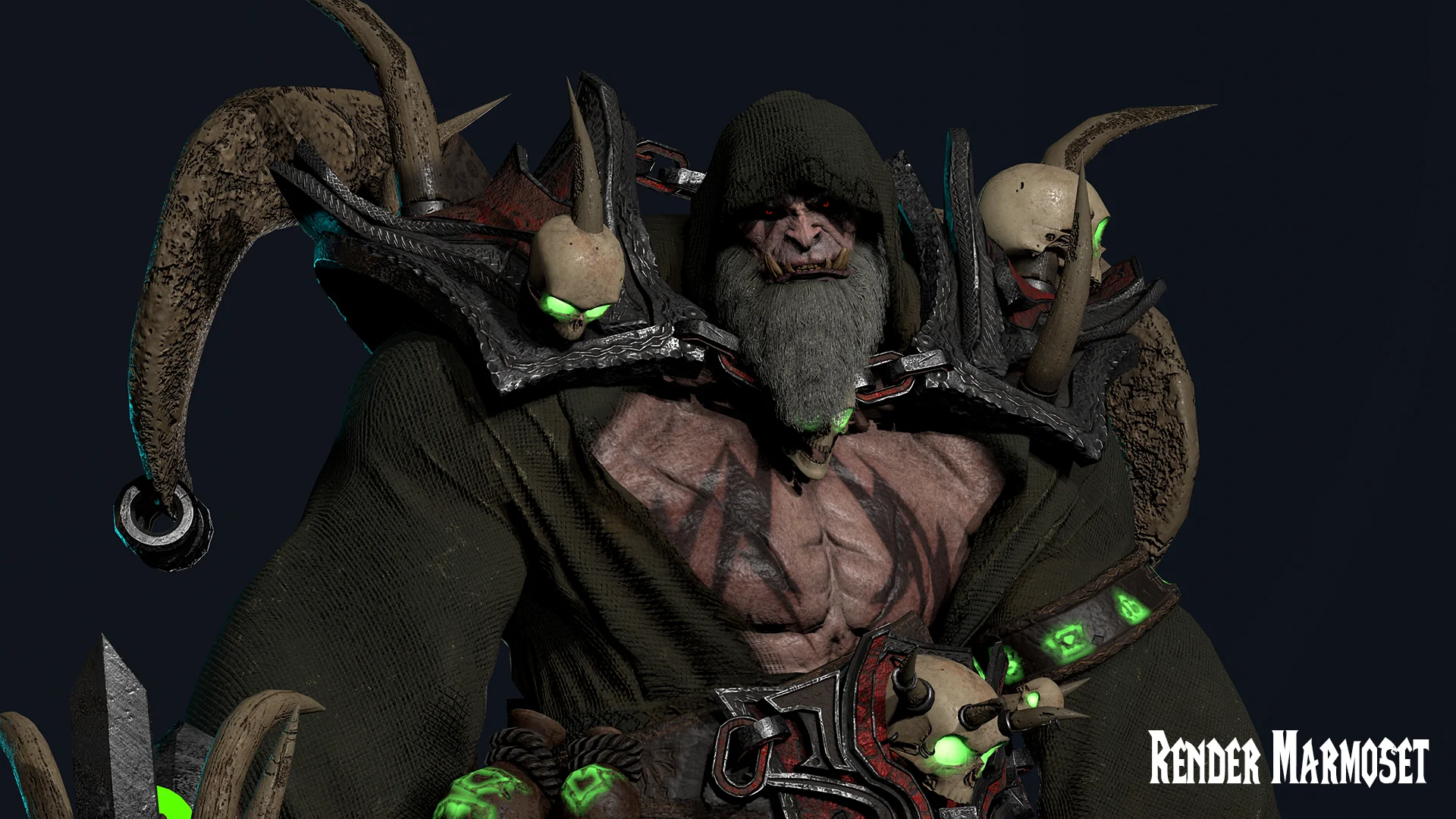
Grim fantasy dungeons, ritualistic altars, and treacherous battlegrounds call for adversaries that convey magical menace through heavy physical presence. A corrupt spellcaster commanding dark arcana requires visual indicators of both brutish power and sorcerous ritual. Projects staging brutal boss encounters, grim dark fantasy role-playing campaigns, or medieval monster hunts often struggle to balance hulking monstrous anatomy with the intricate ornaments worn by a witch or mage. The Orc Warlock addresses this intersection by combining the muscular, beast-like proportions of an ogre, troll, or berserker with the accoutrements of a death-attuned warlock wielding a scythe.
The character fits into diverse encounter roles. Set him up as a solitary dungeon boss summoning dark forces, an elite caster anchoring an offensive squad of goblins and orcs, or a specialized spellcasting champion in a tactical medieval battler. His scythe weapon and worn ritual gear signal melee lethality alongside magical prowess, making him an imposing presence when confronting players in close quarters or casting spells from ritual circles.
Modular Equipment Progression and Armor Stripping
A primary demand in modern role-playing and action games is visual character progression. The model is built with complete modularity, permitting developers to strip away or layer individual components depending on the context of an encounter. In progression-heavy titles, the warlock can start in a stripped-down form and gradually gain equipment as he levels up. You can toggle off garments, accessories, weapons, and hair to represent different stages of power or distinct combat roles.
This modular breakdown allows the base mesh to serve as a naked ritualist or basic cultist early on, later transforming into an elite horned and armored sorcerer adorned with heavy chains and bone trophies. Because each component—from cloth wraps to hanging talismans—can be attached or detached independently, a single asset can generate an entire cabal of varied orcish casters rather than a repeated clone army across different levels of a campaign.
Facial Morph Targets for Dialogue and Live Face Mockup
Beyond standard combat encounters, contemporary narrative titles demand expressive performance during spoken dialogue and story cinematics. The head mesh includes integrated morph targets and blendshapes specifically dedicated to facial expressions. These blendshapes allow the model to move smoothly from neutral sneers to expressive, ritualistic incantations or dialogue during cutscenes.
Technical workflows can harness these morph targets directly for real-time face mockup during live stream setups or drive them through conversation animation sequences in Unreal Engine. This level of expressive facial control elevates the monster from an anonymous obstacle into a primary antagonist capable of holding conversations, reacting to player choices, and casting spells with believable mouth and brow motion.
Orc Warlock Bone Hierarchy and Cloth Simulation Settings
To bring weight to the character's clothing and horrific talismans, the skeleton incorporates dedicated secondary bones made for secondary physics and chained ornaments. Rather than rigging all accessories to standard human joints, the rig features explicit nodes:
Belt_Skull and Belt_Skull1 for waist-bound trophies
Chain_Belt_Lt, Chain_Belt_Lt1, Chain_Belt_Up, Chain_Belt_Up1, Chain_Belt_Rt, and Chain_Belt_Rt1 for the heavy waist links
Skull and Skull1 for secondary bone relics
Chain_Spin_Lt, Chain_Spin_Lt1, Chain_Spin_Lt2, Chain_Spin_Rt, Chain_Spin_Rt1, and Chain_Spin_Rt2 for dynamic spinal linkages
These additional chains and skull bones allow items suspended from the back, spine, and waistline to swing naturally during heavy motion, combat swings, and animation blueprint transitions.
When utilizing cloth simulation in Unreal Engine 5, developers encountering performance hitches or stuttering brakes must adjust one specific parameter: reducing the Self Collision Thickness value inside the cloth simulation properties. While Unreal Engine 4 handles the cloth simulation profile without this friction, Unreal Engine 5's cloth solver requires lowering this thickness setting to eliminate simulation slowdowns while maintaining fluid movement on flowing robes and waist garments.
Texture Layering, Tattoos, and 4K Surface Shading
Visually, the character is mapped across nine separate texture sets: Body, Head, Hair, Eyes, Weapons, Cloth, and Accessories. Every set uses a PBR Metallic/Roughness workflow, authored in clean 4K resolution across normal, metallic, roughness, and albedo maps. This nine-fold division means fine skin folds, weapon edge wear, hair strands, and accessory carvings preserve high visual fidelity even in extreme close-up shots.
The master materials provide built-in controls for color adjustments across garments and surfaces, allowing quick visual distinctions between ranks. Both the body and head materials include integrated tattoo layers, adding tribal and demonic patterning across the skin. To accommodate modular layering and hide underlying geometry when heavy armor or robes are equipped, the body material also incorporates a transparency map, preventing mesh clipping without demanding complex manual mesh cutting.
Engine Performance, Polycounts, and Animation Reconfiguration
On the technical side, the base asset sits at LOD 0 with 38,759 faces, 41,427 vertices, and 78,457 triangles. This polygon density delivers sharp muscular definition, jagged bone silhouettes, and crisp cloth draping suitable for current-gen action and RPG pipelines. Reconfiguring animations is straightforward within Unreal Engine, working cleanly with Epic Skeleton animation pipelines and animation blueprints. Because the rig matches standard animation expectations, developers can readily repurpose walk cycles, spellcasting stances, and combat loops onto the warlock.
For productions building out broader tribal encampments, the asset directly complements companion archetypes from the Orcs, Ogres & Goblins collection, such as the Orc Fury, Orc Tank, and Orc Hunter. Together, these complementary models share design motifs and visual scales, letting teams populate entire dungeon raids with specialized warrior, berserker, defender, and caster units.
Practical Takeaways for Production Teams
Developers assembling third-person action games, tactical strategy titles, or story-driven dungeon crawlers gain an asset capable of serving as a field boss, dark sorcerer, or customizable protagonist. Its combination of modular equipment layers, full 4K PBR sets, facial blendshapes for live mockup, and dedicated chain bones provides the practical flexibility needed for dynamic combat and scripted cutscenes alike.
 Creatures
 Creatures
 Creatures
 Creatures