"7ad89cffa44984cf"{"id":"1002550","slug":"monster-creatures","title":"Monster Creatures","category":"Creatures \u0026 Monsters","engine":"4.26+,5.0+","assetVersion":"","engineVersion":"Engine Version: 4.26+,5.0+","tag":"Creatures","accent":"blue","visual":"character","summary":"Explore the Monster Creatures asset pack featuring five rigged, semi-cartoon stylized characters, complete material setups, and full animation sets.","platform":"Unreal Engine","indexPolicy":"index","publishedAt":"2026-11-13T10:02:12.711Z","updatedAt":"2026-11-13T10:02:12.711Z","sourceNotes":[],"fileContents":[],"compatibility":["Unreal Engine","Engine Version: 4.26+,5.0+"],"featuredImage":{"alt":"Monster Creatures","src":"/wp-content/uploads/published/2026/11/dd70c212b5f8-4b353ef9-d2b2-4937-9579-3d68118bb0f1-b415c84de0.webp"},"hasDownloadLink":true,"downloads":0,"terms":[{"taxonomy":"category","slug":"creatures-and-monsters","name":"Creatures \u0026 Monsters"}],"galleryImages":[{"src":"/wp-content/uploads/published/2026/11/43d4610d880a-bdae7a0e-1c5d-408f-8037-ea7c52782516-a370e73d67.webp","alt":"Monster Creatures"},{"src":"/wp-content/uploads/published/2026/11/863e2ca8fde9-95a8466a-85a4-4e3f-919f-496cb6c49e1f-567c56cbaa.webp","alt":"Monster Creatures"},{"src":"/wp-content/uploads/published/2026/11/2552689d22bc-62a4882c-f017-4616-beca-0dd52329bfc9-55188c7688.webp","alt":"Monster Creatures"},{"src":"/wp-content/uploads/published/2026/11/e1ed53386f55-9139ec62-a983-4c9f-b55f-77a8f1d94d9e-c41a866e6e.webp","alt":"Monster Creatures"},{"src":"/wp-content/uploads/published/2026/11/b631214c17ec-61bc067a-f42e-4f59-bbc1-fffe7a2f0549-6cffed9eb1.webp","alt":"Monster Creatures"},{"src":"/wp-content/uploads/published/2026/11/31d64cbb4360-ab7a1562-e03c-4806-8954-c4c7ef9db8db-a862052a70.webp","alt":"Monster Creatures"}],"accessPanel":{"kind":"resource","title":"Get this resource","eyebrow":"Free resource","message":"Download this resource in your browser.","fileName":"Content.7z","safetyNote":"Resources are manually reviewed before listing to improve quality and reduce obvious risks.","actionLabel":"Get this resource","resourceType":"Resource archive","versions":[]},"contentHtml":"\u003ch2\u003eSetting Up the Monster Creatures Framework\u003c/h2\u003e\u003cp\u003eIntegrating third-party characters into an active gameplay framework requires an understanding of skeletal structures, material constraints, and state transitions. The Monster Creatures package delivers five distinct stylized entities configured for stylized environments: a standard monster, a demon, a forest creature, a monster dog, and an alien. Every entity in the set is pre-rigged and paired with a comprehensive suite of animations crafted to match an expressive, semi-cartoon aesthetic.\u003c/p\u003e\u003cp\u003eDeploying these models begins with organizing the character meshes within your project hierarchy and routing their skeletal data into a dedicated animation blueprint pipeline. Because the pack carries an animation blueprint classification, the skeletons are built to integrate directly with state-driven locomotion and gameplay scripting. Setting up input graphs or artificial intelligence controllers involves linking character movement variables—such as velocity, ground status, and combat triggers—directly to the supplied animation clips.\u003c/p\u003e\u003ch2\u003eTexture Allocation and Single-Material Architecture\u003c/h2\u003e\u003cp\u003eRuntime performance in real-time rendering often hinges on draw call management and texture memory distribution. Monster Creatures addresses performance budgets by confining each of the five characters to a single-material configuration. Rather than splitting body parts, accessories, or appendages across fragmented shading networks, each creature references one unified material node.\u003c/p\u003e\u003cp\u003eEvery model utilizes a dedicated texture set consisting of three maps, uniformly mapped at a 1024x1024 resolution:\u003c/p\u003e\u003cul\u003e\u003cli\u003e\u003cstrong\u003eColor Map:\u003c/strong\u003e Defines the base diffuse tones, stylized surface accents, and distinct pigmentation appropriate for each character type.\u003c/li\u003e\u003cli\u003e\u003cstrong\u003eNormal Map:\u003c/strong\u003e Provides sculpted surface definition, conveying muscle groups, skin folds, and silhouette depth without raising polygon complexity.\u003c/li\u003e\u003cli\u003e\u003cstrong\u003eAmbient Occlusion Map:\u003c/strong\u003e Supplies deep contact shading within crevices, folds, and underbellies, anchoring the semi-cartoon models cleanly beneath runtime illumination.\u003c/li\u003e\u003c/ul\u003e\u003cp\u003eRestricting texture maps to a square 1024x1024 resolution allows multiple entities to occupy a scene simultaneously without exhausting memory bandwidth. For mid-range cameras, top-down tactical angles, or third-person action scenes, this resolution preserves sharp artistic intent while keeping texture streaming pools lightweight and predictable.\u003c/p\u003e\u003ch2\u003eLocomotion Sequences and State Machine Structuring\u003c/h2\u003e\u003cp\u003eThe movement data included across the roster covers basic exploration through complex maneuvers. Setting up the locomotion state machine involves separating base locomotion from erratic combat behavior.\u003c/p\u003e\u003cp\u003eIdling behavior relies on a foundational cycle supported by two secondary variations:\u003c/p\u003e\u003cul\u003e\u003cli\u003e\u003cstrong\u003eBase Idle:\u003c/strong\u003e A looping resting posture reflecting baseline alertness.\u003c/li\u003e\u003cli\u003e\u003cstrong\u003eRandom Idle 1 and 2:\u003c/strong\u003e Variant clips designed to break visual monotony during prolonged periods of inactivity, ideal for guard routines or ambient environmental encounters.\u003c/li\u003e\u003c/ul\u003e\u003cp\u003eFor horizontal locomotion, the collection includes standard forward running as well as running while turning. Incorporating a dedicated turn-run clip eliminates foot sliding and unnatural hip rotation when creatures execute tight directional pivots or follow dynamic navigation paths.\u003c/p\u003e\u003cp\u003eVertical mobility is handled through a three-phase jumping sequence:\u003c/p\u003e\u003cul\u003e\u003cli\u003e\u003cstrong\u003eJump Up:\u003c/strong\u003e The initial launch, capturing muscular anticipation and ground departure.\u003c/li\u003e\u003cli\u003e\u003cstrong\u003eFalling:\u003c/strong\u003e A looping airborne cycle maintained throughout the apex and downward trajectory.\u003c/li\u003e\u003cli\u003e\u003cstrong\u003eLand on Ground:\u003c/strong\u003e The deceleration, floor impact, and recovery blend that cleanly returns the creature to an idle or run state.\u003c/li\u003e\u003c/ul\u003e\u003cp\u003eDecoupling the jump into three separate segments provides gameplay programmers with precise timing hooks. Vertical impulse calculations, ground-distance traces, and fall velocity variables can independently govern each clip for responsive controls.\u003c/p\u003e\u003ch2\u003eCombat States, Damage Feedback, and Monster Actions\u003c/h2\u003e\u003cp\u003eThe combat animation library supplies a versatile set of offensive and defensive movements suited for encounter design. Each creature features three unique attack animations, giving designers the flexibility to build combo sequences, alternate light and heavy strikes, or randomize offensive strikes to keep player encounters unpredictable.\u003c/p\u003e\u003cp\u003eTaking damage is represented by two independent hit reaction clips. Having dual take-damage animations allows state machines to cycle reactions based on attack direction, impact severity, or damage thresholds, preventing the visual repetition that occurs when a single hit animation plays repeatedly during rapid combat sequences.\u003c/p\u003e\u003cp\u003eEvasive maneuvering is supported through a dedicated roll animation. This motion functions effectively for defensive dodges, evasive repositions, or sudden repositioning behaviors within custom artificial intelligence routines. When a creature is incapacitated, the dying and getting up animations form a complete knock-down and recovery cycle. These clips enable temporary stagger-and-stand loops as well as permanent defeat states.\u003c/p\u003e\u003cp\u003eEncounter initiation is reinforced by a roar or taunt animation. Within an active gameplay loop, this motion serves as a clear visual and timing telegraph, warning players of an impending engagement, alerting nearby AI allies, or triggering a boss phase transition.\u003c/p\u003e\u003ch2\u003eEcosystem Cohesion with Animal Friends: Forest Pack\u003c/h2\u003e\u003cp\u003eStylistic alignment across varied environment assets is critical for visual harmony. Monster Creatures maintains structural and artistic compatibility with the Animal Friends: Forest Pack. This shared baseline allows developers to deploy both peaceful wildlife and aggressive fantasy entities within the same environmental biome without visual clash.\u003c/p\u003e\u003cp\u003eWhether populating an alien biosphere, a cursed wilderness, or a subterranean dungeon, the semi-cartoon art direction unifies diverse themes under a coherent design language. With the alien, demon, forest creature, monster dog, and core monster operating on identical material conventions and complementary animation profiles, assembling encounter rosters across your game's levels remains streamlined and technically cohesive.\u003c/p\u003e\n\n\u003ch2\u003eMore From The Same Workflow\u003c/h2\u003e\n\u003cul\u003e\n\u003cli\u003e\u003ca href=\"https://3dcghub.com/dragon-for-boss-monster-pbr/\" rel=\"noopener noreferrer\"\u003eDragon for Boss Monster : PBR\u003c/a\u003e\u003c/li\u003e\n\u003cli\u003e\u003ca href=\"https://3dcghub.com/demonkiller/\" rel=\"noopener noreferrer\"\u003eDemonKiller\u003c/a\u003e\u003c/li\u003e\n\u003cli\u003e\u003ca href=\"https://3dcghub.com/orc-warlock-modular/\" rel=\"noopener noreferrer\"\u003eOrc Warlock (Modular)\u003c/a\u003e\u003c/li\u003e\n\u003cli\u003e\u003ca href=\"https://3dcghub.com/ocean-monster-fish-pack-part-1-fish-low-poly-model-0/\" rel=\"noopener noreferrer\"\u003eOcean Monster Fish Pack - Part 1 - Fish low poly model - #0\u003c/a\u003e\u003c/li\u003e\n\u003cli\u003e\u003ca href=\"https://3dcghub.com/orc-collection/\" rel=\"noopener noreferrer\"\u003eOrc Collection\u003c/a\u003e\u003c/li\u003e\n\u003c/ul\u003e","contentTextLength":6329,"navigation":{"current":27,"total":4499,"previous":{"id":"1002551","slug":"mushroom-monster-pack-pbr","title":"Mushroom Monster Pack PBR","category":"Characters \u0026 Creatures","platform":"Unreal Engine","updatedAt":"2026-11-13T10:04:14.578Z"},"next":{"id":"1002549","slug":"modular-survival-hero","title":"Modular Survival Hero","category":"Characters \u0026 Creatures","platform":"Unreal Engine","updatedAt":"2026-11-13T10:01:07.524Z"}},"relatedResources":[{"id":"1002522","slug":"dragon-for-boss-monster-pbr","title":"Dragon for Boss Monster : PBR","category":"Creatures \u0026 Monsters","engine":"4.26+,5.0+","assetVersion":"","engineVersion":"Engine Version: 4.26+,5.0+","tag":"Creatures","accent":"blue","visual":"character","summary":"Examine the technical specs of Dragon for Boss Monster: PBR, featuring 4 dragon variants under 5k tris, 2048x2048 PBR textures, and 18 animations.","platform":"Unreal Engine","indexPolicy":"index","publishedAt":"2026-11-13T09:07:10.432Z","updatedAt":"2026-11-13T09:07:10.432Z","sourceNotes":[],"fileContents":[],"compatibility":["Unreal Engine","Engine Version: 4.26+,5.0+"],"featuredImage":{"alt":"Dragon for Boss Monster : PBR","src":"/wp-content/uploads/published/2026/11/0361dfebe345-7f290548-664d-40c4-b1b8-1be5aac3991b-b6a71c6843.webp"},"hasDownloadLink":true,"downloads":0},{"id":"1002521","slug":"demonkiller","title":"DemonKiller","category":"Creatures \u0026 Monsters","engine":"4.20+,5.0+","assetVersion":"","engineVersion":"Engine Version: 4.20+,5.0+","tag":"Creatures","accent":"blue","visual":"character","summary":"Explore the DemonKiller low poly character, featuring 19 combat and locomotion animations, 2K to 4K PBR textures, and Animation Blueprint integration.","platform":"Unreal Engine","indexPolicy":"index","publishedAt":"2026-11-13T09:06:10.171Z","updatedAt":"2026-11-13T09:06:10.171Z","sourceNotes":[],"fileContents":[],"compatibility":["Unreal Engine","Engine Version: 4.20+,5.0+"],"featuredImage":{"alt":"DemonKiller","src":"/wp-content/uploads/published/2026/11/4f579b823a5c-5db47bb3-a4c9-4652-918b-d088558c3e1c-a20895aba7.webp"},"hasDownloadLink":true,"downloads":0},{"id":"1002410","slug":"orc-warlock-modular","title":"Orc Warlock (Modular)","category":"Creatures \u0026 Monsters","engine":"4.18+,5.0+","assetVersion":"","engineVersion":"Engine Version: 4.18+,5.0+","tag":"Creatures","accent":"blue","visual":"character","summary":"Modular Orc Warlock 3D character featuring 4K PBR textures, 9 texture sets, facial blendshapes, dynamic bones, and cloth simulation settings.","platform":"Unreal Engine","indexPolicy":"index","publishedAt":"2026-11-10T12:07:32.680Z","updatedAt":"2026-11-10T12:07:32.680Z","sourceNotes":[],"fileContents":[],"compatibility":["Unreal Engine","Engine Version: 4.18+,5.0+"],"featuredImage":{"alt":"Orc Warlock (Modular)","src":"/wp-content/uploads/published/2026/11/ab393dc06201-809dce1d-d4c7-40a4-8ce3-bd687327bc09-5c75a6b4b4.webp"},"hasDownloadLink":true,"downloads":0}]}
Creatures
Monster Creatures
Explore the Monster Creatures asset pack featuring five rigged, semi-cartoon stylized characters, complete material setups, and full animation sets.
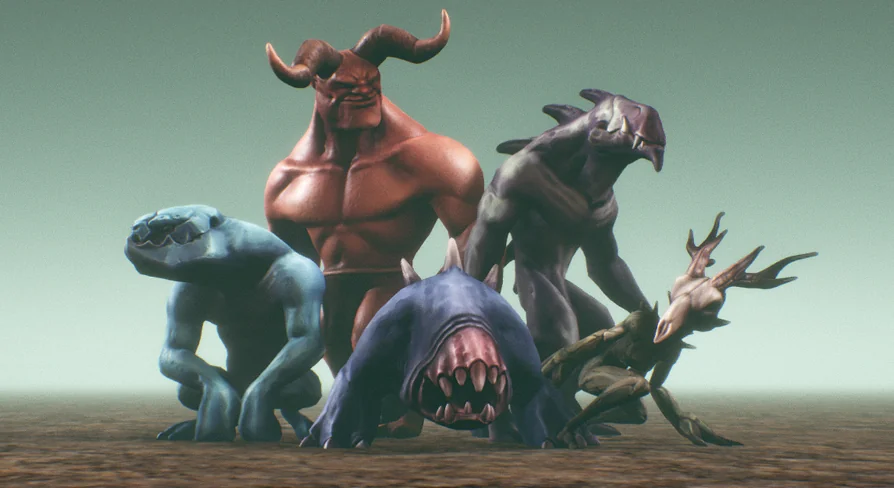
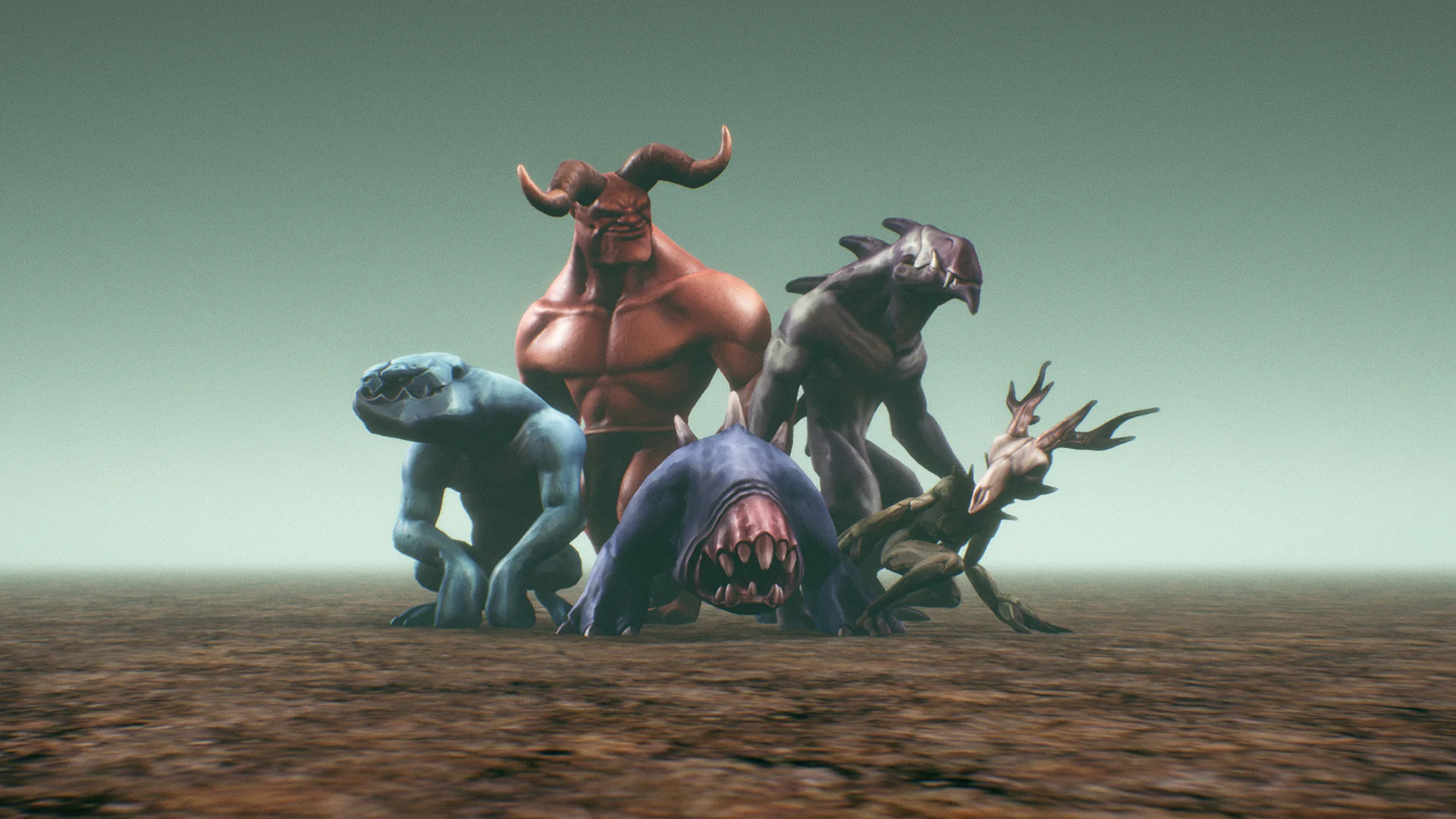
Integrating third-party characters into an active gameplay framework requires an understanding of skeletal structures, material constraints, and state transitions. The Monster Creatures package delivers five distinct stylized entities configured for stylized environments: a standard monster, a demon, a forest creature, a monster dog, and an alien. Every entity in the set is pre-rigged and paired with a comprehensive suite of animations crafted to match an expressive, semi-cartoon aesthetic.
Deploying these models begins with organizing the character meshes within your project hierarchy and routing their skeletal data into a dedicated animation blueprint pipeline. Because the pack carries an animation blueprint classification, the skeletons are built to integrate directly with state-driven locomotion and gameplay scripting. Setting up input graphs or artificial intelligence controllers involves linking character movement variables—such as velocity, ground status, and combat triggers—directly to the supplied animation clips.
Texture Allocation and Single-Material Architecture
Runtime performance in real-time rendering often hinges on draw call management and texture memory distribution. Monster Creatures addresses performance budgets by confining each of the five characters to a single-material configuration. Rather than splitting body parts, accessories, or appendages across fragmented shading networks, each creature references one unified material node.
Every model utilizes a dedicated texture set consisting of three maps, uniformly mapped at a 1024x1024 resolution:
Color Map: Defines the base diffuse tones, stylized surface accents, and distinct pigmentation appropriate for each character type.
Normal Map: Provides sculpted surface definition, conveying muscle groups, skin folds, and silhouette depth without raising polygon complexity.
Ambient Occlusion Map: Supplies deep contact shading within crevices, folds, and underbellies, anchoring the semi-cartoon models cleanly beneath runtime illumination.
Restricting texture maps to a square 1024x1024 resolution allows multiple entities to occupy a scene simultaneously without exhausting memory bandwidth. For mid-range cameras, top-down tactical angles, or third-person action scenes, this resolution preserves sharp artistic intent while keeping texture streaming pools lightweight and predictable.
Locomotion Sequences and State Machine Structuring
The movement data included across the roster covers basic exploration through complex maneuvers. Setting up the locomotion state machine involves separating base locomotion from erratic combat behavior.
Idling behavior relies on a foundational cycle supported by two secondary variations:
Base Idle: A looping resting posture reflecting baseline alertness.
Random Idle 1 and 2: Variant clips designed to break visual monotony during prolonged periods of inactivity, ideal for guard routines or ambient environmental encounters.
For horizontal locomotion, the collection includes standard forward running as well as running while turning. Incorporating a dedicated turn-run clip eliminates foot sliding and unnatural hip rotation when creatures execute tight directional pivots or follow dynamic navigation paths.
Vertical mobility is handled through a three-phase jumping sequence:
Jump Up: The initial launch, capturing muscular anticipation and ground departure.
Falling: A looping airborne cycle maintained throughout the apex and downward trajectory.
Land on Ground: The deceleration, floor impact, and recovery blend that cleanly returns the creature to an idle or run state.
Decoupling the jump into three separate segments provides gameplay programmers with precise timing hooks. Vertical impulse calculations, ground-distance traces, and fall velocity variables can independently govern each clip for responsive controls.
Combat States, Damage Feedback, and Monster Actions
The combat animation library supplies a versatile set of offensive and defensive movements suited for encounter design. Each creature features three unique attack animations, giving designers the flexibility to build combo sequences, alternate light and heavy strikes, or randomize offensive strikes to keep player encounters unpredictable.
Taking damage is represented by two independent hit reaction clips. Having dual take-damage animations allows state machines to cycle reactions based on attack direction, impact severity, or damage thresholds, preventing the visual repetition that occurs when a single hit animation plays repeatedly during rapid combat sequences.
Evasive maneuvering is supported through a dedicated roll animation. This motion functions effectively for defensive dodges, evasive repositions, or sudden repositioning behaviors within custom artificial intelligence routines. When a creature is incapacitated, the dying and getting up animations form a complete knock-down and recovery cycle. These clips enable temporary stagger-and-stand loops as well as permanent defeat states.
Encounter initiation is reinforced by a roar or taunt animation. Within an active gameplay loop, this motion serves as a clear visual and timing telegraph, warning players of an impending engagement, alerting nearby AI allies, or triggering a boss phase transition.
Ecosystem Cohesion with Animal Friends: Forest Pack
Stylistic alignment across varied environment assets is critical for visual harmony. Monster Creatures maintains structural and artistic compatibility with the Animal Friends: Forest Pack. This shared baseline allows developers to deploy both peaceful wildlife and aggressive fantasy entities within the same environmental biome without visual clash.
Whether populating an alien biosphere, a cursed wilderness, or a subterranean dungeon, the semi-cartoon art direction unifies diverse themes under a coherent design language. With the alien, demon, forest creature, monster dog, and core monster operating on identical material conventions and complementary animation profiles, assembling encounter rosters across your game's levels remains streamlined and technically cohesive.
 Creatures
 Creatures
 Creatures
 Creatures