"1062d43bc714d570"{"id":"1001004","slug":"next-gen-destruction-toolkit","title":"Next Gen Destruction Toolkit","category":"Gameplay Features","engine":"5.3+","assetVersion":"","engineVersion":"Engine Version: 5.3+","tag":"Gameplay Features","accent":"blue","visual":"mech","summary":"A UE5 Chaos Destruction framework using data assets, surface-driven VFX and sound, with 15 Blueprints and 14 Niagara systems. Built for Nanite/Lumen.","platform":"Unreal Engine","publishedAt":"2026-08-22T10:54:47.045Z","updatedAt":"2026-08-22T10:54:47.045Z","sourceNotes":[],"fileContents":[],"compatibility":["Unreal Engine","Engine Version: 5.3+"],"featuredImage":{"alt":"Next Gen Destruction Toolkit","src":"/wp-content/uploads/published/2026/08/ae98b282cc03-ed3bc7a2-1533-4764-9cea-bf9d64a790d8-8eb923473f.webp"},"hasDownloadLink":true,"downloads":5,"terms":[{"taxonomy":"category","slug":"gameplay-features","name":"Gameplay Features"}],"galleryImages":[{"src":"/wp-content/uploads/published/2026/08/6571326c2fcb-2445239b-cafb-4c46-85e4-50e1d32d6727-9fb5bd6e5a.webp","alt":"Next Gen Destruction Toolkit"},{"src":"/wp-content/uploads/published/2026/08/3b03510bd89c-7c14887b-338e-4535-b762-e536be896d65-9e50749b7c.webp","alt":"Next Gen Destruction Toolkit"},{"src":"/wp-content/uploads/published/2026/08/b3506a755bf0-f9a36bc5-e1c6-48e5-a96b-894be6289a0b-cd62d4bb4f.webp","alt":"Next Gen Destruction Toolkit"},{"src":"/wp-content/uploads/published/2026/08/eb1eb01af940-858e044b-8540-4d85-8546-7487b720f34a-7fa6bdf384.webp","alt":"Next Gen Destruction Toolkit"},{"src":"/wp-content/uploads/published/2026/08/223af15ad7e5-6efbf06e-a505-4f34-8d2d-05d862a6657e-cc30f6cd02.webp","alt":"Next Gen Destruction Toolkit"},{"src":"/wp-content/uploads/published/2026/08/2c6cffd6e0cc-2fa3ebe1-1617-4f86-8746-742e822b9f2b-a9b1953b72.webp","alt":"Next Gen Destruction Toolkit"},{"src":"/wp-content/uploads/published/2026/08/2109bb702015-f16a87e0-3c9f-4a19-91ac-f26d9ae34fea-848296d35b.webp","alt":"Next Gen Destruction Toolkit"},{"src":"/wp-content/uploads/published/2026/08/96d4dc7c71da-8547383c-764a-43ee-94ea-8d73b9da2e70-39cb8b1957.webp","alt":"Next Gen Destruction Toolkit"},{"src":"/wp-content/uploads/published/2026/08/a023f0cc13f4-71e8d486-addc-4446-ac40-c1698286f00f-28ee7bc0e6.webp","alt":"Next Gen Destruction Toolkit"},{"src":"/wp-content/uploads/published/2026/08/98731b54b677-ada955cf-0c35-4526-88c6-24954aa4ce0a-f4bfc09ec6.webp","alt":"Next Gen Destruction Toolkit"}],"accessPanel":{"kind":"resource","title":"Download this resource","eyebrow":"Free Download","message":"Log in or create a free account to start your download.","fileName":"Next Gen Destruction Toolkit.7z","safetyNote":"Resources are manually reviewed before listing to improve quality and reduce obvious risks.","actionLabel":"Download Free","resourceType":"Resource archive"},"contentHtml":"\u003cp\u003eA bullet hits a coffee table. The geometry cracks, pieces trail off, and a burst of particles appears at the impact point. The sound that follows matches the material, not just a generic crack. That is the kind of reaction the Next Gen Destruction Toolkit is built to produce: destructive events that feel as though they were authored specifically for the object, when in fact they are driven by a reusable data asset.\u003c/p\u003e \u003ch2\u003eA Bullet Impact Only Needs One Definition\u003c/h2\u003e\n\u003cp\u003eThe toolkit is a simple-to-use framework for integrating Chaos Destruction into a UE5 project. Instead of wiring a custom Blueprint for every breakable prop, a designer defines a destructible as a data asset. That asset carries the self-contained responses to bullet impacts, breaking, trailing, and the events that happen after the object gives way. The promise is straightforward: create a destructible quickly, then populate its behaviors with realistic breaking behavior, particle effects, and sounds without rebuilding the logic each time.\u003c/p\u003e \u003cp\u003eThe data asset-driven workflow is specifically there to cut setup time. New destructible assets can be created in minutes, which matters for scenes where a lot of objects need to be breakable. Teams do not have to treat every destruction sequence as a custom script. They define the behavior once, reuse it across props, and adjust individual pieces only when needed.\u003c/p\u003e \u003ch2\u003eSurface-Type Driven Effects Keep the Physics Honest\u003c/h2\u003e\n\u003cp\u003eA physical material determines the on-hit particle VFX and sound. That means the same framework can handle different surface types differently, because the response follows the material, not a hand-placed event. The Chaos Data Interface in Niagara handles the particle side, triggering effects from breaking and trailing events. This is the layer that gives the toolkit its consistency: every material class can carry its own visual and audio identity.\u003c/p\u003e \u003cp\u003ePart of the example content is drawn from CC0 sources. The coffee table and rifle come from 3DModelsCC0, sound effects come from Freesound and OpenGameArt, and the Abandoned Slipway HDRI comes from Poly Haven. These are the building blocks used for demonstration, but the system itself is material-driven, so replacing them with original assets preserves the behavior.\u003c/p\u003e \u003ch2\u003eWhat You Get: 15 Blueprints, 14 Geometry Collections, 14 Niagara Systems\u003c/h2\u003e\n\u003cp\u003eThe package contains 15 Blueprints, 14 Geometry Collections, and 14 Niagara Systems. On top of that are the numerous example assets included for prototyping and reference. The Geometry Collections provide the breakable meshes; the Niagara Systems provide the burst, trail, and impact effects; the Blueprints tie them to interactive events. The high-fidelity models and FX are designed with Nanite and Lumen in mind, which is important for teams that want destruction to hold up under close camera scrutiny.\u003c/p\u003e \u003cp\u003eInput is keyboard and mouse, network replication is not included, and the supported development platform is Windows. This points toward single-player or locally driven destruction scenes rather than a replicated multiplayer setup. A trailer, tutorial playlist, documentation, a support Discord channel, a Twitter feed, and a playable build are all part of the release, giving new users a way to see the framework in motion before wiring it into their own project.\u003c/p\u003e \u003ch2\u003eNanite, Lumen, and the Version Note Worth Reading\u003c/h2\u003e\n\u003cp\u003eThe toolkit is based on the graphics features introduced in UE5: Nanite, Lumen, and VSM. That gives it a specific look: dense geometry, dynamic lighting, and shadowing that reacts to breaking geometry. It also means hardware planning matters. There is a 'performance consideration' map in the project that walks through optimization for lower-end hardware, but the majority of assets are designed with Nanite in mind.\u003c/p\u003e \u003cp\u003eUE 5.3 users need to pay attention to one version-specific problem. The asset notes recommend updating to UE 5.3.1 or above, because an earlier 5.3 build can crash on startup due to a bug fixed in 5.3.1. For teams that cannot update, the alternate fix is disabling Nanite in the DefaultEngine ini with 'r.Nanite.ProjectEnabled=False', but that comes with a performance impact. So the safe path is to update the engine before integrating the toolkit.\u003c/p\u003e \u003ch2\u003eWhere the Toolkit Makes Sense in a Project\u003c/h2\u003e\n\u003cp\u003eGiven the example content, the toolkit fits projects where a player or actor fires a weapon at props and expects a physical response. Coffee tables, rifles, and indoor props are the sort of objects that get shot, knocked over, or blown apart in first-person games and interactive scenes. The Abandoned Slipway HDRI from Poly Haven points toward a demonstration environment more than a game level, but it suggests the team was building showcase scenes rather than production maps.\u003c/p\u003e \u003cp\u003eBecause the destructibles are data asset-driven, level designers and technical artists can set up new breakable actors quickly. They can assign a physical material, pick the relevant VFX and sounds, and let the existing Blueprints and Geometry Collections handle the rest. For projects that need realistic breaking behavior on bullet impacts, and for teams that want to avoid hand-tweaking each object, this reduces a lot of the repetitive work.\u003c/p\u003e \u003cp\u003eThe strongest case for the Next Gen Destruction Toolkit is speed: the data asset layer compresses the usual Chaos Destruction setup into something a designer can iterate on without diving into the Blueprint graph every time. The included Nanite/Lumen-friendly assets show what the system can do, and the performance notes make the hardware requirements clear. Teams on Windows working in UE5 that need breakables with convincing impact, trailing, and material response will find a framework that already has the heavy parts wired.\u003c/p\u003e\n\n\u003ch2\u003eMore From The Same Workflow\u003c/h2\u003e\n\u003cul\u003e\n\u003cli\u003e\u003ca href=\"https://3dcghub.com/dot-matrix-shader-pack/\" title=\"Dot Matrix Shader Pack\"\u003eDot Matrix Shader Pack\u003c/a\u003e\u003c/li\u003e\n\u003cli\u003e\u003ca href=\"https://3dcghub.com/path-tracer-toolkit/\" title=\"Path Tracer Toolkit\"\u003ePath Tracer Toolkit\u003c/a\u003e\u003c/li\u003e\n\u003cli\u003e\u003ca href=\"https://3dcghub.com/sci-fi-screen-constructor/\" title=\"Sci-Fi Screen Constructor\"\u003eSci-Fi Screen Constructor\u003c/a\u003e\u003c/li\u003e\n\u003cli\u003e\u003ca href=\"https://3dcghub.com/modular-gameplay-blueprint-systems/\" title=\"Modular Gameplay Blueprint Systems\"\u003eModular Gameplay Blueprint Systems\u003c/a\u003e\u003c/li\u003e\n\u003cli\u003e\u003ca href=\"https://3dcghub.com/the-flashlight-toolkit/\" title=\"The Flashlight Toolkit\"\u003eThe Flashlight Toolkit\u003c/a\u003e\u003c/li\u003e\n\u003c/ul\u003e","contentTextLength":5864,"navigation":{"current":493,"total":3379,"previous":{"id":"1001005","slug":"orc-warrior","title":"Orc Warrior","category":"Creatures \u0026 Monsters","platform":"Unreal Engine","updatedAt":"2026-08-22T10:59:41.214Z"},"next":{"id":"1001003","slug":"nanite-foliage-v2","title":"Nanite Foliage V2","category":"Nature \u0026 Plants","platform":"Unreal Engine","updatedAt":"2026-08-21T15:56:24.205Z"}},"relatedResources":[{"id":"10738","slug":"dot-matrix-shader-pack","title":"Dot Matrix Shader Pack","category":"Gameplay Features","engine":"5.0+","assetVersion":"Engine version: 5.0+","engineVersion":"5.0","tag":"Gameplay Features","accent":"blue","visual":"animation","summary":"Create authentic digital displays with the Dot Matrix Shader Pack. This toolkit includes blueprints, materials, and textures for building unique LED matrix designs and retro-style screens.","platform":"Unreal Engine","publishedAt":"2026-03-03T16:04:32.000Z","updatedAt":"2026-04-19T15:49:56.000Z","sourceNotes":[],"fileContents":[],"compatibility":["Unreal Engine","Engine version: 5.0+"],"featuredImage":{"alt":"Dot Matrix Shader Pack","src":"https://3dcghub.com/wp-content/uploads/2026/03/c4066241-a2cd-49d7-9f19-646a1ec883f5.webp"},"hasDownloadLink":true,"downloads":0},{"id":"11043","slug":"path-tracer-toolkit","title":"Path Tracer Toolkit","category":"Gameplay Features","engine":"4.27,5.0+","assetVersion":"Engine version: 4.27,5.0+","engineVersion":"4.27","tag":"Gameplay Features","accent":"blue","visual":"city","summary":"The Path Tracer Toolkit provides a comprehensive Blueprint solution for generating paths and borders manually or via runtime point arrays. It includes advanced customization, procedural materials, and performance-optimizing texture baking.","platform":"Unreal Engine","publishedAt":"2026-03-03T16:47:08.000Z","updatedAt":"2026-04-19T15:49:51.000Z","sourceNotes":[],"fileContents":[],"compatibility":["Unreal Engine","Engine version: 4.27,5.0+"],"featuredImage":{"alt":"Path Tracer Toolkit","src":"https://3dcghub.com/wp-content/uploads/2026/03/fd42f630-b95d-4396-bf4a-af676428ed24.webp"},"hasDownloadLink":true,"downloads":1},{"id":"11094","slug":"sci-fi-screen-constructor","title":"Sci-Fi Screen Constructor","category":"Gameplay Features","engine":"4.26+,5.0+","assetVersion":"Engine version: 4.26+,5.0+","engineVersion":"4.18","tag":"Gameplay Features","accent":"blue","visual":"animation","summary":"Enhance your digital environments with the Sci-Fi Screen Constructor. This toolkit provides customizable materials and scripts to build realistic futuristic monitors and displays.","platform":"Unreal Engine","publishedAt":"2026-03-03T16:55:36.000Z","updatedAt":"2026-04-19T15:49:50.000Z","sourceNotes":[],"fileContents":[],"compatibility":["Unreal Engine","Engine version: 4.26+,5.0+"],"featuredImage":{"alt":"Sci-Fi Screen Constructor","src":"https://3dcghub.com/wp-content/uploads/2026/03/1397736e-47c2-4162-895b-1e21f8b38e6b.webp"},"hasDownloadLink":true,"downloads":0}]}
Gameplay Features
Next Gen Destruction Toolkit
A UE5 Chaos Destruction framework using data assets, surface-driven VFX and sound, with 15 Blueprints and 14 Niagara systems. Built for Nanite/Lumen.
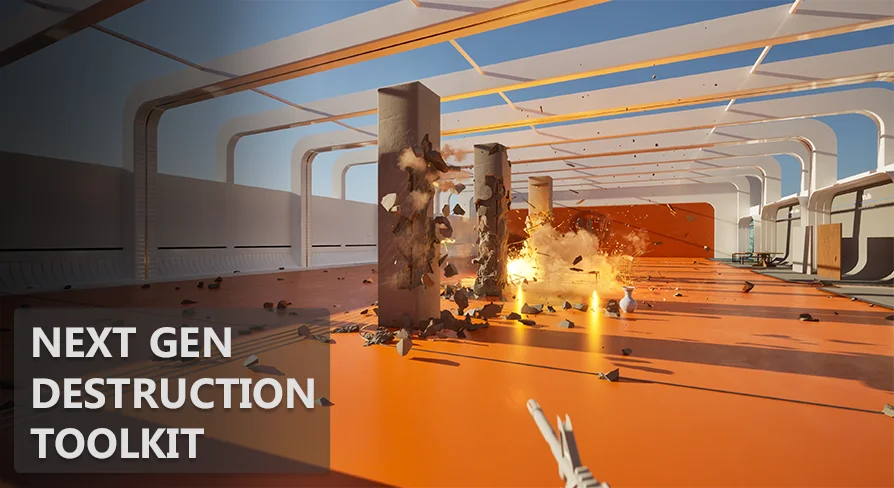
A bullet hits a coffee table. The geometry cracks, pieces trail off, and a burst of particles appears at the impact point. The sound that follows matches the material, not just a generic crack. That is the kind of reaction the Next Gen Destruction Toolkit is built to produce: destructive events that feel as though they were authored specifically for the object, when in fact they are driven by a reusable data asset.
A Bullet Impact Only Needs One Definition
The toolkit is a simple-to-use framework for integrating Chaos Destruction into a UE5 project. Instead of wiring a custom Blueprint for every breakable prop, a designer defines a destructible as a data asset. That asset carries the self-contained responses to bullet impacts, breaking, trailing, and the events that happen after the object gives way. The promise is straightforward: create a destructible quickly, then populate its behaviors with realistic breaking behavior, particle effects, and sounds without rebuilding the logic each time.
The data asset-driven workflow is specifically there to cut setup time. New destructible assets can be created in minutes, which matters for scenes where a lot of objects need to be breakable. Teams do not have to treat every destruction sequence as a custom script. They define the behavior once, reuse it across props, and adjust individual pieces only when needed.
Surface-Type Driven Effects Keep the Physics Honest
A physical material determines the on-hit particle VFX and sound. That means the same framework can handle different surface types differently, because the response follows the material, not a hand-placed event. The Chaos Data Interface in Niagara handles the particle side, triggering effects from breaking and trailing events. This is the layer that gives the toolkit its consistency: every material class can carry its own visual and audio identity.
Part of the example content is drawn from CC0 sources. The coffee table and rifle come from 3DModelsCC0, sound effects come from Freesound and OpenGameArt, and the Abandoned Slipway HDRI comes from Poly Haven. These are the building blocks used for demonstration, but the system itself is material-driven, so replacing them with original assets preserves the behavior.
What You Get: 15 Blueprints, 14 Geometry Collections, 14 Niagara Systems
The package contains 15 Blueprints, 14 Geometry Collections, and 14 Niagara Systems. On top of that are the numerous example assets included for prototyping and reference. The Geometry Collections provide the breakable meshes; the Niagara Systems provide the burst, trail, and impact effects; the Blueprints tie them to interactive events. The high-fidelity models and FX are designed with Nanite and Lumen in mind, which is important for teams that want destruction to hold up under close camera scrutiny.
Input is keyboard and mouse, network replication is not included, and the supported development platform is Windows. This points toward single-player or locally driven destruction scenes rather than a replicated multiplayer setup. A trailer, tutorial playlist, documentation, a support Discord channel, a Twitter feed, and a playable build are all part of the release, giving new users a way to see the framework in motion before wiring it into their own project.
Nanite, Lumen, and the Version Note Worth Reading
The toolkit is based on the graphics features introduced in UE5: Nanite, Lumen, and VSM. That gives it a specific look: dense geometry, dynamic lighting, and shadowing that reacts to breaking geometry. It also means hardware planning matters. There is a 'performance consideration' map in the project that walks through optimization for lower-end hardware, but the majority of assets are designed with Nanite in mind.
UE 5.3 users need to pay attention to one version-specific problem. The asset notes recommend updating to UE 5.3.1 or above, because an earlier 5.3 build can crash on startup due to a bug fixed in 5.3.1. For teams that cannot update, the alternate fix is disabling Nanite in the DefaultEngine ini with 'r.Nanite.ProjectEnabled=False', but that comes with a performance impact. So the safe path is to update the engine before integrating the toolkit.
Where the Toolkit Makes Sense in a Project
Given the example content, the toolkit fits projects where a player or actor fires a weapon at props and expects a physical response. Coffee tables, rifles, and indoor props are the sort of objects that get shot, knocked over, or blown apart in first-person games and interactive scenes. The Abandoned Slipway HDRI from Poly Haven points toward a demonstration environment more than a game level, but it suggests the team was building showcase scenes rather than production maps.
Because the destructibles are data asset-driven, level designers and technical artists can set up new breakable actors quickly. They can assign a physical material, pick the relevant VFX and sounds, and let the existing Blueprints and Geometry Collections handle the rest. For projects that need realistic breaking behavior on bullet impacts, and for teams that want to avoid hand-tweaking each object, this reduces a lot of the repetitive work.
The strongest case for the Next Gen Destruction Toolkit is speed: the data asset layer compresses the usual Chaos Destruction setup into something a designer can iterate on without diving into the Blueprint graph every time. The included Nanite/Lumen-friendly assets show what the system can do, and the performance notes make the hardware requirements clear. Teams on Windows working in UE5 that need breakables with convincing impact, trailing, and material response will find a framework that already has the heavy parts wired.
 Gameplay Features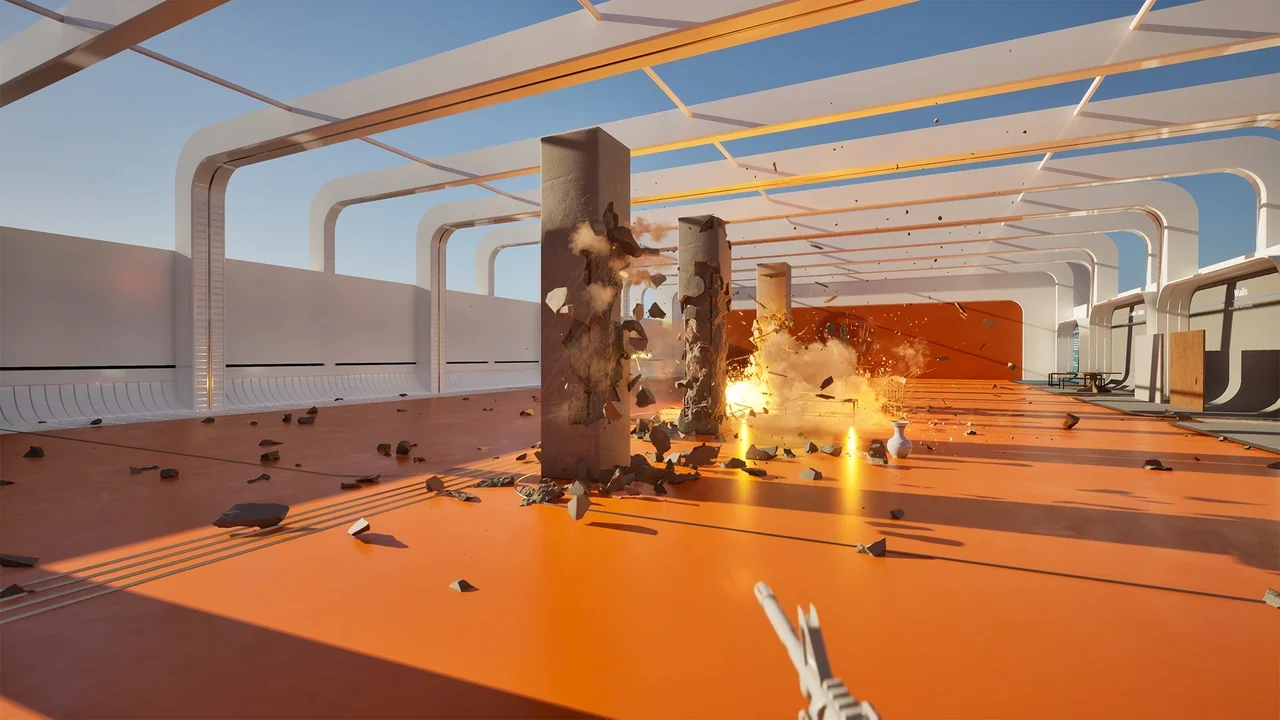
 Gameplay Features
 Gameplay Features
 Gameplay Features