"a19e0535960bd083"{"id":"1001995","slug":"daforma-vertex-shader-based-3d-deformation-effectors","title":"daforma - Vertex Shader based 3D Deformation Effectors","category":"Gameplay Features","engine":"5.0+","assetVersion":"","engineVersion":"Engine Version: 5.0+","tag":"Gameplay Features","accent":"blue","visual":"mech","summary":"Explore daforma, an interactive vertex shader deformation toolkit using Advanced BP Effect actors and HISM grids for real-time ripple, warp, and Lumen effects.","platform":"Unreal Engine","publishedAt":"2026-10-26T12:14:03.022Z","updatedAt":"2026-10-26T12:14:03.022Z","sourceNotes":[],"fileContents":[],"compatibility":["Unreal Engine","Engine Version: 5.0+"],"featuredImage":{"alt":"daforma - Vertex Shader based 3D Deformation Effectors","src":"/wp-content/uploads/published/2026/10/a22ce2a73410-5d0fe4d5-eb06-4722-a1ae-0083113c6806-3acb7f20fe.webp"},"hasDownloadLink":true,"downloads":0,"terms":[{"taxonomy":"category","slug":"gameplay-features","name":"Gameplay Features"}],"galleryImages":[{"src":"/wp-content/uploads/published/2026/10/196eeb98a8dd-6ea2c578-7d17-4135-b398-f4233344e43f-0c0820cded.webp","alt":"daforma - Vertex Shader based 3D Deformation Effectors"},{"src":"/wp-content/uploads/published/2026/10/3933556ee955-593bfd48-79e4-4c91-8190-ec19840b898b-c1cf13c116.webp","alt":"daforma - Vertex Shader based 3D Deformation Effectors"},{"src":"/wp-content/uploads/published/2026/10/30ec05d70c7f-8f6d0b92-8ca5-4980-a5ab-474ada726fc8-edfc557a1f.webp","alt":"daforma - Vertex Shader based 3D Deformation Effectors"},{"src":"/wp-content/uploads/published/2026/10/1c24de63db48-e058636a-de62-42e4-b21c-88aaf344c57d-b14234f050.webp","alt":"daforma - Vertex Shader based 3D Deformation Effectors"},{"src":"/wp-content/uploads/published/2026/10/846f32ae97f1-3ced20ab-0dc1-465b-b95e-346f3bac72bc-6baada770f.webp","alt":"daforma - Vertex Shader based 3D Deformation Effectors"},{"src":"/wp-content/uploads/published/2026/10/2d9f237f9ba4-983a3639-2359-426e-ae7f-09086b387afb-e767726fae.webp","alt":"daforma - Vertex Shader based 3D Deformation Effectors"},{"src":"/wp-content/uploads/published/2026/10/ed6e3032a98f-7b633826-623a-4872-a16d-71087a0e0aa1-3a1c145314.webp","alt":"daforma - Vertex Shader based 3D Deformation Effectors"},{"src":"/wp-content/uploads/published/2026/10/5e88cf3d53be-71c10765-2d97-4c2f-a3a5-92c908011280-0506b4cb7d.webp","alt":"daforma - Vertex Shader based 3D Deformation Effectors"},{"src":"/wp-content/uploads/published/2026/10/d0d5cf496aed-60f5567c-fdcb-438c-bbe3-1bf4ea5f7f5f-674eb07a33.webp","alt":"daforma - Vertex Shader based 3D Deformation Effectors"}],"accessPanel":{"kind":"resource","title":"Download this resource","eyebrow":"Free Download","message":"Log in or create a free account to start your download.","fileName":"daforma - Vertex Shader based 3D Deformation Effectors.7z","safetyNote":"Resources are manually reviewed before listing to improve quality and reduce obvious risks.","actionLabel":"Download Free","resourceType":"Resource archive"},"contentHtml":"\u003ch2\u003eDeforming Instanced Arrays Without CPU Overhead\u003c/h2\u003e\u003cp\u003ePushing dynamic geometric waves, ripples, and warps across thousands of mesh instances often bogs down game engines when managed through central processing scripts. Calculating transforms on the CPU creates bottlenecks that limit how many objects can react simultaneously in real-time environments.\u003c/p\u003e\u003cp\u003eDaforma sidesteps this bottleneck by moving transformation logic directly into vertex shaders through World Position Offset. By pairing shader-level vertex manipulation with Hierarchical Instanced Static Mesh (HISM) grids, the package applies complex motion profiles across large surface arrays without traditional mesh skinning or individual actor ticking. Meshes remain instanced, lightweight, and responsive to scene logic.\u003c/p\u003e\u003ch2\u003eDriving Vertex Shader Deformations with Advanced BP Effect Actors\u003c/h2\u003e\u003cp\u003eShader math requires a bridge to communicate with gameplay events and environmental triggers. Advanced Blueprint effect actors serve as the control nodes that tell the vertex shader where, how, and when to distort the underlying geometry.\u003c/p\u003e\u003cp\u003eThese Blueprint effect actors act as interactive spatial modifiers. When placed in a level, the actor broadcasts transform variables into the material pipeline, allowing real-time shifts in position, scale, and angle without altering the base mesh assets. Scene designers can drop effect actors onto a grid to test how local radii influence nearby vertices, converting rigid instances into an elastic, responsive field.\u003c/p\u003e\u003ch2\u003eHISM Grid Architecture for Ripple and Warp Effects\u003c/h2\u003e\u003cp\u003eHierarchical Instanced Static Meshes provide the memory efficiency needed to display repetitive, dense geometric patterns on screen. Daforma organizes these instances into structured arrays that cleanly accept modifier calculations.\u003c/p\u003e\u003cp\u003eWithin this instanced layout, lowpoly meshes react to localized ripple and warp behaviors governed by the material network. Because the deformation relies on World Position Offset rather than geometry restructuring, the underlying topology never changes. A flat floor or structured backdrop can ripple beneath an object or warp outward from an effector actor, maintaining clean frame rates while displaying fluid surface motion.\u003c/p\u003e\u003ch2\u003eLumen and Emissive Integration Across Interactive Surfaces\u003c/h2\u003e\u003cp\u003eDeformed surfaces in modern real-time rendering engines must interact believably with dynamic lighting passes. When geometry flexes or stretches, its relationship to local light bounces changes immediately.\u003c/p\u003e\u003cp\u003eDaforma incorporates emissive materials that function alongside Lumen global illumination. As lowpoly tiles or grid components shift under the influence of the vertex shader modifiers, emissive highlights adapt to the new contours. Light bounces cast by the deformed shapes illuminate neighboring instances in the HISM grid, ensuring that motion effects register clearly in scenes that rely on dark ambiances punctuated by glowing edges.\u003c/p\u003e\u003ch2\u003eStaging Interactive Environments with Neonify Compatibility\u003c/h2\u003e\u003cp\u003eStylized geometric setups often rely on synchronized aesthetic elements to establish mood. Daforma carries verified compatibility with Neonify - Stylized Neon Stages with Neon Ambience, enabling rapid deployment in stylized virtual sets.\u003c/p\u003e\u003cp\u003eCombining both toolsets allows artists to integrate shifting floor planes, responsive stages, and reactive backdrops into electronic or futuristic architectural spaces. The emissive materials blend directly with ambient neon palettes, while the HISM grid keeps instance counts manageable across complex stage arrangements. Interactive scripts can trigger ripples across the stage floor in sync with stage events or camera moves.\u003c/p\u003e\u003ch2\u003ePositioning daforma in Real-Time Production Pipelines\u003c/h2\u003e\u003cp\u003eComplex visual deformation is frequently locked inside offline simulation tools or heavy skeletal mesh setups that complicate real-time workflows. Lightweight vertex-driven solutions offer an alternate route for interactive projects requiring distinct geometric motion.\u003c/p\u003e\u003cp\u003eIn a standard production pipeline, daforma fits directly into virtual production environments, interactive installations, and stylized game levels. Starting with the quickstart documentation and setup guides, technical artists can deploy the Blueprint effect actors to govern level-wide transformations, test instance counts on the HISM grid, and tie procedural motion directly to real-time scene parameters.\u003c/p\u003e\n\n\u003ch2\u003eMore From The Same Workflow\u003c/h2\u003e\n\u003cul\u003e\n\u003cli\u003e\u003ca href=\"https://3dcghub.com/tile-based-minimap/\" title=\"Tile Based Minimap\"\u003eTile Based Minimap\u003c/a\u003e\u003c/li\u003e\n\u003cli\u003e\u003ca href=\"https://3dcghub.com/3d-dynamicdatacubechart-01/\" title=\"3D DynamicDataCubeChart 01\"\u003e3D DynamicDataCubeChart 01\u003c/a\u003e\u003c/li\u003e\n\u003cli\u003e\u003ca href=\"https://3dcghub.com/time-system/\" title=\"Time System\"\u003eTime System\u003c/a\u003e\u003c/li\u003e\n\u003cli\u003e\u003ca href=\"https://3dcghub.com/interactive-water-ocean-and-swim-systems/\" title=\"Interactive Water, Ocean and Swim Systems\"\u003eInteractive Water, Ocean and Swim Systems\u003c/a\u003e\u003c/li\u003e\n\u003cli\u003e\u003ca href=\"https://3dcghub.com/dot-matrix-shader-pack/\" title=\"Dot Matrix Shader Pack\"\u003eDot Matrix Shader Pack\u003c/a\u003e\u003c/li\u003e\n\u003c/ul\u003e","contentTextLength":4526,"navigation":{"current":96,"total":4026,"previous":{"id":"1001996","slug":"damage-text","title":"Damage Text","category":"Widgets \u0026 Controls","platform":"Unreal Engine","updatedAt":"2026-10-26T12:14:37.980Z"},"next":{"id":"1001994","slug":"cy-bloom-kernel-bundle","title":"Cy Bloom Kernel Bundle","category":"Shaders","platform":"Unreal Engine","updatedAt":"2026-10-26T12:13:11.939Z"}},"relatedResources":[{"id":"15092","slug":"tile-based-minimap","title":"Tile Based Minimap","category":"Gameplay Features","engine":"5.3 - 5.5","assetVersion":"Asset Version: 1.2.2 - 2.1.1","engineVersion":"Engine Version: 5.3 - 5.5","tag":"Gameplay Features","accent":"blue","visual":"mech","summary":"The Tile Based Minimap system provides a robust solution for creating tiled in-game maps using pre-rendered level images. It features GPS-style routing, multi-grid support, and full Blueprint extensibility.","platform":"Unreal Engine","publishedAt":"2026-03-12T07:51:23.000Z","updatedAt":"2026-10-08T12:57:55.645Z","sourceNotes":[],"fileContents":[],"compatibility":["Unreal Engine","Asset Version: 1.2.2 - 2.1.1","Engine Version: 5.3 - 5.5"],"featuredImage":{"alt":"Tile Based Minimap","src":"https://3dcghub.com/wp-content/uploads/2026/03/768cc7d5-0ca5-439b-b02a-f4807a2c39bd.webp"},"hasDownloadLink":true,"downloads":5},{"id":"1001419","slug":"3d-dynamicdatacubechart-01","title":"3D DynamicDataCubeChart 01","category":"Gameplay Features","engine":"5.2+","assetVersion":"","engineVersion":"Engine Version: 5.2+","tag":"Gameplay Features","accent":"blue","visual":"mech","summary":"Configure 3D DynamicDataCubeChart 01 for real-time data visualization in virtual studios using Substrate shaders, Text3D, and dynamic cube arrays.","platform":"Unreal Engine","publishedAt":"2026-10-06T14:59:05.834Z","updatedAt":"2026-10-06T14:59:05.834Z","sourceNotes":[],"fileContents":[],"compatibility":["Unreal Engine","Engine Version: 5.2+"],"featuredImage":{"alt":"3D DynamicDataCubeChart 01","src":"/wp-content/uploads/published/2026/10/c0627c29c04e-fcf13a10-2b56-4f0d-9542-15991e2ba98b-5890c4ca73.webp"},"hasDownloadLink":true,"downloads":0},{"id":"1000698","slug":"time-system","title":"Time System","category":"Gameplay Features","engine":"5.1+","assetVersion":"","engineVersion":"Engine Version: 5.1+","tag":"Gameplay Features","accent":"blue","visual":"mech","summary":"A blueprint-based time management system for Unreal Engine featuring day/night cycles, multiplayer replication, save/load persistence, and sample Niagara spawne","platform":"Unreal Engine","publishedAt":"2026-07-23T17:19:44.409Z","updatedAt":"2026-07-23T17:19:44.409Z","sourceNotes":[],"fileContents":[],"compatibility":["Unreal Engine","Engine Version: 5.1+"],"featuredImage":{"alt":"Time System","src":"/wp-content/uploads/published/2026/07/8217e9535d8a-4749283a-6af3-4d3b-8a67-2347e754444e-73bc9235d6.webp"},"hasDownloadLink":true,"downloads":1}]}
Gameplay Features
daforma - Vertex Shader based 3D Deformation Effectors
Explore daforma, an interactive vertex shader deformation toolkit using Advanced BP Effect actors and HISM grids for real-time ripple, warp, and Lumen effects.
Pushing dynamic geometric waves, ripples, and warps across thousands of mesh instances often bogs down game engines when managed through central processing scripts. Calculating transforms on the CPU creates bottlenecks that limit how many objects can react simultaneously in real-time environments.
Daforma sidesteps this bottleneck by moving transformation logic directly into vertex shaders through World Position Offset. By pairing shader-level vertex manipulation with Hierarchical Instanced Static Mesh (HISM) grids, the package applies complex motion profiles across large surface arrays without traditional mesh skinning or individual actor ticking. Meshes remain instanced, lightweight, and responsive to scene logic.
Driving Vertex Shader Deformations with Advanced BP Effect Actors
Shader math requires a bridge to communicate with gameplay events and environmental triggers. Advanced Blueprint effect actors serve as the control nodes that tell the vertex shader where, how, and when to distort the underlying geometry.
These Blueprint effect actors act as interactive spatial modifiers. When placed in a level, the actor broadcasts transform variables into the material pipeline, allowing real-time shifts in position, scale, and angle without altering the base mesh assets. Scene designers can drop effect actors onto a grid to test how local radii influence nearby vertices, converting rigid instances into an elastic, responsive field.
HISM Grid Architecture for Ripple and Warp Effects
Hierarchical Instanced Static Meshes provide the memory efficiency needed to display repetitive, dense geometric patterns on screen. Daforma organizes these instances into structured arrays that cleanly accept modifier calculations.
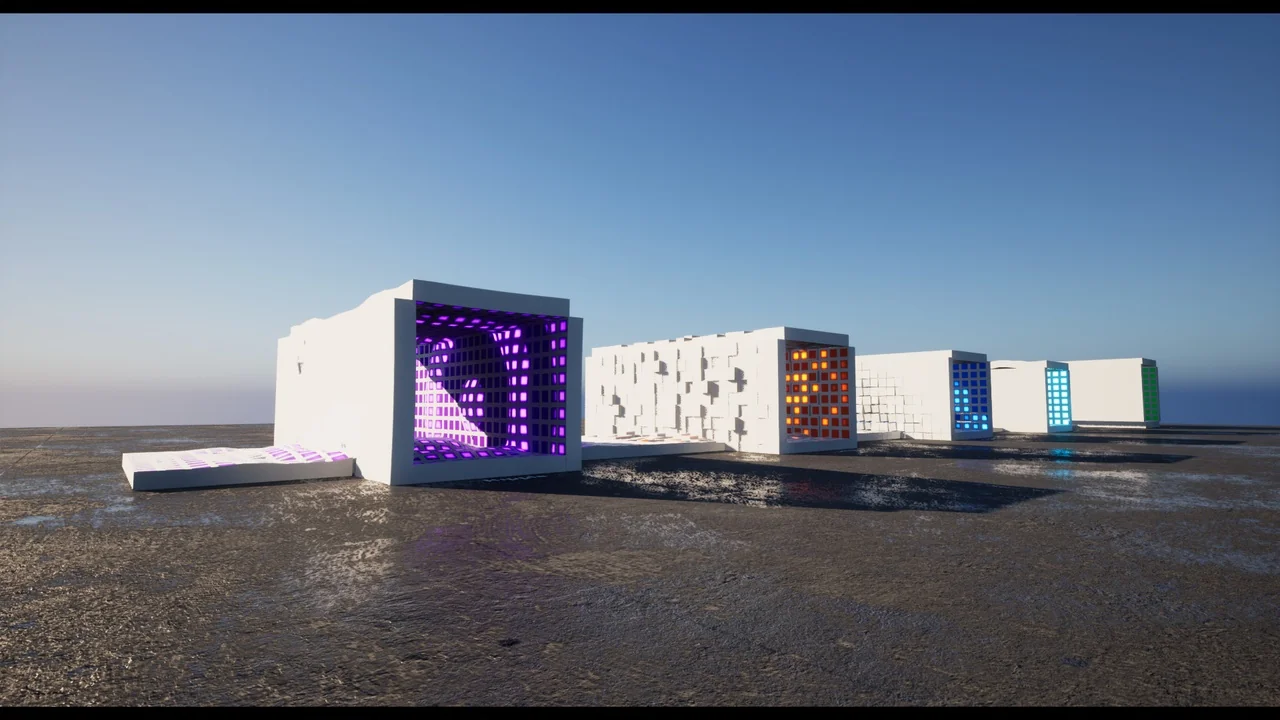
Within this instanced layout, lowpoly meshes react to localized ripple and warp behaviors governed by the material network. Because the deformation relies on World Position Offset rather than geometry restructuring, the underlying topology never changes. A flat floor or structured backdrop can ripple beneath an object or warp outward from an effector actor, maintaining clean frame rates while displaying fluid surface motion.
Lumen and Emissive Integration Across Interactive Surfaces
Deformed surfaces in modern real-time rendering engines must interact believably with dynamic lighting passes. When geometry flexes or stretches, its relationship to local light bounces changes immediately.
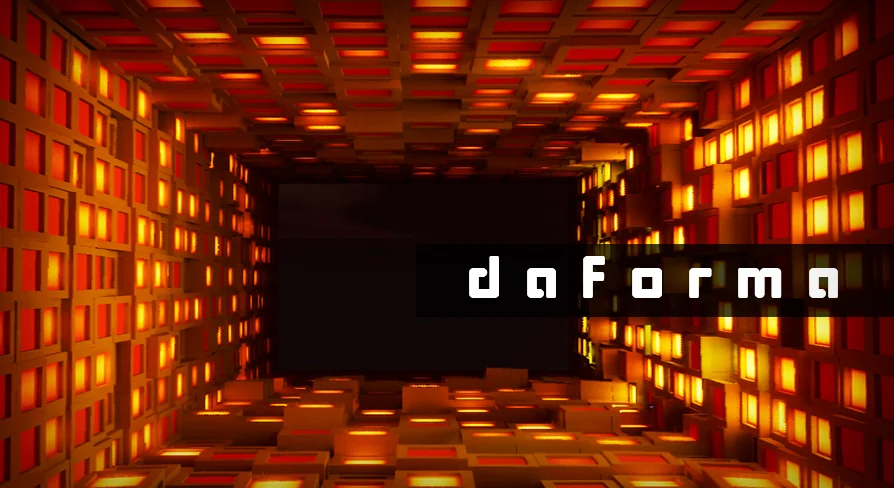
Daforma incorporates emissive materials that function alongside Lumen global illumination. As lowpoly tiles or grid components shift under the influence of the vertex shader modifiers, emissive highlights adapt to the new contours. Light bounces cast by the deformed shapes illuminate neighboring instances in the HISM grid, ensuring that motion effects register clearly in scenes that rely on dark ambiances punctuated by glowing edges.
Staging Interactive Environments with Neonify Compatibility
Stylized geometric setups often rely on synchronized aesthetic elements to establish mood. Daforma carries verified compatibility with Neonify - Stylized Neon Stages with Neon Ambience, enabling rapid deployment in stylized virtual sets.
Combining both toolsets allows artists to integrate shifting floor planes, responsive stages, and reactive backdrops into electronic or futuristic architectural spaces. The emissive materials blend directly with ambient neon palettes, while the HISM grid keeps instance counts manageable across complex stage arrangements. Interactive scripts can trigger ripples across the stage floor in sync with stage events or camera moves.
Positioning daforma in Real-Time Production Pipelines
Complex visual deformation is frequently locked inside offline simulation tools or heavy skeletal mesh setups that complicate real-time workflows. Lightweight vertex-driven solutions offer an alternate route for interactive projects requiring distinct geometric motion.
In a standard production pipeline, daforma fits directly into virtual production environments, interactive installations, and stylized game levels. Starting with the quickstart documentation and setup guides, technical artists can deploy the Blueprint effect actors to govern level-wide transformations, test instance counts on the HISM grid, and tie procedural motion directly to real-time scene parameters.
 Gameplay Features
 Gameplay Features
 Gameplay Features
 Gameplay Features