"7b46a695175d8694"{"id":"1001515","slug":"forest-fire","title":"Forest Fire","category":"Variety","engine":"4.26+,5.0+","assetVersion":"","engineVersion":"Engine Version: 4.26+,5.0+","tag":"Variety","accent":"blue","visual":"mech","summary":"Forest Fire provides 16 particle systems, 21 foliage meshes with vertex painted embers, a 5-material blend ground shader, and educational map breakdowns.","platform":"Unreal Engine","publishedAt":"2026-10-09T13:15:00.623Z","updatedAt":"2026-10-09T13:15:00.623Z","sourceNotes":[],"fileContents":[],"compatibility":["Unreal Engine","Engine Version: 4.26+,5.0+"],"featuredImage":{"alt":"Forest Fire","src":"/wp-content/uploads/published/2026/10/0a939fa1a2f2-bc6978c6-5d71-4002-ac23-6f894ff41b6e-32b8e01bc7.webp"},"hasDownloadLink":true,"downloads":0,"terms":[{"taxonomy":"category","slug":"variety-vfx","name":"Variety"}],"galleryImages":[{"src":"/wp-content/uploads/published/2026/10/390bf0e58ca2-09de5a6b-f3c6-4924-9981-697c6d0e2860-d2eefedd71.webp","alt":"Forest Fire"},{"src":"/wp-content/uploads/published/2026/10/22aafcab719f-05e6afa8-cb9b-4123-81a3-46be6ab4c4e7-d19c663581.webp","alt":"Forest Fire"},{"src":"/wp-content/uploads/published/2026/10/73a0a1f901f1-ef520a27-c173-4871-9e3c-23debe4e0d77-3bcdc2021e.webp","alt":"Forest Fire"},{"src":"/wp-content/uploads/published/2026/10/bbefd05e3f7a-2c83933c-7682-4ccf-a039-a3bc82e352cb-9b5aadb092.webp","alt":"Forest Fire"},{"src":"/wp-content/uploads/published/2026/10/02d3aa4e43bf-3fb8c7e8-b7ef-4f6b-a9fd-fd65c571c58b-9cd4892663.webp","alt":"Forest Fire"}],"accessPanel":{"kind":"resource","title":"Download this resource","eyebrow":"Free Download","message":"Log in or create a free account to start your download.","fileName":"Forest Fire.7z","safetyNote":"Resources are manually reviewed before listing to improve quality and reduce obvious risks.","actionLabel":"Download Free","resourceType":"Resource archive"},"contentHtml":"\u003ch2\u003eBurning Woodland Environments and Particle Dynamics\u003c/h2\u003e\n\u003cp\u003eDense woodland blazes require distinct atmospheric layers to convey escalating heat, ash distribution, and active combustion. Forest Fire delivers an environment toolkit centered around sixteen dedicated particle systems configured across multiple scales. These emitters govern varying sizes of smoke plumes, ambient airborne debris, and direct fire effects. Rather than relying on a single uniform flame emitter, the system isolates smaller ember drift, mid-sized burning pockets, and large-scale billowing smoke columns to reproduce the layered chaos of realistic wildfire propagation.\u003c/p\u003e\n\u003cp\u003eThe ambient systems disperse subtle airborne particulates through the air, while the heavier smoke and fire systems handle high-intensity hotspots. Because the particle systems include built-in Level of Detail (LoD) configurations, the volume and computational expense of active emitters step down appropriately based on camera distance. This keeps wide-angle landscape shots manageable while preserving intense, concentrated particle density during close-up passes through burning tree lines.\u003c/p\u003e \u003ch2\u003eFoliage Meshes, Wind Animations, and Vertex Painted Embers\u003c/h2\u003e\n\u003cp\u003eNatural wildfire visualization requires vegetation that reacts convincingly before, during, and after combustion. Forest Fire supplies 21 distinct forest and foliage meshes configured with specialized shader logic. The accompanying custom materials incorporate real-time wind animations, ensuring that branches, leaves, and underbrush sway dynamically to match turbulent air currents caused by rising heat and ambient weather.\u003c/p\u003e\n\u003cp\u003eBeyond wind motion, the foliage materials rely on vertex painted embers to establish localized burn zones. Artists can paint combustion states directly onto the vertices of the 21 tree and undergrowth models, allowing specific branches or trunks to glow with hot, smoldering embers while adjacent sections remain unburned or fully charred. The custom materials process these vertex color channels alongside fire effects mapped directly to the mesh surfaces. Every included mesh is completely prepared for production lighting pipelines, featuring dedicated lightmaps for static lighting bakes alongside mesh LoDs that transition seamlessly across view distances.\u003c/p\u003e \u003ch2\u003eThe Five-Material Blend Ground Shader Structure\u003c/h2\u003e\n\u003cp\u003eUndergrowth fires radically alter the forest floor, stripping organic matter down to scorched soil and accumulated soot. To unify the landscape with the active fire elements, the package incorporates an advanced five-material blend ground shader built entirely from scratch. This terrain shader interacts directly with the visual cues established by the particle systems, anchoring ash accumulation and flame origins into the ground surface.\u003c/p\u003e\n\u003cp\u003eBlending five distinct material states within a single surface setup allows for nuanced transitions across forest paths, untouched woodland soil, smoldering detritus, and heavily scorched terrain. Because the ground shader was engineered deliberately to align with the airborne embers and smoke particles, surface discoloration and glowing ash lines appear continuous with the surrounding particle systems. The multi-material transitions avoid sharp boundaries between burning foliage bases and the underlying earth.\u003c/p\u003e \u003ch2\u003eOptimization via Mesh and Particle LoDs with Lightmaps\u003c/h2\u003e\n\u003cp\u003eSimulating extensive environmental destruction presents significant rendering challenges, particularly when compounding complex particle counts with animated foliage geometry. Forest Fire balances high-density visual fidelity and runtime performance through strict LoD integration applied evenly to both static and dynamic elements. Both sides of the asset hierarchy—geometry and VFX—incorporate stepped optimization layers.\u003c/p\u003e\n\u003cul\u003e\n\u003cli\u003e\u003cstrong\u003eStatic Geometry Optimization:\u003c/strong\u003e All 21 foliage and forest meshes feature custom LoD steps to reduce polygon overhead at distance, paired with clean lightmaps for predictable, artifact-free static bakes.\u003c/li\u003e\n\u003cli\u003e\u003cstrong\u003eEmitter Scalability:\u003c/strong\u003e All 16 particle systems possess automated LoD steps that throttle particle counts, sprite complexities, and calculation frequencies as the viewpoint moves away from the combustion source.\u003c/li\u003e\n\u003cli\u003e\u003cstrong\u003eUnified Lighting Workflow:\u003c/strong\u003e Lightmapped foliage geometry ensures consistent shadowing under complex atmospheric conditions, grounding active flame emitters into baked environmental illumination.\u003c/li\u003e\n\u003c/ul\u003e \u003ch2\u003eEducational Map Breakdowns and Shader Commenting\u003c/h2\u003e\n\u003cp\u003eUnderstanding how complex multi-material blending, vertex painting, and particle emitters interface is essential for adapting assets to custom production pipelines. To support pipeline integration and learning, Forest Fire includes an educational map that breaks down each technical implementation step by step. This reference level demonstrates optimal mesh placement, effective vertex painting workflows for embers, ground shader layer blending, and the positioning of smoke and flame emitters.\u003c/p\u003e\n\u003cp\u003eIn addition to the educational demonstration level, all material graphs across the package are fully annotated with descriptive comments. The logic controlling wind animation oscillations, vertex-driven ember intensity, flame surface mapping, and the five-way ground blend is explicitly documented inside the shader networks. Technical artists and environment designers can inspect the exact mathematics driving each effect, making it straightforward to tune parameter inputs, isolate specific material functions, or expand the assets for specialized natural disaster scenes. The package also features verified compatibility with the Custom Lens Flare Tool, allowing bright flame centers and burning canopies to produce realistic optical flare responses across active camera views.\u003c/p\u003e\n\n\u003ch2\u003eMore From The Same Workflow\u003c/h2\u003e\n\u003cul\u003e\n\u003cli\u003e\u003ca href=\"https://3dcghub.com/niagara-realistic-starter-vfx-pack-2/\" title=\"Niagara Realistic Starter VFX Pack 2\"\u003eNiagara Realistic Starter VFX Pack 2\u003c/a\u003e\u003c/li\u003e\n\u003cli\u003e\u003ca href=\"https://3dcghub.com/falling-leaves-vfx-pack/\" title=\"Falling Leaves VFX Pack\"\u003eFalling Leaves VFX Pack\u003c/a\u003e\u003c/li\u003e\n\u003cli\u003e\u003ca href=\"https://3dcghub.com/fx-variety-pack/\" title=\"FX Variety Pack\"\u003eFX Variety Pack\u003c/a\u003e\u003c/li\u003e\n\u003cli\u003e\u003ca href=\"https://3dcghub.com/realistic-starter-vfx-pack-vol-2/\" title=\"Realistic Starter VFX Pack Vol 2\"\u003eRealistic Starter VFX Pack Vol 2\u003c/a\u003e\u003c/li\u003e\n\u003cli\u003e\u003ca href=\"https://3dcghub.com/grass-material-premium/\" title=\"Grass Material - Premium\"\u003eGrass Material - Premium\u003c/a\u003e\u003c/li\u003e\n\u003c/ul\u003e","contentTextLength":5863,"navigation":{"current":30,"total":3481,"previous":{"id":"1001516","slug":"fps-world-war-pack","title":"FPS World War Pack","category":"Weapons \u0026 Combat","platform":"Unreal Engine","updatedAt":"2026-10-09T13:17:18.880Z"},"next":{"id":"1001514","slug":"dviz-realistic-house-archviz-project","title":"DVIZ Realistic House Archviz Project","category":"Buildings \u0026 Architecture","platform":"Unreal Engine","updatedAt":"2026-10-09T13:14:25.715Z"}},"relatedResources":[{"id":"24895","slug":"niagara-realistic-starter-vfx-pack-2","title":"Niagara Realistic Starter VFX Pack 2","category":"Variety","engine":"4.26+,5.0+","assetVersion":"Engine version: 4.26+,5.0+","engineVersion":"5.0","tag":"Variety","accent":"blue","visual":"animation","summary":"Niagara Realistic Starter VFX Pack 2 gathers a broad starter set for early project work, with effects aimed at development and prototyping. It covers fire, smoke, destruction, impact, water, lightning, dust, acid, and more, along with supporting materials,...","platform":"Unreal Engine","publishedAt":"2026-04-17T11:51:15.000Z","updatedAt":"2026-04-20T06:12:36.000Z","sourceNotes":[],"fileContents":[],"compatibility":["Unreal Engine","Engine version: 4.26+,5.0+"],"featuredImage":{"alt":"Niagara Realistic Starter VFX Pack 2","src":"https://3dcghub.com/wp-content/uploads/2026/04/d156aa4cf6b6_838c5c1e-48e5-4440-991f-9af45009efe4.webp"},"hasDownloadLink":true,"downloads":3},{"id":"17090","slug":"falling-leaves-vfx-pack","title":"Falling Leaves VFX Pack","category":"Variety","engine":"4.26+,5.0+","assetVersion":"Engine version: 4.26+,5.0+","engineVersion":"4.26","tag":"Variety","accent":"blue","visual":"audio","summary":"The Falling Leaves VFX Pack provides a comprehensive set of nature-based particle effects. With 11 leaf types and multiple wind variations, it offers realistic movement for any project.","platform":"Unreal Engine","publishedAt":"2026-03-13T13:40:59.000Z","updatedAt":"2026-04-19T15:43:37.000Z","sourceNotes":[],"fileContents":[],"compatibility":["Unreal Engine","Engine version: 4.26+,5.0+"],"featuredImage":{"alt":"Falling Leaves VFX Pack","src":"https://3dcghub.com/wp-content/uploads/2026/03/7d254056-511c-401f-9eae-471f1182db0c.webp"},"hasDownloadLink":true,"downloads":2},{"id":"1001193","slug":"fx-variety-pack","title":"FX Variety Pack","category":"Variety","engine":"5.0+","assetVersion":"","engineVersion":"Engine Version: 5.0+","tag":"Variety","accent":"blue","visual":"mech","summary":"Explore the FX Variety Pack for Unreal Engine, featuring Fire, Thunder, and Water balls alongside Storm magic effects optimized with particle LODs.","platform":"Unreal Engine","publishedAt":"2026-09-17T07:38:00.893Z","updatedAt":"2026-09-17T07:38:00.893Z","sourceNotes":[],"fileContents":[],"compatibility":["Unreal Engine","Engine Version: 5.0+"],"featuredImage":{"alt":"FX Variety Pack","src":"/wp-content/uploads/published/2026/09/3b906e5709f7-a45d9b3c-13a8-4e01-80b6-cd6f315da2e6-bc48d97fe6.webp"},"hasDownloadLink":true,"downloads":0}]}
Variety
Forest Fire
Forest Fire provides 16 particle systems, 21 foliage meshes with vertex painted embers, a 5-material blend ground shader, and educational map breakdowns.
Category:Unreal Engine,VarietyPlatform: Unreal EngineEngine Version: 4.26+,5.0+Published: Oct 9, 2026
Variety
Resource overview
Burning Woodland Environments and Particle Dynamics
Dense woodland blazes require distinct atmospheric layers to convey escalating heat, ash distribution, and active combustion. Forest Fire delivers an environment toolkit centered around sixteen dedicated particle systems configured across multiple scales. These emitters govern varying sizes of smoke plumes, ambient airborne debris, and direct fire effects. Rather than relying on a single uniform flame emitter, the system isolates smaller ember drift, mid-sized burning pockets, and large-scale billowing smoke columns to reproduce the layered chaos of realistic wildfire propagation.
The ambient systems disperse subtle airborne particulates through the air, while the heavier smoke and fire systems handle high-intensity hotspots. Because the particle systems include built-in Level of Detail (LoD) configurations, the volume and computational expense of active emitters step down appropriately based on camera distance. This keeps wide-angle landscape shots manageable while preserving intense, concentrated particle density during close-up passes through burning tree lines.
Foliage Meshes, Wind Animations, and Vertex Painted Embers
Natural wildfire visualization requires vegetation that reacts convincingly before, during, and after combustion. Forest Fire supplies 21 distinct forest and foliage meshes configured with specialized shader logic. The accompanying custom materials incorporate real-time wind animations, ensuring that branches, leaves, and underbrush sway dynamically to match turbulent air currents caused by rising heat and ambient weather.
Beyond wind motion, the foliage materials rely on vertex painted embers to establish localized burn zones. Artists can paint combustion states directly onto the vertices of the 21 tree and undergrowth models, allowing specific branches or trunks to glow with hot, smoldering embers while adjacent sections remain unburned or fully charred. The custom materials process these vertex color channels alongside fire effects mapped directly to the mesh surfaces. Every included mesh is completely prepared for production lighting pipelines, featuring dedicated lightmaps for static lighting bakes alongside mesh LoDs that transition seamlessly across view distances.
The Five-Material Blend Ground Shader Structure
Undergrowth fires radically alter the forest floor, stripping organic matter down to scorched soil and accumulated soot. To unify the landscape with the active fire elements, the package incorporates an advanced five-material blend ground shader built entirely from scratch. This terrain shader interacts directly with the visual cues established by the particle systems, anchoring ash accumulation and flame origins into the ground surface.
Blending five distinct material states within a single surface setup allows for nuanced transitions across forest paths, untouched woodland soil, smoldering detritus, and heavily scorched terrain. Because the ground shader was engineered deliberately to align with the airborne embers and smoke particles, surface discoloration and glowing ash lines appear continuous with the surrounding particle systems. The multi-material transitions avoid sharp boundaries between burning foliage bases and the underlying earth.
Optimization via Mesh and Particle LoDs with Lightmaps
Simulating extensive environmental destruction presents significant rendering challenges, particularly when compounding complex particle counts with animated foliage geometry. Forest Fire balances high-density visual fidelity and runtime performance through strict LoD integration applied evenly to both static and dynamic elements. Both sides of the asset hierarchy—geometry and VFX—incorporate stepped optimization layers.
Static Geometry Optimization: All 21 foliage and forest meshes feature custom LoD steps to reduce polygon overhead at distance, paired with clean lightmaps for predictable, artifact-free static bakes.
Emitter Scalability: All 16 particle systems possess automated LoD steps that throttle particle counts, sprite complexities, and calculation frequencies as the viewpoint moves away from the combustion source.
Unified Lighting Workflow: Lightmapped foliage geometry ensures consistent shadowing under complex atmospheric conditions, grounding active flame emitters into baked environmental illumination.
Educational Map Breakdowns and Shader Commenting
Understanding how complex multi-material blending, vertex painting, and particle emitters interface is essential for adapting assets to custom production pipelines. To support pipeline integration and learning, Forest Fire includes an educational map that breaks down each technical implementation step by step. This reference level demonstrates optimal mesh placement, effective vertex painting workflows for embers, ground shader layer blending, and the positioning of smoke and flame emitters.
In addition to the educational demonstration level, all material graphs across the package are fully annotated with descriptive comments. The logic controlling wind animation oscillations, vertex-driven ember intensity, flame surface mapping, and the five-way ground blend is explicitly documented inside the shader networks. Technical artists and environment designers can inspect the exact mathematics driving each effect, making it straightforward to tune parameter inputs, isolate specific material functions, or expand the assets for specialized natural disaster scenes. The package also features verified compatibility with the Custom Lens Flare Tool, allowing bright flame centers and burning canopies to produce realistic optical flare responses across active camera views.
 Variety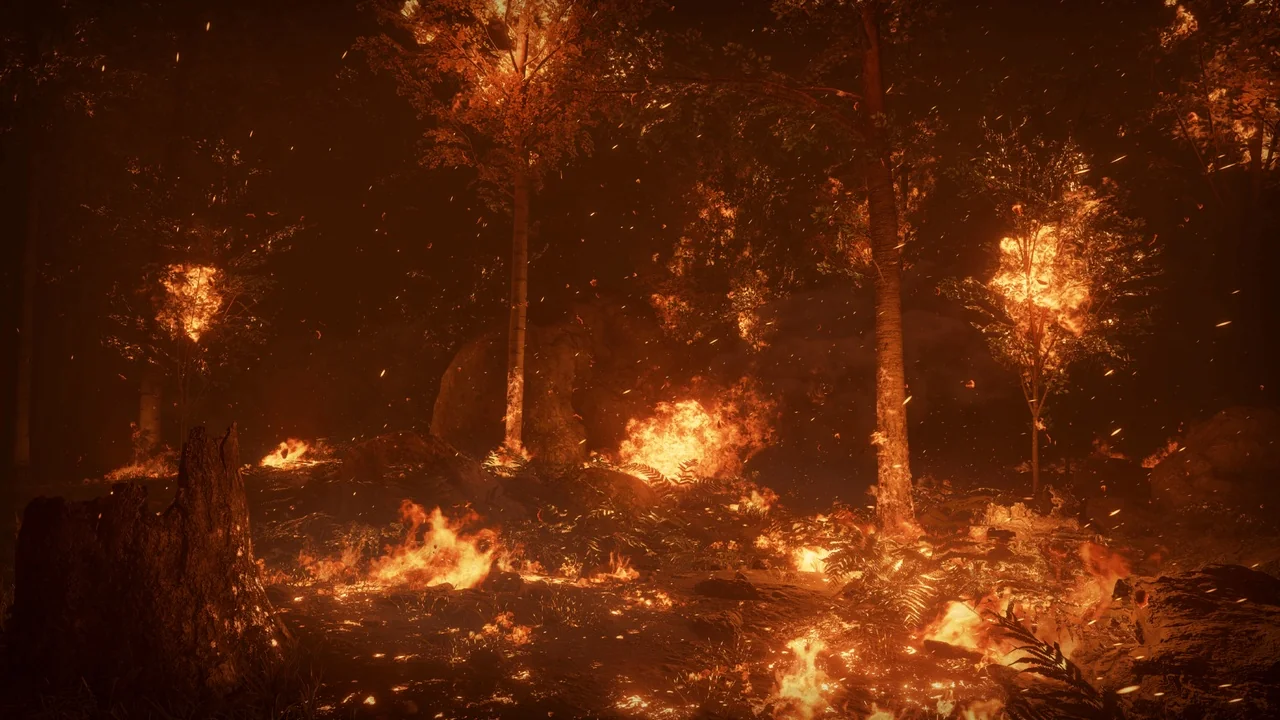
 Variety
 Variety
 Variety