"a19c8d5bcdb9294e"{"id":"1003055","slug":"damage-resource-and-stat-system","title":"Damage, Resource and Stat System","category":"Gameplay Features","engine":"4.24+,5.0+","assetVersion":"","engineVersion":"Engine Version: 4.24+,5.0+","tag":"Gameplay Features","accent":"blue","visual":"mech","summary":"A packaged build of a Blueprint-tagged damage, resource and stat framework: resistance and penetration maths, crit, mana and health pools, stacking effects.","platform":"Unreal Engine","indexPolicy":"index","publishedAt":"2026-11-27T11:52:35.246Z","updatedAt":"2026-11-27T11:52:35.246Z","sourceNotes":[],"fileContents":[],"compatibility":["Unreal Engine","Engine Version: 4.24+,5.0+"],"featuredImage":{"alt":"Damage, Resource and Stat System","src":"/wp-content/uploads/published/2026/11/d8da3041de05-cffab278-746d-4a5d-8646-db2e20903e7c-377003a1e7.webp"},"fileSizeBytes":117695293,"hasDownloadLink":true,"downloads":0,"terms":[{"taxonomy":"category","slug":"gameplay-features","name":"Gameplay Features"}],"galleryImages":[{"src":"/wp-content/uploads/published/2026/11/7c64df9d8fa1-d85ac240-2215-4925-a788-e15d9e3c2b88-3f899f652b.webp","alt":"Damage, Resource and Stat System"},{"src":"/wp-content/uploads/published/2026/11/f243f15c87b3-eab29452-67c4-4056-b6b0-15210967d456-f6635c45f3.webp","alt":"Damage, Resource and Stat System"},{"src":"/wp-content/uploads/published/2026/11/26349bf66520-521d4685-04a5-4f23-bdbb-16ea11e6a837-1e01fa03b4.webp","alt":"Damage, Resource and Stat System"},{"src":"/wp-content/uploads/published/2026/11/b87c5ef3ed8c-bfdfcd3e-3a96-4661-b6d4-d270aafb4d14-ba43786e35.webp","alt":"Damage, Resource and Stat System"},{"src":"/wp-content/uploads/published/2026/11/00d26f9c1a46-b1fa44fe-f278-4e8e-b956-02b72a8c33f9-c84f7b58c4.webp","alt":"Damage, Resource and Stat System"},{"src":"/wp-content/uploads/published/2026/11/7788e08ccc7a-8958a187-0341-4ae1-a366-5627989da163-952a13a736.webp","alt":"Damage, Resource and Stat System"}],"accessPanel":{"kind":"resource","title":"Get this resource","safetyNote":"Resources are manually reviewed before listing to improve quality and reduce obvious risks.","fileFormat":".7z","resourceType":"Resource archive","versions":[]},"contentHtml":"\u003cp\u003eFrost-and-fire casters, rage-driven bruisers, shield-stacking tanks — these are the scenes where a combat framework has to keep several number systems in agreement at once. Damage, Resource and Stat System splits that work into separate pieces: a damage calculator, resource pools, and stats that can be rewritten while the game is running. A project can adopt one of them without dragging the rest along.\u003c/p\u003e \u003ch2\u003eProject Situations That Call for a Shared Damage and Resource Layer\u003c/h2\u003e \u003cp\u003ePicture an ability that deals typed damage against a target with matching resistances, and a second ability that carries two types at once. Picture a health bar that also has to account for a shield pool sitting on top of it, or a rage meter that fills on a regeneration interval rather than instantly. Those situations share a common demand — the numbers have to be calculated in one place, consistently, even when a buff changes them mid-fight.\u003c/p\u003e \u003cp\u003eThe system is organised around those overlapping needs. Damage calculation handles the offensive side, resource components handle the pools, and gameplay effects handle the temporary states layered over both. Because the components are independent, a project that only needs resource management can use the resource component alone and ignore the damage and effect parts entirely.\u003c/p\u003e \u003cp\u003eThe current preview is version 1.22.6, delivered as a packaged build. Demo builds are kept up to date and are the recommended way to get an overview of newer features, since they run ahead of the preview build itself. The tag set — System, Buff, Gameplay, Health, Resource, Blueprint, Damage — maps closely to that split between persistent pools, temporary effects and calculated hits.\u003c/p\u003e \u003ch2\u003eInside the Damage Calculation: Resistance, Penetration and Crit\u003c/h2\u003e \u003cp\u003eThe damage side does not stop at subtracting a flat number. Calculations take resistance and penetration values into account, so a target's defence can reduce incoming damage while the attacker's penetration pushes back against that reduction. Crit chance and crit damage sit on top of the same calculation, giving abilities a chance to land harder hits without a second formula.\u003c/p\u003e \u003cp\u003eCrit is optional rather than mandatory. The feature can be deactivated, which keeps the calculation straightforward for projects that want deterministic damage and no random spikes — useful when balancing is done by hand or when a designer simply doesn't want crit variance in a particular game mode.\u003c/p\u003e \u003ch3\u003eMixed Damage Types and the FrostFire Case\u003c/h3\u003e \u003cp\u003eDamage types can be combined so that a single hit draws on more than one resistance. The example the system uses is FrostFire, which is reduced equally by Frost Resistance and by Fire Resistance. Instead of picking one resistance to check, the hit is filtered through both, which makes hybrid abilities behave the way players expect them to: a target strong against fire but weak to frost takes a partial reduction rather than a full one or none at all.\u003c/p\u003e \u003cp\u003eThat same structure lets a designer build out any pairing of damage types and attach the corresponding resistance values to it, so elemental systems, physical-versus-magical splits and stranger combinations all follow the same path through the calculator.\u003c/p\u003e \u003ch2\u003eResource Components for Mana, Health, Shields and Rage\u003c/h2\u003e \u003cp\u003eResource components cover the pools a character spends and refills: mana, health, shields, rage, or comparable resources. Each pool has its own settings, so a health bar and a rage meter do not have to share behaviour just because they both drain and refill.\u003c/p\u003e \u003cp\u003eThe adjustable options include maximum value and the regeneration rules — delay before regeneration begins, the interval between ticks, and the value restored per tick. Together those three fields describe very different feelings: a shield that starts recovering almost immediately, a mana pool that punishes spending with a long wait, or a slow rage trickle that rewards patience.\u003c/p\u003e \u003ch3\u003eRegeneration Delay, Interval and Value\u003c/h3\u003e \u003cp\u003eSeparating delay from interval is the detail that makes the regeneration model flexible. Delay controls how long the pool stays untouched after it is used, interval controls how often it climbs once recovery starts, and value controls how much each step adds. A designer tuning a health pool for a slow, tense recovery can stretch the delay while keeping the interval short, producing a gradual climb rather than a sudden refill.\u003c/p\u003e \u003cp\u003eResources are also one of the places where the mixed damage model pays off. A shield pool fed by one ability, a health pool reduced by a FrostFire hit and a mana pool draining on every cast all report through the same component type, so combat code does not need a special case for each one.\u003c/p\u003e \u003ch2\u003eGameplay Effects, Stacks and Damage Over Time\u003c/h2\u003e \u003cp\u003eGameplay effects are the layer for anything temporary: buffs, debuffs, and damage-over-time effects that tick while they remain active. Where several effects of the same kind are running at once, they can stack, refresh, or both — a decision that changes how a repeated application behaves. A stacking bleed and a refreshing slow are two very different threats, and both are expressible here.\u003c/p\u003e \u003cp\u003eEffects can also fire events based on their stack size. That gives a designer a way to escalate: an effect that does something modest at one stack and something more significant as stacks accumulate, without writing a separate system to count them.\u003c/p\u003e \u003ch2\u003eStat Base Values and Modifiers That Change at Runtime\u003c/h2\u003e \u003cp\u003eAll values in the system can be adapted dynamically, including float values from every component — resistance, crit chance, regeneration delay and the rest. Nothing is locked at setup time, which means a stat can shift in response to gameplay and the calculations downstream will follow.\u003c/p\u003e \u003cp\u003eBase values act as the foundation for those calculations, and they can be changed by outside sources; an inventory is the example given, where equipping or removing an item alters the base a stat is measured from. Modifiers such as +30% are then applied on top of that base rather than replacing it, so a percentage bonus and a base-value change can coexist and be reasoned about separately. That separation is what keeps late-game stat inflation from turning into a pile of hard-coded overrides.\u003c/p\u003e \u003ch2\u003eWho Gets the Most From the System\u003c/h2\u003e \u003cp\u003eTeams building combat with typed damage, more than one resource pool per character, or buffs that stack and expire will find the most use here, because those are exactly the areas the components address. The independence of the parts matters for smaller projects too: a solo developer who only needs a regeneration-driven resource pool can take that component and leave the damage and effect machinery untouched.\u003c/p\u003e \u003cp\u003eDesigners who expect to retune numbers — resistance curves, crit chance, regeneration pacing — will get more out of it than a project with fixed, hand-authored values, since the base-plus-modifier structure and the runtime adjustability assume that tuning will keep happening. Anyone evaluating it should look at the demo builds first, as they carry the newer features ahead of the version 1.22.6 preview.\u003c/p\u003e\n\n\u003ch2\u003eRelated Resources Worth Checking\u003c/h2\u003e\n\u003cul\u003e\n\u003cli\u003e\u003ca href=\"https://3dcghub.com/character-stats-kit/\" rel=\"noopener noreferrer\"\u003eCharacter Stats Kit\u003c/a\u003e\u003c/li\u003e\n\u003cli\u003e\u003ca href=\"https://3dcghub.com/cargo-delivery-inventory-system/\" rel=\"noopener noreferrer\"\u003eCargo Delivery Inventory System\u003c/a\u003e\u003c/li\u003e\n\u003cli\u003e\u003ca href=\"https://3dcghub.com/target-lock-system/\" rel=\"noopener noreferrer\"\u003eTarget Lock System\u003c/a\u003e\u003c/li\u003e\n\u003cli\u003e\u003ca href=\"https://3dcghub.com/universal-doors-system/\" rel=\"noopener noreferrer\"\u003eUniversal Doors System\u003c/a\u003e\u003c/li\u003e\n\u003cli\u003e\u003ca href=\"https://3dcghub.com/inventory-and-stat-system/\" rel=\"noopener noreferrer\"\u003eInventory and Stat System\u003c/a\u003e\u003c/li\u003e\n\u003c/ul\u003e","contentTextLength":7174,"navigation":{"current":3,"total":4978,"previous":{"id":"1003057","slug":"drivable-cars-pick-up-truck-3d-assets-and-blueprints","title":"Drivable Cars: Pick Up Truck 3D Assets and Blueprints","category":"Cars \u0026 Trucks","platform":"Unreal Engine","updatedAt":"2026-11-27T14:56:40.698Z"},"next":{"id":"1003054","slug":"customizable-deadly-traps","title":"Customizable Deadly Traps","category":"Gameplay Features","platform":"Unreal Engine","updatedAt":"2026-11-27T07:00:49.083Z"}},"relatedResources":[{"id":"1003014","slug":"character-stats-kit","title":"Character Stats Kit","category":"Gameplay Features","engine":"4.15+,5.0+","assetVersion":"","engineVersion":"Engine Version: 4.15+,5.0+","tag":"Gameplay Features","accent":"blue","visual":"character","summary":"Character Stats Kit supplies over 40 Blueprint nodes for classes, reputations, leveling, skill points, and passive mana, health, and hunger behaviour.","platform":"Unreal Engine","indexPolicy":"index","publishedAt":"2026-11-25T16:18:43.371Z","updatedAt":"2026-11-25T16:18:43.371Z","sourceNotes":[],"fileContents":[],"compatibility":["Unreal Engine","Engine Version: 4.15+,5.0+"],"featuredImage":{"alt":"Character Stats Kit","src":"/wp-content/uploads/published/2026/11/3ca1118ad267-732e4075-df26-42cd-870b-bf3f5093fdd8-b1302dfe55.webp"},"fileSizeBytes":14351589,"hasDownloadLink":true,"downloads":0},{"id":"1002309","slug":"cargo-delivery-inventory-system","title":"Cargo Delivery Inventory System","category":"Gameplay Features","engine":"4.23+,5.0+","assetVersion":"","engineVersion":"Engine Version: 4.23+,5.0+","tag":"Gameplay Features","accent":"blue","visual":"mech","summary":"A blueprint-based cargo delivery pack where packages drop into a level, tune through parameters, extend through child blueprints, and show visible damage.","platform":"Unreal Engine","indexPolicy":"index","publishedAt":"2026-11-06T06:12:19.870Z","updatedAt":"2026-11-06T06:12:19.870Z","sourceNotes":[],"fileContents":[],"compatibility":["Unreal Engine","Engine Version: 4.23+,5.0+"],"featuredImage":{"alt":"Cargo Delivery Inventory System","src":"/wp-content/uploads/published/2026/11/9b565f7ba538-fb653dc4-f641-43c0-891e-61f4d06392f9-691b2ad221.webp"},"fileSizeBytes":20781642,"hasDownloadLink":true,"downloads":0},{"id":"1002228","slug":"target-lock-system","title":"Target Lock System","category":"Gameplay Features","engine":"4.26+,5.0+","assetVersion":"","engineVersion":"Engine Version: 4.26+,5.0+","tag":"Gameplay Features","accent":"blue","visual":"mech","summary":"Explore the Blueprint-based Target Lock System for Unreal Engine, featuring multiplayer replication, Souls-like targeting logic, and a basic damage setup.","platform":"Unreal Engine","indexPolicy":"index","publishedAt":"2026-10-29T15:27:07.100Z","updatedAt":"2026-10-29T15:27:07.100Z","sourceNotes":[],"fileContents":[],"compatibility":["Unreal Engine","Engine Version: 4.26+,5.0+"],"featuredImage":{"alt":"Target Lock System","src":"/wp-content/uploads/published/2026/10/5649fa496f95-c155a574-3d0b-4c3a-8a6d-9a6e0ce45b2c-8bf36d7b80.webp"},"fileSizeBytes":50214033,"hasDownloadLink":true,"downloads":0}]}[{"id":4225,"sourceId":4225,"taxonomyId":4225,"taxonomy":"category","slug":"asset-library","name":"Asset Library","parentId":null,"count":0,"hasChildren":true,"href":"/","seoTitle":"Free Game Assets Library | 3DCGHUB","seoDescription":"Browse free Unreal Engine, Unity, Blender assets and game development tutorials on 3DCGHUB with previews, compatibility notes, and secure downloads.","sitemapEnabled":true,"children":[{"id":4227,"sourceId":4227,"taxonomyId":4227,"taxonomy":"category","slug":"blender-add-ons-plugins","name":"Blender Add-ons \u0026 Plugins","parentId":4225,"count":0,"hasChildren":false,"href":"/category/blender-add-ons-plugins/","seoTitle":"Free Blender Add-ons \u0026 Plugins | 3DCGHUB","seoDescription":"Browse free Blender Add-ons \u0026 Plugins tools for Blender on 3DCGHUB: curated downloads with preview images, compatibility notes and secure download access.","sitemapEnabled":true},{"id":514,"sourceId":514,"taxonomyId":514,"taxonomy":"category","slug":"unity-2","name":"Unity","parentId":4225,"count":0,"hasChildren":true,"href":"/category/unity-2/","seoTitle":"Free Unity Assets | 3DCGHUB","seoDescription":"Browse free Unity resources on 3DCGHUB: curated downloads with preview images, compatibility notes and secure download access.","sitemapEnabled":true,"children":[{"id":523,"sourceId":523,"taxonomyId":523,"taxonomy":"category","slug":"2d","name":"2D","parentId":514,"count":0,"hasChildren":true,"href":"/category/2d/","seoTitle":"Free Unity 2D | 3DCGHUB","seoDescription":"Browse free 2D assets for Unity on 3DCGHUB: curated downloads with preview images, compatibility notes and secure download access.","sitemapEnabled":true},{"id":515,"sourceId":515,"taxonomyId":515,"taxonomy":"category","slug":"3d-unity-2","name":"3D","parentId":514,"count":0,"hasChildren":true,"href":"/category/3d-unity-2/","seoTitle":"Free Unity 3D Assets | 3DCGHUB","seoDescription":"Browse free 3D assets for Unity on 3DCGHUB: curated downloads with preview images, compatibility notes and secure download access.","sitemapEnabled":true},{"id":565,"sourceId":565,"taxonomyId":565,"taxonomy":"category","slug":"add-ons","name":"Add-Ons","parentId":514,"count":0,"hasChildren":false,"href":"/category/add-ons/","seoTitle":"Free Unity Add-Ons | 3DCGHUB","seoDescription":"Browse free Add-Ons assets for Unity on 3DCGHUB: curated downloads with preview images, compatibility notes and secure download access.","sitemapEnabled":true},{"id":529,"sourceId":529,"taxonomyId":529,"taxonomy":"category","slug":"audio-unity-2","name":"Audio","parentId":514,"count":0,"hasChildren":true,"href":"/category/audio-unity-2/","seoTitle":"Free Unity Audio | 3DCGHUB","seoDescription":"Browse free Audio for Unity on 3DCGHUB: curated downloads with preview images, compatibility notes and secure download access.","sitemapEnabled":true},{"id":557,"sourceId":557,"taxonomyId":557,"taxonomy":"category","slug":"templates","name":"Templates","parentId":514,"count":0,"hasChildren":true,"href":"/category/templates/","seoTitle":"Free Unity Templates | 3DCGHUB","seoDescription":"Browse free Unity project templates on 3DCGHUB. Starter kits with previews, compatibility notes, and secure download access.","sitemapEnabled":true},{"id":533,"sourceId":533,"taxonomyId":533,"taxonomy":"category","slug":"tools-unity-2","name":"Tools","parentId":514,"count":0,"hasChildren":true,"href":"/category/tools-unity-2/","sitemapEnabled":true},{"id":554,"sourceId":554,"taxonomyId":554,"taxonomy":"category","slug":"vfx-unity-2","name":"VFX","parentId":514,"count":0,"hasChildren":true,"href":"/category/vfx-unity-2/","seoTitle":"Free Unity VFX | 3DCGHUB","seoDescription":"Browse free VFX for Unity on 3DCGHUB: curated downloads with preview images, compatibility notes and secure download access.","sitemapEnabled":true}]},{"id":511,"sourceId":511,"taxonomyId":511,"taxonomy":"category","slug":"unreal-engine-2","name":"Unreal Engine","parentId":4225,"count":0,"hasChildren":true,"href":"/category/unreal-engine-2/","seoTitle":"Free Unreal Engine Assets | 3DCGHUB","seoDescription":"Browse free Unreal Engine resources on 3DCGHUB: curated downloads with preview images, compatibility notes and secure download access.","sitemapEnabled":true,"children":[{"id":54,"sourceId":54,"taxonomyId":54,"taxonomy":"category","slug":"3d","name":"3D","parentId":511,"count":0,"hasChildren":true,"href":"/category/3d/","seoTitle":"Free Unreal Engine 3D | 3DCGHUB","seoDescription":"Browse free 3D assets for Unreal Engine on 3DCGHUB: curated downloads with preview images, compatibility notes and secure download access.","sitemapEnabled":true},{"id":441,"sourceId":441,"taxonomyId":441,"taxonomy":"category","slug":"animations","name":"Animations","parentId":511,"count":0,"hasChildren":true,"href":"/category/animations/","seoTitle":"Free Unreal Engine Animations | 3DCGHUB","seoDescription":"Browse free Animations for Unreal Engine on 3DCGHUB: curated downloads with preview images, compatibility notes and secure download access.","sitemapEnabled":true},{"id":446,"sourceId":446,"taxonomyId":446,"taxonomy":"category","slug":"audio","name":"Audio","parentId":511,"count":0,"hasChildren":true,"href":"/category/audio/","seoTitle":"Free Unreal Engine Audio Resources | 3DCGHUB","seoDescription":"Browse free Unreal Engine audio resources including sound effects, voices, dialogue, and ambient sounds. Curated free downloads on 3DCGHUB.","sitemapEnabled":true},{"id":466,"sourceId":466,"taxonomyId":466,"taxonomy":"category","slug":"game-systems","name":"Game Systems","parentId":511,"count":0,"hasChildren":true,"href":"/category/game-systems/","seoTitle":"Free Unreal Engine Game Systems | 3DCGHUB","seoDescription":"Browse free Game Systems tools for Unreal Engine on 3DCGHUB: curated downloads with preview images, compatibility notes and secure download access.","sitemapEnabled":true},{"id":478,"sourceId":478,"taxonomyId":478,"taxonomy":"category","slug":"game-templates","name":"Game Templates","parentId":511,"count":0,"hasChildren":true,"href":"/category/game-templates/","seoTitle":"Free Unreal Engine Game Templates | 3DCGHUB","seoDescription":"Browse free Game Templates for Unreal Engine on 3DCGHUB: curated downloads with preview images, compatibility notes and secure download access.","sitemapEnabled":true},{"id":432,"sourceId":432,"taxonomyId":432,"taxonomy":"category","slug":"hdri","name":"HDRI","parentId":511,"count":0,"hasChildren":true,"href":"/category/hdri/","seoTitle":"Free Unreal Engine HDRI | 3DCGHUB","seoDescription":"Browse free Unreal Engine HDRI skies and lighting maps on 3DCGHUB. Environment lighting with previews and secure downloads.","sitemapEnabled":true},{"id":228,"sourceId":228,"taxonomyId":228,"taxonomy":"category","slug":"material-and-textures","name":"Material \u0026 Textures","parentId":511,"count":0,"hasChildren":true,"href":"/category/material-and-textures/","seoTitle":"Free Unreal Engine Material \u0026 Textures | 3DCGHUB","seoDescription":"Browse free Material \u0026 Textures for Unreal Engine on 3DCGHUB: curated downloads with preview images, compatibility notes and secure download access.","sitemapEnabled":true},{"id":298,"sourceId":298,"taxonomyId":298,"taxonomy":"category","slug":"sprites-and-flipbooks","name":"Sprites \u0026 Flipbooks","parentId":511,"count":0,"hasChildren":true,"href":"/category/sprites-and-flipbooks/","seoTitle":"Free Unreal Engine Sprites \u0026 Flipbooks | 3DCGHUB","seoDescription":"Browse free Sprites \u0026 Flipbooks assets for Unreal Engine on 3DCGHUB: curated downloads with preview images, compatibility notes and secure download access.","sitemapEnabled":true},{"id":489,"sourceId":489,"taxonomyId":489,"taxonomy":"category","slug":"tools-and-plugins","name":"Tools \u0026 Plugins","parentId":511,"count":0,"hasChildren":true,"href":"/category/tools-and-plugins/","seoTitle":"Free Unreal Engine Tools \u0026 Plugins | 3DCGHUB","seoDescription":"Browse free Tools \u0026 Plugins for Unreal Engine on 3DCGHUB: curated downloads with preview images, compatibility notes and secure download access.","sitemapEnabled":true},{"id":459,"sourceId":459,"taxonomyId":459,"taxonomy":"category","slug":"ui","name":"UI","parentId":511,"count":0,"hasChildren":true,"href":"/category/ui/","seoTitle":"Free Unreal Engine UI | 3DCGHUB","seoDescription":"Browse free UI for Unreal Engine on 3DCGHUB: curated downloads with preview images, compatibility notes and secure download access.","sitemapEnabled":true},{"id":450,"sourceId":450,"taxonomyId":450,"taxonomy":"category","slug":"vfx","name":"VFX","parentId":511,"count":0,"hasChildren":true,"href":"/category/vfx/","seoTitle":"Free Unreal Engine VFX | 3DCGHUB","seoDescription":"Browse free VFX for Unreal Engine on 3DCGHUB: curated downloads with preview images, compatibility notes and secure download access.","sitemapEnabled":true}]}]},{"id":4222,"sourceId":4222,"taxonomyId":4222,"taxonomy":"category","slug":"tutorial-library","name":"Tutorial Library","parentId":null,"count":0,"hasChildren":false,"href":"/tutorials/","seoTitle":"Free Game Development Tutorial Library | 3DCGHUB","seoDescription":"Browse free game development tutorials for Unreal Engine, Unity, Blender, and more on 3DCGHUB with practical workflows and secure downloads.","sitemapEnabled":true}]
Resource screenshots
1 / 6
Asset drops
Daily Asset Drops
Follow 3DCGHUB on Telegram for daily Unreal, Unity & Blender drops and curated CC0 releases.
Resources are manually reviewed before listing to improve quality and reduce obvious risks.
Reviewed archive
Gameplay Features
Damage, Resource and Stat System
A packaged build of a Blueprint-tagged damage, resource and stat framework: resistance and penetration maths, crit, mana and health pools, stacking effects.
Frost-and-fire casters, rage-driven bruisers, shield-stacking tanks — these are the scenes where a combat framework has to keep several number systems in agreement at once. Damage, Resource and Stat System splits that work into separate pieces: a damage calculator, resource pools, and stats that can be rewritten while the game is running. A project can adopt one of them without dragging the rest along.
Project Situations That Call for a Shared Damage and Resource Layer
Picture an ability that deals typed damage against a target with matching resistances, and a second ability that carries two types at once. Picture a health bar that also has to account for a shield pool sitting on top of it, or a rage meter that fills on a regeneration interval rather than instantly. Those situations share a common demand — the numbers have to be calculated in one place, consistently, even when a buff changes them mid-fight.
The system is organised around those overlapping needs. Damage calculation handles the offensive side, resource components handle the pools, and gameplay effects handle the temporary states layered over both. Because the components are independent, a project that only needs resource management can use the resource component alone and ignore the damage and effect parts entirely.
The current preview is version 1.22.6, delivered as a packaged build. Demo builds are kept up to date and are the recommended way to get an overview of newer features, since they run ahead of the preview build itself. The tag set — System, Buff, Gameplay, Health, Resource, Blueprint, Damage — maps closely to that split between persistent pools, temporary effects and calculated hits.
Inside the Damage Calculation: Resistance, Penetration and Crit
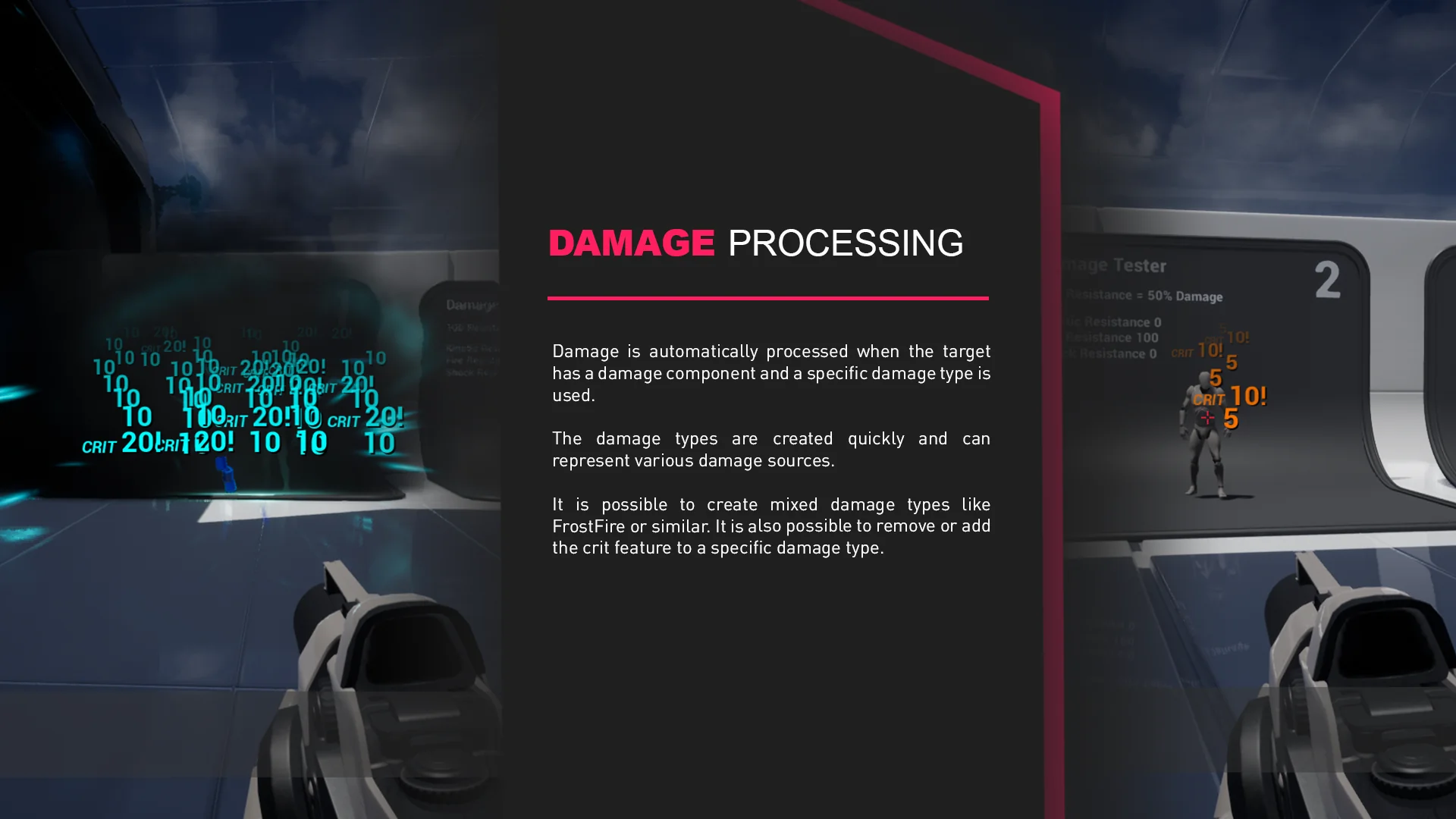
The damage side does not stop at subtracting a flat number. Calculations take resistance and penetration values into account, so a target's defence can reduce incoming damage while the attacker's penetration pushes back against that reduction. Crit chance and crit damage sit on top of the same calculation, giving abilities a chance to land harder hits without a second formula.
Crit is optional rather than mandatory. The feature can be deactivated, which keeps the calculation straightforward for projects that want deterministic damage and no random spikes — useful when balancing is done by hand or when a designer simply doesn't want crit variance in a particular game mode.
Mixed Damage Types and the FrostFire Case
Damage types can be combined so that a single hit draws on more than one resistance. The example the system uses is FrostFire, which is reduced equally by Frost Resistance and by Fire Resistance. Instead of picking one resistance to check, the hit is filtered through both, which makes hybrid abilities behave the way players expect them to: a target strong against fire but weak to frost takes a partial reduction rather than a full one or none at all.
That same structure lets a designer build out any pairing of damage types and attach the corresponding resistance values to it, so elemental systems, physical-versus-magical splits and stranger combinations all follow the same path through the calculator.
Resource Components for Mana, Health, Shields and Rage
Resource components cover the pools a character spends and refills: mana, health, shields, rage, or comparable resources. Each pool has its own settings, so a health bar and a rage meter do not have to share behaviour just because they both drain and refill.
The adjustable options include maximum value and the regeneration rules — delay before regeneration begins, the interval between ticks, and the value restored per tick. Together those three fields describe very different feelings: a shield that starts recovering almost immediately, a mana pool that punishes spending with a long wait, or a slow rage trickle that rewards patience.
Regeneration Delay, Interval and Value
Separating delay from interval is the detail that makes the regeneration model flexible. Delay controls how long the pool stays untouched after it is used, interval controls how often it climbs once recovery starts, and value controls how much each step adds. A designer tuning a health pool for a slow, tense recovery can stretch the delay while keeping the interval short, producing a gradual climb rather than a sudden refill.
Resources are also one of the places where the mixed damage model pays off. A shield pool fed by one ability, a health pool reduced by a FrostFire hit and a mana pool draining on every cast all report through the same component type, so combat code does not need a special case for each one.
Gameplay Effects, Stacks and Damage Over Time
Gameplay effects are the layer for anything temporary: buffs, debuffs, and damage-over-time effects that tick while they remain active. Where several effects of the same kind are running at once, they can stack, refresh, or both — a decision that changes how a repeated application behaves. A stacking bleed and a refreshing slow are two very different threats, and both are expressible here.
Effects can also fire events based on their stack size. That gives a designer a way to escalate: an effect that does something modest at one stack and something more significant as stacks accumulate, without writing a separate system to count them.
Stat Base Values and Modifiers That Change at Runtime
All values in the system can be adapted dynamically, including float values from every component — resistance, crit chance, regeneration delay and the rest. Nothing is locked at setup time, which means a stat can shift in response to gameplay and the calculations downstream will follow.
Base values act as the foundation for those calculations, and they can be changed by outside sources; an inventory is the example given, where equipping or removing an item alters the base a stat is measured from. Modifiers such as +30% are then applied on top of that base rather than replacing it, so a percentage bonus and a base-value change can coexist and be reasoned about separately. That separation is what keeps late-game stat inflation from turning into a pile of hard-coded overrides.
Who Gets the Most From the System
Teams building combat with typed damage, more than one resource pool per character, or buffs that stack and expire will find the most use here, because those are exactly the areas the components address. The independence of the parts matters for smaller projects too: a solo developer who only needs a regeneration-driven resource pool can take that component and leave the damage and effect machinery untouched.
Designers who expect to retune numbers — resistance curves, crit chance, regeneration pacing — will get more out of it than a project with fixed, hand-authored values, since the base-plus-modifier structure and the runtime adjustability assume that tuning will keep happening. Anyone evaluating it should look at the demo builds first, as they carry the newer features ahead of the version 1.22.6 preview.