"ae2217ad8e73450c"{"id":"1003014","slug":"character-stats-kit","title":"Character Stats Kit","category":"Gameplay Features","engine":"4.15+,5.0+","assetVersion":"","engineVersion":"Engine Version: 4.15+,5.0+","tag":"Gameplay Features","accent":"blue","visual":"character","summary":"Character Stats Kit supplies over 40 Blueprint nodes for classes, reputations, leveling, skill points, and passive mana, health, and hunger behaviour.","platform":"Unreal Engine","indexPolicy":"index","publishedAt":"2026-11-25T16:18:43.371Z","updatedAt":"2026-11-25T16:18:43.371Z","sourceNotes":[],"fileContents":[],"compatibility":["Unreal Engine","Engine Version: 4.15+,5.0+"],"featuredImage":{"alt":"Character Stats Kit","src":"/wp-content/uploads/published/2026/11/3ca1118ad267-732e4075-df26-42cd-870b-bf3f5093fdd8-b1302dfe55.webp"},"hasDownloadLink":true,"downloads":0,"terms":[{"taxonomy":"category","slug":"gameplay-features","name":"Gameplay Features"}],"galleryImages":[{"src":"/wp-content/uploads/published/2026/11/2032aaa29dc6-a6628e0c-caaf-4613-b772-18a98b368f27-ff004fef8a.webp","alt":"Character Stats Kit"},{"src":"/wp-content/uploads/published/2026/11/311383943099-7af2fe6b-dc33-4e56-9201-fa6713d65b3a-a3e0ea9e82.webp","alt":"Character Stats Kit"},{"src":"/wp-content/uploads/published/2026/11/c36785c8a58c-0672d0ee-4c3c-4239-b0f1-a5441aee238e-4731a88c77.webp","alt":"Character Stats Kit"},{"src":"/wp-content/uploads/published/2026/11/63b64fb936f7-7b3d73ed-7642-46c1-9e52-39d78888388a-ba48afbd6f.webp","alt":"Character Stats Kit"},{"src":"/wp-content/uploads/published/2026/11/6424748fac85-53632322-036c-4a4e-8dcf-70a53b368ce5-80c566171d.webp","alt":"Character Stats Kit"},{"src":"/wp-content/uploads/published/2026/11/abcbec542c28-e6eb8d2c-b75d-49b9-8aa6-f4663d4711a8-e55b0cf7ba.webp","alt":"Character Stats Kit"}],"accessPanel":{"kind":"resource","title":"Get this resource","safetyNote":"Resources are manually reviewed before listing to improve quality and reduce obvious risks.","fileName":"Content.7z","resourceType":"Resource archive","versions":[]},"contentHtml":"\u003cp\u003eA character can enter a scene with mana already draining, hunger falling, and health regenerating. A class choice can produce a fresh set of base stats, reputation can climb toward a new level, and a player can reset skill points while the game is still running. Character Stats Kit, a Blueprint resource with more than 40 nodes, covers those behaviours and the progression pieces around them.\u003c/p\u003e \u003ch2\u003eA Character Stats Kit That Keeps Values Moving\u003c/h2\u003e\n\u003cp\u003eThe scope runs from experience systems and reputations to skill points and stats. Reputation progress, crafting levels, general levels, and class levels all sit inside the same kit. So do live character values such as mana, health, and hunger. Rather than treating progression as a menu-only concern, the nodes connect to values that can be watched and changed during play.\u003c/p\u003e\n\u003cp\u003eModularity is the defining structural choice. The kit can be put together plug-and-play, with setup measured in minutes. A project can bring in the systems it needs and leave the rest aside; there is no requirement to wire every progression track at once. That makes the kit useful when a prototype needs a visible reputation bar, when a class system needs base stats, or when passive resource drain needs to run alongside health regeneration.\u003c/p\u003e \u003ch2\u003eClasses and Base Stats Generated on the Fly\u003c/h2\u003e\n\u003cp\u003eRanger, Warrior, Necromancer: those are the class examples that give the kit its shape. A class is not just a label attached to a character. Its base stats are dynamically generated, so the starting numbers come from the class setup. That gives a designer a way to make each class feel distinct before play begins, with the generated base forming the foundation for later leveling.\u003c/p\u003e\n\u003cp\u003eClass levels and general levels are separate progression ideas within the same scope, and crafting levels add another track. A game can therefore show advancement in more than one direction without building a separate interface and data path for each one. The class list named in the kit is only a starting point; the structure is built to describe Ranger, Warrior, Necromancer, and other classes in the same pattern.\u003c/p\u003e \u003ch2\u003eMana Drain, Hunger, Thirst, and Health Regeneration\u003c/h2\u003e\n\u003cp\u003ePassive usage gives the stat system a pulse. Mana can drain automatically, hunger or thirst can fall, and health can regenerate without a separate action from the player. These are not one-off values set at spawn; they are stats with behaviour attached. A mana pool that empties on its own creates a different rhythm from one that only changes when a button is pressed. Hunger and thirst add upkeep pressure. Auto-regenerating health changes how recovery is paced.\u003c/p\u003e\n\u003cp\u003eThose behaviours can coexist with the rest of the kit. A project can use passive drain for mana while using hunger or thirst as a slower resource, or let health regenerate alongside either one. The important detail is that the passive side is part of the same stat scope, not an unrelated add-on. Designers can tune the pace of a survival loop, a spellcasting loop, or a class resource without inventing a new mechanism for every stat.\u003c/p\u003e \u003ch2\u003eReputation Bars and Formula-Driven EXP\u003c/h2\u003e\n\u003cp\u003eReputation progress gets its own presentation: bars. Behind the bar sits a customizable formula that changes the EXP required per level. That formula is the control point. A fixed threshold would force every reputation track into the same ramp; a formula lets the EXP requirement change as levels rise. The result can be applied to reputation progress and to any progression display that shares the same bar logic.\u003c/p\u003e\n\u003cp\u003eExperience systems and reputations share the kit's scope, so the bar is not an isolated widget. It is a way to show advancement that is tied to the underlying EXP requirement. For a game with reputation progression, the formula-driven side keeps the bar meaningful across levels rather than only at the first step.\u003c/p\u003e \u003ch2\u003eLevel Settings, Skill Points, and Runtime Resets\u003c/h2\u003e\n\u003cp\u003eLevel settings cover the full path: starting level, leveling up, maximum level, and leveling down. Starting level defines where a character begins. Leveling up and maximum level define the upward range. Leveling down adds the opposite direction, which is a rarer inclusion and gives the system a way to handle loss as well as gain. Those settings are part of the same progression structure as the class and reputation systems.\u003c/p\u003e\n\u003cp\u003eSkill points have their own runtime behaviour. The skill point system can be reset during in-game play, so points can be cleared and reassigned without ending the session. That turns skill allocation into something a player can revisit while the game is running. The level controls and the skill point reset can sit in the same kit, which keeps progression and reallocation from becoming two unrelated pieces of logic.\u003c/p\u003e \u003ch2\u003eMultiplayer Support and Modular Scope\u003c/h2\u003e\n\u003cp\u003eMultiplayer support extends the kit beyond a single-player character sheet. More than one player can be present in the project, and the stat and progression systems are built to operate in that setting. The modular structure still applies: the kit's nodes are separated into pieces that can be assembled for the project's needs, and the plug-and-play setup is intended to take minutes.\u003c/p\u003e\n\u003cp\u003eThe node count gives a sense of the breadth. More than 40 nodes cover classes, reputations, levels, skill points, passive stat usage, and multiplayer support. A team can evaluate the kit by the systems it needs rather than by the whole list. A project with reputation bars and a level cap can use those pieces. A project with classes and passive mana drain can use those. The overlaps are there when the design calls for them.\u003c/p\u003e\n\u003cp\u003eFor a project that needs classes with generated base stats, reputation bars with a configurable EXP formula, level settings that include leveling down, skill point resets during play, and passive mana, hunger, thirst, or health behaviour, Character Stats Kit puts those pieces into one modular Blueprint resource with multiplayer support.\u003c/p\u003e\n\n\u003ch2\u003eRelated Resources Worth Checking\u003c/h2\u003e\n\u003cul\u003e\n\u003cli\u003e\u003ca href=\"https://3dcghub.com/player-farming-system/\" rel=\"noopener noreferrer\"\u003ePlayer Farming System\u003c/a\u003e\u003c/li\u003e\n\u003cli\u003e\u003ca href=\"https://3dcghub.com/fight-game-select-character/\" rel=\"noopener noreferrer\"\u003eFight Game Select Character\u003c/a\u003e\u003c/li\u003e\n\u003cli\u003e\u003ca href=\"https://3dcghub.com/dismemberment-kit-v2/\" rel=\"noopener noreferrer\"\u003eDismemberment Kit V2\u003c/a\u003e\u003c/li\u003e\n\u003cli\u003e\u003ca href=\"https://3dcghub.com/character-skills/\" rel=\"noopener noreferrer\"\u003eCharacter Skills\u003c/a\u003e\u003c/li\u003e\n\u003cli\u003e\u003ca href=\"https://3dcghub.com/ghost-trails/\" rel=\"noopener noreferrer\"\u003eGhost Trails\u003c/a\u003e\u003c/li\u003e\n\u003c/ul\u003e","contentTextLength":6043,"navigation":{"current":30,"total":4964,"previous":{"id":"1003015","slug":"cinematic-targeting","title":"Cinematic Targeting","category":"Gameplay Features","platform":"Unreal Engine","updatedAt":"2026-11-25T16:19:25.233Z"},"next":{"id":"1003013","slug":"character-skills","title":"Character Skills","category":"Gameplay Features","platform":"Unreal Engine","updatedAt":"2026-11-25T16:17:59.912Z"}},"relatedResources":[{"id":"1000865","slug":"player-farming-system","title":"Player Farming System","category":"Gameplay Features","engine":"5.3+","assetVersion":"","engineVersion":"Engine Version: 5.3+","tag":"Gameplay Features","accent":"blue","visual":"mech","summary":"Multiplayer farming Blueprint with plant stats, growth stages, sickness, socket placement, 7 plants, 3 tools, 3 planters, Survival Game Kit V2.","platform":"Unreal Engine","indexPolicy":"index","publishedAt":"2026-08-05T06:42:26.659Z","updatedAt":"2026-08-05T06:42:26.659Z","sourceNotes":[],"fileContents":[],"compatibility":["Unreal Engine","Engine Version: 5.3+"],"featuredImage":{"alt":"Player Farming System","src":"/wp-content/uploads/published/2026/08/41a79560e065-b4125912-9555-45fb-b37f-36aeb529a75e-d4ec89e558.webp"},"fileSizeBytes":392287655,"hasDownloadLink":true,"downloads":2},{"id":"1002304","slug":"fight-game-select-character","title":"Fight Game Select Character","category":"Gameplay Features","engine":"4.26+,5.0+","assetVersion":"","engineVersion":"Engine Version: 4.26+,5.0+","tag":"Gameplay Features","accent":"blue","visual":"character","summary":"A Blueprint kit for fighting games: data-table rosters and stages, an automatic 3D character select grid, start menu HUD, health and energy bars, and camera and","platform":"Unreal Engine","indexPolicy":"index","publishedAt":"2026-11-05T10:04:37.850Z","updatedAt":"2026-11-05T10:04:37.850Z","sourceNotes":[],"fileContents":[],"compatibility":["Unreal Engine","Engine Version: 4.26+,5.0+"],"featuredImage":{"alt":"Fight Game Select Character","src":"/wp-content/uploads/published/2026/11/a51b60b826d5-6c8f6a9a-58b2-415a-810d-3c6a7747031e-6ac7fc7c3a.webp"},"fileSizeBytes":50677138,"hasDownloadLink":true,"downloads":0},{"id":"10714","slug":"dismemberment-kit-v2","title":"Dismemberment Kit V2","category":"Gameplay Features","engine":"5.3+","assetVersion":"Engine version: 5.3+","engineVersion":"4.27","tag":"Gameplay Features","accent":"blue","visual":"character","summary":"Dismemberment Kit V2 provides a streamlined, plug-and-play solution for adding realistic gore to your characters. This fully replicated component allows for quick mesh swapping and animation integration.","platform":"Unreal Engine","indexPolicy":"index","publishedAt":"2026-03-03T16:02:30.000Z","updatedAt":"2026-04-19T15:49:56.000Z","sourceNotes":[],"fileContents":[],"compatibility":["Unreal Engine","Engine version: 5.3+"],"featuredImage":{"alt":"Dismemberment Kit V2","src":"https://3dcghub.com/wp-content/uploads/2026/03/b9cd95a1-bf2a-4ab7-8393-7b2f8b103bd9.webp"},"fileSizeBytes":83723313,"hasDownloadLink":true,"downloads":7}]}[{"id":4225,"sourceId":4225,"taxonomyId":4225,"taxonomy":"category","slug":"asset-library","name":"Asset Library","parentId":null,"count":4817,"hasChildren":true,"href":"/","seoTitle":"Free Game Assets Library | 3DCGHUB","seoDescription":"Browse free Unreal Engine, Unity, Blender assets and game development tutorials on 3DCGHUB with previews, compatibility notes, and secure downloads.","sitemapEnabled":true,"children":[{"id":4227,"sourceId":4227,"taxonomyId":4227,"taxonomy":"category","slug":"blender-add-ons-plugins","name":"Blender Add-ons \u0026 Plugins","parentId":4225,"count":10,"hasChildren":false,"href":"/category/blender-add-ons-plugins/","seoTitle":"Free Blender Add-ons \u0026 Plugins | 3DCGHUB","seoDescription":"Browse free Blender Add-ons \u0026 Plugins tools for Blender on 3DCGHUB: curated downloads with preview images, compatibility notes and secure download access.","sitemapEnabled":true},{"id":514,"sourceId":514,"taxonomyId":514,"taxonomy":"category","slug":"unity-2","name":"Unity","parentId":4225,"count":453,"hasChildren":true,"href":"/category/unity-2/","seoTitle":"Free Unity Assets | 3DCGHUB","seoDescription":"Browse free Unity resources on 3DCGHUB: curated downloads with preview images, compatibility notes and secure download access.","sitemapEnabled":true,"children":[{"id":523,"sourceId":523,"taxonomyId":523,"taxonomy":"category","slug":"2d","name":"2D","parentId":514,"count":1,"hasChildren":true,"href":"/category/2d/","seoTitle":"Free Unity 2D | 3DCGHUB","seoDescription":"Browse free 2D assets for Unity on 3DCGHUB: curated downloads with preview images, compatibility notes and secure download access.","sitemapEnabled":true},{"id":515,"sourceId":515,"taxonomyId":515,"taxonomy":"category","slug":"3d-unity-2","name":"3D","parentId":514,"count":162,"hasChildren":true,"href":"/category/3d-unity-2/","seoTitle":"Free Unity 3D Assets | 3DCGHUB","seoDescription":"Browse free 3D assets for Unity on 3DCGHUB: curated downloads with preview images, compatibility notes and secure download access.","sitemapEnabled":true},{"id":565,"sourceId":565,"taxonomyId":565,"taxonomy":"category","slug":"add-ons","name":"Add-Ons","parentId":514,"count":2,"hasChildren":false,"href":"/category/add-ons/","seoTitle":"Free Unity Add-Ons | 3DCGHUB","seoDescription":"Browse free Add-Ons assets for Unity on 3DCGHUB: curated downloads with preview images, compatibility notes and secure download access.","sitemapEnabled":true},{"id":529,"sourceId":529,"taxonomyId":529,"taxonomy":"category","slug":"audio-unity-2","name":"Audio","parentId":514,"count":1,"hasChildren":true,"href":"/category/audio-unity-2/","seoTitle":"Free Unity Audio | 3DCGHUB","seoDescription":"Browse free Audio for Unity on 3DCGHUB: curated downloads with preview images, compatibility notes and secure download access.","sitemapEnabled":true},{"id":557,"sourceId":557,"taxonomyId":557,"taxonomy":"category","slug":"templates","name":"Templates","parentId":514,"count":36,"hasChildren":true,"href":"/category/templates/","seoTitle":"Free Unity Templates | 3DCGHUB","seoDescription":"Browse free Unity project templates on 3DCGHUB. Starter kits with previews, compatibility notes, and secure download access.","sitemapEnabled":true},{"id":533,"sourceId":533,"taxonomyId":533,"taxonomy":"category","slug":"tools-unity-2","name":"Tools","parentId":514,"count":0,"hasChildren":true,"href":"/category/tools-unity-2/","sitemapEnabled":true},{"id":554,"sourceId":554,"taxonomyId":554,"taxonomy":"category","slug":"vfx-unity-2","name":"VFX","parentId":514,"count":4,"hasChildren":true,"href":"/category/vfx-unity-2/","seoTitle":"Free Unity VFX | 3DCGHUB","seoDescription":"Browse free VFX for Unity on 3DCGHUB: curated downloads with preview images, compatibility notes and secure download access.","sitemapEnabled":true}]},{"id":511,"sourceId":511,"taxonomyId":511,"taxonomy":"category","slug":"unreal-engine-2","name":"Unreal Engine","parentId":4225,"count":4355,"hasChildren":true,"href":"/category/unreal-engine-2/","seoTitle":"Free Unreal Engine Assets | 3DCGHUB","seoDescription":"Browse free Unreal Engine resources on 3DCGHUB: curated downloads with preview images, compatibility notes and secure download access.","sitemapEnabled":true,"children":[{"id":54,"sourceId":54,"taxonomyId":54,"taxonomy":"category","slug":"3d","name":"3D","parentId":511,"count":2441,"hasChildren":true,"href":"/category/3d/","seoTitle":"Free Unreal Engine 3D | 3DCGHUB","seoDescription":"Browse free 3D assets for Unreal Engine on 3DCGHUB: curated downloads with preview images, compatibility notes and secure download access.","sitemapEnabled":true},{"id":441,"sourceId":441,"taxonomyId":441,"taxonomy":"category","slug":"animations","name":"Animations","parentId":511,"count":269,"hasChildren":true,"href":"/category/animations/","seoTitle":"Free Unreal Engine Animations | 3DCGHUB","seoDescription":"Browse free Animations for Unreal Engine on 3DCGHUB: curated downloads with preview images, compatibility notes and secure download access.","sitemapEnabled":true},{"id":446,"sourceId":446,"taxonomyId":446,"taxonomy":"category","slug":"audio","name":"Audio","parentId":511,"count":63,"hasChildren":true,"href":"/category/audio/","seoTitle":"Free Unreal Engine Audio Resources | 3DCGHUB","seoDescription":"Browse free Unreal Engine audio resources including sound effects, voices, dialogue, and ambient sounds. Curated free downloads on 3DCGHUB.","sitemapEnabled":true},{"id":466,"sourceId":466,"taxonomyId":466,"taxonomy":"category","slug":"game-systems","name":"Game Systems","parentId":511,"count":381,"hasChildren":true,"href":"/category/game-systems/","seoTitle":"Free Unreal Engine Game Systems | 3DCGHUB","seoDescription":"Browse free Game Systems tools for Unreal Engine on 3DCGHUB: curated downloads with preview images, compatibility notes and secure download access.","sitemapEnabled":true},{"id":478,"sourceId":478,"taxonomyId":478,"taxonomy":"category","slug":"game-templates","name":"Game Templates","parentId":511,"count":155,"hasChildren":true,"href":"/category/game-templates/","seoTitle":"Free Unreal Engine Game Templates | 3DCGHUB","seoDescription":"Browse free Game Templates for Unreal Engine on 3DCGHUB: curated downloads with preview images, compatibility notes and secure download access.","sitemapEnabled":true},{"id":432,"sourceId":432,"taxonomyId":432,"taxonomy":"category","slug":"hdri","name":"HDRI","parentId":511,"count":6,"hasChildren":true,"href":"/category/hdri/","seoTitle":"Free Unreal Engine HDRI | 3DCGHUB","seoDescription":"Browse free Unreal Engine HDRI skies and lighting maps on 3DCGHUB. Environment lighting with previews and secure downloads.","sitemapEnabled":true},{"id":228,"sourceId":228,"taxonomyId":228,"taxonomy":"category","slug":"material-and-textures","name":"Material \u0026 Textures","parentId":511,"count":172,"hasChildren":true,"href":"/category/material-and-textures/","seoTitle":"Free Unreal Engine Material \u0026 Textures | 3DCGHUB","seoDescription":"Browse free Material \u0026 Textures for Unreal Engine on 3DCGHUB: curated downloads with preview images, compatibility notes and secure download access.","sitemapEnabled":true},{"id":298,"sourceId":298,"taxonomyId":298,"taxonomy":"category","slug":"sprites-and-flipbooks","name":"Sprites \u0026 Flipbooks","parentId":511,"count":18,"hasChildren":true,"href":"/category/sprites-and-flipbooks/","seoTitle":"Free Unreal Engine Sprites \u0026 Flipbooks | 3DCGHUB","seoDescription":"Browse free Sprites \u0026 Flipbooks assets for Unreal Engine on 3DCGHUB: curated downloads with preview images, compatibility notes and secure download access.","sitemapEnabled":true},{"id":489,"sourceId":489,"taxonomyId":489,"taxonomy":"category","slug":"tools-and-plugins","name":"Tools \u0026 Plugins","parentId":511,"count":390,"hasChildren":true,"href":"/category/tools-and-plugins/","seoTitle":"Free Unreal Engine Tools \u0026 Plugins | 3DCGHUB","seoDescription":"Browse free Tools \u0026 Plugins for Unreal Engine on 3DCGHUB: curated downloads with preview images, compatibility notes and secure download access.","sitemapEnabled":true},{"id":459,"sourceId":459,"taxonomyId":459,"taxonomy":"category","slug":"ui","name":"UI","parentId":511,"count":47,"hasChildren":true,"href":"/category/ui/","seoTitle":"Free Unreal Engine UI | 3DCGHUB","seoDescription":"Browse free UI for Unreal Engine on 3DCGHUB: curated downloads with preview images, compatibility notes and secure download access.","sitemapEnabled":true},{"id":450,"sourceId":450,"taxonomyId":450,"taxonomy":"category","slug":"vfx","name":"VFX","parentId":511,"count":413,"hasChildren":true,"href":"/category/vfx/","seoTitle":"Free Unreal Engine VFX | 3DCGHUB","seoDescription":"Browse free VFX for Unreal Engine on 3DCGHUB: curated downloads with preview images, compatibility notes and secure download access.","sitemapEnabled":true}]}]},{"id":4222,"sourceId":4222,"taxonomyId":4222,"taxonomy":"category","slug":"tutorial-library","name":"Tutorial Library","parentId":null,"count":117,"hasChildren":false,"href":"/tutorials/","seoTitle":"Free Game Development Tutorial Library | 3DCGHUB","seoDescription":"Browse free game development tutorials for Unreal Engine, Unity, Blender, and more on 3DCGHUB with practical workflows and secure downloads.","sitemapEnabled":true}]
Resource screenshots
1 / 6
Asset drops
Daily Asset Drops
Follow 3DCGHUB on Telegram for daily Unreal, Unity & Blender drops and curated CC0 releases.
A character can enter a scene with mana already draining, hunger falling, and health regenerating. A class choice can produce a fresh set of base stats, reputation can climb toward a new level, and a player can reset skill points while the game is still running. Character Stats Kit, a Blueprint resource with more than 40 nodes, covers those behaviours and the progression pieces around them.
A Character Stats Kit That Keeps Values Moving
The scope runs from experience systems and reputations to skill points and stats. Reputation progress, crafting levels, general levels, and class levels all sit inside the same kit. So do live character values such as mana, health, and hunger. Rather than treating progression as a menu-only concern, the nodes connect to values that can be watched and changed during play.
Modularity is the defining structural choice. The kit can be put together plug-and-play, with setup measured in minutes. A project can bring in the systems it needs and leave the rest aside; there is no requirement to wire every progression track at once. That makes the kit useful when a prototype needs a visible reputation bar, when a class system needs base stats, or when passive resource drain needs to run alongside health regeneration.
Classes and Base Stats Generated on the Fly
Ranger, Warrior, Necromancer: those are the class examples that give the kit its shape. A class is not just a label attached to a character. Its base stats are dynamically generated, so the starting numbers come from the class setup. That gives a designer a way to make each class feel distinct before play begins, with the generated base forming the foundation for later leveling.
Class levels and general levels are separate progression ideas within the same scope, and crafting levels add another track. A game can therefore show advancement in more than one direction without building a separate interface and data path for each one. The class list named in the kit is only a starting point; the structure is built to describe Ranger, Warrior, Necromancer, and other classes in the same pattern.
Mana Drain, Hunger, Thirst, and Health Regeneration
Passive usage gives the stat system a pulse. Mana can drain automatically, hunger or thirst can fall, and health can regenerate without a separate action from the player. These are not one-off values set at spawn; they are stats with behaviour attached. A mana pool that empties on its own creates a different rhythm from one that only changes when a button is pressed. Hunger and thirst add upkeep pressure. Auto-regenerating health changes how recovery is paced.
Those behaviours can coexist with the rest of the kit. A project can use passive drain for mana while using hunger or thirst as a slower resource, or let health regenerate alongside either one. The important detail is that the passive side is part of the same stat scope, not an unrelated add-on. Designers can tune the pace of a survival loop, a spellcasting loop, or a class resource without inventing a new mechanism for every stat.
Reputation Bars and Formula-Driven EXP
Reputation progress gets its own presentation: bars. Behind the bar sits a customizable formula that changes the EXP required per level. That formula is the control point. A fixed threshold would force every reputation track into the same ramp; a formula lets the EXP requirement change as levels rise. The result can be applied to reputation progress and to any progression display that shares the same bar logic.
Experience systems and reputations share the kit's scope, so the bar is not an isolated widget. It is a way to show advancement that is tied to the underlying EXP requirement. For a game with reputation progression, the formula-driven side keeps the bar meaningful across levels rather than only at the first step.
Level Settings, Skill Points, and Runtime Resets
Level settings cover the full path: starting level, leveling up, maximum level, and leveling down. Starting level defines where a character begins. Leveling up and maximum level define the upward range. Leveling down adds the opposite direction, which is a rarer inclusion and gives the system a way to handle loss as well as gain. Those settings are part of the same progression structure as the class and reputation systems.
Skill points have their own runtime behaviour. The skill point system can be reset during in-game play, so points can be cleared and reassigned without ending the session. That turns skill allocation into something a player can revisit while the game is running. The level controls and the skill point reset can sit in the same kit, which keeps progression and reallocation from becoming two unrelated pieces of logic.
Multiplayer Support and Modular Scope
Multiplayer support extends the kit beyond a single-player character sheet. More than one player can be present in the project, and the stat and progression systems are built to operate in that setting. The modular structure still applies: the kit's nodes are separated into pieces that can be assembled for the project's needs, and the plug-and-play setup is intended to take minutes.
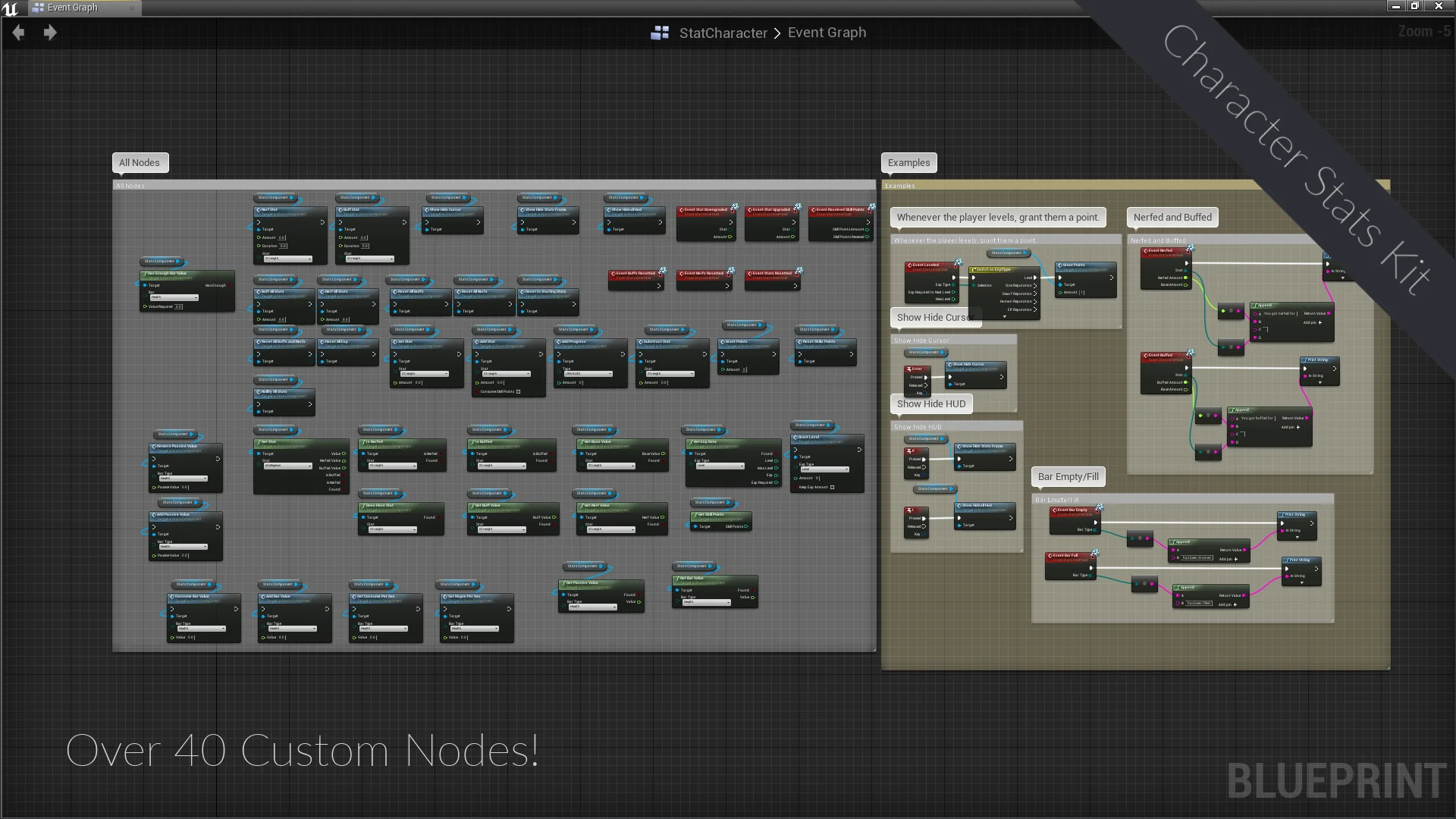
The node count gives a sense of the breadth. More than 40 nodes cover classes, reputations, levels, skill points, passive stat usage, and multiplayer support. A team can evaluate the kit by the systems it needs rather than by the whole list. A project with reputation bars and a level cap can use those pieces. A project with classes and passive mana drain can use those. The overlaps are there when the design calls for them.
For a project that needs classes with generated base stats, reputation bars with a configurable EXP formula, level settings that include leveling down, skill point resets during play, and passive mana, hunger, thirst, or health behaviour, Character Stats Kit puts those pieces into one modular Blueprint resource with multiplayer support.
 Gameplay Features
 Gameplay Features
 Gameplay Features