"ae2217ad8e73450c"{"id":"1003007","slug":"ccg-toolkit","title":"CCG Toolkit","category":"Card Game","engine":"4.26+,5.0+","assetVersion":"","engineVersion":"Engine Version: 4.26+,5.0+","tag":"Card Game","accent":"blue","visual":"mech","summary":"CCG Toolkit is a Blueprint card game framework with multiplayer support, deck building, card game AI, 35+ example cards, and seven included arenas.","platform":"Unreal Engine","indexPolicy":"index","publishedAt":"2026-11-25T16:13:16.010Z","updatedAt":"2026-11-25T16:13:16.010Z","sourceNotes":[],"fileContents":[],"compatibility":["Unreal Engine","Engine Version: 4.26+,5.0+"],"featuredImage":{"alt":"CCG Toolkit","src":"/wp-content/uploads/published/2026/11/39f4d869d7b1-da0942bb-55d6-44b7-9c6b-225f53ce126e-eebc32b6d4.webp"},"hasDownloadLink":true,"downloads":0,"terms":[{"taxonomy":"category","slug":"card-game","name":"Card Game"}],"galleryImages":[{"src":"/wp-content/uploads/published/2026/11/1949d15c2e5f-6d48f456-2704-4d9d-9bd5-97db3a0e621d-006b8491b6.webp","alt":"CCG Toolkit"},{"src":"/wp-content/uploads/published/2026/11/b2c92e199537-5420aa89-26b6-40d4-b96b-2465a16d20b2-70b5fae47b.webp","alt":"CCG Toolkit"},{"src":"/wp-content/uploads/published/2026/11/2f412541c22a-e4dbfd93-eb88-4a8a-a504-034009fc8b59-e3b512c85f.webp","alt":"CCG Toolkit"},{"src":"/wp-content/uploads/published/2026/11/f69645d0f55a-f8088092-880d-4066-a172-2a61c91ad54a-1e71eb3367.webp","alt":"CCG Toolkit"},{"src":"/wp-content/uploads/published/2026/11/428fe0dd6635-9b950d1f-7fab-4206-b40a-d3816f8edac9-598469e97e.webp","alt":"CCG Toolkit"},{"src":"/wp-content/uploads/published/2026/11/eb7c15e70a64-a2e3ba10-f7c5-4256-a5eb-b314d5f4105f-5939018da2.webp","alt":"CCG Toolkit"},{"src":"/wp-content/uploads/published/2026/11/537f35fb5b3e-4014bbe6-50bb-44bf-8080-96cb891c113f-151da3999f.webp","alt":"CCG Toolkit"}],"accessPanel":{"kind":"resource","title":"Get this resource","safetyNote":"Resources are manually reviewed before listing to improve quality and reduce obvious risks.","fileName":"CCG Toolkit.7z","resourceType":"Resource archive","versions":[]},"contentHtml":"\u003cp\u003eCard games look simple on the table and turn complicated the moment they go digital. Shuffling, weighings, turn order, mana, targeting, the graveyard, and keeping all of it in sync between two players are separate systems that each need to exist before a single match feels right. The CCG Toolkit approaches that pile as one framework: a 100% Blueprint package covering single and multiplayer card games, meant either for a fresh idea or for an existing tabletop design that needs a digital version.\u003c/p\u003e \u003ch2\u003eWhat the CCG Toolkit Hands You on Day One\u003c/h2\u003e \u003cp\u003eThe first thing to understand is that nothing here is split between code and editor. The framework is authored entirely in Blueprint, so the systems you extend are the same graphs you can open, read, and rewire.\u003c/p\u003e \u003cp\u003eMultiplayer support is part of the base rather than an add-on bolted on later, and the gameplay layer beneath it is turn-based. That combination shapes how everything else in the package behaves: card interactions, board players, and the timers that bound a turn all sit inside a structure that assumes more than one participant and a defined sequence of play.\u003c/p\u003e \u003ch2\u003eCard Creation and the Card Manager\u003c/h2\u003e \u003cp\u003eCard creation is deliberately open-ended. Cards are highly customizable, and the package ships with card sets containing more than 35 example cards, so there is a working reference for how a finished card is assembled before you build your own.\u003c/p\u003e \u003cp\u003eArt support covers both 2D and 3D card art and assets, which matters if your design calls for flat illustrated faces in one place and physical, three-dimensional cards on the board in another.\u003c/p\u003e \u003cp\u003eThe Card Manager is the piece that governs where cards sit. It carries interchangeable positioning profiles, and the toolkit includes an in-game card positioning editor alongside other game tools. Rather than hard-coding a card's transform and recompiling to check it, positioning becomes something you can adjust while the game is running, and profiles can be swapped to change how placement works. Customizable card placement extends that same flexibility to how cards are laid out during play.\u003c/p\u003e \u003ch2\u003eDeck Builder and the Deck Generator Workflow\u003c/h2\u003e \u003cp\u003eDeck construction gets two separate tools that serve different moments. The deck builder is the player-facing side: create, edit, and save custom decks, with no stated cap on how many can exist. That means a collection of saved lists beyond one fixed deck per session.\u003c/p\u003e \u003cp\u003eThe deck generator handles what happens once a deck enters play. It filters, shuffles, and weighs cards. Filtering and shuffling are the expected parts; weighing is the more interesting one, since it gives the deck a way to treat cards differently from one another rather than as a flat randomized pile.\u003c/p\u003e \u003cp\u003eAround the deck itself sit the smaller conveniences that make a hand readable — mouse-over card previews for inspecting a card without committing to it, and a card graveyard that keeps discarded or destroyed cards tracked instead of simply vanishing.\u003c/p\u003e \u003ch2\u003eAI Opponents, Abilities, and Turn Flow\u003c/h2\u003e \u003cp\u003eThe included card game AI is customizable and comes with a debug UI, so opponent behaviour can be observed and adjusted rather than treated as a black box. For anyone building a single-player mode first, that pairing is the difference between guessing why the AI played a card and being able to see it.\u003c/p\u003e \u003cp\u003eMore than 10 card abilities are included, each with multiple settings variations. The variation part is what makes the ability set usable beyond its examples: the same ability can be configured into several behaviours instead of requiring a new one each time a card needs a slightly different effect.\u003c/p\u003e \u003cp\u003eTurn structure is handled by a turn-based gameplay system with turn and game timers, supported by player health and mana systems. Cards and board players interact directly, and basic card movement comes with visual gameplay cues so that actions read clearly on screen. Basic win and lose conditions close out a match.\u003c/p\u003e \u003ch2\u003eArenas, Menus, and the Supporting Tools\u003c/h2\u003e \u003cp\u003eSeven arenas are included, giving a match somewhere to happen without building an environment first. Getting into those arenas is handled by a simple menu set covering the main menu, deck selection, arena selection, and server selection — the last of which lines up with the multiplayer foundation.\u003c/p\u003e \u003cp\u003eTwo utilities round out the package. An in-game notifications manager handles messaging during play, and several custom function libraries collect reusable logic that the rest of the framework draws on.\u003c/p\u003e \u003ch2\u003eWhere the CCG Toolkit Fits in a Production\u003c/h2\u003e \u003cp\u003eThe clearest fit is a project that already knows its rules and needs the surrounding machinery: a tabletop design being carried into digital space, or a card game concept that has to reach a playable build before anyone can judge whether the loop works. Prototyping is the obvious first stop, because deck creation, card positioning, abilities, and AI configuration can all be tested in-game rather than through repeated rebuilds.\u003c/p\u003e \u003cp\u003eIt also suits teams that want a multiplayer, turn-based card foundation they can read and modify in Blueprint instead of inheriting an opaque system. The example card sets, the arenas, and the debug UI make it a workable reference for developers still learning how the pieces of a digital card game connect — the framework is pitched at an advanced level, but the included content gives you something concrete to take apart. Build the first match, then replace the examples with your own cards, decks, and abilities as the design settles.\u003c/p\u003e\n\n\u003ch2\u003eContinue Browsing Similar Packs\u003c/h2\u003e\n\u003cul\u003e\n\u003cli\u003e\u003ca href=\"https://3dcghub.com/tick-optimization-toolkit/\" rel=\"noopener noreferrer\"\u003eTick Optimization Toolkit\u003c/a\u003e\u003c/li\u003e\n\u003cli\u003e\u003ca href=\"https://3dcghub.com/advanced-turn-based-tile-toolkit/\" rel=\"noopener noreferrer\"\u003eAdvanced Turn Based Tile Toolkit\u003c/a\u003e\u003c/li\u003e\n\u003cli\u003e\u003ca href=\"https://3dcghub.com/multiplayer-fps-procedural-animation-toolkit/\" rel=\"noopener noreferrer\"\u003eMultiplayer FPS Procedural Animation Toolkit\u003c/a\u003e\u003c/li\u003e\n\u003cli\u003e\u003ca href=\"https://3dcghub.com/open-world-rpg-toolkit/\" rel=\"noopener noreferrer\"\u003eOpen World RPG Toolkit\u003c/a\u003e\u003c/li\u003e\n\u003cli\u003e\u003ca href=\"https://3dcghub.com/the-flashlight-toolkit/\" rel=\"noopener noreferrer\"\u003eThe Flashlight Toolkit\u003c/a\u003e\u003c/li\u003e\n\u003c/ul\u003e","contentTextLength":5651,"navigation":{"current":37,"total":4964,"previous":{"id":"1003008","slug":"chainsaw-attacks","title":"Chainsaw Attacks","category":"Combat","platform":"Unreal Engine","updatedAt":"2026-11-25T16:14:04.749Z"},"next":{"id":"1003006","slug":"card-puzzle-template-for-pc-and-mobile","title":"Card Puzzle Template for PC and Mobile","category":"Gameplay Features","platform":"Unreal Engine","updatedAt":"2026-11-25T16:12:27.091Z"}},"relatedResources":[{"id":"24974","slug":"tick-optimization-toolkit","title":"Tick Optimization Toolkit","category":"Engine Tools","engine":"5.3 - 5.6","assetVersion":"Asset Version: 1.4.4 - 1.4.5","engineVersion":"Engine Version: 5.3 - 5.6","tag":"Engine Tools","accent":"blue","visual":"audio","summary":"Tick Optimization Toolkit reduces the cost of ticking in actors, components, and timelines by adjusting frequency or disabling updates through distance and visibility. It keeps the workflow in Blueprints, with C++ support available and multiplayer features...","platform":"Unreal Engine","indexPolicy":"index","publishedAt":"2026-04-17T15:42:20.000Z","updatedAt":"2026-11-21T20:55:08.818Z","sourceNotes":[],"fileContents":[],"compatibility":["Unreal Engine","Asset Version: 1.4.4 - 1.4.5","Engine Version: 5.3 - 5.6"],"featuredImage":{"alt":"Tick Optimization Toolkit","src":"https://3dcghub.com/wp-content/uploads/2026/04/4cc7de927306_2a609578-563a-4cd8-88f7-0d22fce14eb2.webp"},"fileSizeBytes":52894032,"hasDownloadLink":true,"downloads":1},{"id":"1001043","slug":"advanced-turn-based-tile-toolkit","title":"Advanced Turn Based Tile Toolkit","category":"RPG","engine":"5.3+","assetVersion":"Asset Version: 3.5.4","engineVersion":"Engine Version: 5.3+","tag":"RPG","accent":"blue","visual":"mech","summary":"A UE4 toolkit for turn-based tactics with grid pathfinding, square and hexagonal grids, tactical AI, visibility, multiplayer, and multiple example maps.","platform":"Unreal Engine","indexPolicy":"index","publishedAt":"2026-08-27T14:35:27.571Z","updatedAt":"2026-08-27T14:35:27.571Z","sourceNotes":[],"fileContents":[],"compatibility":["Unreal Engine","Asset Version: 3.5.4","Engine Version: 5.3+"],"featuredImage":{"alt":"Advanced Turn Based Tile Toolkit","src":"/wp-content/uploads/published/2026/08/0ce862fc44e6-a214e5d5-e57d-4591-ae11-96db49501f2d-402e714e02.webp"},"fileSizeBytes":654302272,"hasDownloadLink":true,"downloads":0},{"id":"1002124","slug":"multiplayer-fps-procedural-animation-toolkit","title":"Multiplayer FPS Procedural Animation Toolkit","category":"Network \u0026 Multiplayer","engine":"5.0","assetVersion":"Asset Version: 1.0","engineVersion":"Engine Version: 5.0","tag":"Network","accent":"blue","visual":"animation","summary":"Examine the Multiplayer FPS Procedural Animation Toolkit, covering C++ procedural recoil, socket-based aiming, character component setup, and multiplayer replic","platform":"Unreal Engine","indexPolicy":"index","publishedAt":"2026-10-29T09:04:51.154Z","updatedAt":"2026-10-29T09:04:51.154Z","sourceNotes":[],"fileContents":[],"compatibility":["Unreal Engine","Asset Version: 1.0","Engine Version: 5.0"],"featuredImage":{"alt":"Multiplayer FPS Procedural Animation Toolkit","src":"/wp-content/uploads/published/2026/10/2fcdafd7f87f-817ca7b9-9cb8-4982-9a44-338089bb88d1-a98b77170d.webp"},"fileSizeBytes":529682819,"hasDownloadLink":true,"downloads":0}]}[{"id":4225,"sourceId":4225,"taxonomyId":4225,"taxonomy":"category","slug":"asset-library","name":"Asset Library","parentId":null,"count":4817,"hasChildren":true,"href":"/","seoTitle":"Free Game Assets Library | 3DCGHUB","seoDescription":"Browse free Unreal Engine, Unity, Blender assets and game development tutorials on 3DCGHUB with previews, compatibility notes, and secure downloads.","sitemapEnabled":true,"children":[{"id":4227,"sourceId":4227,"taxonomyId":4227,"taxonomy":"category","slug":"blender-add-ons-plugins","name":"Blender Add-ons \u0026 Plugins","parentId":4225,"count":10,"hasChildren":false,"href":"/category/blender-add-ons-plugins/","seoTitle":"Free Blender Add-ons \u0026 Plugins | 3DCGHUB","seoDescription":"Browse free Blender Add-ons \u0026 Plugins tools for Blender on 3DCGHUB: curated downloads with preview images, compatibility notes and secure download access.","sitemapEnabled":true},{"id":514,"sourceId":514,"taxonomyId":514,"taxonomy":"category","slug":"unity-2","name":"Unity","parentId":4225,"count":453,"hasChildren":true,"href":"/category/unity-2/","seoTitle":"Free Unity Assets | 3DCGHUB","seoDescription":"Browse free Unity resources on 3DCGHUB: curated downloads with preview images, compatibility notes and secure download access.","sitemapEnabled":true,"children":[{"id":523,"sourceId":523,"taxonomyId":523,"taxonomy":"category","slug":"2d","name":"2D","parentId":514,"count":1,"hasChildren":true,"href":"/category/2d/","seoTitle":"Free Unity 2D | 3DCGHUB","seoDescription":"Browse free 2D assets for Unity on 3DCGHUB: curated downloads with preview images, compatibility notes and secure download access.","sitemapEnabled":true},{"id":515,"sourceId":515,"taxonomyId":515,"taxonomy":"category","slug":"3d-unity-2","name":"3D","parentId":514,"count":162,"hasChildren":true,"href":"/category/3d-unity-2/","seoTitle":"Free Unity 3D Assets | 3DCGHUB","seoDescription":"Browse free 3D assets for Unity on 3DCGHUB: curated downloads with preview images, compatibility notes and secure download access.","sitemapEnabled":true},{"id":565,"sourceId":565,"taxonomyId":565,"taxonomy":"category","slug":"add-ons","name":"Add-Ons","parentId":514,"count":2,"hasChildren":false,"href":"/category/add-ons/","seoTitle":"Free Unity Add-Ons | 3DCGHUB","seoDescription":"Browse free Add-Ons assets for Unity on 3DCGHUB: curated downloads with preview images, compatibility notes and secure download access.","sitemapEnabled":true},{"id":529,"sourceId":529,"taxonomyId":529,"taxonomy":"category","slug":"audio-unity-2","name":"Audio","parentId":514,"count":1,"hasChildren":true,"href":"/category/audio-unity-2/","seoTitle":"Free Unity Audio | 3DCGHUB","seoDescription":"Browse free Audio for Unity on 3DCGHUB: curated downloads with preview images, compatibility notes and secure download access.","sitemapEnabled":true},{"id":557,"sourceId":557,"taxonomyId":557,"taxonomy":"category","slug":"templates","name":"Templates","parentId":514,"count":36,"hasChildren":true,"href":"/category/templates/","seoTitle":"Free Unity Templates | 3DCGHUB","seoDescription":"Browse free Unity project templates on 3DCGHUB. Starter kits with previews, compatibility notes, and secure download access.","sitemapEnabled":true},{"id":533,"sourceId":533,"taxonomyId":533,"taxonomy":"category","slug":"tools-unity-2","name":"Tools","parentId":514,"count":0,"hasChildren":true,"href":"/category/tools-unity-2/","sitemapEnabled":true},{"id":554,"sourceId":554,"taxonomyId":554,"taxonomy":"category","slug":"vfx-unity-2","name":"VFX","parentId":514,"count":4,"hasChildren":true,"href":"/category/vfx-unity-2/","seoTitle":"Free Unity VFX | 3DCGHUB","seoDescription":"Browse free VFX for Unity on 3DCGHUB: curated downloads with preview images, compatibility notes and secure download access.","sitemapEnabled":true}]},{"id":511,"sourceId":511,"taxonomyId":511,"taxonomy":"category","slug":"unreal-engine-2","name":"Unreal Engine","parentId":4225,"count":4355,"hasChildren":true,"href":"/category/unreal-engine-2/","seoTitle":"Free Unreal Engine Assets | 3DCGHUB","seoDescription":"Browse free Unreal Engine resources on 3DCGHUB: curated downloads with preview images, compatibility notes and secure download access.","sitemapEnabled":true,"children":[{"id":54,"sourceId":54,"taxonomyId":54,"taxonomy":"category","slug":"3d","name":"3D","parentId":511,"count":2441,"hasChildren":true,"href":"/category/3d/","seoTitle":"Free Unreal Engine 3D | 3DCGHUB","seoDescription":"Browse free 3D assets for Unreal Engine on 3DCGHUB: curated downloads with preview images, compatibility notes and secure download access.","sitemapEnabled":true},{"id":441,"sourceId":441,"taxonomyId":441,"taxonomy":"category","slug":"animations","name":"Animations","parentId":511,"count":269,"hasChildren":true,"href":"/category/animations/","seoTitle":"Free Unreal Engine Animations | 3DCGHUB","seoDescription":"Browse free Animations for Unreal Engine on 3DCGHUB: curated downloads with preview images, compatibility notes and secure download access.","sitemapEnabled":true},{"id":446,"sourceId":446,"taxonomyId":446,"taxonomy":"category","slug":"audio","name":"Audio","parentId":511,"count":63,"hasChildren":true,"href":"/category/audio/","seoTitle":"Free Unreal Engine Audio Resources | 3DCGHUB","seoDescription":"Browse free Unreal Engine audio resources including sound effects, voices, dialogue, and ambient sounds. Curated free downloads on 3DCGHUB.","sitemapEnabled":true},{"id":466,"sourceId":466,"taxonomyId":466,"taxonomy":"category","slug":"game-systems","name":"Game Systems","parentId":511,"count":381,"hasChildren":true,"href":"/category/game-systems/","seoTitle":"Free Unreal Engine Game Systems | 3DCGHUB","seoDescription":"Browse free Game Systems tools for Unreal Engine on 3DCGHUB: curated downloads with preview images, compatibility notes and secure download access.","sitemapEnabled":true},{"id":478,"sourceId":478,"taxonomyId":478,"taxonomy":"category","slug":"game-templates","name":"Game Templates","parentId":511,"count":155,"hasChildren":true,"href":"/category/game-templates/","seoTitle":"Free Unreal Engine Game Templates | 3DCGHUB","seoDescription":"Browse free Game Templates for Unreal Engine on 3DCGHUB: curated downloads with preview images, compatibility notes and secure download access.","sitemapEnabled":true},{"id":432,"sourceId":432,"taxonomyId":432,"taxonomy":"category","slug":"hdri","name":"HDRI","parentId":511,"count":6,"hasChildren":true,"href":"/category/hdri/","seoTitle":"Free Unreal Engine HDRI | 3DCGHUB","seoDescription":"Browse free Unreal Engine HDRI skies and lighting maps on 3DCGHUB. Environment lighting with previews and secure downloads.","sitemapEnabled":true},{"id":228,"sourceId":228,"taxonomyId":228,"taxonomy":"category","slug":"material-and-textures","name":"Material \u0026 Textures","parentId":511,"count":172,"hasChildren":true,"href":"/category/material-and-textures/","seoTitle":"Free Unreal Engine Material \u0026 Textures | 3DCGHUB","seoDescription":"Browse free Material \u0026 Textures for Unreal Engine on 3DCGHUB: curated downloads with preview images, compatibility notes and secure download access.","sitemapEnabled":true},{"id":298,"sourceId":298,"taxonomyId":298,"taxonomy":"category","slug":"sprites-and-flipbooks","name":"Sprites \u0026 Flipbooks","parentId":511,"count":18,"hasChildren":true,"href":"/category/sprites-and-flipbooks/","seoTitle":"Free Unreal Engine Sprites \u0026 Flipbooks | 3DCGHUB","seoDescription":"Browse free Sprites \u0026 Flipbooks assets for Unreal Engine on 3DCGHUB: curated downloads with preview images, compatibility notes and secure download access.","sitemapEnabled":true},{"id":489,"sourceId":489,"taxonomyId":489,"taxonomy":"category","slug":"tools-and-plugins","name":"Tools \u0026 Plugins","parentId":511,"count":390,"hasChildren":true,"href":"/category/tools-and-plugins/","seoTitle":"Free Unreal Engine Tools \u0026 Plugins | 3DCGHUB","seoDescription":"Browse free Tools \u0026 Plugins for Unreal Engine on 3DCGHUB: curated downloads with preview images, compatibility notes and secure download access.","sitemapEnabled":true},{"id":459,"sourceId":459,"taxonomyId":459,"taxonomy":"category","slug":"ui","name":"UI","parentId":511,"count":47,"hasChildren":true,"href":"/category/ui/","seoTitle":"Free Unreal Engine UI | 3DCGHUB","seoDescription":"Browse free UI for Unreal Engine on 3DCGHUB: curated downloads with preview images, compatibility notes and secure download access.","sitemapEnabled":true},{"id":450,"sourceId":450,"taxonomyId":450,"taxonomy":"category","slug":"vfx","name":"VFX","parentId":511,"count":413,"hasChildren":true,"href":"/category/vfx/","seoTitle":"Free Unreal Engine VFX | 3DCGHUB","seoDescription":"Browse free VFX for Unreal Engine on 3DCGHUB: curated downloads with preview images, compatibility notes and secure download access.","sitemapEnabled":true}]}]},{"id":4222,"sourceId":4222,"taxonomyId":4222,"taxonomy":"category","slug":"tutorial-library","name":"Tutorial Library","parentId":null,"count":117,"hasChildren":false,"href":"/tutorials/","seoTitle":"Free Game Development Tutorial Library | 3DCGHUB","seoDescription":"Browse free game development tutorials for Unreal Engine, Unity, Blender, and more on 3DCGHUB with practical workflows and secure downloads.","sitemapEnabled":true}]
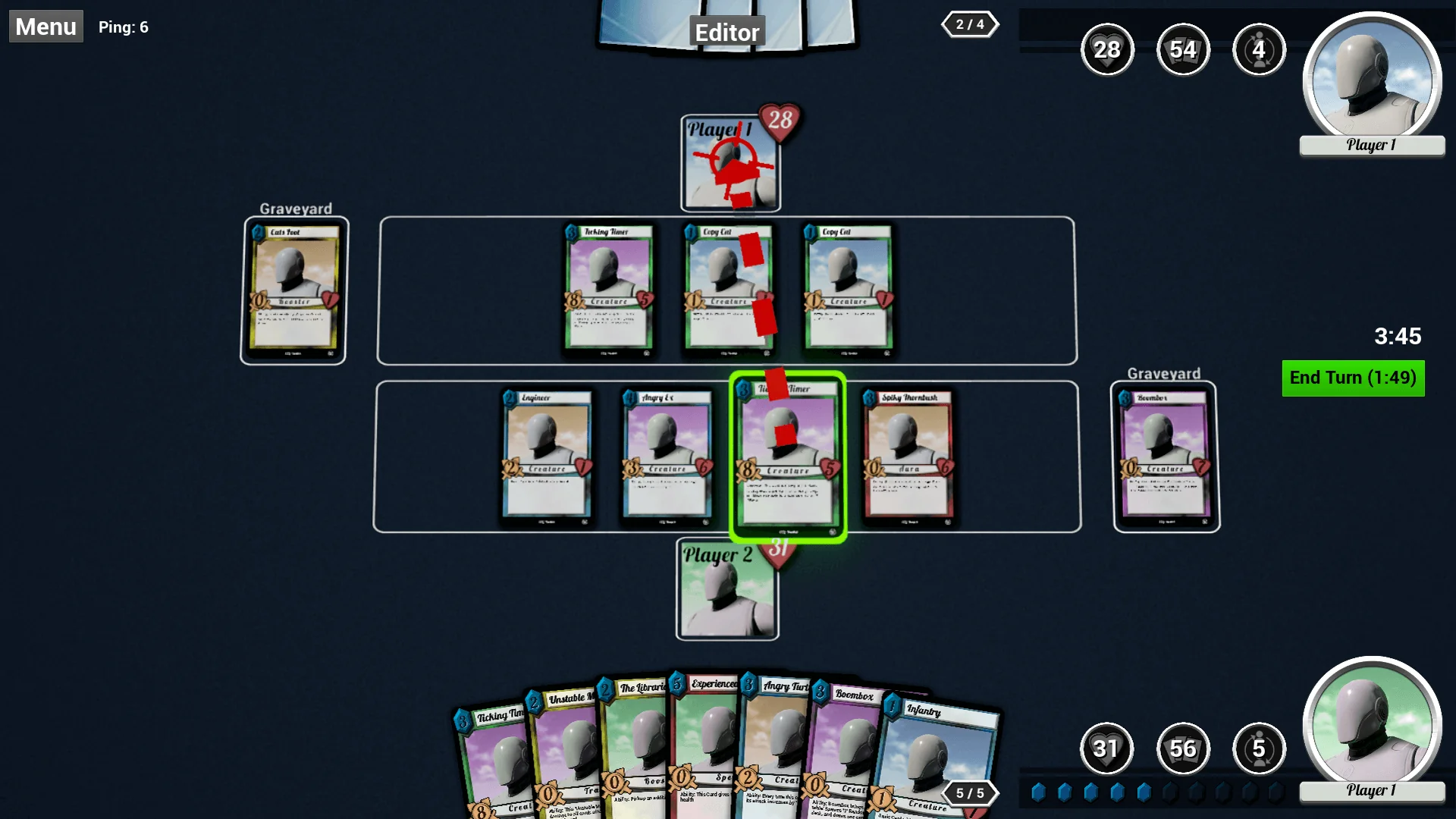
Resource screenshots
1 / 7
Asset drops
Daily Asset Drops
Follow 3DCGHUB on Telegram for daily Unreal, Unity & Blender drops and curated CC0 releases.
Card games look simple on the table and turn complicated the moment they go digital. Shuffling, weighings, turn order, mana, targeting, the graveyard, and keeping all of it in sync between two players are separate systems that each need to exist before a single match feels right. The CCG Toolkit approaches that pile as one framework: a 100% Blueprint package covering single and multiplayer card games, meant either for a fresh idea or for an existing tabletop design that needs a digital version.
What the CCG Toolkit Hands You on Day One
The first thing to understand is that nothing here is split between code and editor. The framework is authored entirely in Blueprint, so the systems you extend are the same graphs you can open, read, and rewire.
Multiplayer support is part of the base rather than an add-on bolted on later, and the gameplay layer beneath it is turn-based. That combination shapes how everything else in the package behaves: card interactions, board players, and the timers that bound a turn all sit inside a structure that assumes more than one participant and a defined sequence of play.
Card Creation and the Card Manager
Card creation is deliberately open-ended. Cards are highly customizable, and the package ships with card sets containing more than 35 example cards, so there is a working reference for how a finished card is assembled before you build your own.
Art support covers both 2D and 3D card art and assets, which matters if your design calls for flat illustrated faces in one place and physical, three-dimensional cards on the board in another.
The Card Manager is the piece that governs where cards sit. It carries interchangeable positioning profiles, and the toolkit includes an in-game card positioning editor alongside other game tools. Rather than hard-coding a card's transform and recompiling to check it, positioning becomes something you can adjust while the game is running, and profiles can be swapped to change how placement works. Customizable card placement extends that same flexibility to how cards are laid out during play.
Deck Builder and the Deck Generator Workflow
Deck construction gets two separate tools that serve different moments. The deck builder is the player-facing side: create, edit, and save custom decks, with no stated cap on how many can exist. That means a collection of saved lists beyond one fixed deck per session.
The deck generator handles what happens once a deck enters play. It filters, shuffles, and weighs cards. Filtering and shuffling are the expected parts; weighing is the more interesting one, since it gives the deck a way to treat cards differently from one another rather than as a flat randomized pile.
Around the deck itself sit the smaller conveniences that make a hand readable — mouse-over card previews for inspecting a card without committing to it, and a card graveyard that keeps discarded or destroyed cards tracked instead of simply vanishing.
AI Opponents, Abilities, and Turn Flow
The included card game AI is customizable and comes with a debug UI, so opponent behaviour can be observed and adjusted rather than treated as a black box. For anyone building a single-player mode first, that pairing is the difference between guessing why the AI played a card and being able to see it.
More than 10 card abilities are included, each with multiple settings variations. The variation part is what makes the ability set usable beyond its examples: the same ability can be configured into several behaviours instead of requiring a new one each time a card needs a slightly different effect.
Turn structure is handled by a turn-based gameplay system with turn and game timers, supported by player health and mana systems. Cards and board players interact directly, and basic card movement comes with visual gameplay cues so that actions read clearly on screen. Basic win and lose conditions close out a match.
Arenas, Menus, and the Supporting Tools
Seven arenas are included, giving a match somewhere to happen without building an environment first. Getting into those arenas is handled by a simple menu set covering the main menu, deck selection, arena selection, and server selection — the last of which lines up with the multiplayer foundation.
Two utilities round out the package. An in-game notifications manager handles messaging during play, and several custom function libraries collect reusable logic that the rest of the framework draws on.
Where the CCG Toolkit Fits in a Production
The clearest fit is a project that already knows its rules and needs the surrounding machinery: a tabletop design being carried into digital space, or a card game concept that has to reach a playable build before anyone can judge whether the loop works. Prototyping is the obvious first stop, because deck creation, card positioning, abilities, and AI configuration can all be tested in-game rather than through repeated rebuilds.
It also suits teams that want a multiplayer, turn-based card foundation they can read and modify in Blueprint instead of inheriting an opaque system. The example card sets, the arenas, and the debug UI make it a workable reference for developers still learning how the pieces of a digital card game connect — the framework is pitched at an advanced level, but the included content gives you something concrete to take apart. Build the first match, then replace the examples with your own cards, decks, and abilities as the design settles.
 Engine Tools
 RPG
 Network