"ae2217ad8e73450c"{"id":"1003008","slug":"chainsaw-attacks","title":"Chainsaw Attacks","category":"Combat","engine":"4.26+,5.0+","assetVersion":"","engineVersion":"Engine Version: 4.26+,5.0+","tag":"Combat","accent":"blue","visual":"mech","summary":"Chainsaw Attacks provides hand-crafted melee combat, movement, finisher, and stagger animations designed for horror games and intense enemy NPC encounters.","platform":"Unreal Engine","indexPolicy":"index","publishedAt":"2026-11-25T16:14:04.749Z","updatedAt":"2026-11-25T16:14:04.749Z","sourceNotes":[],"fileContents":[],"compatibility":["Unreal Engine","Engine Version: 4.26+,5.0+"],"featuredImage":{"alt":"Chainsaw Attacks","src":"/wp-content/uploads/published/2026/11/9183fcf13e6a-ed35b6a0-e90c-4d28-9a75-21e55c3d8cc6-974f0c6ac6.webp"},"hasDownloadLink":true,"downloads":0,"terms":[{"taxonomy":"category","slug":"combat","name":"Combat"}],"galleryImages":[{"src":"/wp-content/uploads/published/2026/11/3cd9a6b7a78b-d9e9b868-a2c4-477e-bd05-1cb0c152101a-9ed1961c44.webp","alt":"Chainsaw Attacks"},{"src":"/wp-content/uploads/published/2026/11/b2d68245a232-e33f4278-4bf3-408f-8e0d-fe9b297acf1d-27bd8e66c8.webp","alt":"Chainsaw Attacks"},{"src":"/wp-content/uploads/published/2026/11/65069c61ccbb-7d3483ee-6389-427f-b4f6-f0eb0d9b4378-7a700e4047.webp","alt":"Chainsaw Attacks"},{"src":"/wp-content/uploads/published/2026/11/8c6b2646b5a2-05fe3be7-b619-4297-bf23-aa8161531752-fb15931d43.webp","alt":"Chainsaw Attacks"},{"src":"/wp-content/uploads/published/2026/11/129d1e42b6fe-291f9d7a-d30e-4dda-a6c0-b83882b16054-c633905936.webp","alt":"Chainsaw Attacks"}],"accessPanel":{"kind":"resource","title":"Get this resource","safetyNote":"Resources are manually reviewed before listing to improve quality and reduce obvious risks.","fileName":"Content.7z","resourceType":"Resource archive","versions":[]},"contentHtml":"\u003cp\u003eSurvival horror scenarios and tension-heavy action sequences frequently hinge on the immediate dread of an advancing opponent wielding industrial equipment. Confronting an antagonist brandishing a running power tool demands distinct body mechanics, where the sheer weight, vibration, and momentum of the weapon dictate every step, swing, and stance. The Chainsaw Attacks animation package delivers motion crafted specifically around these tactile combat parameters, giving hostile NPCs and player characters alike the violent kinetic energy necessary for close-quarters horror gameplay.\u003c/p\u003e \u003ch2\u003eStaging Hostile Encounters with Chainsaw Attacks\u003c/h2\u003e\n\u003cp\u003eMelee pacing in tense, combat-oriented titles relies heavily on anticipation, telegraphing, and follow-through. Within this collection, the ten distinct attack animations provide the core repertoire needed to mount continuous offensive pressure. Because each swing and thrust is hand crafted, the keyframes emphasize the physical burden of driving a heavy blade through the air. Chainsaws cannot be flicked like daggers or balanced like swords; they require wide arcs, committed torso rotations, and deliberate recovery windows that communicate dangerous force to the player.\u003c/p\u003e \u003cp\u003eThese ten attack animations allow developers to build multi-phase combat sequences for enemy types. A heavy boss or relentless pursuer can chain broad horizontal cleaves to control space, or unleash sudden overhead downward cuts to punish players caught out of position. The aggressive posturing embedded in these attacks works equally well for scripted ambushes, emergent arena brawls, or recurring stalker sequences where the opponent repeatedly forces the player on the defensive.\u003c/p\u003e \u003cp\u003eBy focusing purely on distinct melee swings, the combat animations give designers the flexibility to define their own hitboxes, active damage frames, and stamina costs. Whether used to construct a slow, methodical heavy strike or a chaotic sequence of erratic hacking motions, the set supplies the foundational choreography for lethal close-range combat encounters.\u003c/p\u003e \u003ch2\u003eAttacker and Victim Synchronization in Chainsaw Finishers\u003c/h2\u003e\n\u003cp\u003eLethal encounters often culminate in cinematic brutality, especially within the horror and slasher genres. To support high-stakes climaxes, the package includes six paired finisher animations, split evenly between three attacker motions and three corresponding victim reactions. Coordinated execution animations require exact spatial alignment and timing so that the weapon impact connects seamlessly with the receiving character's body without breaking visual immersion.\u003c/p\u003e \u003cp\u003eThe three attacker sequences establish the overpowering dominance of the assailant, using deliberate, ruthless gestures to pin down, impale, or carve through the target. The corresponding victim animations reflect genuine physical collapse, struggle, and desperation. Having both sides of the execution choreographed as matched sets removes the guesswork of blending generic hit reactions into high-intensity kill scenes.\u003c/p\u003e \u003cp\u003eThese finishers serve multiple production purposes across gameplay and narrative delivery. In standard combat, they provide conclusive execution moves triggered when a player or enemy health threshold drops to zero. In narrative-heavy horror scenarios, they can double as fatal failure states when an evasive protagonist is caught by a pursuing NPC, instantly elevating the stakes of stealth segments or corridor chases.\u003c/p\u003e \u003ch2\u003eLocomotion and Movement Variations While Handling a Chainsaw\u003c/h2\u003e\n\u003cp\u003eTraversing an environment while carrying an active two-handed power tool requires specialized locomotion that standard weapon blends cannot capture accurately. The collection features forty movement animations, giving characters the ability to shift weight, track targets, and close distances while keeping both hands clamped firmly on the saw handles. These movement assets establish the heavy, threatening presence required for horror antagonists prowling through derelict corridors or open yards.\u003c/p\u003e \u003cp\u003eA notable update expanded this locomotion library by twenty-three animations, introducing faster variations of existing walks, runs, and attacks, as well as a dedicated sprint state. Variable speeds are critical when designing responsive artificial intelligence. An enemy that only walks at a fixed pace fails to adapt to dynamic player movement; by having access to both deliberate strides and rapid, aggressive runs, AI behavior trees can seamlessly transition from an ominous, measured stalk to a frenzied, full-tilt pursuit.\u003c/p\u003e \u003cp\u003eThe inclusion of a sprint animation bridges the gap between mid-range positioning and immediate melee contact. When an enemy breaks into an outright dash with an active saw, the visual threat spikes instantly, forcing the player to make split-second defensive choices. Combined with faster attack variations, these tempo options allow animators and combat designers to craft escalating encounter phases, where an opponent becomes visibly quicker and more desperate as the fight wears on.\u003c/p\u003e \u003ch2\u003eReaction Dynamics: Staggers and Idles for Chainsaw Wielders\u003c/h2\u003e\n\u003cp\u003eCombat feel depends just as heavily on downtime and counter-reactions as it does on offensive swings. A combatant that never pauses or reacts to resistance feels synthetic and disjointed. The package incorporates three idle animations and four stagger animations to address the essential connective tissue of real-time brawling.\u003c/p\u003e \u003cp\u003eThe three idle states establish character demeanor between strikes. They supply options for ready stances, tense anticipation, or an aggressive neutral posture while the engine revs. When integrated into an animation state machine, these idles give characters life during pauses in combat, ensuring that an opponent waiting for an attack opening remains menacing rather than freezing into a static pose.\u003c/p\u003e \u003cp\u003eThe four stagger animations provide the visual feedback necessary for counter-play. When a player parries an incoming blow, strikes back with a firearm, or interrupts an opponent with an environmental obstacle, the stagger clips illustrate the disruption of balance and momentum. The mass of the tool amplifies this effect; a staggered combatant must fight against the swinging inertia of the blade to regain their footing, providing distinct windows of vulnerability that players can exploit.\u003c/p\u003e \u003ch2\u003eAsset Scope and Technical Boundaries\u003c/h2\u003e\n\u003cp\u003eClarity regarding the content boundary is essential for smooth technical planning. This release is strictly an animation asset pack containing hand-crafted character motion data. It does not include gameplay blueprints, combat logic, trace collision graphs, or interactive behavior frameworks. Developers are responsible for integrating the animation sequences into their own animation blueprints, state machines, and gameplay systems.\u003c/p\u003e \u003cp\u003eIn addition, the character meshes and weapon models seen throughout promotional materials are excluded from the package. The animations are delivered purely as motion clips, ready to be targeted onto compatible skeletons and paired with independent chainsaw prop meshes via standard bone or socket attachments. This separation ensures that studios can cleanly retarget the entire library of forty-plus animations onto their existing cast of original characters, monsters, or survivalists without needing to untangle embedded geometry.\u003c/p\u003e \u003ch2\u003eIdeal Implementation Scenarios\u003c/h2\u003e\n\u003cp\u003eStudios and independent creators developing third-person or first-person horror titles will find the strongest utility in this focused library. Developing specialized melee sets for specific heavy weaponry can consume substantial rigging and keyframing hours. Having ready-made, hand-crafted motion that accounts for the distinct center of gravity required by large industrial tools drastically shortens the prototyping cycle for slasher mechanics, boss battles, and hostile patrol routes.\u003c/p\u003e \u003cp\u003eGameplay programmers and technical animators constructing custom combat systems will also benefit from the modular breakdown of attacks, variable-speed locomotion, synchronized finishers, and stagger states. The presence of varied pacing within the movement states allows engineering teams to implement sophisticated state machines that respond dynamically to player distance, alert levels, and combat states without having to artificially accelerate or stretch standard animations.\u003c/p\u003e\n\n\u003ch2\u003eContinue Browsing Similar Packs\u003c/h2\u003e\n\u003cul\u003e\n\u003cli\u003e\u003ca href=\"https://3dcghub.com/2handed-hammer-animset/\" rel=\"noopener noreferrer\"\u003e2Handed Hammer AnimSet\u003c/a\u003e\u003c/li\u003e\n\u003cli\u003e\u003ca href=\"https://3dcghub.com/brutal-finishers-hand-and-knife/\" rel=\"noopener noreferrer\"\u003eBrutal Finishers - Hand and Knife\u003c/a\u003e\u003c/li\u003e\n\u003cli\u003e\u003ca href=\"https://3dcghub.com/darksorceress-animset/\" rel=\"noopener noreferrer\"\u003eDarkSorceress Animset\u003c/a\u003e\u003c/li\u003e\n\u003cli\u003e\u003ca href=\"https://3dcghub.com/essential-great-sword-animation-pack/\" rel=\"noopener noreferrer\"\u003eEssential Great Sword Animation Pack\u003c/a\u003e\u003c/li\u003e\n\u003cli\u003e\u003ca href=\"https://3dcghub.com/great-pillar-animset-control-rig-animations/\" rel=\"noopener noreferrer\"\u003eGreat Pillar Animset Control Rig Animations\u003c/a\u003e\u003c/li\u003e\n\u003c/ul\u003e","contentTextLength":8503,"navigation":{"current":36,"total":4964,"previous":{"id":"1003009","slug":"character-abilities","title":"Character Abilities","category":"Weapons \u0026 Combat","platform":"Unreal Engine","updatedAt":"2026-11-25T16:14:52.932Z"},"next":{"id":"1003007","slug":"ccg-toolkit","title":"CCG Toolkit","category":"Card Game","platform":"Unreal Engine","updatedAt":"2026-11-25T16:13:16.010Z"}},"relatedResources":[{"id":"27226","slug":"2handed-hammer-animset","title":"2Handed Hammer AnimSet","category":"Combat","engine":"4.26+,5.0+","assetVersion":"Engine version: 4.26+,5.0+","engineVersion":"","tag":"Combat","accent":"blue","visual":"animation","summary":"2Handed Hammer AnimSet focuses on heavy combat motion for action RPG warriors, barbarians, boss monsters, and giant monsters. It includes 81 animations and 9 poses, with movement, attack, reaction, and equipment states that support a full melee encounter.","platform":"Unreal Engine","indexPolicy":"index","publishedAt":"2026-04-22T14:10:33.000Z","updatedAt":"2026-04-22T14:10:35.000Z","sourceNotes":[],"fileContents":[],"compatibility":["Unreal Engine","Engine version: 4.26+,5.0+"],"featuredImage":{"alt":"2Handed Hammer AnimSet","src":"https://3dcghub.com/wp-content/uploads/2026/04/84840b81921d_de01ea22-c1a3-4726-8f47-8760cef1f727.webp"},"fileSizeBytes":53952353,"hasDownloadLink":true,"downloads":10},{"id":"5548","slug":"brutal-finishers-hand-and-knife","title":"Brutal Finishers - Hand and Knife","category":"Combat","engine":"4.26+,5.0+","assetVersion":"Engine version: 4.26+,5.0+","engineVersion":"4.25","tag":"Combat","accent":"blue","visual":"animation","summary":"Enhance your game's combat with this library of 60 brutal finishing moves and paired attacks. Perfect for realistic hand-to-hand and knife fighting scenes.","platform":"Unreal Engine","indexPolicy":"noindex","publishedAt":"2026-02-17T15:56:26.000Z","updatedAt":"2026-04-19T15:56:44.000Z","sourceNotes":[],"fileContents":[],"compatibility":["Unreal Engine","Engine version: 4.26+,5.0+"],"featuredImage":{"alt":"Brutal Finishers - Hand and Knife","src":"https://3dcghub.com/wp-content/uploads/2026/02/c966b20c-2739-4c2a-929e-9c17b247c5d6.webp"},"fileSizeBytes":19253455,"hasDownloadLink":true,"downloads":3},{"id":"1003028","slug":"dynamic-archer-set","title":"Dynamic Archer Set","category":"Combat","engine":"4.15+,5.0+","assetVersion":"","engineVersion":"Engine Version: 4.15+,5.0+","tag":"Combat","accent":"blue","visual":"mech","summary":"A handcrafted action RPG animation package providing rapid attack timings, mobile archery, melee strikes, and locomotion for active main character bowmen.","platform":"Unreal Engine","indexPolicy":"index","publishedAt":"2026-11-25T16:31:38.196Z","updatedAt":"2026-11-25T16:31:38.196Z","sourceNotes":[],"fileContents":[],"compatibility":["Unreal Engine","Engine Version: 4.15+,5.0+"],"featuredImage":{"alt":"Dynamic Archer Set","src":"/wp-content/uploads/published/2026/11/3013bc464814-0d56d26a-c711-483f-9907-14f27701a42d-bb8332ad3d.webp"},"hasDownloadLink":true,"downloads":0}]}[{"id":4225,"sourceId":4225,"taxonomyId":4225,"taxonomy":"category","slug":"asset-library","name":"Asset Library","parentId":null,"count":4817,"hasChildren":true,"href":"/","seoTitle":"Free Game Assets Library | 3DCGHUB","seoDescription":"Browse free Unreal Engine, Unity, Blender assets and game development tutorials on 3DCGHUB with previews, compatibility notes, and secure downloads.","sitemapEnabled":true,"children":[{"id":4227,"sourceId":4227,"taxonomyId":4227,"taxonomy":"category","slug":"blender-add-ons-plugins","name":"Blender Add-ons \u0026 Plugins","parentId":4225,"count":10,"hasChildren":false,"href":"/category/blender-add-ons-plugins/","seoTitle":"Free Blender Add-ons \u0026 Plugins | 3DCGHUB","seoDescription":"Browse free Blender Add-ons \u0026 Plugins tools for Blender on 3DCGHUB: curated downloads with preview images, compatibility notes and secure download access.","sitemapEnabled":true},{"id":514,"sourceId":514,"taxonomyId":514,"taxonomy":"category","slug":"unity-2","name":"Unity","parentId":4225,"count":453,"hasChildren":true,"href":"/category/unity-2/","seoTitle":"Free Unity Assets | 3DCGHUB","seoDescription":"Browse free Unity resources on 3DCGHUB: curated downloads with preview images, compatibility notes and secure download access.","sitemapEnabled":true,"children":[{"id":523,"sourceId":523,"taxonomyId":523,"taxonomy":"category","slug":"2d","name":"2D","parentId":514,"count":1,"hasChildren":true,"href":"/category/2d/","seoTitle":"Free Unity 2D | 3DCGHUB","seoDescription":"Browse free 2D assets for Unity on 3DCGHUB: curated downloads with preview images, compatibility notes and secure download access.","sitemapEnabled":true},{"id":515,"sourceId":515,"taxonomyId":515,"taxonomy":"category","slug":"3d-unity-2","name":"3D","parentId":514,"count":162,"hasChildren":true,"href":"/category/3d-unity-2/","seoTitle":"Free Unity 3D Assets | 3DCGHUB","seoDescription":"Browse free 3D assets for Unity on 3DCGHUB: curated downloads with preview images, compatibility notes and secure download access.","sitemapEnabled":true},{"id":565,"sourceId":565,"taxonomyId":565,"taxonomy":"category","slug":"add-ons","name":"Add-Ons","parentId":514,"count":2,"hasChildren":false,"href":"/category/add-ons/","seoTitle":"Free Unity Add-Ons | 3DCGHUB","seoDescription":"Browse free Add-Ons assets for Unity on 3DCGHUB: curated downloads with preview images, compatibility notes and secure download access.","sitemapEnabled":true},{"id":529,"sourceId":529,"taxonomyId":529,"taxonomy":"category","slug":"audio-unity-2","name":"Audio","parentId":514,"count":1,"hasChildren":true,"href":"/category/audio-unity-2/","seoTitle":"Free Unity Audio | 3DCGHUB","seoDescription":"Browse free Audio for Unity on 3DCGHUB: curated downloads with preview images, compatibility notes and secure download access.","sitemapEnabled":true},{"id":557,"sourceId":557,"taxonomyId":557,"taxonomy":"category","slug":"templates","name":"Templates","parentId":514,"count":36,"hasChildren":true,"href":"/category/templates/","seoTitle":"Free Unity Templates | 3DCGHUB","seoDescription":"Browse free Unity project templates on 3DCGHUB. Starter kits with previews, compatibility notes, and secure download access.","sitemapEnabled":true},{"id":533,"sourceId":533,"taxonomyId":533,"taxonomy":"category","slug":"tools-unity-2","name":"Tools","parentId":514,"count":0,"hasChildren":true,"href":"/category/tools-unity-2/","sitemapEnabled":true},{"id":554,"sourceId":554,"taxonomyId":554,"taxonomy":"category","slug":"vfx-unity-2","name":"VFX","parentId":514,"count":4,"hasChildren":true,"href":"/category/vfx-unity-2/","seoTitle":"Free Unity VFX | 3DCGHUB","seoDescription":"Browse free VFX for Unity on 3DCGHUB: curated downloads with preview images, compatibility notes and secure download access.","sitemapEnabled":true}]},{"id":511,"sourceId":511,"taxonomyId":511,"taxonomy":"category","slug":"unreal-engine-2","name":"Unreal Engine","parentId":4225,"count":4355,"hasChildren":true,"href":"/category/unreal-engine-2/","seoTitle":"Free Unreal Engine Assets | 3DCGHUB","seoDescription":"Browse free Unreal Engine resources on 3DCGHUB: curated downloads with preview images, compatibility notes and secure download access.","sitemapEnabled":true,"children":[{"id":54,"sourceId":54,"taxonomyId":54,"taxonomy":"category","slug":"3d","name":"3D","parentId":511,"count":2441,"hasChildren":true,"href":"/category/3d/","seoTitle":"Free Unreal Engine 3D | 3DCGHUB","seoDescription":"Browse free 3D assets for Unreal Engine on 3DCGHUB: curated downloads with preview images, compatibility notes and secure download access.","sitemapEnabled":true},{"id":441,"sourceId":441,"taxonomyId":441,"taxonomy":"category","slug":"animations","name":"Animations","parentId":511,"count":269,"hasChildren":true,"href":"/category/animations/","seoTitle":"Free Unreal Engine Animations | 3DCGHUB","seoDescription":"Browse free Animations for Unreal Engine on 3DCGHUB: curated downloads with preview images, compatibility notes and secure download access.","sitemapEnabled":true},{"id":446,"sourceId":446,"taxonomyId":446,"taxonomy":"category","slug":"audio","name":"Audio","parentId":511,"count":63,"hasChildren":true,"href":"/category/audio/","seoTitle":"Free Unreal Engine Audio Resources | 3DCGHUB","seoDescription":"Browse free Unreal Engine audio resources including sound effects, voices, dialogue, and ambient sounds. Curated free downloads on 3DCGHUB.","sitemapEnabled":true},{"id":466,"sourceId":466,"taxonomyId":466,"taxonomy":"category","slug":"game-systems","name":"Game Systems","parentId":511,"count":381,"hasChildren":true,"href":"/category/game-systems/","seoTitle":"Free Unreal Engine Game Systems | 3DCGHUB","seoDescription":"Browse free Game Systems tools for Unreal Engine on 3DCGHUB: curated downloads with preview images, compatibility notes and secure download access.","sitemapEnabled":true},{"id":478,"sourceId":478,"taxonomyId":478,"taxonomy":"category","slug":"game-templates","name":"Game Templates","parentId":511,"count":155,"hasChildren":true,"href":"/category/game-templates/","seoTitle":"Free Unreal Engine Game Templates | 3DCGHUB","seoDescription":"Browse free Game Templates for Unreal Engine on 3DCGHUB: curated downloads with preview images, compatibility notes and secure download access.","sitemapEnabled":true},{"id":432,"sourceId":432,"taxonomyId":432,"taxonomy":"category","slug":"hdri","name":"HDRI","parentId":511,"count":6,"hasChildren":true,"href":"/category/hdri/","seoTitle":"Free Unreal Engine HDRI | 3DCGHUB","seoDescription":"Browse free Unreal Engine HDRI skies and lighting maps on 3DCGHUB. Environment lighting with previews and secure downloads.","sitemapEnabled":true},{"id":228,"sourceId":228,"taxonomyId":228,"taxonomy":"category","slug":"material-and-textures","name":"Material \u0026 Textures","parentId":511,"count":172,"hasChildren":true,"href":"/category/material-and-textures/","seoTitle":"Free Unreal Engine Material \u0026 Textures | 3DCGHUB","seoDescription":"Browse free Material \u0026 Textures for Unreal Engine on 3DCGHUB: curated downloads with preview images, compatibility notes and secure download access.","sitemapEnabled":true},{"id":298,"sourceId":298,"taxonomyId":298,"taxonomy":"category","slug":"sprites-and-flipbooks","name":"Sprites \u0026 Flipbooks","parentId":511,"count":18,"hasChildren":true,"href":"/category/sprites-and-flipbooks/","seoTitle":"Free Unreal Engine Sprites \u0026 Flipbooks | 3DCGHUB","seoDescription":"Browse free Sprites \u0026 Flipbooks assets for Unreal Engine on 3DCGHUB: curated downloads with preview images, compatibility notes and secure download access.","sitemapEnabled":true},{"id":489,"sourceId":489,"taxonomyId":489,"taxonomy":"category","slug":"tools-and-plugins","name":"Tools \u0026 Plugins","parentId":511,"count":390,"hasChildren":true,"href":"/category/tools-and-plugins/","seoTitle":"Free Unreal Engine Tools \u0026 Plugins | 3DCGHUB","seoDescription":"Browse free Tools \u0026 Plugins for Unreal Engine on 3DCGHUB: curated downloads with preview images, compatibility notes and secure download access.","sitemapEnabled":true},{"id":459,"sourceId":459,"taxonomyId":459,"taxonomy":"category","slug":"ui","name":"UI","parentId":511,"count":47,"hasChildren":true,"href":"/category/ui/","seoTitle":"Free Unreal Engine UI | 3DCGHUB","seoDescription":"Browse free UI for Unreal Engine on 3DCGHUB: curated downloads with preview images, compatibility notes and secure download access.","sitemapEnabled":true},{"id":450,"sourceId":450,"taxonomyId":450,"taxonomy":"category","slug":"vfx","name":"VFX","parentId":511,"count":413,"hasChildren":true,"href":"/category/vfx/","seoTitle":"Free Unreal Engine VFX | 3DCGHUB","seoDescription":"Browse free VFX for Unreal Engine on 3DCGHUB: curated downloads with preview images, compatibility notes and secure download access.","sitemapEnabled":true}]}]},{"id":4222,"sourceId":4222,"taxonomyId":4222,"taxonomy":"category","slug":"tutorial-library","name":"Tutorial Library","parentId":null,"count":117,"hasChildren":false,"href":"/tutorials/","seoTitle":"Free Game Development Tutorial Library | 3DCGHUB","seoDescription":"Browse free game development tutorials for Unreal Engine, Unity, Blender, and more on 3DCGHUB with practical workflows and secure downloads.","sitemapEnabled":true}]
Resource screenshots
1 / 5
Asset drops
Daily Asset Drops
Follow 3DCGHUB on Telegram for daily Unreal, Unity & Blender drops and curated CC0 releases.
Resources are manually reviewed before listing to improve quality and reduce obvious risks.
Reviewed archive
Combat
Chainsaw Attacks
Chainsaw Attacks provides hand-crafted melee combat, movement, finisher, and stagger animations designed for horror games and intense enemy NPC encounters.
Survival horror scenarios and tension-heavy action sequences frequently hinge on the immediate dread of an advancing opponent wielding industrial equipment. Confronting an antagonist brandishing a running power tool demands distinct body mechanics, where the sheer weight, vibration, and momentum of the weapon dictate every step, swing, and stance. The Chainsaw Attacks animation package delivers motion crafted specifically around these tactile combat parameters, giving hostile NPCs and player characters alike the violent kinetic energy necessary for close-quarters horror gameplay.
Staging Hostile Encounters with Chainsaw Attacks
Melee pacing in tense, combat-oriented titles relies heavily on anticipation, telegraphing, and follow-through. Within this collection, the ten distinct attack animations provide the core repertoire needed to mount continuous offensive pressure. Because each swing and thrust is hand crafted, the keyframes emphasize the physical burden of driving a heavy blade through the air. Chainsaws cannot be flicked like daggers or balanced like swords; they require wide arcs, committed torso rotations, and deliberate recovery windows that communicate dangerous force to the player.
These ten attack animations allow developers to build multi-phase combat sequences for enemy types. A heavy boss or relentless pursuer can chain broad horizontal cleaves to control space, or unleash sudden overhead downward cuts to punish players caught out of position. The aggressive posturing embedded in these attacks works equally well for scripted ambushes, emergent arena brawls, or recurring stalker sequences where the opponent repeatedly forces the player on the defensive.
By focusing purely on distinct melee swings, the combat animations give designers the flexibility to define their own hitboxes, active damage frames, and stamina costs. Whether used to construct a slow, methodical heavy strike or a chaotic sequence of erratic hacking motions, the set supplies the foundational choreography for lethal close-range combat encounters.
Attacker and Victim Synchronization in Chainsaw Finishers
Lethal encounters often culminate in cinematic brutality, especially within the horror and slasher genres. To support high-stakes climaxes, the package includes six paired finisher animations, split evenly between three attacker motions and three corresponding victim reactions. Coordinated execution animations require exact spatial alignment and timing so that the weapon impact connects seamlessly with the receiving character's body without breaking visual immersion.
The three attacker sequences establish the overpowering dominance of the assailant, using deliberate, ruthless gestures to pin down, impale, or carve through the target. The corresponding victim animations reflect genuine physical collapse, struggle, and desperation. Having both sides of the execution choreographed as matched sets removes the guesswork of blending generic hit reactions into high-intensity kill scenes.
These finishers serve multiple production purposes across gameplay and narrative delivery. In standard combat, they provide conclusive execution moves triggered when a player or enemy health threshold drops to zero. In narrative-heavy horror scenarios, they can double as fatal failure states when an evasive protagonist is caught by a pursuing NPC, instantly elevating the stakes of stealth segments or corridor chases.
Locomotion and Movement Variations While Handling a Chainsaw
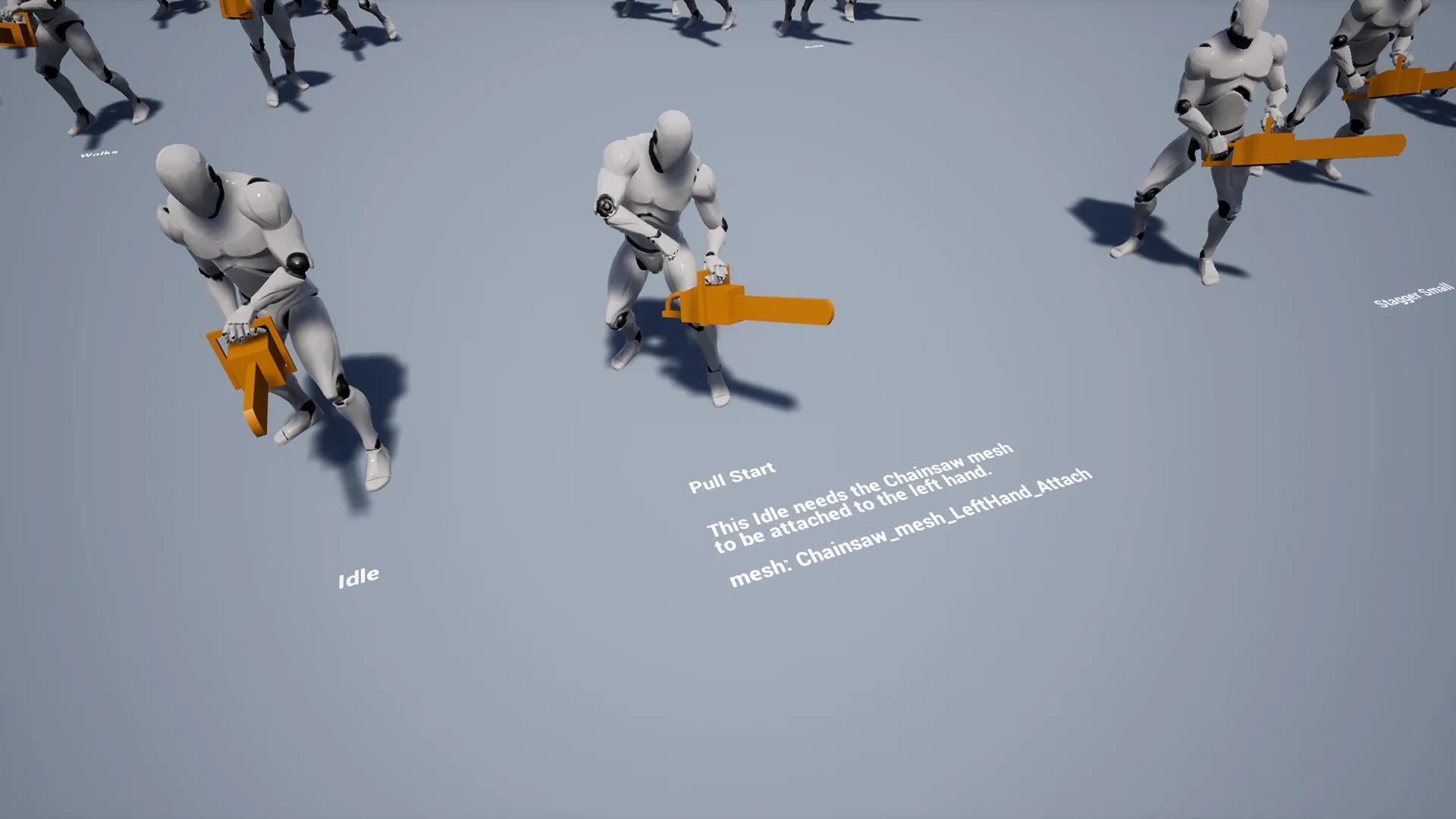
Traversing an environment while carrying an active two-handed power tool requires specialized locomotion that standard weapon blends cannot capture accurately. The collection features forty movement animations, giving characters the ability to shift weight, track targets, and close distances while keeping both hands clamped firmly on the saw handles. These movement assets establish the heavy, threatening presence required for horror antagonists prowling through derelict corridors or open yards.
A notable update expanded this locomotion library by twenty-three animations, introducing faster variations of existing walks, runs, and attacks, as well as a dedicated sprint state. Variable speeds are critical when designing responsive artificial intelligence. An enemy that only walks at a fixed pace fails to adapt to dynamic player movement; by having access to both deliberate strides and rapid, aggressive runs, AI behavior trees can seamlessly transition from an ominous, measured stalk to a frenzied, full-tilt pursuit.
The inclusion of a sprint animation bridges the gap between mid-range positioning and immediate melee contact. When an enemy breaks into an outright dash with an active saw, the visual threat spikes instantly, forcing the player to make split-second defensive choices. Combined with faster attack variations, these tempo options allow animators and combat designers to craft escalating encounter phases, where an opponent becomes visibly quicker and more desperate as the fight wears on.
Reaction Dynamics: Staggers and Idles for Chainsaw Wielders
Combat feel depends just as heavily on downtime and counter-reactions as it does on offensive swings. A combatant that never pauses or reacts to resistance feels synthetic and disjointed. The package incorporates three idle animations and four stagger animations to address the essential connective tissue of real-time brawling.
The three idle states establish character demeanor between strikes. They supply options for ready stances, tense anticipation, or an aggressive neutral posture while the engine revs. When integrated into an animation state machine, these idles give characters life during pauses in combat, ensuring that an opponent waiting for an attack opening remains menacing rather than freezing into a static pose.
The four stagger animations provide the visual feedback necessary for counter-play. When a player parries an incoming blow, strikes back with a firearm, or interrupts an opponent with an environmental obstacle, the stagger clips illustrate the disruption of balance and momentum. The mass of the tool amplifies this effect; a staggered combatant must fight against the swinging inertia of the blade to regain their footing, providing distinct windows of vulnerability that players can exploit.
Asset Scope and Technical Boundaries
Clarity regarding the content boundary is essential for smooth technical planning. This release is strictly an animation asset pack containing hand-crafted character motion data. It does not include gameplay blueprints, combat logic, trace collision graphs, or interactive behavior frameworks. Developers are responsible for integrating the animation sequences into their own animation blueprints, state machines, and gameplay systems.
In addition, the character meshes and weapon models seen throughout promotional materials are excluded from the package. The animations are delivered purely as motion clips, ready to be targeted onto compatible skeletons and paired with independent chainsaw prop meshes via standard bone or socket attachments. This separation ensures that studios can cleanly retarget the entire library of forty-plus animations onto their existing cast of original characters, monsters, or survivalists without needing to untangle embedded geometry.
Ideal Implementation Scenarios
Studios and independent creators developing third-person or first-person horror titles will find the strongest utility in this focused library. Developing specialized melee sets for specific heavy weaponry can consume substantial rigging and keyframing hours. Having ready-made, hand-crafted motion that accounts for the distinct center of gravity required by large industrial tools drastically shortens the prototyping cycle for slasher mechanics, boss battles, and hostile patrol routes.
Gameplay programmers and technical animators constructing custom combat systems will also benefit from the modular breakdown of attacks, variable-speed locomotion, synchronized finishers, and stagger states. The presence of varied pacing within the movement states allows engineering teams to implement sophisticated state machines that respond dynamically to player distance, alert levels, and combat states without having to artificially accelerate or stretch standard animations.
 Combat
 Combat
 Combat