"ae2217ad8e73450c"{"id":"1003009","slug":"character-abilities","title":"Character Abilities","category":"Weapons \u0026 Combat","engine":"4.27,5.0+","assetVersion":"","engineVersion":"Engine Version: 4.27,5.0+","tag":"Weapons \u0026 Combat","accent":"blue","visual":"character","summary":"Character Abilities is a Blueprint-based RPG combat system that adds melee, attack, and rolling components to an existing character without casting.","platform":"Unreal Engine","indexPolicy":"index","publishedAt":"2026-11-25T16:14:52.932Z","updatedAt":"2026-11-25T16:14:52.932Z","sourceNotes":[],"fileContents":[],"compatibility":["Unreal Engine","Engine Version: 4.27,5.0+"],"featuredImage":{"alt":"Character Abilities","src":"/wp-content/uploads/published/2026/11/80c424e21a44-e8bcb779-761c-4ab9-b31c-94a043f6386a-928c574872.webp"},"hasDownloadLink":true,"downloads":0,"terms":[{"taxonomy":"category","slug":"weapons-and-combat","name":"Weapons \u0026 Combat"}],"galleryImages":[{"src":"/wp-content/uploads/published/2026/11/ab53f8259947-0cfa20f0-bc97-484f-b866-45927ddbc950-dbb7e37ce8.webp","alt":"Character Abilities"},{"src":"/wp-content/uploads/published/2026/11/ee4fb5ca6678-55cbfb61-6669-464e-b66d-067db91c6dcd-e164a1aab4.webp","alt":"Character Abilities"},{"src":"/wp-content/uploads/published/2026/11/8ca7f576ea38-5bc69e43-a77a-460e-be50-c576a50111d2-9e9dd2de90.webp","alt":"Character Abilities"},{"src":"/wp-content/uploads/published/2026/11/0e314f91d724-0ef1d543-be2a-4bc8-b3c5-daa7b2908578-3a991b17dc.webp","alt":"Character Abilities"},{"src":"/wp-content/uploads/published/2026/11/e656018c696b-3e4659fd-f310-4994-a6ac-78ee995919fa-9630e0e32d.webp","alt":"Character Abilities"},{"src":"/wp-content/uploads/published/2026/11/b271ac9f1bca-9e97ffdc-7527-4ddf-920f-a5bbd37aa990-423d813aa2.webp","alt":"Character Abilities"},{"src":"/wp-content/uploads/published/2026/11/eb8be4cc6280-d6fb2a8c-5ed7-4854-a744-40d1acf556ca-e2d4ecfef8.webp","alt":"Character Abilities"}],"accessPanel":{"kind":"resource","title":"Get this resource","safetyNote":"Resources are manually reviewed before listing to improve quality and reduce obvious risks.","fileName":"Character Abilities.7z","resourceType":"Resource archive","versions":[]},"contentHtml":"\u003cp\u003eCombat actions are attached to the character already standing in the scene. That is the working shape of \u003cstrong\u003eCharacter Abilities\u003c/strong\u003e: rather than presenting a replacement character class, it supplies components and interfaces that are added to an existing character, with no cast character required. The design reference is AAA games, and the package then offers a modular ability layer meant to extend a character a project already has.\u003c/p\u003e\n\u003cp\u003eThe set is narrow in a useful way. Rolling, attack, and melee describe the combat behavior; RPG describes the project frame; script and Blueprint describe how the behavior is built. Animations can be changed to suit the character, and the content picture is split: one demonstration's animations, characters, and environment are included, while a second demonstration's animations, characters, and environment are not.\u003c/p\u003e\n\u003ch2\u003eHow the Character Abilities Layer Attaches\u003c/h2\u003e\n\u003cp\u003eComponents and interfaces are the connection points. They are added to the character, which means the character remains the project's own rather than being swapped for a cast hero to reach the ability logic. A team can keep the character it has authored and treat the combat behavior as an addition.\u003c/p\u003e\n\u003cp\u003eThat is a different arrangement from a character package that asks for its own protagonist before any ability appears. Here, the character is the constant and the abilities are the variable. The system can follow a character through a project without the character having to be rebuilt around a demo model or a fixed roster.\u003c/p\u003e\n\u003cp\u003eThe logic side is script- and Blueprint-based. Those terms place the ability work in gameplay logic rather than in a sealed character asset. The parts a team will look for first are the components and interfaces, since those are what connect the existing character to the combat behavior.\u003c/p\u003e\n\u003ch2\u003eRolling, Attack, and Melee: The Abilities in Focus\u003c/h2\u003e\n\u003cp\u003eRolling is the clearest movement-oriented ability in the set. Attack and melee cover the offensive side. RPG is the genre frame around them, which places the actions in a role-playing context rather than a stand-alone action vignette. The combination is compact: an evasive roll, an attack action, and melee combat.\u003c/p\u003e\n\u003cp\u003eThose abilities point toward close-quarters encounters. A character built with this set can roll to evade and answer with a melee attack; that is the core loop implied by the named behavior. The set does not need a broad list of unrelated powers to be useful. Its focus is the physical combat vocabulary that an RPG character needs when the fight is settled at close range.\u003c/p\u003e\n\u003cp\u003eThe script and Blueprint side supports that focus. Ability logic expressed in script and Blueprint is gameplay-side work, not a purely cosmetic animation set. A team that wants a character to carry its own combat behavior will find the relevant parts named in the component, interface, script, and Blueprint vocabulary.\u003c/p\u003e\n\u003cp\u003eRolling also does more than decorate a fight. It changes how a character occupies space during combat, giving the player a way to move through an attack rather than simply stand and trade hits. Melee and attack give that movement a purpose. The set reads as a combat language built from movement, evasion, and a strike.\u003c/p\u003e\n\u003ch2\u003eAnimations That Follow Your Existing Character\u003c/h2\u003e\n\u003cp\u003eAnimations can be changed according to the needs of the project. That is the flexibility point for teams whose character already has a movement style or whose combat needs differ from the showcase. The motions are not presented as an unchangeable part of the system; they can be adapted.\u003c/p\u003e\n\u003cp\u003eAnimation content is still part of the package. The animations, characters, and environment from one demonstration are included. A second demonstration shows animations, characters, and environment that are not included. Keeping those two cases separate matters when a team is working out what it will actually have on hand.\u003c/p\u003e\n\u003cp\u003eThe included characters and environment give the ability set a staged scene to be judged in, not just isolated motion. A team can see the roll, attack, and melee behavior inside an environment with characters present. At the same time, the ability to change animations means the presentation does not have to remain the demonstration's presentation.\u003c/p\u003e\n\u003cp\u003eFor a project with its own character, the practical path is to keep the character and adjust the animation side to fit. For a project that wants a starting scene, the included characters and environment provide one. The same package supports both readings because the character connection is handled through components and interfaces, while the animations are changeable.\u003c/p\u003e\n\u003ch2\u003eDemo Testing and the Planned Update Path\u003c/h2\u003e\n\u003cp\u003eA demo is available to test the system. That gives a team a way to inspect the behavior before deciding how it fits, which is useful when the claims are about feel rather than about a static model. The demo lets the roll, attack, and melee set be seen in motion.\u003c/p\u003e\n\u003cp\u003eThe creator also plans to make the asset more realistic in upcoming updates by adding more animations and functions. That is a forward-looking statement, not a description of the current set. It does show the direction: the animation and function coverage is expected to grow, with realism as the stated goal.\u003c/p\u003e\n\u003cp\u003eFor a team evaluating the set now, the update plan is context rather than a promise of specific features. The concrete present-day pieces are the components, interfaces, script and Blueprint logic, rolling, attack, melee, included animation and scene content, and the demo. Those are the parts that can be assessed today.\u003c/p\u003e\n\u003ch2\u003eWhere the Character Abilities Set Fits\u003c/h2\u003e\n\u003cp\u003eThe strongest fit is a project that already has its character and needs a combat ability layer. An RPG with melee encounters can use the roll, attack, and melee vocabulary directly. A prototype with a finished hero can add components and interfaces without replacing the hero. A team that wants to keep character identity separate from ability logic has a reason to look at this arrangement rather than a character-first package.\u003c/p\u003e\n\u003cp\u003eThe AAA reference is the stated design inspiration. It sets the expectation that the abilities are modeled on AAA combat, while the RPG frame keeps the focus on character fighting and close-range actions.\u003c/p\u003e\n\u003cp\u003eWhat a team should check first is whether the component-and-interface workflow matches its own character setup. The second check is animation fit: the motions can be changed, but the included animations, characters, and environment are the material that comes with the set. The third is timing: the demo shows the current behavior, while the update plan points to more animations and functions later.\u003c/p\u003e\n\u003cp\u003eCharacter Abilities is therefore easiest to judge as an attachment. It does not ask a project to cast a new character to reach the combat logic. It asks for an existing character, adds the components and interfaces, and lets the rolling, attack, and melee behavior follow. For teams with that exact gap, the integration model is the most concrete reason to consider it.\u003c/p\u003e\n\n\u003ch2\u003eContinue Browsing Similar Packs\u003c/h2\u003e\n\u003cul\u003e\n\u003cli\u003e\u003ca href=\"https://3dcghub.com/advanced-uav-pack/\" rel=\"noopener noreferrer\"\u003eAdvanced UAV Pack\u003c/a\u003e\u003c/li\u003e\n\u003cli\u003e\u003ca href=\"https://3dcghub.com/rpg-7-grenade-launcher/\" rel=\"noopener noreferrer\"\u003eRPG-7 GRENADE LAUNCHER\u003c/a\u003e\u003c/li\u003e\n\u003cli\u003e\u003ca href=\"https://3dcghub.com/dodge-it-component/\" rel=\"noopener noreferrer\"\u003eDodge It Component\u003c/a\u003e\u003c/li\u003e\n\u003cli\u003e\u003ca href=\"https://3dcghub.com/grapple-hook-system/\" rel=\"noopener noreferrer\"\u003eGrapple Hook System\u003c/a\u003e\u003c/li\u003e\n\u003cli\u003e\u003ca href=\"https://3dcghub.com/african-weapon-pack/\" rel=\"noopener noreferrer\"\u003eAfrican Weapon Pack\u003c/a\u003e\u003c/li\u003e\n\u003c/ul\u003e","contentTextLength":7082,"navigation":{"current":35,"total":4964,"previous":{"id":"1003010","slug":"character-customizer","title":"Character Customizer","category":"Characters \u0026 Creatures","platform":"Unreal Engine","updatedAt":"2026-11-25T16:15:33.755Z"},"next":{"id":"1003008","slug":"chainsaw-attacks","title":"Chainsaw Attacks","category":"Combat","platform":"Unreal Engine","updatedAt":"2026-11-25T16:14:04.749Z"}},"relatedResources":[{"id":"1002290","slug":"advanced-uav-pack","title":"Advanced UAV Pack","category":"Weapons \u0026 Combat","engine":"4.26+,5.0+","assetVersion":"","engineVersion":"Engine Version: 4.26+,5.0+","tag":"Weapons \u0026 Combat","accent":"blue","visual":"mech","summary":"Advanced UAV Pack is a modular low-poly fantasy UAV set with normal and fighting abilities, scripts, Blueprints, a weapon, and Interactive Trebuchet compatibili","platform":"Unreal Engine","indexPolicy":"index","publishedAt":"2026-11-04T05:19:38.870Z","updatedAt":"2026-11-04T05:19:38.870Z","sourceNotes":[],"fileContents":[],"compatibility":["Unreal Engine","Engine Version: 4.26+,5.0+"],"featuredImage":{"alt":"Advanced UAV Pack","src":"/wp-content/uploads/published/2026/11/2e8dc8f7fe6a-94596e4f-e4e8-4c7e-8ca8-06cfbb3a8f4f-e4b2bd2c66.webp"},"fileSizeBytes":11997444,"hasDownloadLink":true,"downloads":0},{"id":"1001830","slug":"rpg-7-grenade-launcher","title":"RPG-7 GRENADE LAUNCHER","category":"Weapons \u0026 Combat","engine":"4.26+,5.0+","assetVersion":"","engineVersion":"Engine Version: 4.26+,5.0+","tag":"Weapons \u0026 Combat","accent":"blue","visual":"mech","summary":"Technical analysis of the RPG-7 Grenade Launcher asset pack, featuring full stand, crouch, and prone character animations for third-person shooter games.","platform":"Unreal Engine","indexPolicy":"index","publishedAt":"2026-10-21T08:22:39.149Z","updatedAt":"2026-10-21T08:22:39.149Z","sourceNotes":[],"fileContents":[],"compatibility":["Unreal Engine","Engine Version: 4.26+,5.0+"],"featuredImage":{"alt":"RPG-7 GRENADE LAUNCHER","src":"/wp-content/uploads/published/2026/10/e4e558e91eae-ea42c3d3-da48-4e47-9273-ccee538d3c30-3392e6f806.webp"},"fileSizeBytes":139475070,"hasDownloadLink":true,"downloads":2},{"id":"1002582","slug":"dodge-it-component","title":"Dodge It Component","category":"Weapons \u0026 Combat","engine":"5.0+","assetVersion":"","engineVersion":"Engine Version: 5.0+","tag":"Weapons \u0026 Combat","accent":"blue","visual":"mech","summary":"Set up responsive, directional dodging and roll animations based on character movement input, fully compatible with the COMBAT FURY system.","platform":"Unreal Engine","indexPolicy":"index","publishedAt":"2026-11-14T05:22:36.409Z","updatedAt":"2026-11-14T05:22:36.409Z","sourceNotes":[],"fileContents":[],"compatibility":["Unreal Engine","Engine Version: 5.0+"],"featuredImage":{"alt":"Dodge It Component","src":"/wp-content/uploads/published/2026/11/99de09d580f2-14287107-5f77-4946-ad0c-b2fe1d590126-38a11861ef.webp"},"fileSizeBytes":37060372,"hasDownloadLink":true,"downloads":0}]}[{"id":4225,"sourceId":4225,"taxonomyId":4225,"taxonomy":"category","slug":"asset-library","name":"Asset Library","parentId":null,"count":4817,"hasChildren":true,"href":"/","seoTitle":"Free Game Assets Library | 3DCGHUB","seoDescription":"Browse free Unreal Engine, Unity, Blender assets and game development tutorials on 3DCGHUB with previews, compatibility notes, and secure downloads.","sitemapEnabled":true,"children":[{"id":4227,"sourceId":4227,"taxonomyId":4227,"taxonomy":"category","slug":"blender-add-ons-plugins","name":"Blender Add-ons \u0026 Plugins","parentId":4225,"count":10,"hasChildren":false,"href":"/category/blender-add-ons-plugins/","seoTitle":"Free Blender Add-ons \u0026 Plugins | 3DCGHUB","seoDescription":"Browse free Blender Add-ons \u0026 Plugins tools for Blender on 3DCGHUB: curated downloads with preview images, compatibility notes and secure download access.","sitemapEnabled":true},{"id":514,"sourceId":514,"taxonomyId":514,"taxonomy":"category","slug":"unity-2","name":"Unity","parentId":4225,"count":453,"hasChildren":true,"href":"/category/unity-2/","seoTitle":"Free Unity Assets | 3DCGHUB","seoDescription":"Browse free Unity resources on 3DCGHUB: curated downloads with preview images, compatibility notes and secure download access.","sitemapEnabled":true,"children":[{"id":523,"sourceId":523,"taxonomyId":523,"taxonomy":"category","slug":"2d","name":"2D","parentId":514,"count":1,"hasChildren":true,"href":"/category/2d/","seoTitle":"Free Unity 2D | 3DCGHUB","seoDescription":"Browse free 2D assets for Unity on 3DCGHUB: curated downloads with preview images, compatibility notes and secure download access.","sitemapEnabled":true},{"id":515,"sourceId":515,"taxonomyId":515,"taxonomy":"category","slug":"3d-unity-2","name":"3D","parentId":514,"count":162,"hasChildren":true,"href":"/category/3d-unity-2/","seoTitle":"Free Unity 3D Assets | 3DCGHUB","seoDescription":"Browse free 3D assets for Unity on 3DCGHUB: curated downloads with preview images, compatibility notes and secure download access.","sitemapEnabled":true},{"id":565,"sourceId":565,"taxonomyId":565,"taxonomy":"category","slug":"add-ons","name":"Add-Ons","parentId":514,"count":2,"hasChildren":false,"href":"/category/add-ons/","seoTitle":"Free Unity Add-Ons | 3DCGHUB","seoDescription":"Browse free Add-Ons assets for Unity on 3DCGHUB: curated downloads with preview images, compatibility notes and secure download access.","sitemapEnabled":true},{"id":529,"sourceId":529,"taxonomyId":529,"taxonomy":"category","slug":"audio-unity-2","name":"Audio","parentId":514,"count":1,"hasChildren":true,"href":"/category/audio-unity-2/","seoTitle":"Free Unity Audio | 3DCGHUB","seoDescription":"Browse free Audio for Unity on 3DCGHUB: curated downloads with preview images, compatibility notes and secure download access.","sitemapEnabled":true},{"id":557,"sourceId":557,"taxonomyId":557,"taxonomy":"category","slug":"templates","name":"Templates","parentId":514,"count":36,"hasChildren":true,"href":"/category/templates/","seoTitle":"Free Unity Templates | 3DCGHUB","seoDescription":"Browse free Unity project templates on 3DCGHUB. Starter kits with previews, compatibility notes, and secure download access.","sitemapEnabled":true},{"id":533,"sourceId":533,"taxonomyId":533,"taxonomy":"category","slug":"tools-unity-2","name":"Tools","parentId":514,"count":0,"hasChildren":true,"href":"/category/tools-unity-2/","sitemapEnabled":true},{"id":554,"sourceId":554,"taxonomyId":554,"taxonomy":"category","slug":"vfx-unity-2","name":"VFX","parentId":514,"count":4,"hasChildren":true,"href":"/category/vfx-unity-2/","seoTitle":"Free Unity VFX | 3DCGHUB","seoDescription":"Browse free VFX for Unity on 3DCGHUB: curated downloads with preview images, compatibility notes and secure download access.","sitemapEnabled":true}]},{"id":511,"sourceId":511,"taxonomyId":511,"taxonomy":"category","slug":"unreal-engine-2","name":"Unreal Engine","parentId":4225,"count":4355,"hasChildren":true,"href":"/category/unreal-engine-2/","seoTitle":"Free Unreal Engine Assets | 3DCGHUB","seoDescription":"Browse free Unreal Engine resources on 3DCGHUB: curated downloads with preview images, compatibility notes and secure download access.","sitemapEnabled":true,"children":[{"id":54,"sourceId":54,"taxonomyId":54,"taxonomy":"category","slug":"3d","name":"3D","parentId":511,"count":2441,"hasChildren":true,"href":"/category/3d/","seoTitle":"Free Unreal Engine 3D | 3DCGHUB","seoDescription":"Browse free 3D assets for Unreal Engine on 3DCGHUB: curated downloads with preview images, compatibility notes and secure download access.","sitemapEnabled":true},{"id":441,"sourceId":441,"taxonomyId":441,"taxonomy":"category","slug":"animations","name":"Animations","parentId":511,"count":269,"hasChildren":true,"href":"/category/animations/","seoTitle":"Free Unreal Engine Animations | 3DCGHUB","seoDescription":"Browse free Animations for Unreal Engine on 3DCGHUB: curated downloads with preview images, compatibility notes and secure download access.","sitemapEnabled":true},{"id":446,"sourceId":446,"taxonomyId":446,"taxonomy":"category","slug":"audio","name":"Audio","parentId":511,"count":63,"hasChildren":true,"href":"/category/audio/","seoTitle":"Free Unreal Engine Audio Resources | 3DCGHUB","seoDescription":"Browse free Unreal Engine audio resources including sound effects, voices, dialogue, and ambient sounds. Curated free downloads on 3DCGHUB.","sitemapEnabled":true},{"id":466,"sourceId":466,"taxonomyId":466,"taxonomy":"category","slug":"game-systems","name":"Game Systems","parentId":511,"count":381,"hasChildren":true,"href":"/category/game-systems/","seoTitle":"Free Unreal Engine Game Systems | 3DCGHUB","seoDescription":"Browse free Game Systems tools for Unreal Engine on 3DCGHUB: curated downloads with preview images, compatibility notes and secure download access.","sitemapEnabled":true},{"id":478,"sourceId":478,"taxonomyId":478,"taxonomy":"category","slug":"game-templates","name":"Game Templates","parentId":511,"count":155,"hasChildren":true,"href":"/category/game-templates/","seoTitle":"Free Unreal Engine Game Templates | 3DCGHUB","seoDescription":"Browse free Game Templates for Unreal Engine on 3DCGHUB: curated downloads with preview images, compatibility notes and secure download access.","sitemapEnabled":true},{"id":432,"sourceId":432,"taxonomyId":432,"taxonomy":"category","slug":"hdri","name":"HDRI","parentId":511,"count":6,"hasChildren":true,"href":"/category/hdri/","seoTitle":"Free Unreal Engine HDRI | 3DCGHUB","seoDescription":"Browse free Unreal Engine HDRI skies and lighting maps on 3DCGHUB. Environment lighting with previews and secure downloads.","sitemapEnabled":true},{"id":228,"sourceId":228,"taxonomyId":228,"taxonomy":"category","slug":"material-and-textures","name":"Material \u0026 Textures","parentId":511,"count":172,"hasChildren":true,"href":"/category/material-and-textures/","seoTitle":"Free Unreal Engine Material \u0026 Textures | 3DCGHUB","seoDescription":"Browse free Material \u0026 Textures for Unreal Engine on 3DCGHUB: curated downloads with preview images, compatibility notes and secure download access.","sitemapEnabled":true},{"id":298,"sourceId":298,"taxonomyId":298,"taxonomy":"category","slug":"sprites-and-flipbooks","name":"Sprites \u0026 Flipbooks","parentId":511,"count":18,"hasChildren":true,"href":"/category/sprites-and-flipbooks/","seoTitle":"Free Unreal Engine Sprites \u0026 Flipbooks | 3DCGHUB","seoDescription":"Browse free Sprites \u0026 Flipbooks assets for Unreal Engine on 3DCGHUB: curated downloads with preview images, compatibility notes and secure download access.","sitemapEnabled":true},{"id":489,"sourceId":489,"taxonomyId":489,"taxonomy":"category","slug":"tools-and-plugins","name":"Tools \u0026 Plugins","parentId":511,"count":390,"hasChildren":true,"href":"/category/tools-and-plugins/","seoTitle":"Free Unreal Engine Tools \u0026 Plugins | 3DCGHUB","seoDescription":"Browse free Tools \u0026 Plugins for Unreal Engine on 3DCGHUB: curated downloads with preview images, compatibility notes and secure download access.","sitemapEnabled":true},{"id":459,"sourceId":459,"taxonomyId":459,"taxonomy":"category","slug":"ui","name":"UI","parentId":511,"count":47,"hasChildren":true,"href":"/category/ui/","seoTitle":"Free Unreal Engine UI | 3DCGHUB","seoDescription":"Browse free UI for Unreal Engine on 3DCGHUB: curated downloads with preview images, compatibility notes and secure download access.","sitemapEnabled":true},{"id":450,"sourceId":450,"taxonomyId":450,"taxonomy":"category","slug":"vfx","name":"VFX","parentId":511,"count":413,"hasChildren":true,"href":"/category/vfx/","seoTitle":"Free Unreal Engine VFX | 3DCGHUB","seoDescription":"Browse free VFX for Unreal Engine on 3DCGHUB: curated downloads with preview images, compatibility notes and secure download access.","sitemapEnabled":true}]}]},{"id":4222,"sourceId":4222,"taxonomyId":4222,"taxonomy":"category","slug":"tutorial-library","name":"Tutorial Library","parentId":null,"count":117,"hasChildren":false,"href":"/tutorials/","seoTitle":"Free Game Development Tutorial Library | 3DCGHUB","seoDescription":"Browse free game development tutorials for Unreal Engine, Unity, Blender, and more on 3DCGHUB with practical workflows and secure downloads.","sitemapEnabled":true}]
Resource screenshots
1 / 7
Asset drops
Daily Asset Drops
Follow 3DCGHUB on Telegram for daily Unreal, Unity & Blender drops and curated CC0 releases.
Combat actions are attached to the character already standing in the scene. That is the working shape of Character Abilities: rather than presenting a replacement character class, it supplies components and interfaces that are added to an existing character, with no cast character required. The design reference is AAA games, and the package then offers a modular ability layer meant to extend a character a project already has.
The set is narrow in a useful way. Rolling, attack, and melee describe the combat behavior; RPG describes the project frame; script and Blueprint describe how the behavior is built. Animations can be changed to suit the character, and the content picture is split: one demonstration's animations, characters, and environment are included, while a second demonstration's animations, characters, and environment are not.
How the Character Abilities Layer Attaches
Components and interfaces are the connection points. They are added to the character, which means the character remains the project's own rather than being swapped for a cast hero to reach the ability logic. A team can keep the character it has authored and treat the combat behavior as an addition.
That is a different arrangement from a character package that asks for its own protagonist before any ability appears. Here, the character is the constant and the abilities are the variable. The system can follow a character through a project without the character having to be rebuilt around a demo model or a fixed roster.
The logic side is script- and Blueprint-based. Those terms place the ability work in gameplay logic rather than in a sealed character asset. The parts a team will look for first are the components and interfaces, since those are what connect the existing character to the combat behavior.
Rolling, Attack, and Melee: The Abilities in Focus
Rolling is the clearest movement-oriented ability in the set. Attack and melee cover the offensive side. RPG is the genre frame around them, which places the actions in a role-playing context rather than a stand-alone action vignette. The combination is compact: an evasive roll, an attack action, and melee combat.
Those abilities point toward close-quarters encounters. A character built with this set can roll to evade and answer with a melee attack; that is the core loop implied by the named behavior. The set does not need a broad list of unrelated powers to be useful. Its focus is the physical combat vocabulary that an RPG character needs when the fight is settled at close range.
The script and Blueprint side supports that focus. Ability logic expressed in script and Blueprint is gameplay-side work, not a purely cosmetic animation set. A team that wants a character to carry its own combat behavior will find the relevant parts named in the component, interface, script, and Blueprint vocabulary.
Rolling also does more than decorate a fight. It changes how a character occupies space during combat, giving the player a way to move through an attack rather than simply stand and trade hits. Melee and attack give that movement a purpose. The set reads as a combat language built from movement, evasion, and a strike.
Animations That Follow Your Existing Character
Animations can be changed according to the needs of the project. That is the flexibility point for teams whose character already has a movement style or whose combat needs differ from the showcase. The motions are not presented as an unchangeable part of the system; they can be adapted.
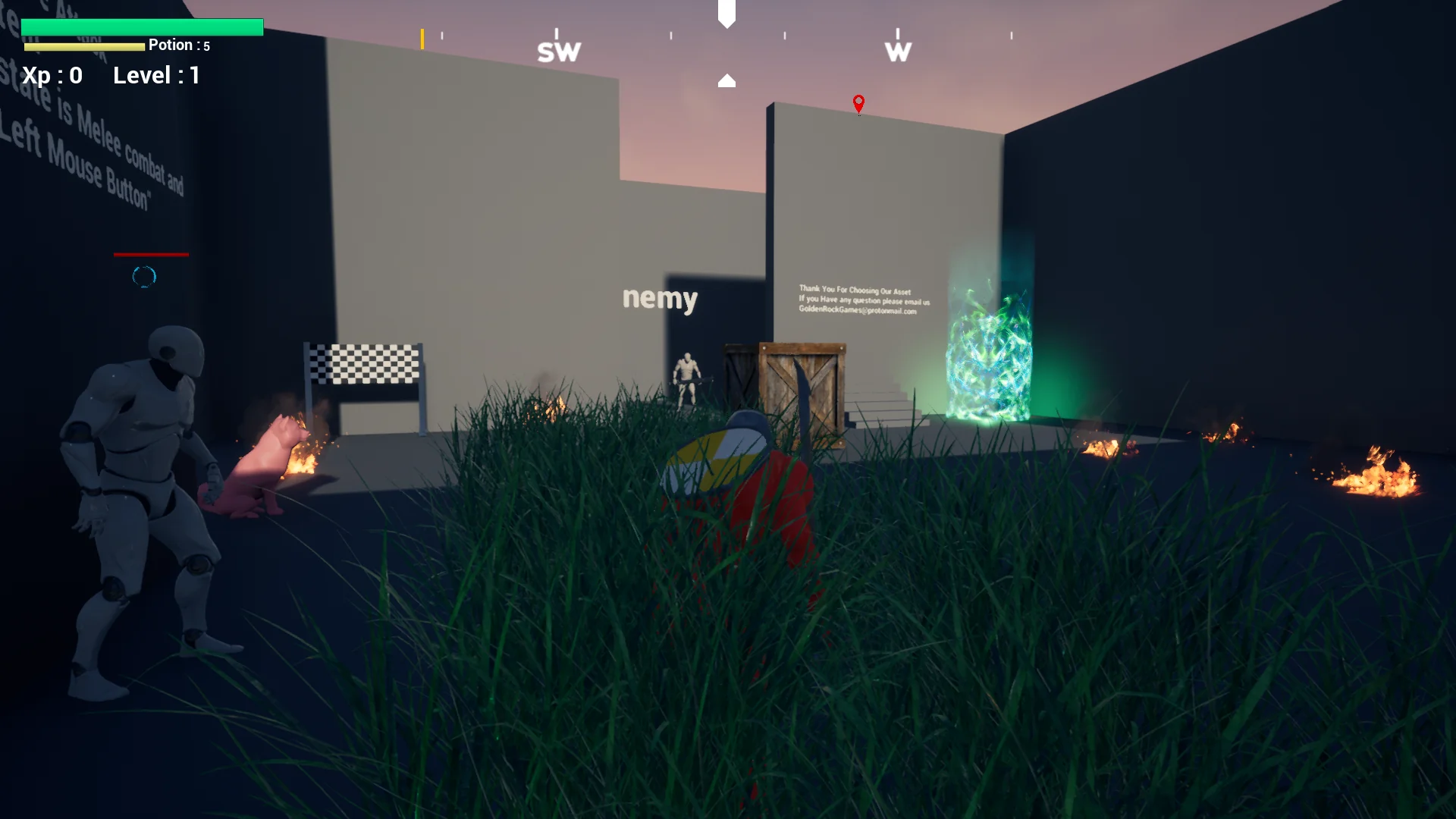
Animation content is still part of the package. The animations, characters, and environment from one demonstration are included. A second demonstration shows animations, characters, and environment that are not included. Keeping those two cases separate matters when a team is working out what it will actually have on hand.
The included characters and environment give the ability set a staged scene to be judged in, not just isolated motion. A team can see the roll, attack, and melee behavior inside an environment with characters present. At the same time, the ability to change animations means the presentation does not have to remain the demonstration's presentation.
For a project with its own character, the practical path is to keep the character and adjust the animation side to fit. For a project that wants a starting scene, the included characters and environment provide one. The same package supports both readings because the character connection is handled through components and interfaces, while the animations are changeable.
Demo Testing and the Planned Update Path
A demo is available to test the system. That gives a team a way to inspect the behavior before deciding how it fits, which is useful when the claims are about feel rather than about a static model. The demo lets the roll, attack, and melee set be seen in motion.
The creator also plans to make the asset more realistic in upcoming updates by adding more animations and functions. That is a forward-looking statement, not a description of the current set. It does show the direction: the animation and function coverage is expected to grow, with realism as the stated goal.
For a team evaluating the set now, the update plan is context rather than a promise of specific features. The concrete present-day pieces are the components, interfaces, script and Blueprint logic, rolling, attack, melee, included animation and scene content, and the demo. Those are the parts that can be assessed today.
Where the Character Abilities Set Fits
The strongest fit is a project that already has its character and needs a combat ability layer. An RPG with melee encounters can use the roll, attack, and melee vocabulary directly. A prototype with a finished hero can add components and interfaces without replacing the hero. A team that wants to keep character identity separate from ability logic has a reason to look at this arrangement rather than a character-first package.
The AAA reference is the stated design inspiration. It sets the expectation that the abilities are modeled on AAA combat, while the RPG frame keeps the focus on character fighting and close-range actions.
What a team should check first is whether the component-and-interface workflow matches its own character setup. The second check is animation fit: the motions can be changed, but the included animations, characters, and environment are the material that comes with the set. The third is timing: the demo shows the current behavior, while the update plan points to more animations and functions later.
Character Abilities is therefore easiest to judge as an attachment. It does not ask a project to cast a new character to reach the combat logic. It asks for an existing character, adds the components and interfaces, and lets the rolling, attack, and melee behavior follow. For teams with that exact gap, the integration model is the most concrete reason to consider it.
 Weapons & Combat
 Weapons & Combat
 Weapons & Combat