"fa182e0cd0a6ea73"{"id":"1001830","slug":"rpg-7-grenade-launcher","title":"RPG-7 GRENADE LAUNCHER","category":"Weapons \u0026 Combat","engine":"4.26+,5.0+","assetVersion":"","engineVersion":"Engine Version: 4.26+,5.0+","tag":"Weapons \u0026 Combat","accent":"blue","visual":"mech","summary":"Technical analysis of the RPG-7 Grenade Launcher asset pack, featuring full stand, crouch, and prone character animations for third-person shooter games.","platform":"Unreal Engine","publishedAt":"2026-10-21T08:22:39.149Z","updatedAt":"2026-10-21T08:22:39.149Z","sourceNotes":[],"fileContents":[],"compatibility":["Unreal Engine","Engine Version: 4.26+,5.0+"],"featuredImage":{"alt":"RPG-7 GRENADE LAUNCHER","src":"/wp-content/uploads/published/2026/10/e4e558e91eae-ea42c3d3-da48-4e47-9273-ccee538d3c30-3392e6f806.webp"},"hasDownloadLink":true,"downloads":0,"terms":[{"taxonomy":"category","slug":"weapons-and-combat","name":"Weapons \u0026 Combat"}],"galleryImages":[{"src":"/wp-content/uploads/published/2026/10/2b5f393b2a7d-ddb82aa4-ac90-4326-8adc-110da4fa3e36-ca98c6b5e0.webp","alt":"RPG-7 GRENADE LAUNCHER"},{"src":"/wp-content/uploads/published/2026/10/7c41e64ccbe6-f724099d-45bc-4af3-a6d4-be5f5230382c-a106b21b7e.webp","alt":"RPG-7 GRENADE LAUNCHER"},{"src":"/wp-content/uploads/published/2026/10/35633b261e72-6c5e9584-6718-442f-82a1-91d5e9d46a36-7c45717d9c.webp","alt":"RPG-7 GRENADE LAUNCHER"}],"accessPanel":{"kind":"resource","title":"Download this resource","eyebrow":"Free Download","message":"Log in or create a free account to start your download.","fileName":"Content.7z","safetyNote":"Resources are manually reviewed before listing to improve quality and reduce obvious risks.","actionLabel":"Download Free","resourceType":"Resource archive"},"contentHtml":"\u003cp\u003eA player character shoulders a heavy rocket tube, adjusts posture against the incoming recoil impulse, and stabilizes their footing before discharging a warhead downrange. Shoulder-fired rocket systems introduce specific physical constraints into character locomotion and weapon handling. Because a launcher requires clear alignment across the shoulder, head, and support hand, generic rifle or handgun animations cannot properly communicate the weight, balance, and operational rhythm of heavy ordnance. The RPG-7 Grenade Launcher package addresses this mechanical challenge directly by pairing the weapon model with a specialized suite of character-driven animations structured for immediate third-person gameplay deployment.\u003c/p\u003e \u003ch2\u003eStance Dynamics Across Standing, Crouching, and Prone Positioning\u003c/h2\u003e \u003cp\u003eCombat scenarios demand continuous spatial adaptation. Players rarely remain stationary when engaging armored targets or fortified defensive positions; they alternate between standing to clear high parapets, crouching behind low barriers, and dropping completely prone to evade suppressive fire. Heavy weaponry often presents a bottleneck in game animation graphs because transitioning between these bodily stances requires tailored handling states that prevent meshes from clipping or contorting unnaturally.\u003c/p\u003e \u003cp\u003eThe asset builds its functional foundation around three dedicated character postures: standing, crouching, and prone. Instead of relying on blended approximations or procedural offsets that distort skeletal balance, the pack supplies distinct animation sets engineered for each of these base poses. A standing operator exhibits an upright, balanced stance capable of absorbing rearward force while keeping the launch tube elevated above shoulder line. Dropping into a crouch reorients the center of gravity, bringing the forward grip closer to the knees to maintain weapon elevation while offering a lower physical profile to hostile fire.\u003c/p\u003e \u003cp\u003eThe prone posture is frequently omitted in third-person weapon packs due to the severe mechanical difficulty of managing a long launch tube along the surface plane. Here, prone execution is addressed as a core locomotion state. Operating a shoulder-mounted tube while lying horizontally alters arm angles, weapon resting points, and line-of-sight checks against the ground mesh. Having dedicated ground-level movements ensures that combat transitions remain visually coherent even when the player is pinned down under direct contact.\u003c/p\u003e \u003ch2\u003eRPG-7 Grenade Launcher Animation Breakdown: Stand, Crouch, and Prone\u003c/h2\u003e \u003cp\u003eThe core movement sets are divided cleanly across the three operational postures, with each posture receiving its own complete gameplay loop. Rather than sharing generic weapon swaps, the pack maps the functional combat lifecycle individually to each physical state:\u003c/p\u003e \u003cul\u003e \u003cli\u003e\u003cstrong\u003eCharacter Stand:\u003c/strong\u003e Features unique tracks for equipping the launcher from a stowed position, returning it to an unequipped state, discharging a rocket downrange, and cycling through a full reload sequence while upright.\u003c/li\u003e \u003cli\u003e\u003cstrong\u003eCharacter Crouch:\u003c/strong\u003e Accommodates low-profile cover play with customized equip, unequip, firing, and reload cycles configured to work within condensed vertical space.\u003c/li\u003e \u003cli\u003e\u003cstrong\u003eCharacter Prone:\u003c/strong\u003e Supplies low-clearance equip, unequip, shooting, and reload motions arranged specifically to respect ground collisions while maintaining the realistic mechanical manipulation of the RPG-7 tube.\u003c/li\u003e\n\u003c/ul\u003e \u003cp\u003eReloading a shoulder-fired launcher while prone involves fundamentally different kinematics than reloading while upright. The operator must roll slightly, reach forward to insert the warhead assembly into the muzzle end, lock the booster mechanism, and reset their sight picture, all without exposing their body above surrounding terrain. Supplying dedicated reload and firing movements across each posture eliminates the awkwardness of characters standing up mid-reload or sinking the weapon geometry into the floor.\u003c/p\u003e \u003ch2\u003eRigged Thirdperson Handling and Weapon Cycle Flow\u003c/h2\u003e \u003cp\u003eWithin a third-person camera perspective, skeletal fidelity is constantly scrutinized by the player. Visual artifacts, unnatural wrist twisting, and disjointed shoulder pivots immediately break mechanical immersion. The included animations are designed around rigged skeletal systems, guaranteeing clean hand placement on the RPG-7 forward grip and firing assembly throughout active play.\u003c/p\u003e \u003cp\u003eThe flow of play depends on smooth transitions between dormant and active states. Equipping and unequipping motions establish clear setup delays, allowing game developers to balance heavy ordnance with appropriate readiness timers. When a player switches from a secondary sidearm or primary assault rifle to the rocket launcher, the unholster and shoulder-mount sequence establishes the heavy tactical role of the tool. Holstering or unequipping reflects a reciprocal movement, lowering the tube and freeing the character rig to return to standard movement states.\u003c/p\u003e \u003cp\u003eThe firing sequences capture the sudden mechanical release of the rocket warhead, giving developers the precise keyframe cues needed to trigger muzzle VFX, backblast particle volumes, screen camera shakes, and ballistic projectile spawning. Because the animation drives the character body through the shot sequence, blending directly into an empty-tube state or transitioning cleanly into the reload animation occurs without visual stutters.\u003c/p\u003e \u003ch2\u003eDeployment Across Open Venues and Football Stadium Scales\u003c/h2\u003e \u003cp\u003eThe functional scope of an RPG-7 is inextricably tied to open engagement distances and clear backblast zones. Confined indoor spaces create significant hazards for rocket propulsion, making spacious, wide-angle environments the natural setting for deploying such hardware. The asset list includes project readiness for large-scale venues, explicitly calling out compatibility for broad arena setups such as a football stadium environment.\u003c/p\u003e \u003cp\u003eDeploying heavy ordnance within large athletic venues or open arena installations introduces massive sightlines where long-distance projectile arcs become central to gameplay. Large-scale structural environments give full context to the distinct character stances. A player maneuvering along tiered stadium seating, navigating concourse railings, or taking cover near structural pillars requires constant posture shifts between stand, crouch, and prone to maintain firing angles across open fields. The rigged animations ensure that whether an operator is kneeling behind bleachers or firing across an open stadium floor, the third-person presentation remains mechanically grounded.\u003c/p\u003e \u003ch2\u003eShooter Game System Integration\u003c/h2\u003e \u003cp\u003eThe asset arrives pre-configured for direct use within shooter game development frameworks. By packaging the launcher model together with rigged third-person character animations, the package removes the complex technical hurdle of matching generic motion capture files to a specialized, shoulder-carried rocket asset. The discrete state organization—separating stand, crouch, and prone across equip, unequip, shoot, and reload tasks—fits smoothly into standard state machines and animation montage slot systems.\u003c/p\u003e \u003cp\u003eDevelopers configuring third-person combat controllers can map the provided motion assets straight into their existing locomotion and combat graphs. The clean compartmentalization of states allows projects to implement robust combat behaviors: full-mobility standing volleys, tactical crouched defense behind obstacles, and desperate prone counter-attacks against distant vehicles or fortified structures, all supported by a unified set of purposeful, rigged animations.\u003c/p\u003e\n\n\u003ch2\u003eRelated Resources Worth Checking\u003c/h2\u003e\n\u003cul\u003e\n\u003cli\u003e\u003ca href=\"https://3dcghub.com/tactical-grenades/\" title=\"Tactical Grenades\"\u003eTactical Grenades\u003c/a\u003e\u003c/li\u003e\n\u003cli\u003e\u003ca href=\"https://3dcghub.com/sci-fi-arsenal-vol-3-1-2/\" title=\"Sci-fi Arsenal Vol 3.1\"\u003eSci-fi Arsenal Vol 3.1\u003c/a\u003e\u003c/li\u003e\n\u003cli\u003e\u003ca href=\"https://3dcghub.com/knife-dagger/\" title=\"Knife Dagger\"\u003eKnife Dagger\u003c/a\u003e\u003c/li\u003e\n\u003cli\u003e\u003ca href=\"https://3dcghub.com/stylized-staves-rpg-weapons/\" title=\"Stylized Staves - RPG Weapons\"\u003eStylized Staves - RPG Weapons\u003c/a\u003e\u003c/li\u003e\n\u003cli\u003e\u003ca href=\"https://3dcghub.com/stylized-shields-rpg-weapons/\" title=\"Stylized Shields - RPG Weapons\"\u003eStylized Shields - RPG Weapons\u003c/a\u003e\u003c/li\u003e\n\u003c/ul\u003e","contentTextLength":7714,"navigation":{"current":26,"total":3789,"previous":{"id":"1001831","slug":"scorcher-modular-military-buggy","title":"Scorcher – Modular Military Buggy","category":"Military","platform":"Unreal Engine","updatedAt":"2026-10-21T08:23:24.707Z"},"next":{"id":"1001829","slug":"robot-robbie-01","title":"Robot Robbie 01","category":"Characters \u0026 Creatures","platform":"Unreal Engine","updatedAt":"2026-10-21T08:21:32.204Z"}},"relatedResources":[{"id":"1001709","slug":"tactical-grenades","title":"Tactical Grenades","category":"Weapons \u0026 Combat","engine":"4.26+,5.0+","assetVersion":"","engineVersion":"Engine Version: 4.26+,5.0+","tag":"Weapons \u0026 Combat","accent":"blue","visual":"mech","summary":"AAA tactical grenades featuring 4K PBR textures, custom animations, visual effects, and audio for PC, console, and VR combat projects.","platform":"Unreal Engine","publishedAt":"2026-10-14T17:14:02.022Z","updatedAt":"2026-10-14T17:14:02.022Z","sourceNotes":[],"fileContents":[],"compatibility":["Unreal Engine","Engine Version: 4.26+,5.0+"],"featuredImage":{"alt":"Tactical Grenades","src":"/wp-content/uploads/published/2026/10/3b1d353a273c-01b18f81-7f25-4166-92a9-31ee2818a19d-3e669dc0f6.webp"},"hasDownloadLink":true,"downloads":5},{"id":"1000755","slug":"sci-fi-arsenal-vol-3-1-2","title":"Sci-fi Arsenal Vol 3.1","category":"Weapons \u0026 Combat","engine":"4.27,5.0+","assetVersion":"","engineVersion":"Engine Version: 4.27,5.0+","tag":"Weapons \u0026 Combat","accent":"blue","visual":"mech","summary":"Sci-fi Arsenal Vol 3.1 delivers over 5 animated weapons for Unreal Engine shooters, including a shotgun, rocket launcher, bow, blades, and ammo boxes with bluep","platform":"Unreal Engine","publishedAt":"2026-07-27T15:19:09.525Z","updatedAt":"2026-07-27T15:19:09.525Z","sourceNotes":[],"fileContents":[],"compatibility":["Unreal Engine","Engine Version: 4.27,5.0+"],"featuredImage":{"alt":"Sci-fi Arsenal Vol 3.1","src":"/wp-content/uploads/published/2026/07/55f35fc469c7-e976b5d6-4493-484b-8d86-8e8c45e987e8-3b11dfffe3.webp"},"hasDownloadLink":true,"downloads":1},{"id":"5396","slug":"knife-dagger","title":"Knife Dagger","category":"Weapons \u0026 Combat","engine":"4.26+,5.0+","assetVersion":"Engine version: 4.26+,5.0+","engineVersion":"4.25","tag":"Weapons \u0026 Combat","accent":"blue","visual":"animation","summary":"Enhance your game with 13 realistic medieval knife and dagger 3D models. Featuring 4K textures and LODs, these assets are perfect for any fantasy RPG project.","platform":"Unreal Engine","publishedAt":"2026-02-15T14:56:18.000Z","updatedAt":"2026-04-19T15:56:57.000Z","sourceNotes":[],"fileContents":[],"compatibility":["Unreal Engine","Engine version: 4.26+,5.0+"],"featuredImage":{"alt":"Knife Dagger","src":"https://3dcghub.com/wp-content/uploads/2026/02/739e278a-7c12-4958-93bc-7cb7c935bbe9.webp"},"hasDownloadLink":true,"downloads":0}]}
Weapons & Combat
RPG-7 GRENADE LAUNCHER
Technical analysis of the RPG-7 Grenade Launcher asset pack, featuring full stand, crouch, and prone character animations for third-person shooter games.
A player character shoulders a heavy rocket tube, adjusts posture against the incoming recoil impulse, and stabilizes their footing before discharging a warhead downrange. Shoulder-fired rocket systems introduce specific physical constraints into character locomotion and weapon handling. Because a launcher requires clear alignment across the shoulder, head, and support hand, generic rifle or handgun animations cannot properly communicate the weight, balance, and operational rhythm of heavy ordnance. The RPG-7 Grenade Launcher package addresses this mechanical challenge directly by pairing the weapon model with a specialized suite of character-driven animations structured for immediate third-person gameplay deployment.
Stance Dynamics Across Standing, Crouching, and Prone Positioning
Combat scenarios demand continuous spatial adaptation. Players rarely remain stationary when engaging armored targets or fortified defensive positions; they alternate between standing to clear high parapets, crouching behind low barriers, and dropping completely prone to evade suppressive fire. Heavy weaponry often presents a bottleneck in game animation graphs because transitioning between these bodily stances requires tailored handling states that prevent meshes from clipping or contorting unnaturally.
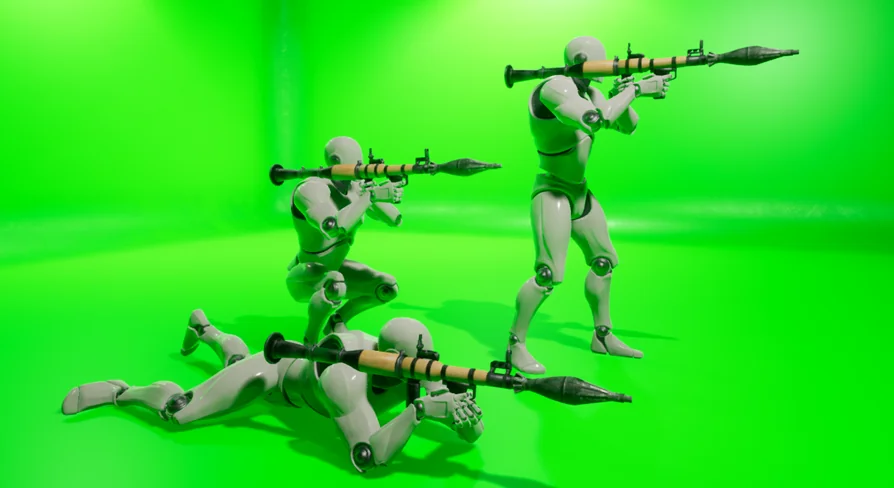
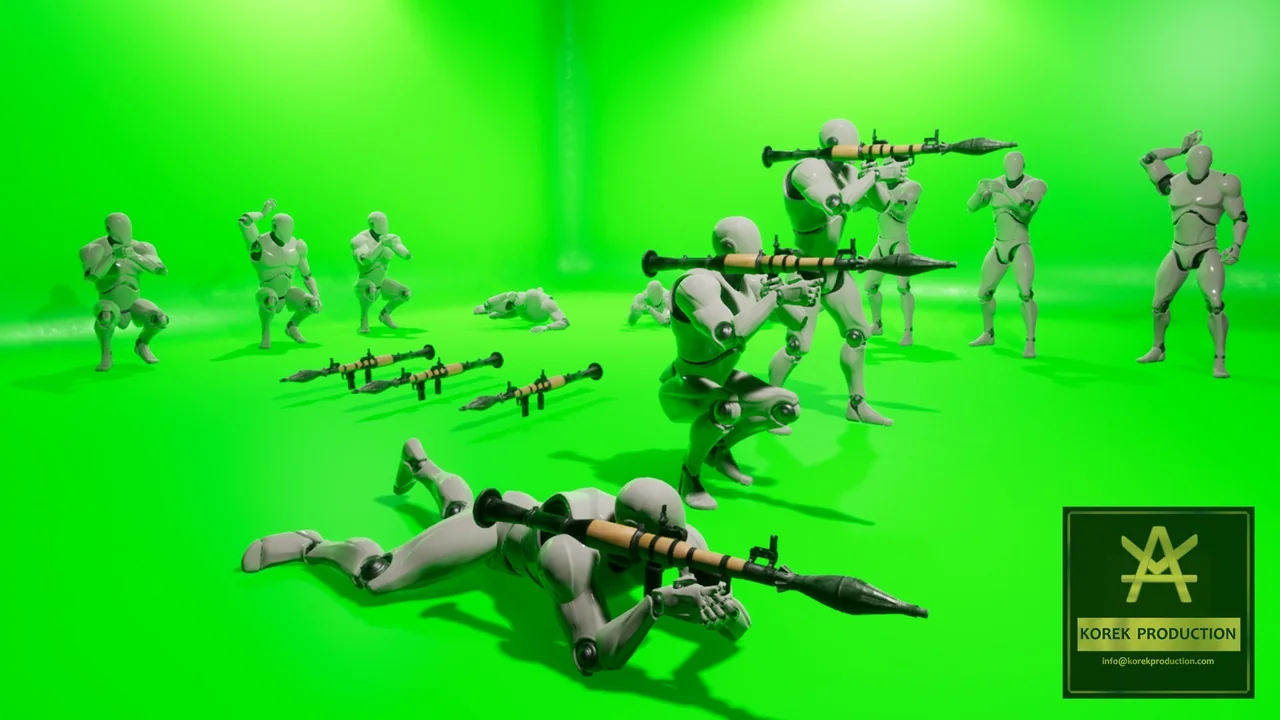
The asset builds its functional foundation around three dedicated character postures: standing, crouching, and prone. Instead of relying on blended approximations or procedural offsets that distort skeletal balance, the pack supplies distinct animation sets engineered for each of these base poses. A standing operator exhibits an upright, balanced stance capable of absorbing rearward force while keeping the launch tube elevated above shoulder line. Dropping into a crouch reorients the center of gravity, bringing the forward grip closer to the knees to maintain weapon elevation while offering a lower physical profile to hostile fire.
The prone posture is frequently omitted in third-person weapon packs due to the severe mechanical difficulty of managing a long launch tube along the surface plane. Here, prone execution is addressed as a core locomotion state. Operating a shoulder-mounted tube while lying horizontally alters arm angles, weapon resting points, and line-of-sight checks against the ground mesh. Having dedicated ground-level movements ensures that combat transitions remain visually coherent even when the player is pinned down under direct contact.
RPG-7 Grenade Launcher Animation Breakdown: Stand, Crouch, and Prone
The core movement sets are divided cleanly across the three operational postures, with each posture receiving its own complete gameplay loop. Rather than sharing generic weapon swaps, the pack maps the functional combat lifecycle individually to each physical state:
Character Stand: Features unique tracks for equipping the launcher from a stowed position, returning it to an unequipped state, discharging a rocket downrange, and cycling through a full reload sequence while upright.
Character Crouch: Accommodates low-profile cover play with customized equip, unequip, firing, and reload cycles configured to work within condensed vertical space.
Character Prone: Supplies low-clearance equip, unequip, shooting, and reload motions arranged specifically to respect ground collisions while maintaining the realistic mechanical manipulation of the RPG-7 tube.
Reloading a shoulder-fired launcher while prone involves fundamentally different kinematics than reloading while upright. The operator must roll slightly, reach forward to insert the warhead assembly into the muzzle end, lock the booster mechanism, and reset their sight picture, all without exposing their body above surrounding terrain. Supplying dedicated reload and firing movements across each posture eliminates the awkwardness of characters standing up mid-reload or sinking the weapon geometry into the floor.
Rigged Thirdperson Handling and Weapon Cycle Flow
Within a third-person camera perspective, skeletal fidelity is constantly scrutinized by the player. Visual artifacts, unnatural wrist twisting, and disjointed shoulder pivots immediately break mechanical immersion. The included animations are designed around rigged skeletal systems, guaranteeing clean hand placement on the RPG-7 forward grip and firing assembly throughout active play.
The flow of play depends on smooth transitions between dormant and active states. Equipping and unequipping motions establish clear setup delays, allowing game developers to balance heavy ordnance with appropriate readiness timers. When a player switches from a secondary sidearm or primary assault rifle to the rocket launcher, the unholster and shoulder-mount sequence establishes the heavy tactical role of the tool. Holstering or unequipping reflects a reciprocal movement, lowering the tube and freeing the character rig to return to standard movement states.
The firing sequences capture the sudden mechanical release of the rocket warhead, giving developers the precise keyframe cues needed to trigger muzzle VFX, backblast particle volumes, screen camera shakes, and ballistic projectile spawning. Because the animation drives the character body through the shot sequence, blending directly into an empty-tube state or transitioning cleanly into the reload animation occurs without visual stutters.
Deployment Across Open Venues and Football Stadium Scales
The functional scope of an RPG-7 is inextricably tied to open engagement distances and clear backblast zones. Confined indoor spaces create significant hazards for rocket propulsion, making spacious, wide-angle environments the natural setting for deploying such hardware. The asset list includes project readiness for large-scale venues, explicitly calling out compatibility for broad arena setups such as a football stadium environment.
Deploying heavy ordnance within large athletic venues or open arena installations introduces massive sightlines where long-distance projectile arcs become central to gameplay. Large-scale structural environments give full context to the distinct character stances. A player maneuvering along tiered stadium seating, navigating concourse railings, or taking cover near structural pillars requires constant posture shifts between stand, crouch, and prone to maintain firing angles across open fields. The rigged animations ensure that whether an operator is kneeling behind bleachers or firing across an open stadium floor, the third-person presentation remains mechanically grounded.
Shooter Game System Integration
The asset arrives pre-configured for direct use within shooter game development frameworks. By packaging the launcher model together with rigged third-person character animations, the package removes the complex technical hurdle of matching generic motion capture files to a specialized, shoulder-carried rocket asset. The discrete state organization—separating stand, crouch, and prone across equip, unequip, shoot, and reload tasks—fits smoothly into standard state machines and animation montage slot systems.
Developers configuring third-person combat controllers can map the provided motion assets straight into their existing locomotion and combat graphs. The clean compartmentalization of states allows projects to implement robust combat behaviors: full-mobility standing volleys, tactical crouched defense behind obstacles, and desperate prone counter-attacks against distant vehicles or fortified structures, all supported by a unified set of purposeful, rigged animations.
 Weapons & Combat
 Weapons & Combat
 Weapons & Combat
 Weapons & Combat