"7b46a695175d8694"{"id":"1001500","slug":"african-village","title":"African Village","category":"Towns \u0026 Villages","engine":"5.1+","assetVersion":"","engineVersion":"Engine Version: 5.1+","tag":"Towns \u0026 Villages","accent":"blue","visual":"mech","summary":"Explore the African Village environment featuring Sudanese rural architecture, low poly foliage, and arranged maps for Unreal Engine 4 and 5.","platform":"Unreal Engine","publishedAt":"2026-10-09T07:27:39.282Z","updatedAt":"2026-10-09T07:27:39.282Z","sourceNotes":[],"fileContents":[],"compatibility":["Unreal Engine","Engine Version: 5.1+"],"featuredImage":{"alt":"African Village","src":"/wp-content/uploads/published/2026/10/8767d94b5a84-27cb8d36-05a6-4351-8839-55a4d385693e-18cc0980b6.webp"},"hasDownloadLink":true,"downloads":0,"terms":[{"taxonomy":"category","slug":"towns-and-villages","name":"Towns \u0026 Villages"}],"galleryImages":[{"src":"/wp-content/uploads/published/2026/10/3dafcc2e9cad-3a2feb55-e42e-4038-8009-9328b0dedc27-da95e83456.webp","alt":"African Village"},{"src":"/wp-content/uploads/published/2026/10/b079f5e72987-417f4b1b-100f-4e31-a8a9-17f9856833cf-041410936f.webp","alt":"African Village"},{"src":"/wp-content/uploads/published/2026/10/411511565793-011a0e4b-9c49-40a0-a900-e03907a80800-63b1046c4a.webp","alt":"African Village"},{"src":"/wp-content/uploads/published/2026/10/e94836f7eecc-e5912acc-35d7-4de8-b05d-163f3fdd5d0a-eec7e7a7ad.webp","alt":"African Village"},{"src":"/wp-content/uploads/published/2026/10/7deb5821cc52-d416201b-0cb4-46a9-b23b-45dc4c81ae22-70cb2ffdc1.webp","alt":"African Village"},{"src":"/wp-content/uploads/published/2026/10/40582d945971-98bb0986-7fdc-4717-9795-090fd3564708-58efa64786.webp","alt":"African Village"},{"src":"/wp-content/uploads/published/2026/10/8fd9287422a7-4a2b35cb-1414-4516-8e71-3a5bab910960-e34a63c0c6.webp","alt":"African Village"},{"src":"/wp-content/uploads/published/2026/10/0ec8060c323a-4371d4a2-d5df-4f63-bfee-2e1607bf1f27-c54c191a5e.webp","alt":"African Village"},{"src":"/wp-content/uploads/published/2026/10/ee964a7615f8-6a2eba9f-89d9-4f11-8227-ec76db8e851b-163bc033fa.webp","alt":"African Village"},{"src":"/wp-content/uploads/published/2026/10/df97cc32776a-d4ef3692-3c57-4811-88cd-e1d4c750f1d4-aa3383071b.webp","alt":"African Village"}],"accessPanel":{"kind":"resource","title":"Download this resource","eyebrow":"Free Download","message":"Log in or create a free account to start your download.","fileName":"African Village.7z","safetyNote":"Resources are manually reviewed before listing to improve quality and reduce obvious risks.","actionLabel":"Download Free","resourceType":"Resource archive"},"contentHtml":"\u003ch2\u003eSudanese Rural Environments and Thatched Cottage Architecture\u003c/h2\u003e\n\u003cp\u003eConstructing believable regional settlements requires architectural forms that reflect authentic material traditions and geographical contexts. African Village delivers an environment influenced directly by Sudanese rural environments, capturing the distinct visual footprint of traditional homesteads, shelters, and communal spaces. Central to this aesthetic is the thatched cottage, alongside rudimentary huts and shelters that define agrarian and pastoral daily life. These structures reflect historical building practices where natural framing and woven thatch provide roofing and boundary definition, creating an unmistakable silhouette across open terrain.\u003c/p\u003e\n\u003cp\u003eThe vernacular structures within the collection are suited for grounding projects in specific cultural or ancient historical timelines. Rather than presenting generic earthen dwellings, the shapes mirror traditional homestead layouts where dwellings, storage shelters, and stable spaces congregate within an open compound. Campfire spaces and functional enclosures sit naturally alongside the primary huts, allowing creators to establish living tribal settlements, historical trade outposts, or survival encampments with distinct local personality.\u003c/p\u003e \u003ch2\u003eLow Poly Trees, Grasses, and Light Foliage\u003c/h2\u003e\n\u003cp\u003ePopulating broad natural expanses often presents a direct conflict between environmental density and runtime performance. African Village resolves this balance by pairing its realistic asset look with low poly trees, light foliage, and native grasses. By keeping the underlying poly counts restrained for vegetation, scenes can host expansive outdoor vistas without overtaxing hardware, ensuring stable frame rates across active gameplay or extensive real-time passes.\u003c/p\u003e\n\u003cp\u003eThe foliage assortment emphasizes the arid, sun-exposed vegetation characteristic of rural African landscapes. Light grasses and hardy trees provide scattered shade and ground breakups around the buildings, avoiding the heavy, dense canopies typical of jungle settings in favor of a sparse, open, and windswept terrain. This distribution assists developers in crafting clear lines of sight, visible pathways between cottages, and vast surrounding land that frames the central village footprint cleanly.\u003c/p\u003e \u003ch2\u003eArranged Map Layout and Large Environment Customization\u003c/h2\u003e\n\u003cp\u003eRather than providing an isolated collection of individual meshes, the package features high quality realistic assets arranged directly in a ready-to-use map. This pre-composed level demonstrates how the cottages, stables, trees, and ground foliage interact under environmental lighting. Developers can navigate the arranged area immediately, using the pre-existing composition as a reference framework for scale, prop placement, and overall settlement geography.\u003c/p\u003e\n\u003cp\u003eBeyond functioning as a static level, the setup is structured so that developers can easily create large environments and customize the map to suit specific scenario requirements. The individual components—from isolated huts to perimeter foliage clusters—can be duplicated, rotated, and shifted to stretch the village across rolling hills, riverbeds, or flat desert expanses. Expanding the settlement into a widespread network of connected hamlets or downsizing it into a lone wilderness survival shelter requires minimal adjustment to the fundamental assets.\u003c/p\u003e \u003ch2\u003eProduction Contexts in Games, Animations, and Education\u003c/h2\u003e\n\u003cp\u003eThe flexible visual style and thematic specificity of the asset collection make it practical across a wide range of interactive and non-interactive workflows. In game development, the environment naturally aligns with survival games, third-person adventure titles, and exploration mechanics. The presence of campfires, shelters, and open land offers an intuitive staging ground for player progression, where resource gathering, navigation, and outpost management play central gameplay roles.\u003c/p\u003e\n\u003cp\u003eCinematic animators and virtual production teams can utilize the arranged map for immediate backdrop establishment, placing characters into rural, tribal, or historical settings without spending development cycles constructing period-appropriate architecture from scratch. Similarly, educational visualizations benefit from the accurate cultural inspiration drawn from Sudanese rural realities, providing students and viewers with an interactive walkthrough of traditional settlement architecture, shelter construction, and rural living arrangements.\u003c/p\u003e \u003ch2\u003eUnreal Engine Compatibility Across UE4 and UE5\u003c/h2\u003e\n\u003cp\u003ePipeline compatibility is supported across multiple iterations of Unreal Engine. The release covers Unreal Engine 4.25, 4.26, and 4.27, ensuring complete stability for projects maintaining older production baselines or legacy codebases. For modern production pipelines, deployment extends seamlessly into Unreal Engine 5.0 and up, allowing modern lighting systems, modern level streaming tools, and updated engine features to leverage the environment assets directly.\u003c/p\u003e\n\u003cp\u003eThis wide engine span makes the African Village environment a versatile candidate for long-term production cycles. Teams transitioning existing projects from late UE4 releases into UE5 can import the map and its component assets without encountering platform barriers or fractured dependencies, maintaining the same visual coherence and settlement layouts across platform upgrades.\u003c/p\u003e\n\n\u003ch2\u003eMore From The Same Workflow\u003c/h2\u003e\n\u003cul\u003e\n\u003cli\u003e\u003ca href=\"https://3dcghub.com/suburb-neighborhood-house-pack-modular/\" title=\"Suburb Neighborhood House Pack (Modular)\"\u003eSuburb Neighborhood House Pack (Modular)\u003c/a\u003e\u003c/li\u003e\n\u003cli\u003e\u003ca href=\"https://3dcghub.com/asian-forest-town/\" title=\"ASIAN - Forest Town\"\u003eASIAN - Forest Town\u003c/a\u003e\u003c/li\u003e\n\u003cli\u003e\u003ca href=\"https://3dcghub.com/modular-medieval-village-medieval-village-stylized-village-fantasy-village/\" title=\"Modular Medieval Village (Medieval Village, Stylized Village, Fantasy Village)\"\u003eModular Medieval Village (Medieval Village, Stylized Village, Fantasy Village)\u003c/a\u003e\u003c/li\u003e\n\u003cli\u003e\u003ca href=\"https://3dcghub.com/modular-town-modular-town-modular-village-rural-town-rural-village-farm/\" title=\"Modular Town (Modular Town, Modular Village, Rural Town, Rural Village, Farm)\"\u003eModular Town (Modular Town, Modular Village, Rural Town, Rural Village, Farm)\u003c/a\u003e\u003c/li\u003e\n\u003cli\u003e\u003ca href=\"https://3dcghub.com/spanish-cottage-spanish-cottage-spanish-cottage-3d-art-nature-tree-medieval/\" title=\"Spanish Cottage ( Spanish Cottage Spanish Cottage 3D Art Nature Tree Medieval )\"\u003eSpanish Cottage ( Spanish Cottage Spanish Cottage 3D Art Nature Tree Medieval )\u003c/a\u003e\u003c/li\u003e\n\u003c/ul\u003e","contentTextLength":5690,"navigation":{"current":45,"total":3481,"previous":{"id":"1001501","slug":"arctic-cliffs","title":"Arctic Cliffs","category":"Mountain","platform":"Unreal Engine","updatedAt":"2026-10-09T07:29:09.683Z"},"next":{"id":"1001499","slug":"advanced-fireworks-system-vfx","title":"Advanced Fireworks System VFX","category":"Fire \u0026 Explosions","platform":"Unreal Engine","updatedAt":"2026-10-09T07:26:39.722Z"}},"relatedResources":[{"id":"1001070","slug":"suburb-neighborhood-house-pack-modular","title":"Suburb Neighborhood House Pack (Modular)","category":"Towns \u0026 Villages","engine":"5.0+","assetVersion":"","engineVersion":"Engine Version: 5.0+","tag":"Towns \u0026 Villages","accent":"blue","visual":"mech","summary":"Modular suburban package with house interiors/exteriors, road system, trees, cars, and furniture. Includes a pre-built day and night map for UE5 projects.","platform":"Unreal Engine","publishedAt":"2026-09-03T17:09:53.903Z","updatedAt":"2026-09-03T17:09:53.903Z","sourceNotes":[],"fileContents":[],"compatibility":["Unreal Engine","Engine Version: 5.0+"],"featuredImage":{"alt":"Suburb Neighborhood House Pack (Modular)","src":"/wp-content/uploads/published/2026/09/9d8f986a1bdd-d39ad75a-ea27-4c68-a14d-41ea2d8ce74c-e6f4b8936e.webp"},"hasDownloadLink":true,"downloads":4},{"id":"1001421","slug":"asian-forest-town","title":"ASIAN - Forest Town","category":"Towns \u0026 Villages","engine":"5.0+","assetVersion":"","engineVersion":"Engine Version: 5.0+","tag":"Towns \u0026 Villages","accent":"blue","visual":"mech","summary":"Explore ASIAN - Forest Town, featuring three lighting scenarios, HDRIBackdrop integration, Lumen setup notes, and CAVE - Mine compatibility.","platform":"Unreal Engine","publishedAt":"2026-10-06T15:00:39.064Z","updatedAt":"2026-10-06T15:00:39.064Z","sourceNotes":[],"fileContents":[],"compatibility":["Unreal Engine","Engine Version: 5.0+"],"featuredImage":{"alt":"ASIAN - Forest Town","src":"/wp-content/uploads/published/2026/10/b98506494ca5-63c8249d-b5ae-4c72-968b-ca03d523bc4f-8063663f0c.webp"},"hasDownloadLink":true,"downloads":0},{"id":"1000656","slug":"modular-medieval-village-medieval-village-stylized-village-fantasy-village","title":"Modular Medieval Village (Medieval Village, Stylized Village, Fantasy Village)","category":"Towns \u0026 Villages","engine":"5.0+","assetVersion":"","engineVersion":"Engine Version: 5.0+","tag":"Towns \u0026 Villages","accent":"blue","visual":"mech","summary":"Stylized medieval village environment with modular houses, full interiors, customizable foliage, animated windmill, VFX, and four landscape materials for fantas","platform":"Unreal Engine","publishedAt":"2026-07-21T20:13:46.984Z","updatedAt":"2026-07-21T20:13:46.984Z","sourceNotes":[],"fileContents":[],"compatibility":["Unreal Engine","Engine Version: 5.0+"],"featuredImage":{"alt":"Modular Medieval Village (Medieval Village, Stylized Village, Fantasy Village)","src":"/wp-content/uploads/published/2026/07/ca7c07789bb0-b7bee89e-026b-4a7d-9512-2cc83a581415-24adf9d89e.webp"},"hasDownloadLink":true,"downloads":2}]}
Towns & Villages
African Village
Explore the African Village environment featuring Sudanese rural architecture, low poly foliage, and arranged maps for Unreal Engine 4 and 5.
Sudanese Rural Environments and Thatched Cottage Architecture
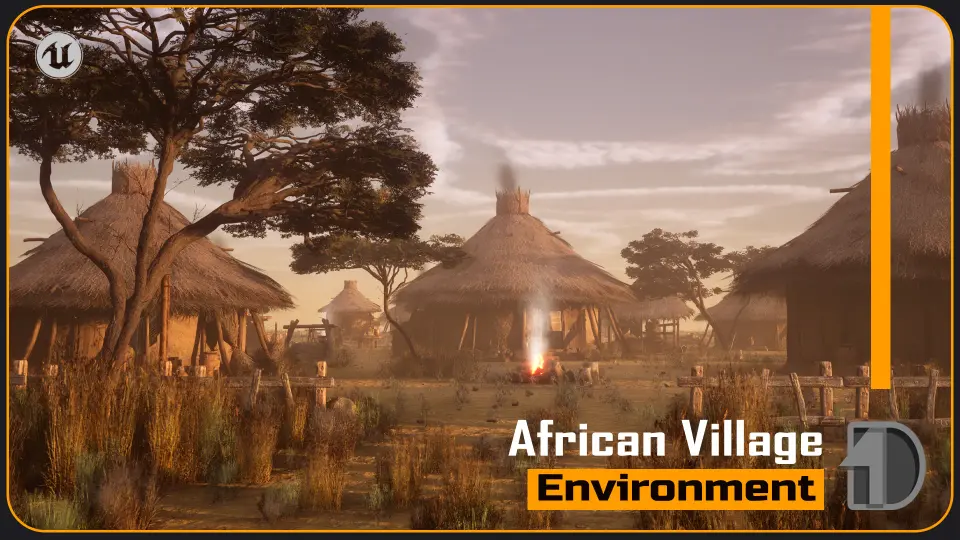
Constructing believable regional settlements requires architectural forms that reflect authentic material traditions and geographical contexts. African Village delivers an environment influenced directly by Sudanese rural environments, capturing the distinct visual footprint of traditional homesteads, shelters, and communal spaces. Central to this aesthetic is the thatched cottage, alongside rudimentary huts and shelters that define agrarian and pastoral daily life. These structures reflect historical building practices where natural framing and woven thatch provide roofing and boundary definition, creating an unmistakable silhouette across open terrain.
The vernacular structures within the collection are suited for grounding projects in specific cultural or ancient historical timelines. Rather than presenting generic earthen dwellings, the shapes mirror traditional homestead layouts where dwellings, storage shelters, and stable spaces congregate within an open compound. Campfire spaces and functional enclosures sit naturally alongside the primary huts, allowing creators to establish living tribal settlements, historical trade outposts, or survival encampments with distinct local personality.
Low Poly Trees, Grasses, and Light Foliage
Populating broad natural expanses often presents a direct conflict between environmental density and runtime performance. African Village resolves this balance by pairing its realistic asset look with low poly trees, light foliage, and native grasses. By keeping the underlying poly counts restrained for vegetation, scenes can host expansive outdoor vistas without overtaxing hardware, ensuring stable frame rates across active gameplay or extensive real-time passes.
The foliage assortment emphasizes the arid, sun-exposed vegetation characteristic of rural African landscapes. Light grasses and hardy trees provide scattered shade and ground breakups around the buildings, avoiding the heavy, dense canopies typical of jungle settings in favor of a sparse, open, and windswept terrain. This distribution assists developers in crafting clear lines of sight, visible pathways between cottages, and vast surrounding land that frames the central village footprint cleanly.
Arranged Map Layout and Large Environment Customization
Rather than providing an isolated collection of individual meshes, the package features high quality realistic assets arranged directly in a ready-to-use map. This pre-composed level demonstrates how the cottages, stables, trees, and ground foliage interact under environmental lighting. Developers can navigate the arranged area immediately, using the pre-existing composition as a reference framework for scale, prop placement, and overall settlement geography.
Beyond functioning as a static level, the setup is structured so that developers can easily create large environments and customize the map to suit specific scenario requirements. The individual components—from isolated huts to perimeter foliage clusters—can be duplicated, rotated, and shifted to stretch the village across rolling hills, riverbeds, or flat desert expanses. Expanding the settlement into a widespread network of connected hamlets or downsizing it into a lone wilderness survival shelter requires minimal adjustment to the fundamental assets.
Production Contexts in Games, Animations, and Education
The flexible visual style and thematic specificity of the asset collection make it practical across a wide range of interactive and non-interactive workflows. In game development, the environment naturally aligns with survival games, third-person adventure titles, and exploration mechanics. The presence of campfires, shelters, and open land offers an intuitive staging ground for player progression, where resource gathering, navigation, and outpost management play central gameplay roles.
Cinematic animators and virtual production teams can utilize the arranged map for immediate backdrop establishment, placing characters into rural, tribal, or historical settings without spending development cycles constructing period-appropriate architecture from scratch. Similarly, educational visualizations benefit from the accurate cultural inspiration drawn from Sudanese rural realities, providing students and viewers with an interactive walkthrough of traditional settlement architecture, shelter construction, and rural living arrangements.
Unreal Engine Compatibility Across UE4 and UE5
Pipeline compatibility is supported across multiple iterations of Unreal Engine. The release covers Unreal Engine 4.25, 4.26, and 4.27, ensuring complete stability for projects maintaining older production baselines or legacy codebases. For modern production pipelines, deployment extends seamlessly into Unreal Engine 5.0 and up, allowing modern lighting systems, modern level streaming tools, and updated engine features to leverage the environment assets directly.
This wide engine span makes the African Village environment a versatile candidate for long-term production cycles. Teams transitioning existing projects from late UE4 releases into UE5 can import the map and its component assets without encountering platform barriers or fractured dependencies, maintaining the same visual coherence and settlement layouts across platform upgrades.
 Towns & Villages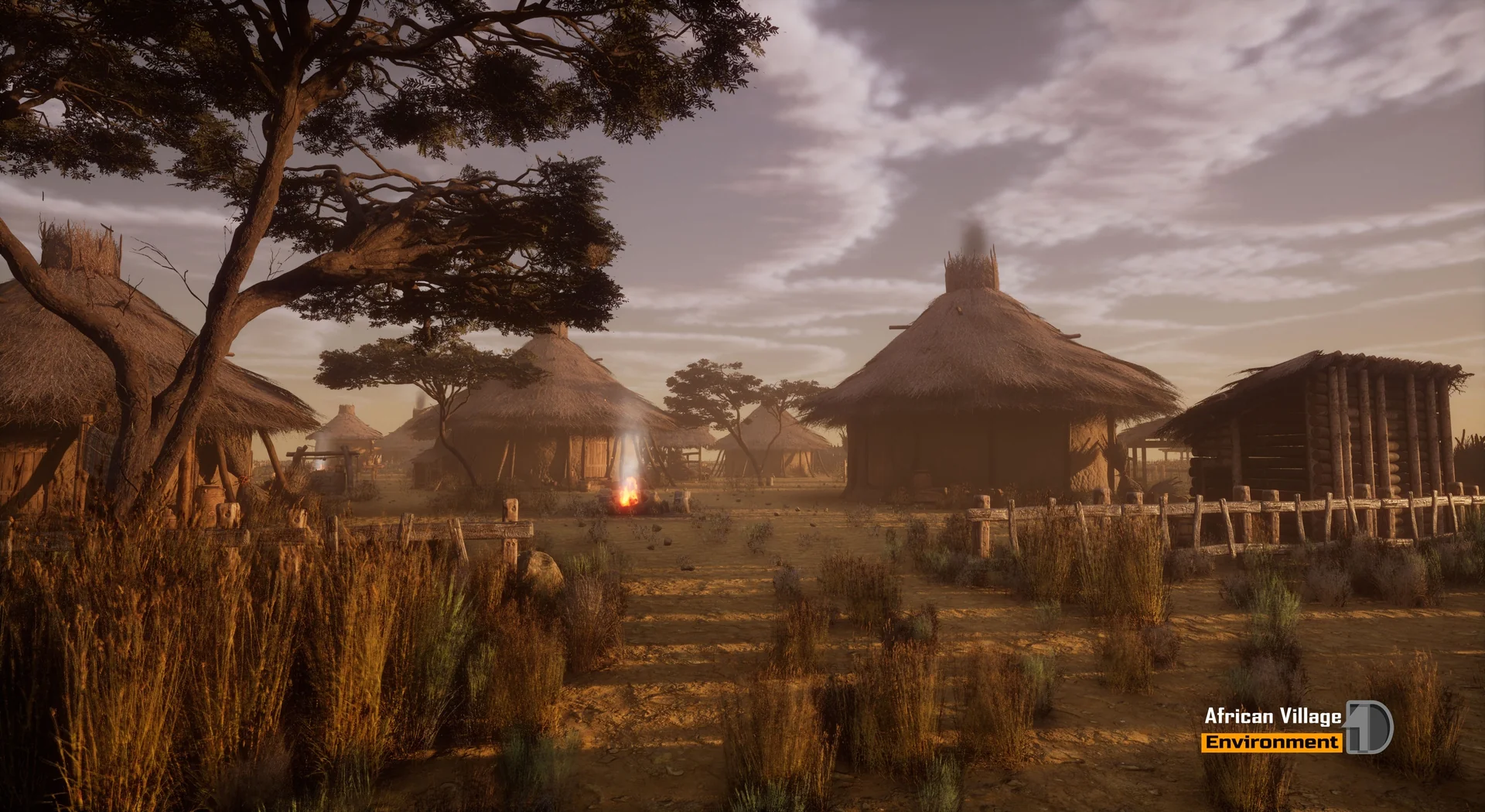
 Towns & Villages
 Towns & Villages
 Towns & Villages