"c14ff6bd758dadb1"{"id":"1000079","slug":"modular-town-modular-town-modular-village-rural-town-rural-village-farm","title":"Modular Town (Modular Town, Modular Village, Rural Town, Rural Village, Farm)","category":"Towns \u0026 Villages","engine":"Engine Version:","assetVersion":"Engine Version: 5.2+","engineVersion":"Engine Version:","tag":"Towns \u0026 Villages","accent":"blue","visual":"mech","summary":"A modular Unreal Engine environment pack with 197 meshes, enterable furnished buildings, tech tools, Nanite foliage, VFX, Lumen, and Nanite support.","platform":"Unreal Engine","publishedAt":"2026-06-05T14:57:56.822Z","updatedAt":"2026-06-05T14:57:56.822Z","sourceNotes":[],"fileContents":[],"compatibility":["Unreal Engine","Engine Version: 5.2+"],"featuredImage":{"alt":"Modular Town (Modular Town, Modular Village, Rural Town, Rural Village, Farm)","src":"/wp-content/uploads/published/2026/06/21b04835f324-6e4eb141-6297-41cc-bdb7-f5b7e553ba76-e638c566e2.webp"},"hasDownloadLink":true,"downloads":3,"terms":[{"taxonomy":"category","slug":"towns-and-villages","name":"Towns \u0026 Villages"}],"galleryImages":[{"src":"/wp-content/uploads/published/2026/06/15ea9a91ba7c-7f4e0820-0b2e-426d-be76-d80ce23b2485-c6c2681a75.webp","alt":"Modular Town (Modular Town, Modular Village, Rural Town, Rural Village, Farm)"},{"src":"/wp-content/uploads/published/2026/06/a1f3cfd09d70-bc15d39a-d2d9-4c27-b4b4-8b4231ecef3c-809e7de854.webp","alt":"Modular Town (Modular Town, Modular Village, Rural Town, Rural Village, Farm)"},{"src":"/wp-content/uploads/published/2026/06/8d4d296c6c1c-e2a736b3-d8b9-417a-9fda-29d3d3b81213-dc6a66054f.webp","alt":"Modular Town (Modular Town, Modular Village, Rural Town, Rural Village, Farm)"},{"src":"/wp-content/uploads/published/2026/06/c6ef1ef5acd3-52ec7f49-6f3a-4c28-a815-612c73ffc942-b03c6f512b.webp","alt":"Modular Town (Modular Town, Modular Village, Rural Town, Rural Village, Farm)"},{"src":"/wp-content/uploads/published/2026/06/ab83fdd2d277-68bd5cee-3f2d-425c-8874-b507a2c5859e-99ba177c1d.webp","alt":"Modular Town (Modular Town, Modular Village, Rural Town, Rural Village, Farm)"},{"src":"/wp-content/uploads/published/2026/06/ab1c6cf252dd-fb268372-3312-4c8e-af38-aab9f1cde1dc-25247492d4.webp","alt":"Modular Town (Modular Town, Modular Village, Rural Town, Rural Village, Farm)"},{"src":"/wp-content/uploads/published/2026/06/15b18f9ff43f-7db53582-91d1-46de-b209-5133d63a906e-b7833a8034.webp","alt":"Modular Town (Modular Town, Modular Village, Rural Town, Rural Village, Farm)"},{"src":"/wp-content/uploads/published/2026/06/f05bfa0460fc-b2894c61-556e-4426-8ea0-1830b9bbed76-fe901515ce.webp","alt":"Modular Town (Modular Town, Modular Village, Rural Town, Rural Village, Farm)"},{"src":"/wp-content/uploads/published/2026/06/f3d5efa3b514-b798b8f0-a88c-483a-9096-b829300d3c74-af0bf2ae65.webp","alt":"Modular Town (Modular Town, Modular Village, Rural Town, Rural Village, Farm)"},{"src":"/wp-content/uploads/published/2026/06/897394a04738-bfbf76c4-e8a4-4d94-8ed5-b8e77d046f2b-f829748dfe.webp","alt":"Modular Town (Modular Town, Modular Village, Rural Town, Rural Village, Farm)"}],"accessPanel":{"kind":"resource","title":"Access this resource","eyebrow":"Free Download","message":"Log in or create a free account to start your download.","fileName":"Content.7z","safetyNote":"Resources are manually reviewed before listing to improve quality and reduce obvious risks.","actionLabel":"Download Free","resourceType":"Resource archive"},"contentHtml":"\u003cp\u003eGetting a town scene moving usually starts with layout, and this pack is clearly structured for that stage first. Modular Town is a fully modular environment kit for assembling medieval towns, cities, rural villages, and farm-like spaces from a shared construction set rather than relying on a few fixed buildings. The package includes 197 meshes, giving scene builders a broad pool of parts to work with when blocking streets, placing structures, and shaping the look of a settlement.\u003c/p\u003e\u003cp\u003eThat makes its place in production easy to read. It sits at the environment-building layer of an Unreal Engine workflow, where teams or solo artists need to move from empty terrain to a believable inhabited location. Instead of treating buildings as sealed exterior shells, the pack goes further by making all buildings fully enterable and fully furnished, which changes how it can be used in gameplay spaces, walkthrough scenes, or cinematic camera paths that move indoors as well as through the street.\u003c/p\u003e\u003cp\u003eThe set also includes a trailer, a playable demo, and documentation, so the implementation path is not limited to raw content alone. Those materials matter because a large modular environment pack often needs a quick visual reference, a practical demonstration of how the pieces come together in a scene, and written guidance for the included tools.\u003c/p\u003e\u003ch2\u003ePlacing a Modular Town from the first blockout\u003c/h2\u003e\u003cp\u003eThe core strength here is scale combined with modularity. With 197 meshes available, Modular Town is positioned as a large construction kit rather than a narrow themed vignette. The stated goal is broad: creating medieval towns, cities, and everything in between. That range gives it room to cover compact village layouts, more open rural arrangements, and denser built-up zones that need repeating architectural language without looking locked to a single prefab arrangement.\u003c/p\u003e\u003cp\u003eIn practice, this kind of kit fits the early and middle stages of scene assembly. A level artist can establish the footprint of a town, define routes through it, and then keep iterating by swapping, extending, or rearranging modules instead of rebuilding from scratch. The pack’s tags point toward village, rural, barn, house, building, homestead, field, forest, farm, town, and city themes, which places it across both countryside and settlement-focused production needs. The tone also stretches across fantasy, realistic, horror, postapocalyptic, and apocalyptic directions, so the same structural base can support different atmosphere choices depending on lighting, dressing, and scene treatment.\u003c/p\u003e\u003cp\u003eBecause the buildings are fully enterable, scene planning does not have to stop at exterior readability. A route can continue through doors and into furnished interiors without a handoff to a separate interior kit. That is especially useful when a project needs continuity between outdoor exploration and indoor detail, or when cinematic staging depends on windows, thresholds, and room spaces rather than facade-only architecture.\u003c/p\u003e\u003ch2\u003eEnterable interiors and the furnished building set\u003c/h2\u003e\u003cp\u003eAll buildings in the pack are fully enterable and fully furnished. That one detail changes the workload the pack can absorb. For an exterior-only environment set, a team still has to solve the inside of every usable structure. Here, the interiors are already part of the package’s identity, which makes the pack more suitable for projects where buildings are not just background dressing.\u003c/p\u003e\u003cp\u003eIn a real production workflow, furnished interiors help at several levels. During prototyping, they let a playable area feel inhabited immediately instead of reading as unfinished shells. During lighting and mood work, they give artists enclosed spaces where light beams, shadow contrast, and room composition can contribute to the scene. During cinematic setup, they create opportunities for camera movement between outdoor streets and indoor rooms without needing a second asset source for basic furnishing.\u003c/p\u003e\u003cp\u003eThe resource name also points toward several overlapping environment types: Modular Town, Modular Village, Rural Town, Rural Village, and Farm. The furnished, enterable approach supports that range well. A farm or village scene benefits from structures that can be stepped into, while a town or city area gains more gameplay and staging flexibility when interiors are available rather than implied.\u003c/p\u003e\u003ch2\u003eFence spline and automatic cable connector tools\u003c/h2\u003e\u003cp\u003eAlongside the environment content, the pack includes two bespoke tech tools: an easy fence spline tool and an automatic cable connector tool. These are not decorative extras. They speak directly to the repetitive but important assembly work that comes with settlement building.\u003c/p\u003e\u003cp\u003eFences are one of the fastest ways to define ownership, route flow, field boundaries, and the edge conditions between roads, yards, and agricultural space. A spline-based fence tool helps with that kind of layout task because fencing rarely follows a perfectly straight, one-off path. It usually needs to bend around terrain, structures, and irregular settlement shapes. Including a dedicated tool for that work means the pack is not only about static meshes; it also addresses a common environment-construction problem.\u003c/p\u003e\u003cp\u003eThe automatic cable connector tool serves a similar role for overhead or attached line work. Cables add connective detail across buildings and streets, but manually placing and aligning them can slow down iteration. An automatic connector tool suggests a more efficient way to establish those links while preserving the layered visual density that helps a town feel built up and lived in.\u003c/p\u003e\u003cp\u003eBoth tools are documented, which is important in practice. Specialized environment tools are only useful if their setup and intended use are clear enough to fold into an artist’s normal workflow without guesswork.\u003c/p\u003e\u003ch2\u003eNanite foliage and VFX in the same environment pass\u003c/h2\u003e\u003cp\u003eModular Town does not stop at architecture. It also includes a vast library of photoscanned foliage intended for use across projects, plus a VFX library with birds, light beams, and more. That combination broadens the pack from a building set into a more complete environment pass.\u003c/p\u003e\u003cp\u003eThe foliage library matters for the spaces between structures as much as for the structures themselves. Rural towns, villages, homesteads, and farm scenes rarely read convincingly through architecture alone. They need vegetation to frame roads, break up open ground, soften hard edges, and connect built spaces to surrounding fields or forested areas. The tags around foliage, field, and forest reinforce that this pack is not limited to houses standing on bare terrain.\u003c/p\u003e\u003cp\u003eThe VFX library adds another layer of scene finish. Birds can help exterior spaces feel active, while light beams contribute atmosphere and depth, especially in interior or transitional spaces where lighting visibility becomes part of the mood. The mention of “and much more” keeps the VFX list open-ended, but the confirmed examples already show the direction: environmental effects that support presentation and ambience rather than replacing the underlying environment work.\u003c/p\u003e\u003cp\u003eUsed together, the meshes, interiors, foliage, and VFX allow a scene to move from base construction into a more complete visual state without switching immediately to unrelated packs for every surrounding detail.\u003c/p\u003e\u003ch2\u003eLumen and Nanite support in Unreal Engine 5.0+\u003c/h2\u003e\u003cp\u003eRendering support is clearly stated. The product supports Lumen for Unreal Engine 5.0+ and supports Nanite for Unreal Engine 5.0+. That places it directly in an Unreal Engine 5 pipeline and aligns its environment content with two of the engine’s headline rendering systems.\u003c/p\u003e\u003cp\u003eLumen support is relevant for an asset set that mixes outdoor streets, furnished interiors, and atmosphere-driven details such as light beams. Dynamic lighting behavior becomes part of how these spaces are presented, particularly when moving between exterior and interior areas. Nanite support is equally important in a pack that includes both architectural content and a library of photoscanned foliage identified as Nanite foliage.\u003c/p\u003e\u003cp\u003eFrom a workflow perspective, these compatibility details help define where the pack belongs: current Unreal Engine environment production that expects modern rendering features rather than older fallback assumptions. The support statement is concise, but it is enough to show that the pack is meant to operate inside Unreal Engine 5.0 and above with both Lumen and Nanite in play.\u003c/p\u003e\u003ch2\u003eWhere Modular Village and Rural Town scenes benefit most\u003c/h2\u003e\u003cp\u003eThis pack fits best when a project needs a settlement with room to explore, not just a row of background buildings. The combination of modular construction, enterable furnished structures, dedicated placement tools, foliage, and VFX makes it suitable for scenes where layout, traversal, and visual atmosphere all matter together.\u003c/p\u003e\u003cp\u003eA rural village can use the modular pieces to establish clustered houses and farm boundaries. A town scene can take advantage of the larger mesh count and the cable tool to create denser connective detail. A forest-edge homestead or field-based farm layout can draw from the foliage library to keep the surrounding environment from feeling disconnected from the built area. A fantasy or horror presentation can work from the same base kit while changing the mood through rendering and scene composition.\u003c/p\u003e\u003cp\u003eThe practical takeaway is simple: Modular Town is not just a set of buildings. It is a broader Unreal Engine town-building package that covers structure placement, accessible interiors, environmental dressing, and engine-ready rendering support in one workflow-friendly set.\u003c/p\u003e\n\n\u003ch2\u003eContinue Browsing Similar Packs\u003c/h2\u003e\n\u003cul\u003e\n\u003cli\u003e\u003ca href=\"https://3dcghub.com/barnyard-megapack-barn-barn-props-farm-environment/\" title=\"Barnyard Megapack (Barn, Barn Props, Farm Environment)\"\u003eBarnyard Megapack (Barn, Barn Props, Farm Environment)\u003c/a\u003e\u003c/li\u003e\n\u003cli\u003e\u003ca href=\"https://3dcghub.com/american-suburban-house-environment/\" title=\"American Suburban House Environment\"\u003eAmerican Suburban House Environment\u003c/a\u003e\u003c/li\u003e\n\u003cli\u003e\u003ca href=\"https://3dcghub.com/modular-chinese-mountain-town/\" title=\"Modular Chinese mountain town\"\u003eModular Chinese mountain town\u003c/a\u003e\u003c/li\u003e\n\u003cli\u003e\u003ca href=\"https://3dcghub.com/native-american-village-village-wild-west-village-mountains-village/\" title=\"Native American Village (Village, Wild West Village, Mountains, Village)\"\u003eNative American Village (Village, Wild West Village, Mountains, Village)\u003c/a\u003e\u003c/li\u003e\n\u003cli\u003e\u003ca href=\"https://3dcghub.com/modular-desert-town-desert-city-desert-village/\" title=\"Modular Desert Town - Desert City - Desert Village\"\u003eModular Desert Town - Desert City - Desert Village\u003c/a\u003e\u003c/li\u003e\n\u003c/ul\u003e","contentTextLength":9871,"navigation":{"current":1783,"total":3719,"previous":{"id":"1000080","slug":"prison","title":"Prison","category":"Interior","platform":"Unreal Engine","updatedAt":"2026-06-05T15:42:35.929Z"},"next":{"id":"15061","slug":"map-system-worldmap-minimap","title":"Map System – WorldMap \u0026 Minimap","category":"Gameplay Features","platform":"Unreal Engine","updatedAt":"2026-06-05T13:14:26.831Z"}},"relatedResources":[{"id":"1000656","slug":"modular-medieval-village-medieval-village-stylized-village-fantasy-village","title":"Modular Medieval Village (Medieval Village, Stylized Village, Fantasy Village)","category":"Towns \u0026 Villages","engine":"5.0+","assetVersion":"","engineVersion":"Engine Version: 5.0+","tag":"Towns \u0026 Villages","accent":"blue","visual":"mech","summary":"Stylized medieval village environment with modular houses, full interiors, customizable foliage, animated windmill, VFX, and four landscape materials for fantas","platform":"Unreal Engine","publishedAt":"2026-07-21T20:13:46.984Z","updatedAt":"2026-07-21T20:13:46.984Z","sourceNotes":[],"fileContents":[],"compatibility":["Unreal Engine","Engine Version: 5.0+"],"featuredImage":{"alt":"Modular Medieval Village (Medieval Village, Stylized Village, Fantasy Village)","src":"/wp-content/uploads/published/2026/07/ca7c07789bb0-b7bee89e-026b-4a7d-9512-2cc83a581415-24adf9d89e.webp"},"hasDownloadLink":true,"downloads":2},{"id":"1000531","slug":"modular-neighborhood-pack","title":"Modular Neighborhood Pack","category":"Towns \u0026 Villages","engine":"4.27,5.0+","assetVersion":"","engineVersion":"Engine Version: 4.27,5.0+","tag":"Towns \u0026 Villages","accent":"blue","visual":"mech","summary":"Build residential estates with over 130 modular house pieces, PBR materials up to 4K, paintable landscapes, animated tree wind, collision, and LODs.","platform":"Unreal Engine","publishedAt":"2026-07-14T17:12:59.787Z","updatedAt":"2026-07-14T17:12:59.787Z","sourceNotes":[],"fileContents":[],"compatibility":["Unreal Engine","Engine Version: 4.27,5.0+"],"featuredImage":{"alt":"Modular Neighborhood Pack","src":"/wp-content/uploads/published/2026/07/d04685ee5271-36877288-95fb-4f95-9c56-306f24ad2167-3cabd135f9.webp"},"hasDownloadLink":true,"downloads":3},{"id":"9919","slug":"barnyard-megapack-barn-barn-props-farm-environment","title":"Barnyard Megapack (Barn, Barn Props, Farm Environment)","category":"Towns \u0026 Villages","engine":"4.26+,5.0+","assetVersion":"Engine version: 4.26+,5.0+","engineVersion":"4.20","tag":"Towns \u0026 Villages","accent":"blue","visual":"city","summary":"Create immersive rural scenes with the Barnyard Megapack, featuring interactive foliage, detailed barn structures, and advanced landscape auto materials.","platform":"Unreal Engine","publishedAt":"2026-03-02T16:38:31.000Z","updatedAt":"2026-04-19T15:50:09.000Z","sourceNotes":[],"fileContents":[],"compatibility":["Unreal Engine","Engine version: 4.26+,5.0+"],"featuredImage":{"alt":"Barnyard Megapack (Barn, Barn Props, Farm Environment)","src":"https://3dcghub.com/wp-content/uploads/2026/03/e20ec59a-4d26-4d05-8a9f-d65d9433e240.webp"},"hasDownloadLink":true,"downloads":4}]}
Towns & Villages
Modular Town (Modular Town, Modular Village, Rural Town, Rural Village, Farm)
A modular Unreal Engine environment pack with 197 meshes, enterable furnished buildings, tech tools, Nanite foliage, VFX, Lumen, and Nanite support.
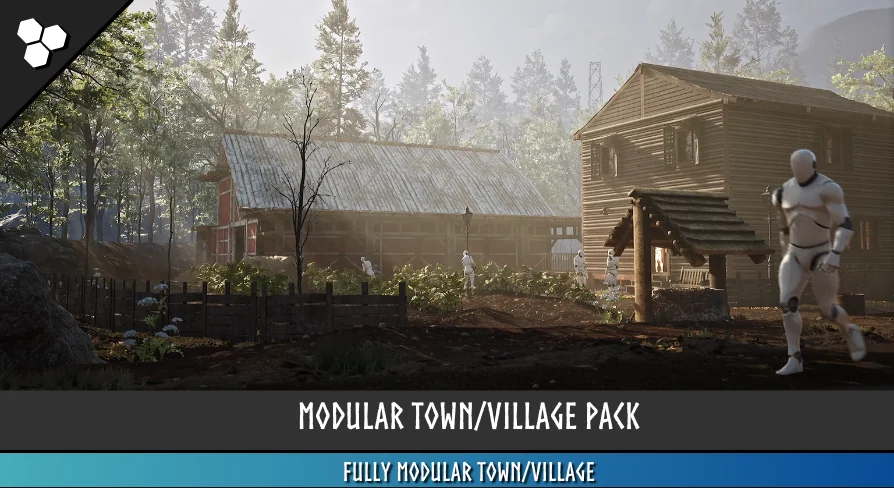
Getting a town scene moving usually starts with layout, and this pack is clearly structured for that stage first. Modular Town is a fully modular environment kit for assembling medieval towns, cities, rural villages, and farm-like spaces from a shared construction set rather than relying on a few fixed buildings. The package includes 197 meshes, giving scene builders a broad pool of parts to work with when blocking streets, placing structures, and shaping the look of a settlement.
That makes its place in production easy to read. It sits at the environment-building layer of an Unreal Engine workflow, where teams or solo artists need to move from empty terrain to a believable inhabited location. Instead of treating buildings as sealed exterior shells, the pack goes further by making all buildings fully enterable and fully furnished, which changes how it can be used in gameplay spaces, walkthrough scenes, or cinematic camera paths that move indoors as well as through the street.
The set also includes a trailer, a playable demo, and documentation, so the implementation path is not limited to raw content alone. Those materials matter because a large modular environment pack often needs a quick visual reference, a practical demonstration of how the pieces come together in a scene, and written guidance for the included tools.
Placing a Modular Town from the first blockout
The core strength here is scale combined with modularity. With 197 meshes available, Modular Town is positioned as a large construction kit rather than a narrow themed vignette. The stated goal is broad: creating medieval towns, cities, and everything in between. That range gives it room to cover compact village layouts, more open rural arrangements, and denser built-up zones that need repeating architectural language without looking locked to a single prefab arrangement.
In practice, this kind of kit fits the early and middle stages of scene assembly. A level artist can establish the footprint of a town, define routes through it, and then keep iterating by swapping, extending, or rearranging modules instead of rebuilding from scratch. The pack’s tags point toward village, rural, barn, house, building, homestead, field, forest, farm, town, and city themes, which places it across both countryside and settlement-focused production needs. The tone also stretches across fantasy, realistic, horror, postapocalyptic, and apocalyptic directions, so the same structural base can support different atmosphere choices depending on lighting, dressing, and scene treatment.
Because the buildings are fully enterable, scene planning does not have to stop at exterior readability. A route can continue through doors and into furnished interiors without a handoff to a separate interior kit. That is especially useful when a project needs continuity between outdoor exploration and indoor detail, or when cinematic staging depends on windows, thresholds, and room spaces rather than facade-only architecture.
Enterable interiors and the furnished building set
All buildings in the pack are fully enterable and fully furnished. That one detail changes the workload the pack can absorb. For an exterior-only environment set, a team still has to solve the inside of every usable structure. Here, the interiors are already part of the package’s identity, which makes the pack more suitable for projects where buildings are not just background dressing.
In a real production workflow, furnished interiors help at several levels. During prototyping, they let a playable area feel inhabited immediately instead of reading as unfinished shells. During lighting and mood work, they give artists enclosed spaces where light beams, shadow contrast, and room composition can contribute to the scene. During cinematic setup, they create opportunities for camera movement between outdoor streets and indoor rooms without needing a second asset source for basic furnishing.
The resource name also points toward several overlapping environment types: Modular Town, Modular Village, Rural Town, Rural Village, and Farm. The furnished, enterable approach supports that range well. A farm or village scene benefits from structures that can be stepped into, while a town or city area gains more gameplay and staging flexibility when interiors are available rather than implied.
Fence spline and automatic cable connector tools
Alongside the environment content, the pack includes two bespoke tech tools: an easy fence spline tool and an automatic cable connector tool. These are not decorative extras. They speak directly to the repetitive but important assembly work that comes with settlement building.
Fences are one of the fastest ways to define ownership, route flow, field boundaries, and the edge conditions between roads, yards, and agricultural space. A spline-based fence tool helps with that kind of layout task because fencing rarely follows a perfectly straight, one-off path. It usually needs to bend around terrain, structures, and irregular settlement shapes. Including a dedicated tool for that work means the pack is not only about static meshes; it also addresses a common environment-construction problem.
The automatic cable connector tool serves a similar role for overhead or attached line work. Cables add connective detail across buildings and streets, but manually placing and aligning them can slow down iteration. An automatic connector tool suggests a more efficient way to establish those links while preserving the layered visual density that helps a town feel built up and lived in.
Both tools are documented, which is important in practice. Specialized environment tools are only useful if their setup and intended use are clear enough to fold into an artist’s normal workflow without guesswork.
Nanite foliage and VFX in the same environment pass
Modular Town does not stop at architecture. It also includes a vast library of photoscanned foliage intended for use across projects, plus a VFX library with birds, light beams, and more. That combination broadens the pack from a building set into a more complete environment pass.
The foliage library matters for the spaces between structures as much as for the structures themselves. Rural towns, villages, homesteads, and farm scenes rarely read convincingly through architecture alone. They need vegetation to frame roads, break up open ground, soften hard edges, and connect built spaces to surrounding fields or forested areas. The tags around foliage, field, and forest reinforce that this pack is not limited to houses standing on bare terrain.
The VFX library adds another layer of scene finish. Birds can help exterior spaces feel active, while light beams contribute atmosphere and depth, especially in interior or transitional spaces where lighting visibility becomes part of the mood. The mention of “and much more” keeps the VFX list open-ended, but the confirmed examples already show the direction: environmental effects that support presentation and ambience rather than replacing the underlying environment work.
Used together, the meshes, interiors, foliage, and VFX allow a scene to move from base construction into a more complete visual state without switching immediately to unrelated packs for every surrounding detail.
Lumen and Nanite support in Unreal Engine 5.0+
Rendering support is clearly stated. The product supports Lumen for Unreal Engine 5.0+ and supports Nanite for Unreal Engine 5.0+. That places it directly in an Unreal Engine 5 pipeline and aligns its environment content with two of the engine’s headline rendering systems.
Lumen support is relevant for an asset set that mixes outdoor streets, furnished interiors, and atmosphere-driven details such as light beams. Dynamic lighting behavior becomes part of how these spaces are presented, particularly when moving between exterior and interior areas. Nanite support is equally important in a pack that includes both architectural content and a library of photoscanned foliage identified as Nanite foliage.
From a workflow perspective, these compatibility details help define where the pack belongs: current Unreal Engine environment production that expects modern rendering features rather than older fallback assumptions. The support statement is concise, but it is enough to show that the pack is meant to operate inside Unreal Engine 5.0 and above with both Lumen and Nanite in play.
Where Modular Village and Rural Town scenes benefit most
This pack fits best when a project needs a settlement with room to explore, not just a row of background buildings. The combination of modular construction, enterable furnished structures, dedicated placement tools, foliage, and VFX makes it suitable for scenes where layout, traversal, and visual atmosphere all matter together.
A rural village can use the modular pieces to establish clustered houses and farm boundaries. A town scene can take advantage of the larger mesh count and the cable tool to create denser connective detail. A forest-edge homestead or field-based farm layout can draw from the foliage library to keep the surrounding environment from feeling disconnected from the built area. A fantasy or horror presentation can work from the same base kit while changing the mood through rendering and scene composition.
The practical takeaway is simple: Modular Town is not just a set of buildings. It is a broader Unreal Engine town-building package that covers structure placement, accessible interiors, environmental dressing, and engine-ready rendering support in one workflow-friendly set.
 Towns & Villages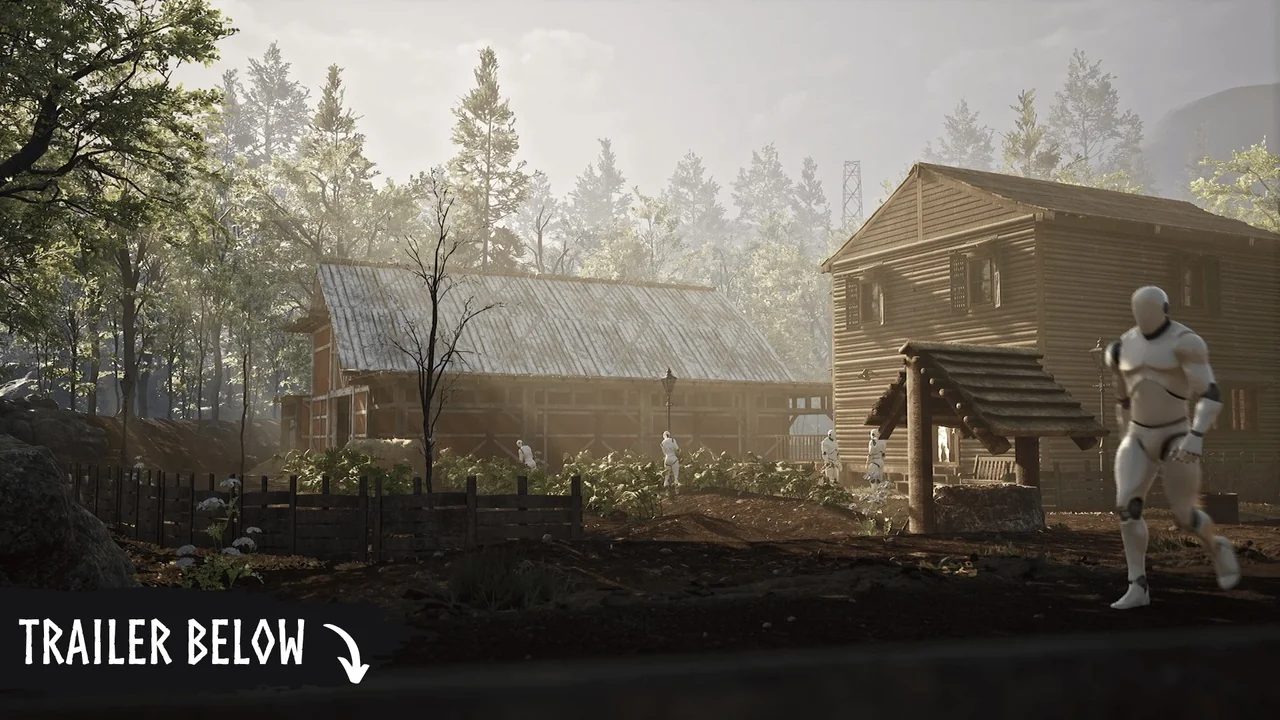
 Towns & Villages
 Towns & Villages
 Towns & Villages