"c14ff6bd758dadb1"{"id":"1000080","slug":"prison","title":"Prison","category":"Interior","engine":"Engine Version: 4.26+,5.0+","assetVersion":"Engine Version: 4.26+,5.0+","engineVersion":"","tag":"Interior","accent":"blue","visual":"mech","summary":"A realistic prison environment with multi-level cell blocks, secure walkways, steel bars, and detailed interiors for tense industrial scenes.","platform":"Unreal Engine","publishedAt":"2026-06-05T15:42:35.929Z","updatedAt":"2026-06-05T15:42:35.929Z","sourceNotes":[],"fileContents":[],"compatibility":["Unreal Engine","Engine Version: 4.26+,5.0+"],"featuredImage":{"alt":"Prison","src":"/wp-content/uploads/published/2026/06/134ef245698e-020ab00c-57d3-4d47-9446-fc60aac88aa6-46a6809804.webp"},"hasDownloadLink":true,"downloads":1,"terms":[{"taxonomy":"category","slug":"interior","name":"Interior"}],"galleryImages":[{"src":"/wp-content/uploads/published/2026/06/29b73e7fc065-983c401c-11d6-4600-a1b9-39adad5fc6ec-e02b3e25a6.webp","alt":"Prison"},{"src":"/wp-content/uploads/published/2026/06/6f0b2898322f-7b6a70ba-a687-44da-9e26-5afbcc4e5d3d-d47d6829f3.webp","alt":"Prison"},{"src":"/wp-content/uploads/published/2026/06/11eea2fe3928-00840528-0752-4294-a5b6-d72ad7757913-08b558f081.webp","alt":"Prison"},{"src":"/wp-content/uploads/published/2026/06/315ec2f0b30d-7d9907bf-e7e9-44a9-b0ae-f1fdfb7781b2-71ddd2b2d3.webp","alt":"Prison"},{"src":"/wp-content/uploads/published/2026/06/6f8205b613e0-a22f27a8-c7f1-4a9a-b91c-45af3577dba4-0fa6c36020.webp","alt":"Prison"},{"src":"/wp-content/uploads/published/2026/06/a772a7109e3e-e10a24d3-db9b-45fc-b5cb-c42624a923d5-c1118e5607.webp","alt":"Prison"},{"src":"/wp-content/uploads/published/2026/06/58c18436b8f9-4b2a37d7-e360-4c33-83ee-819498b022a3-d13a24196c.webp","alt":"Prison"},{"src":"/wp-content/uploads/published/2026/06/05e6969285c4-50f6b99c-0dee-4482-976a-8c204a9db447-232cc336fa.webp","alt":"Prison"},{"src":"/wp-content/uploads/published/2026/06/9cae70902abd-731b3e82-d099-4fc7-a7f9-5817cadc3a4d-d340383f3d.webp","alt":"Prison"},{"src":"/wp-content/uploads/published/2026/06/0d728a96bff1-e48398a2-10f4-4845-89a7-127a0d351dce-397f2a755b.webp","alt":"Prison"}],"accessPanel":{"kind":"resource","title":"Access this resource","eyebrow":"Free Download","message":"Log in or create a free account to start your download.","fileName":"Content.7z","safetyNote":"Resources are manually reviewed before listing to improve quality and reduce obvious risks.","actionLabel":"Download Free","resourceType":"Resource archive"},"contentHtml":"\u003cp\u003eCreating a believable correctional facility from scratch can eat up production time long before a scene reaches the point where lighting, staging, or gameplay can be tested. Prison addresses that problem with a fully realized environment focused on the visual language of confinement: stacked cells, guarded circulation routes, steel barriers, and the lived-in wear that turns an empty structure into a place with pressure and history.\u003c/p\u003e\n\u003cp\u003eThe setting leans into realism rather than abstraction. Its atmosphere comes from practical architectural elements and interior details that make the space feel operational, not decorative. That makes it a useful option when a project needs an authentic prison backdrop for games, films, or virtual experiences without losing the gritty mood that this kind of location depends on.\u003c/p\u003e \u003ch2\u003eBlocking out scenes with multi-level cell blocks and secure walkways\u003c/h2\u003e\n\u003cp\u003eThe strongest identity of Prison starts with its layout. Multi-level cell blocks immediately create vertical structure, giving artists and developers more than a flat hallway of doors. That stacked arrangement opens up lines of sight across floors and between cells, helping scenes feel controlled, exposed, and tense at the same time.\u003c/p\u003e\n\u003cp\u003eSecure walkways reinforce that sense of oversight and movement. They suggest how guards, inmates, or camera paths could travel through the environment while maintaining clear separation between circulation areas and confinement zones. In practical scene building, that means the space can support moments of surveillance, escort, waiting, and confrontation without needing extra explanation from the environment itself. Heavy steel bars complete that visual logic. They are not just props within the scene; they define the environment’s rhythm by repeatedly framing sightlines, restricting access, and emphasizing the hard industrial character of the setting.\u003c/p\u003e \u003ch2\u003ePrison interiors that carry the everyday reality of the space\u003c/h2\u003e\n\u003cp\u003eA prison environment can look convincing at a distance and still fall apart in close shots if the rooms feel empty. Here, the interiors are where much of the immersion comes from.\u003c/p\u003e\n\u003cp\u003eBunk beds, toilets, sinks, and personal items give the cells a practical human scale. These are the details that move the environment away from a generic detention block and toward something that feels inhabited. For developers, those interior elements can help communicate routine and confinement without relying on dialogue or exposition. For artists working on films or virtual experiences, they provide visual anchors for close framing, character placement, and environmental storytelling. Even a quiet shot through the bars gains more weight when there is visible evidence of daily life inside the cell. The inclusion of personal items is especially important because it adds variation in tone, suggesting occupancy and lived experience rather than sterile repetition.\u003c/p\u003e \u003ch2\u003eUsing the visitation area for narrative pressure\u003c/h2\u003e\n\u003cp\u003eBeyond cells and corridors, the functional visitation area broadens what can happen in the environment. It introduces a different kind of prison space: one shaped less by containment alone and more by controlled interaction.\u003c/p\u003e\n\u003cp\u003eThat makes the environment useful for scenes that need emotional contrast within the same location. A visitation space can support exchanges, observation, separation, and negotiation while still staying inside the prison’s overall security logic. In a game, it could become a memorable checkpoint in the player’s progression through the facility simply because it changes the social texture of the environment. In cinematic work, it offers a place where tension can become quieter and more personal without losing the institutional atmosphere. Since the area is described as functional, it reads as part of an active facility rather than an afterthought, helping maintain consistency across the environment.\u003c/p\u003e \u003ch2\u003eSubtle lighting, worn floors, and scattered debris shape the mood\u003c/h2\u003e\n\u003cp\u003eThe prison’s atmosphere is not carried by architecture alone. Much of its realism comes from surface condition and lighting treatment.\u003c/p\u003e\n\u003cp\u003eSubtle lighting suggests restraint instead of spectacle, which fits a correctional setting far better than dramatic stylization. It supports the gritty feel of an operational prison by letting shadow, distance, and enclosure do the work. Worn floors add another layer of credibility. They imply constant traffic, routine, and age, all of which strengthen the impression that this is a functioning place with systems and history. Scattered debris pushes that even further by breaking visual cleanliness and introducing a sense of neglect or hard use. Together, these details create a tense industrial ambiance that can support a range of tones, from grounded realism to more stylized settings hinted at by tags like futuristic, scifi, and cyberpunk. Those tags suggest the environment can lean into different art directions while still preserving its core identity as a prison interior.\u003c/p\u003e \u003ch2\u003eWhere corridor, chamber, and cell spaces become useful in production\u003c/h2\u003e\n\u003cp\u003eThe environment’s tags point to a flexible range of enclosed spaces: corridor, chamber, cell, room, bunker, shelter, observation, dungeon, and underground. Even without adding new features, that vocabulary says a lot about how the location can function creatively.\u003c/p\u003e\n\u003cp\u003eCorridors and cells naturally support patrol routes, stealth sequences, pursuit shots, or tense approach scenes. Chambers and observation-related spaces suggest moments of monitoring, isolation, or interrogation in a broader dramatic sense. Terms like bunker, underground, and shelter shift the prison’s feel toward hardened infrastructure, making the environment suitable for stories that need confinement tied to security and survival as much as punishment. The futuristic, modular, scifi, and cyberpunk tags widen the stylistic frame further. They do not erase the prison’s realistic base; instead, they suggest a setting that can sit comfortably in near-future or industrial speculative work where steel, confinement, and urban decay remain central. That leaves an environment that can support both straightforward correctional scenes and more stylized institutional worlds, as long as the project still benefits from the hard-edged language of bars, corridors, cells, and controlled circulation.\u003c/p\u003e \u003ch2\u003ePrison in a game, film, or virtual experience pipeline\u003c/h2\u003e\n\u003cp\u003ePrison fits productions that need a location with immediate dramatic clarity. A viewer or player understands the stakes of the setting quickly because the architecture, furnishings, and condition all point in the same direction.\u003c/p\u003e\n\u003cp\u003eThat clarity makes it useful at several scales. It can serve as the main backdrop for an extended sequence inside a correctional facility, or it can appear as a contained but memorable location within a larger project. The environment’s realism gives it strength for grounded scenarios, while its industrial and tagged futuristic qualities leave room for darker genre work. For teams developing interactive experiences, the combination of multi-level cell blocks, secure walkways, detailed interiors, and a visitation area offers multiple kinds of scene spaces within one cohesive prison setting. For artists staging non-interactive work, the same elements provide visual variation without breaking the location’s identity. It is best suited to productions that need confinement, surveillance, wear, and institutional tension to be visible in the environment itself.\u003c/p\u003e\n\n\u003ch2\u003eExplore Similar Assets\u003c/h2\u003e\n\u003cul\u003e\n\u003cli\u003e\u003ca href=\"https://3dcghub.com/modular-medieval-underground-prison-kit/\" title=\"Modular Medieval Underground Prison Kit\"\u003eModular Medieval Underground Prison Kit\u003c/a\u003e\u003c/li\u003e\n\u003cli\u003e\u003ca href=\"https://3dcghub.com/garage-warehouse-environment-garage-warehouse-modular-garage-interior-3d/\" title=\"Garage Warehouse Environment ( Garage Warehouse Modular Garage Interior 3d )\"\u003eGarage Warehouse Environment ( Garage Warehouse Modular Garage Interior 3d )\u003c/a\u003e\u003c/li\u003e\n\u003cli\u003e\u003ca href=\"https://3dcghub.com/low-poly-industrial-area/\" title=\"Low Poly: Industrial Area\"\u003eLow Poly: Industrial Area\u003c/a\u003e\u003c/li\u003e\n\u003cli\u003e\u003ca href=\"https://3dcghub.com/detective-office/\" title=\"Detective Office\"\u003eDetective Office\u003c/a\u003e\u003c/li\u003e\n\u003cli\u003e\u003ca href=\"https://3dcghub.com/generic-space-station/\" title=\"Generic Space Station\"\u003eGeneric Space Station\u003c/a\u003e\u003c/li\u003e\n\u003c/ul\u003e","contentTextLength":7657,"navigation":{"current":1782,"total":3719,"previous":{"id":"1000081","slug":"multiplayer-horror-bodycam","title":"Multiplayer Horror Bodycam","category":"Network \u0026 Multiplayer","platform":"Unreal Engine","updatedAt":"2026-06-05T15:48:54.954Z"},"next":{"id":"1000079","slug":"modular-town-modular-town-modular-village-rural-town-rural-village-farm","title":"Modular Town (Modular Town, Modular Village, Rural Town, Rural Village, Farm)","category":"Towns \u0026 Villages","platform":"Unreal Engine","updatedAt":"2026-06-05T14:57:56.822Z"}},"relatedResources":[{"id":"1000172","slug":"devton-abandoned-prison","title":"DevTon Abandoned Prison","category":"Industrial","engine":"4.26+,5.0+","assetVersion":"","engineVersion":"Engine Version: 4.26+,5.0+","tag":"Industrial","accent":"blue","visual":"mech","summary":"DevTon Abandoned Prison delivers a modular realistic prison environment with tessellated wall and floor materials, dust blending, decals, particles, and LODs.","platform":"Unreal Engine","publishedAt":"2026-06-20T03:55:41.644Z","updatedAt":"2026-06-20T03:55:41.644Z","sourceNotes":[],"fileContents":[],"compatibility":["Unreal Engine","Engine Version: 4.26+,5.0+"],"featuredImage":{"alt":"DevTon Abandoned Prison","src":"/wp-content/uploads/published/2026/06/026c7e2ba2ff-7933a860-20a7-4351-b4fe-d30577b032b8-cbd1e5f11e.webp"},"hasDownloadLink":true,"downloads":1},{"id":"7866","slug":"modular-medieval-underground-prison-kit","title":"Modular Medieval Underground Prison Kit","category":"Dungeon","engine":"4.27,5.0+","assetVersion":"Engine version: 4.27,5.0+","engineVersion":"4.27","tag":"Dungeon","accent":"blue","visual":"city","summary":"Build atmospheric and realistic medieval dungeons with ease using this comprehensive modular kit. It features high-quality meshes, flexible materials, and pre-built blueprints to speed up your level design process.","platform":"Unreal Engine","publishedAt":"2026-02-21T18:10:03.000Z","updatedAt":"2026-04-19T15:55:54.000Z","sourceNotes":[],"fileContents":[],"compatibility":["Unreal Engine","Engine version: 4.27,5.0+"],"featuredImage":{"alt":"Modular Medieval Underground Prison Kit","src":"https://3dcghub.com/wp-content/uploads/2026/02/e0e05312-e5fb-43e6-a599-a84ff6b92028.webp"},"hasDownloadLink":true,"downloads":0},{"id":"1000532","slug":"modular-prison","title":"Modular Prison","category":"Cities","engine":"5.0+","assetVersion":"","engineVersion":"Engine Version: 5.0+","tag":"Cities","accent":"blue","visual":"mech","summary":"A modular prison environment pack for Unreal Engine with interior and exterior assets, Lumen support, customizable materials, and blueprints for building custom","platform":"Unreal Engine","publishedAt":"2026-07-14T17:21:57.447Z","updatedAt":"2026-07-14T17:21:57.447Z","sourceNotes":[],"fileContents":[],"compatibility":["Unreal Engine","Engine Version: 5.0+"],"featuredImage":{"alt":"Modular Prison","src":"/wp-content/uploads/published/2026/07/490889aeb95b-5fcf7696-fdf6-4ee4-9eb9-393a22be1c1d-104eec1784.webp"},"hasDownloadLink":true,"downloads":2}]}
Interior
Prison
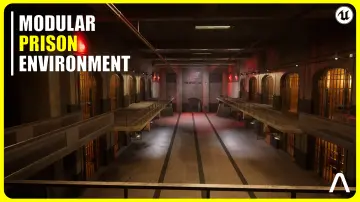
A realistic prison environment with multi-level cell blocks, secure walkways, steel bars, and detailed interiors for tense industrial scenes.
Category:Unreal Engine,InteriorPlatform: Unreal EngineEngine Version: 4.26+,5.0+Published: Jun 5, 2026
Interior
Resource overview
Creating a believable correctional facility from scratch can eat up production time long before a scene reaches the point where lighting, staging, or gameplay can be tested. Prison addresses that problem with a fully realized environment focused on the visual language of confinement: stacked cells, guarded circulation routes, steel barriers, and the lived-in wear that turns an empty structure into a place with pressure and history.
The setting leans into realism rather than abstraction. Its atmosphere comes from practical architectural elements and interior details that make the space feel operational, not decorative. That makes it a useful option when a project needs an authentic prison backdrop for games, films, or virtual experiences without losing the gritty mood that this kind of location depends on.
Blocking out scenes with multi-level cell blocks and secure walkways
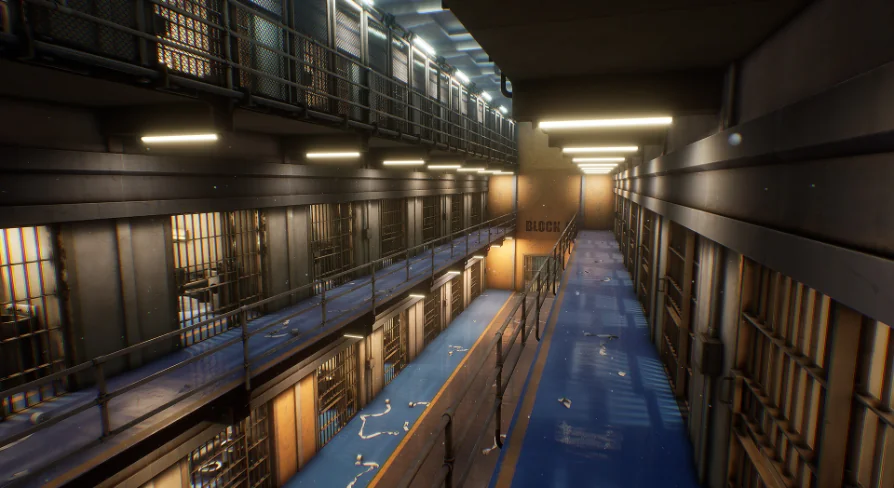
The strongest identity of Prison starts with its layout. Multi-level cell blocks immediately create vertical structure, giving artists and developers more than a flat hallway of doors. That stacked arrangement opens up lines of sight across floors and between cells, helping scenes feel controlled, exposed, and tense at the same time.
Secure walkways reinforce that sense of oversight and movement. They suggest how guards, inmates, or camera paths could travel through the environment while maintaining clear separation between circulation areas and confinement zones. In practical scene building, that means the space can support moments of surveillance, escort, waiting, and confrontation without needing extra explanation from the environment itself. Heavy steel bars complete that visual logic. They are not just props within the scene; they define the environment’s rhythm by repeatedly framing sightlines, restricting access, and emphasizing the hard industrial character of the setting.
Prison interiors that carry the everyday reality of the space
A prison environment can look convincing at a distance and still fall apart in close shots if the rooms feel empty. Here, the interiors are where much of the immersion comes from.
Bunk beds, toilets, sinks, and personal items give the cells a practical human scale. These are the details that move the environment away from a generic detention block and toward something that feels inhabited. For developers, those interior elements can help communicate routine and confinement without relying on dialogue or exposition. For artists working on films or virtual experiences, they provide visual anchors for close framing, character placement, and environmental storytelling. Even a quiet shot through the bars gains more weight when there is visible evidence of daily life inside the cell. The inclusion of personal items is especially important because it adds variation in tone, suggesting occupancy and lived experience rather than sterile repetition.
Using the visitation area for narrative pressure
Beyond cells and corridors, the functional visitation area broadens what can happen in the environment. It introduces a different kind of prison space: one shaped less by containment alone and more by controlled interaction.
That makes the environment useful for scenes that need emotional contrast within the same location. A visitation space can support exchanges, observation, separation, and negotiation while still staying inside the prison’s overall security logic. In a game, it could become a memorable checkpoint in the player’s progression through the facility simply because it changes the social texture of the environment. In cinematic work, it offers a place where tension can become quieter and more personal without losing the institutional atmosphere. Since the area is described as functional, it reads as part of an active facility rather than an afterthought, helping maintain consistency across the environment.
Subtle lighting, worn floors, and scattered debris shape the mood
The prison’s atmosphere is not carried by architecture alone. Much of its realism comes from surface condition and lighting treatment.
Subtle lighting suggests restraint instead of spectacle, which fits a correctional setting far better than dramatic stylization. It supports the gritty feel of an operational prison by letting shadow, distance, and enclosure do the work. Worn floors add another layer of credibility. They imply constant traffic, routine, and age, all of which strengthen the impression that this is a functioning place with systems and history. Scattered debris pushes that even further by breaking visual cleanliness and introducing a sense of neglect or hard use. Together, these details create a tense industrial ambiance that can support a range of tones, from grounded realism to more stylized settings hinted at by tags like futuristic, scifi, and cyberpunk. Those tags suggest the environment can lean into different art directions while still preserving its core identity as a prison interior.
Where corridor, chamber, and cell spaces become useful in production
The environment’s tags point to a flexible range of enclosed spaces: corridor, chamber, cell, room, bunker, shelter, observation, dungeon, and underground. Even without adding new features, that vocabulary says a lot about how the location can function creatively.
Corridors and cells naturally support patrol routes, stealth sequences, pursuit shots, or tense approach scenes. Chambers and observation-related spaces suggest moments of monitoring, isolation, or interrogation in a broader dramatic sense. Terms like bunker, underground, and shelter shift the prison’s feel toward hardened infrastructure, making the environment suitable for stories that need confinement tied to security and survival as much as punishment. The futuristic, modular, scifi, and cyberpunk tags widen the stylistic frame further. They do not erase the prison’s realistic base; instead, they suggest a setting that can sit comfortably in near-future or industrial speculative work where steel, confinement, and urban decay remain central. That leaves an environment that can support both straightforward correctional scenes and more stylized institutional worlds, as long as the project still benefits from the hard-edged language of bars, corridors, cells, and controlled circulation.
Prison in a game, film, or virtual experience pipeline
Prison fits productions that need a location with immediate dramatic clarity. A viewer or player understands the stakes of the setting quickly because the architecture, furnishings, and condition all point in the same direction.
That clarity makes it useful at several scales. It can serve as the main backdrop for an extended sequence inside a correctional facility, or it can appear as a contained but memorable location within a larger project. The environment’s realism gives it strength for grounded scenarios, while its industrial and tagged futuristic qualities leave room for darker genre work. For teams developing interactive experiences, the combination of multi-level cell blocks, secure walkways, detailed interiors, and a visitation area offers multiple kinds of scene spaces within one cohesive prison setting. For artists staging non-interactive work, the same elements provide visual variation without breaking the location’s identity. It is best suited to productions that need confinement, surveillance, wear, and institutional tension to be visible in the environment itself.
 Interior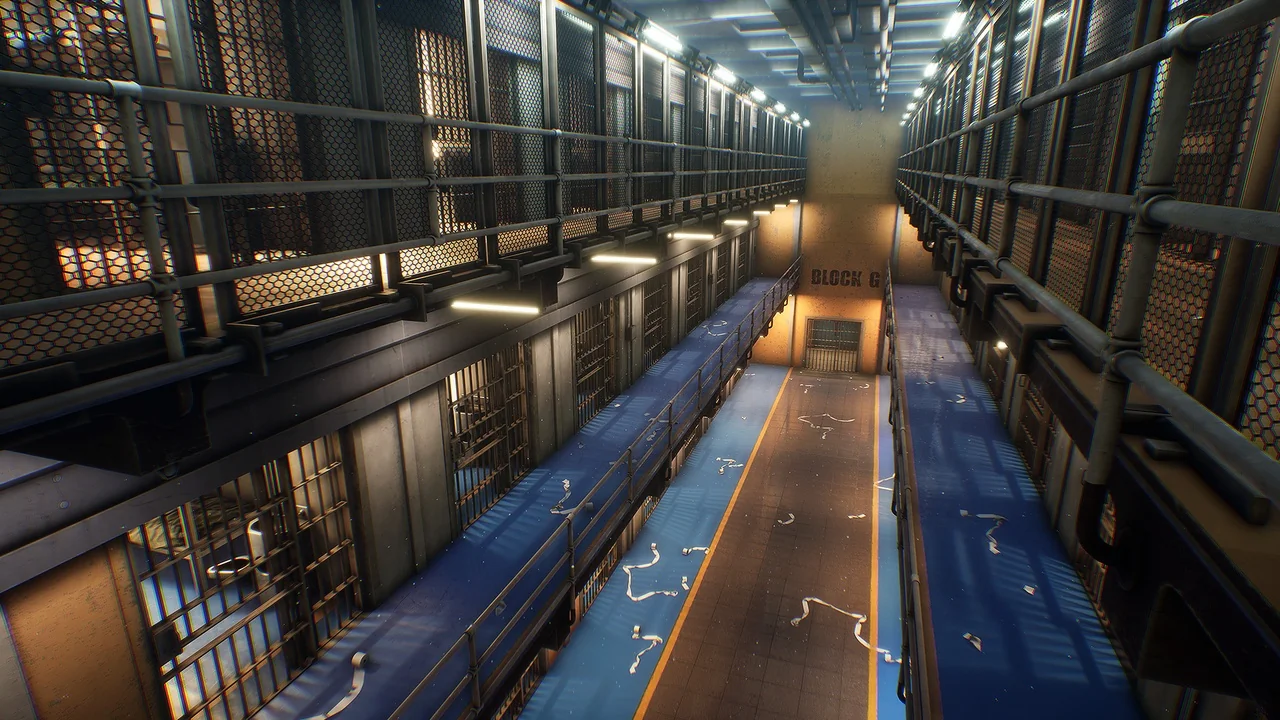
 Industrial
 Dungeon
 Cities