"1f00f67f9253451b"{"id":"1000172","slug":"devton-abandoned-prison","title":"DevTon Abandoned Prison","category":"Industrial","engine":"4.26+,5.0+","assetVersion":"","engineVersion":"Engine Version: 4.26+,5.0+","tag":"Industrial","accent":"blue","visual":"mech","summary":"DevTon Abandoned Prison delivers a modular realistic prison environment with tessellated wall and floor materials, dust blending, decals, particles, and LODs.","platform":"Unreal Engine","publishedAt":"2026-06-20T03:55:41.644Z","updatedAt":"2026-06-20T03:55:41.644Z","sourceNotes":[],"fileContents":[],"compatibility":["Unreal Engine","Engine Version: 4.26+,5.0+"],"featuredImage":{"alt":"DevTon Abandoned Prison","src":"/wp-content/uploads/published/2026/06/026c7e2ba2ff-7933a860-20a7-4351-b4fe-d30577b032b8-cbd1e5f11e.webp"},"hasDownloadLink":true,"downloads":0,"terms":[{"taxonomy":"category","slug":"industrial-environments","name":"Industrial"}],"galleryImages":[{"src":"/wp-content/uploads/published/2026/06/e66aa6cb4641-6bb33858-3d83-4b33-9c42-fbd89b2d0366-77c47c57ca.webp","alt":"DevTon Abandoned Prison"},{"src":"/wp-content/uploads/published/2026/06/7c6927e6c277-2514dc9e-11d2-40f9-9cc9-3efe21d003d2-5a62f00512.webp","alt":"DevTon Abandoned Prison"},{"src":"/wp-content/uploads/published/2026/06/270357a1e8ea-0825e12c-c012-42b7-aed4-9b0968319447-5f2d27aa17.webp","alt":"DevTon Abandoned Prison"},{"src":"/wp-content/uploads/published/2026/06/e65cb287e2ba-f896d104-0478-420d-bdc3-6f873618a4c5-8efc79b085.webp","alt":"DevTon Abandoned Prison"},{"src":"/wp-content/uploads/published/2026/06/be1019074fd9-cfae48a4-181e-4ff2-941f-1e2458b46a46-2b66eda16e.webp","alt":"DevTon Abandoned Prison"},{"src":"/wp-content/uploads/published/2026/06/a2ed860bd208-29aff2a8-0139-4bba-ba42-379aa1f64d35-519d54dc8f.webp","alt":"DevTon Abandoned Prison"},{"src":"/wp-content/uploads/published/2026/06/73f35c7ebf8f-ecbbdd0f-6393-4a17-ab55-0e45320e4644-0d07de7e5d.webp","alt":"DevTon Abandoned Prison"},{"src":"/wp-content/uploads/published/2026/06/5ef1f0459d1c-2f4c0f5e-bd1b-4dbf-b2a1-e6e8fee667e3-722150fa9f.webp","alt":"DevTon Abandoned Prison"}],"accessPanel":{"kind":"resource","title":"Download this resource","eyebrow":"Free Download","message":"Log in or create a free account to start your download.","fileName":"Content.7z","safetyNote":"Resources are manually reviewed before listing to improve quality and reduce obvious risks.","actionLabel":"Download Free","resourceType":"Resource archive"},"contentHtml":"\u003cp\u003eDevTon Abandoned Prison fits projects that need tense, neglected interior spaces rather than clean architectural backdrops. A prison setting gains much of its identity from repetition, wear, and the feeling that every corridor, wall section, and floor stretch belongs to a larger structure. That is where the package’s modular approach matters most. The main meshes are modular, making the environment more useful for artists and developers who want to assemble different room layouts, passages, and connected sections while staying within a consistent visual language.\u003c/p\u003e\n\u003cp\u003eAn abandoned prison scene usually depends on more than the base shape of the architecture. It needs surfaces that feel old, neglected, and physically marked by time. This package addresses that through material work on walls and floors, dust treatment across other materials, and a set of decals that can push spaces further away from a clean or untouched look. Instead of relying on a single flat layer of aging, it gives several ways to build visual deterioration into the scene.\u003c/p\u003e \u003ch2\u003eAbandoned Prison spaces that benefit from modular construction\u003c/h2\u003e\n\u003cp\u003eModular meshes are one of the clearest practical strengths here. In a prison environment, many spaces are naturally repetitive: stretches of wall, floor sections, structural divisions, and cell block style layouts all lend themselves to modular assembly. That makes the package useful not only for one fixed composition, but for projects that need to reshape the environment to suit gameplay or shot framing.\u003c/p\u003e\n\u003cp\u003eFor level art, modular content supports quicker iteration. A creator can develop a tighter corridor, open it into a larger room, or extend the environment into additional wings without abandoning the established look. For gameplay scenarios, that same modularity helps when building routes, sightlines, and constrained spaces that need to feel believable as part of the same prison complex. The package’s visual identity stays rooted in abandonment, but the structure is flexible enough to support multiple arrangements of that theme.\u003c/p\u003e\n\u003cp\u003eThis matters especially in prison scenes because repetition is not a weakness in the setting. It is part of the setting. Reused architectural pieces can make a space feel more authentic, while surface treatment and decals help prevent those repeated forms from feeling sterile or overly uniform.\u003c/p\u003e \u003ch2\u003eVertex painting tessellated material on walls and floors\u003c/h2\u003e\n\u003cp\u003eThe walls and floors use a vertex painting tessellated material, which gives these major surfaces a more active role in shaping the environment’s mood. Walls and floors dominate most prison interiors, so they carry much of the burden of selling age, damage, and neglect. A dedicated material setup on those surfaces makes the package more than a collection of static pieces with a single fixed finish.\u003c/p\u003e\n\u003cp\u003eVertex painting gives creators room to vary how those surfaces read across the scene. In practice, that can help break up the sameness that often appears when modular pieces are repeated over and over. A prison block can keep its structural consistency while still showing shifts in wear from one area to another. Some stretches can feel more deteriorated or more visually dense than others, which is valuable when building focal points or showing environmental history.\u003c/p\u003e\n\u003cp\u003eThe tessellated treatment also speaks to the package’s focus on surface quality rather than only silhouette. In an abandoned setting, the state of the walls and floors often defines the tone more strongly than decorative objects do. Giving those surfaces a specialized material treatment helps them carry that tone across the whole environment.\u003c/p\u003e \u003ch2\u003eDust blending, scratched surfaces, Water Grime, and Oil\u003c/h2\u003e\n\u003cp\u003eAbandonment rarely reads convincingly through one effect alone. Dust, stains, scratches, and residue each suggest a different kind of neglect, and this package includes several of those layers. All other materials include a blended function for dust, which gives the environment a unifying aged quality beyond the wall and floor treatment. Dust helps tie separate objects and surfaces together so the prison does not feel like a set of isolated clean assets placed in a dirty room. It can make the whole space feel undisturbed and left behind.\u003c/p\u003e\n\u003cp\u003eThe included decals expand this even further. Decals are especially useful in a prison environment because they add local damage and grime without forcing every surface into the same condition. The set includes examples such as scratched surfaces, Water Grime, and Oil. Those details are practical scene-building tools. Scratched surfaces can imply repeated physical contact, rough use, or long-term wear. Water Grime can introduce dampness, runoff, and poor maintenance. Oil can suggest machinery, utility areas, or residue in more industrial corners of the environment.\u003c/p\u003e\n\u003cp\u003eTogether, these decal types allow an artist to shift the character of individual areas while staying within the same abandoned prison theme. A corridor can feel mostly dry and dusty, while another section can show heavier staining or more aggressive surface damage. That kind of variation is often what keeps a realistic environment from looking too evenly weathered.\u003c/p\u003e \u003ch2\u003eDust particle effect for abandoned atmosphere\u003c/h2\u003e\n\u003cp\u003eThe package also includes a dust particle effect to add immersion to an abandoned environment. That addition is small in description, but it plays an important role in how a scene feels during movement. Static damage on walls and floors establishes age, while airborne particles can make the environment feel inhabited by time rather than frozen in place.\u003c/p\u003e\n\u003cp\u003eIn a prison setting, dust particles can support quiet tension. They help enclosed spaces feel stale, undisturbed, and heavy. For cinematic work, they can strengthen light shafts and deepen the sense of atmosphere in interior shots. For interactive scenes, they contribute to the impression that the player is moving through a space that has been sitting untouched for a long time. The effect pairs naturally with the dust blending in the materials, since both are working toward the same abandoned visual language.\u003c/p\u003e\n\u003cp\u003eWhat stands out here is the consistency of purpose. The modular meshes handle structure, the materials handle broad surface aging, the decals handle local damage, and the particle effect handles atmosphere. Each part supports the same type of environment instead of pulling in different stylistic directions.\u003c/p\u003e \u003ch2\u003ePrepared LOD levels and the texture set in DevTon Abandoned Prison\u003c/h2\u003e\n\u003cp\u003eAll models are accurately unwrapped and have two prepared LOD levels. That is a useful production note for anyone planning to place the environment into a larger scene rather than treating it as a single hero prop. Prepared LODs indicate that the models are set up with scene use in mind, and accurate unwrapping supports the material and texture work that carries so much of the package’s visual identity.\u003c/p\u003e\n\u003cp\u003eThe material setup uses high quality textures consisting of albedo, roughness, normal, metal, and height maps. Those texture types align with the package’s emphasis on realistic surfaces and layered wear. Albedo carries the base color information, while roughness helps shape how clean, dry, dusty, or stained a surface feels. Normal and height information support the sense of physical detail across walls, floors, and worn areas, and metal maps contribute where metallic response is needed in the materials.\u003c/p\u003e\n\u003cp\u003eBecause the package focuses heavily on environmental condition, these texture components are not incidental. They are part of what allows the prison to read as a believable neglected place rather than a simple arrangement of modular pieces. The technical notes here stay directly connected to visual outcomes: better surface response, more grounded wear, and stronger consistency across the environment.\u003c/p\u003e \u003ch2\u003eWho gets the most from this abandoned modular prison set\u003c/h2\u003e\n\u003cp\u003eDevTon Abandoned Prison suits artists and developers who want to create realistic prison interiors with visible age and atmosphere, not just assemble bare structural pieces. Its modular meshes support layout flexibility, while the wall and floor material treatment, dust blending, decals, and dust particle effect provide several layers of environmental storytelling. The two prepared LOD levels and accurately unwrapped models make it a practical fit for scene building, especially when the goal is to craft prison spaces that feel worn, dusty, and convincingly abandoned.\u003c/p\u003e\n\n\u003ch2\u003eExplore Similar Assets\u003c/h2\u003e\n\u003cul\u003e\n\u003cli\u003e\u003ca href=\"https://3dcghub.com/abandoned-factory-factory-warehouse-industrial-factory-industrial-warehouse/\" title=\"Abandoned Factory (Factory, Warehouse, Industrial Factory, Industrial Warehouse)\"\u003eAbandoned Factory (Factory, Warehouse, Industrial Factory, Industrial Warehouse)\u003c/a\u003e\u003c/li\u003e\n\u003cli\u003e\u003ca href=\"https://3dcghub.com/winter-base/\" title=\"Winter Base\"\u003eWinter Base\u003c/a\u003e\u003c/li\u003e\n\u003cli\u003e\u003ca href=\"https://3dcghub.com/modular-medieval-underground-prison-kit/\" title=\"Modular Medieval Underground Prison Kit\"\u003eModular Medieval Underground Prison Kit\u003c/a\u003e\u003c/li\u003e\n\u003cli\u003e\u003ca href=\"https://3dcghub.com/abandoned-train-pack/\" title=\"Abandoned Train Pack\"\u003eAbandoned Train Pack\u003c/a\u003e\u003c/li\u003e\n\u003cli\u003e\u003ca href=\"https://3dcghub.com/office-space-megapack/\" title=\"Office Space Megapack\"\u003eOffice Space Megapack\u003c/a\u003e\u003c/li\u003e\n\u003c/ul\u003e","contentTextLength":8613,"navigation":{"current":1177,"total":3222,"previous":{"id":"1000173","slug":"detectiveoffice","title":"DetectiveOffice","category":"Interior","platform":"Unreal Engine","updatedAt":"2026-06-20T04:18:09.703Z"},"next":{"id":"1000171","slug":"photorealistic-helicopter","title":"Photorealistic Helicopter","category":"Aircraft","platform":"Unreal Engine","updatedAt":"2026-06-19T17:08:32.476Z"}},"relatedResources":[{"id":"1001161","slug":"warehouse-abandoned-factory-district","title":"Warehouse - Abandoned Factory District","category":"Industrial","engine":"4.27,5.0+","assetVersion":"","engineVersion":"Engine Version: 4.27,5.0+","tag":"Industrial","accent":"blue","visual":"mech","summary":"Warehouse - Abandoned Factory District delivers over 1,000 industrial assets, functional motion blueprints, audio, and photogrammetry detailing.","platform":"Unreal Engine","publishedAt":"2026-09-11T09:39:32.707Z","updatedAt":"2026-09-11T09:39:32.707Z","sourceNotes":[],"fileContents":[],"compatibility":["Unreal Engine","Engine Version: 4.27,5.0+"],"featuredImage":{"alt":"Warehouse - Abandoned Factory District","src":"/wp-content/uploads/published/2026/09/0d31143c8102-96fa8327-2ea3-4f37-ac7e-addb57c90780-9c79c1476e.webp"},"hasDownloadLink":true,"downloads":1},{"id":"8533","slug":"abandoned-factory-factory-warehouse-industrial-factory-industrial-warehouse","title":"Abandoned Factory (Factory, Warehouse, Industrial Factory, Industrial Warehouse)","category":"Industrial","engine":"5.1+","assetVersion":"Engine version: 5.1+","engineVersion":"5.1","tag":"Industrial","accent":"blue","visual":"city","summary":"Discover a hauntingly detailed industrial environment for Unreal Engine 5. This modular pack features Lumen and Nanite support to create eerie, high-performance factory interiors.","platform":"Unreal Engine","publishedAt":"2026-02-23T17:42:18.000Z","updatedAt":"2026-04-19T15:55:25.000Z","sourceNotes":[],"fileContents":[],"compatibility":["Unreal Engine","Engine version: 5.1+"],"featuredImage":{"alt":"Abandoned Factory (Factory, Warehouse, Industrial Factory, Industrial Warehouse)","src":"https://3dcghub.com/wp-content/uploads/2026/02/1a226462-18db-4ce2-abd9-6a4036207706.webp"},"hasDownloadLink":true,"downloads":1},{"id":"1000267","slug":"gate-backyard","title":"Gate Backyard","category":"Industrial","engine":"4.26+,5.0+","assetVersion":"","engineVersion":"Engine Version: 4.26+,5.0+","tag":"Industrial","accent":"blue","visual":"mech","summary":"A highly detailed, real-time optimized 3D environment package featuring over 335 modular assets to construct realistic, abandoned industrial outdoor spaces.","platform":"Unreal Engine","publishedAt":"2026-07-01T19:46:17.666Z","updatedAt":"2026-07-01T19:46:17.666Z","sourceNotes":[],"fileContents":[],"compatibility":["Unreal Engine","Engine Version: 4.26+,5.0+"],"featuredImage":{"alt":"Gate Backyard","src":"/wp-content/uploads/published/2026/07/b3f2e2614967-27ac32fa-39ae-41c1-8ba8-76a486e504ff-6a34131d2d.webp"},"hasDownloadLink":true,"downloads":0}]}
Industrial
DevTon Abandoned Prison
DevTon Abandoned Prison delivers a modular realistic prison environment with tessellated wall and floor materials, dust blending, decals, particles, and LODs.
Category:Unreal Engine,IndustrialPlatform: Unreal EngineEngine Version: 4.26+,5.0+Published: Jun 20, 2026
Industrial
Resource overview
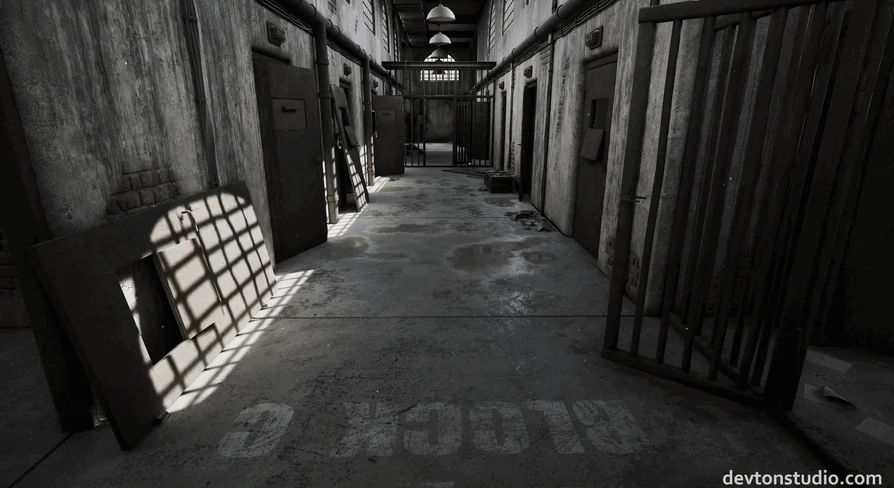
DevTon Abandoned Prison fits projects that need tense, neglected interior spaces rather than clean architectural backdrops. A prison setting gains much of its identity from repetition, wear, and the feeling that every corridor, wall section, and floor stretch belongs to a larger structure. That is where the package’s modular approach matters most. The main meshes are modular, making the environment more useful for artists and developers who want to assemble different room layouts, passages, and connected sections while staying within a consistent visual language.
An abandoned prison scene usually depends on more than the base shape of the architecture. It needs surfaces that feel old, neglected, and physically marked by time. This package addresses that through material work on walls and floors, dust treatment across other materials, and a set of decals that can push spaces further away from a clean or untouched look. Instead of relying on a single flat layer of aging, it gives several ways to build visual deterioration into the scene.
Abandoned Prison spaces that benefit from modular construction
Modular meshes are one of the clearest practical strengths here. In a prison environment, many spaces are naturally repetitive: stretches of wall, floor sections, structural divisions, and cell block style layouts all lend themselves to modular assembly. That makes the package useful not only for one fixed composition, but for projects that need to reshape the environment to suit gameplay or shot framing.
For level art, modular content supports quicker iteration. A creator can develop a tighter corridor, open it into a larger room, or extend the environment into additional wings without abandoning the established look. For gameplay scenarios, that same modularity helps when building routes, sightlines, and constrained spaces that need to feel believable as part of the same prison complex. The package’s visual identity stays rooted in abandonment, but the structure is flexible enough to support multiple arrangements of that theme.
This matters especially in prison scenes because repetition is not a weakness in the setting. It is part of the setting. Reused architectural pieces can make a space feel more authentic, while surface treatment and decals help prevent those repeated forms from feeling sterile or overly uniform.
Vertex painting tessellated material on walls and floors
The walls and floors use a vertex painting tessellated material, which gives these major surfaces a more active role in shaping the environment’s mood. Walls and floors dominate most prison interiors, so they carry much of the burden of selling age, damage, and neglect. A dedicated material setup on those surfaces makes the package more than a collection of static pieces with a single fixed finish.
Vertex painting gives creators room to vary how those surfaces read across the scene. In practice, that can help break up the sameness that often appears when modular pieces are repeated over and over. A prison block can keep its structural consistency while still showing shifts in wear from one area to another. Some stretches can feel more deteriorated or more visually dense than others, which is valuable when building focal points or showing environmental history.
The tessellated treatment also speaks to the package’s focus on surface quality rather than only silhouette. In an abandoned setting, the state of the walls and floors often defines the tone more strongly than decorative objects do. Giving those surfaces a specialized material treatment helps them carry that tone across the whole environment.
Dust blending, scratched surfaces, Water Grime, and Oil
Abandonment rarely reads convincingly through one effect alone. Dust, stains, scratches, and residue each suggest a different kind of neglect, and this package includes several of those layers. All other materials include a blended function for dust, which gives the environment a unifying aged quality beyond the wall and floor treatment. Dust helps tie separate objects and surfaces together so the prison does not feel like a set of isolated clean assets placed in a dirty room. It can make the whole space feel undisturbed and left behind.
The included decals expand this even further. Decals are especially useful in a prison environment because they add local damage and grime without forcing every surface into the same condition. The set includes examples such as scratched surfaces, Water Grime, and Oil. Those details are practical scene-building tools. Scratched surfaces can imply repeated physical contact, rough use, or long-term wear. Water Grime can introduce dampness, runoff, and poor maintenance. Oil can suggest machinery, utility areas, or residue in more industrial corners of the environment.
Together, these decal types allow an artist to shift the character of individual areas while staying within the same abandoned prison theme. A corridor can feel mostly dry and dusty, while another section can show heavier staining or more aggressive surface damage. That kind of variation is often what keeps a realistic environment from looking too evenly weathered.
Dust particle effect for abandoned atmosphere
The package also includes a dust particle effect to add immersion to an abandoned environment. That addition is small in description, but it plays an important role in how a scene feels during movement. Static damage on walls and floors establishes age, while airborne particles can make the environment feel inhabited by time rather than frozen in place.
In a prison setting, dust particles can support quiet tension. They help enclosed spaces feel stale, undisturbed, and heavy. For cinematic work, they can strengthen light shafts and deepen the sense of atmosphere in interior shots. For interactive scenes, they contribute to the impression that the player is moving through a space that has been sitting untouched for a long time. The effect pairs naturally with the dust blending in the materials, since both are working toward the same abandoned visual language.
What stands out here is the consistency of purpose. The modular meshes handle structure, the materials handle broad surface aging, the decals handle local damage, and the particle effect handles atmosphere. Each part supports the same type of environment instead of pulling in different stylistic directions.
Prepared LOD levels and the texture set in DevTon Abandoned Prison
All models are accurately unwrapped and have two prepared LOD levels. That is a useful production note for anyone planning to place the environment into a larger scene rather than treating it as a single hero prop. Prepared LODs indicate that the models are set up with scene use in mind, and accurate unwrapping supports the material and texture work that carries so much of the package’s visual identity.
The material setup uses high quality textures consisting of albedo, roughness, normal, metal, and height maps. Those texture types align with the package’s emphasis on realistic surfaces and layered wear. Albedo carries the base color information, while roughness helps shape how clean, dry, dusty, or stained a surface feels. Normal and height information support the sense of physical detail across walls, floors, and worn areas, and metal maps contribute where metallic response is needed in the materials.
Because the package focuses heavily on environmental condition, these texture components are not incidental. They are part of what allows the prison to read as a believable neglected place rather than a simple arrangement of modular pieces. The technical notes here stay directly connected to visual outcomes: better surface response, more grounded wear, and stronger consistency across the environment.
Who gets the most from this abandoned modular prison set
DevTon Abandoned Prison suits artists and developers who want to create realistic prison interiors with visible age and atmosphere, not just assemble bare structural pieces. Its modular meshes support layout flexibility, while the wall and floor material treatment, dust blending, decals, and dust particle effect provide several layers of environmental storytelling. The two prepared LOD levels and accurately unwrapped models make it a practical fit for scene building, especially when the goal is to craft prison spaces that feel worn, dusty, and convincingly abandoned.
 Industrial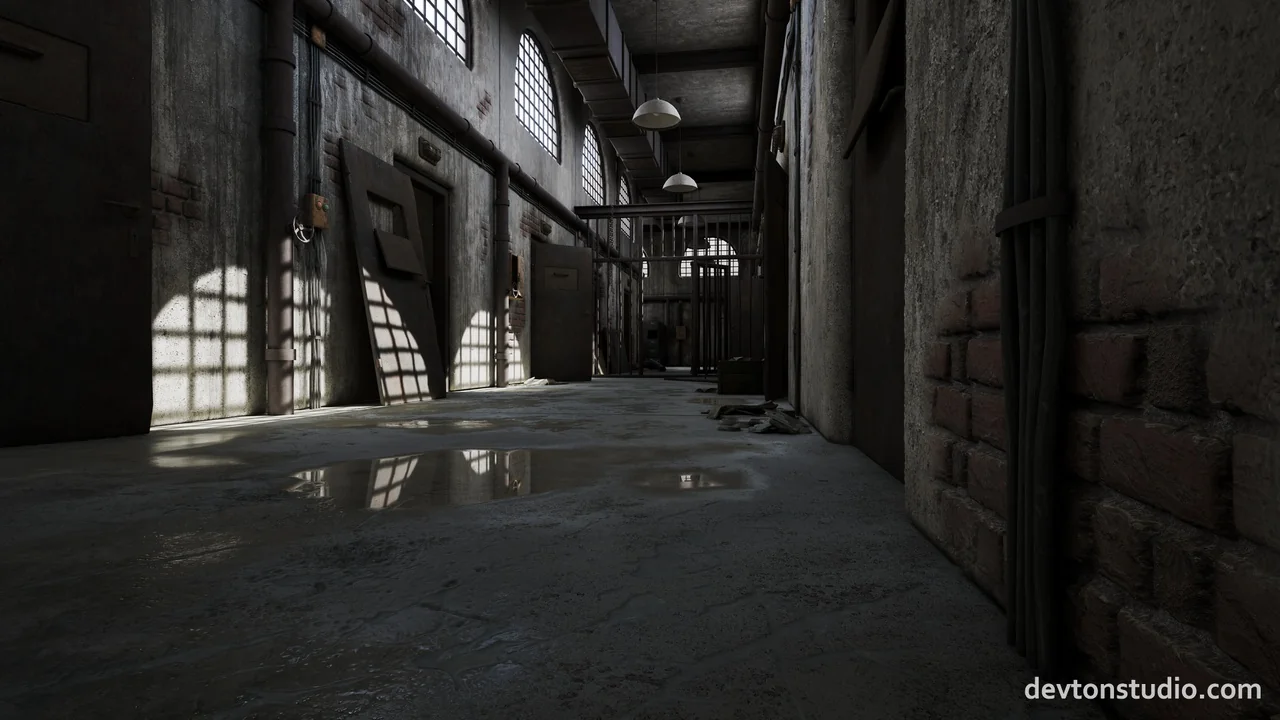
 Industrial
 Industrial
 Industrial