"6ac84fdb0bd06614"{"id":"28140","slug":"office-space-megapack","title":"Office Space Megapack","category":"Industrial","engine":"4.26+,5.0+","assetVersion":"Engine version: 4.26+,5.0+","engineVersion":"","tag":"Industrial","accent":"blue","visual":"city","summary":"Office Space Megapack is a modular office environment package aimed at building detailed workplace interiors for Unreal projects. It combines over 250 props, more than 150 unique set dressing items, and a first-person-focused texel standard that suits close...","platform":"Unreal Engine","publishedAt":"2026-05-04T15:40:16.000Z","updatedAt":"2026-05-04T15:40:17.000Z","sourceNotes":[],"fileContents":[],"compatibility":["Unreal Engine","Engine version: 4.26+,5.0+"],"featuredImage":{"alt":"Office Space Megapack","src":"https://3dcghub.com/wp-content/uploads/2026/05/5c378f05fe62_cbea38bb-ee98-4d19-810d-109867987322.webp"},"hasDownloadLink":true,"downloads":3,"terms":[{"taxonomy":"category","slug":"industrial-environments","name":"Industrial"},{"taxonomy":"post_tag","slug":"environment","name":"Environment"},{"taxonomy":"post_tag","slug":"materials","name":"Materials"},{"taxonomy":"post_tag","slug":"unreal-engine-5","name":"Unreal Engine 5"}],"galleryImages":[{"src":"https://3dcghub.com/wp-content/uploads/2026/05/7f1d257af8be_f28ac76f-8f59-40dd-b801-9c7b012c04c8.webp","alt":"Office Space Megapack"},{"src":"https://3dcghub.com/wp-content/uploads/2026/05/1c723ee240f4_fd578b63-49a2-448b-968f-90104a4ea2d5.webp","alt":"Office Space Megapack"},{"src":"https://3dcghub.com/wp-content/uploads/2026/05/294005c2aa28_bd9f1a09-f327-41ae-bb9a-325bd0bc9a68.webp","alt":"Office Space Megapack"},{"src":"https://3dcghub.com/wp-content/uploads/2026/05/2d9f8772bbe3_18795ddd-5b48-42dd-bc29-2ee4df211a9c.webp","alt":"Office Space Megapack"},{"src":"https://3dcghub.com/wp-content/uploads/2026/05/8fedbbb8f070_c8be851c-abef-4ca2-abef-6e2f8ccd6f1b.webp","alt":"Office Space Megapack"},{"src":"https://3dcghub.com/wp-content/uploads/2026/05/f3fb52fdfe6c_32bfaac4-b611-464c-909d-5234ea41b23a.webp","alt":"Office Space Megapack"},{"src":"https://3dcghub.com/wp-content/uploads/2026/05/5abc66da4423_7c641e04-cfe8-40ab-a1a3-e70b1de4a3d4.webp","alt":"Office Space Megapack"},{"src":"https://3dcghub.com/wp-content/uploads/2026/05/cf545d681a64_9c45f7c7-127a-47fe-a9bc-ca8a91fc1606.webp","alt":"Office Space Megapack"},{"src":"https://3dcghub.com/wp-content/uploads/2026/05/cdd291eef28d_cd1ba636-1146-4f35-bb2a-2ea3a58a7ad3.webp","alt":"Office Space Megapack"}],"accessPanel":{"kind":"resource","title":"Access this resource","eyebrow":"Free Download","message":"Log in or create a free account to start your download.","fileName":"Office.7z","safetyNote":"All resources are 100% manually reviewed to eliminate all risks.","actionLabel":"Download Free","resourceType":"Resource archive"},"contentHtml":"\u003cp\u003eWhen a project needs a workplace interior that can hold up in close view, Office Space Megapack sits in a very practical part of the pipeline. It is a fully modular interior office space package, meant for assembling office scenes rather than relying on a single fixed environment. That makes it useful for teams building walkable levels, cinematic interiors, or simulation spaces where the room layout needs to be adjusted to fit a specific sequence, route, or interaction.\u003c/p\u003e\u003cp\u003eThe pack is positioned as a large office environment set, with over 250 props and more than 150 unique items. Those numbers matter less as a headline than in day-to-day production: they point to a package that covers both the structural side of an office and the small pieces that stop a space from feeling empty. Modular pieces shape the layout, while set dressing props help sell the lived-in detail that office scenes usually need.\u003c/p\u003e\u003ch2\u003eOffice Space Megapack in production scenes\u003c/h2\u003e\u003cp\u003eThis pack fits best in projects that need an office interior users can move through rather than just look at from a distance. The assets are set up by default for First Person and VR games, which places the emphasis on close-range viewing. In practical terms, that means the environment is not only about broad room composition. It is also meant to retain detail where players or viewers are likely to approach desks, walls, furniture, and supporting props at eye level.\u003c/p\u003e\u003cp\u003eThat first-person focus also makes the pack relevant for cinematic work inside Unreal. A walkthrough or room-to-room camera path puts heavy pressure on environment assets because surfaces and props stay on screen long enough for texture quality and scene consistency to show. Office Space Megapack addresses that with an audited texel ratio of 10.24ppm across the assets, described as first-person quality. For a production team, that kind of standardization helps when combining many objects in one interior and trying to avoid visual jumps between hero pieces and background dressing.\u003c/p\u003e\u003cp\u003eThe included example scene is stated to run at 120fps while using a physically based lighting setup. That does not replace optimization work in a real project, but it gives this pack a clear place in a workflow that values both presentation and performance testing. An office environment often ends up carrying a high density of repeated objects and materials, so a fast example scene with physically based lighting is a useful signpost for how the package is intended to behave in an assembled state.\u003c/p\u003e\u003ch2\u003eOver 250 props and 150 unique items for office dressing\u003c/h2\u003e\u003cp\u003eThe strongest practical feature here is coverage. Over 250 props are included, spanning modular pieces and more than 150 unique set dressing props. That mix is important because office interiors rarely come together from architecture alone. They need repetition in some areas and specificity in others. Repeated modular elements define the structure of the floor, while unique dressing pieces break up the uniform look that can make an office feel artificial.\u003c/p\u003e\u003cp\u003eFor environment artists, that makes the pack easier to place in different stages of scene building. The modular side supports blockout refinement and layout iteration. The set dressing side supports the pass where a clean shell becomes a believable workplace. A team can establish the floor plan first, then layer in the objects that create variation and density.\u003c/p\u003e\u003cp\u003eThe tags attached to the pack point to a realistic office with industrial and vintage notes. Those tags do not spell out exact object categories, but they do indicate the visual lane this package occupies. It is not framed as a stylized office set. It is aimed at realistic scenes, which is consistent with the emphasis on first-person viewing, physically based lighting, and maintaining detail without aggressive texture reduction.\u003c/p\u003e\u003ch2\u003e10.24ppm and first-person VR setup\u003c/h2\u003e\u003cp\u003eOne of the more production-focused details is the stated texel ratio of 10.24ppm for all assets. Every asset is audited to meet that target, and the pack frames it as first-person quality. That creates a clear expectation for where the assets are supposed to live in a scene: close enough that texture sharpness matters. In a workflow, that is especially helpful when an environment has to support player movement through narrow office spaces, headset viewing in VR, or cinematics that linger on surfaces and props.\u003c/p\u003e\u003cp\u003eThe pack also directly addresses a common compromise in environment work: reducing textures to stay inside budgets and losing visible detail in the process. Office Space Megapack is presented as maintaining AAA quality while still being able to withstand a later optimization pass. That is a useful position in production because it lets a team begin from a higher-detail baseline and then optimize as needed, instead of starting from visibly reduced assets and trying to recover fidelity later.\u003c/p\u003e\u003cp\u003eThere is also a workflow benefit in consistency. When assets are held to the same texel density standard, an office scene tends to be easier to light, frame, and populate without certain props suddenly reading softer or sharper than everything around them. In first-person and VR work, those mismatches are hard to hide. This package is clearly intended to avoid that problem.\u003c/p\u003e\u003ch2\u003eModular office interiors with reduced material calls\u003c/h2\u003e\u003cp\u003eLarge office scenes can become heavy quickly because they combine many props, repeated furniture, architectural pieces, and surface variations. Office Space Megapack addresses that through asset packing described as sensible and intended to reduce material calls on large amounts of items. That detail places the pack firmly in the real production conversation, because office spaces are exactly the kind of environments where repeated assets can multiply draw and material complexity if they are not handled carefully.\u003c/p\u003e\u003cp\u003eFor teams building sizable interiors, that means the package is not only about visual coverage. It is also structured with scene assembly in mind. A modular office pack has to do more than offer enough pieces to fill rooms. It needs to stay manageable when those rooms scale up into a larger floor or multi-area walkthrough. Reducing material calls supports that kind of expansion.\u003c/p\u003e\u003cp\u003eThe pack also describes itself as the biggest office pack on the Unreal Marketplace to date and claims a higher quality level than most of that space. The practical takeaway is less about the comparison and more about scope: this is meant to function as a broad office environment library rather than a narrow prop set. That makes it relevant for productions that do not want to hunt across multiple smaller packs just to build one coherent office setting.\u003c/p\u003e\u003ch2\u003eWhere Office Space Megapack helps most\u003c/h2\u003e\u003cp\u003eOffice Space Megapack is best suited to projects that need a realistic office interior people will spend time inside, not just pass by. Its modular structure supports layout building, its large prop count supports dressing and variation, and its first-person and VR setup supports close inspection. The audited 10.24ppm texel ratio, physically based lighting example scene, and reduced material call approach all point to the same use case: office environments that need to look detailed while still fitting into a production workflow.\u003c/p\u003e\u003cp\u003eTeams working on first-person levels, VR office scenes, realistic simulations, or cinematic walkthroughs would get the clearest benefit, especially when they need both layout flexibility and enough unique dressing to keep the environment from feeling repeated.\u003c/p\u003e\n\n\u003ch2\u003eMore From The Same Workflow\u003c/h2\u003e\n\u003cul\u003e\n\u003cli\u003e\u003ca href=\"https://3dcghub.com/56-fabric-textile-materials-4k-pbr-collection/\" title=\"56 Fabric \u0026amp;amp; Textile Materials (4K PBR Collection)\"\u003e56 Fabric \u0026amp; Textile Materials (4K PBR Collection)\u003c/a\u003e\u003c/li\u003e\n\u003cli\u003e\u003ca href=\"https://3dcghub.com/advanced-road-materials/\" title=\"Advanced road materials\"\u003eAdvanced road materials\u003c/a\u003e\u003c/li\u003e\n\u003cli\u003e\u003ca href=\"https://3dcghub.com/master-materials-and-layer-system-for-daz3d-imports/\" title=\"Master Materials and Layer System for Daz3D Imports\"\u003eMaster Materials and Layer System for Daz3D Imports\u003c/a\u003e\u003c/li\u003e\n\u003cli\u003e\u003ca href=\"https://3dcghub.com/realistic-materials-vol-7-water-ice-25-materials/\" title=\"Realistic Materials Vol. 7 – Water \u0026amp;amp; Ice (25+ Materials)\"\u003eRealistic Materials Vol. 7 – Water \u0026amp; Ice (25+ Materials)\u003c/a\u003e\u003c/li\u003e\n\u003cli\u003e\u003ca href=\"https://3dcghub.com/stylized-250-materials-bundle/\" title=\"Stylized 250 Materials Bundle\"\u003eStylized 250 Materials Bundle\u003c/a\u003e\u003c/li\u003e\n\u003c/ul\u003e\n\n\u003ch2\u003eAsset Gallery\u003c/h2\u003e","contentTextLength":7779,"navigation":{"current":1328,"total":3181,"previous":{"id":"28150","slug":"ue5-spawn-character-mesh-vfx","title":"UE5 Spawn Character/Mesh VFX","category":"Spells \u0026 Combat","platform":"Unreal Engine","updatedAt":"2026-05-04T15:44:11.000Z"},"next":{"id":"28127","slug":"overcrowd-massive-crowd-simulation","title":"OverCrowd - Massive Crowd Simulation","category":"Engine Tools","platform":"Unreal Engine","updatedAt":"2026-05-04T14:28:51.000Z"}},"relatedResources":[{"id":"28434","slug":"1900s-office-1900s-1900th-office-officed-workspace-workspace","title":"1900s Office ( 1900s 1900th Office Officed Workspace Workspace )","category":"Industrial","engine":"4.26+,5.0+","assetVersion":"Engine version: 4.26+,5.0+","engineVersion":"","tag":"Industrial","accent":"blue","visual":"city","summary":"1900s Office Environment focuses on a ready-to-populate historical workspace with 109 unique meshes and a showcased preassembled scene. Its compatibility with ULAT also opens a faster path for custom modular building work and more natural scene population.","platform":"Unreal Engine","publishedAt":"2026-05-15T16:33:54.000Z","updatedAt":"2026-05-15T16:50:42.000Z","sourceNotes":[],"fileContents":[],"compatibility":["Unreal Engine","Engine version: 4.26+,5.0+"],"featuredImage":{"alt":"1900s Office ( 1900s 1900th Office Officed Workspace Workspace )","src":"https://3dcghub.com/wp-content/uploads/2026/05/e33c39f2457c_aefe9087-7ffd-4238-bf03-148884fc6a4e.webp"},"hasDownloadLink":true,"downloads":0},{"id":"1001131","slug":"big-office","title":"Big Office","category":"Interior","engine":"4.26+,5.0+","assetVersion":"","engineVersion":"Engine Version: 4.26+,5.0+","tag":"Interior","accent":"blue","visual":"mech","summary":"Big Office is a low-poly UE5.1-ready environment with 18 interior spaces, from security and lounge areas to seven managers' rooms, a coffee shop, and more.","platform":"Unreal Engine","publishedAt":"2026-09-09T02:07:18.459Z","updatedAt":"2026-09-09T02:07:18.459Z","sourceNotes":[],"fileContents":[],"compatibility":["Unreal Engine","Engine Version: 4.26+,5.0+"],"featuredImage":{"alt":"Big Office","src":"/wp-content/uploads/published/2026/09/1fc67bdacb0e-912f6c79-55f8-4791-8fe7-bdb3422334af-659f2d3649.webp"},"hasDownloadLink":true,"downloads":1},{"id":"27405","slug":"arghanions-cosmic-forge-space-nebula-skyboxes-volume-11","title":"Arghanion's Cosmic Forge - Space Nebula Skyboxes - Volume 11","category":"Sky","engine":"5.2+","assetVersion":"Engine version: 5.2+","engineVersion":"","tag":"Sky","accent":"blue","visual":"luts","summary":"Arghanion's Cosmic Forge - Space Nebula Skyboxes - Volume 11 combines 8 HDR skybox textures, alpha maps, and starfields with an Unreal Engine Blueprint material setup. It can load two HDRIs at once, rotate a second skybox independently, and add flowmap dist...","platform":"Unreal Engine","publishedAt":"2026-04-25T06:33:00.000Z","updatedAt":"2026-04-25T06:33:01.000Z","sourceNotes":[],"fileContents":[],"compatibility":["Unreal Engine","Engine version: 5.2+"],"featuredImage":{"alt":"Arghanion's Cosmic Forge - Space Nebula Skyboxes - Volume 11","src":"https://3dcghub.com/wp-content/uploads/2026/04/9b31bc18d5b4_ca5da42c-68cb-40d6-bc47-f6686d432130.webp"},"hasDownloadLink":true,"downloads":0}]}
Industrial
Office Space Megapack
Office Space Megapack is a modular office environment package aimed at building detailed workplace interiors for Unreal projects. It combines over 250 props, more than 150 unique set dressing items, and a first-person-focused texel standard that suits close...
Category:Unreal Engine, IndustrialPlatform: Unreal EngineEngine version: 4.26+,5.0+Published: May 4, 2026
Industrial
Resource overview
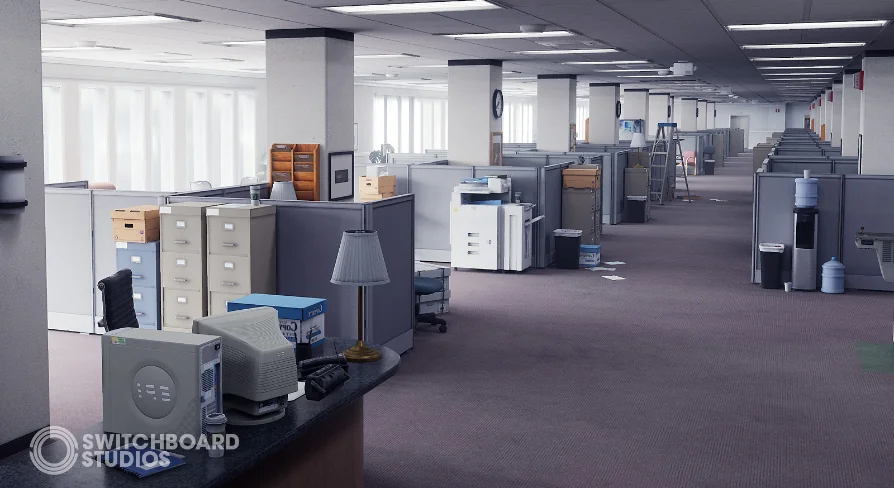
When a project needs a workplace interior that can hold up in close view, Office Space Megapack sits in a very practical part of the pipeline. It is a fully modular interior office space package, meant for assembling office scenes rather than relying on a single fixed environment. That makes it useful for teams building walkable levels, cinematic interiors, or simulation spaces where the room layout needs to be adjusted to fit a specific sequence, route, or interaction.
The pack is positioned as a large office environment set, with over 250 props and more than 150 unique items. Those numbers matter less as a headline than in day-to-day production: they point to a package that covers both the structural side of an office and the small pieces that stop a space from feeling empty. Modular pieces shape the layout, while set dressing props help sell the lived-in detail that office scenes usually need.
Office Space Megapack in production scenes
This pack fits best in projects that need an office interior users can move through rather than just look at from a distance. The assets are set up by default for First Person and VR games, which places the emphasis on close-range viewing. In practical terms, that means the environment is not only about broad room composition. It is also meant to retain detail where players or viewers are likely to approach desks, walls, furniture, and supporting props at eye level.
That first-person focus also makes the pack relevant for cinematic work inside Unreal. A walkthrough or room-to-room camera path puts heavy pressure on environment assets because surfaces and props stay on screen long enough for texture quality and scene consistency to show. Office Space Megapack addresses that with an audited texel ratio of 10.24ppm across the assets, described as first-person quality. For a production team, that kind of standardization helps when combining many objects in one interior and trying to avoid visual jumps between hero pieces and background dressing.
The included example scene is stated to run at 120fps while using a physically based lighting setup. That does not replace optimization work in a real project, but it gives this pack a clear place in a workflow that values both presentation and performance testing. An office environment often ends up carrying a high density of repeated objects and materials, so a fast example scene with physically based lighting is a useful signpost for how the package is intended to behave in an assembled state.
Over 250 props and 150 unique items for office dressing
The strongest practical feature here is coverage. Over 250 props are included, spanning modular pieces and more than 150 unique set dressing props. That mix is important because office interiors rarely come together from architecture alone. They need repetition in some areas and specificity in others. Repeated modular elements define the structure of the floor, while unique dressing pieces break up the uniform look that can make an office feel artificial.
For environment artists, that makes the pack easier to place in different stages of scene building. The modular side supports blockout refinement and layout iteration. The set dressing side supports the pass where a clean shell becomes a believable workplace. A team can establish the floor plan first, then layer in the objects that create variation and density.
The tags attached to the pack point to a realistic office with industrial and vintage notes. Those tags do not spell out exact object categories, but they do indicate the visual lane this package occupies. It is not framed as a stylized office set. It is aimed at realistic scenes, which is consistent with the emphasis on first-person viewing, physically based lighting, and maintaining detail without aggressive texture reduction.
10.24ppm and first-person VR setup
One of the more production-focused details is the stated texel ratio of 10.24ppm for all assets. Every asset is audited to meet that target, and the pack frames it as first-person quality. That creates a clear expectation for where the assets are supposed to live in a scene: close enough that texture sharpness matters. In a workflow, that is especially helpful when an environment has to support player movement through narrow office spaces, headset viewing in VR, or cinematics that linger on surfaces and props.
The pack also directly addresses a common compromise in environment work: reducing textures to stay inside budgets and losing visible detail in the process. Office Space Megapack is presented as maintaining AAA quality while still being able to withstand a later optimization pass. That is a useful position in production because it lets a team begin from a higher-detail baseline and then optimize as needed, instead of starting from visibly reduced assets and trying to recover fidelity later.
There is also a workflow benefit in consistency. When assets are held to the same texel density standard, an office scene tends to be easier to light, frame, and populate without certain props suddenly reading softer or sharper than everything around them. In first-person and VR work, those mismatches are hard to hide. This package is clearly intended to avoid that problem.
Modular office interiors with reduced material calls
Large office scenes can become heavy quickly because they combine many props, repeated furniture, architectural pieces, and surface variations. Office Space Megapack addresses that through asset packing described as sensible and intended to reduce material calls on large amounts of items. That detail places the pack firmly in the real production conversation, because office spaces are exactly the kind of environments where repeated assets can multiply draw and material complexity if they are not handled carefully.
For teams building sizable interiors, that means the package is not only about visual coverage. It is also structured with scene assembly in mind. A modular office pack has to do more than offer enough pieces to fill rooms. It needs to stay manageable when those rooms scale up into a larger floor or multi-area walkthrough. Reducing material calls supports that kind of expansion.
The pack also describes itself as the biggest office pack on the Unreal Marketplace to date and claims a higher quality level than most of that space. The practical takeaway is less about the comparison and more about scope: this is meant to function as a broad office environment library rather than a narrow prop set. That makes it relevant for productions that do not want to hunt across multiple smaller packs just to build one coherent office setting.
Where Office Space Megapack helps most
Office Space Megapack is best suited to projects that need a realistic office interior people will spend time inside, not just pass by. Its modular structure supports layout building, its large prop count supports dressing and variation, and its first-person and VR setup supports close inspection. The audited 10.24ppm texel ratio, physically based lighting example scene, and reduced material call approach all point to the same use case: office environments that need to look detailed while still fitting into a production workflow.
Teams working on first-person levels, VR office scenes, realistic simulations, or cinematic walkthroughs would get the clearest benefit, especially when they need both layout flexibility and enough unique dressing to keep the environment from feeling repeated.
 Industrial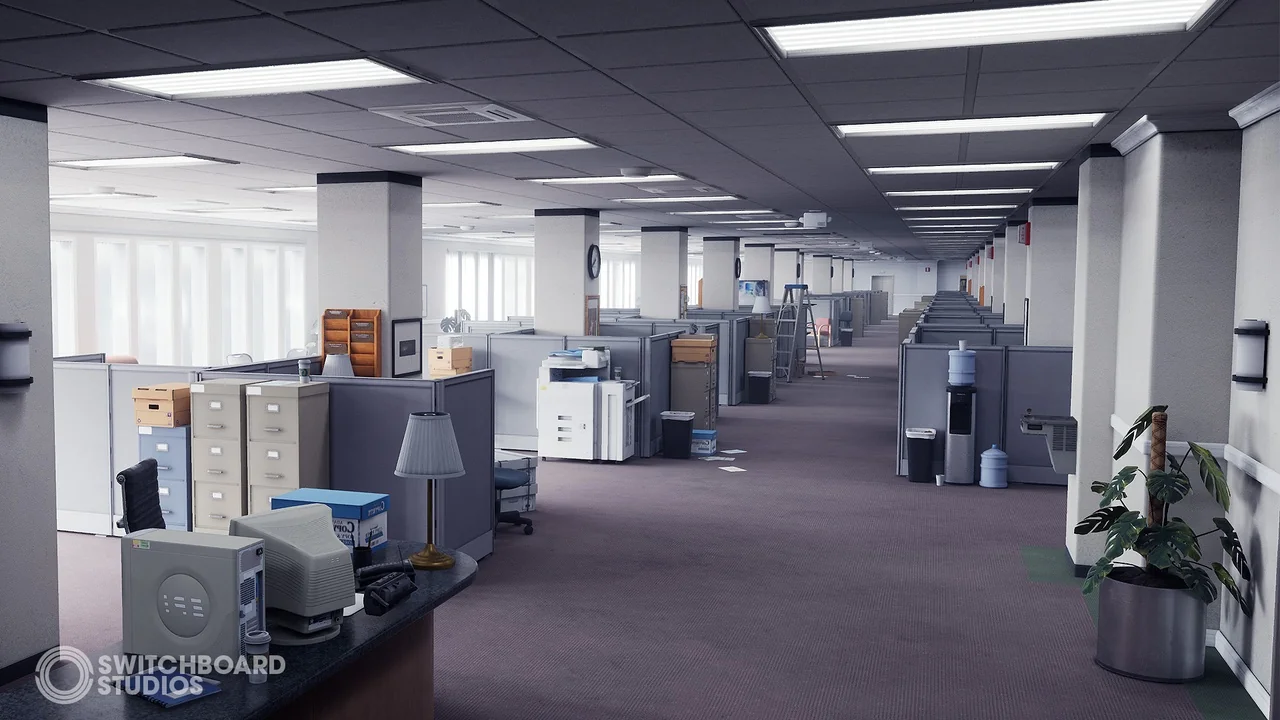
 Industrial
 Interior
 Sky
Sky