"7066dd76da796369"{"id":"27541","slug":"cpu-world","title":"Cpu World","category":"Industrial","engine":"4.26+,5.0+","assetVersion":"Engine version: 4.26+,5.0+","engineVersion":"","tag":"Industrial","accent":"blue","visual":"city","summary":"CPU World places a character inside a miniature field of electronic components and chip walls. Flashing LEDs and the small-scale layout push the scene toward surreal realism while keeping the technology theme clear.","platform":"Unreal Engine","publishedAt":"2026-04-26T07:18:31.000Z","updatedAt":"2026-04-26T07:18:32.000Z","sourceNotes":[],"fileContents":[],"compatibility":["Unreal Engine","Engine version: 4.26+,5.0+"],"featuredImage":{"alt":"Cpu World","src":"https://3dcghub.com/wp-content/uploads/2026/04/f820e39a2b85_104642b2-320a-43bd-be3e-d969f2fbbacc.webp"},"hasDownloadLink":true,"downloads":0,"terms":[{"taxonomy":"category","slug":"industrial-environments","name":"Industrial"},{"taxonomy":"post_tag","slug":"characters","name":"Characters"},{"taxonomy":"post_tag","slug":"environment","name":"Environment"},{"taxonomy":"post_tag","slug":"prop","name":"Prop"}],"galleryImages":[{"src":"https://3dcghub.com/wp-content/uploads/2026/04/8c13b4e150cb_c1fdd106-043d-4f5f-b227-489fe1db9e1d.webp","alt":"Cpu World"},{"src":"https://3dcghub.com/wp-content/uploads/2026/04/83ff5e131163_3fc673b7-0245-4487-b812-947391dafa7e.webp","alt":"Cpu World"},{"src":"https://3dcghub.com/wp-content/uploads/2026/04/2c7cefa2f498_21407bc9-7467-4809-a5e4-4328bc336fd7.webp","alt":"Cpu World"},{"src":"https://3dcghub.com/wp-content/uploads/2026/04/5de79f5ba064_8516bc52-53ab-42e2-bf4c-ea000ec4c848.webp","alt":"Cpu World"},{"src":"https://3dcghub.com/wp-content/uploads/2026/04/ed48ffc31ea0_12dc85d8-4ea0-4879-8e76-91f622eefacd.webp","alt":"Cpu World"},{"src":"https://3dcghub.com/wp-content/uploads/2026/04/d59bcebf9d61_298533fd-69e4-45ca-a937-f795aa39468b.webp","alt":"Cpu World"},{"src":"https://3dcghub.com/wp-content/uploads/2026/04/eb1c4eab4c9d_69b60264-1173-439e-b857-81e7e3e21dd0.webp","alt":"Cpu World"},{"src":"https://3dcghub.com/wp-content/uploads/2026/04/7758f49314b2_10118f82-8dff-4718-921c-f8b6c02ee7f9.webp","alt":"Cpu World"},{"src":"https://3dcghub.com/wp-content/uploads/2026/04/1d8bcf1dc4ec_75a944cf-263e-420a-b710-e0cb42fac675.webp","alt":"Cpu World"},{"src":"https://3dcghub.com/wp-content/uploads/2026/04/56e1b6aafb1d_2ccfe3d8-a138-44f7-95a4-39b9b2fa40a4.webp","alt":"Cpu World"}],"accessPanel":{"kind":"resource","title":"Access this resource","eyebrow":"Free Download","message":"Log in or create a free account to start your download.","fileName":"Content.7z","safetyNote":"All resources are 100% manually reviewed to eliminate all risks.","actionLabel":"Download Free","resourceType":"Resource archive"},"contentHtml":"\u003ch2\u003eCPU World for a character-sized electronic landscape\u003c/h2\u003e\u003cp\u003eCPU World turns a technical surface into a place a character can enter. Instead of reading like a normal room or street, the scene is made from electronic components and chip walls, with the whole setup scaled so the character can dive into it.\u003c/p\u003e\u003cp\u003eThat scale shift changes how the environment reads. The components stop feeling like isolated props and start acting as terrain, while the chip walls give the space a structured, mechanical edge. The result is a compact world that keeps the language of computers and electrical hardware visible at every turn.\u003c/p\u003e\u003ch2\u003eChip walls, electronic components, and miniature scale\u003c/h2\u003e\u003cp\u003eThe most direct visual idea in CPU World is the combination of component-filled surfaces and chip walls. Those elements define the environment’s shape and help it feel like a miniature technical world rather than a generic sci-fi backdrop.\u003c/p\u003e\u003cp\u003eThe miniature aspect matters because it frames the scene as something small, dense, and detailed. A character moving through that kind of space would be surrounded by hardware forms instead of open architecture, which gives the environment a tightly packed, layered look. The tags point to a level, an environmental piece, and a prop-like use, so the scene fits naturally where a build needs a strong technical identity.\u003c/p\u003e\u003ch2\u003eFlashing LEDs and surreal realism in CPU World\u003c/h2\u003e\u003cp\u003eFlashing LEDs give the scene motion and energy. They add a clear electrical signal inside the stillness of the chip walls and components, and they help the world feel alive even though its materials are rigid and mechanical.\u003c/p\u003e\u003cp\u003eThe phrase surreal realism is important here. CPU World does not lean into abstraction alone; it keeps enough visual grounding in familiar electronic parts to stay believable, then shifts the scale and arrangement to make the world feel unusual. That mix creates a space that is recognizable as technology while still feeling dreamlike.\u003c/p\u003e\u003cp\u003eThis balance works well when a scene needs both clarity and visual oddity. The hardware reads as hardware, but the environment is arranged in a way that makes it feel larger, stranger, and more immersive than a simple tabletop layout.\u003c/p\u003e\u003ch2\u003eWhere CPU World fits in a level, prop, or gaming environment\u003c/h2\u003e\u003cp\u003eCPU World fits best in a project that wants a technology-forward setting with a miniature twist. It can serve as a level space, an environmental piece, or a prop-style world where the scene itself carries the concept.\u003c/p\u003e\u003cp\u003eThe tags attached to the asset point toward computer, technical, realistic, miniature, environmental, gaming, and electrical themes. That combination makes the scene useful when a production needs a controlled visual language: compact surfaces, flashing light sources, and an electronic world that feels engineered rather than organic.\u003c/p\u003e\u003cp\u003eFor production work, the practical value is in the scene’s clarity. The components, chip walls, and LEDs already establish the look, so the environment can sit in a game or cinematic build as a focused technical space with a surreal realistic finish.\u003c/p\u003e\n\n\u003ch2\u003eMore From The Same Workflow\u003c/h2\u003e\n\u003cul\u003e\n\u003cli\u003e\u003ca href=\"https://3dcghub.com/hospital-modular-building-props-and-characters/\" title=\"Hospital – modular building, props and characters\"\u003eHospital – modular building, props and characters\u003c/a\u003e\u003c/li\u003e\n\u003cli\u003e\u003ca href=\"https://3dcghub.com/barnyard-megapack-barn-barn-props-farm-environment/\" title=\"Barnyard Megapack (Barn, Barn Props, Farm Environment)\"\u003eBarnyard Megapack (Barn, Barn Props, Farm Environment)\u003c/a\u003e\u003c/li\u003e\n\u003cli\u003e\u003ca href=\"https://3dcghub.com/mountain-village-environment-village-modular-village-houses-village-props/\" title=\"Mountain Village Environment (Village, Modular Village Houses, Village Props)\"\u003eMountain Village Environment (Village, Modular Village Houses, Village Props)\u003c/a\u003e\u003c/li\u003e\n\u003cli\u003e\u003ca href=\"https://3dcghub.com/spaceships-props-and-modular-environment-tiles-sci-fi-low-poly-voxel/\" title=\"Spaceships, props and modular environment tiles (sci-fi, low poly, voxel)\"\u003eSpaceships, props and modular environment tiles (sci-fi, low poly, voxel)\u003c/a\u003e\u003c/li\u003e\n\u003cli\u003e\u003ca href=\"https://3dcghub.com/1950s-characters-bundle-1950s-characters-bundle-1950-character-gangster-3d/\" title=\"1950s Characters Bundle ( 1950s Characters Bundle 1950 Character Gangster 3D )\"\u003e1950s Characters Bundle ( 1950s Characters Bundle 1950 Character Gangster 3D )\u003c/a\u003e\u003c/li\u003e\n\u003c/ul\u003e","contentTextLength":3431,"navigation":{"current":2251,"total":4016,"previous":{"id":"27554","slug":"cyberpunk-high-city","title":"Cyberpunk - High City","category":"Cyberpunk","platform":"Unreal Engine","updatedAt":"2026-04-26T07:32:20.000Z"},"next":{"id":"14171","slug":"material-assignment-tool-materiall-assignmentt-tooll-materialed-tooled","title":"Material Assignment Tool ( Materiall Assignmentt Tooll Materialed Tooled )","category":"Engine Tools","platform":"Unreal Engine","updatedAt":"2026-04-26T06:59:33.000Z"}},"relatedResources":[{"id":"28434","slug":"1900s-office-1900s-1900th-office-officed-workspace-workspace","title":"1900s Office ( 1900s 1900th Office Officed Workspace Workspace )","category":"Industrial","engine":"4.26+,5.0+","assetVersion":"Engine version: 4.26+,5.0+","engineVersion":"","tag":"Industrial","accent":"blue","visual":"city","summary":"1900s Office Environment focuses on a ready-to-populate historical workspace with 109 unique meshes and a showcased preassembled scene. Its compatibility with ULAT also opens a faster path for custom modular building work and more natural scene population.","platform":"Unreal Engine","publishedAt":"2026-05-15T16:33:54.000Z","updatedAt":"2026-05-15T16:50:42.000Z","sourceNotes":[],"fileContents":[],"compatibility":["Unreal Engine","Engine version: 4.26+,5.0+"],"featuredImage":{"alt":"1900s Office ( 1900s 1900th Office Officed Workspace Workspace )","src":"https://3dcghub.com/wp-content/uploads/2026/05/e33c39f2457c_aefe9087-7ffd-4238-bf03-148884fc6a4e.webp"},"hasDownloadLink":true,"downloads":0},{"id":"27159","slug":"junkyard-environment-14-assets","title":"Junkyard Environment / 14 Assets","category":"Industrial","engine":"4.26+,5.0+","assetVersion":"Engine version: 4.26+,5.0+","engineVersion":"","tag":"Industrial","accent":"blue","visual":"city","summary":"Junkyard Environment / 14 Assets gathers rusty vehicles, a crane, trucks, a pickup, and other junkyard pieces into a focused prop package. Its PBR workflow and optimized, modular direction make it useful for exterior scenes that need visual weight without l...","platform":"Unreal Engine","publishedAt":"2026-04-21T13:49:45.000Z","updatedAt":"2026-04-21T13:49:46.000Z","sourceNotes":[],"fileContents":[],"compatibility":["Unreal Engine","Engine version: 4.26+,5.0+"],"featuredImage":{"alt":"Junkyard Environment / 14 Assets","src":"https://3dcghub.com/wp-content/uploads/2026/04/ba5b2081c43f_7994d52c-7990-4428-84b6-ce1157a852f2.webp"},"hasDownloadLink":true,"downloads":0},{"id":"24823","slug":"ultimate-open-world","title":"Ultimate Open World","category":"Shooter","engine":"5.5+","assetVersion":"Engine version: 5.5+","engineVersion":"Asset Version:1.1 - 1.2","tag":"Shooter","accent":"blue","visual":"character","summary":"Ultimate Open World is set up as a starting point for open world games that need a clear, organized base. It combines the studioâs work in models, animations, programming, and ready-to-use environments with materials that help frame setup and implementation.","platform":"Unreal Engine","publishedAt":"2026-04-17T09:16:54.000Z","updatedAt":"2026-04-29T05:47:19.000Z","sourceNotes":[],"fileContents":[],"compatibility":["Unreal Engine","Engine version: 5.5+","Asset Version: 1.1 - 1.2"],"featuredImage":{"alt":"Ultimate Open World","src":"https://3dcghub.com/wp-content/uploads/2026/04/f6218a722e6e_0253a61c-4a7a-4655-abf5-4f829b521192.webp"},"hasDownloadLink":true,"downloads":17}]}
Industrial
Cpu World
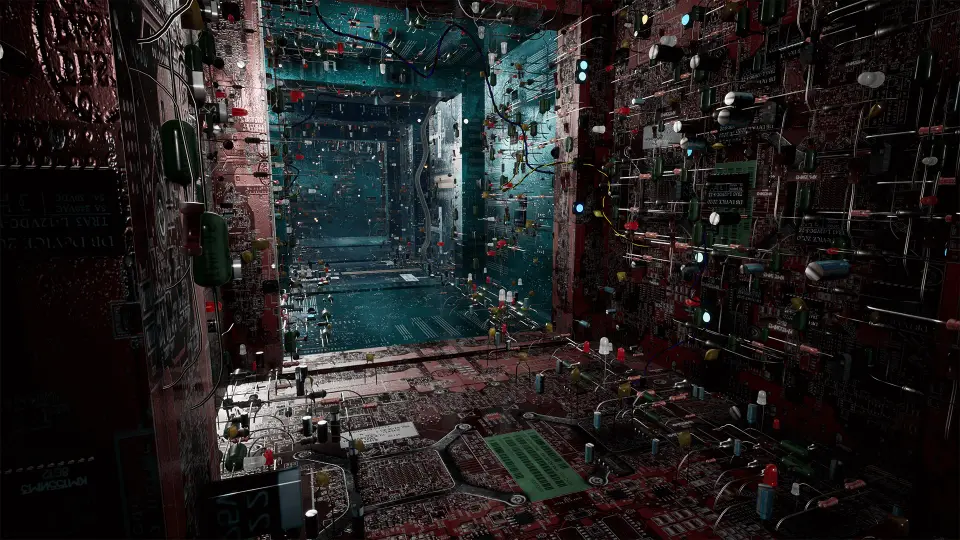
CPU World places a character inside a miniature field of electronic components and chip walls. Flashing LEDs and the small-scale layout push the scene toward surreal realism while keeping the technology theme clear.
CPU World for a character-sized electronic landscape
CPU World turns a technical surface into a place a character can enter. Instead of reading like a normal room or street, the scene is made from electronic components and chip walls, with the whole setup scaled so the character can dive into it.
That scale shift changes how the environment reads. The components stop feeling like isolated props and start acting as terrain, while the chip walls give the space a structured, mechanical edge. The result is a compact world that keeps the language of computers and electrical hardware visible at every turn.
Chip walls, electronic components, and miniature scale
The most direct visual idea in CPU World is the combination of component-filled surfaces and chip walls. Those elements define the environment’s shape and help it feel like a miniature technical world rather than a generic sci-fi backdrop.
The miniature aspect matters because it frames the scene as something small, dense, and detailed. A character moving through that kind of space would be surrounded by hardware forms instead of open architecture, which gives the environment a tightly packed, layered look. The tags point to a level, an environmental piece, and a prop-like use, so the scene fits naturally where a build needs a strong technical identity.
Flashing LEDs and surreal realism in CPU World
Flashing LEDs give the scene motion and energy. They add a clear electrical signal inside the stillness of the chip walls and components, and they help the world feel alive even though its materials are rigid and mechanical.
The phrase surreal realism is important here. CPU World does not lean into abstraction alone; it keeps enough visual grounding in familiar electronic parts to stay believable, then shifts the scale and arrangement to make the world feel unusual. That mix creates a space that is recognizable as technology while still feeling dreamlike.
This balance works well when a scene needs both clarity and visual oddity. The hardware reads as hardware, but the environment is arranged in a way that makes it feel larger, stranger, and more immersive than a simple tabletop layout.
Where CPU World fits in a level, prop, or gaming environment
CPU World fits best in a project that wants a technology-forward setting with a miniature twist. It can serve as a level space, an environmental piece, or a prop-style world where the scene itself carries the concept.
The tags attached to the asset point toward computer, technical, realistic, miniature, environmental, gaming, and electrical themes. That combination makes the scene useful when a production needs a controlled visual language: compact surfaces, flashing light sources, and an electronic world that feels engineered rather than organic.
For production work, the practical value is in the scene’s clarity. The components, chip walls, and LEDs already establish the look, so the environment can sit in a game or cinematic build as a focused technical space with a surreal realistic finish.
 Industrial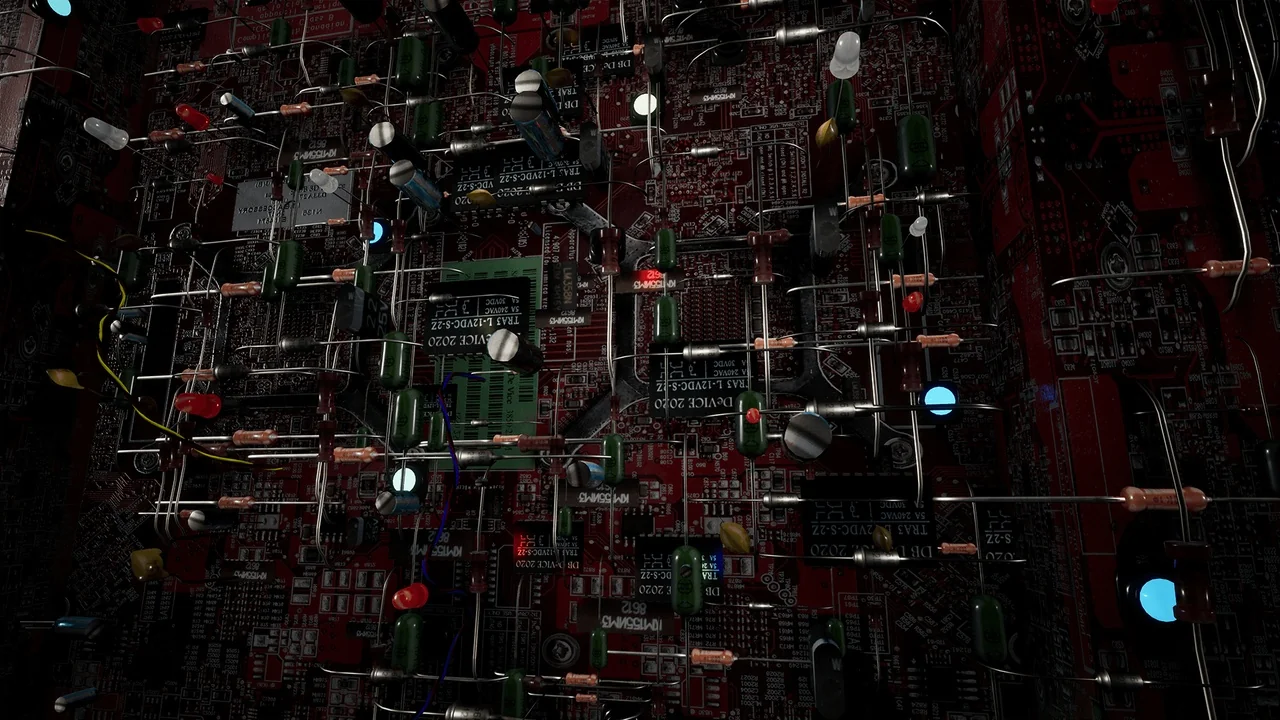
 Industrial
 Industrial
 Shooter