"1f00f67f9253451b"{"id":"1000173","slug":"detectiveoffice","title":"DetectiveOffice","category":"Interior","engine":"5.5+","assetVersion":"","engineVersion":"Engine Version: 5.5+","tag":"Interior","accent":"blue","visual":"mech","summary":"DetectiveOffice is a noir-style interior scene for cinematics, storytelling, short films, and games, centered on a private investigator workspace.","platform":"Unreal Engine","publishedAt":"2026-06-20T04:18:09.703Z","updatedAt":"2026-06-20T04:18:09.703Z","sourceNotes":[],"fileContents":[],"compatibility":["Unreal Engine","Engine Version: 5.5+"],"featuredImage":{"alt":"DetectiveOffice","src":"/wp-content/uploads/published/2026/06/f048c95f04d1-113ab1b0-51eb-4be4-b060-5c963e323946-ca75e10862.webp"},"hasDownloadLink":true,"downloads":1,"terms":[{"taxonomy":"category","slug":"interior","name":"Interior"}],"galleryImages":[{"src":"/wp-content/uploads/published/2026/06/56952c1fa660-c7d6a950-2bfd-465c-809f-82ead99372bf-3b9790a40d.webp","alt":"DetectiveOffice"},{"src":"/wp-content/uploads/published/2026/06/74b82ae89e33-0a8e286a-fadb-497d-a43c-711c9c50dd3d-eb5e1e2b20.webp","alt":"DetectiveOffice"},{"src":"/wp-content/uploads/published/2026/06/cdd79133e0d8-cfaa0bc2-9f9a-46a5-9bdc-4b99710ce16c-3ec0c88fca.webp","alt":"DetectiveOffice"},{"src":"/wp-content/uploads/published/2026/06/f5de17a383e7-c7b79628-4230-4346-aaf8-16a805d11650-4b9e0e58c4.webp","alt":"DetectiveOffice"},{"src":"/wp-content/uploads/published/2026/06/0b3cb721cb73-e377049f-169f-47aa-acf2-36a0fbed4de2-d73e5ef327.webp","alt":"DetectiveOffice"},{"src":"/wp-content/uploads/published/2026/06/abb9f65f5b4a-aa23789e-3f2b-40e9-83cc-75e88d2d11c1-81ff1fe253.webp","alt":"DetectiveOffice"},{"src":"/wp-content/uploads/published/2026/06/2b535f4c7bf6-aaaf5090-541f-4a99-bf2d-c2b15551b7c8-333a981a1d.webp","alt":"DetectiveOffice"},{"src":"/wp-content/uploads/published/2026/06/361fa9e60479-16242436-3005-4e9a-b04f-5454a72310cf-ca61806ca1.webp","alt":"DetectiveOffice"},{"src":"/wp-content/uploads/published/2026/06/076fb94eb55e-6d7a624a-1a2b-407d-b09e-a041b4581a2f-9c42d64f7c.webp","alt":"DetectiveOffice"},{"src":"/wp-content/uploads/published/2026/06/d6f22fd2b761-d8f309d3-635b-4f6b-9b27-4b5a33a928c9-5bda70a45b.webp","alt":"DetectiveOffice"}],"accessPanel":{"kind":"resource","title":"Download this resource","eyebrow":"Free Download","message":"Log in or create a free account to start your download.","fileName":"DetectiveOffice.7z","safetyNote":"Resources are manually reviewed before listing to improve quality and reduce obvious risks.","actionLabel":"Download Free","resourceType":"Resource archive"},"contentHtml":"\u003cp\u003eDetectiveOffice starts from a clear production need: setting a scene fast without having to assemble the mood piece by piece. The environment already leans into a cinematic noir direction, with a private investigator’s office arranged around clues, paperwork, and visual tension. Rather than functioning as a neutral interior, it comes with a defined dramatic identity, making it useful when a project needs a room that immediately reads as investigation, secrecy, and old-school detective fiction.\u003c/p\u003e\n\u003cp\u003eThe environment draws from classic crime movies and vintage detective stories. That inspiration is visible in the way the space is staged. Evidence boards, documents, photographs, and mysterious clues are not treated as background decoration alone; they are part of what gives the office its narrative weight. The room is not just an office interior. It is an investigative workspace where every wall and surface helps establish that someone has been following leads, collecting fragments, and trying to connect them.\u003c/p\u003e \u003ch2\u003eSetting up a scene with DetectiveOffice\u003c/h2\u003e\n\u003cp\u003eFor anyone building a cinematic moment or a story sequence, the strongest part of DetectiveOffice is how much atmosphere is already embedded in the environment. The office is arranged to support framing and scene blocking through its props and internal points of interest. A detective desk gives the room a clear anchor, while the investigation board adds a second focal area that naturally supports close-up shots, character interaction, or moments of discovery.\u003c/p\u003e\n\u003cp\u003eThat structure matters when an environment needs to do more than fill space. A room with a desk, a clue board, archive storage, seating, and a stairway gives a production several different visual zones to work with. A character can sit and review documents, stand at the board and study connections, cross the room toward stored files, or move between levels to shift the pacing of a scene. Even without adding new elements, the layout already suggests movement, pauses, and visual contrast within a single interior.\u003c/p\u003e\n\u003cp\u003eThe office is described as a cinematic interior, and that comes through in the way the space appears to be carefully arranged rather than randomly furnished. Props are placed to support a dramatic investigative mood. For implementation, that means the environment is not only a container for action but also a storytelling layer in itself. It can carry the burden of mood and context before a character even speaks.\u003c/p\u003e \u003ch2\u003eThe investigation board, desk, and archive boxes as story anchors\u003c/h2\u003e\n\u003cp\u003eDetectiveOffice includes multiple detailed areas, and each one contributes to a different kind of scene work. The detective desk is the most direct symbol of the office as a working place. It suggests paperwork, decisions, and the solitary side of detective fiction. In practical use, it offers a grounded center for character-focused shots, whether the emphasis is on quiet review or rising tension.\u003c/p\u003e\n\u003cp\u003eThe investigation board full of clues shifts the environment from general office space into something more specific. A clue board immediately communicates active inquiry. Combined with documents and photographs throughout the room, it turns the interior into a visual map of a case in progress. For storytelling, this is one of the most useful parts of the environment because it gives the scene an object that can be looked at, approached, studied, and framed from different distances. Wide shots can use it to establish the case-driven identity of the room, while tighter compositions can focus on the density of clues and the sense of unresolved mystery.\u003c/p\u003e\n\u003cp\u003eArchive boxes extend that same logic in a quieter way. They reinforce the idea that this office holds records, old leads, and stored evidence. In a production context, boxes like these broaden the range of the room beyond one dramatic centerpiece. They help the office feel used and accumulated over time rather than newly decorated. That contributes to the realistic and photorealistic character reflected in the tags, while also supporting the detective theme without needing overt action.\u003c/p\u003e\n\u003cp\u003eLounge seating changes the rhythm of the room. Instead of everything being structured through standing work surfaces and storage, the office also includes a place to sit and hold a conversation, wait, or create a pause between investigative beats. This is useful for staging because a detective office often needs room not only for research but also for interviews, reflection, or scenes that rest on mood more than movement.\u003c/p\u003e \u003ch2\u003eWarm interior lighting and window light in the noir atmosphere\u003c/h2\u003e\n\u003cp\u003eThe lighting setup is one of the most defining aspects of DetectiveOffice. Warm interior lighting is combined with window light to create a classic film-noir atmosphere. That combination gives the environment its tonal contrast. Warm interior sources suggest habitation and late-night work, while window light introduces another layer that can shape silhouettes, edges, and the sense of separation between the office and the outside world.\u003c/p\u003e\n\u003cp\u003eFor cinematics and short films, this is relevant because lighting is doing narrative work here, not just visibility work. The room is tuned toward a dramatic investigative mood, so the light is part of how the scene tells the viewer what kind of story they are entering. A detective office lit in this way carries tension and introspection more naturally than a flat or evenly lit room would. That leaves an environment that already supports noir framing and mood-heavy composition.\u003c/p\u003e\n\u003cp\u003eThis lighting direction also helps unify the large number of clue-driven props. Documents, photographs, and evidence boards can easily become visually busy, but a room with a strong lighting identity can bind those details together. In DetectiveOffice, the warm interior glow and the presence of window light work as a shared visual language across the office’s different areas. The desk, board, lounge seating, archive boxes, and stairway all belong to the same mood rather than feeling like disconnected set pieces.\u003c/p\u003e \u003ch2\u003eWhere DetectiveOffice fits: cinematics, storytelling, short films, and games\u003c/h2\u003e\n\u003cp\u003eDetectiveOffice is intended for cinematics, storytelling, short films, and games. Those uses are related, but each one benefits from a slightly different aspect of the scene. In cinematics, the office offers ready-made dramatic framing and a space dense with narrative cues. In storytelling work, the clues, documents, and photographs provide environmental context that can carry part of the plot without requiring exposition. In short films, the contained nature of the interior is an advantage because several scene types can happen within one location. In games, the room can support exploration, mission setup, dialogue sequences, or atmosphere-driven progression.\u003c/p\u003e\n\u003cp\u003eThe detective theme is specific enough to give projects a strong identity, but the office is broad enough in layout to handle multiple kinds of scenes. A production can treat it as a headquarters, a case room, a place of revelation, or a setting for character interaction. Since the environment includes both work-focused details and seating, as well as a stairway leading to an upper level, it does not trap all action into a single flat composition. It offers layers within the same interior footprint.\u003c/p\u003e\n\u003cp\u003eThe tags attached to the environment point toward carpet, agency, police, investigation, office, interior, detective, and room, along with realistic and photorealistic qualities. Taken together, those descriptors place the environment firmly in grounded crime-fiction territory rather than fantasy or abstract stylization. That gives it a practical role in projects looking for a serious investigative setting with a recognizable real-world office structure.\u003c/p\u003e \u003ch2\u003eThe stairway and upper level as part of the room’s visual flow\u003c/h2\u003e\n\u003cp\u003eOne detail that broadens the environment beyond a single-room set is the stairway leading to an upper level. Even without additional explanation, that vertical transition changes how the office can be used. A stairway introduces directional movement, layered framing, and a stronger sense that the office extends beyond one static floor area. In visual terms, it helps break up the interior and makes the scene feel more spatially developed.\u003c/p\u003e\n\u003cp\u003eFor implementation, this means the room can support more than desk-level action. Characters can enter or leave through different depths of the set, pause on the stairs, or be framed from below or above for more dramatic compositions. In a noir context, stairs are especially useful because they naturally add shadow, separation, and anticipation. The upper-level connection also makes the office feel more established, as if it belongs to a larger working space rather than existing only for one camera angle.\u003c/p\u003e\n\u003cp\u003eThat layered layout works well with the rest of the room’s detailed areas. The desk and investigation board handle focused story beats. Archive boxes and seating support atmosphere and lived-in realism. The stairway contributes movement and vertical contrast. Together, these details make DetectiveOffice practical for scenes that need a contained but expressive investigative environment. Its strongest quality is not a single prop or one dramatic element, but the way its noir style, clue-filled dressing, and warm lighting come together into a production-ready interior identity.\u003c/p\u003e\n\n\u003ch2\u003eRelated Resources Worth Checking\u003c/h2\u003e\n\u003cul\u003e\n\u003cli\u003e\u003ca href=\"https://3dcghub.com/artists-attic-studio-environment/\" title=\"Artist’s Attic Studio Environment\"\u003eArtist’s Attic Studio Environment\u003c/a\u003e\u003c/li\u003e\n\u003cli\u003e\u003ca href=\"https://3dcghub.com/pharmacy-drugstore-environment-pharmacy-medicine-chemistry-medicines-shop/\" title=\"Pharmacy / Drugstore Environment ( Pharmacy Medicine Chemistry Medicines Shop )\"\u003ePharmacy / Drugstore Environment ( Pharmacy Medicine Chemistry Medicines Shop )\u003c/a\u003e\u003c/li\u003e\n\u003cli\u003e\u003ca href=\"https://3dcghub.com/horror-farm/\" title=\"Horror Farm\"\u003eHorror Farm\u003c/a\u003e\u003c/li\u003e\n\u003cli\u003e\u003ca href=\"https://3dcghub.com/woodworking-workshop-environment-woodworking-craftman-craft-interior-carpenter/\" title=\"Woodworking Workshop Environment / Woodworking Craftman Craft Interior Carpenter\"\u003eWoodworking Workshop Environment / Woodworking Craftman Craft Interior Carpenter\u003c/a\u003e\u003c/li\u003e\n\u003cli\u003e\u003ca href=\"https://3dcghub.com/atmospheric-house-modular/\" title=\"Atmospheric House (Modular)\"\u003eAtmospheric House (Modular)\u003c/a\u003e\u003c/li\u003e\n\u003c/ul\u003e","contentTextLength":9576,"navigation":{"current":1176,"total":3222,"previous":{"id":"14623","slug":"skinned-decal-component","title":"Skinned Decal Component","category":"Engine Tools","platform":"Unreal Engine","updatedAt":"2026-06-20T04:53:55.480Z"},"next":{"id":"1000172","slug":"devton-abandoned-prison","title":"DevTon Abandoned Prison","category":"Industrial","platform":"Unreal Engine","updatedAt":"2026-06-20T03:55:41.644Z"}},"relatedResources":[{"id":"27418","slug":"artists-attic-studio-environment","title":"Artist’s Attic Studio Environment","category":"Interior","engine":"5.5+","assetVersion":"Engine version: 5.5+","engineVersion":"","tag":"Interior","accent":"blue","visual":"city","summary":"Artist’s Attic Studio Environment is a fully dressed attic interior with a warm, lived-in feel, modular structural pieces, and studio props. It fits scenes that need a cozy, story-rich space for cinematic framing or gameplay.","platform":"Unreal Engine","publishedAt":"2026-04-25T08:27:44.000Z","updatedAt":"2026-04-25T08:27:47.000Z","sourceNotes":[],"fileContents":[],"compatibility":["Unreal Engine","Engine version: 5.5+"],"featuredImage":{"alt":"Artist’s Attic Studio Environment","src":"https://3dcghub.com/wp-content/uploads/2026/04/1fce6996a87b_29a2b5f1-a05c-4f5a-bfc8-78a1ef2046a2.webp"},"hasDownloadLink":true,"downloads":0},{"id":"1000714","slug":"vintage-attic-environment-kit","title":"Vintage Attic Environment Kit","category":"Interior","engine":"5.1+","assetVersion":"","engineVersion":"Engine Version: 5.1+","tag":"Interior","accent":"blue","visual":"city","summary":"208 modular meshes, 156 materials, and day/night demo levels for building realistic or retro attic scenes across films, games, and presentations.","platform":"Unreal Engine","publishedAt":"2026-07-24T08:55:12.301Z","updatedAt":"2026-07-24T08:55:12.301Z","sourceNotes":[],"fileContents":[],"compatibility":["Unreal Engine","Engine Version: 5.1+"],"featuredImage":{"alt":"Vintage Attic Environment Kit","src":"/wp-content/uploads/published/2026/07/179c47e283e5-5ae6c363-88dc-49cc-a191-85397eae84bc-2dc0365baf.webp"},"hasDownloadLink":true,"downloads":2},{"id":"1000579","slug":"contemporary-restaurant","title":"Contemporary Restaurant","category":"Interior","engine":"5.0+","assetVersion":"","engineVersion":"Engine Version: 5.0+","tag":"Interior","accent":"blue","visual":"mech","summary":"Modern restaurant interior scene for Unreal Engine with UV-unwrapped furniture, gamepad control support, and Lumen compatibility for UE 5.0+ projects.","platform":"Unreal Engine","publishedAt":"2026-07-16T23:31:08.674Z","updatedAt":"2026-07-16T23:31:08.674Z","sourceNotes":[],"fileContents":[],"compatibility":["Unreal Engine","Engine Version: 5.0+"],"featuredImage":{"alt":"Contemporary Restaurant","src":"/wp-content/uploads/published/2026/07/151020456d69-d21114dc-2bbf-468a-945d-1b5e31df791a-75a9579df8.webp"},"hasDownloadLink":true,"downloads":1}]}
Interior
DetectiveOffice
DetectiveOffice is a noir-style interior scene for cinematics, storytelling, short films, and games, centered on a private investigator workspace.
Category:Unreal Engine,InteriorPlatform: Unreal EngineEngine Version: 5.5+Published: Jun 20, 2026
Interior
Resource overview
DetectiveOffice starts from a clear production need: setting a scene fast without having to assemble the mood piece by piece. The environment already leans into a cinematic noir direction, with a private investigator’s office arranged around clues, paperwork, and visual tension. Rather than functioning as a neutral interior, it comes with a defined dramatic identity, making it useful when a project needs a room that immediately reads as investigation, secrecy, and old-school detective fiction.
The environment draws from classic crime movies and vintage detective stories. That inspiration is visible in the way the space is staged. Evidence boards, documents, photographs, and mysterious clues are not treated as background decoration alone; they are part of what gives the office its narrative weight. The room is not just an office interior. It is an investigative workspace where every wall and surface helps establish that someone has been following leads, collecting fragments, and trying to connect them.
Setting up a scene with DetectiveOffice
For anyone building a cinematic moment or a story sequence, the strongest part of DetectiveOffice is how much atmosphere is already embedded in the environment. The office is arranged to support framing and scene blocking through its props and internal points of interest. A detective desk gives the room a clear anchor, while the investigation board adds a second focal area that naturally supports close-up shots, character interaction, or moments of discovery.
That structure matters when an environment needs to do more than fill space. A room with a desk, a clue board, archive storage, seating, and a stairway gives a production several different visual zones to work with. A character can sit and review documents, stand at the board and study connections, cross the room toward stored files, or move between levels to shift the pacing of a scene. Even without adding new elements, the layout already suggests movement, pauses, and visual contrast within a single interior.
The office is described as a cinematic interior, and that comes through in the way the space appears to be carefully arranged rather than randomly furnished. Props are placed to support a dramatic investigative mood. For implementation, that means the environment is not only a container for action but also a storytelling layer in itself. It can carry the burden of mood and context before a character even speaks.
The investigation board, desk, and archive boxes as story anchors
DetectiveOffice includes multiple detailed areas, and each one contributes to a different kind of scene work. The detective desk is the most direct symbol of the office as a working place. It suggests paperwork, decisions, and the solitary side of detective fiction. In practical use, it offers a grounded center for character-focused shots, whether the emphasis is on quiet review or rising tension.
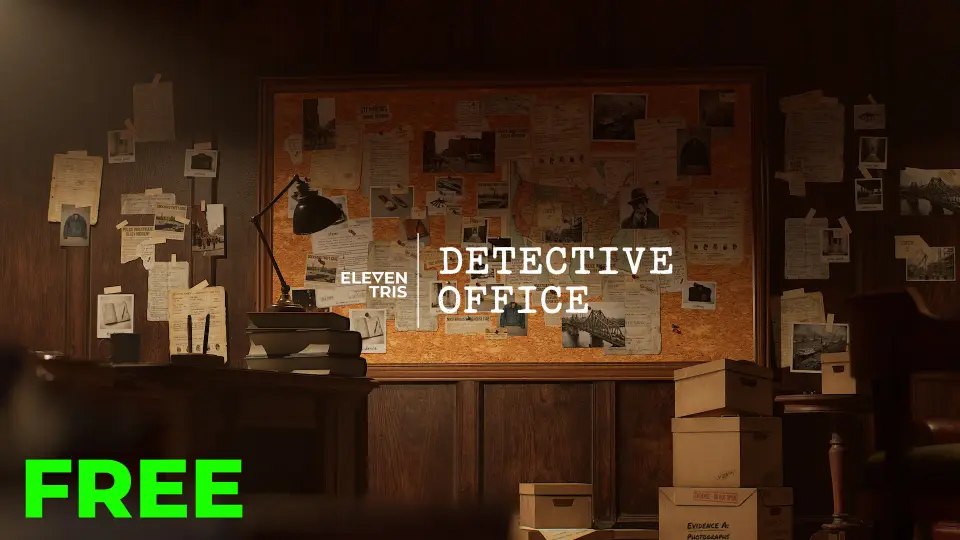
The investigation board full of clues shifts the environment from general office space into something more specific. A clue board immediately communicates active inquiry. Combined with documents and photographs throughout the room, it turns the interior into a visual map of a case in progress. For storytelling, this is one of the most useful parts of the environment because it gives the scene an object that can be looked at, approached, studied, and framed from different distances. Wide shots can use it to establish the case-driven identity of the room, while tighter compositions can focus on the density of clues and the sense of unresolved mystery.
Archive boxes extend that same logic in a quieter way. They reinforce the idea that this office holds records, old leads, and stored evidence. In a production context, boxes like these broaden the range of the room beyond one dramatic centerpiece. They help the office feel used and accumulated over time rather than newly decorated. That contributes to the realistic and photorealistic character reflected in the tags, while also supporting the detective theme without needing overt action.
Lounge seating changes the rhythm of the room. Instead of everything being structured through standing work surfaces and storage, the office also includes a place to sit and hold a conversation, wait, or create a pause between investigative beats. This is useful for staging because a detective office often needs room not only for research but also for interviews, reflection, or scenes that rest on mood more than movement.
Warm interior lighting and window light in the noir atmosphere
The lighting setup is one of the most defining aspects of DetectiveOffice. Warm interior lighting is combined with window light to create a classic film-noir atmosphere. That combination gives the environment its tonal contrast. Warm interior sources suggest habitation and late-night work, while window light introduces another layer that can shape silhouettes, edges, and the sense of separation between the office and the outside world.
For cinematics and short films, this is relevant because lighting is doing narrative work here, not just visibility work. The room is tuned toward a dramatic investigative mood, so the light is part of how the scene tells the viewer what kind of story they are entering. A detective office lit in this way carries tension and introspection more naturally than a flat or evenly lit room would. That leaves an environment that already supports noir framing and mood-heavy composition.
This lighting direction also helps unify the large number of clue-driven props. Documents, photographs, and evidence boards can easily become visually busy, but a room with a strong lighting identity can bind those details together. In DetectiveOffice, the warm interior glow and the presence of window light work as a shared visual language across the office’s different areas. The desk, board, lounge seating, archive boxes, and stairway all belong to the same mood rather than feeling like disconnected set pieces.
Where DetectiveOffice fits: cinematics, storytelling, short films, and games
DetectiveOffice is intended for cinematics, storytelling, short films, and games. Those uses are related, but each one benefits from a slightly different aspect of the scene. In cinematics, the office offers ready-made dramatic framing and a space dense with narrative cues. In storytelling work, the clues, documents, and photographs provide environmental context that can carry part of the plot without requiring exposition. In short films, the contained nature of the interior is an advantage because several scene types can happen within one location. In games, the room can support exploration, mission setup, dialogue sequences, or atmosphere-driven progression.
The detective theme is specific enough to give projects a strong identity, but the office is broad enough in layout to handle multiple kinds of scenes. A production can treat it as a headquarters, a case room, a place of revelation, or a setting for character interaction. Since the environment includes both work-focused details and seating, as well as a stairway leading to an upper level, it does not trap all action into a single flat composition. It offers layers within the same interior footprint.
The tags attached to the environment point toward carpet, agency, police, investigation, office, interior, detective, and room, along with realistic and photorealistic qualities. Taken together, those descriptors place the environment firmly in grounded crime-fiction territory rather than fantasy or abstract stylization. That gives it a practical role in projects looking for a serious investigative setting with a recognizable real-world office structure.
The stairway and upper level as part of the room’s visual flow
One detail that broadens the environment beyond a single-room set is the stairway leading to an upper level. Even without additional explanation, that vertical transition changes how the office can be used. A stairway introduces directional movement, layered framing, and a stronger sense that the office extends beyond one static floor area. In visual terms, it helps break up the interior and makes the scene feel more spatially developed.
For implementation, this means the room can support more than desk-level action. Characters can enter or leave through different depths of the set, pause on the stairs, or be framed from below or above for more dramatic compositions. In a noir context, stairs are especially useful because they naturally add shadow, separation, and anticipation. The upper-level connection also makes the office feel more established, as if it belongs to a larger working space rather than existing only for one camera angle.
That layered layout works well with the rest of the room’s detailed areas. The desk and investigation board handle focused story beats. Archive boxes and seating support atmosphere and lived-in realism. The stairway contributes movement and vertical contrast. Together, these details make DetectiveOffice practical for scenes that need a contained but expressive investigative environment. Its strongest quality is not a single prop or one dramatic element, but the way its noir style, clue-filled dressing, and warm lighting come together into a production-ready interior identity.
 Interior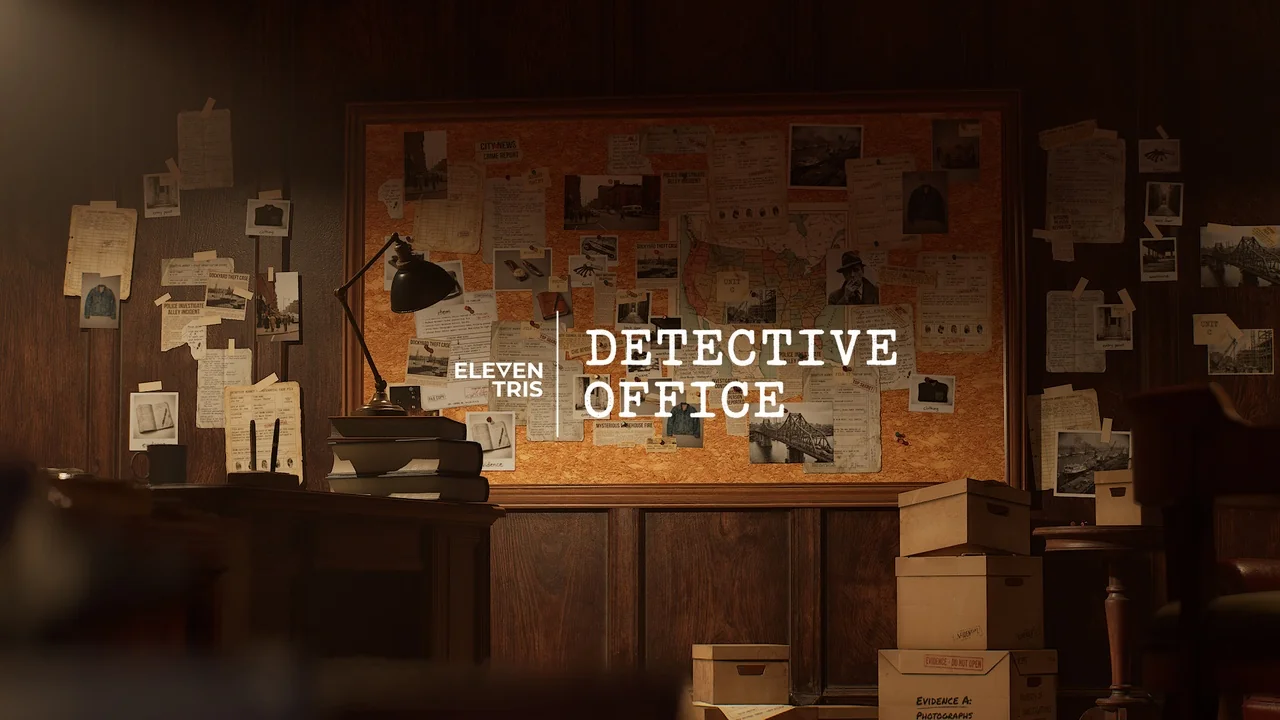
 Interior
 Interior
 Interior