"c68a05d5e51405b3"{"id":"1000714","slug":"vintage-attic-environment-kit","title":"Vintage Attic Environment Kit","category":"Interior","engine":"5.1+","assetVersion":"","engineVersion":"Engine Version: 5.1+","tag":"Interior","accent":"blue","visual":"city","summary":"208 modular meshes, 156 materials, and day/night demo levels for building realistic or retro attic scenes across films, games, and presentations.","platform":"Unreal Engine","publishedAt":"2026-07-24T08:55:12.301Z","updatedAt":"2026-07-24T08:55:12.301Z","sourceNotes":[],"fileContents":[],"compatibility":["Unreal Engine","Engine Version: 5.1+"],"featuredImage":{"alt":"Vintage Attic Environment Kit","src":"/wp-content/uploads/published/2026/07/179c47e283e5-5ae6c363-88dc-49cc-a191-85397eae84bc-2dc0365baf.webp"},"hasDownloadLink":true,"downloads":2,"terms":[{"taxonomy":"category","slug":"interior","name":"Interior"}],"galleryImages":[{"src":"/wp-content/uploads/published/2026/07/b75d38344710-443c012e-cf73-4b7d-85eb-08e3c984e9c8-59a7da9f99.webp","alt":"Vintage Attic Environment Kit"},{"src":"/wp-content/uploads/published/2026/07/54dfd07f95b3-01dc5935-062e-47b0-817b-d2a02a77ba95-ed8f2a49dc.webp","alt":"Vintage Attic Environment Kit"},{"src":"/wp-content/uploads/published/2026/07/34af04dd3a10-4fe01648-ca3d-4440-932e-97e6c4e89bc3-b4c269690f.webp","alt":"Vintage Attic Environment Kit"},{"src":"/wp-content/uploads/published/2026/07/092564df66ca-c0c48480-8a96-463c-95c2-c705a085bd0c-3720b24ed1.webp","alt":"Vintage Attic Environment Kit"},{"src":"/wp-content/uploads/published/2026/07/c0efe69ad9cf-00439452-f790-4707-9392-056c7a8c826b-29b80a102a.webp","alt":"Vintage Attic Environment Kit"},{"src":"/wp-content/uploads/published/2026/07/c97d35a7d8ff-87f0d0fd-3304-4fd7-9d7a-e8a184db1827-c04c51b12e.webp","alt":"Vintage Attic Environment Kit"},{"src":"/wp-content/uploads/published/2026/07/8f61fa0ca1cc-0fffc2d2-dd03-44e6-853a-373518110dfa-95bb65124f.webp","alt":"Vintage Attic Environment Kit"},{"src":"/wp-content/uploads/published/2026/07/3be31ce8c814-2f26daa0-d7a8-4d9e-8e87-d82457e10bdf-7c28c7a7b2.webp","alt":"Vintage Attic Environment Kit"},{"src":"/wp-content/uploads/published/2026/07/63061f1a7b70-dbba7916-4a3c-44a2-8f51-766f2ab1a9b4-f3b7fb4939.webp","alt":"Vintage Attic Environment Kit"},{"src":"/wp-content/uploads/published/2026/07/f7817d8f041d-acd193b1-ed73-4d4b-b283-7b36f4d56412-75790c5b5f.webp","alt":"Vintage Attic Environment Kit"}],"accessPanel":{"kind":"resource","title":"Download this resource","eyebrow":"Free Download","message":"Log in or create a free account to start your download.","fileName":"Content.7z","safetyNote":"Resources are manually reviewed before listing to improve quality and reduce obvious risks.","actionLabel":"Download Free","resourceType":"Resource archive"},"contentHtml":"\u003cp\u003eDropping a camera into a dusty, light-streaked attic and letting the scene tell its own story is exactly the scenario this package is built to deliver. The Vintage Attic Environment Kit functions as a complete construction set for interior attic spaces, giving developers and artists the modular pieces, props, and lighting setups needed to assemble realistic, fantasy, or retro environments rooted in a single cohesive theme.\u003c/p\u003e\n\n\u003ch2\u003eBuilding Attic Spaces with Modular Meshes and Arch Pieces\u003c/h2\u003e\n\n\u003cp\u003eThe pack is structured around a modular workflow. Wall sections, floor segments, ceiling modules, and architectural arch pieces snap together to form the structural shell of an attic room. Working from these modules, a creator can lay out anything from a tight, cluttered crawlspace to a more open, habitable loft-style room without having to model geometry from scratch.\u003c/p\u003e\n\n\u003cp\u003eThe modularity is reinforced by the mesh count and the collision setup:\u003c/p\u003e\n\u003cul\u003e\n\u003cli\u003e\u003cstrong\u003e108 unique meshes\u003c/strong\u003e comprise the full asset library, covering structural modules, props, and architectural elements.\u003c/li\u003e\n\u003cli\u003e\u003cstrong\u003eCollision\u003c/strong\u003e is included, combining both custom and automatically generated shapes so placed assets interact properly with players, physics objects, or camera volumes.\u003c/li\u003e\n\u003cli\u003e\u003cstrong\u003eLODs\u003c/strong\u003e are present, meaning each mesh ships with Level of Detail variants to help manage performance when the scene is viewed from different distances.\u003c/li\u003e\n\u003c/ul\u003e\n\n\u003cp\u003eVertex counts across the kit range from a low of 10 to a high of 50,000. That spread points to a mixed geometry strategy: small props and simple modules keep their polygon counts extremely low, while more complex hero pieces carry denser geometry where detail actually matters.\u003c/p\u003e\n\n\u003ch2\u003eProps That Define the Vintage Attic Theme\u003c/h2\u003e\n\u003cp\u003eBeyond raw structure, the kit leans heavily on props to establish mood and context. The asset tags tell the story of what sits inside these attic rooms: furniture, a console, a chandelier, a desk, and a vintage television. There are also toys scattered through the prop list, including a train set and items keyed to a kid's room theme.\u003c/p\u003e\n\n\u003cp\u003eThese props allow a scene to move between lived-in warmth and abandoned nostalgia. A desk against a slanted roof line with a wood chair and a retro television creates one reading. Adding a toy train track across the floor shifts the space toward a child's forgotten playroom. The tags and prop selection suggest suburban American houses with handcrafted wood details, which gives the kit a distinct regional and stylistic identity rather than a generic interior look.\u003c/p\u003e\n\n\u003ch3\u003eLighting Demonstrations Across Two Demo Levels\u003c/h3\u003e\n\u003cp\u003eTwo demonstration levels are included: Day and Night. These are not empty showcases. They represent the assets in the best possible lighting conditions for each extreme, giving a direct reference for how the modular pieces, props, and materials respond to sunlight streaming through attic windows versus interior lamps casting warm pools across cluttered surfaces.\u003c/p\u003e\n\n\u003cp\u003eHaving both day and night scenes included means an artist can evaluate material response under contrasting conditions before deciding how to light a custom level. It also serves as a practical benchmark: if the demo levels run well on a target platform, a custom build using the same assets has a reliable performance baseline to measure against.\u003c/p\u003e\n\n\u003ch2\u003ePBR Materials and Customization Through Instances\u003c/h2\u003e\n\u003cp\u003eThe visual surface quality depends on PBR materials and a layered instance system. The kit includes 156 materials and material instances, with 424 textures feeding those surfaces. Texture resolutions reach 4096 × 4096, with some textures stepping down to 2048 × 2048, which allows high-quality close-up renders without forcing every surface to carry uncompressed 4K maps.\u003c/p\u003e\n\n\u003cp\u003eMaterial instances are provided specifically for further customization. An artist can tweak an existing material instance to shift color, roughness, or other parameters without having to build a new material from scratch. This is useful for differentiating between multiple pieces of similar furniture or adjusting how wood grain reads under different lighting.\u003c/p\u003e\n\n\u003ch2\u003eBlueprints, Sequences, and Platform Support\u003c/h2\u003e\n\u003cp\u003eThe package includes one Blueprint and one Sequence. The Blueprint gives a ready-made logic or assembly asset that can be placed into a level, while the Sequence is tied to the included flythrough showcase. A flythrough Sequence provides a cinematic camera path through the demo environment, which is useful for presentation renders, portfolio captures, or visual reference when planning how a custom scene might be shot.\u003c/p\u003e\n\n\u003cp\u003eSupported development platforms cover both Windows and Mac. This cross-platform support means the kit can be opened, edited, and tested on either operating system without platform-specific blockers.\u003c/p\u003e\n\n\u003ch3\u003eWhere This Kit Fits a Production Pipeline\u003c/h3\u003e\n\u003cp\u003eThe intended use cases span presentations, films, games, and custom level creation. For game development, the modular pieces, collision, and LODs make the kit practical for interactive environments where players walk through, inspect, or interact with the space. The presence of game-ready tags confirms that the assets are prepared with runtime use in mind, not just offline rendering.\u003c/p\u003e\n\n\u003cp\u003eFor film and presentation work, the included flythrough Sequence and the two fully lit demo levels give directors and motion graphics artists a starting point. Rather than building an attic from scratch, the kit provides a dressed, lit, and textured environment that can be modified or captured directly.\u003c/p\u003e\n\n\u003cp\u003eCustom level creators benefit from the modular arch pieces and the wall-to-floor-to-ceiling construction approach. The structure allows iterative layout changes, and the material instance system supports efficient visual iteration without breaking performance budgets.\u003c/p\u003e\n\n\u003cp\u003eTeams evaluating this kit should focus on the combination of 108 unique meshes, 156 material instances, custom and generated collision, and the day/night demonstration levels. The strongest advantage is the full pipeline readiness: structural modularity, prop variety, lighting references, and an included flythrough Sequence all working from a single vintage attic theme, compatible with both Windows and Mac development environments.\u003c/p\u003e\n\n\u003ch2\u003eContinue Browsing Similar Packs\u003c/h2\u003e\n\u003cul\u003e\n\u003cli\u003e\u003ca href=\"https://3dcghub.com/artists-attic-studio-environment/\" title=\"Artist’s Attic Studio Environment\"\u003eArtist’s Attic Studio Environment\u003c/a\u003e\u003c/li\u003e\n\u003cli\u003e\u003ca href=\"https://3dcghub.com/shopping-mall-environment-kit/\" title=\"Shopping Mall Environment Kit\"\u003eShopping Mall Environment Kit\u003c/a\u003e\u003c/li\u003e\n\u003cli\u003e\u003ca href=\"https://3dcghub.com/1950s-nyc-environment-megapack-1950s-50s-nycs-nycity-environment-packs-urban/\" title=\"1950s NYC Environment Megapack ( 1950s 50s nycs NYCity Environment Packs Urban )\"\u003e1950s NYC Environment Megapack ( 1950s 50s nycs NYCity Environment Packs Urban )\u003c/a\u003e\u003c/li\u003e\n\u003cli\u003e\u003ca href=\"https://3dcghub.com/soviet-apartment-megapack-modular-interior-exterior/\" title=\"Soviet Apartment Megapack - Modular Interior Exterior\"\u003eSoviet Apartment Megapack - Modular Interior Exterior\u003c/a\u003e\u003c/li\u003e\n\u003cli\u003e\u003ca href=\"https://3dcghub.com/classic-sport-car-01-classic-sport-car-cars-vintage-vehicle-vehicles/\" title=\"Classic Sport Car 01 ( Classic Sport Car Cars Vintage Vehicle Vehicles )\"\u003eClassic Sport Car 01 ( Classic Sport Car Cars Vintage Vehicle Vehicles )\u003c/a\u003e\u003c/li\u003e\n\u003c/ul\u003e","contentTextLength":6434,"navigation":{"current":1289,"total":3860,"previous":{"id":"1000715","slug":"western-npc-metahuman","title":"Western NPC - Metahuman","category":"Characters \u0026 Creatures","platform":"Unreal Engine","updatedAt":"2026-07-24T11:47:34.725Z"},"next":{"id":"1000713","slug":"vhs-project-2-5","title":"VHS Project 2.5","category":"Action-Adventure","platform":"Unreal Engine","updatedAt":"2026-07-24T02:42:53.418Z"}},"relatedResources":[{"id":"27418","slug":"artists-attic-studio-environment","title":"Artist’s Attic Studio Environment","category":"Interior","engine":"5.5+","assetVersion":"Engine version: 5.5+","engineVersion":"","tag":"Interior","accent":"blue","visual":"city","summary":"Artist’s Attic Studio Environment is a fully dressed attic interior with a warm, lived-in feel, modular structural pieces, and studio props. It fits scenes that need a cozy, story-rich space for cinematic framing or gameplay.","platform":"Unreal Engine","publishedAt":"2026-04-25T08:27:44.000Z","updatedAt":"2026-04-25T08:27:47.000Z","sourceNotes":[],"fileContents":[],"compatibility":["Unreal Engine","Engine version: 5.5+"],"featuredImage":{"alt":"Artist’s Attic Studio Environment","src":"https://3dcghub.com/wp-content/uploads/2026/04/1fce6996a87b_29a2b5f1-a05c-4f5a-bfc8-78a1ef2046a2.webp"},"hasDownloadLink":true,"downloads":0},{"id":"1000412","slug":"shopping-mall-environment-kit","title":"Shopping Mall Environment Kit","category":"Interior","engine":"4.26+,5.0+","assetVersion":"","engineVersion":"Engine Version: 4.26+,5.0+","tag":"Interior","accent":"blue","visual":"city","summary":"Construct modular retail levels with the Shopping Mall Environment Kit, featuring AAA-quality main building structures, diverse stores, cafes, props, and decals","platform":"Unreal Engine","publishedAt":"2026-07-08T12:35:53.626Z","updatedAt":"2026-07-08T12:35:53.626Z","sourceNotes":[],"fileContents":[],"compatibility":["Unreal Engine","Engine Version: 4.26+,5.0+"],"featuredImage":{"alt":"Shopping Mall Environment Kit","src":"/wp-content/uploads/published/2026/07/98098dd75e75-2a186567-685e-4cb8-bbf9-3f344c3cc213-e4de6104fa.webp"},"hasDownloadLink":true,"downloads":2},{"id":"9019","slug":"soviet-apartment-megapack-modular-interior-exterior","title":"Soviet Apartment Megapack - Modular Interior Exterior","category":"Interior","engine":"4.26+,5.0+","assetVersion":"Engine version: 4.26+,5.0+","engineVersion":"4.24","tag":"Interior","accent":"blue","visual":"city","summary":"Transform your game environments with the Soviet Apartment Megapack - Modular Interior Exterior. This comprehensive kit features hundreds of assets, from modular elevators to detailed furniture, perfect for realistic urban settings.","platform":"Unreal Engine","publishedAt":"2026-02-25T17:45:40.000Z","updatedAt":"2026-04-19T15:55:19.000Z","sourceNotes":[],"fileContents":[],"compatibility":["Unreal Engine","Engine version: 4.26+,5.0+"],"featuredImage":{"alt":"Soviet Apartment Megapack - Modular Interior Exterior","src":"https://3dcghub.com/wp-content/uploads/2026/02/2084d866-2385-4ce7-822d-bc15f9879365.webp"},"hasDownloadLink":true,"downloads":2}]}
Interior
Vintage Attic Environment Kit
208 modular meshes, 156 materials, and day/night demo levels for building realistic or retro attic scenes across films, games, and presentations.
Dropping a camera into a dusty, light-streaked attic and letting the scene tell its own story is exactly the scenario this package is built to deliver. The Vintage Attic Environment Kit functions as a complete construction set for interior attic spaces, giving developers and artists the modular pieces, props, and lighting setups needed to assemble realistic, fantasy, or retro environments rooted in a single cohesive theme.
Building Attic Spaces with Modular Meshes and Arch Pieces
The pack is structured around a modular workflow. Wall sections, floor segments, ceiling modules, and architectural arch pieces snap together to form the structural shell of an attic room. Working from these modules, a creator can lay out anything from a tight, cluttered crawlspace to a more open, habitable loft-style room without having to model geometry from scratch.
The modularity is reinforced by the mesh count and the collision setup:
108 unique meshes comprise the full asset library, covering structural modules, props, and architectural elements.
Collision is included, combining both custom and automatically generated shapes so placed assets interact properly with players, physics objects, or camera volumes.
LODs are present, meaning each mesh ships with Level of Detail variants to help manage performance when the scene is viewed from different distances.
Vertex counts across the kit range from a low of 10 to a high of 50,000. That spread points to a mixed geometry strategy: small props and simple modules keep their polygon counts extremely low, while more complex hero pieces carry denser geometry where detail actually matters.
Props That Define the Vintage Attic Theme
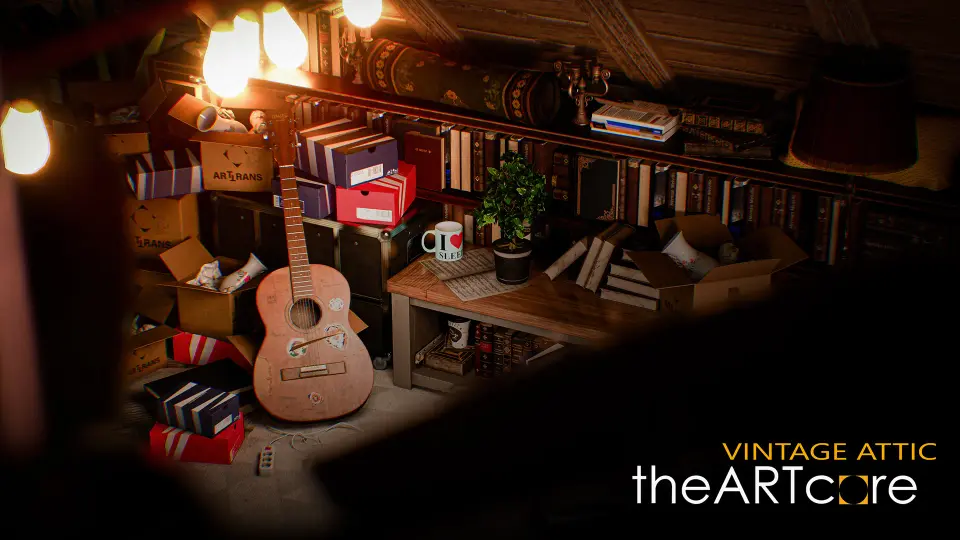
Beyond raw structure, the kit leans heavily on props to establish mood and context. The asset tags tell the story of what sits inside these attic rooms: furniture, a console, a chandelier, a desk, and a vintage television. There are also toys scattered through the prop list, including a train set and items keyed to a kid's room theme.
These props allow a scene to move between lived-in warmth and abandoned nostalgia. A desk against a slanted roof line with a wood chair and a retro television creates one reading. Adding a toy train track across the floor shifts the space toward a child's forgotten playroom. The tags and prop selection suggest suburban American houses with handcrafted wood details, which gives the kit a distinct regional and stylistic identity rather than a generic interior look.
Lighting Demonstrations Across Two Demo Levels
Two demonstration levels are included: Day and Night. These are not empty showcases. They represent the assets in the best possible lighting conditions for each extreme, giving a direct reference for how the modular pieces, props, and materials respond to sunlight streaming through attic windows versus interior lamps casting warm pools across cluttered surfaces.
Having both day and night scenes included means an artist can evaluate material response under contrasting conditions before deciding how to light a custom level. It also serves as a practical benchmark: if the demo levels run well on a target platform, a custom build using the same assets has a reliable performance baseline to measure against.
PBR Materials and Customization Through Instances
The visual surface quality depends on PBR materials and a layered instance system. The kit includes 156 materials and material instances, with 424 textures feeding those surfaces. Texture resolutions reach 4096 × 4096, with some textures stepping down to 2048 × 2048, which allows high-quality close-up renders without forcing every surface to carry uncompressed 4K maps.
Material instances are provided specifically for further customization. An artist can tweak an existing material instance to shift color, roughness, or other parameters without having to build a new material from scratch. This is useful for differentiating between multiple pieces of similar furniture or adjusting how wood grain reads under different lighting.
Blueprints, Sequences, and Platform Support
The package includes one Blueprint and one Sequence. The Blueprint gives a ready-made logic or assembly asset that can be placed into a level, while the Sequence is tied to the included flythrough showcase. A flythrough Sequence provides a cinematic camera path through the demo environment, which is useful for presentation renders, portfolio captures, or visual reference when planning how a custom scene might be shot.
Supported development platforms cover both Windows and Mac. This cross-platform support means the kit can be opened, edited, and tested on either operating system without platform-specific blockers.
Where This Kit Fits a Production Pipeline
The intended use cases span presentations, films, games, and custom level creation. For game development, the modular pieces, collision, and LODs make the kit practical for interactive environments where players walk through, inspect, or interact with the space. The presence of game-ready tags confirms that the assets are prepared with runtime use in mind, not just offline rendering.
For film and presentation work, the included flythrough Sequence and the two fully lit demo levels give directors and motion graphics artists a starting point. Rather than building an attic from scratch, the kit provides a dressed, lit, and textured environment that can be modified or captured directly.
Custom level creators benefit from the modular arch pieces and the wall-to-floor-to-ceiling construction approach. The structure allows iterative layout changes, and the material instance system supports efficient visual iteration without breaking performance budgets.
Teams evaluating this kit should focus on the combination of 108 unique meshes, 156 material instances, custom and generated collision, and the day/night demonstration levels. The strongest advantage is the full pipeline readiness: structural modularity, prop variety, lighting references, and an included flythrough Sequence all working from a single vintage attic theme, compatible with both Windows and Mac development environments.
 Interior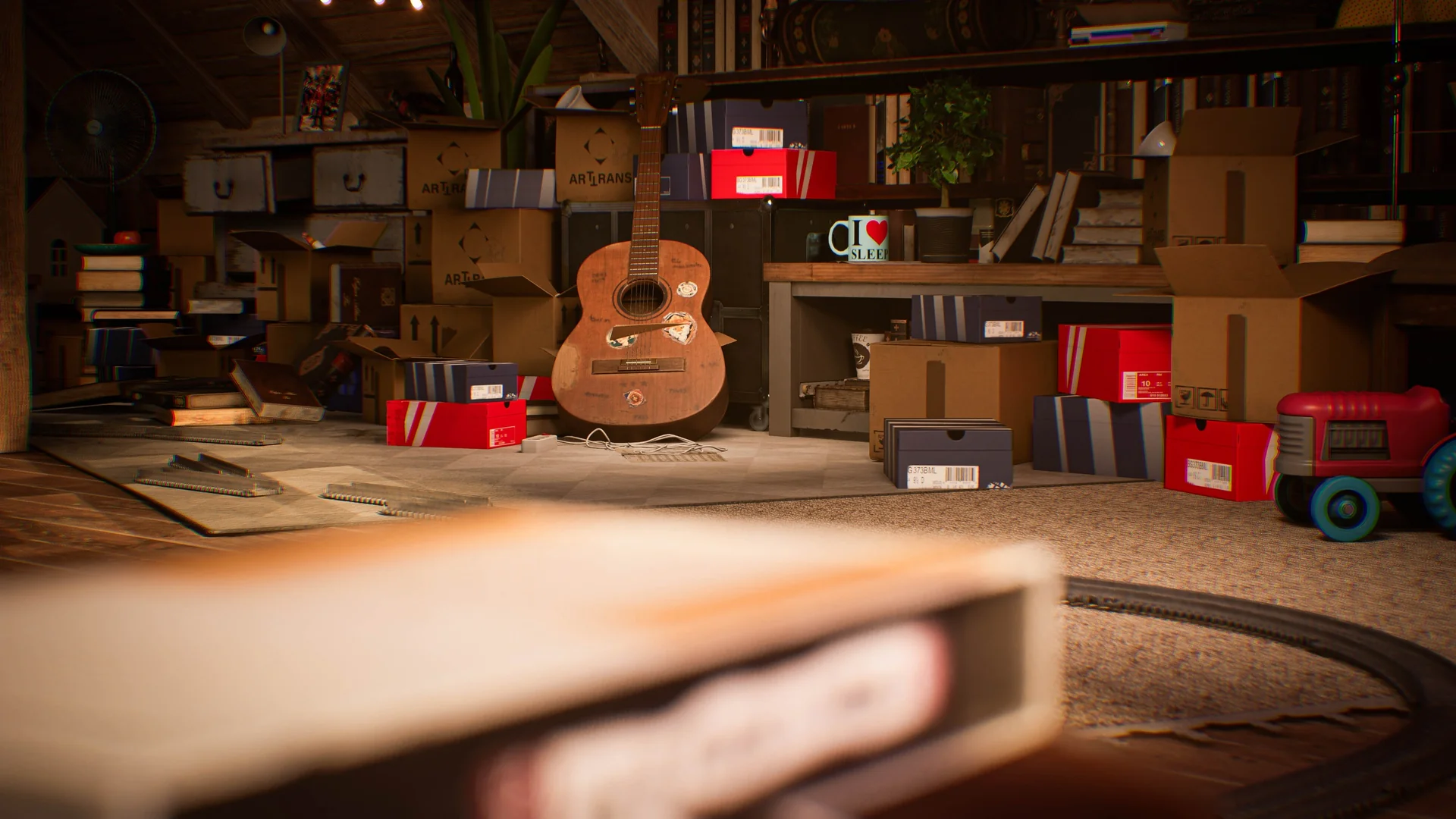
 Interior
 Interior
 Interior