"c14ff6bd758dadb1"{"id":"1000077","slug":"modular-desert-town-desert-city-desert-village","title":"Modular Desert Town - Desert City - Desert Village","category":"Towns \u0026 Villages","engine":"Engine Version: 5.0+","assetVersion":"Engine Version: 5.0+","engineVersion":"","tag":"Towns \u0026 Villages","accent":"blue","visual":"city","summary":"A UE5 modular desert town kit with a 3 lane shooter map, 178 unique meshes, decals, vertex paint, adjustable materials, and Lumen support.","platform":"Unreal Engine","publishedAt":"2026-06-04T16:14:54.174Z","updatedAt":"2026-06-04T16:14:54.174Z","sourceNotes":[],"fileContents":[],"compatibility":["Unreal Engine","Engine Version: 5.0+"],"featuredImage":{"alt":"Modular Desert Town - Desert City - Desert Village","src":"/wp-content/uploads/published/2026/06/984a26bdad5b-fa20815b-607b-49dc-941a-debfc8a4e42b-8847efb134.webp"},"hasDownloadLink":true,"downloads":1,"terms":[{"taxonomy":"category","slug":"towns-and-villages","name":"Towns \u0026 Villages"}],"galleryImages":[{"src":"/wp-content/uploads/published/2026/06/2adcfeb6db78-f807d2f7-164f-4c63-bce5-9d8180d79f94-eab0ce968b.webp","alt":"Modular Desert Town - Desert City - Desert Village"},{"src":"/wp-content/uploads/published/2026/06/03856aa05eb6-f452b807-6c05-4e99-961c-facdeab01238-911feb9900.webp","alt":"Modular Desert Town - Desert City - Desert Village"},{"src":"/wp-content/uploads/published/2026/06/998b1f1ec7ce-3809c3db-605e-4c33-9be8-387788d57d98-07c8b477af.webp","alt":"Modular Desert Town - Desert City - Desert Village"},{"src":"/wp-content/uploads/published/2026/06/0495a1c702f4-7a299cae-7f85-4720-8c1b-453a39472de1-aecca8f366.webp","alt":"Modular Desert Town - Desert City - Desert Village"},{"src":"/wp-content/uploads/published/2026/06/871538a72015-e8b5fca2-ebba-47d2-a3ef-b662f68b6493-a9df5d67fc.webp","alt":"Modular Desert Town - Desert City - Desert Village"},{"src":"/wp-content/uploads/published/2026/06/692f401ddb03-99a01103-c903-4f5e-a83f-8681f7cacb57-4cce03e200.webp","alt":"Modular Desert Town - Desert City - Desert Village"},{"src":"/wp-content/uploads/published/2026/06/73e71cfa45f1-d264cb40-4448-4577-9ce5-8618145a0598-2690879ae4.webp","alt":"Modular Desert Town - Desert City - Desert Village"},{"src":"/wp-content/uploads/published/2026/06/6e78037457cd-3a58d9c3-5aac-4c4e-affd-f026ac9ec97d-8e1e6b5cbf.webp","alt":"Modular Desert Town - Desert City - Desert Village"},{"src":"/wp-content/uploads/published/2026/06/853599d28958-325daf43-ab4c-4aaf-a6f5-45a2833af841-4b46e38780.webp","alt":"Modular Desert Town - Desert City - Desert Village"},{"src":"/wp-content/uploads/published/2026/06/c05700d069a3-fc810dac-9b21-49fe-8231-b1691a0af21f-bdfcc654ca.webp","alt":"Modular Desert Town - Desert City - Desert Village"}],"accessPanel":{"kind":"resource","title":"Access this resource","eyebrow":"Free Download","message":"Log in or create a free account to start your download.","fileName":"Content.7z","safetyNote":"Resources are manually reviewed before listing to improve quality and reduce obvious risks.","actionLabel":"Download Free","resourceType":"Resource archive"},"contentHtml":"\u003cp\u003eFor teams building a shooter map, esports arena, or a desert settlement that needs to come together as a playable space not just one static scene, \u003cstrong\u003eModular Desert Town - Desert City - Desert Village\u003c/strong\u003e Centers its workflow on modular construction. The pack targets Unreal Engine 5 and presents a 3 lane style map as a practical foundation for projects that need readable routes, strong environment identity, and room to scale outward into larger city or village layouts.\u003c/p\u003e \u003cp\u003eThe setting leans into desert architecture and Middle Eastern themed towns and cities, with tags that point toward Arabia, Arabic, Islamic, oasis, palace, village, city, ruin, dune, sand, dust, and interior spaces. That gives the pack a clear visual lane: it is not a generic urban set, but a desert environment kit with enough range to move between streets, compounds, larger town structures, and more atmospheric sand-worn spaces.\u003c/p\u003e \u003ch2\u003e3 lane shooter spaces in a desert town setting\u003c/h2\u003e\n\u003cp\u003eThe most immediate use case here is a lane-based competitive map. The included 3 lane style direction makes this especially relevant for shooter and esports projects, where route clarity and repeatable navigation matter as much as visual style. In use, that means the environment is positioned to support spaces that read quickly during movement and combat while still carrying a distinctive desert town identity.\u003c/p\u003e \u003cp\u003eInstead of relying on a single locked arrangement, the pack uses a modular approach so the lane structure can function as a starting point rather than a limit. A developer can work from the established style of play and then extend it into side passages, courtyard transitions, interiors, denser town blocks, or wider city-like stretches using the same visual language. The presence of 178 unique meshes is important here because it suggests the kit has enough breadth to avoid a small repeated loop of parts when assembling larger scenes.\u003c/p\u003e \u003cp\u003eThat scale also matters for projects that want to move beyond a compact match map. The pack explicitly supports the creation of massive Middle Eastern themed cities and towns, so the same resource can serve a contained combat space and a more expansive settlement layout. For teams trying to keep visual continuity between a main arena and surrounding environment, that flexibility is one of the strongest practical angles.\u003c/p\u003e \u003ch2\u003eUE5, Lumen, and parallax occlusion in Modular Desert Town - Desert City - Desert Village\u003c/h2\u003e\n\u003cp\u003eThis map was made specifically for Unreal Engine 5, and that focus shows in the way its rendering features are described. Lumen support is central to the package, with the environment built from the ground up for UE5 while utilizing Lumen to its fullest potential. The product supports Lumen for Unreal Engine 5.0+, which places it firmly in a modern UE5 lighting workflow rather than as a carryover environment adapted secondarily for the engine.\u003c/p\u003e \u003cp\u003eParallax occlusion is another defining piece of the setup. Here, it is used to make otherwise stylized flat surfaces feel volumetric, adding extra depth and surface presence. In a desert town environment, where wall sections, floors, and broad architectural planes can easily become visually flat, that kind of treatment helps surfaces read with more dimension without changing the overall style direction. The pack frames this as a major part of how visuals are enhanced, alongside performance considerations.\u003c/p\u003e \u003cp\u003eThat leaves a kit that is not just modular in terms of construction pieces, but also visually tuned for UE5 presentation. Lumen handles the broader lighting support, while parallax occlusion reinforces material depth on surfaces that could otherwise feel simplified. For environment artists, that combination makes the resource useful both as a blockout-to-final kit and as a finishing pass toolset for scenes that need more presence across repeated architectural elements.\u003c/p\u003e \u003ch2\u003e178 unique meshes and a kit built for large city layouts\u003c/h2\u003e\n\u003cp\u003eThe pack includes \u003cstrong\u003e178 unique meshes\u003c/strong\u003e, and that number is one of the clearest indicators of how it is meant to be used. A modular environment lives or dies by variation, and this set is positioned for building massive desert towns and cities rather than a tiny diorama. Unique meshes give the creator room to establish streets, compounds, connecting structures, landmark forms, and interior-adjacent spaces without every section collapsing into obvious repetition.\u003c/p\u003e \u003cp\u003eBecause the kit is described as fully modular, the intended workflow is straightforward: assemble your own desert themed environments from reusable parts. That kind of setup is especially valuable in production contexts where the target scene may change during iteration. A competitive map might need route adjustments. A town layout might need to expand. An oasis-side district might need a denser cluster of structures. A ruin or palace-adjacent area might need a different arrangement while still belonging to the same place. The modular structure supports those shifts without requiring an entirely new environment set.\u003c/p\u003e \u003cp\u003eThe style cues attached to the pack broaden its creative use while staying within one coherent theme. Village, town, city, palace, oasis, ruin, interior, dune, and sand all point toward a desert world that can be arranged at multiple scales. Some teams may use it for a focused shooter level, while others may lean on the same pieces for a more layered settlement backdrop. The pack’s strength is that it keeps those possibilities within one kit instead of splitting them into disconnected scene types.\u003c/p\u003e \u003ch2\u003eDecals, vertex paint, and adjustable wall and floor materials\u003c/h2\u003e\n\u003cp\u003eOnce the core layout is in place, the pack shifts from assembly to detailing. Decals are included to add instant detail not only to this kit but also to other environments. That makes them useful beyond the immediate map itself. In practice, decals can help break up repeated surfaces, introduce wear, sharpen localized visual identity, and make modular pieces feel more integrated once they are placed together.\u003c/p\u003e \u003cp\u003eVertex paint adds another layer of control. The vertex painting function is described as versatile and works on almost all pieces of the map, which matters because consistency is critical in a modular set. When a detailing system only works on a narrow subset of meshes, the results can feel uneven. Here, the broad coverage means the creator can push more surface variation across the environment instead of isolating that treatment to a few hero elements.\u003c/p\u003e \u003cp\u003eWall and floor materials are also adjustable through material instances. That gives the pack a practical middle ground between fixed materials and fully custom shader work. A creator can tune core architectural surfaces without rebuilding the asset set from scratch, which is especially useful when trying to establish different moods inside the same desert theme. A cleaner section of town, a more weathered ruin-like zone, or a more worn combat route can all benefit from material adjustment while still staying visually connected.\u003c/p\u003e \u003cp\u003eTaken together, decals, vertex paint, parallax occlusion, and adjustable material instances turn the kit into more than a collection of construction pieces. They create a workflow for pushing scene finish after the basic town or city layout exists. That is a practical distinction: the pack helps with both structure and surface treatment.\u003c/p\u003e \u003ch2\u003eWhere this desert city kit fits best\u003c/h2\u003e\n\u003cp\u003eThis resource fits best in UE5 projects that need a desert town or city environment with competitive-map readability and modular expansion potential. The direct match is a shooter or esports title using a 3 lane map style, but the broader utility comes from the ability to build massive Middle Eastern themed towns and cities from the same set of 178 unique meshes.\u003c/p\u003e \u003cp\u003eIt is also a strong fit for creators who want environment detail to come from built-in tools rather than only from hand-placing extra objects. Decals can quickly enrich surfaces, vertex paint works across almost all map pieces, parallax occlusion adds depth to flatter materials, and wall and floor materials remain adjustable through material instances. For teams already committed to Lumen in Unreal Engine 5.0+, that alignment is especially relevant.\u003c/p\u003e \u003cp\u003eThe pack will benefit developers and environment artists who need a desert-themed modular kit that can move from playable shooter lanes to larger city and village construction without changing visual direction or stepping outside a UE5-focused workflow.\u003c/p\u003e\n\n\u003ch2\u003eRelated Resources Worth Checking\u003c/h2\u003e\n\u003cul\u003e\n\u003cli\u003e\u003ca href=\"https://3dcghub.com/palisade-walls-and-barriers-v1/\" title=\"Palisade Walls and Barriers - v1\"\u003ePalisade Walls and Barriers - v1\u003c/a\u003e\u003c/li\u003e\n\u003cli\u003e\u003ca href=\"https://3dcghub.com/barnyard-megapack-barn-barn-props-farm-environment/\" title=\"Barnyard Megapack (Barn, Barn Props, Farm Environment)\"\u003eBarnyard Megapack (Barn, Barn Props, Farm Environment)\u003c/a\u003e\u003c/li\u003e\n\u003cli\u003e\u003ca href=\"https://3dcghub.com/modular-medieval-docks-harbor-medieval-town-stylized-town-town-city/\" title=\"Modular Medieval Docks / Harbor (Medieval Town, Stylized Town, Town, City)\"\u003eModular Medieval Docks / Harbor (Medieval Town, Stylized Town, Town, City)\u003c/a\u003e\u003c/li\u003e\n\u003cli\u003e\u003ca href=\"https://3dcghub.com/sharurs-stylized-viking-ruins/\" title=\"Sharur\u0026#039;s Stylized Viking Ruins\"\u003eSharur\u0026#039;s Stylized Viking Ruins\u003c/a\u003e\u003c/li\u003e\n\u003cli\u003e\u003ca href=\"https://3dcghub.com/enterable-medieval-houses-and-cottages-v1/\" title=\"Enterable Medieval Houses and Cottages - v1\"\u003eEnterable Medieval Houses and Cottages - v1\u003c/a\u003e\u003c/li\u003e\n\u003c/ul\u003e","contentTextLength":8688,"navigation":{"current":1786,"total":3719,"previous":{"id":"1000078","slug":"modular-modern-wine-cellar","title":"Modular Modern Wine Cellar","category":"Interior","platform":"Unreal Engine","updatedAt":"2026-06-04T16:33:00.279Z"},"next":{"id":"1000076","slug":"modern-office-environment-modern-office-environment-modern-office-3d-office","title":"Modern Office Environment ( Modern Office Environment Modern Office 3D Office )","category":"Interior","platform":"Unreal Engine","updatedAt":"2026-06-04T14:57:57.733Z"}},"relatedResources":[{"id":"1000956","slug":"modular-medieval-town-medieval-town-medieval-village-fantasy-town","title":"Modular Medieval Town (Medieval Town, Medieval Village, Fantasy Town)","category":"Towns \u0026 Villages","engine":"5.0+","assetVersion":"","engineVersion":"Engine Version: 5.0+","tag":"Towns \u0026 Villages","accent":"blue","visual":"mech","summary":"A fully modular UE5 medieval town kit with enterable buildings, Lumen and Nanite support, a large VFX library, and day/night lighting setups.","platform":"Unreal Engine","publishedAt":"2026-08-14T15:02:12.705Z","updatedAt":"2026-08-14T15:02:12.705Z","sourceNotes":[],"fileContents":[],"compatibility":["Unreal Engine","Engine Version: 5.0+"],"featuredImage":{"alt":"Modular Medieval Town (Medieval Town, Medieval Village, Fantasy Town)","src":"/wp-content/uploads/published/2026/08/3b4a0b38b4d6-7e8a5053-19a6-4ce0-a71f-0845c1dacfd5-3e1b4f58fd.webp"},"hasDownloadLink":true,"downloads":3},{"id":"1001075","slug":"alpine-mountains-villa","title":"Alpine Mountains Villa","category":"Towns \u0026 Villages","engine":"5.1+","assetVersion":"","engineVersion":"Engine Version: 5.1+","tag":"Towns \u0026 Villages","accent":"blue","visual":"mech","summary":"Complete alpine villa environment pack with 90 static meshes, showcase level, material instances, LODs and collisions. Ready to open and customize.","platform":"Unreal Engine","publishedAt":"2026-09-04T14:37:49.702Z","updatedAt":"2026-09-04T14:37:49.702Z","sourceNotes":[],"fileContents":[],"compatibility":["Unreal Engine","Engine Version: 5.1+"],"featuredImage":{"alt":"Alpine Mountains Villa","src":"/wp-content/uploads/published/2026/09/3ad0e44ef21a-5e84eaf2-85d7-4a13-b7d1-5e8f321069f7-074ad07a1f.webp"},"hasDownloadLink":true,"downloads":0},{"id":"1000656","slug":"modular-medieval-village-medieval-village-stylized-village-fantasy-village","title":"Modular Medieval Village (Medieval Village, Stylized Village, Fantasy Village)","category":"Towns \u0026 Villages","engine":"5.0+","assetVersion":"","engineVersion":"Engine Version: 5.0+","tag":"Towns \u0026 Villages","accent":"blue","visual":"mech","summary":"Stylized medieval village environment with modular houses, full interiors, customizable foliage, animated windmill, VFX, and four landscape materials for fantas","platform":"Unreal Engine","publishedAt":"2026-07-21T20:13:46.984Z","updatedAt":"2026-07-21T20:13:46.984Z","sourceNotes":[],"fileContents":[],"compatibility":["Unreal Engine","Engine Version: 5.0+"],"featuredImage":{"alt":"Modular Medieval Village (Medieval Village, Stylized Village, Fantasy Village)","src":"/wp-content/uploads/published/2026/07/ca7c07789bb0-b7bee89e-026b-4a7d-9512-2cc83a581415-24adf9d89e.webp"},"hasDownloadLink":true,"downloads":2}]}
Towns & Villages
Modular Desert Town - Desert City - Desert Village
A UE5 modular desert town kit with a 3 lane shooter map, 178 unique meshes, decals, vertex paint, adjustable materials, and Lumen support.
For teams building a shooter map, esports arena, or a desert settlement that needs to come together as a playable space not just one static scene, Modular Desert Town - Desert City - Desert Village Centers its workflow on modular construction. The pack targets Unreal Engine 5 and presents a 3 lane style map as a practical foundation for projects that need readable routes, strong environment identity, and room to scale outward into larger city or village layouts.
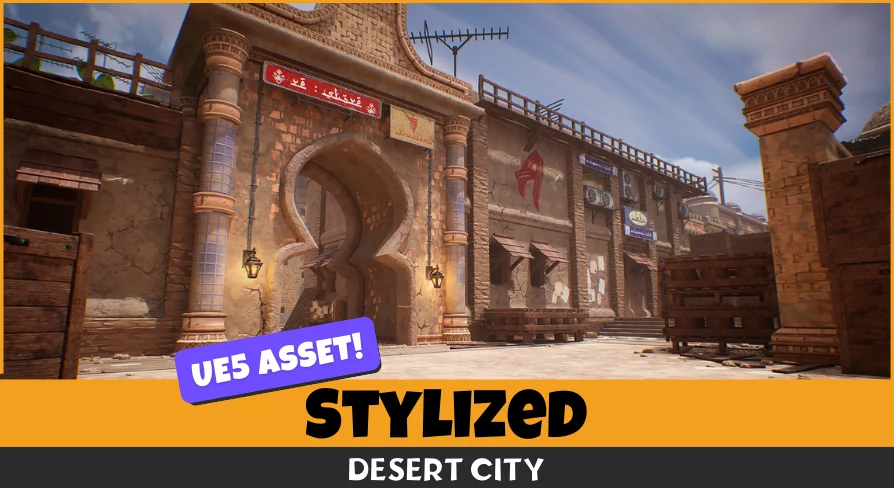
The setting leans into desert architecture and Middle Eastern themed towns and cities, with tags that point toward Arabia, Arabic, Islamic, oasis, palace, village, city, ruin, dune, sand, dust, and interior spaces. That gives the pack a clear visual lane: it is not a generic urban set, but a desert environment kit with enough range to move between streets, compounds, larger town structures, and more atmospheric sand-worn spaces.
3 lane shooter spaces in a desert town setting
The most immediate use case here is a lane-based competitive map. The included 3 lane style direction makes this especially relevant for shooter and esports projects, where route clarity and repeatable navigation matter as much as visual style. In use, that means the environment is positioned to support spaces that read quickly during movement and combat while still carrying a distinctive desert town identity.
Instead of relying on a single locked arrangement, the pack uses a modular approach so the lane structure can function as a starting point rather than a limit. A developer can work from the established style of play and then extend it into side passages, courtyard transitions, interiors, denser town blocks, or wider city-like stretches using the same visual language. The presence of 178 unique meshes is important here because it suggests the kit has enough breadth to avoid a small repeated loop of parts when assembling larger scenes.
That scale also matters for projects that want to move beyond a compact match map. The pack explicitly supports the creation of massive Middle Eastern themed cities and towns, so the same resource can serve a contained combat space and a more expansive settlement layout. For teams trying to keep visual continuity between a main arena and surrounding environment, that flexibility is one of the strongest practical angles.
UE5, Lumen, and parallax occlusion in Modular Desert Town - Desert City - Desert Village
This map was made specifically for Unreal Engine 5, and that focus shows in the way its rendering features are described. Lumen support is central to the package, with the environment built from the ground up for UE5 while utilizing Lumen to its fullest potential. The product supports Lumen for Unreal Engine 5.0+, which places it firmly in a modern UE5 lighting workflow rather than as a carryover environment adapted secondarily for the engine.
Parallax occlusion is another defining piece of the setup. Here, it is used to make otherwise stylized flat surfaces feel volumetric, adding extra depth and surface presence. In a desert town environment, where wall sections, floors, and broad architectural planes can easily become visually flat, that kind of treatment helps surfaces read with more dimension without changing the overall style direction. The pack frames this as a major part of how visuals are enhanced, alongside performance considerations.
That leaves a kit that is not just modular in terms of construction pieces, but also visually tuned for UE5 presentation. Lumen handles the broader lighting support, while parallax occlusion reinforces material depth on surfaces that could otherwise feel simplified. For environment artists, that combination makes the resource useful both as a blockout-to-final kit and as a finishing pass toolset for scenes that need more presence across repeated architectural elements.
178 unique meshes and a kit built for large city layouts
The pack includes 178 unique meshes, and that number is one of the clearest indicators of how it is meant to be used. A modular environment lives or dies by variation, and this set is positioned for building massive desert towns and cities rather than a tiny diorama. Unique meshes give the creator room to establish streets, compounds, connecting structures, landmark forms, and interior-adjacent spaces without every section collapsing into obvious repetition.
Because the kit is described as fully modular, the intended workflow is straightforward: assemble your own desert themed environments from reusable parts. That kind of setup is especially valuable in production contexts where the target scene may change during iteration. A competitive map might need route adjustments. A town layout might need to expand. An oasis-side district might need a denser cluster of structures. A ruin or palace-adjacent area might need a different arrangement while still belonging to the same place. The modular structure supports those shifts without requiring an entirely new environment set.
The style cues attached to the pack broaden its creative use while staying within one coherent theme. Village, town, city, palace, oasis, ruin, interior, dune, and sand all point toward a desert world that can be arranged at multiple scales. Some teams may use it for a focused shooter level, while others may lean on the same pieces for a more layered settlement backdrop. The pack’s strength is that it keeps those possibilities within one kit instead of splitting them into disconnected scene types.
Decals, vertex paint, and adjustable wall and floor materials
Once the core layout is in place, the pack shifts from assembly to detailing. Decals are included to add instant detail not only to this kit but also to other environments. That makes them useful beyond the immediate map itself. In practice, decals can help break up repeated surfaces, introduce wear, sharpen localized visual identity, and make modular pieces feel more integrated once they are placed together.
Vertex paint adds another layer of control. The vertex painting function is described as versatile and works on almost all pieces of the map, which matters because consistency is critical in a modular set. When a detailing system only works on a narrow subset of meshes, the results can feel uneven. Here, the broad coverage means the creator can push more surface variation across the environment instead of isolating that treatment to a few hero elements.
Wall and floor materials are also adjustable through material instances. That gives the pack a practical middle ground between fixed materials and fully custom shader work. A creator can tune core architectural surfaces without rebuilding the asset set from scratch, which is especially useful when trying to establish different moods inside the same desert theme. A cleaner section of town, a more weathered ruin-like zone, or a more worn combat route can all benefit from material adjustment while still staying visually connected.
Taken together, decals, vertex paint, parallax occlusion, and adjustable material instances turn the kit into more than a collection of construction pieces. They create a workflow for pushing scene finish after the basic town or city layout exists. That is a practical distinction: the pack helps with both structure and surface treatment.
Where this desert city kit fits best
This resource fits best in UE5 projects that need a desert town or city environment with competitive-map readability and modular expansion potential. The direct match is a shooter or esports title using a 3 lane map style, but the broader utility comes from the ability to build massive Middle Eastern themed towns and cities from the same set of 178 unique meshes.
It is also a strong fit for creators who want environment detail to come from built-in tools rather than only from hand-placing extra objects. Decals can quickly enrich surfaces, vertex paint works across almost all map pieces, parallax occlusion adds depth to flatter materials, and wall and floor materials remain adjustable through material instances. For teams already committed to Lumen in Unreal Engine 5.0+, that alignment is especially relevant.
The pack will benefit developers and environment artists who need a desert-themed modular kit that can move from playable shooter lanes to larger city and village construction without changing visual direction or stepping outside a UE5-focused workflow.
 Towns & Villages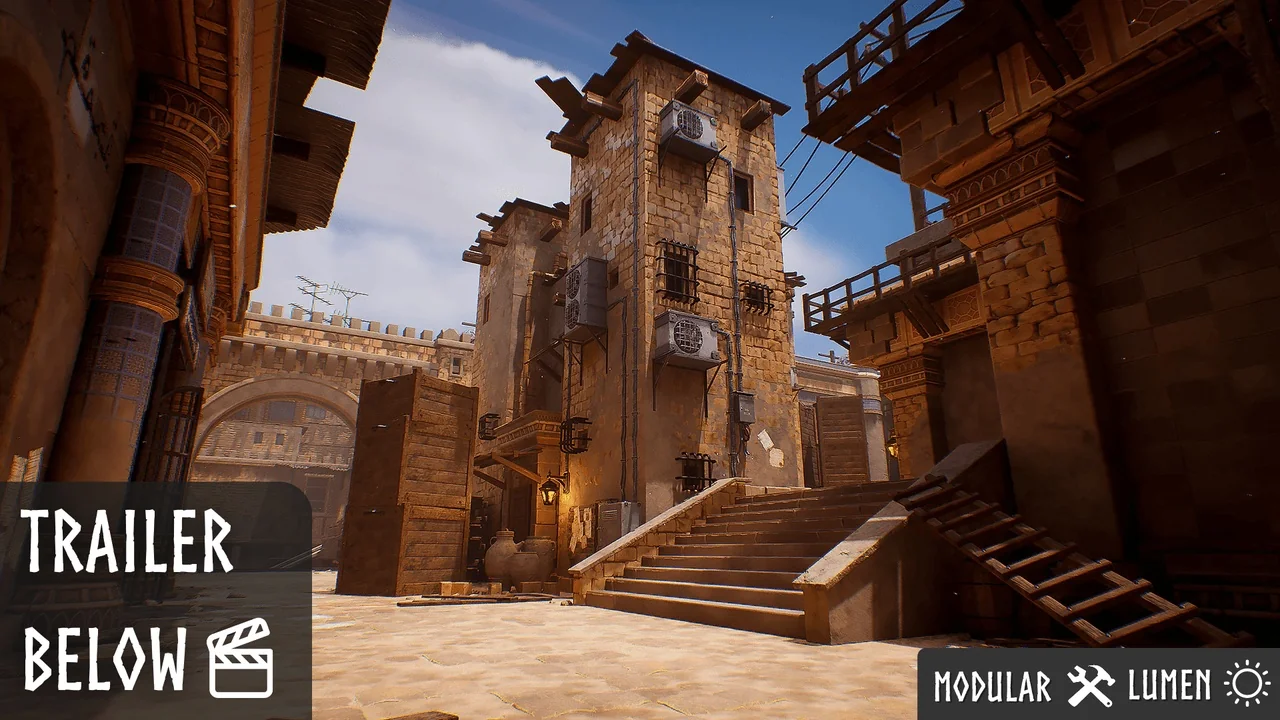
 Towns & Villages
 Towns & Villages
 Towns & Villages