"d33c94b0a941547b"{"id":"1002752","slug":"stylized-village-fatpack","title":"Stylized Village Fatpack","category":"Towns \u0026 Villages","engine":"5.0+","assetVersion":"","engineVersion":"Engine Version: 5.0+","tag":"Towns \u0026 Villages","accent":"blue","visual":"mech","summary":"Explore the Stylized Village Fatpack by MESHINGUN STUDIO and William Tate, featuring 450 meshes, 8 LOD levels, Nanite foliage, and pre-assembled maps.","platform":"Unreal Engine","indexPolicy":"index","publishedAt":"2026-11-19T07:05:17.136Z","updatedAt":"2026-11-19T07:05:17.136Z","sourceNotes":[],"fileContents":[],"compatibility":["Unreal Engine","Engine Version: 5.0+"],"featuredImage":{"alt":"Stylized Village Fatpack","src":"/wp-content/uploads/published/2026/11/5d06c4f6a9f3-393e02d2-5e08-4a74-8ada-7974e7cd300d-96128e9e1f.webp"},"fileSizeBytes":1778879394,"hasDownloadLink":true,"downloads":0,"terms":[{"taxonomy":"category","slug":"towns-and-villages","name":"Towns \u0026 Villages"}],"galleryImages":[{"src":"/wp-content/uploads/published/2026/11/44bc31f966cf-9ebe8a4b-ae81-4ab5-a388-ffe43f1a8f12-7f02512787.webp","alt":"Stylized Village Fatpack"},{"src":"/wp-content/uploads/published/2026/11/af4ee460ab73-348e1923-9b89-4b1f-8c56-321c444d5dc1-f33e67ccc7.webp","alt":"Stylized Village Fatpack"},{"src":"/wp-content/uploads/published/2026/11/bac1a443fd46-561b7b55-b1b6-4240-b96e-0c230131f460-93017ce5a0.webp","alt":"Stylized Village Fatpack"},{"src":"/wp-content/uploads/published/2026/11/1e6cad7f4ab9-63e1b8df-7a99-410a-a762-7f8b8b3ccd47-0572b6db5a.webp","alt":"Stylized Village Fatpack"},{"src":"/wp-content/uploads/published/2026/11/952c997b5e15-05753c69-1ea1-4dd2-a3fa-cf89340ed4a7-a0c78cb24b.webp","alt":"Stylized Village Fatpack"},{"src":"/wp-content/uploads/published/2026/11/4a4fe901c719-54dd32bc-fe78-4c60-9205-81a3fc9daf9c-0f7a0b1f0d.webp","alt":"Stylized Village Fatpack"},{"src":"/wp-content/uploads/published/2026/11/7179f672e6c0-5c588ae5-7245-4d56-b39f-726646988739-197466d8fd.webp","alt":"Stylized Village Fatpack"},{"src":"/wp-content/uploads/published/2026/11/4093e9a37df0-aaf4f6e4-1bf5-4286-97cb-e289598e4bbe-685694b3f7.webp","alt":"Stylized Village Fatpack"},{"src":"/wp-content/uploads/published/2026/11/d55008147a78-5e4ce4dd-9cae-442e-986b-75dac68d8768-0c8a1d7312.webp","alt":"Stylized Village Fatpack"}],"accessPanel":{"kind":"resource","title":"Get this resource","safetyNote":"Resources are manually reviewed before listing to improve quality and reduce obvious risks.","fileName":"Content.7z","resourceType":"Resource archive","versions":[]},"contentHtml":"\u003cp\u003eDeploying the Stylized Village Fatpack into a project begins with testing layout configurations across its pre-assembled environments. Created through a collaboration between MESHINGUN STUDIO and William Tate, the asset collection provides three complete demonstration maps configured to display distinct lighting conditions, spatial densities, and atmospheric treatments. These complete scenes serve as direct reference points for how the individual pieces lock together, demonstrating how terrain elevation, water distribution, and architecture interact within a coherent stylized art style.\u003c/p\u003e\u003ch2\u003eInitial Map Setup and Assembled Village Environments\u003c/h2\u003e\u003cp\u003eWorking through the three pre-built level setups allows technical artists and level designers to evaluate scene performance and composition immediately. The package focuses on stylized and fantasy aesthetics, combining soft environmental shapes with distinct medieval architectural silhouettes. A standalone playable demo exists to let developers verify frame stability and asset quality directly on specific hardware configurations prior to committing assets into an active production branch. In addition to the three core showcase scenes, the environment collection expands with dedicated seasonal setups, including a winter map variant configured to illustrate cold-weather transformations of the architectural and natural geometry.\u003c/p\u003e\u003cp\u003eThe pre-assembled maps organize town perimeters, working riverbanks, and central town squares to show how the structural elements scale against one another. Rather than presenting unconnected assets on a flat testing grid, the showcase levels illustrate realistic sightlines, elevation shifts handled by rock faces and stairs, and atmospheric scattering suited to stylized fantasy worlds. Designers can dissect these maps to understand spacing between dwellings, the placement of visual anchors such as windmills, and the integration of moving mechanical elements along water channels.\u003c/p\u003e\u003ch2\u003eModular Architecture, Turbines, and Windmills\u003c/h2\u003e\u003cp\u003eAt the center of the asset library are 450 unique static meshes constructed with modular assembly in mind. The medieval and fantasy themes are reinforced by distinct functional buildings, utility structures, and industrial rustic props. Level builders have access to modular structural components capable of forming multi-story homes, village workshops, storage sheds, and boundary walls. Rooflines, timber supports, stone foundations, and entryways can be combined in varied orientations to prevent repetitive housing clusters across larger settlement layouts.\u003c/p\u003e\u003cp\u003eBeyond standard residential structures, the pack features prominent mechanical focal points including wind turbines, classic windmills, and waterwheel structures. These assets provide verticality and kinetic identity to a village layout. Water-driven machinery can be aligned with river channels, while windmills serve as landmarks on hilltops or open farm boundaries. Because all structural pieces share matching geometric proportions and artistic language, builders can quickly draft unique architectural footprints without encountering seam mismatches or visual inconsistencies.\u003c/p\u003e\u003ch2\u003eFoliage Optimization and Stylized Mesh Hierarchies\u003c/h2\u003e\u003cp\u003ePopulating a broad natural environment requires balanced asset scaling and strict polygon management. Every static mesh in the collection includes an automated or handcrafted hierarchy reaching up to eight levels of detail (LOD 0 through LOD 7). This extended range prevents sudden geometric silhouette changes when players traverse open terrain or look across sprawling village valleys. For expansive greenery, larger foliage meshes incorporate imposter LODs, collapsing intricate leaf geometry into low-cost billboard representations at long distances to protect frame budgets during broad panoramic shots.\u003c/p\u003e\u003cp\u003eThe vegetation assets complement the stylized landscape by offering varied trees, shrubs, grasses, and groundcover. The artistic treatment favors clean silhouettes and bold leaf shapes over hyper-detailed sub-elements, ensuring that natural formations read cleanly from distance while retaining substantial visual character up close. Using the eight LOD tiers alongside imposter systems allows large forested areas and dense undergrowth clusters to run reliably without causing draw-call bottlenecks on mid-tier hardware targets.\u003c/p\u003e\u003ch2\u003eMaterial Instances, Deformed Waterfalls, and Water Blueprints\u003c/h2\u003e\u003cp\u003eSurfacing across the entire kit is managed through an efficient texturing pipeline. The library contains approximately 300 base textures tied into more than 100 specialized material instances. This architecture relies on master shaders that govern surface response while parameterizing variables such as tint, roughness offsets, normal intensities, and seasonal shifts. Managing properties through material instances keeps shader compilation overhead down and allows artists to re-color roofs, shift foliage tones, or tweak stone roughness without altering root code.\u003c/p\u003e\u003cp\u003eDynamic environmental elements are supported through Blueprint utility setups and specialized fluid meshes. The kit includes deformed waterfall meshes configured to simulate turbulent, stylized water cascades across varying height drops and cliff sides. Coupled with dedicated water surfaces, the package facilitates running riverbeds that power village turbines and flow through mill channels. Material instances dedicated to the water and waterfall assets allow for adjustments in foam intensity, flow rate, and opacity to match the calm or rapid nature of local water features.\u003c/p\u003e\u003ch2\u003eNanite Implementation and Engine Version Updates\u003c/h2\u003e\u003cp\u003eTargeted engine updates expand how geometry and landscape surfaces are processed. In version 5.3 configurations, the environment implements Nanite geometry virtualization across key natural layers. Nanite is enabled directly for the landscape terrain, scattered foliage assets, and the deformed waterfall meshes. This eliminates traditional distance culling constraints for high-density landscape shapes and lets designers place dense vegetation and fluid cascades without relying solely on aggressive manual LOD switching.\u003c/p\u003e\u003cp\u003eThe combination of classic 8-level LODs with imposter systems and modern Nanite integration makes the asset library flexible across differing pipeline standards. Developers running legacy rendering pathways can utilize the comprehensive LOD stages to maintain precise control over polycounts, while teams targeting newer engine workflows can leverage Nanite on landscape geometry, water structures, and vegetation to reduce manual mesh optimization time. The broad asset range—encompassing 450 static components, robust material instancing, mechanical village centerpieces, and environmental foliage—provides a cohesive foundation for teams constructing stylized medieval settlements and fantasy realms.\u003c/p\u003e\n\n\u003ch2\u003eRelated Resources Worth Checking\u003c/h2\u003e\n\u003cul\u003e\n\u003cli\u003e\u003ca href=\"https://3dcghub.com/stylized-clay-forest-village-pack/\" rel=\"noopener noreferrer\"\u003eStylized - Clay Forest Village Pack\u003c/a\u003e\u003c/li\u003e\n\u003cli\u003e\u003ca href=\"https://3dcghub.com/house-on-a-hill-house-houses-fantasy-house-stylized-house/\" rel=\"noopener noreferrer\"\u003eHouse On A Hill (House, Houses, Fantasy House, Stylized House)\u003c/a\u003e\u003c/li\u003e\n\u003cli\u003e\u003ca href=\"https://3dcghub.com/modular-medieval-village-medieval-village-stylized-village-fantasy-village/\" rel=\"noopener noreferrer\"\u003eModular Medieval Village (Medieval Village, Stylized Village, Fantasy Village)\u003c/a\u003e\u003c/li\u003e\n\u003cli\u003e\u003ca href=\"https://3dcghub.com/american-suburban-house-environment/\" rel=\"noopener noreferrer\"\u003eAmerican Suburban House Environment\u003c/a\u003e\u003c/li\u003e\n\u003cli\u003e\u003ca href=\"https://3dcghub.com/stylized-viking-hut-stylized-stylized-stylized-viking-viking-hut-hut-forest/\" rel=\"noopener noreferrer\"\u003eStylized Viking Hut ( Stylized Stylized Stylized Viking Viking Hut Hut Forest )\u003c/a\u003e\u003c/li\u003e\n\u003c/ul\u003e","contentTextLength":7163,"navigation":{"current":5,"total":4676,"previous":{"id":"1002753","slug":"modular-low-poly-factory-desktop-and-mobile","title":"Modular Low Poly Factory [Desktop \u0026 Mobile]","category":"Industrial","platform":"Unreal Engine","updatedAt":"2026-11-19T07:08:41.828Z"},"next":{"id":"1002751","slug":"wild-west-city-wild-west-town-wild-west-sky-city-steampunk-town-steampunk","title":"Wild West City (Wild West Town, Wild West Sky City, Steampunk Town, Steampunk)","category":"Unreal Engine","platform":"Unreal Engine","updatedAt":"2026-11-19T07:04:04.503Z"}},"relatedResources":[{"id":"1002731","slug":"stylized-clay-forest-village-pack","title":"Stylized - Clay Forest Village Pack","category":"Towns \u0026 Villages","engine":"5.0+","assetVersion":"","engineVersion":"Engine Version: 5.0+","tag":"Towns \u0026 Villages","accent":"blue","visual":"mech","summary":"Explore the Stylized - Clay Forest Village Pack for Unreal Engine 5.0+, featuring 42 clay assets, RVT grass, Kuwahara shaders, and Lumen lighting.","platform":"Unreal Engine","indexPolicy":"index","publishedAt":"2026-11-17T19:07:53.736Z","updatedAt":"2026-11-17T19:07:53.736Z","sourceNotes":[],"fileContents":[],"compatibility":["Unreal Engine","Engine Version: 5.0+"],"featuredImage":{"alt":"Stylized - Clay Forest Village Pack","src":"/wp-content/uploads/published/2026/11/6b2dee2d4769-0df59578-6ec3-46a2-9bbb-f9477cf2d006-8ad0f94bc3.webp"},"fileSizeBytes":330413013,"hasDownloadLink":true,"downloads":0},{"id":"1002054","slug":"house-on-a-hill-house-houses-fantasy-house-stylized-house","title":"House On A Hill (House, Houses, Fantasy House, Stylized House)","category":"Towns \u0026 Villages","engine":"5.1+","assetVersion":"","engineVersion":"Engine Version: 5.1+","tag":"Towns \u0026 Villages","accent":"blue","visual":"mech","summary":"Explore the stylized House On A Hill environment, featuring custom foliage master materials, an ocean shader, cloud sky meshes, and painterly assets.","platform":"Unreal Engine","indexPolicy":"index","publishedAt":"2026-10-26T15:11:51.550Z","updatedAt":"2026-10-26T15:11:51.550Z","sourceNotes":[],"fileContents":[],"compatibility":["Unreal Engine","Engine Version: 5.1+"],"featuredImage":{"alt":"House On A Hill (House, Houses, Fantasy House, Stylized House)","src":"/wp-content/uploads/published/2026/10/d65827fec754-8ca013ea-7461-4817-a2c6-0e33fcafbb65-8bb25d340e.webp"},"fileSizeBytes":1565549185,"hasDownloadLink":true,"downloads":0},{"id":"1000656","slug":"modular-medieval-village-medieval-village-stylized-village-fantasy-village","title":"Modular Medieval Village (Medieval Village, Stylized Village, Fantasy Village)","category":"Towns \u0026 Villages","engine":"5.0+","assetVersion":"","engineVersion":"Engine Version: 5.0+","tag":"Towns \u0026 Villages","accent":"blue","visual":"mech","summary":"Stylized medieval village environment with modular houses, full interiors, customizable foliage, animated windmill, VFX, and four landscape materials for fantas","platform":"Unreal Engine","indexPolicy":"index","publishedAt":"2026-07-21T20:13:46.984Z","updatedAt":"2026-07-21T20:13:46.984Z","sourceNotes":[],"fileContents":[],"compatibility":["Unreal Engine","Engine Version: 5.0+"],"featuredImage":{"alt":"Modular Medieval Village (Medieval Village, Stylized Village, Fantasy Village)","src":"/wp-content/uploads/published/2026/07/ca7c07789bb0-b7bee89e-026b-4a7d-9512-2cc83a581415-24adf9d89e.webp"},"fileSizeBytes":808131269,"hasDownloadLink":true,"downloads":2}]}
Resource screenshots
1 / 9
Join our channel
Follow 3DCGHUB on Telegram for new resource drops, migration updates, and community notices.
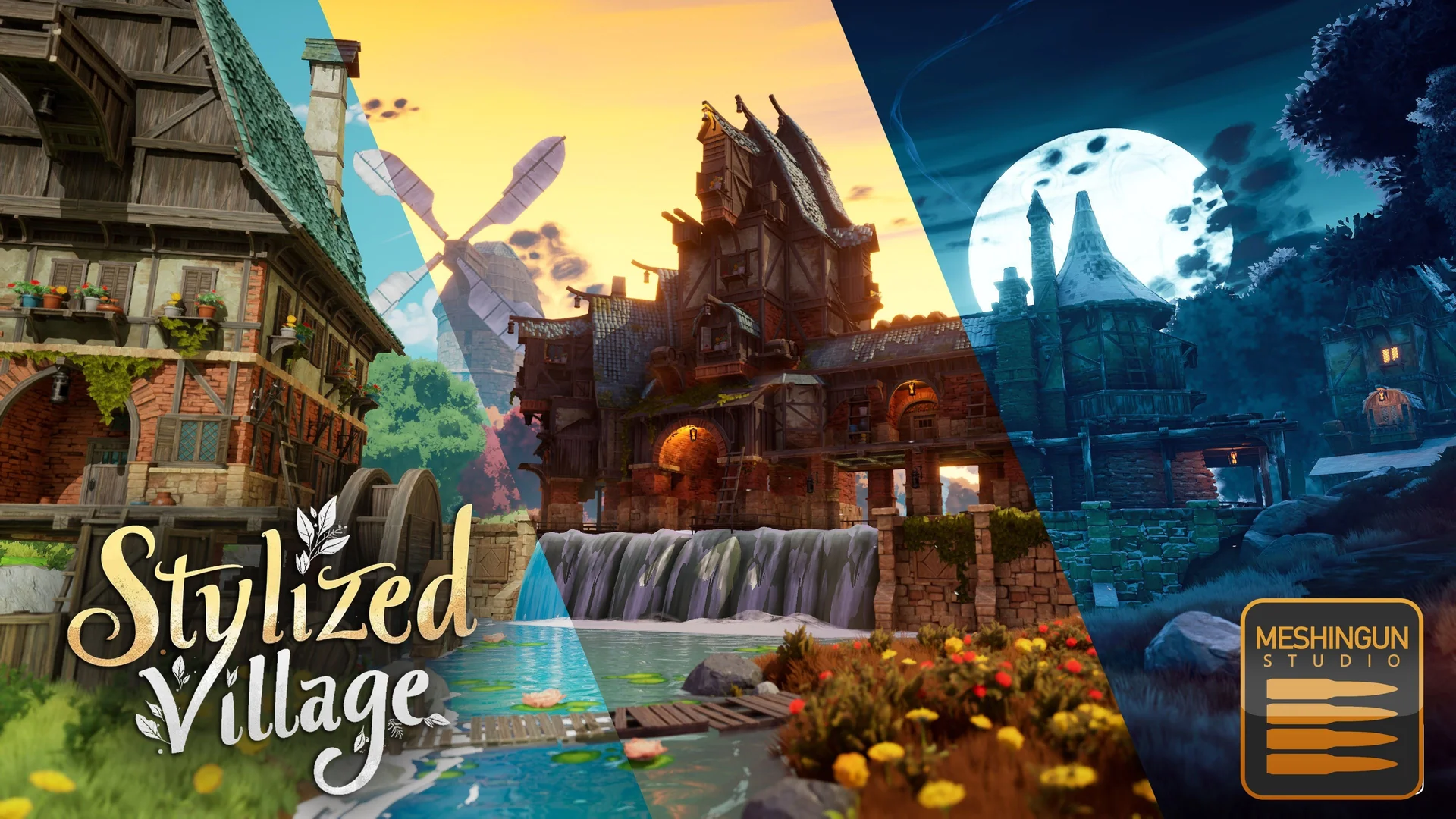
Deploying the Stylized Village Fatpack into a project begins with testing layout configurations across its pre-assembled environments. Created through a collaboration between MESHINGUN STUDIO and William Tate, the asset collection provides three complete demonstration maps configured to display distinct lighting conditions, spatial densities, and atmospheric treatments. These complete scenes serve as direct reference points for how the individual pieces lock together, demonstrating how terrain elevation, water distribution, and architecture interact within a coherent stylized art style.
Initial Map Setup and Assembled Village Environments
Working through the three pre-built level setups allows technical artists and level designers to evaluate scene performance and composition immediately. The package focuses on stylized and fantasy aesthetics, combining soft environmental shapes with distinct medieval architectural silhouettes. A standalone playable demo exists to let developers verify frame stability and asset quality directly on specific hardware configurations prior to committing assets into an active production branch. In addition to the three core showcase scenes, the environment collection expands with dedicated seasonal setups, including a winter map variant configured to illustrate cold-weather transformations of the architectural and natural geometry.
The pre-assembled maps organize town perimeters, working riverbanks, and central town squares to show how the structural elements scale against one another. Rather than presenting unconnected assets on a flat testing grid, the showcase levels illustrate realistic sightlines, elevation shifts handled by rock faces and stairs, and atmospheric scattering suited to stylized fantasy worlds. Designers can dissect these maps to understand spacing between dwellings, the placement of visual anchors such as windmills, and the integration of moving mechanical elements along water channels.
Modular Architecture, Turbines, and Windmills
At the center of the asset library are 450 unique static meshes constructed with modular assembly in mind. The medieval and fantasy themes are reinforced by distinct functional buildings, utility structures, and industrial rustic props. Level builders have access to modular structural components capable of forming multi-story homes, village workshops, storage sheds, and boundary walls. Rooflines, timber supports, stone foundations, and entryways can be combined in varied orientations to prevent repetitive housing clusters across larger settlement layouts.
Beyond standard residential structures, the pack features prominent mechanical focal points including wind turbines, classic windmills, and waterwheel structures. These assets provide verticality and kinetic identity to a village layout. Water-driven machinery can be aligned with river channels, while windmills serve as landmarks on hilltops or open farm boundaries. Because all structural pieces share matching geometric proportions and artistic language, builders can quickly draft unique architectural footprints without encountering seam mismatches or visual inconsistencies.
Foliage Optimization and Stylized Mesh Hierarchies
Populating a broad natural environment requires balanced asset scaling and strict polygon management. Every static mesh in the collection includes an automated or handcrafted hierarchy reaching up to eight levels of detail (LOD 0 through LOD 7). This extended range prevents sudden geometric silhouette changes when players traverse open terrain or look across sprawling village valleys. For expansive greenery, larger foliage meshes incorporate imposter LODs, collapsing intricate leaf geometry into low-cost billboard representations at long distances to protect frame budgets during broad panoramic shots.
The vegetation assets complement the stylized landscape by offering varied trees, shrubs, grasses, and groundcover. The artistic treatment favors clean silhouettes and bold leaf shapes over hyper-detailed sub-elements, ensuring that natural formations read cleanly from distance while retaining substantial visual character up close. Using the eight LOD tiers alongside imposter systems allows large forested areas and dense undergrowth clusters to run reliably without causing draw-call bottlenecks on mid-tier hardware targets.
Material Instances, Deformed Waterfalls, and Water Blueprints
Surfacing across the entire kit is managed through an efficient texturing pipeline. The library contains approximately 300 base textures tied into more than 100 specialized material instances. This architecture relies on master shaders that govern surface response while parameterizing variables such as tint, roughness offsets, normal intensities, and seasonal shifts. Managing properties through material instances keeps shader compilation overhead down and allows artists to re-color roofs, shift foliage tones, or tweak stone roughness without altering root code.
Dynamic environmental elements are supported through Blueprint utility setups and specialized fluid meshes. The kit includes deformed waterfall meshes configured to simulate turbulent, stylized water cascades across varying height drops and cliff sides. Coupled with dedicated water surfaces, the package facilitates running riverbeds that power village turbines and flow through mill channels. Material instances dedicated to the water and waterfall assets allow for adjustments in foam intensity, flow rate, and opacity to match the calm or rapid nature of local water features.
Nanite Implementation and Engine Version Updates
Targeted engine updates expand how geometry and landscape surfaces are processed. In version 5.3 configurations, the environment implements Nanite geometry virtualization across key natural layers. Nanite is enabled directly for the landscape terrain, scattered foliage assets, and the deformed waterfall meshes. This eliminates traditional distance culling constraints for high-density landscape shapes and lets designers place dense vegetation and fluid cascades without relying solely on aggressive manual LOD switching.
The combination of classic 8-level LODs with imposter systems and modern Nanite integration makes the asset library flexible across differing pipeline standards. Developers running legacy rendering pathways can utilize the comprehensive LOD stages to maintain precise control over polycounts, while teams targeting newer engine workflows can leverage Nanite on landscape geometry, water structures, and vegetation to reduce manual mesh optimization time. The broad asset range—encompassing 450 static components, robust material instancing, mechanical village centerpieces, and environmental foliage—provides a cohesive foundation for teams constructing stylized medieval settlements and fantasy realms.
 Towns & Villages
 Towns & Villages
 Towns & Villages