"f0d304d7232d0332"{"id":"1002731","slug":"stylized-clay-forest-village-pack","title":"Stylized - Clay Forest Village Pack","category":"Towns \u0026 Villages","engine":"5.0+","assetVersion":"","engineVersion":"Engine Version: 5.0+","tag":"Towns \u0026 Villages","accent":"blue","visual":"mech","summary":"Explore the Stylized - Clay Forest Village Pack for Unreal Engine 5.0+, featuring 42 clay assets, RVT grass, Kuwahara shaders, and Lumen lighting.","platform":"Unreal Engine","indexPolicy":"index","publishedAt":"2026-11-17T19:07:53.736Z","updatedAt":"2026-11-17T19:07:53.736Z","sourceNotes":[],"fileContents":[],"compatibility":["Unreal Engine","Engine Version: 5.0+"],"featuredImage":{"alt":"Stylized - Clay Forest Village Pack","src":"/wp-content/uploads/published/2026/11/6b2dee2d4769-0df59578-6ec3-46a2-9bbb-f9477cf2d006-8ad0f94bc3.webp"},"fileSizeBytes":330413013,"hasDownloadLink":true,"downloads":0,"terms":[{"taxonomy":"category","slug":"towns-and-villages","name":"Towns \u0026 Villages"}],"galleryImages":[{"src":"/wp-content/uploads/published/2026/11/2b40ed88ad53-e57622ce-c348-4c37-9787-3dfedb431368-af60ad2a80.webp","alt":"Stylized - Clay Forest Village Pack"},{"src":"/wp-content/uploads/published/2026/11/5423a1302ed4-b7ac4e78-f1ee-48dd-8057-f78b2787a2eb-fd5123186d.webp","alt":"Stylized - Clay Forest Village Pack"},{"src":"/wp-content/uploads/published/2026/11/77386bf5696c-48a5b120-7c7d-4665-9955-2736f3f0ae90-cd1ad61952.webp","alt":"Stylized - Clay Forest Village Pack"},{"src":"/wp-content/uploads/published/2026/11/78a94aec4c4a-d1d5f740-d503-4a39-8d6b-5fdfda794e35-2948f54b32.webp","alt":"Stylized - Clay Forest Village Pack"},{"src":"/wp-content/uploads/published/2026/11/a07adc27a52c-4bee6940-1cca-4f74-8a61-f8ae52816369-29831799d7.webp","alt":"Stylized - Clay Forest Village Pack"},{"src":"/wp-content/uploads/published/2026/11/0f869f666187-0fe28a1d-abfb-4b5d-ae67-ae1e46bf0f6b-c1432cd975.webp","alt":"Stylized - Clay Forest Village Pack"},{"src":"/wp-content/uploads/published/2026/11/05d01efc2255-e7de5a67-390e-4d57-807e-f2e21f536911-18e27099c3.webp","alt":"Stylized - Clay Forest Village Pack"}],"accessPanel":{"kind":"resource","title":"Get this resource","safetyNote":"Resources are manually reviewed before listing to improve quality and reduce obvious risks.","fileName":"Content.7z","resourceType":"Resource archive","versions":[]},"contentHtml":"\u003ch2\u003eAssembling Settlements with the Clay Forest Village Modular Elements\u003c/h2\u003e\u003cp\u003eConstructing cohesive stylized environments often requires balancing distinct visual personality with clean architectural modularity. The Stylized - Clay Forest Village Pack provides a collection of 42 clay-like props and foliage assets designed to build complete rural hamlets and woodland settlements. The asset inventory includes modular lowpoly houses, diverse exterior props, mature trees, flowering plants, and dedicated ground-cover vegetation. Built to convey a cartoon aesthetic while taking advantage of physically based rendering standards, the structural and organic pieces can be combined into complete village layouts, countryside outposts, or dense forest clearings.\u003c/p\u003e\u003cp\u003eA core element of the package is the inclusion of Runtime Virtual Texture (RVT) grass. Ground greenery assets configured with RVT allow individual grass blades and clumps to sample the underlying terrain surface dynamically. This integration eliminates hard geometric seams where foliage meshes intersect with the ground. By sharing color and normal information through virtual texturing, the grass blends naturally into the soil and paths, providing a unified surface transition across large environment levels without manual vertex painting on every instance.\u003c/p\u003e\u003ch2\u003eToon Outlines and Kuwahara Shading in the Stylized Visual Pipeline\u003c/h2\u003e\u003cp\u003eAchieving a convincing non-photorealistic finish involves more than applying soft textures to lowpoly meshes. To elevate the clay aesthetic into a painterly presentation, the package deploys two specialized post-process materials: a Toon Outline shader and a Kuwahara Filter. The toon outline material identifies surface edges and depth discontinuities across the screen, overlaying crisp boundary lines that accentuate the cartoon silhouettes of houses, foliage clusters, and village props. This outlines every structure distinctly, preserving readability against dense forest backgrounds.\u003c/p\u003e\u003cp\u003eComplementing the outlines, the Kuwahara filter post-process material calculates local pixel variance to soften interior surface gradients while retaining clean edge boundaries. This filter removes digital harshness and transforms standard geometric shading into an expressive, painting-like visual output across the entire scene. In Update 1.1, released in July 2024, the developer resolved an issue with post-process exposure settings inside levels. This fix prevents unexpected lighting and exposure swings during camera transitions, ensuring that the painting-like quality remains balanced whether viewing intimate village pathways or wide-angle landscape panoramas.\u003c/p\u003e\u003ch2\u003eCoordinated Wind Motion Across Forest Trees and Foliage\u003c/h2\u003e\u003cp\u003eLarge-scale nature scenes require synchronized environmental motion to feel alive and physically grounded. The foliage assets in the collection operate through global wind parameters that control all tree and flower instances simultaneously. Rather than displaying mismatched, chaotic vertex movement, the forest canopy and ground vegetation react to the same unified wind vector and oscillation settings. When adjustments are made to the wind values, the swaying motion across all branches, leaves, and flower petals updates together.\u003c/p\u003e\u003cp\u003eThis synchronized movement ensures that light breezes or heavy gusts pass uniformly over both foreground settlements and background tree lines. Because the flowers and trees respond to shared parameters, environment artists can fine-tune the intensity, speed, and responsiveness of the vegetation movement globally across the level without opening individual foliage meshes or altering individual material instances manually.\u003c/p\u003e\u003ch2\u003eAtmospheric Particle Systems and Directional Cloud Shadows\u003c/h2\u003e\u003cp\u003eOpen-world village lighting can easily become static without atmospheric variation breaking up direct sunlight. To solve this, the package includes a custom light function made for the scene's directional light. This light function continuously pans procedural cloud shadows across the entire landscape, houses, and vegetation. As the cloud shapes drift across the environment, they cast moving shadow patterns that dynamically vary the illumination on roofs, pathways, and tree canopies, mimicking the look of an active sky without relying on heavy volumetric cloud systems.\u003c/p\u003e\u003cp\u003eFurthering the ambient life of the settlement, the kit incorporates a series of dedicated particle effects. Rising chimney smoke emitters ground the modular houses as lived-in structures, sending stylized smoke plumes into the air. Drifting wind trails move through open areas to visually reinforce the global wind systems, while floating ambient dust particles catch directional light shafts in shaded village alleys and dense woodland spaces. Together, these effects layer subtle movement into every layer of the scene.\u003c/p\u003e\u003ch2\u003eClay Landscape, Single Layer Water, and Master Material Workflows\u003c/h2\u003e\u003cp\u003eTerrain and fluid surfaces within the package are handled by dedicated shader setups designed to match the clay art style. A custom clay landscape material gives the terrain a soft, sculpted quality that mirrors the hand-molded look of the modular house meshes and small props. For waterways, streams, or village ponds, the package includes a single layer water material. This water shader delivers stylized fluid transparency, color depth, and surface motion while maintaining high performance across complex environment levels.\u003c/p\u003e\u003cp\u003eAsset customization across the entire collection is anchored by comprehensive master materials. Every master material included in the project exposes numerous parameters for adjusting material instances. Artists can modify color tones, roughness levels, and surface highlights across the 42 props and foliage meshes directly inside the material instance editor. This parameterized framework allows teams to quickly generate regional variants, change the mood of the settlement, or align prop coloring with specific project palettes without authoring new source textures.\u003c/p\u003e\u003ch2\u003eLumen Global Illumination Integration for Unreal Engine 5.0+\u003c/h2\u003e\u003cp\u003eThe project is designed to run with native Lumen support for Unreal Engine 5.0 and above. Lumen dynamic global illumination and reflections calculate bounced light across the soft clay surfaces and non-photorealistic materials in real time. Sunlight penetrating the forest canopy bounces naturally into covered porches, narrow streets, and house entryways, producing realistic indirect illumination that flatters the stylized PBR textures.\u003c/p\u003e\u003cp\u003eLumen reflections also interact with the single layer water material and reflective prop surfaces, grounding assets in their surroundings without the need for baked reflection captures or static lighting maps. This native lighting integration allows creators to reconfigure modular village buildings, reposition foliage, and alter time-of-day lighting setups with immediate visual feedback throughout production.\u003c/p\u003e\n\n\u003ch2\u003eMore From The Same Workflow\u003c/h2\u003e\n\u003cul\u003e\n\u003cli\u003e\u003ca href=\"https://3dcghub.com/house-on-a-hill-house-houses-fantasy-house-stylized-house/\" rel=\"noopener noreferrer\"\u003eHouse On A Hill (House, Houses, Fantasy House, Stylized House)\u003c/a\u003e\u003c/li\u003e\n\u003cli\u003e\u003ca href=\"https://3dcghub.com/modular-medieval-village-medieval-village-stylized-village-fantasy-village/\" rel=\"noopener noreferrer\"\u003eModular Medieval Village (Medieval Village, Stylized Village, Fantasy Village)\u003c/a\u003e\u003c/li\u003e\n\u003cli\u003e\u003ca href=\"https://3dcghub.com/asian-forest-town/\" rel=\"noopener noreferrer\"\u003eASIAN - Forest Town\u003c/a\u003e\u003c/li\u003e\n\u003cli\u003e\u003ca href=\"https://3dcghub.com/american-suburban-house-environment/\" rel=\"noopener noreferrer\"\u003eAmerican Suburban House Environment\u003c/a\u003e\u003c/li\u003e\n\u003cli\u003e\u003ca href=\"https://3dcghub.com/stylized-castle-environment-stylized-stronghold-castle-land-fort-castle-3d/\" rel=\"noopener noreferrer\"\u003eStylized Castle Environment ( Stylized Stronghold Castle Land Fort Castle 3D )\u003c/a\u003e\u003c/li\u003e\n\u003c/ul\u003e","contentTextLength":7202,"navigation":{"current":9,"total":4660,"previous":{"id":"1002732","slug":"stylized-dynamic-nature","title":"Stylized - Dynamic Nature","category":"Island","platform":"Unreal Engine","updatedAt":"2026-11-17T19:08:34.771Z"},"next":{"id":"1002730","slug":"storage-house-set","title":"Storage House Set","category":"Industrial","platform":"Unreal Engine","updatedAt":"2026-11-17T19:06:43.185Z"}},"relatedResources":[{"id":"1002054","slug":"house-on-a-hill-house-houses-fantasy-house-stylized-house","title":"House On A Hill (House, Houses, Fantasy House, Stylized House)","category":"Towns \u0026 Villages","engine":"5.1+","assetVersion":"","engineVersion":"Engine Version: 5.1+","tag":"Towns \u0026 Villages","accent":"blue","visual":"mech","summary":"Explore the stylized House On A Hill environment, featuring custom foliage master materials, an ocean shader, cloud sky meshes, and painterly assets.","platform":"Unreal Engine","indexPolicy":"index","publishedAt":"2026-10-26T15:11:51.550Z","updatedAt":"2026-10-26T15:11:51.550Z","sourceNotes":[],"fileContents":[],"compatibility":["Unreal Engine","Engine Version: 5.1+"],"featuredImage":{"alt":"House On A Hill (House, Houses, Fantasy House, Stylized House)","src":"/wp-content/uploads/published/2026/10/d65827fec754-8ca013ea-7461-4817-a2c6-0e33fcafbb65-8bb25d340e.webp"},"fileSizeBytes":1565549185,"hasDownloadLink":true,"downloads":0},{"id":"1000656","slug":"modular-medieval-village-medieval-village-stylized-village-fantasy-village","title":"Modular Medieval Village (Medieval Village, Stylized Village, Fantasy Village)","category":"Towns \u0026 Villages","engine":"5.0+","assetVersion":"","engineVersion":"Engine Version: 5.0+","tag":"Towns \u0026 Villages","accent":"blue","visual":"mech","summary":"Stylized medieval village environment with modular houses, full interiors, customizable foliage, animated windmill, VFX, and four landscape materials for fantas","platform":"Unreal Engine","indexPolicy":"index","publishedAt":"2026-07-21T20:13:46.984Z","updatedAt":"2026-07-21T20:13:46.984Z","sourceNotes":[],"fileContents":[],"compatibility":["Unreal Engine","Engine Version: 5.0+"],"featuredImage":{"alt":"Modular Medieval Village (Medieval Village, Stylized Village, Fantasy Village)","src":"/wp-content/uploads/published/2026/07/ca7c07789bb0-b7bee89e-026b-4a7d-9512-2cc83a581415-24adf9d89e.webp"},"fileSizeBytes":808131269,"hasDownloadLink":true,"downloads":2},{"id":"1001421","slug":"asian-forest-town","title":"ASIAN - Forest Town","category":"Towns \u0026 Villages","engine":"5.0+","assetVersion":"","engineVersion":"Engine Version: 5.0+","tag":"Towns \u0026 Villages","accent":"blue","visual":"mech","summary":"Explore ASIAN - Forest Town, featuring three lighting scenarios, HDRIBackdrop integration, Lumen setup notes, and CAVE - Mine compatibility.","platform":"Unreal Engine","indexPolicy":"index","publishedAt":"2026-10-06T15:00:39.064Z","updatedAt":"2026-10-06T15:00:39.064Z","sourceNotes":[],"fileContents":[],"compatibility":["Unreal Engine","Engine Version: 5.0+"],"featuredImage":{"alt":"ASIAN - Forest Town","src":"/wp-content/uploads/published/2026/10/b98506494ca5-63c8249d-b5ae-4c72-968b-ca03d523bc4f-8063663f0c.webp"},"fileSizeBytes":3078256894,"hasDownloadLink":true,"downloads":0}]}
Resource screenshots
1 / 7
Join our channel
Follow 3DCGHUB on Telegram for new resource drops, migration updates, and community notices.
Assembling Settlements with the Clay Forest Village Modular Elements
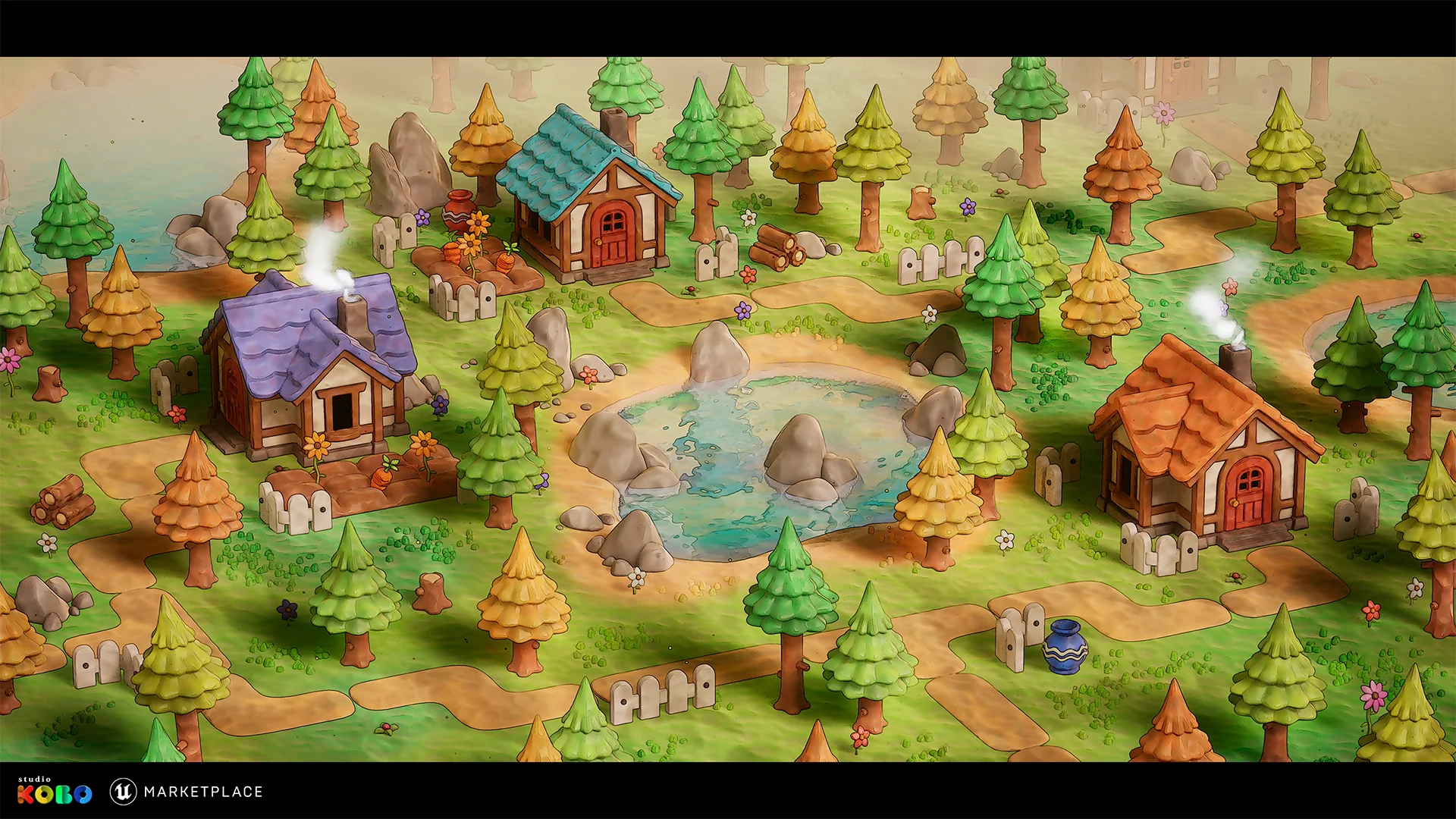
Constructing cohesive stylized environments often requires balancing distinct visual personality with clean architectural modularity. The Stylized - Clay Forest Village Pack provides a collection of 42 clay-like props and foliage assets designed to build complete rural hamlets and woodland settlements. The asset inventory includes modular lowpoly houses, diverse exterior props, mature trees, flowering plants, and dedicated ground-cover vegetation. Built to convey a cartoon aesthetic while taking advantage of physically based rendering standards, the structural and organic pieces can be combined into complete village layouts, countryside outposts, or dense forest clearings.
A core element of the package is the inclusion of Runtime Virtual Texture (RVT) grass. Ground greenery assets configured with RVT allow individual grass blades and clumps to sample the underlying terrain surface dynamically. This integration eliminates hard geometric seams where foliage meshes intersect with the ground. By sharing color and normal information through virtual texturing, the grass blends naturally into the soil and paths, providing a unified surface transition across large environment levels without manual vertex painting on every instance.
Toon Outlines and Kuwahara Shading in the Stylized Visual Pipeline
Achieving a convincing non-photorealistic finish involves more than applying soft textures to lowpoly meshes. To elevate the clay aesthetic into a painterly presentation, the package deploys two specialized post-process materials: a Toon Outline shader and a Kuwahara Filter. The toon outline material identifies surface edges and depth discontinuities across the screen, overlaying crisp boundary lines that accentuate the cartoon silhouettes of houses, foliage clusters, and village props. This outlines every structure distinctly, preserving readability against dense forest backgrounds.
Complementing the outlines, the Kuwahara filter post-process material calculates local pixel variance to soften interior surface gradients while retaining clean edge boundaries. This filter removes digital harshness and transforms standard geometric shading into an expressive, painting-like visual output across the entire scene. In Update 1.1, released in July 2024, the developer resolved an issue with post-process exposure settings inside levels. This fix prevents unexpected lighting and exposure swings during camera transitions, ensuring that the painting-like quality remains balanced whether viewing intimate village pathways or wide-angle landscape panoramas.
Coordinated Wind Motion Across Forest Trees and Foliage
Large-scale nature scenes require synchronized environmental motion to feel alive and physically grounded. The foliage assets in the collection operate through global wind parameters that control all tree and flower instances simultaneously. Rather than displaying mismatched, chaotic vertex movement, the forest canopy and ground vegetation react to the same unified wind vector and oscillation settings. When adjustments are made to the wind values, the swaying motion across all branches, leaves, and flower petals updates together.
This synchronized movement ensures that light breezes or heavy gusts pass uniformly over both foreground settlements and background tree lines. Because the flowers and trees respond to shared parameters, environment artists can fine-tune the intensity, speed, and responsiveness of the vegetation movement globally across the level without opening individual foliage meshes or altering individual material instances manually.
Atmospheric Particle Systems and Directional Cloud Shadows
Open-world village lighting can easily become static without atmospheric variation breaking up direct sunlight. To solve this, the package includes a custom light function made for the scene's directional light. This light function continuously pans procedural cloud shadows across the entire landscape, houses, and vegetation. As the cloud shapes drift across the environment, they cast moving shadow patterns that dynamically vary the illumination on roofs, pathways, and tree canopies, mimicking the look of an active sky without relying on heavy volumetric cloud systems.
Furthering the ambient life of the settlement, the kit incorporates a series of dedicated particle effects. Rising chimney smoke emitters ground the modular houses as lived-in structures, sending stylized smoke plumes into the air. Drifting wind trails move through open areas to visually reinforce the global wind systems, while floating ambient dust particles catch directional light shafts in shaded village alleys and dense woodland spaces. Together, these effects layer subtle movement into every layer of the scene.
Clay Landscape, Single Layer Water, and Master Material Workflows
Terrain and fluid surfaces within the package are handled by dedicated shader setups designed to match the clay art style. A custom clay landscape material gives the terrain a soft, sculpted quality that mirrors the hand-molded look of the modular house meshes and small props. For waterways, streams, or village ponds, the package includes a single layer water material. This water shader delivers stylized fluid transparency, color depth, and surface motion while maintaining high performance across complex environment levels.
Asset customization across the entire collection is anchored by comprehensive master materials. Every master material included in the project exposes numerous parameters for adjusting material instances. Artists can modify color tones, roughness levels, and surface highlights across the 42 props and foliage meshes directly inside the material instance editor. This parameterized framework allows teams to quickly generate regional variants, change the mood of the settlement, or align prop coloring with specific project palettes without authoring new source textures.
Lumen Global Illumination Integration for Unreal Engine 5.0+
The project is designed to run with native Lumen support for Unreal Engine 5.0 and above. Lumen dynamic global illumination and reflections calculate bounced light across the soft clay surfaces and non-photorealistic materials in real time. Sunlight penetrating the forest canopy bounces naturally into covered porches, narrow streets, and house entryways, producing realistic indirect illumination that flatters the stylized PBR textures.
Lumen reflections also interact with the single layer water material and reflective prop surfaces, grounding assets in their surroundings without the need for baked reflection captures or static lighting maps. This native lighting integration allows creators to reconfigure modular village buildings, reposition foliage, and alter time-of-day lighting setups with immediate visual feedback throughout production.
 Towns & Villages
 Towns & Villages
 Towns & Villages