"f0d304d7232d0332"{"id":"1002726","slug":"sharur-s-normandy-village-pcg-plants","title":"Sharur's Normandy Village + PCG Plants","category":"Towns \u0026 Villages","engine":"5.6+","assetVersion":"","engineVersion":"Engine Version: 5.6+","tag":"Towns \u0026 Villages","accent":"blue","visual":"mech","summary":"Build dynamic ruined medieval environments with Sharur's Normandy Village + PCG Plants, featuring 97 modular meshes, animated vegetation, and PCG graphs.","platform":"Unreal Engine","indexPolicy":"index","publishedAt":"2026-11-17T19:02:16.466Z","updatedAt":"2026-11-17T19:02:16.466Z","sourceNotes":[],"fileContents":[],"compatibility":["Unreal Engine","Engine Version: 5.6+"],"featuredImage":{"alt":"Sharur's Normandy Village + PCG Plants","src":"/wp-content/uploads/published/2026/11/a8e6ceeb7953-91495857-ab8f-4ebf-96d9-7b406dac1b29-ea8d08908a.webp"},"fileSizeBytes":4025461831,"hasDownloadLink":true,"downloads":0,"terms":[{"taxonomy":"category","slug":"towns-and-villages","name":"Towns \u0026 Villages"}],"galleryImages":[{"src":"/wp-content/uploads/published/2026/11/299a1c2a4053-9403ae7f-3ff7-451b-8825-f91ddae7c307-f17d9eae06.webp","alt":"Sharur's Normandy Village + PCG Plants"},{"src":"/wp-content/uploads/published/2026/11/a6f8e2077cce-9991b087-d794-449b-96b2-fd3fa9767c76-cae60da963.webp","alt":"Sharur's Normandy Village + PCG Plants"},{"src":"/wp-content/uploads/published/2026/11/86ea3ee00ba6-f39460cb-8fcc-47cd-8d8d-efd8c264ee16-5e314e1ccb.webp","alt":"Sharur's Normandy Village + PCG Plants"},{"src":"/wp-content/uploads/published/2026/11/5ea608895d90-8e1fb93b-a9ee-488f-88a1-907a1eb11291-4249631605.webp","alt":"Sharur's Normandy Village + PCG Plants"},{"src":"/wp-content/uploads/published/2026/11/90f029da57da-e9309b2b-edb4-486e-99b0-68332743a4a1-ade31de846.webp","alt":"Sharur's Normandy Village + PCG Plants"},{"src":"/wp-content/uploads/published/2026/11/5d67893dbc18-b28d5e3a-78b0-4836-8f0c-c72285c0d2a1-69311cbb35.webp","alt":"Sharur's Normandy Village + PCG Plants"},{"src":"/wp-content/uploads/published/2026/11/3759cca4d4bb-a9f8f114-58a9-46fc-9ad1-41afed6d97a8-7cec81b01e.webp","alt":"Sharur's Normandy Village + PCG Plants"}],"accessPanel":{"kind":"resource","title":"Get this resource","safetyNote":"Resources are manually reviewed before listing to improve quality and reduce obvious risks.","fileName":"Content.7z","resourceType":"Resource archive","versions":[]},"contentHtml":"\u003ch2\u003eDynamic Illumination and Architectural Ruins in Normandy Village\u003c/h2\u003e\n\u003cp\u003eLight interacts with ruined architecture in fundamentally different ways than it does with intact structures. When roofs collapse, masonry fractures, and walls split open, sunlight and ambient skylight cut through interior voids that would otherwise remain in deep shadow. Sharur's Normandy Village + PCG Plants targets this exact environmental reality by operating strictly within dynamic illumination workflows. The pack is engineered specifically for Lumen and the Pathtracer, rejecting traditional baked or static lighting methods entirely. Because static lighting is unsupported, projects utilizing these assets must configure their rendering settings for real-time global illumination and dynamic light evaluation from the outset.\u003c/p\u003e\n\u003cp\u003eWorking solely with dynamic lighting allows ruined stone walls, fragmented rafters, and tumbled masonry to cast precise, moving shadows as the sun changes position across an open sky. Lumen calculates bouncing indirect light through hollow doorframes and cracked stone surfaces in real time. The Pathtracer option provides an alternate, physically accurate rendering path suitable for cinematic frames, offline rendering, and visual benchmarking where light transport across complex stone decay requires uncompromising fidelity.\u003c/p\u003e \u003ch2\u003eModular Assembly with Broken Stone and Wood Structures\u003c/h2\u003e\n\u003cp\u003eConstructing believable decay requires modules designed with irregular silhouettes and visible structural trauma rather than clean, repeated edges. The asset collection delivers 97 modular meshes focused directly on the assembly of broken and ruined stone buildings. Rather than providing pre-assembled, unchangeable structures, the kit relies on individual modular units that can be combined freely to build structures ranging from small crumbled cottages to larger fortified compounds.\u003c/p\u003e\n\u003cp\u003eThese 97 building elements encompass ruined stone surfaces alongside complementary wood details, reflecting authentic medieval structural practices. Stone serves as the heavy foundation and defensive walling, while timber elements represent framing, exposed joists, and fractured interior flooring. Builders can place jagged, collapsed wall segments side by side with partially standing facades to create believable structural degradation. Because the pieces reflect fractured masonry rather than uniform building blocks, environment artists can stagger modules to eliminate visible repetition across long village roads or clustered settlements. The inclusion of Nanite enables dense geometrical relief across these modular stone surfaces without requiring artists to juggle manual level-of-detail transitions during assembly.\u003c/p\u003e \u003ch2\u003eAnimated Foliage Dynamics and Bush Motion Systems\u003c/h2\u003e\n\u003cp\u003eA ruined settlement quickly becomes barren if the surrounding landscape feels static and inert. Vegetation in this environment pack is structured to provide constant biological motion against the rigid, decaying stone. The vegetation suite contains six distinct types of fully animated grass, three tree models, and nine bushes rigged with Pivot Painter data, rounded out by wall ivy for structural overgrowth.\u003c/p\u003e\n\u003cp\u003eThe nine bushes leverage Pivot Painter to achieve naturalistic movement in the wind. By storing transformation hierarchy and pivot positions directly within the mesh texture data, Pivot Painter allows foliage branches and leaves to flex, bend, and twist with organic responsiveness rather than moving as a single rigid cluster or relying purely on simple vertex noise. When wind forces sweep across the village landscape, these bushes react with differentiated limb movement that mirrors real-world foliage behavior.\u003c/p\u003e\n\u003cp\u003eThe six variations of fully animated grass complement the bush models, providing varied ground-cover height, density, and wind reaction across the terrain. These grass varieties prevent open spaces around ruined stone foundations from appearing flat or uniform. To integrate the plant life directly into the architecture, wall ivy meshes are supplied to cling across broken masonry, soften hard architectural corners, and indicate long-term exposure to the elements. The three tree assets provide essential vertical scale, casting complex foliage shadows over roofs, dirt roads, and exposed stone rubble.\u003c/p\u003e \u003ch2\u003eProcedural Environment Distribution via PCG Graphs and Plants\u003c/h2\u003e\n\u003cp\u003ePopulating extensive level layouts by hand-placing thousands of individual blades of grass and clusters of trees quickly becomes impractical. Sharur's Normandy Village + PCG Plants resolves this scale problem through integrated Procedural Content Generation graphs. These PCG graphs automate the distribution of grass and expansive forest clusters across arbitrary level geometry and landscape terrain.\u003c/p\u003e\n\u003cp\u003eThe procedural graphs evaluate surfaces and scatter the animated grass varieties according to designated density and spatial parameters. Similarly, the tree and bush distribution graphs allow wide forested zones to form quickly around the outskirts of ruined settlements. Instead of meticulously stamping foliage actors across an entire level, developers can define broad bounding regions and let the procedural logic populate organic undergrowth, scattered shrubs, and tree lines automatically. Because the graphs scatter both the animated grass types and the Pivot Painter-driven bushes, the procedurally generated areas immediately inherit the same realistic motion and dynamic lighting response found in manually placed scenic vignettes.\u003c/p\u003e \u003ch2\u003ePlugin Dependencies and Dynamic Pipeline Requirements\u003c/h2\u003e\n\u003cp\u003eTo operate the procedural systems and construct landscapes as intended, projects integrating this pack require specific Unreal Engine plugins to be enabled. The procedural framework relies on three specific engine extensions:\u003c/p\u003e\n\u003cul\u003e \u003cli\u003e\u003cstrong\u003ePCG:\u003c/strong\u003e The core framework responsible for evaluating procedural nodes, handling point generation, and managing procedural actor spawning in the level.\u003c/li\u003e \u003cli\u003e\u003cstrong\u003ePCGExternalDataInterop:\u003c/strong\u003e Enables the procedural system to communicate with external data sources, facilitating advanced point-distribution workflows and data exchange.\u003c/li\u003e \u003cli\u003e\u003cstrong\u003ePCGGeometryScriptInterop:\u003c/strong\u003e Bridges procedural graphs with Geometry Scripting, permitting real-time procedural geometry queries and mesh operations directly during level generation.\u003c/li\u003e\n\u003c/ul\u003e\n\u003cp\u003eConfiguring these three plugins ensures the included PCG scatter graphs execute correctly when applied across level bounds. In tandem with the plugin requirements, dynamic lighting must be enforced across the project configuration. Static lightmaps must remain disabled, as the materials, Nanite geometry, and modular stone assets are built exclusively to resolve under Lumen dynamic bounces or Pathtracer passes. Teams assembling medieval ruins, fractured settlements, or overgrown rustic landscapes can depend on this technical foundation to balance procedural landscape generation with modular stone ruin construction.\u003c/p\u003e\n\n\u003ch2\u003eContinue Browsing Similar Packs\u003c/h2\u003e\n\u003cul\u003e\n\u003cli\u003e\u003ca href=\"https://3dcghub.com/suburb-neighborhood-house-pack-modular/\" rel=\"noopener noreferrer\"\u003eSuburb Neighborhood House Pack (Modular)\u003c/a\u003e\u003c/li\u003e\n\u003cli\u003e\u003ca href=\"https://3dcghub.com/house-on-a-hill-house-houses-fantasy-house-stylized-house/\" rel=\"noopener noreferrer\"\u003eHouse On A Hill (House, Houses, Fantasy House, Stylized House)\u003c/a\u003e\u003c/li\u003e\n\u003cli\u003e\u003ca href=\"https://3dcghub.com/african-village/\" rel=\"noopener noreferrer\"\u003eAfrican Village\u003c/a\u003e\u003c/li\u003e\n\u003cli\u003e\u003ca href=\"https://3dcghub.com/asian-forest-town/\" rel=\"noopener noreferrer\"\u003eASIAN - Forest Town\u003c/a\u003e\u003c/li\u003e\n\u003cli\u003e\u003ca href=\"https://3dcghub.com/sharurs-stylized-viking-ruins/\" rel=\"noopener noreferrer\"\u003eSharur\u0026#039;s Stylized Viking Ruins\u003c/a\u003e\u003c/li\u003e\n\u003c/ul\u003e","contentTextLength":7096,"navigation":{"current":14,"total":4660,"previous":{"id":"1002727","slug":"sicka-dynasty","title":"SICKA DYNASTY","category":"Fantasy","platform":"Unreal Engine","updatedAt":"2026-11-17T19:03:36.248Z"},"next":{"id":"1002725","slug":"sewer-dungeon-medieval-dungeon-fantasy-dungeon-dungeon","title":"Sewer Dungeon ( Medieval Dungeon Fantasy Dungeon Dungeon )","category":"Dungeon","platform":"Unreal Engine","updatedAt":"2026-11-17T19:01:21.082Z"}},"relatedResources":[{"id":"1002731","slug":"stylized-clay-forest-village-pack","title":"Stylized - Clay Forest Village Pack","category":"Towns \u0026 Villages","engine":"5.0+","assetVersion":"","engineVersion":"Engine Version: 5.0+","tag":"Towns \u0026 Villages","accent":"blue","visual":"mech","summary":"Explore the Stylized - Clay Forest Village Pack for Unreal Engine 5.0+, featuring 42 clay assets, RVT grass, Kuwahara shaders, and Lumen lighting.","platform":"Unreal Engine","indexPolicy":"index","publishedAt":"2026-11-17T19:07:53.736Z","updatedAt":"2026-11-17T19:07:53.736Z","sourceNotes":[],"fileContents":[],"compatibility":["Unreal Engine","Engine Version: 5.0+"],"featuredImage":{"alt":"Stylized - Clay Forest Village Pack","src":"/wp-content/uploads/published/2026/11/6b2dee2d4769-0df59578-6ec3-46a2-9bbb-f9477cf2d006-8ad0f94bc3.webp"},"fileSizeBytes":330413013,"hasDownloadLink":true,"downloads":0},{"id":"1001070","slug":"suburb-neighborhood-house-pack-modular","title":"Suburb Neighborhood House Pack (Modular)","category":"Towns \u0026 Villages","engine":"5.0+","assetVersion":"","engineVersion":"Engine Version: 5.0+","tag":"Towns \u0026 Villages","accent":"blue","visual":"mech","summary":"Modular suburban package with house interiors/exteriors, road system, trees, cars, and furniture. Includes a pre-built day and night map for UE5 projects.","platform":"Unreal Engine","indexPolicy":"index","publishedAt":"2026-09-03T17:09:53.903Z","updatedAt":"2026-09-03T17:09:53.903Z","sourceNotes":[],"fileContents":[],"compatibility":["Unreal Engine","Engine Version: 5.0+"],"featuredImage":{"alt":"Suburb Neighborhood House Pack (Modular)","src":"/wp-content/uploads/published/2026/09/9d8f986a1bdd-d39ad75a-ea27-4c68-a14d-41ea2d8ce74c-e6f4b8936e.webp"},"fileSizeBytes":1538859611,"hasDownloadLink":true,"downloads":7},{"id":"1002054","slug":"house-on-a-hill-house-houses-fantasy-house-stylized-house","title":"House On A Hill (House, Houses, Fantasy House, Stylized House)","category":"Towns \u0026 Villages","engine":"5.1+","assetVersion":"","engineVersion":"Engine Version: 5.1+","tag":"Towns \u0026 Villages","accent":"blue","visual":"mech","summary":"Explore the stylized House On A Hill environment, featuring custom foliage master materials, an ocean shader, cloud sky meshes, and painterly assets.","platform":"Unreal Engine","indexPolicy":"index","publishedAt":"2026-10-26T15:11:51.550Z","updatedAt":"2026-10-26T15:11:51.550Z","sourceNotes":[],"fileContents":[],"compatibility":["Unreal Engine","Engine Version: 5.1+"],"featuredImage":{"alt":"House On A Hill (House, Houses, Fantasy House, Stylized House)","src":"/wp-content/uploads/published/2026/10/d65827fec754-8ca013ea-7461-4817-a2c6-0e33fcafbb65-8bb25d340e.webp"},"fileSizeBytes":1565549185,"hasDownloadLink":true,"downloads":0}]}
Resource screenshots
1 / 7
Join our channel
Follow 3DCGHUB on Telegram for new resource drops, migration updates, and community notices.
Dynamic Illumination and Architectural Ruins in Normandy Village
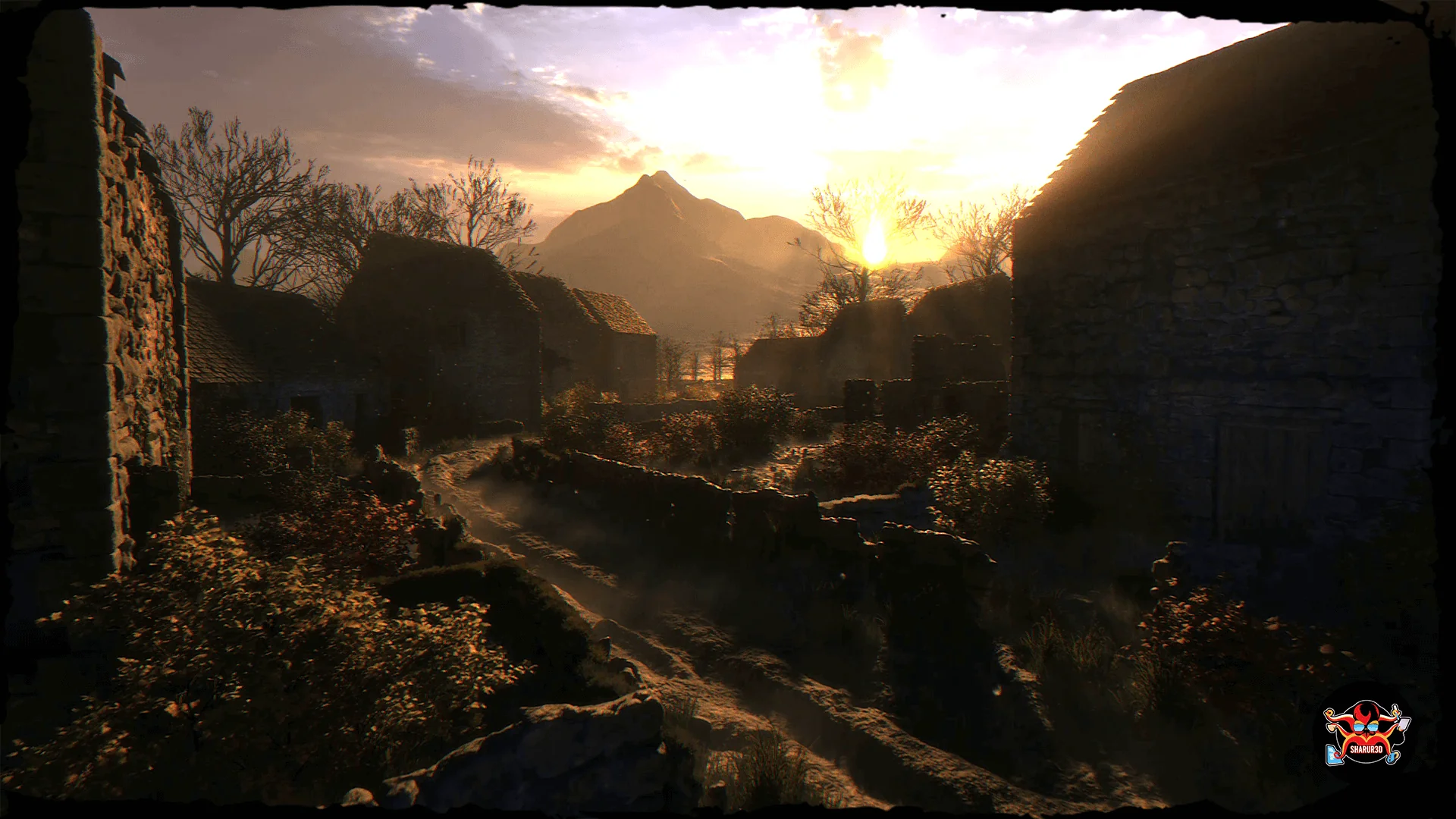
Light interacts with ruined architecture in fundamentally different ways than it does with intact structures. When roofs collapse, masonry fractures, and walls split open, sunlight and ambient skylight cut through interior voids that would otherwise remain in deep shadow. Sharur's Normandy Village + PCG Plants targets this exact environmental reality by operating strictly within dynamic illumination workflows. The pack is engineered specifically for Lumen and the Pathtracer, rejecting traditional baked or static lighting methods entirely. Because static lighting is unsupported, projects utilizing these assets must configure their rendering settings for real-time global illumination and dynamic light evaluation from the outset.
Working solely with dynamic lighting allows ruined stone walls, fragmented rafters, and tumbled masonry to cast precise, moving shadows as the sun changes position across an open sky. Lumen calculates bouncing indirect light through hollow doorframes and cracked stone surfaces in real time. The Pathtracer option provides an alternate, physically accurate rendering path suitable for cinematic frames, offline rendering, and visual benchmarking where light transport across complex stone decay requires uncompromising fidelity.
Modular Assembly with Broken Stone and Wood Structures
Constructing believable decay requires modules designed with irregular silhouettes and visible structural trauma rather than clean, repeated edges. The asset collection delivers 97 modular meshes focused directly on the assembly of broken and ruined stone buildings. Rather than providing pre-assembled, unchangeable structures, the kit relies on individual modular units that can be combined freely to build structures ranging from small crumbled cottages to larger fortified compounds.
These 97 building elements encompass ruined stone surfaces alongside complementary wood details, reflecting authentic medieval structural practices. Stone serves as the heavy foundation and defensive walling, while timber elements represent framing, exposed joists, and fractured interior flooring. Builders can place jagged, collapsed wall segments side by side with partially standing facades to create believable structural degradation. Because the pieces reflect fractured masonry rather than uniform building blocks, environment artists can stagger modules to eliminate visible repetition across long village roads or clustered settlements. The inclusion of Nanite enables dense geometrical relief across these modular stone surfaces without requiring artists to juggle manual level-of-detail transitions during assembly.
Animated Foliage Dynamics and Bush Motion Systems
A ruined settlement quickly becomes barren if the surrounding landscape feels static and inert. Vegetation in this environment pack is structured to provide constant biological motion against the rigid, decaying stone. The vegetation suite contains six distinct types of fully animated grass, three tree models, and nine bushes rigged with Pivot Painter data, rounded out by wall ivy for structural overgrowth.
The nine bushes leverage Pivot Painter to achieve naturalistic movement in the wind. By storing transformation hierarchy and pivot positions directly within the mesh texture data, Pivot Painter allows foliage branches and leaves to flex, bend, and twist with organic responsiveness rather than moving as a single rigid cluster or relying purely on simple vertex noise. When wind forces sweep across the village landscape, these bushes react with differentiated limb movement that mirrors real-world foliage behavior.
The six variations of fully animated grass complement the bush models, providing varied ground-cover height, density, and wind reaction across the terrain. These grass varieties prevent open spaces around ruined stone foundations from appearing flat or uniform. To integrate the plant life directly into the architecture, wall ivy meshes are supplied to cling across broken masonry, soften hard architectural corners, and indicate long-term exposure to the elements. The three tree assets provide essential vertical scale, casting complex foliage shadows over roofs, dirt roads, and exposed stone rubble.
Procedural Environment Distribution via PCG Graphs and Plants
Populating extensive level layouts by hand-placing thousands of individual blades of grass and clusters of trees quickly becomes impractical. Sharur's Normandy Village + PCG Plants resolves this scale problem through integrated Procedural Content Generation graphs. These PCG graphs automate the distribution of grass and expansive forest clusters across arbitrary level geometry and landscape terrain.
The procedural graphs evaluate surfaces and scatter the animated grass varieties according to designated density and spatial parameters. Similarly, the tree and bush distribution graphs allow wide forested zones to form quickly around the outskirts of ruined settlements. Instead of meticulously stamping foliage actors across an entire level, developers can define broad bounding regions and let the procedural logic populate organic undergrowth, scattered shrubs, and tree lines automatically. Because the graphs scatter both the animated grass types and the Pivot Painter-driven bushes, the procedurally generated areas immediately inherit the same realistic motion and dynamic lighting response found in manually placed scenic vignettes.
Plugin Dependencies and Dynamic Pipeline Requirements
To operate the procedural systems and construct landscapes as intended, projects integrating this pack require specific Unreal Engine plugins to be enabled. The procedural framework relies on three specific engine extensions:
PCG: The core framework responsible for evaluating procedural nodes, handling point generation, and managing procedural actor spawning in the level.
PCGExternalDataInterop: Enables the procedural system to communicate with external data sources, facilitating advanced point-distribution workflows and data exchange.
PCGGeometryScriptInterop: Bridges procedural graphs with Geometry Scripting, permitting real-time procedural geometry queries and mesh operations directly during level generation.
Configuring these three plugins ensures the included PCG scatter graphs execute correctly when applied across level bounds. In tandem with the plugin requirements, dynamic lighting must be enforced across the project configuration. Static lightmaps must remain disabled, as the materials, Nanite geometry, and modular stone assets are built exclusively to resolve under Lumen dynamic bounces or Pathtracer passes. Teams assembling medieval ruins, fractured settlements, or overgrown rustic landscapes can depend on this technical foundation to balance procedural landscape generation with modular stone ruin construction.
 Towns & Villages
 Towns & Villages
 Towns & Villages