"148d1066ed74e216"{"id":"1002964","slug":"unka-the-dragon","title":"Unka the Dragon","category":"Characters \u0026 Creatures","engine":"4.26+,5.0+","assetVersion":"","engineVersion":"Engine Version: 4.26+,5.0+","tag":"Characters","accent":"blue","visual":"character","summary":"Explore Unka the Dragon, featuring realistic, handpainted, and polyart styles, Substance Designer textures, and animation blueprint integration.","platform":"Unreal Engine","indexPolicy":"index","publishedAt":"2026-11-22T12:54:21.216Z","updatedAt":"2026-11-22T12:54:21.216Z","sourceNotes":[],"fileContents":[],"compatibility":["Unreal Engine","Engine Version: 4.26+,5.0+"],"featuredImage":{"alt":"Unka the Dragon","src":"/wp-content/uploads/published/2026/11/21fb670353e0-502602b0-3be6-4cce-a75b-ee0d4d6c7e08-4354840a01.webp"},"fileSizeBytes":392852545,"hasDownloadLink":true,"downloads":0,"terms":[{"taxonomy":"category","slug":"characters-and-creatures","name":"Characters \u0026 Creatures"}],"galleryImages":[{"src":"/wp-content/uploads/published/2026/11/f4aee756440f-dd6216f2-b9be-4d88-8385-204cd2d18ea2-5a22a7f662.webp","alt":"Unka the Dragon"},{"src":"/wp-content/uploads/published/2026/11/06dad9a5b958-561d857f-9f9c-47e4-9676-2bd48765d689-4dd882a453.webp","alt":"Unka the Dragon"},{"src":"/wp-content/uploads/published/2026/11/8a0d301edb3a-f4bc317e-2e2b-41d1-8044-400da09edf7c-a8bcf14e04.webp","alt":"Unka the Dragon"},{"src":"/wp-content/uploads/published/2026/11/9d5029e25b25-cf8fe26c-7816-4f79-aac6-20a0449cc6ca-92f6f0f083.webp","alt":"Unka the Dragon"},{"src":"/wp-content/uploads/published/2026/11/0c365c1a674c-7b37593d-4fd7-4857-965b-5dc7cc8e2c44-e73361826b.webp","alt":"Unka the Dragon"},{"src":"/wp-content/uploads/published/2026/11/53088a5b789c-98ee0639-2b0f-4674-8c47-d3676ee56be3-c2926298ca.webp","alt":"Unka the Dragon"},{"src":"/wp-content/uploads/published/2026/11/17c538e81d48-116384ef-8763-4da0-90a3-a713b838a886-aa418b6e9a.webp","alt":"Unka the Dragon"}],"accessPanel":{"kind":"resource","title":"Get this resource","safetyNote":"Resources are manually reviewed before listing to improve quality and reduce obvious risks.","fileName":"Unka the Dragon.7z","resourceType":"Resource archive","versions":[]},"contentHtml":"\u003ch2\u003eUnka Visual Profiles Across Realistic, Toon, and PolyArt Presentations\u003c/h2\u003e\u003cp\u003eUnka the Dragon addresses multiple production directions by supplying three distinct visual treatments: a Realistic mode, a Toon or HandPainted look, and a PolyArt or LowPoly format. Each aesthetic directs how the character receives light, interprets organic detail, and integrates into diverse environmental art styles. Rather than restricting the creature to a single artistic pipeline, these variations provide completely different surface languages while maintaining the core anatomical structure of the fantasy beast.\u003c/p\u003e\u003cp\u003eThe Realistic profile focuses on fine reptilian grain, anatomical definitions, and natural light falloff across scales, horns, and wing membranes. In projects prioritizing high-fidelity biological forms, this presentation allows the dragon to appear weighty, grounded, and texturally complex. Flesh folds around the joints, ridges along the spine, and subtle color gradations across the hide react predictably to standard physical rendering workflows, making the character convincing under dynamic atmospheric lighting conditions.\u003c/p\u003e\u003cp\u003eThe Toon and HandPainted option departs from micro-surface realism to focus on expressive strokes, illustrative lighting cues, and stylized clarity. Color palettes in this variant emphasize readable contrasts and painted highlights that suit non-photorealistic rendering, storybook aesthetics, or stylized fantasy titles. The surface reads cleanly even at distant camera framing, avoiding high-frequency visual noise while retaining the distinctive lizard and dragon silhouettes.\u003c/p\u003e\u003cp\u003eThe PolyArt and LowPoly configuration highlights flat facets, clean planar breaks, and crisp geometric simplicity. Light breaks cleanly over angular polygons, establishing a modern minimalist feel common in stylized independent productions, retro-inspired campaigns, and mobile formats where clean geometric readability is paramount. By packaging these three treatments together, the character avoids being locked into a singular visual genre.\u003c/p\u003e\u003ch2\u003eSubstance Designer Customization for the Dragon Surface\u003c/h2\u003e\u003cp\u003eMaterial flexibility forms a core component of the creature package through the inclusion of Substance Designer textures. These textures unlock deep procedural control over how the dragon's surface looks and behaves in real time, granting artists the ability to modify color distributions, tonal accents, scale patterns, and material finishes without needing to construct new texture maps from scratch outside the engine.\u003c/p\u003e\u003cp\u003eSubstance Designer graphs allow precise adjustments to roughness balances, tint palettes, and procedural mask thresholds across the creature hide. A developer seeking a scorched, soot-covered wyvern can dial up darker tones, adjust carbonized values across the ridge crests, and emphasize charred contrast across the wings. Conversely, lightening specific channel values creates a frost-themed or subterranean variant exhibiting pale underbellies and icy translucent epidermal tones.\u003c/p\u003e\u003cp\u003eThis level of procedural customization means multiple instances of the model can appear in the same environment while exhibiting distinct visual identities. In an open-world fantasy ecosystem, an alpha predator can feature darker, saturated hide tones and high-contrast facial highlights, while junior beasts or allied companions display muted, neutral color patterns derived from the same base material framework.\u003c/p\u003e\u003ch2\u003eBoss, Companion, and Player-Driven Fantasy Deployments\u003c/h2\u003e\u003cp\u003eThe creature is framed around three distinct game design implementations: acting as a climactic main boss, functioning as a loyal allied companion, or serving as the direct player-controlled avatar. Each deployment demands different spatial considerations, interaction zones, and behavioral expectations within a game's logic.\u003c/p\u003e\u003cp\u003eWhen positioned as a main boss encounter, the creature commands the arena through large physical presence and sweeping threat areas. Its broad wingspan and heavy tail silhouette provide immediate visual indicators during high-intensity combat encounters, telegraphing sweeping attacks, lunges, and aerial transitions to the player. The terrifying presence of a massive fantasy wyvern fits cleanly into climactic arena set pieces where distinct visual phases and clear attack staging are necessary to balance difficulty.\u003c/p\u003e\u003cp\u003eConfiguring the character as a companion fundamentally shifts its role toward cooperative dynamics. Instead of dominating the arena against the player, the creature works alongside them, following navigation waypoints, flanking hostile encounters, and offering support from aerial or ground vantages. The multiple visual styles allow developers to tone down the creature's aggression visually, matching the companion's appearance to the companion party's specific aesthetic tone.\u003c/p\u003e\u003cp\u003eDirect player control changes the focus entirely, turning the asset into the primary vehicle for interaction. Operating as the dragon requires smooth camera orbiting, responsive flight turning arcs, banking physics, and clear camera framing that does not obscure the surrounding terrain. Flying, diving, and traversing the game world from the viewpoint of a winged fantasy beast requires immediate feedback across all locomotion states, which directly ties into the underlying animation systems.\u003c/p\u003e\u003ch2\u003eAnimationblueprint Systems and Script Support for Unka\u003c/h2\u003e\u003cp\u003eLocomotion and behavioral flow rely on an integrated Animationblueprint and accompanying script support, bridging the gap between raw mesh deformation and responsive gameplay controls. Managing a dual-locomotion creature that both walks on land like a lizard and takes flight like a wyvern requires a robust state machine structure capable of handling complex transitional blending.\u003c/p\u003e\u003cp\u003eThe Animationblueprint structures how grounded crawls, sprints, takeoffs, glides, banking turns, and landings interpolate seamlessly. Transition rules evaluate velocity vectors, vertical climbing rates, and surface collisions to ensure the wings fold naturally when traversing rocky ground and snap outward when launching into flight states. Tail physics and secondary motion across the wings prevent the creature from appearing rigid during rapid directional shifts or evasive aerial maneuvers.\u003c/p\u003e\u003cp\u003eScript support ties character variables directly into game inputs and AI decision engines. Whether an AI controller dictates aggression ranges, patrol loops, and attack cooldowns for a boss encounter, or a player controller routes analog stick inputs into yaw, pitch, and roll commands, the scripting architecture ensures parameters pass fluidly into the animation tree. Combat states such as bites, tail whips, claw strikes, and roar triggers can fire with predictable timing and cleanly defined hit-frame notifies.\u003c/p\u003e\u003ch2\u003eLizard and Wyvern Character Profiles within Fantasy Frameworks\u003c/h2\u003e\u003cp\u003eTagged as a dragon, wyvern, lizard, and lowpoly fantasy character, the design balances mythological majesty with grounded reptilian anatomy. The anatomical profile draws heavily from wyvern morphology, combining wings with forelimbs to produce a fast, predatory posture suited for both agile aerial diving and quadrupedal ground stalking.\u003c/p\u003e\u003cp\u003eReptilian traits show clearly in the heavy cranial structure, armored spinal crests, and powerful hindquarters built for launching into the air. This hybrid lizard-wyvern construction gives the creature an earthy, beast-like nature rather than an overly humanized or mechanical aesthetic, fitting naturally into ancient ruins, mountain peaks, subterranean caverns, and enchanted forests.\u003c/p\u003e\u003cp\u003eThe lowpoly foundation ensures optimal runtime efficiency across diverse hardware configurations. Clean mesh flow preserves anatomical volume during wing extensions and jaw opening sequences while minimizing superfluous vertex overhead. Because performance budgets can remain tightly managed, developers can deploy the asset in crowded battle scenes or complex natural environments without exceeding strict rendering constraints, making it a dependable, versatile centerpiece for diverse fantasy adventures.\u003c/p\u003e\n\n\u003ch2\u003eExplore Similar Assets\u003c/h2\u003e\n\u003cul\u003e\n\u003cli\u003e\u003ca href=\"https://3dcghub.com/dragons-pack-pbr/\" rel=\"noopener noreferrer\"\u003eDragons Pack PBR\u003c/a\u003e\u003c/li\u003e\n\u003cli\u003e\u003ca href=\"https://3dcghub.com/black-dragon/\" rel=\"noopener noreferrer\"\u003eBlack Dragon\u003c/a\u003e\u003c/li\u003e\n\u003cli\u003e\u003ca href=\"https://3dcghub.com/winter-dragon-wyvern/\" rel=\"noopener noreferrer\"\u003eWinter Dragon (Wyvern)\u003c/a\u003e\u003c/li\u003e\n\u003cli\u003e\u003ca href=\"https://3dcghub.com/desert-dragon/\" rel=\"noopener noreferrer\"\u003eDESERT DRAGON\u003c/a\u003e\u003c/li\u003e\n\u003cli\u003e\u003ca href=\"https://3dcghub.com/wyvern-rex-lite-version/\" rel=\"noopener noreferrer\"\u003eWyvern Rex Lite Version\u003c/a\u003e\u003c/li\u003e\n\u003c/ul\u003e","contentTextLength":8166,"navigation":{"current":5,"total":4890,"previous":{"id":"1002965","slug":"wendigo","title":"Wendigo","category":"Characters \u0026 Creatures","platform":"Unreal Engine","updatedAt":"2026-11-22T12:56:32.744Z"},"next":{"id":"1002963","slug":"undertaker","title":"Undertaker","category":"Characters \u0026 Creatures","platform":"Unreal Engine","updatedAt":"2026-11-22T12:52:58.979Z"}},"relatedResources":[{"id":"1002553","slug":"dragons-pack-pbr","title":"Dragons Pack PBR","category":"Characters \u0026 Creatures","engine":"4.26+,5.0+","assetVersion":"","engineVersion":"Engine Version: 4.26+,5.0+","tag":"Characters","accent":"blue","visual":"character","summary":"A modular dragon character with three heads, four backs, two tails, morphable meshes, land and air animations, riding gear, and texture customization.","platform":"Unreal Engine","indexPolicy":"index","publishedAt":"2026-11-13T10:44:04.939Z","updatedAt":"2026-11-13T10:44:04.939Z","sourceNotes":[],"fileContents":[],"compatibility":["Unreal Engine","Engine Version: 4.26+,5.0+"],"featuredImage":{"alt":"Dragons Pack PBR","src":"/wp-content/uploads/published/2026/11/3da1c57f3803-c7f49a80-8d53-4c2e-a37d-b60a8158091b-4055ba50f8.webp"},"fileSizeBytes":3782695716,"hasDownloadLink":true,"downloads":0},{"id":"1002508","slug":"black-dragon","title":"Black Dragon","category":"Characters \u0026 Creatures","engine":"4.15+,5.0+","assetVersion":"","engineVersion":"Engine Version: 4.15+,5.0+","tag":"Characters","accent":"blue","visual":"character","summary":"A technical breakdown of the Black Dragon asset, examining its 32 Ktris geometry, 105-bone rig, dual-material setup, 4K textures, and 22 animations.","platform":"Unreal Engine","indexPolicy":"index","publishedAt":"2026-11-13T08:22:50.098Z","updatedAt":"2026-11-13T08:22:50.098Z","sourceNotes":[],"fileContents":[],"compatibility":["Unreal Engine","Engine Version: 4.15+,5.0+"],"featuredImage":{"alt":"Black Dragon","src":"/wp-content/uploads/published/2026/11/57ed55afd22d-4b325e15-b03d2a6228.webp"},"fileSizeBytes":103128000,"hasDownloadLink":true,"downloads":0},{"id":"1000933","slug":"winter-dragon-wyvern","title":"Winter Dragon (Wyvern)","category":"Characters \u0026 Creatures","engine":"4.26+,5.0+","assetVersion":"","engineVersion":"Engine Version: 4.26+,5.0+","tag":"Characters","accent":"blue","visual":"character","summary":"A UE4-rendered wyvern with 56 animations, ice and realistic skins, blend shapes, and a hue-shiftable material instance for quick winter dragon variations.","platform":"Unreal Engine","indexPolicy":"index","publishedAt":"2026-08-09T17:00:32.602Z","updatedAt":"2026-08-09T17:00:32.602Z","sourceNotes":[],"fileContents":[],"compatibility":["Unreal Engine","Engine Version: 4.26+,5.0+"],"featuredImage":{"alt":"Winter Dragon (Wyvern)","src":"/wp-content/uploads/published/2026/08/fb846469fc17-a7cd50c8-93e9-4c62-a6cd-a2d15f3ce167-4ccf19b9f5.webp"},"fileSizeBytes":316706575,"hasDownloadLink":true,"downloads":1}]}[{"id":4225,"sourceId":4225,"taxonomyId":4225,"taxonomy":"category","slug":"asset-library","name":"Asset Library","parentId":null,"count":4744,"hasChildren":true,"href":"/","seoTitle":"Free Game Assets Library | 3DCGHUB","seoDescription":"Browse free Unreal Engine, Unity, Blender assets and game development tutorials on 3DCGHUB with previews, compatibility notes, and secure downloads.","sitemapEnabled":true,"children":[{"id":4227,"sourceId":4227,"taxonomyId":4227,"taxonomy":"category","slug":"blender-add-ons-plugins","name":"Blender Add-ons \u0026 Plugins","parentId":4225,"count":10,"hasChildren":false,"href":"/category/blender-add-ons-plugins/","seoTitle":"Free Blender Add-ons \u0026 Plugins | 3DCGHUB","seoDescription":"Browse free Blender Add-ons \u0026 Plugins tools for Blender on 3DCGHUB: curated downloads with preview images, compatibility notes and secure download access.","sitemapEnabled":true},{"id":514,"sourceId":514,"taxonomyId":514,"taxonomy":"category","slug":"unity-2","name":"Unity","parentId":4225,"count":453,"hasChildren":true,"href":"/category/unity-2/","seoTitle":"Free Unity Assets | 3DCGHUB","seoDescription":"Browse free Unity resources on 3DCGHUB: curated downloads with preview images, compatibility notes and secure download access.","sitemapEnabled":true,"children":[{"id":523,"sourceId":523,"taxonomyId":523,"taxonomy":"category","slug":"2d","name":"2D","parentId":514,"count":1,"hasChildren":true,"href":"/category/2d/","seoTitle":"Free Unity 2D | 3DCGHUB","seoDescription":"Browse free 2D assets for Unity on 3DCGHUB: curated downloads with preview images, compatibility notes and secure download access.","sitemapEnabled":true},{"id":515,"sourceId":515,"taxonomyId":515,"taxonomy":"category","slug":"3d-unity-2","name":"3D","parentId":514,"count":162,"hasChildren":true,"href":"/category/3d-unity-2/","seoTitle":"Free Unity 3D Assets | 3DCGHUB","seoDescription":"Browse free 3D assets for Unity on 3DCGHUB: curated downloads with preview images, compatibility notes and secure download access.","sitemapEnabled":true},{"id":565,"sourceId":565,"taxonomyId":565,"taxonomy":"category","slug":"add-ons","name":"Add-Ons","parentId":514,"count":2,"hasChildren":false,"href":"/category/add-ons/","seoTitle":"Free Unity Add-Ons | 3DCGHUB","seoDescription":"Browse free Add-Ons assets for Unity on 3DCGHUB: curated downloads with preview images, compatibility notes and secure download access.","sitemapEnabled":true},{"id":529,"sourceId":529,"taxonomyId":529,"taxonomy":"category","slug":"audio-unity-2","name":"Audio","parentId":514,"count":1,"hasChildren":true,"href":"/category/audio-unity-2/","seoTitle":"Free Unity Audio | 3DCGHUB","seoDescription":"Browse free Audio for Unity on 3DCGHUB: curated downloads with preview images, compatibility notes and secure download access.","sitemapEnabled":true},{"id":557,"sourceId":557,"taxonomyId":557,"taxonomy":"category","slug":"templates","name":"Templates","parentId":514,"count":36,"hasChildren":true,"href":"/category/templates/","seoTitle":"Free Unity Templates | 3DCGHUB","seoDescription":"Browse free Unity project templates on 3DCGHUB. Starter kits with previews, compatibility notes, and secure download access.","sitemapEnabled":true},{"id":533,"sourceId":533,"taxonomyId":533,"taxonomy":"category","slug":"tools-unity-2","name":"Tools","parentId":514,"count":0,"hasChildren":true,"href":"/category/tools-unity-2/","sitemapEnabled":true},{"id":554,"sourceId":554,"taxonomyId":554,"taxonomy":"category","slug":"vfx-unity-2","name":"VFX","parentId":514,"count":4,"hasChildren":true,"href":"/category/vfx-unity-2/","seoTitle":"Free Unity VFX | 3DCGHUB","seoDescription":"Browse free VFX for Unity on 3DCGHUB: curated downloads with preview images, compatibility notes and secure download access.","sitemapEnabled":true}]},{"id":511,"sourceId":511,"taxonomyId":511,"taxonomy":"category","slug":"unreal-engine-2","name":"Unreal Engine","parentId":4225,"count":4282,"hasChildren":true,"href":"/category/unreal-engine-2/","seoTitle":"Free Unreal Engine Assets | 3DCGHUB","seoDescription":"Browse free Unreal Engine resources on 3DCGHUB: curated downloads with preview images, compatibility notes and secure download access.","sitemapEnabled":true,"children":[{"id":54,"sourceId":54,"taxonomyId":54,"taxonomy":"category","slug":"3d","name":"3D","parentId":511,"count":2428,"hasChildren":true,"href":"/category/3d/","seoTitle":"Free Unreal Engine 3D | 3DCGHUB","seoDescription":"Browse free 3D assets for Unreal Engine on 3DCGHUB: curated downloads with preview images, compatibility notes and secure download access.","sitemapEnabled":true},{"id":441,"sourceId":441,"taxonomyId":441,"taxonomy":"category","slug":"animations","name":"Animations","parentId":511,"count":245,"hasChildren":true,"href":"/category/animations/","seoTitle":"Free Unreal Engine Animations | 3DCGHUB","seoDescription":"Browse free Animations for Unreal Engine on 3DCGHUB: curated downloads with preview images, compatibility notes and secure download access.","sitemapEnabled":true},{"id":446,"sourceId":446,"taxonomyId":446,"taxonomy":"category","slug":"audio","name":"Audio","parentId":511,"count":63,"hasChildren":true,"href":"/category/audio/","seoTitle":"Free Unreal Engine Audio Resources | 3DCGHUB","seoDescription":"Browse free Unreal Engine audio resources including sound effects, voices, dialogue, and ambient sounds. Curated free downloads on 3DCGHUB.","sitemapEnabled":true},{"id":466,"sourceId":466,"taxonomyId":466,"taxonomy":"category","slug":"game-systems","name":"Game Systems","parentId":511,"count":356,"hasChildren":true,"href":"/category/game-systems/","seoTitle":"Free Unreal Engine Game Systems | 3DCGHUB","seoDescription":"Browse free Game Systems tools for Unreal Engine on 3DCGHUB: curated downloads with preview images, compatibility notes and secure download access.","sitemapEnabled":true},{"id":478,"sourceId":478,"taxonomyId":478,"taxonomy":"category","slug":"game-templates","name":"Game Templates","parentId":511,"count":150,"hasChildren":true,"href":"/category/game-templates/","seoTitle":"Free Unreal Engine Game Templates | 3DCGHUB","seoDescription":"Browse free Game Templates for Unreal Engine on 3DCGHUB: curated downloads with preview images, compatibility notes and secure download access.","sitemapEnabled":true},{"id":432,"sourceId":432,"taxonomyId":432,"taxonomy":"category","slug":"hdri","name":"HDRI","parentId":511,"count":6,"hasChildren":true,"href":"/category/hdri/","seoTitle":"Free Unreal Engine HDRI | 3DCGHUB","seoDescription":"Browse free Unreal Engine HDRI skies and lighting maps on 3DCGHUB. Environment lighting with previews and secure downloads.","sitemapEnabled":true},{"id":228,"sourceId":228,"taxonomyId":228,"taxonomy":"category","slug":"material-and-textures","name":"Material \u0026 Textures","parentId":511,"count":172,"hasChildren":true,"href":"/category/material-and-textures/","seoTitle":"Free Unreal Engine Material \u0026 Textures | 3DCGHUB","seoDescription":"Browse free Material \u0026 Textures for Unreal Engine on 3DCGHUB: curated downloads with preview images, compatibility notes and secure download access.","sitemapEnabled":true},{"id":298,"sourceId":298,"taxonomyId":298,"taxonomy":"category","slug":"sprites-and-flipbooks","name":"Sprites \u0026 Flipbooks","parentId":511,"count":17,"hasChildren":true,"href":"/category/sprites-and-flipbooks/","seoTitle":"Free Unreal Engine Sprites \u0026 Flipbooks | 3DCGHUB","seoDescription":"Browse free Sprites \u0026 Flipbooks assets for Unreal Engine on 3DCGHUB: curated downloads with preview images, compatibility notes and secure download access.","sitemapEnabled":true},{"id":489,"sourceId":489,"taxonomyId":489,"taxonomy":"category","slug":"tools-and-plugins","name":"Tools \u0026 Plugins","parentId":511,"count":390,"hasChildren":true,"href":"/category/tools-and-plugins/","seoTitle":"Free Unreal Engine Tools \u0026 Plugins | 3DCGHUB","seoDescription":"Browse free Tools \u0026 Plugins for Unreal Engine on 3DCGHUB: curated downloads with preview images, compatibility notes and secure download access.","sitemapEnabled":true},{"id":459,"sourceId":459,"taxonomyId":459,"taxonomy":"category","slug":"ui","name":"UI","parentId":511,"count":43,"hasChildren":true,"href":"/category/ui/","seoTitle":"Free Unreal Engine UI | 3DCGHUB","seoDescription":"Browse free UI for Unreal Engine on 3DCGHUB: curated downloads with preview images, compatibility notes and secure download access.","sitemapEnabled":true},{"id":450,"sourceId":450,"taxonomyId":450,"taxonomy":"category","slug":"vfx","name":"VFX","parentId":511,"count":412,"hasChildren":true,"href":"/category/vfx/","seoTitle":"Free Unreal Engine VFX | 3DCGHUB","seoDescription":"Browse free VFX for Unreal Engine on 3DCGHUB: curated downloads with preview images, compatibility notes and secure download access.","sitemapEnabled":true}]}]},{"id":4222,"sourceId":4222,"taxonomyId":4222,"taxonomy":"category","slug":"tutorial-library","name":"Tutorial Library","parentId":null,"count":117,"hasChildren":false,"href":"/tutorials/","seoTitle":"Free Game Development Tutorial Library | 3DCGHUB","seoDescription":"Browse free game development tutorials for Unreal Engine, Unity, Blender, and more on 3DCGHUB with practical workflows and secure downloads.","sitemapEnabled":true}]
Resource screenshots
1 / 7
Join our channel
Follow 3DCGHUB on Telegram for new resource drops, migration updates, and community notices.
Unka Visual Profiles Across Realistic, Toon, and PolyArt Presentations
Unka the Dragon addresses multiple production directions by supplying three distinct visual treatments: a Realistic mode, a Toon or HandPainted look, and a PolyArt or LowPoly format. Each aesthetic directs how the character receives light, interprets organic detail, and integrates into diverse environmental art styles. Rather than restricting the creature to a single artistic pipeline, these variations provide completely different surface languages while maintaining the core anatomical structure of the fantasy beast.
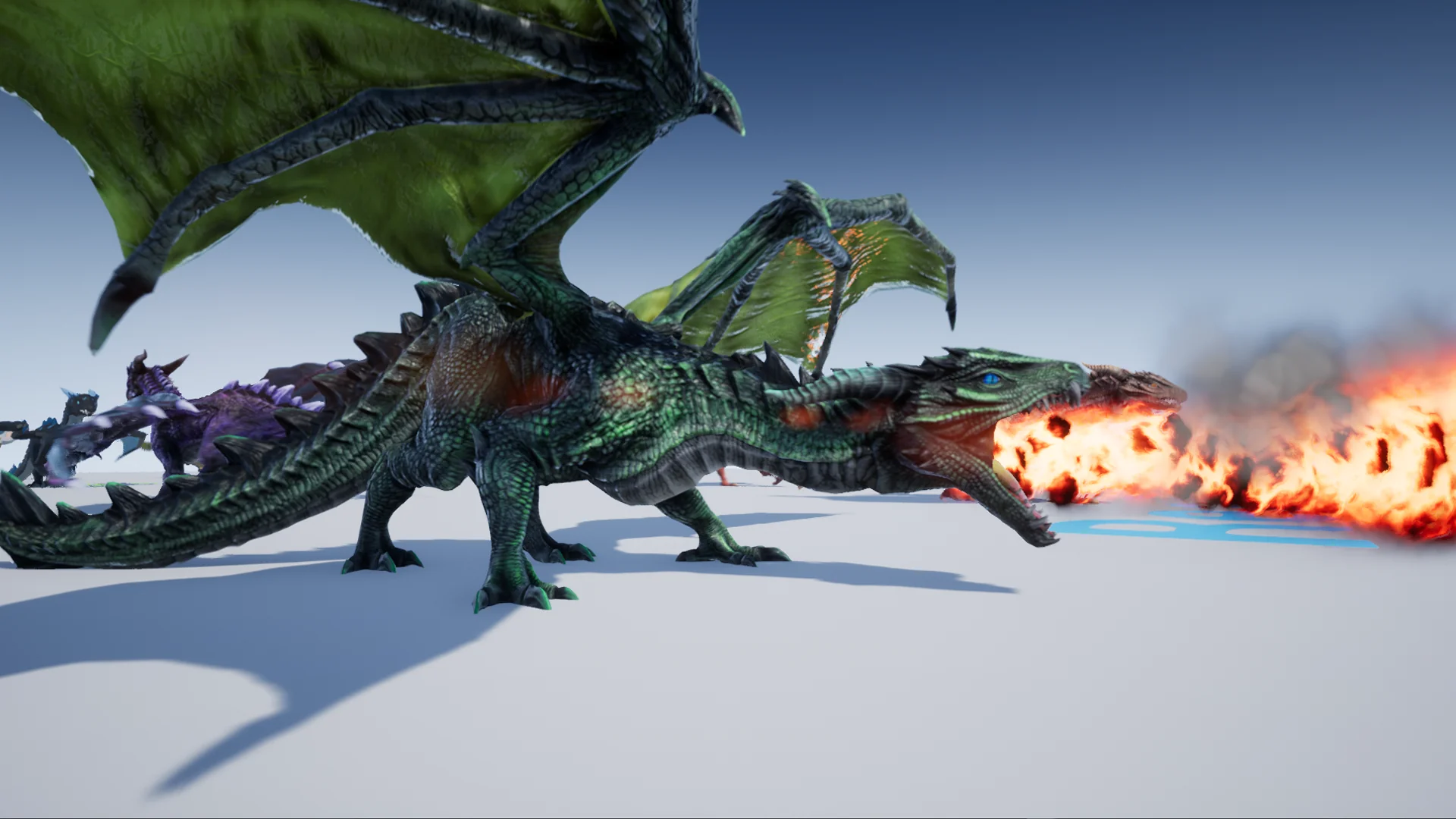
The Realistic profile focuses on fine reptilian grain, anatomical definitions, and natural light falloff across scales, horns, and wing membranes. In projects prioritizing high-fidelity biological forms, this presentation allows the dragon to appear weighty, grounded, and texturally complex. Flesh folds around the joints, ridges along the spine, and subtle color gradations across the hide react predictably to standard physical rendering workflows, making the character convincing under dynamic atmospheric lighting conditions.
The Toon and HandPainted option departs from micro-surface realism to focus on expressive strokes, illustrative lighting cues, and stylized clarity. Color palettes in this variant emphasize readable contrasts and painted highlights that suit non-photorealistic rendering, storybook aesthetics, or stylized fantasy titles. The surface reads cleanly even at distant camera framing, avoiding high-frequency visual noise while retaining the distinctive lizard and dragon silhouettes.
The PolyArt and LowPoly configuration highlights flat facets, clean planar breaks, and crisp geometric simplicity. Light breaks cleanly over angular polygons, establishing a modern minimalist feel common in stylized independent productions, retro-inspired campaigns, and mobile formats where clean geometric readability is paramount. By packaging these three treatments together, the character avoids being locked into a singular visual genre.
Substance Designer Customization for the Dragon Surface
Material flexibility forms a core component of the creature package through the inclusion of Substance Designer textures. These textures unlock deep procedural control over how the dragon's surface looks and behaves in real time, granting artists the ability to modify color distributions, tonal accents, scale patterns, and material finishes without needing to construct new texture maps from scratch outside the engine.
Substance Designer graphs allow precise adjustments to roughness balances, tint palettes, and procedural mask thresholds across the creature hide. A developer seeking a scorched, soot-covered wyvern can dial up darker tones, adjust carbonized values across the ridge crests, and emphasize charred contrast across the wings. Conversely, lightening specific channel values creates a frost-themed or subterranean variant exhibiting pale underbellies and icy translucent epidermal tones.
This level of procedural customization means multiple instances of the model can appear in the same environment while exhibiting distinct visual identities. In an open-world fantasy ecosystem, an alpha predator can feature darker, saturated hide tones and high-contrast facial highlights, while junior beasts or allied companions display muted, neutral color patterns derived from the same base material framework.
Boss, Companion, and Player-Driven Fantasy Deployments
The creature is framed around three distinct game design implementations: acting as a climactic main boss, functioning as a loyal allied companion, or serving as the direct player-controlled avatar. Each deployment demands different spatial considerations, interaction zones, and behavioral expectations within a game's logic.
When positioned as a main boss encounter, the creature commands the arena through large physical presence and sweeping threat areas. Its broad wingspan and heavy tail silhouette provide immediate visual indicators during high-intensity combat encounters, telegraphing sweeping attacks, lunges, and aerial transitions to the player. The terrifying presence of a massive fantasy wyvern fits cleanly into climactic arena set pieces where distinct visual phases and clear attack staging are necessary to balance difficulty.
Configuring the character as a companion fundamentally shifts its role toward cooperative dynamics. Instead of dominating the arena against the player, the creature works alongside them, following navigation waypoints, flanking hostile encounters, and offering support from aerial or ground vantages. The multiple visual styles allow developers to tone down the creature's aggression visually, matching the companion's appearance to the companion party's specific aesthetic tone.
Direct player control changes the focus entirely, turning the asset into the primary vehicle for interaction. Operating as the dragon requires smooth camera orbiting, responsive flight turning arcs, banking physics, and clear camera framing that does not obscure the surrounding terrain. Flying, diving, and traversing the game world from the viewpoint of a winged fantasy beast requires immediate feedback across all locomotion states, which directly ties into the underlying animation systems.
Animationblueprint Systems and Script Support for Unka
Locomotion and behavioral flow rely on an integrated Animationblueprint and accompanying script support, bridging the gap between raw mesh deformation and responsive gameplay controls. Managing a dual-locomotion creature that both walks on land like a lizard and takes flight like a wyvern requires a robust state machine structure capable of handling complex transitional blending.
The Animationblueprint structures how grounded crawls, sprints, takeoffs, glides, banking turns, and landings interpolate seamlessly. Transition rules evaluate velocity vectors, vertical climbing rates, and surface collisions to ensure the wings fold naturally when traversing rocky ground and snap outward when launching into flight states. Tail physics and secondary motion across the wings prevent the creature from appearing rigid during rapid directional shifts or evasive aerial maneuvers.
Script support ties character variables directly into game inputs and AI decision engines. Whether an AI controller dictates aggression ranges, patrol loops, and attack cooldowns for a boss encounter, or a player controller routes analog stick inputs into yaw, pitch, and roll commands, the scripting architecture ensures parameters pass fluidly into the animation tree. Combat states such as bites, tail whips, claw strikes, and roar triggers can fire with predictable timing and cleanly defined hit-frame notifies.
Lizard and Wyvern Character Profiles within Fantasy Frameworks
Tagged as a dragon, wyvern, lizard, and lowpoly fantasy character, the design balances mythological majesty with grounded reptilian anatomy. The anatomical profile draws heavily from wyvern morphology, combining wings with forelimbs to produce a fast, predatory posture suited for both agile aerial diving and quadrupedal ground stalking.
Reptilian traits show clearly in the heavy cranial structure, armored spinal crests, and powerful hindquarters built for launching into the air. This hybrid lizard-wyvern construction gives the creature an earthy, beast-like nature rather than an overly humanized or mechanical aesthetic, fitting naturally into ancient ruins, mountain peaks, subterranean caverns, and enchanted forests.
The lowpoly foundation ensures optimal runtime efficiency across diverse hardware configurations. Clean mesh flow preserves anatomical volume during wing extensions and jaw opening sequences while minimizing superfluous vertex overhead. Because performance budgets can remain tightly managed, developers can deploy the asset in crowded battle scenes or complex natural environments without exceeding strict rendering constraints, making it a dependable, versatile centerpiece for diverse fantasy adventures.
 Characters
 Characters
 Characters