"7ad89cffa44984cf"{"id":"1002508","slug":"black-dragon","title":"Black Dragon","category":"Characters \u0026 Creatures","engine":"4.15+,5.0+","assetVersion":"","engineVersion":"Engine Version: 4.15+,5.0+","tag":"Characters","accent":"blue","visual":"character","summary":"A technical breakdown of the Black Dragon asset, examining its 32 Ktris geometry, 105-bone rig, dual-material setup, 4K textures, and 22 animations.","platform":"Unreal Engine","indexPolicy":"index","publishedAt":"2026-11-13T08:22:50.098Z","updatedAt":"2026-11-13T08:22:50.098Z","sourceNotes":[],"fileContents":[],"compatibility":["Unreal Engine","Engine Version: 4.15+,5.0+"],"featuredImage":{"alt":"Black Dragon","src":"/wp-content/uploads/published/2026/11/57ed55afd22d-4b325e15-b03d2a6228.webp"},"hasDownloadLink":true,"downloads":0,"terms":[{"taxonomy":"category","slug":"characters-and-creatures","name":"Characters \u0026 Creatures"}],"galleryImages":[{"src":"/wp-content/uploads/published/2026/11/85d821c7e5b4-b4072af0-61bc20e832.webp","alt":"Black Dragon"},{"src":"/wp-content/uploads/published/2026/11/2197644baa39-2abb3709-9be2ee51f1.webp","alt":"Black Dragon"},{"src":"/wp-content/uploads/published/2026/11/4603282b8a1c-761e65ef-a3960cd4f2.webp","alt":"Black Dragon"},{"src":"/wp-content/uploads/published/2026/11/05a6118d9f53-c5784acc-fd7df7490e.webp","alt":"Black Dragon"},{"src":"/wp-content/uploads/published/2026/11/8aa9ed9c948a-f544ecf5-87d0839ce8.webp","alt":"Black Dragon"}],"accessPanel":{"kind":"resource","title":"Get this resource","eyebrow":"Free resource","message":"Download this resource in your browser.","fileName":"Content.7z","safetyNote":"Resources are manually reviewed before listing to improve quality and reduce obvious risks.","actionLabel":"Get this resource","resourceType":"Resource archive","versions":[]},"contentHtml":"\u003cp\u003eReal-time serpentine creatures present a unique set of technical requirements inside a modern graphics engine. The Black Dragon provides an Asian-inspired creature model configured with an articulated skeletal chain, a balanced polygon budget, dual material assignments, high-resolution textures, and dedicated behavioral assets. Its combination of low-poly optimization and realistic detailing makes it a versatile element for fantasy environments requiring an exotic, serpentine reptilian presence.\u003c/p\u003e \u003ch2\u003eThe Black Dragon Skeletal Hierarchy and Motion Set\u003c/h2\u003e\n\u003cp\u003eSerpentine and Asian dragon morphologies demand a significantly higher density of skeletal articulation than standard quadrupeds or western dragon archetypes. The Black Dragon is built upon a 105-bone rig designed to accommodate fluid, undulating movements across its entire anatomy. Traditional vertebrate rigs allocate the majority of their bone counts to limbs and hands, but an Asian dragon must propagate motion continuously through an elongated spine, flowing whiskers, facial horns, and tail segments.\u003c/p\u003e\n\u003cp\u003eWith 105 joints distributed throughout the skeleton, the rig allows secondary motion to travel through each spinal link without causing severe mesh folding or unweighted pinching. The skeletal setup controls both the dense anatomical chain of the body and the mobile appendages, giving the dragon the mechanical infrastructure needed for expressive poses. Facial structures, chin barbels, and expressive head elements receive dedicated joints that let the creature react dynamically during movement cycles.\u003c/p\u003e\n\u003cp\u003eDriving this 105-bone rig is an included set of 22 distinct animations. These motion assets supply the foundation for essential gameplay states, ranging from baseline idles and locomotion sequences to dramatic actions and transitions. Distributing 22 animations across an Asian dragon skeleton ensures that developers do not have to hand-craft basic locomotion or flight arcs, providing an out-of-the-box movement vocabulary that handles the undulating mechanics characteristic of Eastern fantasy creatures.\u003c/p\u003e \u003ch2\u003eTriangulation Budget and Mesh Density in the 32 Ktris Silhouette\u003c/h2\u003e\n\u003cp\u003eAt 32 Ktris (32,000 triangles), the geometry of the Black Dragon sits at a balanced midpoint between performance economy and silhouette detail. Long, winding bodies present a severe risk of silhouette degradation if the polygon budget is throttled too low. A polygonal count of 32,000 triangles gives the mesh sufficient cross-sectional subdivisions to maintain smooth tubular curves when the body bends sharply along extreme arcs during flight or coiling animations.\u003c/p\u003e\n\u003cp\u003eThe mesh distribution focuses geometric density where joint deformation is most frequent. The spinal segments, limb sockets, jaw articulation, and neck curvature retain enough edge loops to bend smoothly under the influence of the 105 bones without exposing faceted, hard-edged breaks in the silhouette. Claws, horns, spinal ridges, and expressive head contours utilize targeted edge placement to achieve a crisp, realistic profile without bloating the overall polygon budget into an unmanageable tier for real-time rendering pipelines.\u003c/p\u003e\n\u003cp\u003eClassified under both lowpoly and realistic styling metrics, the model serves as an efficient candidate for real-time game scenes where multiple creatures, extensive terrain, or complex lighting setups compete for compute resources. The geometry achieves convincing organic volume while avoiding the extreme vertex density that typically strains real-time skinning evaluation on modern hardware.\u003c/p\u003e \u003ch2\u003eMaterial Separation Between Dragon Body and Hair\u003c/h2\u003e\n\u003cp\u003eSurface shading on the Black Dragon is partitioned into two distinct material slots: one assigned to the main body and one reserved specifically for hair. Splitting the model across two materials represents an efficient rendering strategy for organic fantasy creatures, isolating opaque surfaces from strand-based or card-based geometry that may require distinct shading parameters.\u003c/p\u003e\n\u003cp\u003eThe main body material handles the vast majority of the creature's surface area, including reptilian scales, leathery skin folds, claws, teeth, and horns. Separating the hair onto its own material channel allows the flowing mane, beard, and whisker elements to receive tailored shading treatments, such as specialized opacity masking, subsurface scattering, or two-sided surface evaluation, without forcing those computational steps onto the entire scaly body mesh.\u003c/p\u003e\n\u003cp\u003eTexture maps in the package range up to 4096\u0026times;4096 resolution. Supplying 4K resolution textures ensures that high-frequency surface details, including individual scale borders, skin creases, and horn grain, remain sharp even when camera angles push close to the creature's head or torso. The expansive resolution prevents the texturing from blurring across the elongated surface of the serpentine form, preserving the realistic aesthetic expected of an imposing mythological beast.\u003c/p\u003e \u003ch2\u003eBlack Dragon Control Logic and Ecosystem Integration\u003c/h2\u003e\n\u003cp\u003eBeyond raw art assets, the package incorporates functional control architecture through the inclusion of script elements and an animation blueprint. Managing 22 animation clips on a 105-bone creature requires systematic state management to transition between ground motion, aerial flight, coiled pauses, and reactive strikes. The animation blueprint provides the operational logic necessary to blend between clips based on movement variables, direction, and engine events, minimizing the setup time needed to hook the creature into interactive mechanics.\u003c/p\u003e\n\u003cp\u003eThe asset also maintains explicit compatibility with the Farm Animals Pack framework. This shared structural alignment ensures that developers utilizing that ecosystem can introduce the Black Dragon into their existing project architecture without re-engineering character controllers, movement logic, or asset organization conventions from scratch. By adhering to the same baseline compatibility, the asset bridges fantasy creature mechanics with pre-established animal control systems.\u003c/p\u003e\n\u003cp\u003eThrough its 32 Ktris mesh, high-resolution 4K dual-material setup, comprehensive 105-bone skeleton, and automated animation blueprint logic, the Black Dragon delivers a complete, production-ready creature pipeline tailored for complex fantasy environments.\u003c/p\u003e\n\n\u003ch2\u003eMore From The Same Workflow\u003c/h2\u003e\n\u003cul\u003e\n\u003cli\u003e\u003ca href=\"https://3dcghub.com/winter-dragon-wyvern/\" rel=\"noopener noreferrer\"\u003eWinter Dragon (Wyvern)\u003c/a\u003e\u003c/li\u003e\n\u003cli\u003e\u003ca href=\"https://3dcghub.com/black-kit-modular/\" rel=\"noopener noreferrer\"\u003eBlack Kit Modular\u003c/a\u003e\u003c/li\u003e\n\u003cli\u003e\u003ca href=\"https://3dcghub.com/desert-dragon/\" rel=\"noopener noreferrer\"\u003eDESERT DRAGON\u003c/a\u003e\u003c/li\u003e\n\u003cli\u003e\u003ca href=\"https://3dcghub.com/wyvern-rex-lite-version/\" rel=\"noopener noreferrer\"\u003eWyvern Rex Lite Version\u003c/a\u003e\u003c/li\u003e\n\u003cli\u003e\u003ca href=\"https://3dcghub.com/black-girl-zahira-african-female-character-npc-vrhc/\" rel=\"noopener noreferrer\"\u003eBlack Girl Zahira African Female Character NPC VRHC\u003c/a\u003e\u003c/li\u003e\n\u003c/ul\u003e","contentTextLength":6438,"navigation":{"current":69,"total":4499,"previous":{"id":"1002509","slug":"bone-monster-3","title":"Bone Monster 3","category":"Characters \u0026 Creatures","platform":"Unreal Engine","updatedAt":"2026-11-13T08:43:09.387Z"},"next":{"id":"1002507","slug":"bishop-and-rook-set","title":"Bishop and Rook Set","category":"Game Development Resource","platform":"Unreal Engine","updatedAt":"2026-11-13T08:21:18.795Z"}},"relatedResources":[{"id":"1002553","slug":"dragons-pack-pbr","title":"Dragons Pack PBR","category":"Characters \u0026 Creatures","engine":"4.26+,5.0+","assetVersion":"","engineVersion":"Engine Version: 4.26+,5.0+","tag":"Characters","accent":"blue","visual":"character","summary":"A modular dragon character with three heads, four backs, two tails, morphable meshes, land and air animations, riding gear, and texture customization.","platform":"Unreal Engine","indexPolicy":"index","publishedAt":"2026-11-13T10:44:04.939Z","updatedAt":"2026-11-13T10:44:04.939Z","sourceNotes":[],"fileContents":[],"compatibility":["Unreal Engine","Engine Version: 4.26+,5.0+"],"featuredImage":{"alt":"Dragons Pack PBR","src":"/wp-content/uploads/published/2026/11/3da1c57f3803-c7f49a80-8d53-4c2e-a37d-b60a8158091b-4055ba50f8.webp"},"hasDownloadLink":true,"downloads":0},{"id":"1000933","slug":"winter-dragon-wyvern","title":"Winter Dragon (Wyvern)","category":"Characters \u0026 Creatures","engine":"4.26+,5.0+","assetVersion":"","engineVersion":"Engine Version: 4.26+,5.0+","tag":"Characters","accent":"blue","visual":"character","summary":"A UE4-rendered wyvern with 56 animations, ice and realistic skins, blend shapes, and a hue-shiftable material instance for quick winter dragon variations.","platform":"Unreal Engine","indexPolicy":"index","publishedAt":"2026-08-09T17:00:32.602Z","updatedAt":"2026-08-09T17:00:32.602Z","sourceNotes":[],"fileContents":[],"compatibility":["Unreal Engine","Engine Version: 4.26+,5.0+"],"featuredImage":{"alt":"Winter Dragon (Wyvern)","src":"/wp-content/uploads/published/2026/08/fb846469fc17-a7cd50c8-93e9-4c62-a6cd-a2d15f3ce167-4ccf19b9f5.webp"},"hasDownloadLink":true,"downloads":1},{"id":"1000164","slug":"black-kit-modular","title":"Black Kit Modular","category":"Characters \u0026 Creatures","engine":"4.26+,5.0+","assetVersion":"","engineVersion":"Engine Version: 4.26+,5.0+","tag":"Characters","accent":"blue","visual":"character","summary":"A realistic modular soldier character for third-person shooter work, with high resolution textures and a detailed mesh, positioned for character setup.","platform":"Unreal Engine","indexPolicy":"index","publishedAt":"2026-06-18T23:09:52.033Z","updatedAt":"2026-06-18T23:09:52.033Z","sourceNotes":[],"fileContents":[],"compatibility":["Unreal Engine","Engine Version: 4.26+,5.0+"],"featuredImage":{"alt":"Black Kit Modular","src":"/wp-content/uploads/published/2026/06/b8cc1ce06157-6993d800-4b2b-4c37-ac40-127175434f44-94e9a1f76c.webp"},"hasDownloadLink":true,"downloads":2}]}
Characters
Black Dragon
A technical breakdown of the Black Dragon asset, examining its 32 Ktris geometry, 105-bone rig, dual-material setup, 4K textures, and 22 animations.
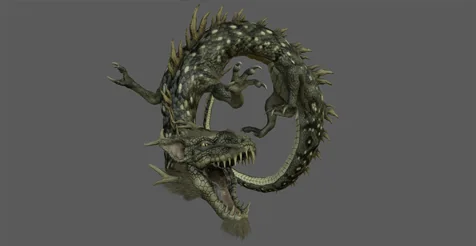
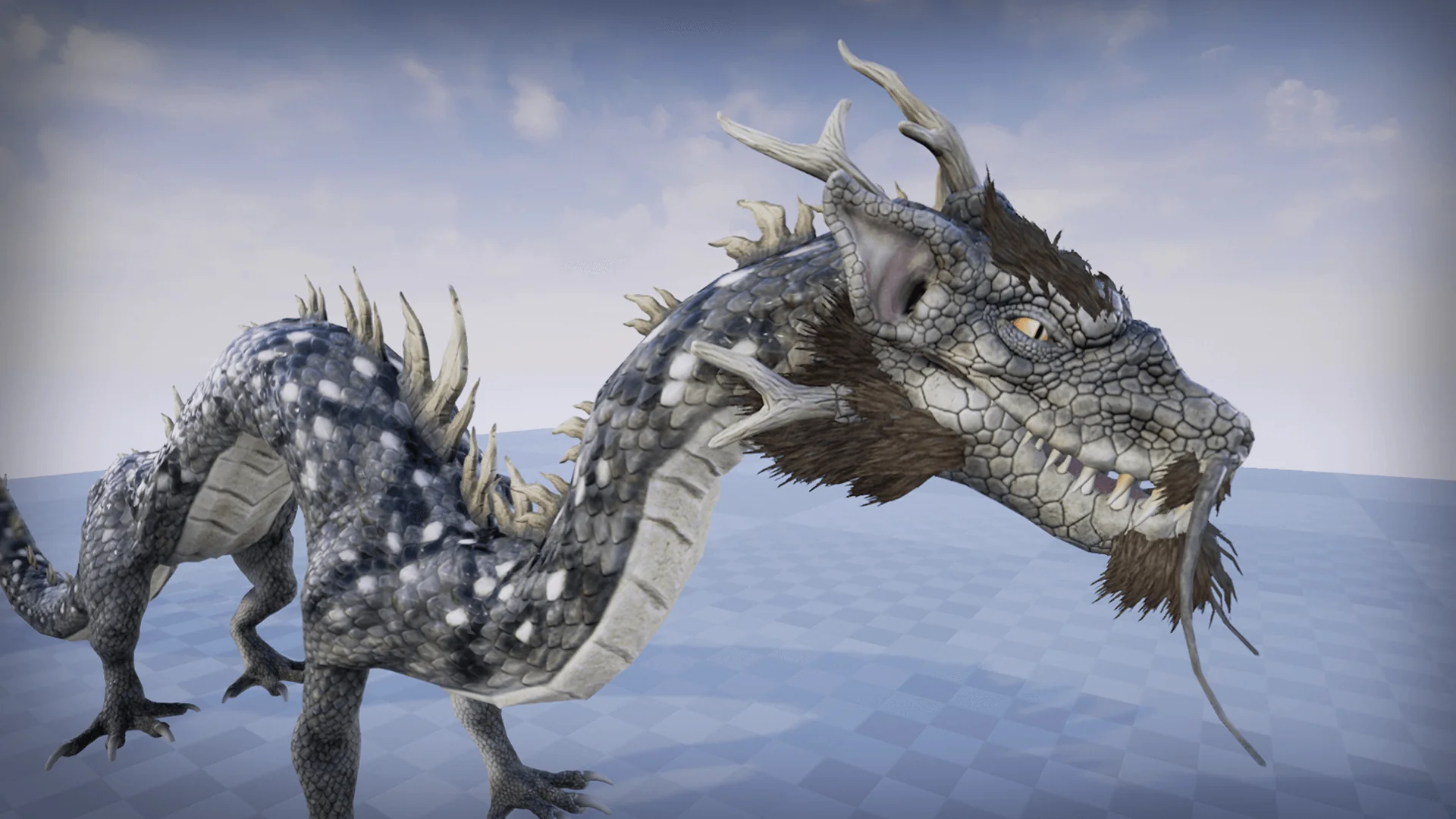
Real-time serpentine creatures present a unique set of technical requirements inside a modern graphics engine. The Black Dragon provides an Asian-inspired creature model configured with an articulated skeletal chain, a balanced polygon budget, dual material assignments, high-resolution textures, and dedicated behavioral assets. Its combination of low-poly optimization and realistic detailing makes it a versatile element for fantasy environments requiring an exotic, serpentine reptilian presence.
The Black Dragon Skeletal Hierarchy and Motion Set
Serpentine and Asian dragon morphologies demand a significantly higher density of skeletal articulation than standard quadrupeds or western dragon archetypes. The Black Dragon is built upon a 105-bone rig designed to accommodate fluid, undulating movements across its entire anatomy. Traditional vertebrate rigs allocate the majority of their bone counts to limbs and hands, but an Asian dragon must propagate motion continuously through an elongated spine, flowing whiskers, facial horns, and tail segments.
With 105 joints distributed throughout the skeleton, the rig allows secondary motion to travel through each spinal link without causing severe mesh folding or unweighted pinching. The skeletal setup controls both the dense anatomical chain of the body and the mobile appendages, giving the dragon the mechanical infrastructure needed for expressive poses. Facial structures, chin barbels, and expressive head elements receive dedicated joints that let the creature react dynamically during movement cycles.
Driving this 105-bone rig is an included set of 22 distinct animations. These motion assets supply the foundation for essential gameplay states, ranging from baseline idles and locomotion sequences to dramatic actions and transitions. Distributing 22 animations across an Asian dragon skeleton ensures that developers do not have to hand-craft basic locomotion or flight arcs, providing an out-of-the-box movement vocabulary that handles the undulating mechanics characteristic of Eastern fantasy creatures.
Triangulation Budget and Mesh Density in the 32 Ktris Silhouette
At 32 Ktris (32,000 triangles), the geometry of the Black Dragon sits at a balanced midpoint between performance economy and silhouette detail. Long, winding bodies present a severe risk of silhouette degradation if the polygon budget is throttled too low. A polygonal count of 32,000 triangles gives the mesh sufficient cross-sectional subdivisions to maintain smooth tubular curves when the body bends sharply along extreme arcs during flight or coiling animations.
The mesh distribution focuses geometric density where joint deformation is most frequent. The spinal segments, limb sockets, jaw articulation, and neck curvature retain enough edge loops to bend smoothly under the influence of the 105 bones without exposing faceted, hard-edged breaks in the silhouette. Claws, horns, spinal ridges, and expressive head contours utilize targeted edge placement to achieve a crisp, realistic profile without bloating the overall polygon budget into an unmanageable tier for real-time rendering pipelines.
Classified under both lowpoly and realistic styling metrics, the model serves as an efficient candidate for real-time game scenes where multiple creatures, extensive terrain, or complex lighting setups compete for compute resources. The geometry achieves convincing organic volume while avoiding the extreme vertex density that typically strains real-time skinning evaluation on modern hardware.
Material Separation Between Dragon Body and Hair
Surface shading on the Black Dragon is partitioned into two distinct material slots: one assigned to the main body and one reserved specifically for hair. Splitting the model across two materials represents an efficient rendering strategy for organic fantasy creatures, isolating opaque surfaces from strand-based or card-based geometry that may require distinct shading parameters.
The main body material handles the vast majority of the creature's surface area, including reptilian scales, leathery skin folds, claws, teeth, and horns. Separating the hair onto its own material channel allows the flowing mane, beard, and whisker elements to receive tailored shading treatments, such as specialized opacity masking, subsurface scattering, or two-sided surface evaluation, without forcing those computational steps onto the entire scaly body mesh.
Texture maps in the package range up to 4096×4096 resolution. Supplying 4K resolution textures ensures that high-frequency surface details, including individual scale borders, skin creases, and horn grain, remain sharp even when camera angles push close to the creature's head or torso. The expansive resolution prevents the texturing from blurring across the elongated surface of the serpentine form, preserving the realistic aesthetic expected of an imposing mythological beast.
Black Dragon Control Logic and Ecosystem Integration
Beyond raw art assets, the package incorporates functional control architecture through the inclusion of script elements and an animation blueprint. Managing 22 animation clips on a 105-bone creature requires systematic state management to transition between ground motion, aerial flight, coiled pauses, and reactive strikes. The animation blueprint provides the operational logic necessary to blend between clips based on movement variables, direction, and engine events, minimizing the setup time needed to hook the creature into interactive mechanics.
The asset also maintains explicit compatibility with the Farm Animals Pack framework. This shared structural alignment ensures that developers utilizing that ecosystem can introduce the Black Dragon into their existing project architecture without re-engineering character controllers, movement logic, or asset organization conventions from scratch. By adhering to the same baseline compatibility, the asset bridges fantasy creature mechanics with pre-established animal control systems.
Through its 32 Ktris mesh, high-resolution 4K dual-material setup, comprehensive 105-bone skeleton, and automated animation blueprint logic, the Black Dragon delivers a complete, production-ready creature pipeline tailored for complex fantasy environments.
 Characters
 Characters
 Characters
 Characters