"148d1066ed74e216"{"id":"1002965","slug":"wendigo","title":"Wendigo","category":"Characters \u0026 Creatures","engine":"4.18+,5.0+","assetVersion":"","engineVersion":"Engine Version: 4.18+,5.0+","tag":"Characters","accent":"blue","visual":"character","summary":"Technical analysis of the low-poly Wendigo creature model, detailing its UE4-to-UE5 skeletal structure, extra accessory bones, textures, and 17 animations.","platform":"Unreal Engine","indexPolicy":"index","publishedAt":"2026-11-22T12:56:32.744Z","updatedAt":"2026-11-22T12:56:32.744Z","sourceNotes":[],"fileContents":[],"compatibility":["Unreal Engine","Engine Version: 4.18+,5.0+"],"featuredImage":{"alt":"Wendigo","src":"/wp-content/uploads/published/2026/11/feeb708c78ed-8367564e-05f0-4d1c-99c9-ac207c8ac657-332528d432.webp"},"fileSizeBytes":243996955,"hasDownloadLink":true,"downloads":0,"terms":[{"taxonomy":"category","slug":"characters-and-creatures","name":"Characters \u0026 Creatures"}],"galleryImages":[{"src":"/wp-content/uploads/published/2026/11/f26d712adbe9-a5824486-c13a-4cf2-966c-ddd7b4ad2dd5-e9d99e97ad.webp","alt":"Wendigo"},{"src":"/wp-content/uploads/published/2026/11/a4f6f45b85a4-298d09f5-d026-44c5-a3b2-b3242ba2caa6-e4614604a9.webp","alt":"Wendigo"},{"src":"/wp-content/uploads/published/2026/11/ab986b5e66cc-4c9a3306-d0c1-4f3e-904f-0ef592918253-d5e937ba24.webp","alt":"Wendigo"},{"src":"/wp-content/uploads/published/2026/11/48ea0820b0d6-24c32e77-cea8-4ae9-8f83-46e20e5c3ac7-93a8878f81.webp","alt":"Wendigo"},{"src":"/wp-content/uploads/published/2026/11/f8c6ac2ee540-b9331969-6c0d-44a9-8f59-a1f3aaafed29-2170026b41.webp","alt":"Wendigo"},{"src":"/wp-content/uploads/published/2026/11/6facacc64f18-5f9fa237-53b6-4e77-841b-851d978943a7-50e04d135f.webp","alt":"Wendigo"},{"src":"/wp-content/uploads/published/2026/11/8dbbb6ccd8d4-07103b5e-b415-4004-95db-c30efcfe0d21-27e4d4bc00.webp","alt":"Wendigo"}],"accessPanel":{"kind":"resource","title":"Get this resource","safetyNote":"Resources are manually reviewed before listing to improve quality and reduce obvious risks.","fileName":"Content.7z","resourceType":"Resource archive","versions":[]},"contentHtml":"\u003cp\u003eA stalking creature lunging from shadowed terrain requires distinct physical articulation to communicate threat before combat even initiates. The low-poly Wendigo model provides a complete motion and mesh foundation engineered specifically for this type of encounter, bridging immediate hostile behaviors with a flexible skeletal hierarchy. Configured to serve across first-person horror titles, top-down strategy games, and open-world role-playing systems, the asset delivers a fully rigged silhouette capable of aggressive stalking, reactive staggers, and sudden frenzies.\u003c/p\u003e \u003ch2\u003eAnimating the Wendigo Across Movement and Combat States\u003c/h2\u003e\n\u003cp\u003eHostile creature logic relies on diverse locomotion blending to prevent combat encounters from feeling mechanical or repetitive. The Wendigo comes supplied with an animation library designed to accommodate multi-directional patrolling and varied offensive engagements. Movement is anchored by four distinct walking variations alongside a dedicated running cycle, allowing behavior trees to transition between slow, unnerving exploratory paces and swift charges toward the player. Directional adjustments are supported by two individual left and right strafing clips (Straif LR), enabling the model to circle targets or navigate tight perimeter paths without breaking stride.\u003c/p\u003e \u003cp\u003eStationary positioning utilizes three idle variants that convey tension while resting in environmental patrol zones or ambush spots. Combat logic is handled through four separate attack sequences, providing enough variety to build attack combos or stagger heavy and light hits without immediate visual looping. Taking damage is covered by three get-hit animations, ensuring the mesh responds plausibly when struck from different angles or weapons. The set also features a specialized rage animation, which can trigger during phase shifts, alert sequences, or boss encounters to broadcast increased threat. When defeated, three distinct death animations provide varied terminations, preventing repeated fallen-enemy bodies from showing identical resting postures across a battlefield.\u003c/p\u003e \u003ch2\u003eArticulating the Wendigo Skeleton and Accessory Chains\u003c/h2\u003e\n\u003cp\u003eUnderpinning the locomotion system is a specialized skeletal framework built on the Epic Skeleton hierarchy. While retaining core humanoid and beast-like proportions, the rig integrates dedicated extra bones designed to bring life to organic facial movement and dangling physical adornments. Mandibular motion is controlled by a multi-tiered jaw chain consisting of Jaw, Jaw1, Jaw2, and Jaw3. This four-stage jaw rigging allows animators to articulate deep unhinging bites, subtle guttural snarls, or prolonged roars with nuanced joint deformation rather than relying on stiff, single-pivot rotations.\u003c/p\u003e \u003cp\u003eSecondary motion on exterior elements is achieved through an asymmetric set of accessory bones distributed across the character's limbs. The left side includes five sequential attachment joints: left_acessories, left_acessories1, left_acessories2, left_acessories3, and left_acessories4. The right side features an extended chain of seven joints: right_acessories, right_acessories1, right_acessories2, right_acessories3, right_acessories4, right_acessories5, and right_acessories6. These bones provide targeted rigging points for dangling charms, severed trinkets, ragged fabric strands, or braided foliage, allowing technical artists to hook runtime dynamic physics or manual keyframing into the creature's appendages without interfering with the primary arm and spine weights.\u003c/p\u003e \u003ch2\u003ePolygon Budget and Two-Sided Shading Requirements\u003c/h2\u003e\n\u003cp\u003eThe mesh structure balances visual density against real-time rendering constraints. Geometric profiling places the Wendigo at 27,787 faces, 53,698 triangles, and 64,676 vertices. This polygon budget distributes sufficient geometric edge loops through the torso, elongated limbs, and expressive facial regions to preserve deformation volumes during extreme animations like running and attacking, while remaining light enough to deploy in strategy groups or crowded horde shooters.\u003c/p\u003e \u003cp\u003eA crucial consideration when setting up the rendering pipeline is the surface display mode. It is desirable to implement a material shader configured with two-sided display of polygons. Many organic silhouettes, frayed skin folds, decorative elements, and torn edges are built using single-plane geometry to maintain an efficient polygon footprint. Enabling two-sided rendering within the engine's master material prevents backface culling from turning hollow or inverted surfaces invisible when the camera catches dynamic, twisting movements during attacks or flinches.\u003c/p\u003e \u003ch2\u003eSurface Maps and Alternate Skin Pipelines\u003c/h2\u003e\n\u003cp\u003eShading across the Wendigo is structured through four dedicated materials powered by a complete 17-texture library. To accommodate both close-up first-person inspection and distant third-person or top-down rendering, texture map sets are authored at two distinct resolutions: 4096x4096 and 2048x2048. The higher-resolution maps capture fine anatomical detail, cracked textures, and subtle subsurface cues suitable for cutscenes or boss encounters, while the lower resolution maps keep memory footprints manageable when instancing multiple creatures.\u003c/p\u003e \u003cp\u003eVisual diversity is reinforced through two included skin variants. These alternative colorations allow level designers to signal varying regional origins, corrupted states, or encounter ranks—such as distinguishing pack leaders from standard wandering threats. Physical-based rendering workflows ensure that light interacts accurately across wet tissue, desiccated flesh, and bone-like structures under varied scene lighting, whether placed in an overcast medieval forest or a dim subterranean ruin.\u003c/p\u003e \u003ch2\u003eIntegrating the Creature Rig in Unreal Engine 5\u003c/h2\u003e\n\u003cp\u003eFor engine implementation, the base mesh is delivered in both FBX and Maya project formats, facilitating custom modifications to geometry, additional skinning tweaks, or authoring project-specific animations directly inside familiar authoring tools. The asset imports seamlessly into Unreal Engine 5 environments, with meshes, materials, and physics assets ready for blueprint assignment.\u003c/p\u003e \u003cp\u003eA vital architectural note centers on the skeletal framework: although the character is loaded and works cleanly in Unreal Engine 5, the skeleton itself utilizes an Unreal Engine 4 structure. Developers mapping this asset into Unreal Engine 5 animation blueprints or setting up retargeting chains must note this design choice. Utilizing an Unreal Engine 4 bone hierarchy within an Unreal Engine 5 project means retargeting profiles, mannequin mappings, and IK rigs should be matched against the UE4 Epic Skeleton standard rather than the updated default UE5 mannequin structure. Once properly accounted for, the Wendigo provides an immediate, versatile creature ready for custom AI blueprints, state machines, and environmental encounters.\u003c/p\u003e\n\n\u003ch2\u003eRelated Resources Worth Checking\u003c/h2\u003e\n\u003cul\u003e\n\u003cli\u003e\u003ca href=\"https://3dcghub.com/mr-plague-doctor/\" rel=\"noopener noreferrer\"\u003emr. Plague Doctor\u003c/a\u003e\u003c/li\u003e\n\u003cli\u003e\u003ca href=\"https://3dcghub.com/defender-girl/\" rel=\"noopener noreferrer\"\u003eDefender Girl\u003c/a\u003e\u003c/li\u003e\n\u003cli\u003e\u003ca href=\"https://3dcghub.com/heavyknight/\" rel=\"noopener noreferrer\"\u003eHeavyKnight\u003c/a\u003e\u003c/li\u003e\n\u003cli\u003e\u003ca href=\"https://3dcghub.com/cyberpunk-character/\" rel=\"noopener noreferrer\"\u003eCyberpunk Character\u003c/a\u003e\u003c/li\u003e\n\u003cli\u003e\u003ca href=\"https://3dcghub.com/modern-character/\" rel=\"noopener noreferrer\"\u003eModern character\u003c/a\u003e\u003c/li\u003e\n\u003c/ul\u003e","contentTextLength":7010,"navigation":{"current":4,"total":4890,"previous":{"id":"1002966","slug":"wild-tribe-warriors","title":"Wild Tribe warriors","category":"Characters \u0026 Creatures","platform":"Unreal Engine","updatedAt":"2026-11-22T12:58:29.358Z"},"next":{"id":"1002964","slug":"unka-the-dragon","title":"Unka the Dragon","category":"Characters \u0026 Creatures","platform":"Unreal Engine","updatedAt":"2026-11-22T12:54:21.216Z"}},"relatedResources":[{"id":"1002490","slug":"mr-plague-doctor","title":"mr. Plague Doctor","category":"Characters \u0026 Creatures","engine":"4.18+,5.0+","assetVersion":"","engineVersion":"Engine Version: 4.18+,5.0+","tag":"Characters","accent":"blue","visual":"character","summary":"Technical analysis of mr. Plague Doctor, covering its low-poly geometry, Epic Skeleton v4 rig, 39 animations, and 2048x2048 PBR metallic texture workflow.","platform":"Unreal Engine","indexPolicy":"index","publishedAt":"2026-11-12T03:55:35.329Z","updatedAt":"2026-11-12T03:55:35.329Z","sourceNotes":[],"fileContents":[],"compatibility":["Unreal Engine","Engine Version: 4.18+,5.0+"],"featuredImage":{"alt":"mr. Plague Doctor","src":"/wp-content/uploads/published/2026/11/640616c0ad64-a2624ca2-2168-47eb-b4a4-cdcc8a3a16a3-a60fbb70df.webp"},"fileSizeBytes":149353184,"hasDownloadLink":true,"downloads":0},{"id":"1002473","slug":"defender-girl","title":"Defender Girl","category":"Characters \u0026 Creatures","engine":"4.18+,5.0+","assetVersion":"","engineVersion":"Engine Version: 4.18+,5.0+","tag":"Characters","accent":"blue","visual":"character","summary":"Technical breakdown of the Defender Girl low-poly character model, covering its UE4 skeleton in UE5, PBR textures, tissue physics, and mesh metrics.","platform":"Unreal Engine","indexPolicy":"index","publishedAt":"2026-11-12T03:21:41.247Z","updatedAt":"2026-11-12T03:21:41.247Z","sourceNotes":[],"fileContents":[],"compatibility":["Unreal Engine","Engine Version: 4.18+,5.0+"],"featuredImage":{"alt":"Defender Girl","src":"/wp-content/uploads/published/2026/11/34ebf783c1cb-7e1bc220-ffb4-405c-a452-f998b5628309-21cc64a9cc.webp"},"fileSizeBytes":707677160,"hasDownloadLink":true,"downloads":0},{"id":"1002531","slug":"heavyknight","title":"HeavyKnight","category":"Characters \u0026 Creatures","engine":"4.18+,5.0+","assetVersion":"","engineVersion":"Engine Version: 4.18+,5.0+","tag":"Characters","accent":"blue","visual":"character","summary":"A low-poly medieval HeavyKnight character model featuring UE4 Epic skeleton rigging, tissue physics, 4K and 2K PBR textures, and Unreal Engine 5 readiness.","platform":"Unreal Engine","indexPolicy":"index","publishedAt":"2026-11-13T09:29:35.306Z","updatedAt":"2026-11-13T09:29:35.306Z","sourceNotes":[],"fileContents":[],"compatibility":["Unreal Engine","Engine Version: 4.18+,5.0+"],"featuredImage":{"alt":"HeavyKnight","src":"/wp-content/uploads/published/2026/11/582da6741401-55e55d2c-d2be-4396-8e4a-82dd9b756769-e2a56c4444.webp"},"fileSizeBytes":198051759,"hasDownloadLink":true,"downloads":0}]}[{"id":4225,"sourceId":4225,"taxonomyId":4225,"taxonomy":"category","slug":"asset-library","name":"Asset Library","parentId":null,"count":4744,"hasChildren":true,"href":"/","seoTitle":"Free Game Assets Library | 3DCGHUB","seoDescription":"Browse free Unreal Engine, Unity, Blender assets and game development tutorials on 3DCGHUB with previews, compatibility notes, and secure downloads.","sitemapEnabled":true,"children":[{"id":4227,"sourceId":4227,"taxonomyId":4227,"taxonomy":"category","slug":"blender-add-ons-plugins","name":"Blender Add-ons \u0026 Plugins","parentId":4225,"count":10,"hasChildren":false,"href":"/category/blender-add-ons-plugins/","seoTitle":"Free Blender Add-ons \u0026 Plugins | 3DCGHUB","seoDescription":"Browse free Blender Add-ons \u0026 Plugins tools for Blender on 3DCGHUB: curated downloads with preview images, compatibility notes and secure download access.","sitemapEnabled":true},{"id":514,"sourceId":514,"taxonomyId":514,"taxonomy":"category","slug":"unity-2","name":"Unity","parentId":4225,"count":453,"hasChildren":true,"href":"/category/unity-2/","seoTitle":"Free Unity Assets | 3DCGHUB","seoDescription":"Browse free Unity resources on 3DCGHUB: curated downloads with preview images, compatibility notes and secure download access.","sitemapEnabled":true,"children":[{"id":523,"sourceId":523,"taxonomyId":523,"taxonomy":"category","slug":"2d","name":"2D","parentId":514,"count":1,"hasChildren":true,"href":"/category/2d/","seoTitle":"Free Unity 2D | 3DCGHUB","seoDescription":"Browse free 2D assets for Unity on 3DCGHUB: curated downloads with preview images, compatibility notes and secure download access.","sitemapEnabled":true},{"id":515,"sourceId":515,"taxonomyId":515,"taxonomy":"category","slug":"3d-unity-2","name":"3D","parentId":514,"count":162,"hasChildren":true,"href":"/category/3d-unity-2/","seoTitle":"Free Unity 3D Assets | 3DCGHUB","seoDescription":"Browse free 3D assets for Unity on 3DCGHUB: curated downloads with preview images, compatibility notes and secure download access.","sitemapEnabled":true},{"id":565,"sourceId":565,"taxonomyId":565,"taxonomy":"category","slug":"add-ons","name":"Add-Ons","parentId":514,"count":2,"hasChildren":false,"href":"/category/add-ons/","seoTitle":"Free Unity Add-Ons | 3DCGHUB","seoDescription":"Browse free Add-Ons assets for Unity on 3DCGHUB: curated downloads with preview images, compatibility notes and secure download access.","sitemapEnabled":true},{"id":529,"sourceId":529,"taxonomyId":529,"taxonomy":"category","slug":"audio-unity-2","name":"Audio","parentId":514,"count":1,"hasChildren":true,"href":"/category/audio-unity-2/","seoTitle":"Free Unity Audio | 3DCGHUB","seoDescription":"Browse free Audio for Unity on 3DCGHUB: curated downloads with preview images, compatibility notes and secure download access.","sitemapEnabled":true},{"id":557,"sourceId":557,"taxonomyId":557,"taxonomy":"category","slug":"templates","name":"Templates","parentId":514,"count":36,"hasChildren":true,"href":"/category/templates/","seoTitle":"Free Unity Templates | 3DCGHUB","seoDescription":"Browse free Unity project templates on 3DCGHUB. Starter kits with previews, compatibility notes, and secure download access.","sitemapEnabled":true},{"id":533,"sourceId":533,"taxonomyId":533,"taxonomy":"category","slug":"tools-unity-2","name":"Tools","parentId":514,"count":0,"hasChildren":true,"href":"/category/tools-unity-2/","sitemapEnabled":true},{"id":554,"sourceId":554,"taxonomyId":554,"taxonomy":"category","slug":"vfx-unity-2","name":"VFX","parentId":514,"count":4,"hasChildren":true,"href":"/category/vfx-unity-2/","seoTitle":"Free Unity VFX | 3DCGHUB","seoDescription":"Browse free VFX for Unity on 3DCGHUB: curated downloads with preview images, compatibility notes and secure download access.","sitemapEnabled":true}]},{"id":511,"sourceId":511,"taxonomyId":511,"taxonomy":"category","slug":"unreal-engine-2","name":"Unreal Engine","parentId":4225,"count":4282,"hasChildren":true,"href":"/category/unreal-engine-2/","seoTitle":"Free Unreal Engine Assets | 3DCGHUB","seoDescription":"Browse free Unreal Engine resources on 3DCGHUB: curated downloads with preview images, compatibility notes and secure download access.","sitemapEnabled":true,"children":[{"id":54,"sourceId":54,"taxonomyId":54,"taxonomy":"category","slug":"3d","name":"3D","parentId":511,"count":2428,"hasChildren":true,"href":"/category/3d/","seoTitle":"Free Unreal Engine 3D | 3DCGHUB","seoDescription":"Browse free 3D assets for Unreal Engine on 3DCGHUB: curated downloads with preview images, compatibility notes and secure download access.","sitemapEnabled":true},{"id":441,"sourceId":441,"taxonomyId":441,"taxonomy":"category","slug":"animations","name":"Animations","parentId":511,"count":245,"hasChildren":true,"href":"/category/animations/","seoTitle":"Free Unreal Engine Animations | 3DCGHUB","seoDescription":"Browse free Animations for Unreal Engine on 3DCGHUB: curated downloads with preview images, compatibility notes and secure download access.","sitemapEnabled":true},{"id":446,"sourceId":446,"taxonomyId":446,"taxonomy":"category","slug":"audio","name":"Audio","parentId":511,"count":63,"hasChildren":true,"href":"/category/audio/","seoTitle":"Free Unreal Engine Audio Resources | 3DCGHUB","seoDescription":"Browse free Unreal Engine audio resources including sound effects, voices, dialogue, and ambient sounds. Curated free downloads on 3DCGHUB.","sitemapEnabled":true},{"id":466,"sourceId":466,"taxonomyId":466,"taxonomy":"category","slug":"game-systems","name":"Game Systems","parentId":511,"count":356,"hasChildren":true,"href":"/category/game-systems/","seoTitle":"Free Unreal Engine Game Systems | 3DCGHUB","seoDescription":"Browse free Game Systems tools for Unreal Engine on 3DCGHUB: curated downloads with preview images, compatibility notes and secure download access.","sitemapEnabled":true},{"id":478,"sourceId":478,"taxonomyId":478,"taxonomy":"category","slug":"game-templates","name":"Game Templates","parentId":511,"count":150,"hasChildren":true,"href":"/category/game-templates/","seoTitle":"Free Unreal Engine Game Templates | 3DCGHUB","seoDescription":"Browse free Game Templates for Unreal Engine on 3DCGHUB: curated downloads with preview images, compatibility notes and secure download access.","sitemapEnabled":true},{"id":432,"sourceId":432,"taxonomyId":432,"taxonomy":"category","slug":"hdri","name":"HDRI","parentId":511,"count":6,"hasChildren":true,"href":"/category/hdri/","seoTitle":"Free Unreal Engine HDRI | 3DCGHUB","seoDescription":"Browse free Unreal Engine HDRI skies and lighting maps on 3DCGHUB. Environment lighting with previews and secure downloads.","sitemapEnabled":true},{"id":228,"sourceId":228,"taxonomyId":228,"taxonomy":"category","slug":"material-and-textures","name":"Material \u0026 Textures","parentId":511,"count":172,"hasChildren":true,"href":"/category/material-and-textures/","seoTitle":"Free Unreal Engine Material \u0026 Textures | 3DCGHUB","seoDescription":"Browse free Material \u0026 Textures for Unreal Engine on 3DCGHUB: curated downloads with preview images, compatibility notes and secure download access.","sitemapEnabled":true},{"id":298,"sourceId":298,"taxonomyId":298,"taxonomy":"category","slug":"sprites-and-flipbooks","name":"Sprites \u0026 Flipbooks","parentId":511,"count":17,"hasChildren":true,"href":"/category/sprites-and-flipbooks/","seoTitle":"Free Unreal Engine Sprites \u0026 Flipbooks | 3DCGHUB","seoDescription":"Browse free Sprites \u0026 Flipbooks assets for Unreal Engine on 3DCGHUB: curated downloads with preview images, compatibility notes and secure download access.","sitemapEnabled":true},{"id":489,"sourceId":489,"taxonomyId":489,"taxonomy":"category","slug":"tools-and-plugins","name":"Tools \u0026 Plugins","parentId":511,"count":390,"hasChildren":true,"href":"/category/tools-and-plugins/","seoTitle":"Free Unreal Engine Tools \u0026 Plugins | 3DCGHUB","seoDescription":"Browse free Tools \u0026 Plugins for Unreal Engine on 3DCGHUB: curated downloads with preview images, compatibility notes and secure download access.","sitemapEnabled":true},{"id":459,"sourceId":459,"taxonomyId":459,"taxonomy":"category","slug":"ui","name":"UI","parentId":511,"count":43,"hasChildren":true,"href":"/category/ui/","seoTitle":"Free Unreal Engine UI | 3DCGHUB","seoDescription":"Browse free UI for Unreal Engine on 3DCGHUB: curated downloads with preview images, compatibility notes and secure download access.","sitemapEnabled":true},{"id":450,"sourceId":450,"taxonomyId":450,"taxonomy":"category","slug":"vfx","name":"VFX","parentId":511,"count":412,"hasChildren":true,"href":"/category/vfx/","seoTitle":"Free Unreal Engine VFX | 3DCGHUB","seoDescription":"Browse free VFX for Unreal Engine on 3DCGHUB: curated downloads with preview images, compatibility notes and secure download access.","sitemapEnabled":true}]}]},{"id":4222,"sourceId":4222,"taxonomyId":4222,"taxonomy":"category","slug":"tutorial-library","name":"Tutorial Library","parentId":null,"count":117,"hasChildren":false,"href":"/tutorials/","seoTitle":"Free Game Development Tutorial Library | 3DCGHUB","seoDescription":"Browse free game development tutorials for Unreal Engine, Unity, Blender, and more on 3DCGHUB with practical workflows and secure downloads.","sitemapEnabled":true}]
Resource screenshots
1 / 7
Join our channel
Follow 3DCGHUB on Telegram for new resource drops, migration updates, and community notices.
Resources are manually reviewed before listing to improve quality and reduce obvious risks.
No account required
Characters
Wendigo
Technical analysis of the low-poly Wendigo creature model, detailing its UE4-to-UE5 skeletal structure, extra accessory bones, textures, and 17 animations.
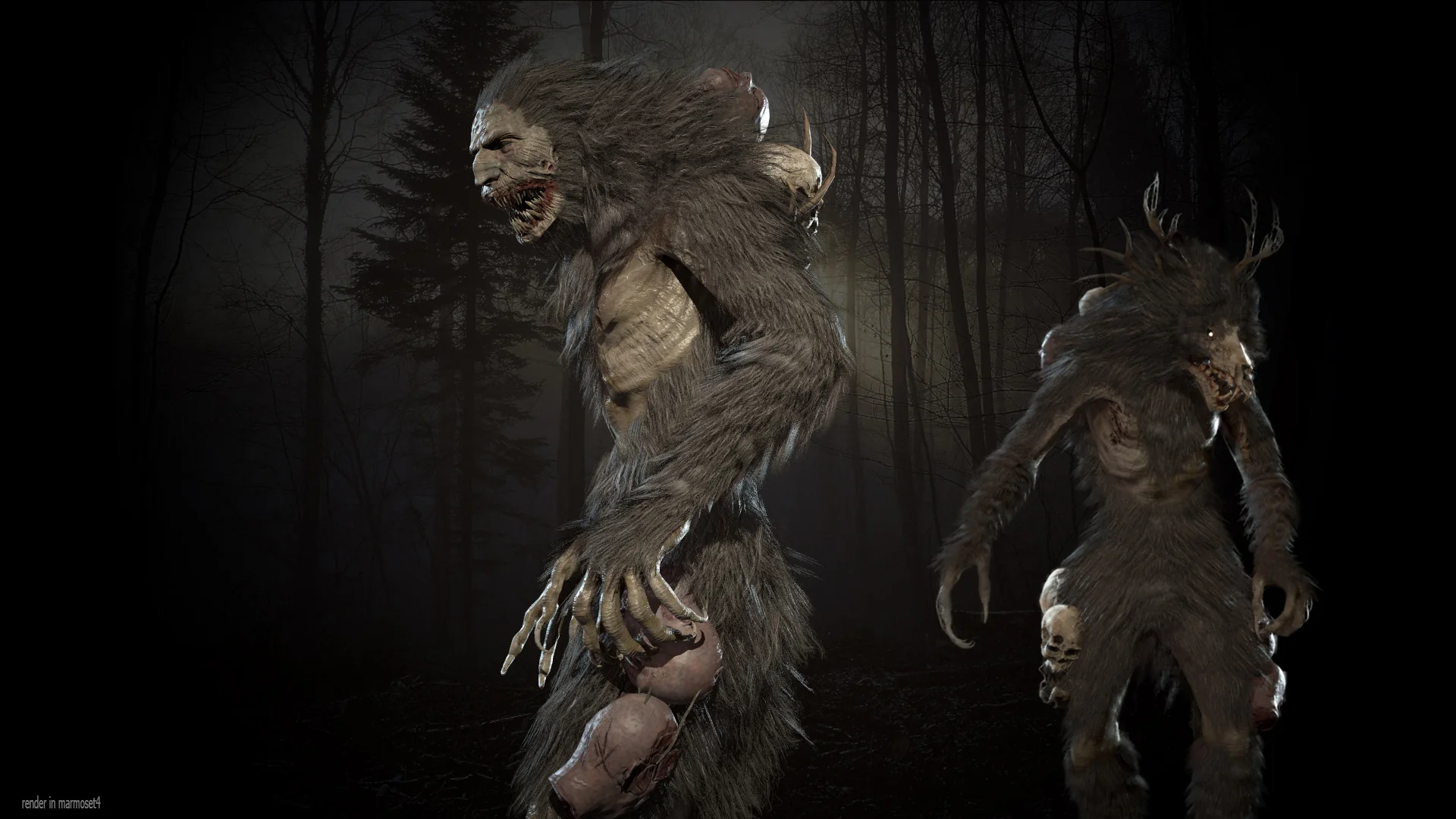
A stalking creature lunging from shadowed terrain requires distinct physical articulation to communicate threat before combat even initiates. The low-poly Wendigo model provides a complete motion and mesh foundation engineered specifically for this type of encounter, bridging immediate hostile behaviors with a flexible skeletal hierarchy. Configured to serve across first-person horror titles, top-down strategy games, and open-world role-playing systems, the asset delivers a fully rigged silhouette capable of aggressive stalking, reactive staggers, and sudden frenzies.
Animating the Wendigo Across Movement and Combat States
Hostile creature logic relies on diverse locomotion blending to prevent combat encounters from feeling mechanical or repetitive. The Wendigo comes supplied with an animation library designed to accommodate multi-directional patrolling and varied offensive engagements. Movement is anchored by four distinct walking variations alongside a dedicated running cycle, allowing behavior trees to transition between slow, unnerving exploratory paces and swift charges toward the player. Directional adjustments are supported by two individual left and right strafing clips (Straif LR), enabling the model to circle targets or navigate tight perimeter paths without breaking stride.
Stationary positioning utilizes three idle variants that convey tension while resting in environmental patrol zones or ambush spots. Combat logic is handled through four separate attack sequences, providing enough variety to build attack combos or stagger heavy and light hits without immediate visual looping. Taking damage is covered by three get-hit animations, ensuring the mesh responds plausibly when struck from different angles or weapons. The set also features a specialized rage animation, which can trigger during phase shifts, alert sequences, or boss encounters to broadcast increased threat. When defeated, three distinct death animations provide varied terminations, preventing repeated fallen-enemy bodies from showing identical resting postures across a battlefield.
Articulating the Wendigo Skeleton and Accessory Chains
Underpinning the locomotion system is a specialized skeletal framework built on the Epic Skeleton hierarchy. While retaining core humanoid and beast-like proportions, the rig integrates dedicated extra bones designed to bring life to organic facial movement and dangling physical adornments. Mandibular motion is controlled by a multi-tiered jaw chain consisting of Jaw, Jaw1, Jaw2, and Jaw3. This four-stage jaw rigging allows animators to articulate deep unhinging bites, subtle guttural snarls, or prolonged roars with nuanced joint deformation rather than relying on stiff, single-pivot rotations.
Secondary motion on exterior elements is achieved through an asymmetric set of accessory bones distributed across the character's limbs. The left side includes five sequential attachment joints: left_acessories, left_acessories1, left_acessories2, left_acessories3, and left_acessories4. The right side features an extended chain of seven joints: right_acessories, right_acessories1, right_acessories2, right_acessories3, right_acessories4, right_acessories5, and right_acessories6. These bones provide targeted rigging points for dangling charms, severed trinkets, ragged fabric strands, or braided foliage, allowing technical artists to hook runtime dynamic physics or manual keyframing into the creature's appendages without interfering with the primary arm and spine weights.
Polygon Budget and Two-Sided Shading Requirements
The mesh structure balances visual density against real-time rendering constraints. Geometric profiling places the Wendigo at 27,787 faces, 53,698 triangles, and 64,676 vertices. This polygon budget distributes sufficient geometric edge loops through the torso, elongated limbs, and expressive facial regions to preserve deformation volumes during extreme animations like running and attacking, while remaining light enough to deploy in strategy groups or crowded horde shooters.
A crucial consideration when setting up the rendering pipeline is the surface display mode. It is desirable to implement a material shader configured with two-sided display of polygons. Many organic silhouettes, frayed skin folds, decorative elements, and torn edges are built using single-plane geometry to maintain an efficient polygon footprint. Enabling two-sided rendering within the engine's master material prevents backface culling from turning hollow or inverted surfaces invisible when the camera catches dynamic, twisting movements during attacks or flinches.
Surface Maps and Alternate Skin Pipelines
Shading across the Wendigo is structured through four dedicated materials powered by a complete 17-texture library. To accommodate both close-up first-person inspection and distant third-person or top-down rendering, texture map sets are authored at two distinct resolutions: 4096x4096 and 2048x2048. The higher-resolution maps capture fine anatomical detail, cracked textures, and subtle subsurface cues suitable for cutscenes or boss encounters, while the lower resolution maps keep memory footprints manageable when instancing multiple creatures.
Visual diversity is reinforced through two included skin variants. These alternative colorations allow level designers to signal varying regional origins, corrupted states, or encounter ranks—such as distinguishing pack leaders from standard wandering threats. Physical-based rendering workflows ensure that light interacts accurately across wet tissue, desiccated flesh, and bone-like structures under varied scene lighting, whether placed in an overcast medieval forest or a dim subterranean ruin.
Integrating the Creature Rig in Unreal Engine 5
For engine implementation, the base mesh is delivered in both FBX and Maya project formats, facilitating custom modifications to geometry, additional skinning tweaks, or authoring project-specific animations directly inside familiar authoring tools. The asset imports seamlessly into Unreal Engine 5 environments, with meshes, materials, and physics assets ready for blueprint assignment.
A vital architectural note centers on the skeletal framework: although the character is loaded and works cleanly in Unreal Engine 5, the skeleton itself utilizes an Unreal Engine 4 structure. Developers mapping this asset into Unreal Engine 5 animation blueprints or setting up retargeting chains must note this design choice. Utilizing an Unreal Engine 4 bone hierarchy within an Unreal Engine 5 project means retargeting profiles, mannequin mappings, and IK rigs should be matched against the UE4 Epic Skeleton standard rather than the updated default UE5 mannequin structure. Once properly accounted for, the Wendigo provides an immediate, versatile creature ready for custom AI blueprints, state machines, and environmental encounters.
 Characters
 Characters
 Characters