"07a32e720bd988c8"{"id":"1002473","slug":"defender-girl","title":"Defender Girl","category":"Characters \u0026 Creatures","engine":"4.18+,5.0+","assetVersion":"","engineVersion":"Engine Version: 4.18+,5.0+","tag":"Characters","accent":"blue","visual":"character","summary":"Technical breakdown of the Defender Girl low-poly character model, covering its UE4 skeleton in UE5, PBR textures, tissue physics, and mesh metrics.","platform":"Unreal Engine","indexPolicy":"index","publishedAt":"2026-11-12T03:21:41.247Z","updatedAt":"2026-11-12T03:21:41.247Z","sourceNotes":[],"fileContents":[],"compatibility":["Unreal Engine","Engine Version: 4.18+,5.0+"],"featuredImage":{"alt":"Defender Girl","src":"/wp-content/uploads/published/2026/11/34ebf783c1cb-7e1bc220-ffb4-405c-a452-f998b5628309-21cc64a9cc.webp"},"hasDownloadLink":true,"downloads":0,"terms":[{"taxonomy":"category","slug":"characters-and-creatures","name":"Characters \u0026 Creatures"}],"galleryImages":[{"src":"/wp-content/uploads/published/2026/11/2e7db5de7a7f-e4dfaa19-a1e8-4366-a5f8-dc042cc24d70-72ff63c166.webp","alt":"Defender Girl"},{"src":"/wp-content/uploads/published/2026/11/10675f1f052e-f5743077-dccf-4ba5-b926-e7a2fa465ebb-78abdb6f81.webp","alt":"Defender Girl"},{"src":"/wp-content/uploads/published/2026/11/6d75214e1060-5f9d41a5-46f2-4500-819e-ea6ae012bf1d-eb970abe45.webp","alt":"Defender Girl"},{"src":"/wp-content/uploads/published/2026/11/3afa7d0ecb7b-414000ea-ed57-4efb-9246-148d116dd224-08489a5b57.webp","alt":"Defender Girl"},{"src":"/wp-content/uploads/published/2026/11/15633d1b9f2c-8dd4e691-ed3c-45ba-9a44-128689b1a284-a2cf597f17.webp","alt":"Defender Girl"},{"src":"/wp-content/uploads/published/2026/11/60674612c76e-a23622d0-688f-409b-b821-fd48859a8d2c-bbe93ce39b.webp","alt":"Defender Girl"},{"src":"/wp-content/uploads/published/2026/11/036ecac69602-1171939d-1b22-4810-b458-20da94325c31-bb741ef716.webp","alt":"Defender Girl"},{"src":"/wp-content/uploads/published/2026/11/5dfd2df78cc5-e11a933b-d34f-4143-9675-f0ddb3d923ef-c25d4f8cbf.webp","alt":"Defender Girl"}],"accessPanel":{"kind":"resource","title":"Get this resource","eyebrow":"Free resource","message":"Download this resource in your browser.","fileName":"Content.7z","safetyNote":"Resources are manually reviewed before listing to improve quality and reduce obvious risks.","actionLabel":"Get this resource","resourceType":"Resource archive","versions":[]},"contentHtml":"\u003ch2\u003eIntegrating Defender Girl into Unreal Engine 5 Workflows\u003c/h2\u003e\u003cp\u003eWorking with the Defender Girl asset in modern real-time pipelines begins with a distinct technical consideration regarding engine generations. The model loads directly and functions inside Unreal Engine 5, yet the underlying bone hierarchy retains the foundational skeleton structure established in Unreal Engine 4. This specific architecture requires animators and technical artists to configure their character setups with that generational difference in mind.\u003c/p\u003e\u003cp\u003eBecause the asset utilizes an Epic skeleton layout derived from the Unreal Engine 4 format, retargeting workflows inside Unreal Engine 5 follow standard procedural translation routes. When pairing the mesh with Unreal Engine 5 Mannequin animation blueprints or existing UE4 animation libraries, the native UE4 bone naming conventions and joint orientations ensure immediate compatibility with legacy motion capture clips, attack cycles, and locomotion trees. The rig bypasses the need for manual bone renaming when working against standard UE4-targeted animation packages, saving time during the initial playable character setup.\u003c/p\u003e\u003cp\u003eFor projects making use of the Animation Blueprint system, the character hooks straight into state machines suited to standard humanoid combatants. The inclusion of scripted animation capabilities allows technical designers to blend between locomotion, directional dodging, and combat moves without building secondary deformation rigs from scratch. The Cerberus compatibility profile further extends its utility, providing reliable behavior when placed alongside matched pipeline tools and character frameworks.\u003c/p\u003e\u003ch2\u003eDeconstructing Defender Girl Geometry and Polycount\u003c/h2\u003e\u003cp\u003eReal-time optimization relies heavily on predictable triangle distribution, and the Defender Girl mesh operates within a distinct low-poly budget tailored for performance. The complete geometry registers at 25,484 faces, 21,861 vertices, and 31,464 triangles. This polygon density places the warrior model in a balanced tier suitable for dense combat scenarios, crowd placement, or third-person action environments where rendering overhead must remain tightly controlled.\u003c/p\u003e\u003cp\u003eA triangle count of 31,464 delivers enough localized density along deformation zones—such as elbows, knees, shoulders, and hips—to withstand wide dynamic poses during heavy weapon animations. The vertex distribution preserves structural silhouettes across the facial features and anatomy without relying on excessive micro-geometry. For mid-range action scenes, top-down strategy views, or survival scenarios where multiple primitive fighters share the screen, this polygon density provides clean edge loops while leaving sufficient GPU headroom for post-processing, volumetric lighting, and shadow passes.\u003c/p\u003e\u003cp\u003eThe structural silhouette supports both close-quarters cinematic combat and distant level navigation. Because the 21,861 vertices are grouped effectively across the anatomical form and its associated battle attachments, light passes cleanly across planar surfaces without rendering artifacts or pinched vertex normal seams during aggressive skeletal transformations.\u003c/p\u003e\u003ch2\u003ePhysics Simulation and Epic Skeleton Rigging\u003c/h2\u003e\u003cp\u003eBeyond standard rigid bone transformations, Defender Girl includes dedicated support for tissue physics. This dynamic component operates in tandem with the rigged Epic skeleton, introducing secondary motion to soft surface areas and specialized structural elements on the body. Real-time tissue physics mitigates the stiff, unnatural movement often seen in rigid low-poly character meshes when executing sudden stops, fast melee swings, or heavy impacts.\u003c/p\u003e\u003cp\u003eSetting up physics-driven soft tissues requires balancing simulation stiffness and collision volumes against the underlying skeletal movements. With the Epic skeleton handling the primary skeletal poses through the animation blueprint, dynamic cloth and tissue simulations take over secondary procedural movement. This layer of physics simulation responds organically to directional acceleration, gravity, and external forces, heightening physical realism across realistic combat encounters, primitive survival sequences, and fantasy battlegrounds.\u003c/p\u003e\u003cp\u003eThe integration between the primary rig and dynamic physics extends directly into combat mechanics. Whether the character is shifting weight during an evasive roll or absorbing a direct strike, the underlying skinning coordinates seamlessly with the active physics solvers. This reduces clipping between adjacent anatomical areas and ensures predictable motion throughout fast-paced fighting sequences.\u003c/p\u003e\u003ch2\u003eMaterials, Skins, and Combat Equipment Profiles\u003c/h2\u003e\u003cp\u003eDefender Girl comes with support for both 4K and 2K PBR (Physically Based Rendering) texture resolutions, allowing developers to scale visual fidelity according to hardware targets. The 4K texture set provides crisp surface responses, distinct material separations, and clear micro-surface detailing for close-up inspection, character selection menus, or high-end desktop platforms. When optimizing for tighter memory constraints or mobile performance profiles, the 2K textures offer a lighter texture footprint while retaining accurate roughness, metalness, and ambient occlusion values across the entire model.\u003c/p\u003e\u003cp\u003eVisual customization is handled through three distinct skin variations built into the package. These skin variants enable quick differentiation across multiple instances of the character, making it easy to field multiple warriors, clan members, or defenders without displaying identical visual themes. The textures accentuate the primal, medieval, and realistic warrior aesthetic, adapting readily to primitive fantasy environments, tribal skirmishes, or historical combat zones.\u003c/p\u003e\u003cp\u003eThe character package also features combat gear suited to direct confrontation, incorporating spear and shield loadouts. The spear provides long-reach thrusting and sweeping mechanics, while the shield balances the defensive capabilities required of a steadfast defender archetype. Both equipment elements align naturally with the woman warrior theme, supporting dynamic defensive stances, block reactions, and coordinated spear thrusts within any scripted combat system or animation blueprint workflow.\u003c/p\u003e\n\n\u003ch2\u003eMore From The Same Workflow\u003c/h2\u003e\n\u003cul\u003e\n\u003cli\u003e\u003ca href=\"https://3dcghub.com/novice-girl/\" rel=\"noopener noreferrer\"\u003eNovice Girl\u003c/a\u003e\u003c/li\u003e\n\u003cli\u003e\u003ca href=\"https://3dcghub.com/cyberpunk-sniper-girl/\" rel=\"noopener noreferrer\"\u003eCyberpunk Sniper Girl\u003c/a\u003e\u003c/li\u003e\n\u003cli\u003e\u003ca href=\"https://3dcghub.com/samantha-cyberpunk-girl/\" rel=\"noopener noreferrer\"\u003eSamantha - Cyberpunk girl\u003c/a\u003e\u003c/li\u003e\n\u003cli\u003e\u003ca href=\"https://3dcghub.com/forest-druid-girl/\" rel=\"noopener noreferrer\"\u003eForest Druid Girl\u003c/a\u003e\u003c/li\u003e\n\u003cli\u003e\u003ca href=\"https://3dcghub.com/cyberpunk-girl-2/\" rel=\"noopener noreferrer\"\u003eCyberpunk Girl\u003c/a\u003e\u003c/li\u003e\n\u003c/ul\u003e","contentTextLength":6378,"navigation":{"current":26,"total":4421,"previous":{"id":"1002474","slug":"esm-aida-s1-young-female-knight","title":"ESM Aida S1: young female knight","category":"Characters \u0026 Creatures","platform":"Unreal Engine","updatedAt":"2026-11-12T03:23:24.987Z"},"next":{"id":"1002472","slug":"cyberpunk-female-characters","title":"Cyberpunk female characters","category":"Characters \u0026 Creatures","platform":"Unreal Engine","updatedAt":"2026-11-12T03:19:32.975Z"}},"relatedResources":[{"id":"1002496","slug":"subculture-girl","title":"Subculture Girl","category":"Characters \u0026 Creatures","engine":"4.21+,5.0+","assetVersion":"","engineVersion":"Engine Version: 4.21+,5.0+","tag":"Characters","accent":"blue","visual":"character","summary":"Explore Subculture Girl for Unreal Engine, featuring modular clothing, 40 Blueprint combinations, NvCloth skirt physics, and deep material masking.","platform":"Unreal Engine","indexPolicy":"index","publishedAt":"2026-11-12T04:04:56.009Z","updatedAt":"2026-11-12T04:04:56.009Z","sourceNotes":[],"fileContents":[],"compatibility":["Unreal Engine","Engine Version: 4.21+,5.0+"],"featuredImage":{"alt":"Subculture Girl","src":"/wp-content/uploads/published/2026/11/68cbf763cdde-b8b88f11-ae6e-4044-828a-d9ec94b9c819-9cdc7bfc70.webp"},"hasDownloadLink":true,"downloads":0},{"id":"1002393","slug":"novice-girl","title":"Novice Girl","category":"Characters \u0026 Creatures","engine":"4.19+,5.0+","assetVersion":"","engineVersion":"Engine Version: 4.19+,5.0+","tag":"Characters","accent":"blue","visual":"character","summary":"Explore the Novice Girl modular 3D character featuring Epic Skeleton retargeting, 4K PBR textures, custom secondary bones, and facial blendshapes.","platform":"Unreal Engine","indexPolicy":"index","publishedAt":"2026-11-10T04:18:53.597Z","updatedAt":"2026-11-10T04:18:53.597Z","sourceNotes":[],"fileContents":[],"compatibility":["Unreal Engine","Engine Version: 4.19+,5.0+"],"featuredImage":{"alt":"Novice Girl","src":"/wp-content/uploads/published/2026/11/e8273e779ef8-dcc4dcfd-4b9c-4e05-8d40-f18cadfc206b-6adc7cfe28.webp"},"hasDownloadLink":true,"downloads":0},{"id":"1001605","slug":"cyberpunk-sniper-girl","title":"Cyberpunk Sniper Girl","category":"Characters \u0026 Creatures","engine":"4.26+,5.0+","assetVersion":"","engineVersion":"Engine Version: 4.26+,5.0+","tag":"Characters","accent":"blue","visual":"character","summary":"Cyberpunk Sniper Girl character breakdown covering 4 body shapes, Epic Skeleton rigging, 10 4K PBR texture sets, and Apple ARKit facial blendshapes.","platform":"Unreal Engine","indexPolicy":"index","publishedAt":"2026-10-10T16:29:58.108Z","updatedAt":"2026-10-10T16:29:58.108Z","sourceNotes":[],"fileContents":[],"compatibility":["Unreal Engine","Engine Version: 4.26+,5.0+"],"featuredImage":{"alt":"Cyberpunk Sniper Girl","src":"/wp-content/uploads/published/2026/10/506286d4db2b-22acae93-9939-48b9-8849-2410b63ab75c-7980f17e44.webp"},"hasDownloadLink":true,"downloads":1}]}
Characters
Defender Girl
Technical breakdown of the Defender Girl low-poly character model, covering its UE4 skeleton in UE5, PBR textures, tissue physics, and mesh metrics.
Integrating Defender Girl into Unreal Engine 5 Workflows
Working with the Defender Girl asset in modern real-time pipelines begins with a distinct technical consideration regarding engine generations. The model loads directly and functions inside Unreal Engine 5, yet the underlying bone hierarchy retains the foundational skeleton structure established in Unreal Engine 4. This specific architecture requires animators and technical artists to configure their character setups with that generational difference in mind.
Because the asset utilizes an Epic skeleton layout derived from the Unreal Engine 4 format, retargeting workflows inside Unreal Engine 5 follow standard procedural translation routes. When pairing the mesh with Unreal Engine 5 Mannequin animation blueprints or existing UE4 animation libraries, the native UE4 bone naming conventions and joint orientations ensure immediate compatibility with legacy motion capture clips, attack cycles, and locomotion trees. The rig bypasses the need for manual bone renaming when working against standard UE4-targeted animation packages, saving time during the initial playable character setup.
For projects making use of the Animation Blueprint system, the character hooks straight into state machines suited to standard humanoid combatants. The inclusion of scripted animation capabilities allows technical designers to blend between locomotion, directional dodging, and combat moves without building secondary deformation rigs from scratch. The Cerberus compatibility profile further extends its utility, providing reliable behavior when placed alongside matched pipeline tools and character frameworks.
Deconstructing Defender Girl Geometry and Polycount
Real-time optimization relies heavily on predictable triangle distribution, and the Defender Girl mesh operates within a distinct low-poly budget tailored for performance. The complete geometry registers at 25,484 faces, 21,861 vertices, and 31,464 triangles. This polygon density places the warrior model in a balanced tier suitable for dense combat scenarios, crowd placement, or third-person action environments where rendering overhead must remain tightly controlled.
A triangle count of 31,464 delivers enough localized density along deformation zones—such as elbows, knees, shoulders, and hips—to withstand wide dynamic poses during heavy weapon animations. The vertex distribution preserves structural silhouettes across the facial features and anatomy without relying on excessive micro-geometry. For mid-range action scenes, top-down strategy views, or survival scenarios where multiple primitive fighters share the screen, this polygon density provides clean edge loops while leaving sufficient GPU headroom for post-processing, volumetric lighting, and shadow passes.
The structural silhouette supports both close-quarters cinematic combat and distant level navigation. Because the 21,861 vertices are grouped effectively across the anatomical form and its associated battle attachments, light passes cleanly across planar surfaces without rendering artifacts or pinched vertex normal seams during aggressive skeletal transformations.
Physics Simulation and Epic Skeleton Rigging
Beyond standard rigid bone transformations, Defender Girl includes dedicated support for tissue physics. This dynamic component operates in tandem with the rigged Epic skeleton, introducing secondary motion to soft surface areas and specialized structural elements on the body. Real-time tissue physics mitigates the stiff, unnatural movement often seen in rigid low-poly character meshes when executing sudden stops, fast melee swings, or heavy impacts.
Setting up physics-driven soft tissues requires balancing simulation stiffness and collision volumes against the underlying skeletal movements. With the Epic skeleton handling the primary skeletal poses through the animation blueprint, dynamic cloth and tissue simulations take over secondary procedural movement. This layer of physics simulation responds organically to directional acceleration, gravity, and external forces, heightening physical realism across realistic combat encounters, primitive survival sequences, and fantasy battlegrounds.
The integration between the primary rig and dynamic physics extends directly into combat mechanics. Whether the character is shifting weight during an evasive roll or absorbing a direct strike, the underlying skinning coordinates seamlessly with the active physics solvers. This reduces clipping between adjacent anatomical areas and ensures predictable motion throughout fast-paced fighting sequences.
Materials, Skins, and Combat Equipment Profiles
Defender Girl comes with support for both 4K and 2K PBR (Physically Based Rendering) texture resolutions, allowing developers to scale visual fidelity according to hardware targets. The 4K texture set provides crisp surface responses, distinct material separations, and clear micro-surface detailing for close-up inspection, character selection menus, or high-end desktop platforms. When optimizing for tighter memory constraints or mobile performance profiles, the 2K textures offer a lighter texture footprint while retaining accurate roughness, metalness, and ambient occlusion values across the entire model.
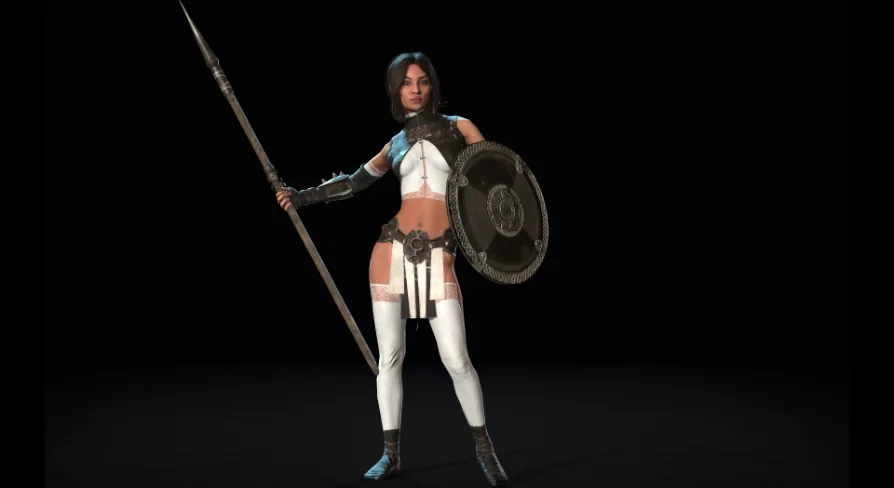
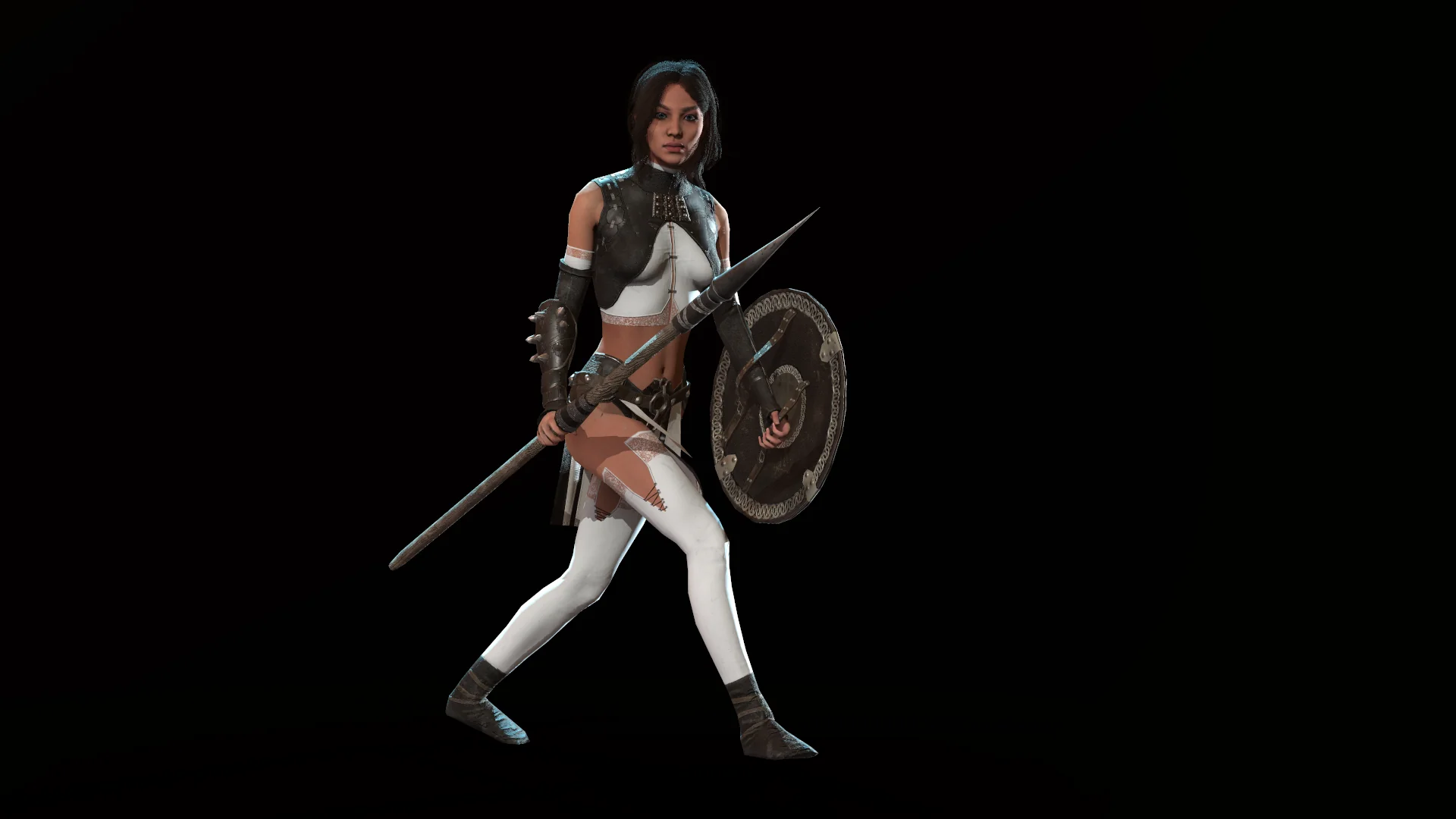
Visual customization is handled through three distinct skin variations built into the package. These skin variants enable quick differentiation across multiple instances of the character, making it easy to field multiple warriors, clan members, or defenders without displaying identical visual themes. The textures accentuate the primal, medieval, and realistic warrior aesthetic, adapting readily to primitive fantasy environments, tribal skirmishes, or historical combat zones.
The character package also features combat gear suited to direct confrontation, incorporating spear and shield loadouts. The spear provides long-reach thrusting and sweeping mechanics, while the shield balances the defensive capabilities required of a steadfast defender archetype. Both equipment elements align naturally with the woman warrior theme, supporting dynamic defensive stances, block reactions, and coordinated spear thrusts within any scripted combat system or animation blueprint workflow.
 Characters
 Characters
 Characters
 Characters