"07a32e720bd988c8"{"id":"1002496","slug":"subculture-girl","title":"Subculture Girl","category":"Characters \u0026 Creatures","engine":"4.21+,5.0+","assetVersion":"","engineVersion":"Engine Version: 4.21+,5.0+","tag":"Characters","accent":"blue","visual":"character","summary":"Explore Subculture Girl for Unreal Engine, featuring modular clothing, 40 Blueprint combinations, NvCloth skirt physics, and deep material masking.","platform":"Unreal Engine","indexPolicy":"index","publishedAt":"2026-11-12T04:04:56.009Z","updatedAt":"2026-11-12T04:04:56.009Z","sourceNotes":[],"fileContents":[],"compatibility":["Unreal Engine","Engine Version: 4.21+,5.0+"],"featuredImage":{"alt":"Subculture Girl","src":"/wp-content/uploads/published/2026/11/68cbf763cdde-b8b88f11-ae6e-4044-828a-d9ec94b9c819-9cdc7bfc70.webp"},"hasDownloadLink":true,"downloads":0,"terms":[{"taxonomy":"category","slug":"characters-and-creatures","name":"Characters \u0026 Creatures"}],"galleryImages":[{"src":"/wp-content/uploads/published/2026/11/fd0acbccb5bf-fbd46d0d-32d3-40bf-b65f-f479817aca08-bdd3a29f7b.webp","alt":"Subculture Girl"},{"src":"/wp-content/uploads/published/2026/11/c814650874f5-f62c6d06-6a09-4b13-9690-ea16822ea9c6-94a768f337.webp","alt":"Subculture Girl"},{"src":"/wp-content/uploads/published/2026/11/3bd651188c14-9bf7d957-943f-47ba-b083-e1e74429cacb-b707ffba37.webp","alt":"Subculture Girl"},{"src":"/wp-content/uploads/published/2026/11/ad79f72ec9fe-39fb979c-37ff-43a2-8524-1b3fc0555552-8d1ace47d2.webp","alt":"Subculture Girl"},{"src":"/wp-content/uploads/published/2026/11/026a04b11866-7ee537d5-e836-43a8-a89d-eea38119daf6-6786a0469e.webp","alt":"Subculture Girl"},{"src":"/wp-content/uploads/published/2026/11/ea3921363424-bc04f524-4739-4791-8e37-d8b90dda5ec6-638137c9db.webp","alt":"Subculture Girl"},{"src":"/wp-content/uploads/published/2026/11/2c8775c8044f-0bbbb8b1-6204-4bc5-b50a-9fced337e966-5e219cd5ac.webp","alt":"Subculture Girl"},{"src":"/wp-content/uploads/published/2026/11/fb13c8a300ca-6e95ac52-48fe-41a8-a6a9-619b0298aae3-c84185b361.webp","alt":"Subculture Girl"},{"src":"/wp-content/uploads/published/2026/11/273e3b3c09a2-c48c2789-fb75-44f7-9692-2549bd51b6ca-cbf5470b67.webp","alt":"Subculture Girl"},{"src":"/wp-content/uploads/published/2026/11/4e3b2652eb64-06e519ea-ac39-4d60-b9d4-cb58753f1bbb-707139a30c.webp","alt":"Subculture Girl"}],"accessPanel":{"kind":"resource","title":"Get this resource","eyebrow":"Free resource","message":"Download this resource in your browser.","fileName":"Content.7z","safetyNote":"Resources are manually reviewed before listing to improve quality and reduce obvious risks.","actionLabel":"Get this resource","resourceType":"Resource archive","versions":[]},"contentHtml":"\u003cp\u003eRunning through a third-person scene requires responsive character motion and cloth dynamics that match gameplay pacing. Subculture Girl brings an expressive, stylized female character into that operational space, providing pre-rigged clothing elements, dynamic hair chains, and specialized cloth physics configured to react naturally while running, jumping, and navigating camera sweeps. The asset leans into alternative stylistic themes across its wardrobe, delivering distinct silhouettes that remain interchangeable across multiple assembly configurations.\u003c/p\u003e \u003ch2\u003eRuntime Integration and Subculture Girl Blueprint Setup\u003c/h2\u003e\n\u003cp\u003eThird-person mechanics rely heavily on stable Character Blueprint configurations right out of the box. During migration or execution within Unreal Engine 5, developers will encounter a specific Blueprint change that triggers an error when entering Play mode at runtime. The root of this behavior traces directly to the virtual reality input mapping nodes contained within the core character logic.\u003c/p\u003e \u003cp\u003eResolving this runtime crash requires one of two direct corrective steps:\u003c/p\u003e\n\u003cul\u003e \u003cli\u003eEnable the OpenXR plugin in your engine project settings to allow the VR input logic to register properly.\u003c/li\u003e \u003cli\u003eOpen the provided Character Blueprint, navigate to the event graph, and delete the \u003ccode\u003eInputAction ResetVR\u003c/code\u003e Node completely if virtual reality functionality is not needed for your production.\u003c/li\u003e\n\u003c/ul\u003e \u003cp\u003eOnce this input discrepancy is cleared, the system behaves cleanly within standard third-person game loops. The base character incorporates dedicated Animation Blueprint logic, allowing developers to route locomotion states, blendspaces, and action montages directly through the rig without needing to rebuild foundational movement structures.\u003c/p\u003e \u003ch2\u003eModular Breakdown and Wardrobe Pieces for Subculture Girl\u003c/h2\u003e\n\u003cp\u003eWardrobe flexibility serves as a key pillar in the asset architecture. The character system divides clothing and anatomical structures into separate pieces, allowing creators to assemble looks dynamically rather than relying on single-mesh baked geometry. Included in the package are 26 modular clothing components and 8 modular accessories, accompanied by an included naked base body mesh that functions as the underlying canvas for clothing overlays.\u003c/p\u003e \u003cp\u003eHead choices and styling details offer several paths for identity generation:\u003c/p\u003e\n\u003cul\u003e \u003cli\u003e3 facial variations that yield distinct baseline appearances.\u003c/li\u003e \u003cli\u003e8 independent hairstyles, engineered with dynamic chain setups for active strand response.\u003c/li\u003e \u003cli\u003eCompatibility with the external Hairstyles Pack: Female v03 library for extended visual diversity.\u003c/li\u003e \u003cli\u003eFull interchangeability with Casual Girl assets, expanding the cross-pack wardrobe pool.\u003c/li\u003e\n\u003c/ul\u003e \u003cp\u003eTo demonstrate structural modularity, the package includes 40 distinct Blueprint examples that combine Skeletal Mesh Components into coordinated outfits. These setups demonstrate exactly how separated body meshes attach cleanly to the underlying skeleton without clipping or seam separation. The modularity allows developers to combine individual skirts, shirts, shoes, jackets, and accessories into hundreds of alternate variations simply by swapping mesh components across the exposed slots.\u003c/p\u003e \u003cp\u003eMorph target production across the three unique heads has intentionally been kept focused to prevent unnecessary project scope inflation. While the faces remain distinct, restricting the count of individual morph targets per face prevents excessive runtime overhead and ensures the asset remains streamlined for production use.\u003c/p\u003e \u003ch2\u003eSurface Customization with Texture Masks and Material Variations\u003c/h2\u003e\n\u003cp\u003eCosmetic variation across the wardrobe relies on a broad material framework. The package provides over 400 configurable materials paired with over 300 base textures. Rather than locking artists into predetermined colorways, the surface system relies on 190 RGB texture masks and pattern files to drive parameter changes across fabric, leather, trim, and skin surfaces.\u003c/p\u003e \u003cp\u003eWithin the Clothes project subfolder, users can inspect the pre-configured seamless texture patterns to understand how mask data routes through the master shaders. Channels within the RGB masks split individual garments into isolated zones, giving control over individual color values, roughness characteristics, and pattern tiling directly in material instances. Replicating this workflow is straightforward: artists can introduce their own tiling graphic patterns or export matching masks to create custom subculture styles that match their game's environmental palette.\u003c/p\u003e \u003ch2\u003eSkeletal Rigging, Dynamic Chains, and Cloth Simulation\u003c/h2\u003e\n\u003cp\u003eMotion behavior across clothing and hair relies on specific technical implementations built directly into the character files. The skirt geometry utilizes NVIDIA's NvCloth framework, which provides natural drape and responsive collision against the lower limbs during running, pivoting, and crouch transitions. Because cloth collision is handled natively, the fabric folds dynamically rather than deforming rigidly with character bones.\u003c/p\u003e \u003cp\u003eHair meshes feature dynamic chains, which introduce physics-driven secondary motion to ponytails, bangs, and hanging locks as the player accelerates or turns. For productions requiring secondary anatomical dynamics, the character rig is fully prepared. The underlying skeleton features dedicated bones and accurate skin weighting in the chest area, allowing technical artists with physical asset authoring experience to enable breast physics quickly inside standard physics asset editors without requiring re-rigging or custom weight painting.\u003c/p\u003e \u003ch2\u003eEcosystem Compatibility and Character Assembly\u003c/h2\u003e\n\u003cp\u003eThe asset functions cleanly across stylized, cartoon, and third-person action genres where distinct, youth-oriented or urban-inspired aesthetics are required. Because the component structure matches the conventions seen in Casual Girl, assets can be shared across both systems to multiply character variety across NPC populations or player customization menus. Studios looking to implement deeply modular character systems with active cloth dynamics and scalable shader palettes will find the package offers a clean, production-ready starting foundation.\u003c/p\u003e\n\n\u003ch2\u003eContinue Browsing Similar Packs\u003c/h2\u003e\n\u003cul\u003e\n\u003cli\u003e\u003ca href=\"https://3dcghub.com/defender-girl/\" rel=\"noopener noreferrer\"\u003eDefender Girl\u003c/a\u003e\u003c/li\u003e\n\u003cli\u003e\u003ca href=\"https://3dcghub.com/novice-girl/\" rel=\"noopener noreferrer\"\u003eNovice Girl\u003c/a\u003e\u003c/li\u003e\n\u003cli\u003e\u003ca href=\"https://3dcghub.com/cyberpunk-sniper-girl/\" rel=\"noopener noreferrer\"\u003eCyberpunk Sniper Girl\u003c/a\u003e\u003c/li\u003e\n\u003cli\u003e\u003ca href=\"https://3dcghub.com/samantha-cyberpunk-girl/\" rel=\"noopener noreferrer\"\u003eSamantha - Cyberpunk girl\u003c/a\u003e\u003c/li\u003e\n\u003cli\u003e\u003ca href=\"https://3dcghub.com/forest-druid-girl/\" rel=\"noopener noreferrer\"\u003eForest Druid Girl\u003c/a\u003e\u003c/li\u003e\n\u003c/ul\u003e","contentTextLength":6247,"navigation":{"current":3,"total":4421,"previous":{"id":"1002497","slug":"the-leader-of-the-bandits","title":"The leader of the bandits","category":"Characters \u0026 Creatures","platform":"Unreal Engine","updatedAt":"2026-11-12T04:08:31.277Z"},"next":{"id":"1002495","slug":"sci-fi-space-soldier","title":"Sci Fi Space Soldier","category":"Characters \u0026 Creatures","platform":"Unreal Engine","updatedAt":"2026-11-12T04:03:25.497Z"}},"relatedResources":[{"id":"1002473","slug":"defender-girl","title":"Defender Girl","category":"Characters \u0026 Creatures","engine":"4.18+,5.0+","assetVersion":"","engineVersion":"Engine Version: 4.18+,5.0+","tag":"Characters","accent":"blue","visual":"character","summary":"Technical breakdown of the Defender Girl low-poly character model, covering its UE4 skeleton in UE5, PBR textures, tissue physics, and mesh metrics.","platform":"Unreal Engine","indexPolicy":"index","publishedAt":"2026-11-12T03:21:41.247Z","updatedAt":"2026-11-12T03:21:41.247Z","sourceNotes":[],"fileContents":[],"compatibility":["Unreal Engine","Engine Version: 4.18+,5.0+"],"featuredImage":{"alt":"Defender Girl","src":"/wp-content/uploads/published/2026/11/34ebf783c1cb-7e1bc220-ffb4-405c-a452-f998b5628309-21cc64a9cc.webp"},"hasDownloadLink":true,"downloads":0},{"id":"1002393","slug":"novice-girl","title":"Novice Girl","category":"Characters \u0026 Creatures","engine":"4.19+,5.0+","assetVersion":"","engineVersion":"Engine Version: 4.19+,5.0+","tag":"Characters","accent":"blue","visual":"character","summary":"Explore the Novice Girl modular 3D character featuring Epic Skeleton retargeting, 4K PBR textures, custom secondary bones, and facial blendshapes.","platform":"Unreal Engine","indexPolicy":"index","publishedAt":"2026-11-10T04:18:53.597Z","updatedAt":"2026-11-10T04:18:53.597Z","sourceNotes":[],"fileContents":[],"compatibility":["Unreal Engine","Engine Version: 4.19+,5.0+"],"featuredImage":{"alt":"Novice Girl","src":"/wp-content/uploads/published/2026/11/e8273e779ef8-dcc4dcfd-4b9c-4e05-8d40-f18cadfc206b-6adc7cfe28.webp"},"hasDownloadLink":true,"downloads":0},{"id":"1001605","slug":"cyberpunk-sniper-girl","title":"Cyberpunk Sniper Girl","category":"Characters \u0026 Creatures","engine":"4.26+,5.0+","assetVersion":"","engineVersion":"Engine Version: 4.26+,5.0+","tag":"Characters","accent":"blue","visual":"character","summary":"Cyberpunk Sniper Girl character breakdown covering 4 body shapes, Epic Skeleton rigging, 10 4K PBR texture sets, and Apple ARKit facial blendshapes.","platform":"Unreal Engine","indexPolicy":"index","publishedAt":"2026-10-10T16:29:58.108Z","updatedAt":"2026-10-10T16:29:58.108Z","sourceNotes":[],"fileContents":[],"compatibility":["Unreal Engine","Engine Version: 4.26+,5.0+"],"featuredImage":{"alt":"Cyberpunk Sniper Girl","src":"/wp-content/uploads/published/2026/10/506286d4db2b-22acae93-9939-48b9-8849-2410b63ab75c-7980f17e44.webp"},"hasDownloadLink":true,"downloads":1}]}
Characters
Subculture Girl
Explore Subculture Girl for Unreal Engine, featuring modular clothing, 40 Blueprint combinations, NvCloth skirt physics, and deep material masking.
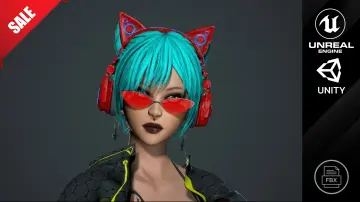
Running through a third-person scene requires responsive character motion and cloth dynamics that match gameplay pacing. Subculture Girl brings an expressive, stylized female character into that operational space, providing pre-rigged clothing elements, dynamic hair chains, and specialized cloth physics configured to react naturally while running, jumping, and navigating camera sweeps. The asset leans into alternative stylistic themes across its wardrobe, delivering distinct silhouettes that remain interchangeable across multiple assembly configurations.
Runtime Integration and Subculture Girl Blueprint Setup
Third-person mechanics rely heavily on stable Character Blueprint configurations right out of the box. During migration or execution within Unreal Engine 5, developers will encounter a specific Blueprint change that triggers an error when entering Play mode at runtime. The root of this behavior traces directly to the virtual reality input mapping nodes contained within the core character logic.
Resolving this runtime crash requires one of two direct corrective steps:
Enable the OpenXR plugin in your engine project settings to allow the VR input logic to register properly.
Open the provided Character Blueprint, navigate to the event graph, and delete the InputAction ResetVR Node completely if virtual reality functionality is not needed for your production.
Once this input discrepancy is cleared, the system behaves cleanly within standard third-person game loops. The base character incorporates dedicated Animation Blueprint logic, allowing developers to route locomotion states, blendspaces, and action montages directly through the rig without needing to rebuild foundational movement structures.
Modular Breakdown and Wardrobe Pieces for Subculture Girl
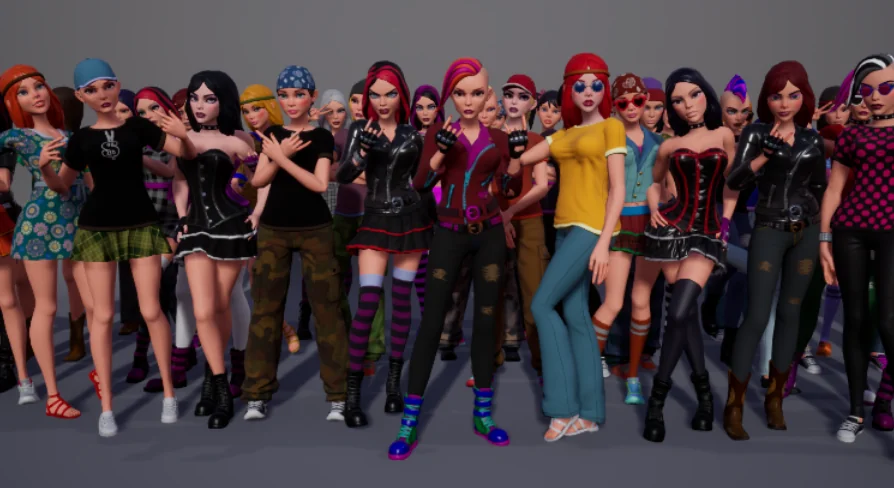
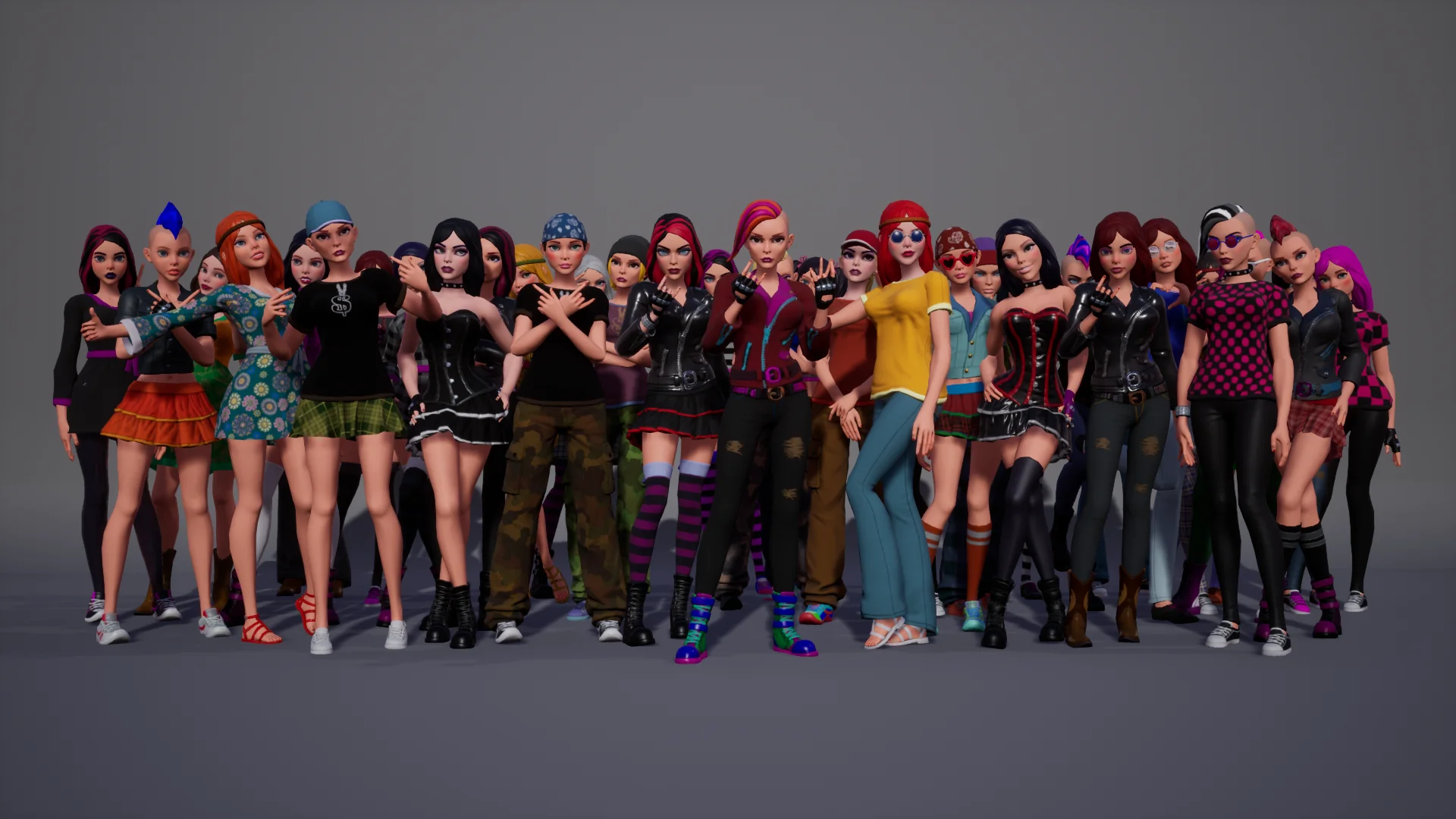
Wardrobe flexibility serves as a key pillar in the asset architecture. The character system divides clothing and anatomical structures into separate pieces, allowing creators to assemble looks dynamically rather than relying on single-mesh baked geometry. Included in the package are 26 modular clothing components and 8 modular accessories, accompanied by an included naked base body mesh that functions as the underlying canvas for clothing overlays.
Head choices and styling details offer several paths for identity generation:
3 facial variations that yield distinct baseline appearances.
8 independent hairstyles, engineered with dynamic chain setups for active strand response.
Compatibility with the external Hairstyles Pack: Female v03 library for extended visual diversity.
Full interchangeability with Casual Girl assets, expanding the cross-pack wardrobe pool.
To demonstrate structural modularity, the package includes 40 distinct Blueprint examples that combine Skeletal Mesh Components into coordinated outfits. These setups demonstrate exactly how separated body meshes attach cleanly to the underlying skeleton without clipping or seam separation. The modularity allows developers to combine individual skirts, shirts, shoes, jackets, and accessories into hundreds of alternate variations simply by swapping mesh components across the exposed slots.
Morph target production across the three unique heads has intentionally been kept focused to prevent unnecessary project scope inflation. While the faces remain distinct, restricting the count of individual morph targets per face prevents excessive runtime overhead and ensures the asset remains streamlined for production use.
Surface Customization with Texture Masks and Material Variations
Cosmetic variation across the wardrobe relies on a broad material framework. The package provides over 400 configurable materials paired with over 300 base textures. Rather than locking artists into predetermined colorways, the surface system relies on 190 RGB texture masks and pattern files to drive parameter changes across fabric, leather, trim, and skin surfaces.
Within the Clothes project subfolder, users can inspect the pre-configured seamless texture patterns to understand how mask data routes through the master shaders. Channels within the RGB masks split individual garments into isolated zones, giving control over individual color values, roughness characteristics, and pattern tiling directly in material instances. Replicating this workflow is straightforward: artists can introduce their own tiling graphic patterns or export matching masks to create custom subculture styles that match their game's environmental palette.
Skeletal Rigging, Dynamic Chains, and Cloth Simulation
Motion behavior across clothing and hair relies on specific technical implementations built directly into the character files. The skirt geometry utilizes NVIDIA's NvCloth framework, which provides natural drape and responsive collision against the lower limbs during running, pivoting, and crouch transitions. Because cloth collision is handled natively, the fabric folds dynamically rather than deforming rigidly with character bones.
Hair meshes feature dynamic chains, which introduce physics-driven secondary motion to ponytails, bangs, and hanging locks as the player accelerates or turns. For productions requiring secondary anatomical dynamics, the character rig is fully prepared. The underlying skeleton features dedicated bones and accurate skin weighting in the chest area, allowing technical artists with physical asset authoring experience to enable breast physics quickly inside standard physics asset editors without requiring re-rigging or custom weight painting.
Ecosystem Compatibility and Character Assembly
The asset functions cleanly across stylized, cartoon, and third-person action genres where distinct, youth-oriented or urban-inspired aesthetics are required. Because the component structure matches the conventions seen in Casual Girl, assets can be shared across both systems to multiply character variety across NPC populations or player customization menus. Studios looking to implement deeply modular character systems with active cloth dynamics and scalable shader palettes will find the package offers a clean, production-ready starting foundation.
 Characters
 Characters
 Characters
 Characters