"07a32e720bd988c8"{"id":"1002495","slug":"sci-fi-space-soldier","title":"Sci Fi Space Soldier","category":"Characters \u0026 Creatures","engine":"4.18+,5.0+","assetVersion":"","engineVersion":"Engine Version: 4.18+,5.0+","tag":"Characters","accent":"blue","visual":"character","summary":"An in-depth look at the Sci Fi Space Soldier character asset, featuring Epic skeleton rigging, custom material masks, retarget poses, and animation testing.","platform":"Unreal Engine","indexPolicy":"index","publishedAt":"2026-11-12T04:03:25.497Z","updatedAt":"2026-11-12T04:03:25.497Z","sourceNotes":[],"fileContents":[],"compatibility":["Unreal Engine","Engine Version: 4.18+,5.0+"],"featuredImage":{"alt":"Sci Fi Space Soldier","src":"/wp-content/uploads/published/2026/11/3d796a9a0908-bf151e50-e203-4f75-a5f9-6c6f632572f0-00db45fe88.webp"},"hasDownloadLink":true,"downloads":0,"terms":[{"taxonomy":"category","slug":"characters-and-creatures","name":"Characters \u0026 Creatures"}],"galleryImages":[{"src":"/wp-content/uploads/published/2026/11/f4b8fec58683-20e24fd9-4d26-43c3-bd6a-ead7834018ce-ac9fa6f48b.webp","alt":"Sci Fi Space Soldier"},{"src":"/wp-content/uploads/published/2026/11/7f57d7fe0596-03f6f205-af28-4812-940d-d0856b69347d-2790775e3a.webp","alt":"Sci Fi Space Soldier"},{"src":"/wp-content/uploads/published/2026/11/e69024b4ef10-c4c3fb2e-8677-45e3-b7d3-4ddbb522d8e1-5b07694570.webp","alt":"Sci Fi Space Soldier"},{"src":"/wp-content/uploads/published/2026/11/5891316b6fed-5a87f8e8-9645-4835-a986-87bca4f3df1a-13c4aca2c6.webp","alt":"Sci Fi Space Soldier"},{"src":"/wp-content/uploads/published/2026/11/d60ba4e417f9-1b8a73fb-a816-4f0c-a052-fd19c20c5c76-7814503576.webp","alt":"Sci Fi Space Soldier"},{"src":"/wp-content/uploads/published/2026/11/c4154164175e-c8977c21-ba76-43b6-873c-6f769361cf1f-502a2b30f0.webp","alt":"Sci Fi Space Soldier"},{"src":"/wp-content/uploads/published/2026/11/3c90e88ee20c-142b74a3-2ed3-48bc-ae80-96aa4d407cb7-cfb2c7955d.webp","alt":"Sci Fi Space Soldier"},{"src":"/wp-content/uploads/published/2026/11/d2517ab8efc9-33020df3-128d-4ab3-ac29-c3579a0e6676-d440f0cee8.webp","alt":"Sci Fi Space Soldier"},{"src":"/wp-content/uploads/published/2026/11/27f030d361bb-befcc328-0571-4355-a650-6ee913fb0b35-b3bb63f4d9.webp","alt":"Sci Fi Space Soldier"},{"src":"/wp-content/uploads/published/2026/11/81be4842a7d0-dae0eb9a-58c0-475d-9e8a-247f274b54ea-13af5e3ed6.webp","alt":"Sci Fi Space Soldier"}],"accessPanel":{"kind":"resource","title":"Get this resource","eyebrow":"Free resource","message":"Download this resource in your browser.","fileName":"Content.7z","safetyNote":"Resources are manually reviewed before listing to improve quality and reduce obvious risks.","actionLabel":"Get this resource","resourceType":"Resource archive","versions":[]},"contentHtml":"\u003cp\u003eThe Sci Fi Space Soldier provides a fully rigged character model structured specifically to integrate with standard skeletal animation pipelines. Built to represent a realistic military operative equipped for orbital or off-world deployment, the asset centers on an articulation framework built on the standard Epic skeleton. Rather than presenting an isolated, static mesh that requires manual joint mapping or custom deformation passes, the character incorporates pre-configured animation retargeting and verified playback support right out of the box.\u003c/p\u003e \u003cp\u003eBy pairing realistic visual elements with native rigging conventions, the character serves as an out-of-the-box solution for projects requiring specialized infantry units, space army divisions, or tactical male combatants operating within realistic science-fiction settings.\u003c/p\u003e \u003ch2\u003eEpic Skeleton Setup for the Sci Fi Space Soldier\u003c/h2\u003e \u003cp\u003eCharacter integration in technical production environments depends heavily on skeleton uniformity. The Sci Fi Space Soldier is completely rigged using the standard Epic skeleton hierarchy, ensuring direct translation to existing motion libraries that share the same joint names, orientations, and hierarchy. This structural choice removes the friction of remap scripts or custom constraint nodes when applying common character maneuvers.\u003c/p\u003e \u003cp\u003eIn addition to adhering to the standard bone hierarchy, the asset includes an already established retarget pose. In standard engine retargeting workflows, mismatched default stances—such as differences between strict T-poses and relaxed A-poses—frequently lead to broken shoulder alignments, compressed hips, or twisted forearm geometry during motion transfer. Because a dedicated retarget pose is supplied with the soldier, transferring motion sequences from external libraries requires minimal adjustment. Joint rotations align predictably against the baseline, allowing locomotion data to map across the limbs without manual bone roll adjustments.\u003c/p\u003e \u003ch2\u003eAnimation Blueprint Execution and Motion Testing\u003c/h2\u003e \u003cp\u003eDynamic movement validation forms a core part of the asset setup. The Sci Fi Space Soldier is fully functional with character animation blueprints and has undergone motion testing using the basic animation package as well as the free animation pack. This testing confirms that standard locomotion state machines—encompassing idle stances, directional walks, sprinting cycles, and jump transitions—drive the character's joints correctly.\u003c/p\u003e \u003cp\u003eUsing animation blueprints in conjunction with verified motion libraries allows the model to respond seamlessly to directional input scripts. Ground checks, forward velocity, and weapon stances translate directly through the skeletal mesh without destabilizing the physics profile or producing irregular bone offsets. Testing against the basic animation package proves that core motion clips translate naturally to the torso and extremities, establishing a solid baseline for scripted gameplay actions.\u003c/p\u003e \u003ch2\u003eSpace Soldier Material Layers and Visor Customization\u003c/h2\u003e \u003cp\u003eVisual diversity is managed through a focused material setup that emphasizes direct color customization rather than relying entirely on unique texture exports for every squad variation. The core material configuration includes two selectable customizable colors, giving developers control over primary and secondary armor plating tones across the uniform.\u003c/p\u003e \u003cp\u003eAccompanying the main color controls is a dedicated slot for an emissive mask color. In science-fiction environments where lighting communicates unit status, specialization, or atmosphere-sealed power systems, the emissive channel provides high-contrast visual cues on the suit. Operators can configure glowing readouts, illuminated seams, or chest-mounted technical elements to distinguish rank or team affiliation.\u003c/p\u003e \u003cp\u003eThe visor surface also features an editable color parameter. By adjusting the visor tint alongside the two base armor colors and the emissive mask, multiple variations of the soldier can be deployed across the same scene without altering the underlying texture sets. A frontline infantry unit might sport muted, low-visibility armor tones with a darkened face shield, while command personnel or hazardous-environment units can be given distinct primary accents and high-visibility visor reflections.\u003c/p\u003e \u003ch2\u003eSkinning Corrections and Skeleton Revisions\u003c/h2\u003e \u003cp\u003eSkeletal mesh stability requires iterative refinement to hold up under extreme poses. The development of the Sci Fi Space Soldier reflects ongoing maintenance aimed at resolving articulation issues that can emerge during deep crouches, wide stances, or rapid combat movements.\u003c/p\u003e \u003cp\u003eEarly revisions targeted structural skeleton bugs, with version 1.1 resolving underlying skeleton problems to ensure uninterrupted motion playback across standard clips. Version 1.2 expanded on this stability by correcting skinning errors where vertex weighting around high-deformation areas had previously produced unwanted stretching or mesh clipping. Version 1.2 also introduced the editable visor color control, formalizing the headgear as a distinct, tweakable visual channel. These combined refinements mean the suit's armored panels, soft inner joints, and segmented waist hold their form cleanly when driven by intensive animation blueprint sequences.\u003c/p\u003e \u003ch2\u003eDeploying the Sci Fi Soldier Male in Army Formations\u003c/h2\u003e \u003cp\u003eCompatibility considerations make the asset an effective match for projects configured around the Sci Fi Soldier Male standard. When staging large-scale combat engagements involving multiple space army personnel, uniform modularity and visual hierarchy become essential. The combination of realistic hard-surface styling and localized color masking allows technical artists to populate background, mid-ground, and playable roles from a single base asset.\u003c/p\u003e \u003cp\u003eBecause the character already conforms to standard movement blueprints and the Epic bone structure, it slots directly into squads alongside existing compatible male combatants. Team colors, unit designations, and glowing tactical markers can be adjusted directly within the material parameters, allowing the Sci Fi Space Soldier to serve reliably across varied terrain and space combat scenarios.\u003c/p\u003e\n\n\u003ch2\u003eContinue Browsing Similar Packs\u003c/h2\u003e\n\u003cul\u003e\n\u003cli\u003e\u003ca href=\"https://3dcghub.com/sci-fi-survey-drones/\" rel=\"noopener noreferrer\"\u003eSci-fi Survey Drones\u003c/a\u003e\u003c/li\u003e\n\u003cli\u003e\u003ca href=\"https://3dcghub.com/sci-fi-armor-7/\" rel=\"noopener noreferrer\"\u003eSci-Fi Armor 7\u003c/a\u003e\u003c/li\u003e\n\u003cli\u003e\u003ca href=\"https://3dcghub.com/sci-fi-alien-soldier/\" rel=\"noopener noreferrer\"\u003eSci Fi Alien Soldier\u003c/a\u003e\u003c/li\u003e\n\u003cli\u003e\u003ca href=\"https://3dcghub.com/sci-fi-space-soldier-female/\" rel=\"noopener noreferrer\"\u003eSci Fi Space Soldier Female\u003c/a\u003e\u003c/li\u003e\n\u003cli\u003e\u003ca href=\"https://3dcghub.com/sci-fi-soldier-02/\" rel=\"noopener noreferrer\"\u003eSci-Fi Soldier 02\u003c/a\u003e\u003c/li\u003e\n\u003c/ul\u003e","contentTextLength":6304,"navigation":{"current":4,"total":4421,"previous":{"id":"1002496","slug":"subculture-girl","title":"Subculture Girl","category":"Characters \u0026 Creatures","platform":"Unreal Engine","updatedAt":"2026-11-12T04:04:56.009Z"},"next":{"id":"1002494","slug":"sci-fi-robots-pack-vol-1","title":"SCI FI ROBOTS PACK VOL 1","category":"Characters \u0026 Creatures","platform":"Unreal Engine","updatedAt":"2026-11-12T04:01:24.809Z"}},"relatedResources":[{"id":"3439","slug":"sci-fi-survey-drones","title":"Sci-fi Survey Drones","category":"Characters \u0026 Creatures","engine":"4.25+,5.0+","assetVersion":"","engineVersion":"Engine Version: 4.25+,5.0+","tag":"Characters","accent":"blue","visual":"character","summary":"Enhance your AAA game with these 3 high-quality sci-fi surveillance drones. Features include sonar scan VFX, follow systems, and full Blueprint integration.","platform":"Unreal Engine","indexPolicy":"noindex","publishedAt":"2026-02-09T07:19:42.000Z","updatedAt":"2026-10-28T12:37:24.933Z","sourceNotes":[],"fileContents":[],"compatibility":["Unreal Engine","Engine Version: 4.25+,5.0+"],"featuredImage":{"alt":"Sci-fi Survey Drones","src":"https://3dcghub.com/wp-content/uploads/2026/02/b0dca7aa-dcbf-4d85-b515-4ca30dc2465d.webp"},"hasDownloadLink":true,"downloads":2},{"id":"1002462","slug":"sci-fi-armor-7","title":"Sci-Fi Armor 7","category":"Characters \u0026 Creatures","engine":"4.23+,5.0+","assetVersion":"","engineVersion":"Engine Version: 4.23+,5.0+","tag":"Characters","accent":"blue","visual":"character","summary":"Explore Sci-Fi Armor 7 featuring an Epic Skeleton rig, 7 PBR texture sets, custom color materials, 23,748 triangles, and Demon 2 compatibility.","platform":"Unreal Engine","indexPolicy":"index","publishedAt":"2026-11-11T08:49:35.570Z","updatedAt":"2026-11-11T08:49:35.570Z","sourceNotes":[],"fileContents":[],"compatibility":["Unreal Engine","Engine Version: 4.23+,5.0+"],"featuredImage":{"alt":"Sci-Fi Armor 7","src":"/wp-content/uploads/published/2026/11/f884fd84f883-1691686d-8568-43a7-a8eb-a0e3d00ecbaa-9a3e3b2c04.webp"},"hasDownloadLink":true,"downloads":0},{"id":"1002461","slug":"sci-fi-alien-soldier","title":"Sci Fi Alien Soldier","category":"Characters \u0026 Creatures","engine":"4.16+,5.0+","assetVersion":"","engineVersion":"Engine Version: 4.16+,5.0+","tag":"Characters","accent":"blue","visual":"character","summary":"Examine the Sci Fi Alien Soldier, featuring Epic skeleton rigging, tested animation support, customizable color materials, and emissive masking.","platform":"Unreal Engine","indexPolicy":"index","publishedAt":"2026-11-11T08:48:30.204Z","updatedAt":"2026-11-11T08:48:30.204Z","sourceNotes":[],"fileContents":[],"compatibility":["Unreal Engine","Engine Version: 4.16+,5.0+"],"featuredImage":{"alt":"Sci Fi Alien Soldier","src":"/wp-content/uploads/published/2026/11/068918ee3039-06b44861-59c1-4c05-a6b6-6a97ae440ac4-9510f961ec.webp"},"hasDownloadLink":true,"downloads":0}]}
Characters
Sci Fi Space Soldier
An in-depth look at the Sci Fi Space Soldier character asset, featuring Epic skeleton rigging, custom material masks, retarget poses, and animation testing.
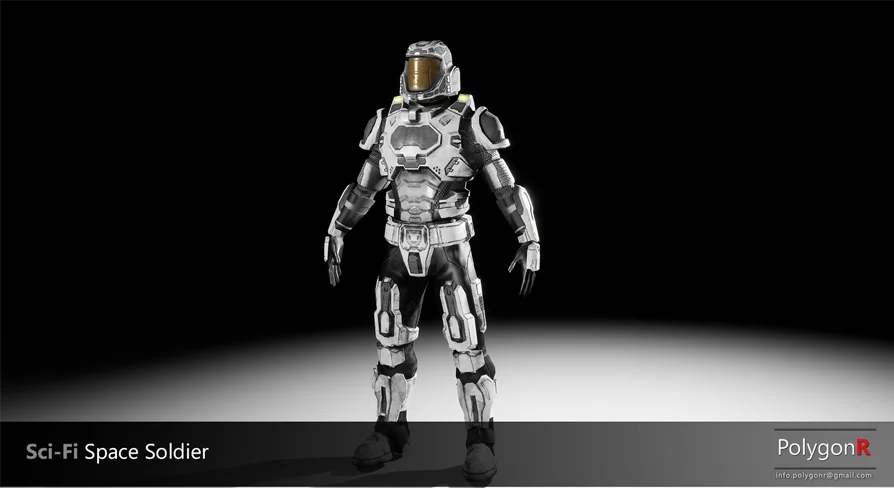
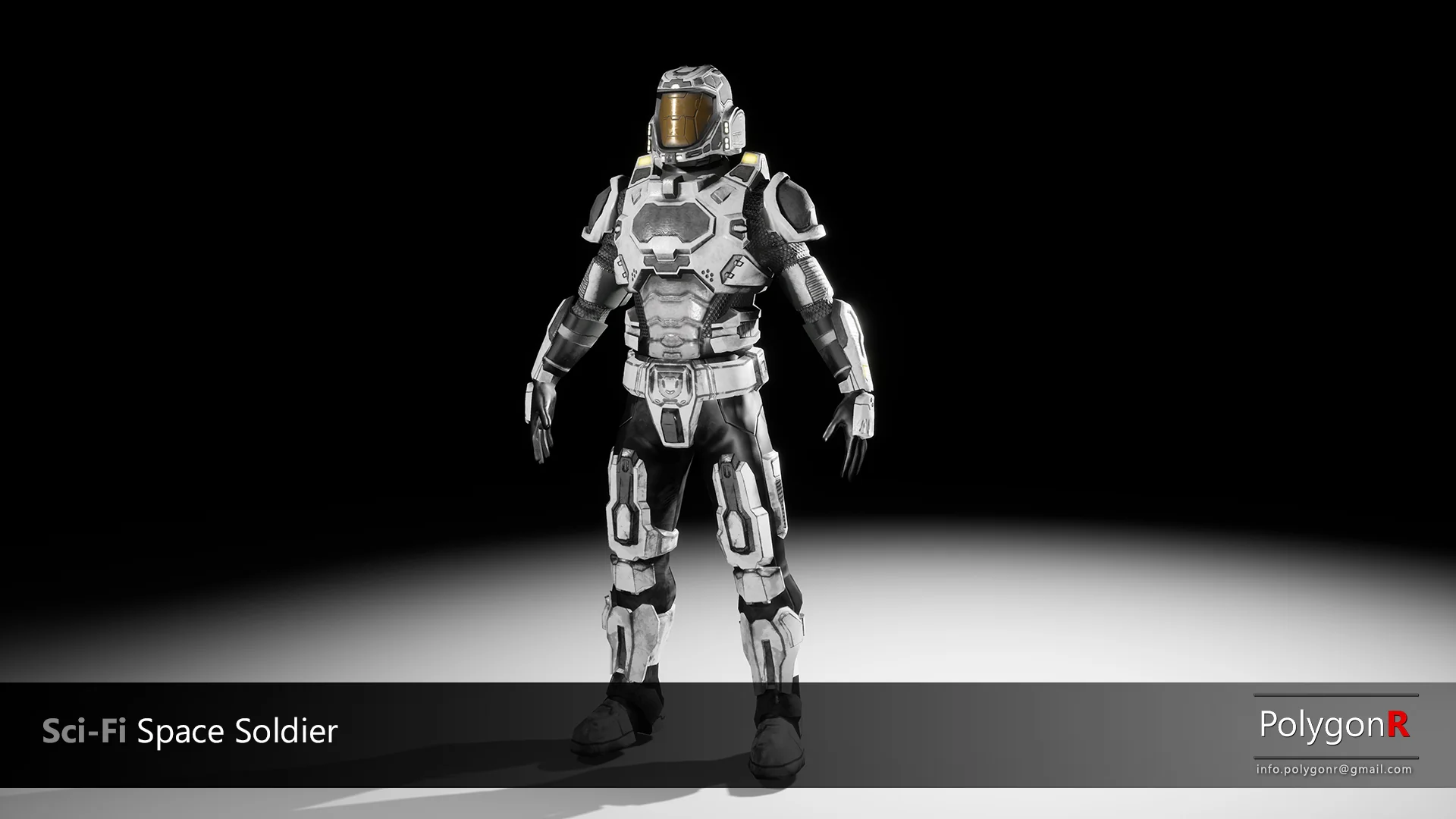
The Sci Fi Space Soldier provides a fully rigged character model structured specifically to integrate with standard skeletal animation pipelines. Built to represent a realistic military operative equipped for orbital or off-world deployment, the asset centers on an articulation framework built on the standard Epic skeleton. Rather than presenting an isolated, static mesh that requires manual joint mapping or custom deformation passes, the character incorporates pre-configured animation retargeting and verified playback support right out of the box.
By pairing realistic visual elements with native rigging conventions, the character serves as an out-of-the-box solution for projects requiring specialized infantry units, space army divisions, or tactical male combatants operating within realistic science-fiction settings.
Epic Skeleton Setup for the Sci Fi Space Soldier
Character integration in technical production environments depends heavily on skeleton uniformity. The Sci Fi Space Soldier is completely rigged using the standard Epic skeleton hierarchy, ensuring direct translation to existing motion libraries that share the same joint names, orientations, and hierarchy. This structural choice removes the friction of remap scripts or custom constraint nodes when applying common character maneuvers.
In addition to adhering to the standard bone hierarchy, the asset includes an already established retarget pose. In standard engine retargeting workflows, mismatched default stances—such as differences between strict T-poses and relaxed A-poses—frequently lead to broken shoulder alignments, compressed hips, or twisted forearm geometry during motion transfer. Because a dedicated retarget pose is supplied with the soldier, transferring motion sequences from external libraries requires minimal adjustment. Joint rotations align predictably against the baseline, allowing locomotion data to map across the limbs without manual bone roll adjustments.
Animation Blueprint Execution and Motion Testing
Dynamic movement validation forms a core part of the asset setup. The Sci Fi Space Soldier is fully functional with character animation blueprints and has undergone motion testing using the basic animation package as well as the free animation pack. This testing confirms that standard locomotion state machines—encompassing idle stances, directional walks, sprinting cycles, and jump transitions—drive the character's joints correctly.
Using animation blueprints in conjunction with verified motion libraries allows the model to respond seamlessly to directional input scripts. Ground checks, forward velocity, and weapon stances translate directly through the skeletal mesh without destabilizing the physics profile or producing irregular bone offsets. Testing against the basic animation package proves that core motion clips translate naturally to the torso and extremities, establishing a solid baseline for scripted gameplay actions.
Space Soldier Material Layers and Visor Customization
Visual diversity is managed through a focused material setup that emphasizes direct color customization rather than relying entirely on unique texture exports for every squad variation. The core material configuration includes two selectable customizable colors, giving developers control over primary and secondary armor plating tones across the uniform.
Accompanying the main color controls is a dedicated slot for an emissive mask color. In science-fiction environments where lighting communicates unit status, specialization, or atmosphere-sealed power systems, the emissive channel provides high-contrast visual cues on the suit. Operators can configure glowing readouts, illuminated seams, or chest-mounted technical elements to distinguish rank or team affiliation.
The visor surface also features an editable color parameter. By adjusting the visor tint alongside the two base armor colors and the emissive mask, multiple variations of the soldier can be deployed across the same scene without altering the underlying texture sets. A frontline infantry unit might sport muted, low-visibility armor tones with a darkened face shield, while command personnel or hazardous-environment units can be given distinct primary accents and high-visibility visor reflections.
Skinning Corrections and Skeleton Revisions
Skeletal mesh stability requires iterative refinement to hold up under extreme poses. The development of the Sci Fi Space Soldier reflects ongoing maintenance aimed at resolving articulation issues that can emerge during deep crouches, wide stances, or rapid combat movements.
Early revisions targeted structural skeleton bugs, with version 1.1 resolving underlying skeleton problems to ensure uninterrupted motion playback across standard clips. Version 1.2 expanded on this stability by correcting skinning errors where vertex weighting around high-deformation areas had previously produced unwanted stretching or mesh clipping. Version 1.2 also introduced the editable visor color control, formalizing the headgear as a distinct, tweakable visual channel. These combined refinements mean the suit's armored panels, soft inner joints, and segmented waist hold their form cleanly when driven by intensive animation blueprint sequences.
Deploying the Sci Fi Soldier Male in Army Formations
Compatibility considerations make the asset an effective match for projects configured around the Sci Fi Soldier Male standard. When staging large-scale combat engagements involving multiple space army personnel, uniform modularity and visual hierarchy become essential. The combination of realistic hard-surface styling and localized color masking allows technical artists to populate background, mid-ground, and playable roles from a single base asset.
Because the character already conforms to standard movement blueprints and the Epic bone structure, it slots directly into squads alongside existing compatible male combatants. Team colors, unit designations, and glowing tactical markers can be adjusted directly within the material parameters, allowing the Sci Fi Space Soldier to serve reliably across varied terrain and space combat scenarios.
 Characters
 Characters
 Characters
 Characters