"95ccd6d7c96110f6"{"id":"1002461","slug":"sci-fi-alien-soldier","title":"Sci Fi Alien Soldier","category":"Characters \u0026 Creatures","engine":"4.16+,5.0+","assetVersion":"","engineVersion":"Engine Version: 4.16+,5.0+","tag":"Characters","accent":"blue","visual":"character","summary":"Examine the Sci Fi Alien Soldier, featuring Epic skeleton rigging, tested animation support, customizable color materials, and emissive masking.","platform":"Unreal Engine","indexPolicy":"index","publishedAt":"2026-11-11T08:48:30.204Z","updatedAt":"2026-11-11T08:48:30.204Z","sourceNotes":[],"fileContents":[],"compatibility":["Unreal Engine","Engine Version: 4.16+,5.0+"],"featuredImage":{"alt":"Sci Fi Alien Soldier","src":"/wp-content/uploads/published/2026/11/068918ee3039-06b44861-59c1-4c05-a6b6-6a97ae440ac4-9510f961ec.webp"},"hasDownloadLink":true,"downloads":0,"terms":[{"taxonomy":"category","slug":"characters-and-creatures","name":"Characters \u0026 Creatures"}],"galleryImages":[{"src":"/wp-content/uploads/published/2026/11/9aa02043de91-89d8c11f-7f6a-4b75-b6fe-32a60cc70ecf-7ce92c6f38.webp","alt":"Sci Fi Alien Soldier"},{"src":"/wp-content/uploads/published/2026/11/3996859ee41b-13f2d118-3f5f-4ff4-aaf0-2de2f3627e1f-485f731750.webp","alt":"Sci Fi Alien Soldier"},{"src":"/wp-content/uploads/published/2026/11/a475c6dd5559-19c084d0-b34f-4f73-9913-3be3c9441b31-70203a4841.webp","alt":"Sci Fi Alien Soldier"},{"src":"/wp-content/uploads/published/2026/11/abb7d7f5cdff-72d42f93-2545-4088-a4fd-8a2f4fe33540-d9fae3acee.webp","alt":"Sci Fi Alien Soldier"},{"src":"/wp-content/uploads/published/2026/11/1e0d09048fec-4bfb14d1-2f20-4bf7-8511-ee689a0da41a-0333505613.webp","alt":"Sci Fi Alien Soldier"}],"accessPanel":{"kind":"resource","title":"Get this resource","eyebrow":"Free resource","message":"Download this resource in your browser.","fileName":"Content.7z","safetyNote":"Resources are manually reviewed before listing to improve quality and reduce obvious risks.","actionLabel":"Get this resource","resourceType":"Resource archive","versions":[]},"contentHtml":"\u003ch2\u003eDeploying the Sci Fi Alien Soldier across Realistic Extraterrestrial Encounters\u003c/h2\u003e\n\u003cp\u003eFuturistic combat scenarios demand believable character silhouettes capable of filling out hostile outposts, deep-space boarding actions, and unmapped planetary surfaces. The Sci Fi Alien Soldier steps into these settings as a realistic extraterrestrial combatant designed to serve both as a frontline warrior and an interactive non-player character. Grounded in a realistic visual style, the asset provides the anatomical proportion and physical weight needed to integrate naturally into gritty, high-stakes science fiction worlds.\u003c/p\u003e\n\u003cp\u003eWhen staging conflict across tactical science fiction levels, variation among combatants prevents encounters from feeling repetitive. The model represents a disciplined warrior archetype rather than a mindless beast, allowing level designers to construct defensive perimeters, tactical ambush sequences, and structured military engagements. Because the design embraces a realistic tone, it fits comfortably into contemporary rendering pipelines where physical light interactions, dark corridor reflections, and detailed planetary atmospheres shape the mood of the environment.\u003c/p\u003e\n\u003cp\u003eWhether cast as an invading force breaching a secure installation or a perimeter guard patrolling an alien fortress, the character offers the physical posture and presence expected of an organized soldier. Its construction allows creators to populate scenes with combat-ready units that immediately communicate threat, operational discipline, and extraterrestrial technology to the player.\u003c/p\u003e \u003ch2\u003eEpic Skeleton Rigging and Animation Blueprint Functionality\u003c/h2\u003e\n\u003cp\u003eIntegrating a new character into an active game project relies heavily on predictable skeletal geometry. The Sci Fi Alien Soldier is completely rigged using the Epic skeleton standard, establishing immediate harmony with established character controllers, standard retargeting tools, and universal animation sequences. This structural choice removes the bottleneck of authoring custom bone hierarchies from scratch, enabling technical artists to map movement data directly onto the rig.\u003c/p\u003e\n\u003cp\u003eReliability in dynamic locomotion has been verified through testing against the free animation pack. By validating the skeletal structure against these core motion sets, the rig demonstrates dependable deformation across running, walking, crouching, dodging, and weapon-handling sequences. Key articulation points such as the shoulders, hips, knees, and spine respond predictably without unnatural mesh collapse, preserving the character's athletic posture during rapid combat state changes.\u003c/p\u003e\n\u003cp\u003eUnderpinning this movement setup is compatibility with Animation Blueprints and scripting systems. Developers can connect standard state machines, blend spaces, and locomotion nodes directly to the character. Locomotion logic, combat transitions, hit reactions, and death simulations can be wired through an Animation Blueprint without reworking the underlying rig. This standard-compliant setup streamlines the path from importing the asset to having a fully ambulatory warrior traversing a level.\u003c/p\u003e \u003ch2\u003eMaterial Customization with Selective Colors and Emissive Masking\u003c/h2\u003e\n\u003cp\u003eVisual diversity within an army or security detachment requires flexible surface shading. The Sci Fi Alien Soldier features a material setup structured around three customizable colors, complemented by a dedicated color channel for an emissive mask. This configuration gives artists substantial control over how different sections of the soldier’s suit and gear present themselves under distinct lighting environments.\u003c/p\u003e\n\u003cp\u003eThe three distinct color channels make it possible to establish distinct unit classifications or environmental camo variations across identical geometry. By altering the base tones, a production team can differentiate rank hierarchies, separate squad leaders from standard infantry, or distinguish elite guards from frontline scouts. Shifting colors across distinct zones also helps adapt the soldier to specific environments, such as swapping out muted subterranean tones for desert or arctic variants, all while retaining the core visual structure.\u003c/p\u003e\n\u003cp\u003eThe addition of an independent color channel for the emissive mask introduces technical lighting utility to the character. Emissive elements are vital in science fiction projects for depicting powered cybernetics, energy relays, tactical readouts, or specialized visor optics. Controlling this glowing accent independently allows creators to convey power states, alert conditions, or faction affiliations. When set to high luminance values in dark corridors, the emissive mask casts dynamic highlights on surrounding geometry, emphasizing the hostile presence of the soldier.\u003c/p\u003e \u003ch2\u003eAlignment with Sci Fi Soldier Male in Combat Scenarios\u003c/h2\u003e\n\u003cp\u003eBuilding balanced science fiction conflicts often requires symmetrical design assets that can interact seamlessly in the same game space. The Sci Fi Alien Soldier features explicit compatibility with the Sci Fi Soldier Male, providing a natural counterpart for bilateral combat engagements, asymmetric skirmishes, or mixed-species strike teams.\u003c/p\u003e\n\u003cp\u003eThis technical and stylistic alignment ensures that scaling, bone dimensions, and visual fidelity match up smoothly when the two characters share the screen. Designers staging close-quarters combat or reciprocal cover-shooting sequences do not have to compensate for disparate visual languages or awkward height mismatches. The shared design context allows narrative teams to pit human combatants against alien adversaries with an inherent sense of physical balance and competitive parity.\u003c/p\u003e\n\u003cp\u003eBeyond antagonistic dynamics, the compatibility between these models supports multi-faction squad building. In scenarios where human and alien operatives form alliances, their parallel tactical aesthetics enable them to look like cohesive operating forces. Weapon rigging, two-handed aim offsets, and shared combat stances can be synchronized across both asset types, accelerating encounter choreography across campaign missions.\u003c/p\u003e \u003ch2\u003eImplementing the Alien Soldier as an Interactive NPC or Warrior\u003c/h2\u003e\n\u003cp\u003eWith verified tagging as a script-driven warrior and NPC, the Sci Fi Alien Soldier is suited for extensive behavioral programming in gameplay environments. Setting up enemy artificial intelligence requires a character mesh that can respond reliably to behavioral trees, sensing components, and navmesh navigation. Because the character supports standard scripting workflows, developers can link perception systems, attack cones, and tactical retreats directly to the character’s blueprint logic.\u003c/p\u003e\n\u003cp\u003eThe model functions cleanly as an aggressive combatant executing search-and-destroy routines, suppression fire, or flanking movements. At the same time, its structured realistic design supports passive non-player character roles, such as standing watch at defensive gates, guarding command centers, or appearing in non-hostile narrative sequences. Scripted interactive triggers can transition the character from idle observation to high-alert combat states seamlessly through the existing Animation Blueprint pathways.\u003c/p\u003e\n\u003cp\u003eDevelopers producing tactical third-person shooters, isometric strategy titles, or atmospheric first-person encounters will find the asset’s blend of standard rigging, animation validation, and flexible shading immediately practical. The Sci Fi Alien Soldier offers the mechanical stability and aesthetic detail necessary to field convincing extraterrestrial forces with minimal pipeline friction.\u003c/p\u003e\n\n\u003ch2\u003eContinue Browsing Similar Packs\u003c/h2\u003e\n\u003cul\u003e\n\u003cli\u003e\u003ca href=\"https://3dcghub.com/sci-fi-survey-drones/\" rel=\"noopener noreferrer\"\u003eSci-fi Survey Drones\u003c/a\u003e\u003c/li\u003e\n\u003cli\u003e\u003ca href=\"https://3dcghub.com/sci-fi-space-soldier-female/\" rel=\"noopener noreferrer\"\u003eSci Fi Space Soldier Female\u003c/a\u003e\u003c/li\u003e\n\u003cli\u003e\u003ca href=\"https://3dcghub.com/sci-fi-soldier-02/\" rel=\"noopener noreferrer\"\u003eSci-Fi Soldier 02\u003c/a\u003e\u003c/li\u003e\n\u003cli\u003e\u003ca href=\"https://3dcghub.com/sci-fi-character-03-yakuza/\" rel=\"noopener noreferrer\"\u003eSci-Fi Character 03 (Yakuza)\u003c/a\u003e\u003c/li\u003e\n\u003cli\u003e\u003ca href=\"https://3dcghub.com/sci-fi-heavy-bot/\" rel=\"noopener noreferrer\"\u003eSci Fi Heavy Bot\u003c/a\u003e\u003c/li\u003e\n\u003c/ul\u003e","contentTextLength":7671,"navigation":{"current":4,"total":4387,"previous":{"id":"1002462","slug":"sci-fi-armor-7","title":"Sci-Fi Armor 7","category":"Characters \u0026 Creatures","platform":"Unreal Engine","updatedAt":"2026-11-11T08:49:35.570Z"},"next":{"id":"1002460","slug":"biotech-rogue","title":"Biotech - Rogue","category":"Characters \u0026 Creatures","platform":"Unreal Engine","updatedAt":"2026-11-11T08:47:38.898Z"}},"relatedResources":[{"id":"3439","slug":"sci-fi-survey-drones","title":"Sci-fi Survey Drones","category":"Characters \u0026 Creatures","engine":"4.25+,5.0+","assetVersion":"","engineVersion":"Engine Version: 4.25+,5.0+","tag":"Characters","accent":"blue","visual":"character","summary":"Enhance your AAA game with these 3 high-quality sci-fi surveillance drones. Features include sonar scan VFX, follow systems, and full Blueprint integration.","platform":"Unreal Engine","indexPolicy":"index","publishedAt":"2026-02-09T07:19:42.000Z","updatedAt":"2026-10-28T12:37:24.933Z","sourceNotes":[],"fileContents":[],"compatibility":["Unreal Engine","Engine Version: 4.25+,5.0+"],"featuredImage":{"alt":"Sci-fi Survey Drones","src":"https://3dcghub.com/wp-content/uploads/2026/02/b0dca7aa-dcbf-4d85-b515-4ca30dc2465d.webp"},"hasDownloadLink":true,"downloads":2},{"id":"1002462","slug":"sci-fi-armor-7","title":"Sci-Fi Armor 7","category":"Characters \u0026 Creatures","engine":"4.23+,5.0+","assetVersion":"","engineVersion":"Engine Version: 4.23+,5.0+","tag":"Characters","accent":"blue","visual":"character","summary":"Explore Sci-Fi Armor 7 featuring an Epic Skeleton rig, 7 PBR texture sets, custom color materials, 23,748 triangles, and Demon 2 compatibility.","platform":"Unreal Engine","indexPolicy":"index","publishedAt":"2026-11-11T08:49:35.570Z","updatedAt":"2026-11-11T08:49:35.570Z","sourceNotes":[],"fileContents":[],"compatibility":["Unreal Engine","Engine Version: 4.23+,5.0+"],"featuredImage":{"alt":"Sci-Fi Armor 7","src":"/wp-content/uploads/published/2026/11/f884fd84f883-1691686d-8568-43a7-a8eb-a0e3d00ecbaa-9a3e3b2c04.webp"},"hasDownloadLink":true,"downloads":0},{"id":"1001659","slug":"sci-fi-space-soldier-female","title":"Sci Fi Space Soldier Female","category":"Characters \u0026 Creatures","engine":"4.16+,5.0+","assetVersion":"","engineVersion":"Engine Version: 4.16+,5.0+","tag":"Characters","accent":"blue","visual":"character","summary":"Sci Fi Space Soldier Female features 2 model versions, 2 LOD levels at 29K and 10K triangles, Epic skeleton rigging, and customizable multi-tone materials.","platform":"Unreal Engine","indexPolicy":"index","publishedAt":"2026-10-13T14:48:21.104Z","updatedAt":"2026-10-13T14:48:21.104Z","sourceNotes":[],"fileContents":[],"compatibility":["Unreal Engine","Engine Version: 4.16+,5.0+"],"featuredImage":{"alt":"Sci Fi Space Soldier Female","src":"/wp-content/uploads/published/2026/10/c9df1964c209-c1a5eaa9-4d71-4521-b647-674811bda59b-9cb1722b78.webp"},"hasDownloadLink":true,"downloads":1}]}
Characters
Sci Fi Alien Soldier
Examine the Sci Fi Alien Soldier, featuring Epic skeleton rigging, tested animation support, customizable color materials, and emissive masking.
Deploying the Sci Fi Alien Soldier across Realistic Extraterrestrial Encounters
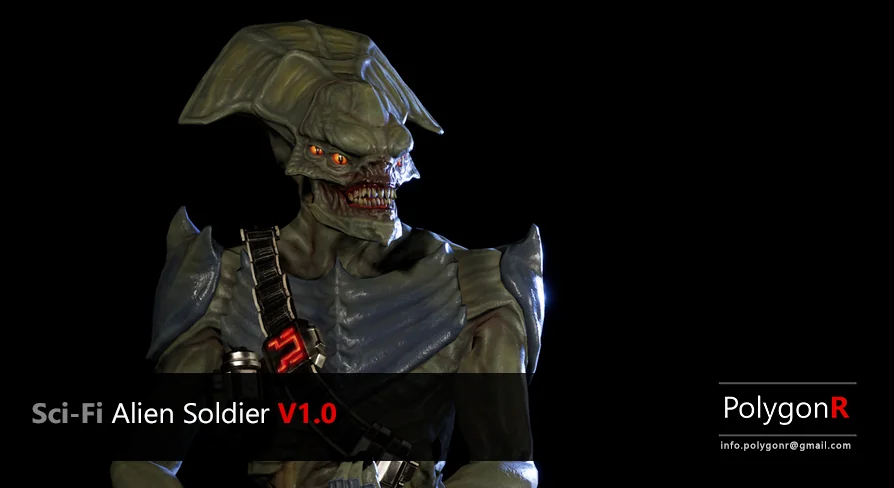
Futuristic combat scenarios demand believable character silhouettes capable of filling out hostile outposts, deep-space boarding actions, and unmapped planetary surfaces. The Sci Fi Alien Soldier steps into these settings as a realistic extraterrestrial combatant designed to serve both as a frontline warrior and an interactive non-player character. Grounded in a realistic visual style, the asset provides the anatomical proportion and physical weight needed to integrate naturally into gritty, high-stakes science fiction worlds.
When staging conflict across tactical science fiction levels, variation among combatants prevents encounters from feeling repetitive. The model represents a disciplined warrior archetype rather than a mindless beast, allowing level designers to construct defensive perimeters, tactical ambush sequences, and structured military engagements. Because the design embraces a realistic tone, it fits comfortably into contemporary rendering pipelines where physical light interactions, dark corridor reflections, and detailed planetary atmospheres shape the mood of the environment.
Whether cast as an invading force breaching a secure installation or a perimeter guard patrolling an alien fortress, the character offers the physical posture and presence expected of an organized soldier. Its construction allows creators to populate scenes with combat-ready units that immediately communicate threat, operational discipline, and extraterrestrial technology to the player.
Epic Skeleton Rigging and Animation Blueprint Functionality
Integrating a new character into an active game project relies heavily on predictable skeletal geometry. The Sci Fi Alien Soldier is completely rigged using the Epic skeleton standard, establishing immediate harmony with established character controllers, standard retargeting tools, and universal animation sequences. This structural choice removes the bottleneck of authoring custom bone hierarchies from scratch, enabling technical artists to map movement data directly onto the rig.
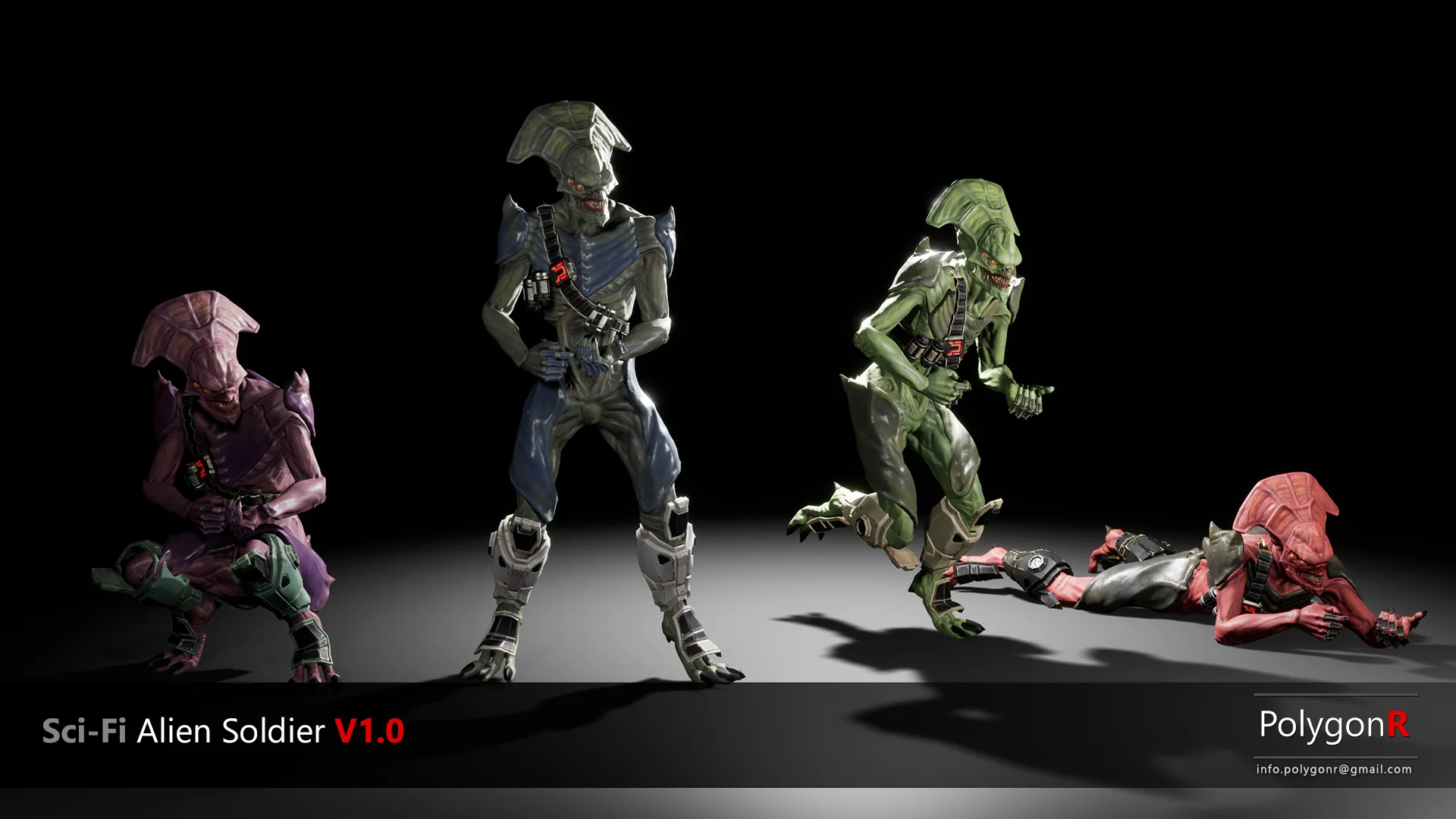
Reliability in dynamic locomotion has been verified through testing against the free animation pack. By validating the skeletal structure against these core motion sets, the rig demonstrates dependable deformation across running, walking, crouching, dodging, and weapon-handling sequences. Key articulation points such as the shoulders, hips, knees, and spine respond predictably without unnatural mesh collapse, preserving the character's athletic posture during rapid combat state changes.
Underpinning this movement setup is compatibility with Animation Blueprints and scripting systems. Developers can connect standard state machines, blend spaces, and locomotion nodes directly to the character. Locomotion logic, combat transitions, hit reactions, and death simulations can be wired through an Animation Blueprint without reworking the underlying rig. This standard-compliant setup streamlines the path from importing the asset to having a fully ambulatory warrior traversing a level.
Material Customization with Selective Colors and Emissive Masking
Visual diversity within an army or security detachment requires flexible surface shading. The Sci Fi Alien Soldier features a material setup structured around three customizable colors, complemented by a dedicated color channel for an emissive mask. This configuration gives artists substantial control over how different sections of the soldier’s suit and gear present themselves under distinct lighting environments.
The three distinct color channels make it possible to establish distinct unit classifications or environmental camo variations across identical geometry. By altering the base tones, a production team can differentiate rank hierarchies, separate squad leaders from standard infantry, or distinguish elite guards from frontline scouts. Shifting colors across distinct zones also helps adapt the soldier to specific environments, such as swapping out muted subterranean tones for desert or arctic variants, all while retaining the core visual structure.
The addition of an independent color channel for the emissive mask introduces technical lighting utility to the character. Emissive elements are vital in science fiction projects for depicting powered cybernetics, energy relays, tactical readouts, or specialized visor optics. Controlling this glowing accent independently allows creators to convey power states, alert conditions, or faction affiliations. When set to high luminance values in dark corridors, the emissive mask casts dynamic highlights on surrounding geometry, emphasizing the hostile presence of the soldier.
Alignment with Sci Fi Soldier Male in Combat Scenarios
Building balanced science fiction conflicts often requires symmetrical design assets that can interact seamlessly in the same game space. The Sci Fi Alien Soldier features explicit compatibility with the Sci Fi Soldier Male, providing a natural counterpart for bilateral combat engagements, asymmetric skirmishes, or mixed-species strike teams.
This technical and stylistic alignment ensures that scaling, bone dimensions, and visual fidelity match up smoothly when the two characters share the screen. Designers staging close-quarters combat or reciprocal cover-shooting sequences do not have to compensate for disparate visual languages or awkward height mismatches. The shared design context allows narrative teams to pit human combatants against alien adversaries with an inherent sense of physical balance and competitive parity.
Beyond antagonistic dynamics, the compatibility between these models supports multi-faction squad building. In scenarios where human and alien operatives form alliances, their parallel tactical aesthetics enable them to look like cohesive operating forces. Weapon rigging, two-handed aim offsets, and shared combat stances can be synchronized across both asset types, accelerating encounter choreography across campaign missions.
Implementing the Alien Soldier as an Interactive NPC or Warrior
With verified tagging as a script-driven warrior and NPC, the Sci Fi Alien Soldier is suited for extensive behavioral programming in gameplay environments. Setting up enemy artificial intelligence requires a character mesh that can respond reliably to behavioral trees, sensing components, and navmesh navigation. Because the character supports standard scripting workflows, developers can link perception systems, attack cones, and tactical retreats directly to the character’s blueprint logic.
The model functions cleanly as an aggressive combatant executing search-and-destroy routines, suppression fire, or flanking movements. At the same time, its structured realistic design supports passive non-player character roles, such as standing watch at defensive gates, guarding command centers, or appearing in non-hostile narrative sequences. Scripted interactive triggers can transition the character from idle observation to high-alert combat states seamlessly through the existing Animation Blueprint pathways.
Developers producing tactical third-person shooters, isometric strategy titles, or atmospheric first-person encounters will find the asset’s blend of standard rigging, animation validation, and flexible shading immediately practical. The Sci Fi Alien Soldier offers the mechanical stability and aesthetic detail necessary to field convincing extraterrestrial forces with minimal pipeline friction.
 Characters
 Characters
 Characters
 Characters