"95ccd6d7c96110f6"{"id":"1002460","slug":"biotech-rogue","title":"Biotech - Rogue","category":"Characters \u0026 Creatures","engine":"4.16+,5.0+","assetVersion":"","engineVersion":"Engine Version: 4.16+,5.0+","tag":"Characters","accent":"blue","visual":"character","summary":"Examine Biotech - Rogue, a sci-fi android character featuring UE4 mannequin rigging, dedicated FPS hands, customizable mask materials, and runnable blueprints.","platform":"Unreal Engine","indexPolicy":"index","publishedAt":"2026-11-11T08:47:38.898Z","updatedAt":"2026-11-11T08:47:38.898Z","sourceNotes":[],"fileContents":[],"compatibility":["Unreal Engine","Engine Version: 4.16+,5.0+"],"featuredImage":{"alt":"Biotech - Rogue","src":"/wp-content/uploads/published/2026/11/5c5f91d16b3a-424a7832-2ed9-42d4-81db-c0a0867cf683-5d7c4b3259.webp"},"hasDownloadLink":true,"downloads":0,"terms":[{"taxonomy":"category","slug":"characters-and-creatures","name":"Characters \u0026 Creatures"}],"galleryImages":[{"src":"/wp-content/uploads/published/2026/11/4b06d5e23d91-73e6226a-4969-484e-b38c-b3e1de24955c-eeee54733f.webp","alt":"Biotech - Rogue"},{"src":"/wp-content/uploads/published/2026/11/0c2bb3527bf4-3cb71054-5331-4b48-a8a9-428a7347f9cd-9120436e32.webp","alt":"Biotech - Rogue"},{"src":"/wp-content/uploads/published/2026/11/ea3e21e6c21c-df25af0e-2110-4999-92cb-74465fd82259-2e0ecf525a.webp","alt":"Biotech - Rogue"},{"src":"/wp-content/uploads/published/2026/11/035e82d2c438-068451bf-f15e-47e4-b5a3-5febab734141-6abc234a19.webp","alt":"Biotech - Rogue"},{"src":"/wp-content/uploads/published/2026/11/e483d3d96c60-e4757cf7-6e31-499e-8341-24c0e8fe6d7c-eebf1c62bf.webp","alt":"Biotech - Rogue"},{"src":"/wp-content/uploads/published/2026/11/6d86d11510bb-8eb8064e-0a20-4cbf-b3ab-d81f5c7a1da0-6e8131fa83.webp","alt":"Biotech - Rogue"},{"src":"/wp-content/uploads/published/2026/11/98b39341f398-56a2657c-e82f-407b-8a7a-6166319e86a7-8a1128e5bd.webp","alt":"Biotech - Rogue"},{"src":"/wp-content/uploads/published/2026/11/63a7fd73af88-a9f2564b-4047-42bb-9d7f-478b86eac0cf-cd3a282751.webp","alt":"Biotech - Rogue"},{"src":"/wp-content/uploads/published/2026/11/5210590b4bad-138bbf34-6c2e-4eff-bd9d-6d7058b98286-9fd37ce92b.webp","alt":"Biotech - Rogue"}],"accessPanel":{"kind":"resource","title":"Get this resource","eyebrow":"Free resource","message":"Download this resource in your browser.","fileName":"Content.7z","safetyNote":"Resources are manually reviewed before listing to improve quality and reduce obvious risks.","actionLabel":"Get this resource","resourceType":"Resource archive","versions":[]},"contentHtml":"\u003cp\u003eSci-fi corridors, derelict orbital platforms, and sterile research facilities often demand mechanical or synthetic characters that can slip straight into functional gameplay without extensive technical friction. In projects centering on robotic infantry, rogue artificial intelligence, or synthetic exploration teams, character models must offer flexible identity styling alongside dependable motion foundations. Biotech - Rogue targets these exact project situations, arriving as an android asset tailored for sci-fi environments where a single robotic chassis might need to serve simultaneously as an active protagonist, a relentless adversary, or an ambient mechanical guard stationed within background architecture.\u003c/p\u003e \u003ch2\u003eDeploying Biotech - Rogue Across Sci-Fi Production Roles\u003c/h2\u003e\n\u003cp\u003eBecause synthetic models in speculative fiction frequently occupy diverse gameplay functions, this asset provides an adaptable base suited for distinct combat and narrative capacities. The realistic android design fits seamlessly into space settings, futuristic facilities, and tech-heavy battlegrounds. When implemented as a player avatar, the android frame provides a crisp, metallic presence on screen that communicates weight and durability. The clean mechanical contours emphasize artificial construction, establishing an immediate sense of engineered precision.\u003c/p\u003e\n\u003cp\u003eIn enemy configurations, the robotic exterior enables rapid deployment across combat encounters. Swarms of automated sentinels, specialized security droids, or rogue android units can be populated using the same fundamental model geometry. Because the asset also operates effectively as stationary or contextual scene decoration, developers can position the model into charging stations, maintenance bays, or industrial repair pods to enrich environmental storytelling without creating dedicated non-playable asset variants.\u003c/p\u003e\n\u003cp\u003eThe visual language avoids hyper-specific faction markings on the mesh itself, allowing the model to represent military androids, civilian utility chassis that have been reprogrammed, or hostile cyborg forces operating in outer space. This neutral mechanical foundation gives teams the freedom to designate allegiance, unit class, or tactical specialization directly through behavioral scripts, lighting cues, and surface coloration.\u003c/p\u003e \u003ch2\u003eFirst-Person and Third-Person Rigging Systems in Rogue\u003c/h2\u003e\n\u003cp\u003eCharacter implementation often diverges depending on camera perspective, creating extra work when bridging first-person and third-person viewpoints. Biotech - Rogue resolves this hurdle by supplying assets tailored to both camera distances. The full humanoid model is rigged to the default UE4 mannequin skeleton, granting immediate access to existing motion systems. Locomotion sets, tactical combat animations, melee strikes, and idle cycles created for the standard mannequin map directly onto the android body, eliminating the need to retarget or adjust joint hierarchies manually.\u003c/p\u003e\n\u003cp\u003eFor perspective shifts focused entirely down the barrel of a weapon, the package provides a separate asset containing dedicated FPS hands. These hands are rigged to the standard first-person hands skeleton, maintaining full alignment with weapon-handling animations, firearm reloads, and equipment handling libraries designed around marketplace rigging norms. Maintaining dedicated first-person geometry ensures that close-up weapon stances display high-detail mechanical joints and surfaces without clipping artifacts or unnecessary full-body mesh overhead.\u003c/p\u003e\n\u003cp\u003eThe inclusion of basic UE4 mannequin animations within the project allows developers to verify bone weight distribution and movement fluidity right away. Foot plants, arm swings, and posture shifts can be evaluated across the full humanoid model inside test spaces before moving the asset into custom animation blueprint graphs.\u003c/p\u003e \u003ch2\u003eConfiguring the Biotech - Rogue Shading Network and Emissive Channels\u003c/h2\u003e\n\u003cp\u003eVisual diversity is essential when deploying a single mechanical asset across multiple gameplay roles or squad rosters. The surfacing workflow for the model relies on a main master material driven by texture masks, enabling broad adjustments without altering the underlying texture maps. By partitioning the surface into distinct masked zones, individual sections of the chassis can accept independent adjustments for base color, roughness values, and metalness characteristics.\u003c/p\u003e\n\u003cp\u003eThis texture-mask architecture allows teams to convert a clean, factory-fresh reflective android into a dull, matte-finished industrial machine, or an armor-plated military robot with distinct surface friction across different panels. Adjusting metalness and roughness values across these separated mask regions alters how external environment lighting reflects off the mechanical limbs, helping the asset integrate into dark industrial interiors, high-exposure planetary exteriors, or neon-lit corridors.\u003c/p\u003e\n\u003cp\u003eEmissive lighting on the model is split across three distinct mask layers: the visor, the main lights, and the secondary lights. Isolating these illumination elements permits granular control over both light color and glow intensity:\u003c/p\u003e\n\u003cul\u003e\n\u003cli\u003e\u003cstrong\u003eVisor Emissive Mask:\u003c/strong\u003e Directs illumination across the facial visor, allowing immediate color changes to denote state awareness, targeting modes, or active hostility.\u003c/li\u003e\n\u003cli\u003e\u003cstrong\u003eMain Lights Mask:\u003c/strong\u003e Governs the primary energy indicators distributed across the torso and limbs, establishing the central power signature of the unit.\u003c/li\u003e\n\u003cli\u003e\u003cstrong\u003eSecondary Lights Mask:\u003c/strong\u003e Controls auxiliary accent lights, joint indicators, or low-intensity running lights, providing multi-tiered lighting contrast on the chassis.\u003c/li\u003e\n\u003c/ul\u003e\n\u003cp\u003eFive material instances are included out of the box, illustrating different color schemes and surface finishes. These preset instances demonstrate how quickly the model shifts identity through altered palette selections, offering immediate presets for team-based multiplayer indicators or distinct robotic squad archetypes.\u003c/p\u003e \u003ch2\u003eBlueprint Architecture and Interactive Playtesting Setup\u003c/h2\u003e\n\u003cp\u003eTesting asset movement, camera framing, and control responsiveness usually requires linking input bindings and animation states within engine project settings. To bypass initial setup time, Biotech - Rogue includes a dedicated Character Blueprint alongside an accompanying Game Mode Blueprint. Dropping into the included overview map provides immediate access to an interactive test environment where the character can be driven using standard input keys.\u003c/p\u003e\n\u003cp\u003eThe bundled blueprint configuration accepts default controls directly: directional navigation through [W], [A], [S], and [D], jumping actions mapped to [Space], sprint or modifier commands through [Shift], and interactive triggers assigned to [F]. This functional framework allows teams to verify movement velocity, turn rates, jump arcs, and physical collision parameters against prototype level geometry without authoring dedicated gameplay scripts first.\u003c/p\u003e\n\u003cp\u003eBecause the logic is encapsulated inside standard Blueprint nodes, the framework serves as an accessible reference for hooking custom gameplay mechanics into the character. Mechanics such as stamina-drained sprinting, interaction traces on [F], or dynamic camera adjustments can be built straight onto the existing character structure, speeding up early prototype phases.\u003c/p\u003e \u003ch2\u003eAsset Ecosystem Compatibility and Intended User Workflows\u003c/h2\u003e\n\u003cp\u003eWithin broader production environments, this asset operates in close compatibility with Biotech - Hornet, sharing design sensibilities, mechanical aesthetics, and structural logic that allow the two releases to function alongside one another in combined sci-fi rosters. Whether deployed as paired combat units or differentiated android tiers within the same universe, their matching design standards prevent visual clashes.\u003c/p\u003e\n\u003cp\u003eSolo developers, small independent studios, and rapid prototyping teams benefit most from this package. Because the asset supplies standard UE4 mannequin compatibility, dedicated first-person hands, ready-to-play control blueprints, and deeply customizable mask-driven materials, it eliminates the technical setup work typically required to get an android asset running in both third-person and shooter perspectives.\u003c/p\u003e\n\n\u003ch2\u003eExplore Similar Assets\u003c/h2\u003e\n\u003cul\u003e\n\u003cli\u003e\u003ca href=\"https://3dcghub.com/biotech-hornet/\" rel=\"noopener noreferrer\"\u003eBiotech - Hornet\u003c/a\u003e\u003c/li\u003e\n\u003cli\u003e\u003ca href=\"https://3dcghub.com/biotech-toxic/\" rel=\"noopener noreferrer\"\u003eBiotech - Toxic\u003c/a\u003e\u003c/li\u003e\n\u003cli\u003e\u003ca href=\"https://3dcghub.com/sci-fi-space-soldier-female/\" rel=\"noopener noreferrer\"\u003eSci Fi Space Soldier Female\u003c/a\u003e\u003c/li\u003e\n\u003cli\u003e\u003ca href=\"https://3dcghub.com/sci-fi-soldier-02/\" rel=\"noopener noreferrer\"\u003eSci-Fi Soldier 02\u003c/a\u003e\u003c/li\u003e\n\u003cli\u003e\u003ca href=\"https://3dcghub.com/flying-monster/\" rel=\"noopener noreferrer\"\u003eFlying Monster\u003c/a\u003e\u003c/li\u003e\n\u003c/ul\u003e","contentTextLength":8284,"navigation":{"current":5,"total":4387,"previous":{"id":"1002461","slug":"sci-fi-alien-soldier","title":"Sci Fi Alien Soldier","category":"Characters \u0026 Creatures","platform":"Unreal Engine","updatedAt":"2026-11-11T08:48:30.204Z"},"next":{"id":"1002459","slug":"rbots","title":"Rbots","category":"Characters \u0026 Creatures","platform":"Unreal Engine","updatedAt":"2026-11-11T08:46:36.988Z"}},"relatedResources":[{"id":"1002453","slug":"biotech-hornet","title":"Biotech - Hornet","category":"Characters \u0026 Creatures","engine":"4.18+,5.0+","assetVersion":"","engineVersion":"Engine Version: 4.18+,5.0+","tag":"Characters","accent":"blue","visual":"character","summary":"Biotech - Hornet provides a modular sci-fi humanoid rigged to the UE4 mannequin, complete with FPS hands, mask materials, and blueprint testing tools.","platform":"Unreal Engine","indexPolicy":"index","publishedAt":"2026-11-11T08:42:07.950Z","updatedAt":"2026-11-11T08:42:07.950Z","sourceNotes":[],"fileContents":[],"compatibility":["Unreal Engine","Engine Version: 4.18+,5.0+"],"featuredImage":{"alt":"Biotech - Hornet","src":"/wp-content/uploads/published/2026/11/9ac17c54d635-ba6440ec-46de-4dd7-ba9e-2616dd0740c1-f43993f06b.webp"},"hasDownloadLink":true,"downloads":0},{"id":"1001721","slug":"biotech-toxic","title":"Biotech - Toxic","category":"Characters \u0026 Creatures","engine":"4.26+,5.0+","assetVersion":"","engineVersion":"Engine Version: 4.26+,5.0+","tag":"Characters","accent":"blue","visual":"character","summary":"Explore Biotech - Toxic, a modular sci-fi character for Unreal Engine featuring mask-driven materials, dual emissive channels, and full UE4 rigging.","platform":"Unreal Engine","indexPolicy":"index","publishedAt":"2026-10-19T16:18:32.190Z","updatedAt":"2026-10-19T16:18:32.190Z","sourceNotes":[],"fileContents":[],"compatibility":["Unreal Engine","Engine Version: 4.26+,5.0+"],"featuredImage":{"alt":"Biotech - Toxic","src":"/wp-content/uploads/published/2026/10/f1eef831ddd5-3f442017-27c0-4dff-b3a4-9f0dc6b6c3c7-14f08bb4cd.webp"},"hasDownloadLink":true,"downloads":0},{"id":"1002461","slug":"sci-fi-alien-soldier","title":"Sci Fi Alien Soldier","category":"Characters \u0026 Creatures","engine":"4.16+,5.0+","assetVersion":"","engineVersion":"Engine Version: 4.16+,5.0+","tag":"Characters","accent":"blue","visual":"character","summary":"Examine the Sci Fi Alien Soldier, featuring Epic skeleton rigging, tested animation support, customizable color materials, and emissive masking.","platform":"Unreal Engine","indexPolicy":"index","publishedAt":"2026-11-11T08:48:30.204Z","updatedAt":"2026-11-11T08:48:30.204Z","sourceNotes":[],"fileContents":[],"compatibility":["Unreal Engine","Engine Version: 4.16+,5.0+"],"featuredImage":{"alt":"Sci Fi Alien Soldier","src":"/wp-content/uploads/published/2026/11/068918ee3039-06b44861-59c1-4c05-a6b6-6a97ae440ac4-9510f961ec.webp"},"hasDownloadLink":true,"downloads":0}]}
Characters
Biotech - Rogue
Examine Biotech - Rogue, a sci-fi android character featuring UE4 mannequin rigging, dedicated FPS hands, customizable mask materials, and runnable blueprints.
Sci-fi corridors, derelict orbital platforms, and sterile research facilities often demand mechanical or synthetic characters that can slip straight into functional gameplay without extensive technical friction. In projects centering on robotic infantry, rogue artificial intelligence, or synthetic exploration teams, character models must offer flexible identity styling alongside dependable motion foundations. Biotech - Rogue targets these exact project situations, arriving as an android asset tailored for sci-fi environments where a single robotic chassis might need to serve simultaneously as an active protagonist, a relentless adversary, or an ambient mechanical guard stationed within background architecture.
Deploying Biotech - Rogue Across Sci-Fi Production Roles
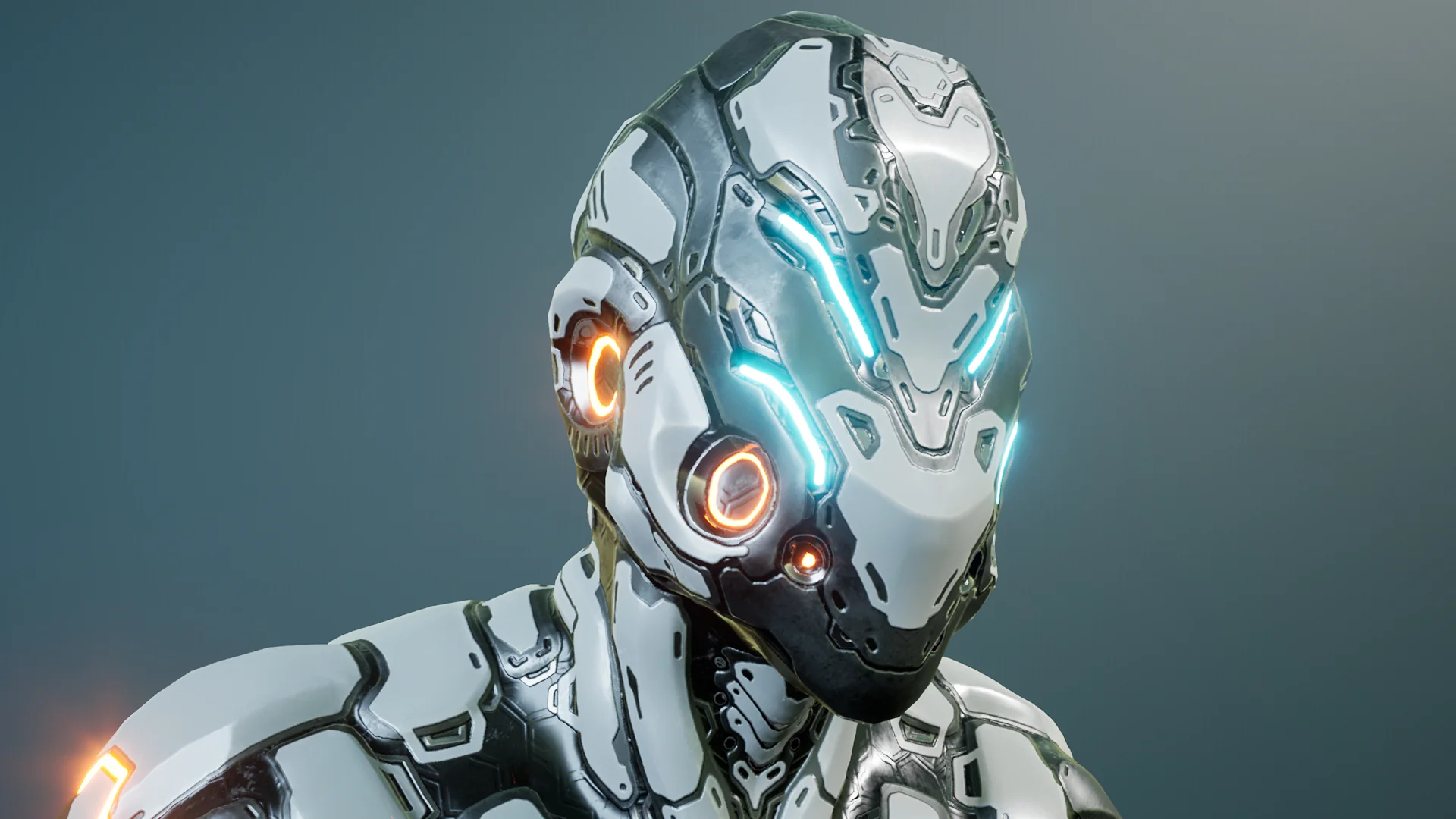
Because synthetic models in speculative fiction frequently occupy diverse gameplay functions, this asset provides an adaptable base suited for distinct combat and narrative capacities. The realistic android design fits seamlessly into space settings, futuristic facilities, and tech-heavy battlegrounds. When implemented as a player avatar, the android frame provides a crisp, metallic presence on screen that communicates weight and durability. The clean mechanical contours emphasize artificial construction, establishing an immediate sense of engineered precision.
In enemy configurations, the robotic exterior enables rapid deployment across combat encounters. Swarms of automated sentinels, specialized security droids, or rogue android units can be populated using the same fundamental model geometry. Because the asset also operates effectively as stationary or contextual scene decoration, developers can position the model into charging stations, maintenance bays, or industrial repair pods to enrich environmental storytelling without creating dedicated non-playable asset variants.
The visual language avoids hyper-specific faction markings on the mesh itself, allowing the model to represent military androids, civilian utility chassis that have been reprogrammed, or hostile cyborg forces operating in outer space. This neutral mechanical foundation gives teams the freedom to designate allegiance, unit class, or tactical specialization directly through behavioral scripts, lighting cues, and surface coloration.
First-Person and Third-Person Rigging Systems in Rogue
Character implementation often diverges depending on camera perspective, creating extra work when bridging first-person and third-person viewpoints. Biotech - Rogue resolves this hurdle by supplying assets tailored to both camera distances. The full humanoid model is rigged to the default UE4 mannequin skeleton, granting immediate access to existing motion systems. Locomotion sets, tactical combat animations, melee strikes, and idle cycles created for the standard mannequin map directly onto the android body, eliminating the need to retarget or adjust joint hierarchies manually.
For perspective shifts focused entirely down the barrel of a weapon, the package provides a separate asset containing dedicated FPS hands. These hands are rigged to the standard first-person hands skeleton, maintaining full alignment with weapon-handling animations, firearm reloads, and equipment handling libraries designed around marketplace rigging norms. Maintaining dedicated first-person geometry ensures that close-up weapon stances display high-detail mechanical joints and surfaces without clipping artifacts or unnecessary full-body mesh overhead.
The inclusion of basic UE4 mannequin animations within the project allows developers to verify bone weight distribution and movement fluidity right away. Foot plants, arm swings, and posture shifts can be evaluated across the full humanoid model inside test spaces before moving the asset into custom animation blueprint graphs.
Configuring the Biotech - Rogue Shading Network and Emissive Channels
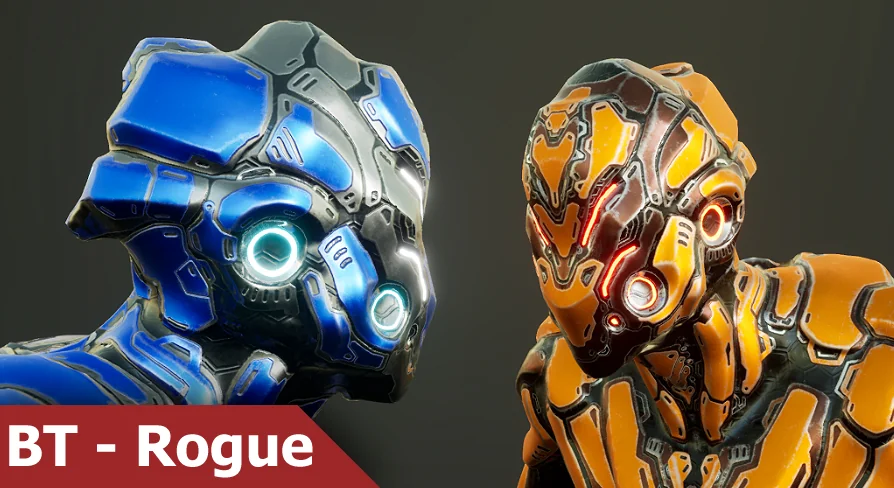
Visual diversity is essential when deploying a single mechanical asset across multiple gameplay roles or squad rosters. The surfacing workflow for the model relies on a main master material driven by texture masks, enabling broad adjustments without altering the underlying texture maps. By partitioning the surface into distinct masked zones, individual sections of the chassis can accept independent adjustments for base color, roughness values, and metalness characteristics.
This texture-mask architecture allows teams to convert a clean, factory-fresh reflective android into a dull, matte-finished industrial machine, or an armor-plated military robot with distinct surface friction across different panels. Adjusting metalness and roughness values across these separated mask regions alters how external environment lighting reflects off the mechanical limbs, helping the asset integrate into dark industrial interiors, high-exposure planetary exteriors, or neon-lit corridors.
Emissive lighting on the model is split across three distinct mask layers: the visor, the main lights, and the secondary lights. Isolating these illumination elements permits granular control over both light color and glow intensity:
Visor Emissive Mask: Directs illumination across the facial visor, allowing immediate color changes to denote state awareness, targeting modes, or active hostility.
Main Lights Mask: Governs the primary energy indicators distributed across the torso and limbs, establishing the central power signature of the unit.
Secondary Lights Mask: Controls auxiliary accent lights, joint indicators, or low-intensity running lights, providing multi-tiered lighting contrast on the chassis.
Five material instances are included out of the box, illustrating different color schemes and surface finishes. These preset instances demonstrate how quickly the model shifts identity through altered palette selections, offering immediate presets for team-based multiplayer indicators or distinct robotic squad archetypes.
Blueprint Architecture and Interactive Playtesting Setup
Testing asset movement, camera framing, and control responsiveness usually requires linking input bindings and animation states within engine project settings. To bypass initial setup time, Biotech - Rogue includes a dedicated Character Blueprint alongside an accompanying Game Mode Blueprint. Dropping into the included overview map provides immediate access to an interactive test environment where the character can be driven using standard input keys.
The bundled blueprint configuration accepts default controls directly: directional navigation through [W], [A], [S], and [D], jumping actions mapped to [Space], sprint or modifier commands through [Shift], and interactive triggers assigned to [F]. This functional framework allows teams to verify movement velocity, turn rates, jump arcs, and physical collision parameters against prototype level geometry without authoring dedicated gameplay scripts first.
Because the logic is encapsulated inside standard Blueprint nodes, the framework serves as an accessible reference for hooking custom gameplay mechanics into the character. Mechanics such as stamina-drained sprinting, interaction traces on [F], or dynamic camera adjustments can be built straight onto the existing character structure, speeding up early prototype phases.
Asset Ecosystem Compatibility and Intended User Workflows
Within broader production environments, this asset operates in close compatibility with Biotech - Hornet, sharing design sensibilities, mechanical aesthetics, and structural logic that allow the two releases to function alongside one another in combined sci-fi rosters. Whether deployed as paired combat units or differentiated android tiers within the same universe, their matching design standards prevent visual clashes.
Solo developers, small independent studios, and rapid prototyping teams benefit most from this package. Because the asset supplies standard UE4 mannequin compatibility, dedicated first-person hands, ready-to-play control blueprints, and deeply customizable mask-driven materials, it eliminates the technical setup work typically required to get an android asset running in both third-person and shooter perspectives.
 Characters
 Characters
 Characters
 Characters