"95ccd6d7c96110f6"{"id":"1002453","slug":"biotech-hornet","title":"Biotech - Hornet","category":"Characters \u0026 Creatures","engine":"4.18+,5.0+","assetVersion":"","engineVersion":"Engine Version: 4.18+,5.0+","tag":"Characters","accent":"blue","visual":"character","summary":"Biotech - Hornet provides a modular sci-fi humanoid rigged to the UE4 mannequin, complete with FPS hands, mask materials, and blueprint testing tools.","platform":"Unreal Engine","indexPolicy":"index","publishedAt":"2026-11-11T08:42:07.950Z","updatedAt":"2026-11-11T08:42:07.950Z","sourceNotes":[],"fileContents":[],"compatibility":["Unreal Engine","Engine Version: 4.18+,5.0+"],"featuredImage":{"alt":"Biotech - Hornet","src":"/wp-content/uploads/published/2026/11/9ac17c54d635-ba6440ec-46de-4dd7-ba9e-2616dd0740c1-f43993f06b.webp"},"hasDownloadLink":true,"downloads":0,"terms":[{"taxonomy":"category","slug":"characters-and-creatures","name":"Characters \u0026 Creatures"}],"galleryImages":[{"src":"/wp-content/uploads/published/2026/11/418134b6a4fc-70a769b5-1647-4db0-a57f-310476a87ca0-e8ae2eca27.webp","alt":"Biotech - Hornet"},{"src":"/wp-content/uploads/published/2026/11/520e0321f531-9a67d386-e928-4972-8e52-91dd6c56f32d-8959df93b5.webp","alt":"Biotech - Hornet"},{"src":"/wp-content/uploads/published/2026/11/6ab892ec0f6f-7bd1c4c2-afb4-4a31-b6c6-6532a4de9982-da60882c57.webp","alt":"Biotech - Hornet"},{"src":"/wp-content/uploads/published/2026/11/56232859a1d1-5b5f2c28-adcc-422a-a937-664eaf9a9e14-9a5f12820d.webp","alt":"Biotech - Hornet"},{"src":"/wp-content/uploads/published/2026/11/78ddf6c58620-8c70c2ab-d699-42e1-a9f2-bddd855c8a1e-a13de2ee81.webp","alt":"Biotech - Hornet"},{"src":"/wp-content/uploads/published/2026/11/f138f079fd0f-c89a889a-fc72-4e56-8bd4-61317b3b0608-6812031499.webp","alt":"Biotech - Hornet"},{"src":"/wp-content/uploads/published/2026/11/43569c4f6eda-b7f226c0-06d9-4743-90c3-095087bfd410-7acc0058cd.webp","alt":"Biotech - Hornet"},{"src":"/wp-content/uploads/published/2026/11/521dca1b922e-020be21f-48f0-4209-949b-d3c11c380e81-ad8d297946.webp","alt":"Biotech - Hornet"},{"src":"/wp-content/uploads/published/2026/11/5cabf0932e84-3b2e1349-bcc4-4bce-ab83-268a5a166925-9893cb6f65.webp","alt":"Biotech - Hornet"},{"src":"/wp-content/uploads/published/2026/11/b0bf0bc4dd03-4bc9af3f-1f0a-44e6-a054-57a5fac737cf-e1ac486c26.webp","alt":"Biotech - Hornet"}],"accessPanel":{"kind":"resource","title":"Get this resource","eyebrow":"Free resource","message":"Download this resource in your browser.","fileName":"Content.7z","safetyNote":"Resources are manually reviewed before listing to improve quality and reduce obvious risks.","actionLabel":"Get this resource","resourceType":"Resource archive","versions":[]},"contentHtml":"\u003cp\u003eNeon-lit cyberpunk backstreets, subterranean research laboratories, orbital defense stations, and industrial manufacturing bays all demand character models that communicate advanced technology while functioning reliably under active gameplay mechanics. Biotech - Hornet addresses these environments directly. Structured as a sci-fi humanoid with an aesthetic spanning android, cyborg, and robotic themes, the asset supplies a realistic technological design ready for deployment as an aggressive enemy combatant, a controllable main protagonist, or an inactive environmental prop within futuristic level designs.\u003c/p\u003e \u003ch2\u003eSkeletal Framework and Animation Mapping in Biotech - Hornet\u003c/h2\u003e\n\u003cp\u003eCharacter integration in modern development pipelines frequently encounters friction during retargeting and rigging phases. Biotech - Hornet bypasses these technical hurdles by aligning its full-body humanoid structure directly to the default UE4 mannequin skeleton. Because the bone hierarchy and proportions match this widely adopted standard, the character can immediately receive, execute, and blend animation sequences from standard marketplace libraries without requiring custom skeleton translation or destructive retargeting steps.\u003c/p\u003e \u003cp\u003eLocomotion blends, combat combos, idle cycles, aiming offsets, and hit reactions authored for the mannequin map cleanly across the Hornet frame. For projects prioritizing first-person perspectives, the pack includes a distinct set of FPS hands. Rather than forcing developers to clip or position third-person arm geometry into camera viewports, these hands are rigged explicitly to the default FPS hands skeleton. This dual-rig configuration guarantees that standard weapon handling, reloading, tool manipulation, and camera-aligned gestures operate with proper perspective alignment, preventing the distortion and mesh clipping that often occur when repurposing third-person rigs for first-person perspectives.\u003c/p\u003e \u003ch2\u003eMask-Driven Shading and Emissive Channels on the Hornet Mesh\u003c/h2\u003e\n\u003cp\u003eStatic, pre-baked textures limit how a character model fits into diverse art directions. Biotech - Hornet circumvents color fatigue through a modular material system shaped by mask textures. Instead of locking specific panels and mechanical joints to flat diffuse maps, the material structure allows artists to isolate discrete zones of the model to adjust surface properties individually.\u003c/p\u003e \u003cp\u003eEach masked section provides direct control over three fundamental shading components: color tint, surface roughness, and metalness values. By manipulating these parameters, the exterior plating can transition from polished, mirror-like chrome finishes to matte industrial polymers or weathered metallic alloys. This level of granularity ensures that multiple instances of the character can populate the same encounter while displaying distinct unit designations or faction alignments.\u003c/p\u003e \u003cp\u003eIllumination across the chassis relies on two isolated emissive light masks beyond one unified channel. The visor and the main chassis lights are governed by independent control nodes, allowing creators to adjust both color and intensity separately:\u003c/p\u003e\n\u003cul\u003e \u003cli\u003e\u003cstrong\u003eVisor Emissive Mask:\u003c/strong\u003e Regulates the glowing optic interface across the faceplate, supporting distinct color changes and intense light bursts for targeting modes, stealth indicators, or power-down sequences.\u003c/li\u003e \u003cli\u003e\u003cstrong\u003eMain Lights Emissive Mask:\u003c/strong\u003e Controls the accent strips, core conduits, and functional indicators distributed across the torso and limbs, enabling multi-toned lighting schemes that contrast with the headpiece.\u003c/li\u003e\n\u003c/ul\u003e \u003cp\u003eTo ground the character within harsh gameplay environments, the surface shader features a dedicated dirt level pass. This procedural weathering system gives developers direct command over dirt accumulation across the mechanical frame. The dirt layer provides its own independent controls for color, roughness, and metalness, permitting realistic dust, oily residue, or dried grime to settle across the high-tech plating without altering the pristine base material beneath it.\u003c/p\u003e \u003ch2\u003eReal-Time Blueprint Controls and the Biotech Skin Generator\u003c/h2\u003e\n\u003cp\u003eEvaluating character motion and visual variations typically requires setting up custom testing levels, input bindings, and camera components. Biotech - Hornet expedites evaluation by providing a ready-to-run setup consisting of a preconfigured Character Blueprint, a Game Mode Blueprint, and an overview map. Upon launching the overview level, developers can immediately pilot the character through standard movement inputs to observe mesh deformation, physics reactions, and lighting responses under active engine conditions.\u003c/p\u003e \u003cp\u003eThe integrated testing inputs cover standard movement and direct material cycling:\u003c/p\u003e\n\u003cul\u003e \u003cli\u003e\u003cstrong\u003eLocomotion Keys [W][A][S][D]:\u003c/strong\u003e Drive standard directional ground translation to observe animation transitions and root movement.\u003c/li\u003e \u003cli\u003e\u003cstrong\u003eJump [Space]:\u003c/strong\u003e Triggers vertical jumping and evaluates mid-air postures against the animation blueprint setup.\u003c/li\u003e \u003cli\u003e\u003cstrong\u003eSprint [Shift]:\u003c/strong\u003e Accelerates movement velocity to test high-speed running animations and rapid directional changes.\u003c/li\u003e \u003cli\u003e\u003cstrong\u003eMaterial Toggle [F]:\u003c/strong\u003e Cycles through pre-built example material instances to display diverse visual configurations created with the mask system.\u003c/li\u003e \u003cli\u003e\u003cstrong\u003eRandom Skin Generator [R]:\u003c/strong\u003e Executes a scripted randomization routine that alters mask-driven color, roughness, and metalness values in real time, demonstrating the dynamic range of procedural variations possible on the chassis.\u003c/li\u003e\n\u003c/ul\u003e \u003ch2\u003eAdapting Hornet for First-Person and Third-Person Project Scope\u003c/h2\u003e\n\u003cp\u003eBecause the asset includes both full-body geometry and dedicated first-person arms, it integrates seamlessly into hybrid perspective designs. In tactical shooters or survival horror titles where players switch between first-person aiming and third-person exploration, having matching skeletal setups preserves visual consistency between what the player sees on screen and what other players observe in multiplayer encounters. The scripted blueprint logic demonstrates how easily the character hooks into animation blueprints and input maps, serving as a functional reference point for custom player controller implementations.\u003c/p\u003e \u003cp\u003eThe mechanical styling fits cleanly alongside complementary robotic assets, including compatibility with the Basic Chibi Character 01 - BroBot framework. Whether configured as an agile cyborg scout with high-intensity visor optics, a weathered line android coated in industrial grime, or stationary decorative machinery flanking high-tech corridors, Biotech - Hornet delivers the mechanical fidelity, shading modularity, and standard skeletal alignment required for immediate production use.\u003c/p\u003e\n\n\u003ch2\u003eRelated Resources Worth Checking\u003c/h2\u003e\n\u003cul\u003e\n\u003cli\u003e\u003ca href=\"https://3dcghub.com/biotech-toxic/\" rel=\"noopener noreferrer\"\u003eBiotech - Toxic\u003c/a\u003e\u003c/li\u003e\n\u003cli\u003e\u003ca href=\"https://3dcghub.com/rebel/\" rel=\"noopener noreferrer\"\u003eRebel\u003c/a\u003e\u003c/li\u003e\n\u003cli\u003e\u003ca href=\"https://3dcghub.com/native-american/\" rel=\"noopener noreferrer\"\u003eNative American\u003c/a\u003e\u003c/li\u003e\n\u003cli\u003e\u003ca href=\"https://3dcghub.com/medical-worker-01/\" rel=\"noopener noreferrer\"\u003eMedical Worker 01\u003c/a\u003e\u003c/li\u003e\n\u003cli\u003e\u003ca href=\"https://3dcghub.com/animated-stylized-wizard/\" rel=\"noopener noreferrer\"\u003eAnimated Stylized Wizard\u003c/a\u003e\u003c/li\u003e\n\u003c/ul\u003e","contentTextLength":6693,"navigation":{"current":12,"total":4387,"previous":{"id":"1002454","slug":"dystopia-mech-and-pilot","title":"Dystopia Mech and Pilot","category":"Characters \u0026 Creatures","platform":"Unreal Engine","updatedAt":"2026-11-11T08:42:53.204Z"},"next":{"id":"1002452","slug":"assistant-dog","title":"Assistant Dog","category":"Characters \u0026 Creatures","platform":"Unreal Engine","updatedAt":"2026-11-11T08:40:54.802Z"}},"relatedResources":[{"id":"1002460","slug":"biotech-rogue","title":"Biotech - Rogue","category":"Characters \u0026 Creatures","engine":"4.16+,5.0+","assetVersion":"","engineVersion":"Engine Version: 4.16+,5.0+","tag":"Characters","accent":"blue","visual":"character","summary":"Examine Biotech - Rogue, a sci-fi android character featuring UE4 mannequin rigging, dedicated FPS hands, customizable mask materials, and runnable blueprints.","platform":"Unreal Engine","indexPolicy":"index","publishedAt":"2026-11-11T08:47:38.898Z","updatedAt":"2026-11-11T08:47:38.898Z","sourceNotes":[],"fileContents":[],"compatibility":["Unreal Engine","Engine Version: 4.16+,5.0+"],"featuredImage":{"alt":"Biotech - Rogue","src":"/wp-content/uploads/published/2026/11/5c5f91d16b3a-424a7832-2ed9-42d4-81db-c0a0867cf683-5d7c4b3259.webp"},"hasDownloadLink":true,"downloads":0},{"id":"1001721","slug":"biotech-toxic","title":"Biotech - Toxic","category":"Characters \u0026 Creatures","engine":"4.26+,5.0+","assetVersion":"","engineVersion":"Engine Version: 4.26+,5.0+","tag":"Characters","accent":"blue","visual":"character","summary":"Explore Biotech - Toxic, a modular sci-fi character for Unreal Engine featuring mask-driven materials, dual emissive channels, and full UE4 rigging.","platform":"Unreal Engine","indexPolicy":"index","publishedAt":"2026-10-19T16:18:32.190Z","updatedAt":"2026-10-19T16:18:32.190Z","sourceNotes":[],"fileContents":[],"compatibility":["Unreal Engine","Engine Version: 4.26+,5.0+"],"featuredImage":{"alt":"Biotech - Toxic","src":"/wp-content/uploads/published/2026/10/f1eef831ddd5-3f442017-27c0-4dff-b3a4-9f0dc6b6c3c7-14f08bb4cd.webp"},"hasDownloadLink":true,"downloads":0},{"id":"1002396","slug":"rebel","title":"Rebel","category":"Characters \u0026 Creatures","engine":"4.18+,5.0+","assetVersion":"","engineVersion":"Engine Version: 4.18+,5.0+","tag":"Characters","accent":"blue","visual":"character","summary":"A modular, lowpoly character featuring an Epic skeleton, PBR materials, full compatibility with Epic's starter animation pack, and bunker integration.","platform":"Unreal Engine","indexPolicy":"index","publishedAt":"2026-11-10T04:25:09.218Z","updatedAt":"2026-11-10T04:25:09.218Z","sourceNotes":[],"fileContents":[],"compatibility":["Unreal Engine","Engine Version: 4.18+,5.0+"],"featuredImage":{"alt":"Rebel","src":"/wp-content/uploads/published/2026/11/af838f79fb05-5338b567-0fb2-44c8-ace0-520b6ddd835e-038f876b70.webp"},"hasDownloadLink":true,"downloads":0}]}
Characters
Biotech - Hornet
Biotech - Hornet provides a modular sci-fi humanoid rigged to the UE4 mannequin, complete with FPS hands, mask materials, and blueprint testing tools.
Neon-lit cyberpunk backstreets, subterranean research laboratories, orbital defense stations, and industrial manufacturing bays all demand character models that communicate advanced technology while functioning reliably under active gameplay mechanics. Biotech - Hornet addresses these environments directly. Structured as a sci-fi humanoid with an aesthetic spanning android, cyborg, and robotic themes, the asset supplies a realistic technological design ready for deployment as an aggressive enemy combatant, a controllable main protagonist, or an inactive environmental prop within futuristic level designs.
Skeletal Framework and Animation Mapping in Biotech - Hornet
Character integration in modern development pipelines frequently encounters friction during retargeting and rigging phases. Biotech - Hornet bypasses these technical hurdles by aligning its full-body humanoid structure directly to the default UE4 mannequin skeleton. Because the bone hierarchy and proportions match this widely adopted standard, the character can immediately receive, execute, and blend animation sequences from standard marketplace libraries without requiring custom skeleton translation or destructive retargeting steps.
Locomotion blends, combat combos, idle cycles, aiming offsets, and hit reactions authored for the mannequin map cleanly across the Hornet frame. For projects prioritizing first-person perspectives, the pack includes a distinct set of FPS hands. Rather than forcing developers to clip or position third-person arm geometry into camera viewports, these hands are rigged explicitly to the default FPS hands skeleton. This dual-rig configuration guarantees that standard weapon handling, reloading, tool manipulation, and camera-aligned gestures operate with proper perspective alignment, preventing the distortion and mesh clipping that often occur when repurposing third-person rigs for first-person perspectives.
Mask-Driven Shading and Emissive Channels on the Hornet Mesh
Static, pre-baked textures limit how a character model fits into diverse art directions. Biotech - Hornet circumvents color fatigue through a modular material system shaped by mask textures. Instead of locking specific panels and mechanical joints to flat diffuse maps, the material structure allows artists to isolate discrete zones of the model to adjust surface properties individually.
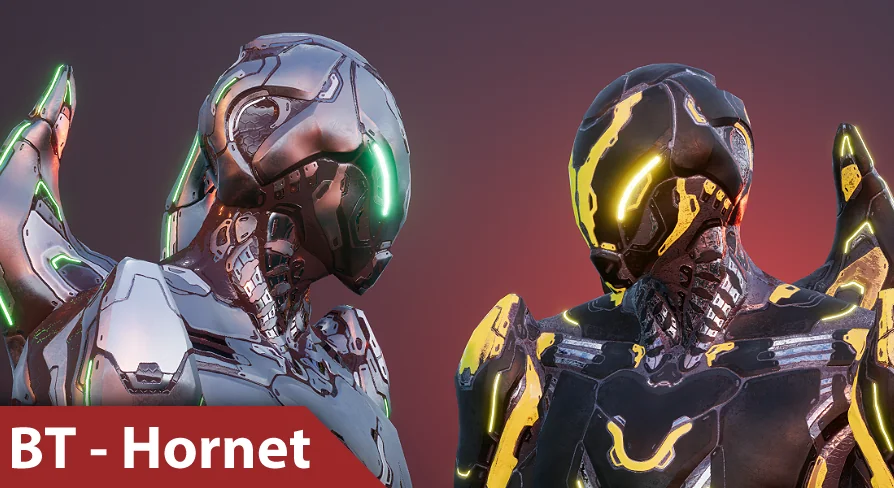
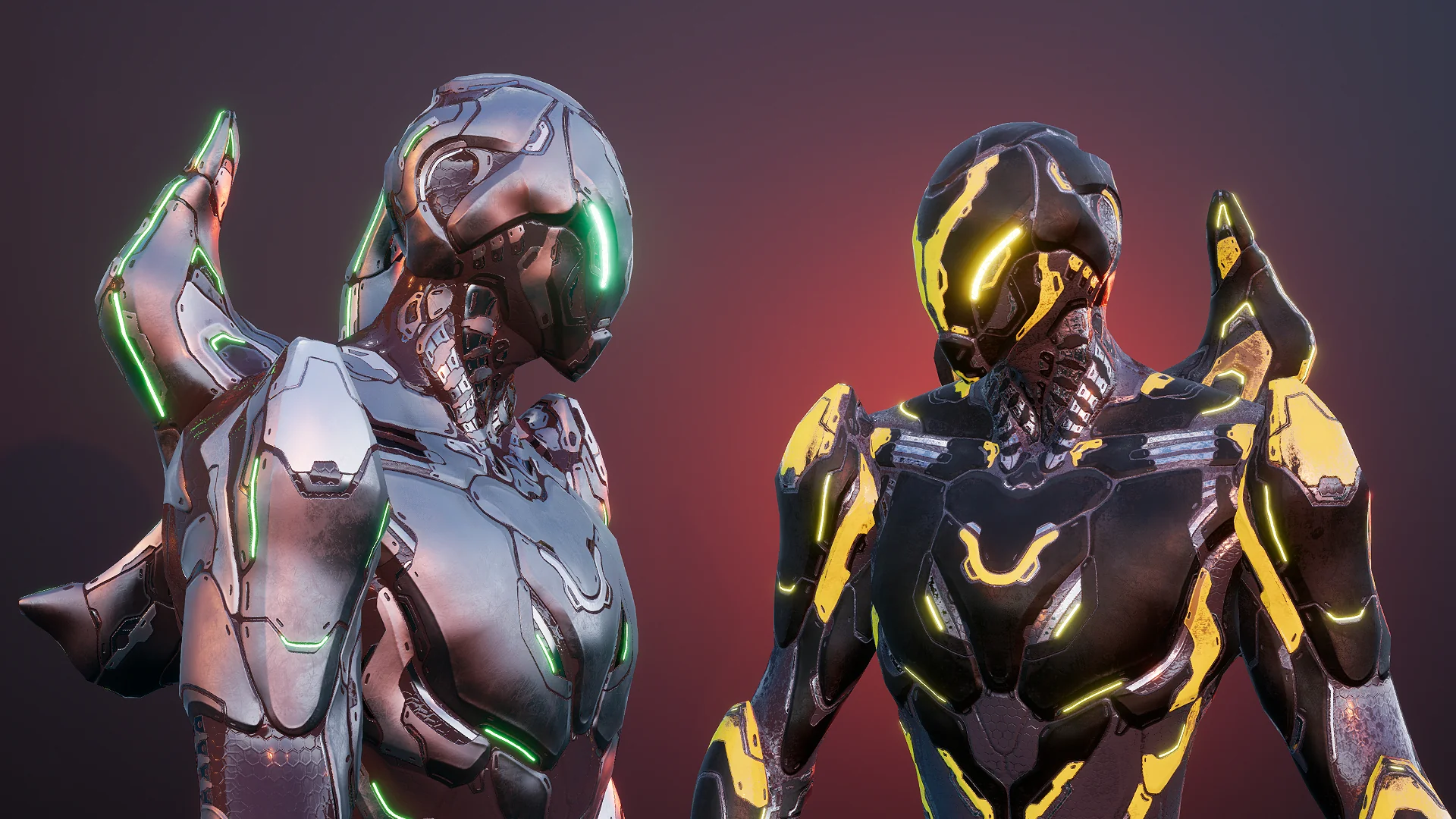
Each masked section provides direct control over three fundamental shading components: color tint, surface roughness, and metalness values. By manipulating these parameters, the exterior plating can transition from polished, mirror-like chrome finishes to matte industrial polymers or weathered metallic alloys. This level of granularity ensures that multiple instances of the character can populate the same encounter while displaying distinct unit designations or faction alignments.
Illumination across the chassis relies on two isolated emissive light masks beyond one unified channel. The visor and the main chassis lights are governed by independent control nodes, allowing creators to adjust both color and intensity separately:
Visor Emissive Mask: Regulates the glowing optic interface across the faceplate, supporting distinct color changes and intense light bursts for targeting modes, stealth indicators, or power-down sequences.
Main Lights Emissive Mask: Controls the accent strips, core conduits, and functional indicators distributed across the torso and limbs, enabling multi-toned lighting schemes that contrast with the headpiece.
To ground the character within harsh gameplay environments, the surface shader features a dedicated dirt level pass. This procedural weathering system gives developers direct command over dirt accumulation across the mechanical frame. The dirt layer provides its own independent controls for color, roughness, and metalness, permitting realistic dust, oily residue, or dried grime to settle across the high-tech plating without altering the pristine base material beneath it.
Real-Time Blueprint Controls and the Biotech Skin Generator
Evaluating character motion and visual variations typically requires setting up custom testing levels, input bindings, and camera components. Biotech - Hornet expedites evaluation by providing a ready-to-run setup consisting of a preconfigured Character Blueprint, a Game Mode Blueprint, and an overview map. Upon launching the overview level, developers can immediately pilot the character through standard movement inputs to observe mesh deformation, physics reactions, and lighting responses under active engine conditions.
The integrated testing inputs cover standard movement and direct material cycling:
Locomotion Keys [W][A][S][D]: Drive standard directional ground translation to observe animation transitions and root movement.
Jump [Space]: Triggers vertical jumping and evaluates mid-air postures against the animation blueprint setup.
Sprint [Shift]: Accelerates movement velocity to test high-speed running animations and rapid directional changes.
Material Toggle [F]: Cycles through pre-built example material instances to display diverse visual configurations created with the mask system.
Random Skin Generator [R]: Executes a scripted randomization routine that alters mask-driven color, roughness, and metalness values in real time, demonstrating the dynamic range of procedural variations possible on the chassis.
Adapting Hornet for First-Person and Third-Person Project Scope
Because the asset includes both full-body geometry and dedicated first-person arms, it integrates seamlessly into hybrid perspective designs. In tactical shooters or survival horror titles where players switch between first-person aiming and third-person exploration, having matching skeletal setups preserves visual consistency between what the player sees on screen and what other players observe in multiplayer encounters. The scripted blueprint logic demonstrates how easily the character hooks into animation blueprints and input maps, serving as a functional reference point for custom player controller implementations.
The mechanical styling fits cleanly alongside complementary robotic assets, including compatibility with the Basic Chibi Character 01 - BroBot framework. Whether configured as an agile cyborg scout with high-intensity visor optics, a weathered line android coated in industrial grime, or stationary decorative machinery flanking high-tech corridors, Biotech - Hornet delivers the mechanical fidelity, shading modularity, and standard skeletal alignment required for immediate production use.
 Characters
 Characters
 Characters
 Characters