"fb5ea1e7d1b41445"{"id":"1002416","slug":"native-american","title":"Native American","category":"Characters \u0026 Creatures","engine":"4.18+,5.0+","assetVersion":"","engineVersion":"Engine Version: 4.18+,5.0+","tag":"Characters","accent":"blue","visual":"character","summary":"Technical breakdown of the Native American lowpoly character model, featuring Epic Skeleton rigging, 44 animations, SSS materials, and physics setups.","platform":"Unreal Engine","indexPolicy":"index","publishedAt":"2026-11-10T13:36:44.305Z","updatedAt":"2026-11-10T13:36:44.305Z","sourceNotes":[],"fileContents":[],"compatibility":["Unreal Engine","Engine Version: 4.18+,5.0+"],"featuredImage":{"alt":"Native American","src":"/wp-content/uploads/published/2026/11/edbc47aac0c7-a2e36e55-bd1f-45fc-8037-7d656ac1de87-2613efbab3.webp"},"hasDownloadLink":true,"downloads":0,"terms":[{"taxonomy":"category","slug":"characters-and-creatures","name":"Characters \u0026 Creatures"}],"galleryImages":[{"src":"/wp-content/uploads/published/2026/11/2ffc26395af6-b667c184-952e-48f2-aa49-0c38b5e12e33-da8adfbf03.webp","alt":"Native American"},{"src":"/wp-content/uploads/published/2026/11/de30746f397f-ea72e0d7-11dd-479a-a9bb-1d8aba296c15-ec990d900c.webp","alt":"Native American"},{"src":"/wp-content/uploads/published/2026/11/26fd273c07d8-55ff3b88-e69d-4042-ac4f-e825bb1bf8f1-db4357901e.webp","alt":"Native American"},{"src":"/wp-content/uploads/published/2026/11/30e64f6ac1d5-7fd09363-b167-4ee2-840b-1bac15b534dc-3969b1cf45.webp","alt":"Native American"},{"src":"/wp-content/uploads/published/2026/11/e52e7aa5cc94-b52d512a-38df-41eb-a178-e25b42309d45-fb61409a2a.webp","alt":"Native American"},{"src":"/wp-content/uploads/published/2026/11/8ed5c62ad762-27c6c88b-1cd2-484e-8b82-50cde6e957fd-e4fa12ac96.webp","alt":"Native American"},{"src":"/wp-content/uploads/published/2026/11/f6045ebaa1ad-1e77d4e5-47ac-4401-aad4-ad4f87012da7-9e55e3d5c3.webp","alt":"Native American"},{"src":"/wp-content/uploads/published/2026/11/bb979d77bf0a-4633f0d7-516a-4f36-9f27-571998e53132-5394cb3160.webp","alt":"Native American"},{"src":"/wp-content/uploads/published/2026/11/45abd974bb1a-8998e117-1f64-4f27-8dbe-d47dcaecd396-00eb6d12a1.webp","alt":"Native American"},{"src":"/wp-content/uploads/published/2026/11/363083a94dcf-bcabdf72-60d6-4bd5-9e97-115c33da20cc-4a4bfe4139.webp","alt":"Native American"}],"accessPanel":{"kind":"resource","title":"Get this resource","eyebrow":"Free resource","message":"Download this resource in your browser.","fileName":"Content.7z","safetyNote":"Resources are manually reviewed before listing to improve quality and reduce obvious risks.","actionLabel":"Get this resource","resourceType":"Resource archive","versions":[]},"contentHtml":"\u003ch2\u003eRigging Architecture and the Native American Animation Blueprint\u003c/h2\u003e\n\u003cp\u003eIntegrating a character model into an active gameplay pipeline requires clear skeletal hierarchy and predictable deformation logic. Built directly upon the Epic Skeleton, this lowpoly male warrior model circumvents the friction often encountered during skeletal retargeting. Standard bone naming conventions and hierarchical alignments allow the character to inherit shared animation trees, state machines, and locomotion graphs with minimal manual remapping.\u003c/p\u003e\n\u003cp\u003eThe package supplies 44 distinct animations designed to handle foundational locomotion, active stances, and combat transitions. Because the character relies on an Animation Blueprint structure, state changes between idling, sprinting, directional movement, and combat actions can be blended using standard blend spaces and transition rules. Script integration hooks make it straightforward to link velocity variables, directional inputs, and attack triggers to the character's movement component.\u003c/p\u003e\n\u003cp\u003eWhether placed in a historical medieval battle, a realistic wilderness setting, or a stylized fantasy universe, the underlying rig maintains proportional accuracy during extreme motions. Joint weighting across high-deformation zones—such as the shoulders, elbows, and knees—ensures that the mesh retains volume during dynamic swings, dodges, and impacts without pinching or volume loss.\u003c/p\u003e \u003ch2\u003eGeometric Density and Mesh Optimization\u003c/h2\u003e\n\u003cp\u003eReal-time performance depends heavily on keeping triangle budgets strictly budgeted while maintaining anatomical silhouette fidelity. The character mesh operates within clear lowpoly constraints, clocking in at 15,329 faces, 18,095 vertices, and 30,404 triangles. This budget delivers a balance suited for modern game engines, rendering cleanly in third-person hero perspectives while remaining lightweight enough for mid-range distance rendering in crowded scenes.\u003c/p\u003e\n\u003cp\u003eThe 30,404 triangles are distributed strategically across the anatomical form and its costuming. Facial features, hands, muscular contours, and joint junctions receive denser edge-loop allocation to facilitate natural deformation during gameplay animations. Flatter planes along the limbs and torso maintain clean edge flow, avoiding extraneous geometry that would inflate vertex processing costs.\u003c/p\u003e\n\u003cp\u003eThis polygon density allows developers to deploy the asset in real-time combat systems without requiring aggressive early-stage level-of-detail (LOD) reductions. The model functions efficiently across varied camera distances, whether tracking up close behind the character's shoulder or pulled back to display wide battlefield compositions.\u003c/p\u003e \u003ch2\u003eNative American Material Instances, PBR Maps, and Skin Variations\u003c/h2\u003e\n\u003cp\u003eVisual fidelity is driven by a physically based rendering (PBR) texture workflow resolved at 4096x4096 resolution in.tga format. The texturing set consists of discrete map channels including Albedo, DirectX-format Normal maps, and a packed map consolidating Ambient Occlusion, Roughness, and Metallic values into individual color channels. This packing structure reduces texture sample calls per frame, streamlining shader execution on the GPU.\u003c/p\u003e\n\u003cp\u003eThe shading pipeline incorporates Subsurface Scattering (SSS) specifically calibrated for skin surfaces. By simulating the diffusion of light through epidermal layers, the character avoids the harsh, dry look that standard diffuse lighting often imposes on real-time characters. The SSS setup provides soft light transitions along muscular contours, facial planes, and ears when exposed to direct directional lighting or dynamic rim lights.\u003c/p\u003e\n\u003cp\u003eMaterial flexibility is handled through a master material and instance workflow. Within these material instances, developers can swap texture sets and adjust visual parameters without recompiling complex shader graphs. The character features multiple skin variations designed to support different faction identities or visual states:\u003c/p\u003e\n\u003cul\u003e \u003cli\u003eClean: A natural skin tone without surface markings or paint.\u003c/li\u003e \u003cli\u003eBlack: Dark war paint markings applied across the skin.\u003c/li\u003e \u003cli\u003eRed: Crimson pigment patterns suited for combat or ceremonial roles.\u003c/li\u003e \u003cli\u003eBlue: Cool-toned markings for alternate tribal or factional alignments.\u003c/li\u003e \u003cli\u003eWhite: High-contrast chalk-like war paint accents.\u003c/li\u003e\n\u003c/ul\u003e\n\u003cp\u003eThese surface variants allow teams to populate scenes with varied male warrior units while drawing from a shared master material and mesh foundation.\u003c/p\u003e \u003ch2\u003eDynamic Physics Setup for Hair and Garments\u003c/h2\u003e\n\u003cp\u003eA static model quickly breaks immersion once put into motion, especially when adorned with loose costuming and free-hanging hair. This character includes pre-configured physics assets targeted directly at the hair strands and flexible clothing elements. Bone chains mapped to these accessory assets respond dynamically to gravity, character velocity, and sudden directional momentum.\u003c/p\u003e\n\u003cp\u003eThe hair physics setup ensures that strands sway realistically during locomotion cycles, reacting naturally when the character breaks into a sprint or performs an abrupt dodge. Because these parameters are tuned out of the box, developers avoid spending production hours defining collision spheres and joint damping limits just to keep the hair from clipping through the skull or shoulders.\u003c/p\u003e\n\u003cp\u003eCloth simulation behaves similarly on the warrior's garments. As the legs cycle through rapid strides or wide combat stances, the cloth components yield to physical movement rather than remaining stiffly pinned to the primary skeletal joints. This hybrid combination of rigid skeletal skinning for main body mass and soft-body damping on peripheral elements produces convincing secondary motion across all 44 included animations.\u003c/p\u003e \u003ch2\u003eWeapon Integration and Project Compatibility\u003c/h2\u003e\n\u003cp\u003eThe character package extends beyond the base humanoid mesh by including two bonus weapons matched to the warrior's visual aesthetic. These weapons are optimized to slot directly into the character's hand sockets via the standard Epic Skeleton socketing system, aligning naturally with weapon-holding animation poses.\u003c/p\u003e\n\u003cp\u003eBecause the character adheres to universal skeletal standards and includes an Animation Blueprint, combat behaviors can be layered with ease. Sockets established at the palms allow weapons to be attached, sheathed, or swapped dynamically through blueprint logic during attack strings or equipment change events. The included 44 animations feature motion clips tailored for engagement, movement with armament, and idling under tension.\u003c/p\u003e\n\u003cp\u003eIn addition to standard modular workflows, the asset is configured for straightforward compatibility with the Fighting Girls Super Pack ecosystem. Developers leveraging shared combat frameworks or animation libraries from that system can cross-pollinate animations, retarget shared combat moves, and maintain consistent mechanical logic across disparate character rosters. The mesh's clean technical execution ensures that whether acting as a savage warrior in an action RPG or a grounded historical combatant, implementation proceeds without technical bottlenecks.\u003c/p\u003e\n\n\u003ch2\u003eMore From The Same Workflow\u003c/h2\u003e\n\u003cul\u003e\n\u003cli\u003e\u003ca href=\"https://3dcghub.com/animalia-bluebird/\" rel=\"noopener noreferrer\"\u003eAnimalia - Bluebird\u003c/a\u003e\u003c/li\u003e\n\u003cli\u003e\u003ca href=\"https://3dcghub.com/dinosaur-brachiosaurus-sauropod/\" rel=\"noopener noreferrer\"\u003eDinosaur Brachiosaurus Sauropod\u003c/a\u003e\u003c/li\u003e\n\u003cli\u003e\u003ca href=\"https://3dcghub.com/rebel/\" rel=\"noopener noreferrer\"\u003eRebel\u003c/a\u003e\u003c/li\u003e\n\u003cli\u003e\u003ca href=\"https://3dcghub.com/medical-worker-01/\" rel=\"noopener noreferrer\"\u003eMedical Worker 01\u003c/a\u003e\u003c/li\u003e\n\u003cli\u003e\u003ca href=\"https://3dcghub.com/fps-devices/\" rel=\"noopener noreferrer\"\u003eFPS Devices\u003c/a\u003e\u003c/li\u003e\n\u003c/ul\u003e","contentTextLength":7128,"navigation":{"current":3,"total":4340,"previous":{"id":"1002417","slug":"samurai-ichiro","title":"Samurai Ichiro","category":"Characters \u0026 Creatures","platform":"Unreal Engine","updatedAt":"2026-11-10T13:38:03.315Z"},"next":{"id":"1002415","slug":"teacher","title":"Teacher","category":"Characters \u0026 Creatures","platform":"Unreal Engine","updatedAt":"2026-11-10T13:09:54.962Z"}},"relatedResources":[{"id":"1000269","slug":"animalia-bluebird","title":"Animalia - Bluebird","category":"Characters \u0026 Creatures","engine":"4.26+,5.0+","assetVersion":"","engineVersion":"Engine Version: 4.26+,5.0+","tag":"Characters","accent":"blue","visual":"character","summary":"A highly detailed bluebird model featuring 4K textures, 60fps animations, LODs, and native Maya and 3ds Max rigs for seamless pipeline integration.","platform":"Unreal Engine","indexPolicy":"index","publishedAt":"2026-07-02T16:14:43.171Z","updatedAt":"2026-07-02T16:14:43.171Z","sourceNotes":[],"fileContents":[],"compatibility":["Unreal Engine","Engine Version: 4.26+,5.0+"],"featuredImage":{"alt":"Animalia - Bluebird","src":"/wp-content/uploads/published/2026/07/dac77bc204dd-f18c2222-4dc5-4770-84e0-75ffa7b8e997-d899c3da43.webp"},"hasDownloadLink":true,"downloads":0},{"id":"1001595","slug":"dinosaur-brachiosaurus-sauropod","title":"Dinosaur Brachiosaurus Sauropod","category":"Characters \u0026 Creatures","engine":"5.0+","assetVersion":"","engineVersion":"Engine Version: 5.0+","tag":"Characters","accent":"blue","visual":"character","summary":"Examine the Dinosaur Brachiosaurus Sauropod model, featuring 66 animations, 7 skin colors, 8K PBR textures, and native Unreal Engine 4.26 and 5.0 uassets.","platform":"Unreal Engine","indexPolicy":"index","publishedAt":"2026-10-10T16:17:58.830Z","updatedAt":"2026-10-10T16:17:58.830Z","sourceNotes":[],"fileContents":[],"compatibility":["Unreal Engine","Engine Version: 5.0+"],"featuredImage":{"alt":"Dinosaur Brachiosaurus Sauropod","src":"/wp-content/uploads/published/2026/10/d64aaaa45572-b9b0cd53-5b5f-4f1e-8982-1944871b16a4-8394a84579.webp"},"hasDownloadLink":true,"downloads":0},{"id":"1002396","slug":"rebel","title":"Rebel","category":"Characters \u0026 Creatures","engine":"4.18+,5.0+","assetVersion":"","engineVersion":"Engine Version: 4.18+,5.0+","tag":"Characters","accent":"blue","visual":"character","summary":"A modular, lowpoly character featuring an Epic skeleton, PBR materials, full compatibility with Epic's starter animation pack, and bunker integration.","platform":"Unreal Engine","indexPolicy":"index","publishedAt":"2026-11-10T04:25:09.218Z","updatedAt":"2026-11-10T04:25:09.218Z","sourceNotes":[],"fileContents":[],"compatibility":["Unreal Engine","Engine Version: 4.18+,5.0+"],"featuredImage":{"alt":"Rebel","src":"/wp-content/uploads/published/2026/11/af838f79fb05-5338b567-0fb2-44c8-ace0-520b6ddd835e-038f876b70.webp"},"hasDownloadLink":true,"downloads":0}]}
Characters
Native American
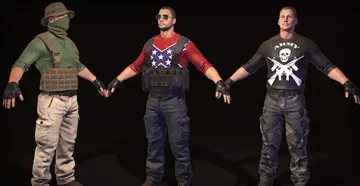
Technical breakdown of the Native American lowpoly character model, featuring Epic Skeleton rigging, 44 animations, SSS materials, and physics setups.
Rigging Architecture and the Native American Animation Blueprint
Integrating a character model into an active gameplay pipeline requires clear skeletal hierarchy and predictable deformation logic. Built directly upon the Epic Skeleton, this lowpoly male warrior model circumvents the friction often encountered during skeletal retargeting. Standard bone naming conventions and hierarchical alignments allow the character to inherit shared animation trees, state machines, and locomotion graphs with minimal manual remapping.
The package supplies 44 distinct animations designed to handle foundational locomotion, active stances, and combat transitions. Because the character relies on an Animation Blueprint structure, state changes between idling, sprinting, directional movement, and combat actions can be blended using standard blend spaces and transition rules. Script integration hooks make it straightforward to link velocity variables, directional inputs, and attack triggers to the character's movement component.
Whether placed in a historical medieval battle, a realistic wilderness setting, or a stylized fantasy universe, the underlying rig maintains proportional accuracy during extreme motions. Joint weighting across high-deformation zones—such as the shoulders, elbows, and knees—ensures that the mesh retains volume during dynamic swings, dodges, and impacts without pinching or volume loss.
Geometric Density and Mesh Optimization
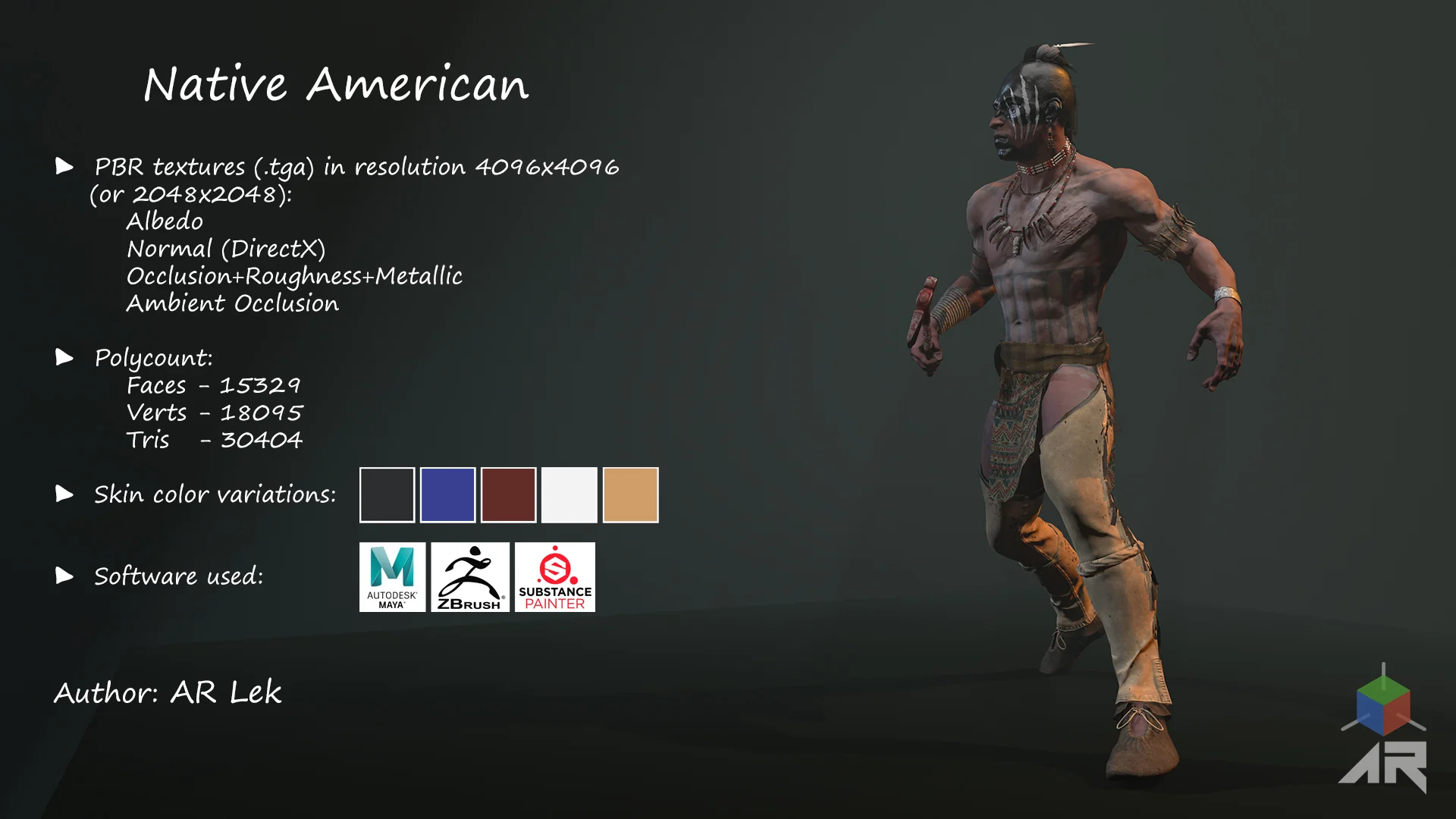
Real-time performance depends heavily on keeping triangle budgets strictly budgeted while maintaining anatomical silhouette fidelity. The character mesh operates within clear lowpoly constraints, clocking in at 15,329 faces, 18,095 vertices, and 30,404 triangles. This budget delivers a balance suited for modern game engines, rendering cleanly in third-person hero perspectives while remaining lightweight enough for mid-range distance rendering in crowded scenes.
The 30,404 triangles are distributed strategically across the anatomical form and its costuming. Facial features, hands, muscular contours, and joint junctions receive denser edge-loop allocation to facilitate natural deformation during gameplay animations. Flatter planes along the limbs and torso maintain clean edge flow, avoiding extraneous geometry that would inflate vertex processing costs.
This polygon density allows developers to deploy the asset in real-time combat systems without requiring aggressive early-stage level-of-detail (LOD) reductions. The model functions efficiently across varied camera distances, whether tracking up close behind the character's shoulder or pulled back to display wide battlefield compositions.
Native American Material Instances, PBR Maps, and Skin Variations
Visual fidelity is driven by a physically based rendering (PBR) texture workflow resolved at 4096x4096 resolution in.tga format. The texturing set consists of discrete map channels including Albedo, DirectX-format Normal maps, and a packed map consolidating Ambient Occlusion, Roughness, and Metallic values into individual color channels. This packing structure reduces texture sample calls per frame, streamlining shader execution on the GPU.
The shading pipeline incorporates Subsurface Scattering (SSS) specifically calibrated for skin surfaces. By simulating the diffusion of light through epidermal layers, the character avoids the harsh, dry look that standard diffuse lighting often imposes on real-time characters. The SSS setup provides soft light transitions along muscular contours, facial planes, and ears when exposed to direct directional lighting or dynamic rim lights.
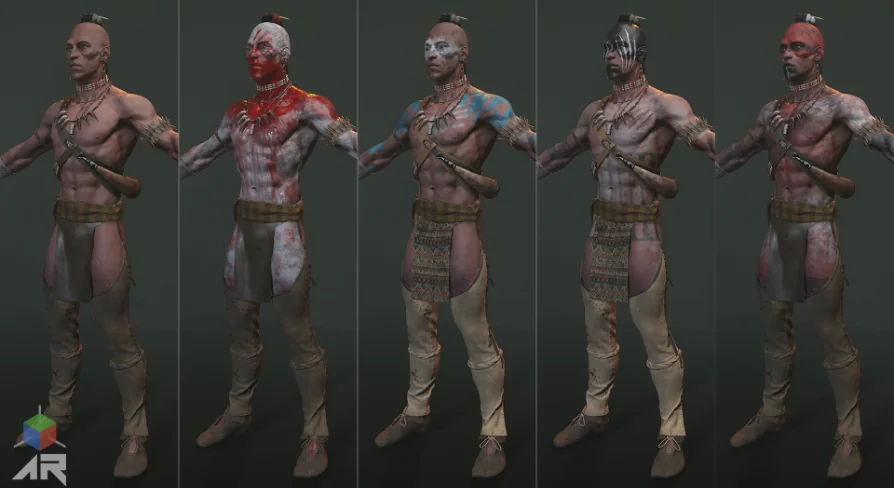
Material flexibility is handled through a master material and instance workflow. Within these material instances, developers can swap texture sets and adjust visual parameters without recompiling complex shader graphs. The character features multiple skin variations designed to support different faction identities or visual states:
Clean: A natural skin tone without surface markings or paint.
Black: Dark war paint markings applied across the skin.
Red: Crimson pigment patterns suited for combat or ceremonial roles.
Blue: Cool-toned markings for alternate tribal or factional alignments.
White: High-contrast chalk-like war paint accents.
These surface variants allow teams to populate scenes with varied male warrior units while drawing from a shared master material and mesh foundation.
Dynamic Physics Setup for Hair and Garments
A static model quickly breaks immersion once put into motion, especially when adorned with loose costuming and free-hanging hair. This character includes pre-configured physics assets targeted directly at the hair strands and flexible clothing elements. Bone chains mapped to these accessory assets respond dynamically to gravity, character velocity, and sudden directional momentum.
The hair physics setup ensures that strands sway realistically during locomotion cycles, reacting naturally when the character breaks into a sprint or performs an abrupt dodge. Because these parameters are tuned out of the box, developers avoid spending production hours defining collision spheres and joint damping limits just to keep the hair from clipping through the skull or shoulders.
Cloth simulation behaves similarly on the warrior's garments. As the legs cycle through rapid strides or wide combat stances, the cloth components yield to physical movement rather than remaining stiffly pinned to the primary skeletal joints. This hybrid combination of rigid skeletal skinning for main body mass and soft-body damping on peripheral elements produces convincing secondary motion across all 44 included animations.
Weapon Integration and Project Compatibility
The character package extends beyond the base humanoid mesh by including two bonus weapons matched to the warrior's visual aesthetic. These weapons are optimized to slot directly into the character's hand sockets via the standard Epic Skeleton socketing system, aligning naturally with weapon-holding animation poses.
Because the character adheres to universal skeletal standards and includes an Animation Blueprint, combat behaviors can be layered with ease. Sockets established at the palms allow weapons to be attached, sheathed, or swapped dynamically through blueprint logic during attack strings or equipment change events. The included 44 animations feature motion clips tailored for engagement, movement with armament, and idling under tension.
In addition to standard modular workflows, the asset is configured for straightforward compatibility with the Fighting Girls Super Pack ecosystem. Developers leveraging shared combat frameworks or animation libraries from that system can cross-pollinate animations, retarget shared combat moves, and maintain consistent mechanical logic across disparate character rosters. The mesh's clean technical execution ensures that whether acting as a savage warrior in an action RPG or a grounded historical combatant, implementation proceeds without technical bottlenecks.
 Characters
 Characters
 Characters
 Characters