"fb5ea1e7d1b41445"{"id":"1002417","slug":"samurai-ichiro","title":"Samurai Ichiro","category":"Characters \u0026 Creatures","engine":"4.22+,5.0+","assetVersion":"","engineVersion":"Engine Version: 4.22+,5.0+","tag":"Characters","accent":"blue","visual":"character","summary":"Explore Samurai Ichiro, a modular character for Unreal Engine featuring 31 interchangeable parts, cloth physics, ARKit facial morphs, and Epic Skeleton v4.","platform":"Unreal Engine","indexPolicy":"index","publishedAt":"2026-11-10T13:38:03.315Z","updatedAt":"2026-11-10T13:38:03.315Z","sourceNotes":[],"fileContents":[],"compatibility":["Unreal Engine","Engine Version: 4.22+,5.0+"],"featuredImage":{"alt":"Samurai Ichiro","src":"https://media.fab.com/image_previews/gallery_images/b608b4d2-db53-48b8-905d-fef150e77617/95c2b24e-7a2d-4663-97f3-e173b1fced37.png"},"hasDownloadLink":true,"downloads":0,"terms":[{"taxonomy":"category","slug":"characters-and-creatures","name":"Characters \u0026 Creatures"}],"galleryImages":[{"src":"/wp-content/uploads/published/2026/11/6a91f1ab1166-e755d611-b9fd-4fdf-8bc1-c38d8f766d43-c96f9cac77.webp","alt":"Samurai Ichiro"},{"src":"/wp-content/uploads/published/2026/11/0b703633364e-10ead019-bd3b-46b7-b54f-5b4ec0a338be-4e9bc795f8.webp","alt":"Samurai Ichiro"},{"src":"/wp-content/uploads/published/2026/11/6015bf0b7de5-19f107d0-5540-4148-a2c0-ef2e2ef936ed-4b6f18d597.webp","alt":"Samurai Ichiro"},{"src":"/wp-content/uploads/published/2026/11/d05a9c3b424e-4b2c6ce7-c976-4f3f-b89f-89021f13c079-21cf394842.webp","alt":"Samurai Ichiro"},{"src":"/wp-content/uploads/published/2026/11/7c25adc8779a-f1aab798-4606-4432-ba36-f5b1bceb0f22-56aa10076a.webp","alt":"Samurai Ichiro"},{"src":"/wp-content/uploads/published/2026/11/d7cd2a959243-01eb071c-6f57-4665-93c9-2e15e34cfa76-f2dd791fe4.webp","alt":"Samurai Ichiro"},{"src":"/wp-content/uploads/published/2026/11/6f254012fcd8-e1c9564c-d0b0-498e-b7af-a96666268cdd-fc477070e1.webp","alt":"Samurai Ichiro"},{"src":"/wp-content/uploads/published/2026/11/509a42300a2a-1cbc97f2-42c4-41ff-bf5e-b9d309122559-8d940a5f77.webp","alt":"Samurai Ichiro"},{"src":"/wp-content/uploads/published/2026/11/06e0760fa12f-174187ef-e07b-4a6d-8c79-b3bfe5d4af09-23d907a0c0.webp","alt":"Samurai Ichiro"},{"src":"/wp-content/uploads/published/2026/11/127750d19717-d6d61e34-2cac-4c8b-bc8a-b884cb36cc6b-32c3bba3bd.webp","alt":"Samurai Ichiro"},{"src":"/wp-content/uploads/published/2026/11/9827f23dd2d4-8c698f84-c8dc-483b-85a3-0c906d3dbcc8-356cab6642.webp","alt":"Samurai Ichiro"}],"accessPanel":{"kind":"resource","title":"Get this resource","eyebrow":"Free resource","message":"Download this resource in your browser.","fileName":"Content.7z","safetyNote":"Resources are manually reviewed before listing to improve quality and reduce obvious risks.","actionLabel":"Get this resource","resourceType":"Resource archive","versions":[]},"contentHtml":"\u003ch2\u003eStaging Samurai Ichiro Across Historical and Dark Fantasy Encounters\u003c/h2\u003e\u003cp\u003eHigh-tempo combat encounters demand character designs that visually convey velocity, technique, and narrative weight. Samurai Ichiro steps into this space as an agile fighter wrapped in historical armor motifs with dark, mystical undertones. Marked by a distinctive bleeding mask and sharp swords, the character balances the grounded presence of a seasoned warrior with stylized, supernatural elements suited for fast-paced skirmishes, boss duels, and stealth sequences.\u003c/p\u003e\u003cp\u003eIn feudal, shogun, and dark fantasy settings, combat encounters often require distinct visual tiers for combatants, from lone ronin wanderers to elite guard commanders. Because the character features an aesthetic defined by sharp blades, ornate plating, and mysterious visual accents, it slots directly into narrative sequences where an opponent or protagonist carries an ambiguous, mystical past. The presence of the bleeding mask immediately establishes dramatic tension in cinematic cutscenes, eliminating the need to build custom facial overlays for trauma or grim battle damage.\u003c/p\u003e\u003cp\u003eBeyond set-piece encounters, projects running agile combat systems benefit from character geometry that does not bog down motion readability. Slashing actions, quick-draw katana strikes, and evasive rolls depend on clear silhouettes. The model maintains distinct outlines across various angles, ensuring players can anticipate attack telegraphs and defensive frames during intense melee gameplay.\u003c/p\u003e\u003ch2\u003eModular Outfitting and Armor Variations for Samurai Ichiro\u003c/h2\u003e\u003cp\u003eBuilding character variety across an entire campaign or multi-enemy encounter requires deep asset flexibility. Samurai Ichiro answers this need by supplying six fully prepared, ready-made character variations right out of the box, alongside 31 individual modular pieces that allow developers to assemble custom configurations.\u003c/p\u003e\u003cp\u003eThese thirty-one component parts isolate armor plates, clothing layers, and structural pieces so technical artists can strip away decorative items or combine heavy plating for distinct battlefield roles. You can isolate lighter garments for an unencumbered assassin build or compile full chest, shoulder, and leg protection for an imposing shogun guardian. This modularity reduces asset redundancy across large levels, letting a single base identity generate an entire cadre of distinct fighters.\u003c/p\u003e\u003cp\u003eMaterial customization broadens this flexibility further. The surface materials can be tuned to alter the mood of the gear, adapting clean lacquered finishes into worn, battle-weathered textiles. Facial and bodily tattoos can be customized or entirely removed with a single click, allowing the mesh to pivot quickly from an arcane, marked swordsman into a conventional medieval foot soldier. The weapon complement, centering on traditional sharp katana blades, coordinates with each visual variation to ensure equipment scale matches the chosen armor silhouette.\u003c/p\u003e\u003ch2\u003eEpic Skeleton Rigging, Proportion Offsets, and Motion Mechanics\u003c/h2\u003e\u003cp\u003eMotion integration forms the backbone of any action character. The internal hierarchy of Samurai Ichiro matches Epic Skeleton version 4, aligning bone positions, poses, and joint structures to the standard hierarchy without adding extra bones. This clean skeleton setup keeps retargeting workflows transparent and avoids cluttering project animation trees with non-standard auxiliary joints.\u003c/p\u003e\u003cp\u003eAn essential technical consideration lies in the physical proportions of the model. While the bone hierarchy mirrors Epic Skeleton v4, the actual physical proportions differ from the default mannequin. Because limb lengths and torso dimensions deviate from the baseline template, retargeted animations require specific hand adjustments. Hands will not grip weapon hilts automatically with exact precision right out of the box, making secondary animation passes or procedural hand Inverse Kinematics (IK) fixes necessary inside your animation blueprints.\u003c/p\u003e\u003cp\u003eDemonstrations utilizing the Advanced Locomotion System (ALS) highlight how the character translates complex locomotion states, from sprint-to-stop transitions to grounded combat stances. When handling directional dodges, foot planting, and weapon swings, the underlying skeletal alignment holds firm. Developers implementing dedicated katana movesets can rely on standard animation blueprints, provided they account for the proportional offsets at the palms and wrists to guarantee firm contact with the sword grips during two-handed strikes and sheath draws.\u003c/p\u003e\u003ch2\u003eDeformable Cloth Physics and Mask Detailing\u003c/h2\u003e\u003cp\u003eFluid physical motion extends beyond skeletal animation into dynamic secondary deformation. Samurai Ichiro incorporates cloth physics across dynamic garment sections and hanging armor pieces, allowing fabrics to react naturally to rapid changes in velocity, jump arcs, and environmental wind forces.\u003c/p\u003e\u003cp\u003eDuring high-speed martial arts routines, rigid geometry can shatter visual immersion if hanging tassets or fabric sashes clip stiffly through legs during deep lunges. The integrated cloth simulation addresses this directly by softening transitions between high-impact strikes and sudden halts. When the character executes rapid spins or evades backward, the trailing elements billow and settle realistically under real-time physics calculations, amplifying the sensation of speed and momentum.\u003c/p\u003e\u003cp\u003eThe character's signature bleeding mask anchors the upper body's visual identity. Crafted to communicate an eerie, mystical presence, the mask conceals facial features while hinting at unseen lore. The visual bleed effect pairs naturally with dark fantasy storytelling, letting creators stage unsettling boss reveals or high-stakes confrontations without needing complex decal projectors attached to the head socket.\u003c/p\u003e\u003ch2\u003eFacial Morphs, ARKit Tracking, and Engine Visualization\u003c/h2\u003e\u003cp\u003eExpressive dialogue scenes and nuanced cutscenes require robust blendshape solutions. Despite wearing a mask, Samurai Ichiro includes a dedicated collection of target morphs governing facial expressions and eye movements. The asset provides a set of custom blanks alongside a fully functional Apple ARKit working set, enabling live-link performance capture and detailed facial tracking.\u003c/p\u003e\u003cp\u003eThese morph targets give animators complete control over squinting, brow furrowing, and subtle ocular direction behind or around headwear openings. Production pipelines utilizing ARKit can stream live actor facial data directly onto the rig, capturing performance nuances for narrative dialogue, grunts of exertion, or micro-expressions during cinematic face-offs.\u003c/p\u003e\u003cp\u003eVisual output has been proven in Unreal Engine 4.27 and Unreal Engine 5.0 utilizing Lumen lighting architectures. Real-time global illumination and indirect lighting react cleanly across the metallic sheens of the armor, the matte folds of the simulated cloth, and the blood textures on the mask. Rendering performance remains stable across dynamic daytime scenes and shadowed interior dojos, though lighting results may adjust slightly depending on custom engine exposure and post-processing setups.\u003c/p\u003e\u003ch2\u003eTarget Project Profiles and Practical Takeaways\u003c/h2\u003e\u003cp\u003eAction titles emphasizing deliberate, precise melee combat stand to gain the most from this package. Solo creators and small development teams working on third-person action games, samurai combat sandboxes, or dark fantasy dungeon crawlers receive an immediately deployable character with rich modular depth and zero unnecessary bone bloat.\u003c/p\u003e\u003cp\u003eThe package is equally relevant for cinematic animators and virtual production teams who rely on ARKit facial streaming and need a battle-ready Japanese warrior with authentic physics-driven garments. By pairing robust modularity with clear skeletal guidelines, Samurai Ichiro delivers an efficient base for stylized, high-stakes swordsmanship.\u003c/p\u003e\n\n\u003ch2\u003eMore From The Same Workflow\u003c/h2\u003e\n\u003cul\u003e\n\u003cli\u003e\u003ca href=\"https://3dcghub.com/oni-samurai/\" rel=\"noopener noreferrer\"\u003eOni Samurai\u003c/a\u003e\u003c/li\u003e\n\u003cli\u003e\u003ca href=\"https://3dcghub.com/samurai/\" rel=\"noopener noreferrer\"\u003eSAMURAI\u003c/a\u003e\u003c/li\u003e\n\u003cli\u003e\u003ca href=\"https://3dcghub.com/samurai-warriors/\" rel=\"noopener noreferrer\"\u003eSamurai Warriors\u003c/a\u003e\u003c/li\u003e\n\u003cli\u003e\u003ca href=\"https://3dcghub.com/cyberpunk-samurai/\" rel=\"noopener noreferrer\"\u003eCyberpunk Samurai\u003c/a\u003e\u003c/li\u003e\n\u003cli\u003e\u003ca href=\"https://3dcghub.com/samurai-girl/\" rel=\"noopener noreferrer\"\u003eSamurai Girl\u003c/a\u003e\u003c/li\u003e\n\u003c/ul\u003e","contentTextLength":7931,"navigation":{"current":2,"total":4340,"previous":{"id":"2149","slug":"cyberpunk-girl","title":"Cyberpunk Girl","category":"Characters \u0026 Creatures","platform":"Unreal Engine","updatedAt":"2026-11-10T13:41:41.350Z"},"next":{"id":"1002416","slug":"native-american","title":"Native American","category":"Characters \u0026 Creatures","platform":"Unreal Engine","updatedAt":"2026-11-10T13:36:44.305Z"}},"relatedResources":[{"id":"1002395","slug":"oni-samurai","title":"Oni Samurai","category":"Characters \u0026 Creatures","engine":"4.26+,5.0+","assetVersion":"","engineVersion":"Engine Version: 4.26+,5.0+","tag":"Characters","accent":"blue","visual":"character","summary":"Analyze the Oni Samurai creature asset, featuring an Epic Skeleton rig, 13 custom animations, Animation Blueprint support, and Asian fantasy monster design.","platform":"Unreal Engine","indexPolicy":"index","publishedAt":"2026-11-10T04:21:55.542Z","updatedAt":"2026-11-10T04:21:55.542Z","sourceNotes":[],"fileContents":[],"compatibility":["Unreal Engine","Engine Version: 4.26+,5.0+"],"featuredImage":{"alt":"Oni Samurai","src":"/wp-content/uploads/published/2026/11/a6dc275561fc-a527b6cf-a1cf-49a2-914b-8adee334a80d-52d04755dc.webp"},"hasDownloadLink":true,"downloads":0},{"id":"1002279","slug":"samurai","title":"SAMURAI","category":"Characters \u0026 Creatures","engine":"4.26+,5.0+","assetVersion":"","engineVersion":"Engine Version: 4.26+,5.0+","tag":"Characters","accent":"blue","visual":"character","summary":"Explore the SAMURAI character asset featuring fabric simulation, two helmets, face morphing, PBR materials, and animation blueprint integration.","platform":"Unreal Engine","indexPolicy":"index","publishedAt":"2026-10-29T16:37:21.426Z","updatedAt":"2026-10-29T16:37:21.426Z","sourceNotes":[],"fileContents":[],"compatibility":["Unreal Engine","Engine Version: 4.26+,5.0+"],"featuredImage":{"alt":"SAMURAI","src":"/wp-content/uploads/published/2026/10/2774666ed7de-030835d0-0371-44da-a539-a45fa7290a7f-0a539c9354.webp"},"hasDownloadLink":true,"downloads":0},{"id":"1001658","slug":"samurai-warriors","title":"Samurai Warriors","category":"Characters \u0026 Creatures","engine":"4.19+,5.0+","assetVersion":"","engineVersion":"Engine Version: 4.19+,5.0+","tag":"Characters","accent":"blue","visual":"character","summary":"Integrate Samurai Warriors with UE mannequin compatibility, NvCloth solver cloth dynamics, and modular material controls for medieval combat projects.","platform":"Unreal Engine","indexPolicy":"index","publishedAt":"2026-10-13T08:34:57.969Z","updatedAt":"2026-10-13T08:34:57.969Z","sourceNotes":[],"fileContents":[],"compatibility":["Unreal Engine","Engine Version: 4.19+,5.0+"],"featuredImage":{"alt":"Samurai Warriors","src":"/wp-content/uploads/published/2026/10/86ea906ffa4f-d5fb222a-187f-4a65-9e5f-6bf524e306b5-605f393566.webp"},"hasDownloadLink":true,"downloads":0}]}
Characters
Samurai Ichiro
Explore Samurai Ichiro, a modular character for Unreal Engine featuring 31 interchangeable parts, cloth physics, ARKit facial morphs, and Epic Skeleton v4.
Staging Samurai Ichiro Across Historical and Dark Fantasy Encounters
High-tempo combat encounters demand character designs that visually convey velocity, technique, and narrative weight. Samurai Ichiro steps into this space as an agile fighter wrapped in historical armor motifs with dark, mystical undertones. Marked by a distinctive bleeding mask and sharp swords, the character balances the grounded presence of a seasoned warrior with stylized, supernatural elements suited for fast-paced skirmishes, boss duels, and stealth sequences.
In feudal, shogun, and dark fantasy settings, combat encounters often require distinct visual tiers for combatants, from lone ronin wanderers to elite guard commanders. Because the character features an aesthetic defined by sharp blades, ornate plating, and mysterious visual accents, it slots directly into narrative sequences where an opponent or protagonist carries an ambiguous, mystical past. The presence of the bleeding mask immediately establishes dramatic tension in cinematic cutscenes, eliminating the need to build custom facial overlays for trauma or grim battle damage.
Beyond set-piece encounters, projects running agile combat systems benefit from character geometry that does not bog down motion readability. Slashing actions, quick-draw katana strikes, and evasive rolls depend on clear silhouettes. The model maintains distinct outlines across various angles, ensuring players can anticipate attack telegraphs and defensive frames during intense melee gameplay.
Modular Outfitting and Armor Variations for Samurai Ichiro
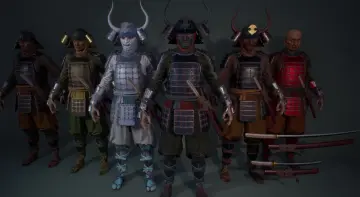
Building character variety across an entire campaign or multi-enemy encounter requires deep asset flexibility. Samurai Ichiro answers this need by supplying six fully prepared, ready-made character variations right out of the box, alongside 31 individual modular pieces that allow developers to assemble custom configurations.
These thirty-one component parts isolate armor plates, clothing layers, and structural pieces so technical artists can strip away decorative items or combine heavy plating for distinct battlefield roles. You can isolate lighter garments for an unencumbered assassin build or compile full chest, shoulder, and leg protection for an imposing shogun guardian. This modularity reduces asset redundancy across large levels, letting a single base identity generate an entire cadre of distinct fighters.
Material customization broadens this flexibility further. The surface materials can be tuned to alter the mood of the gear, adapting clean lacquered finishes into worn, battle-weathered textiles. Facial and bodily tattoos can be customized or entirely removed with a single click, allowing the mesh to pivot quickly from an arcane, marked swordsman into a conventional medieval foot soldier. The weapon complement, centering on traditional sharp katana blades, coordinates with each visual variation to ensure equipment scale matches the chosen armor silhouette.
Epic Skeleton Rigging, Proportion Offsets, and Motion Mechanics
Motion integration forms the backbone of any action character. The internal hierarchy of Samurai Ichiro matches Epic Skeleton version 4, aligning bone positions, poses, and joint structures to the standard hierarchy without adding extra bones. This clean skeleton setup keeps retargeting workflows transparent and avoids cluttering project animation trees with non-standard auxiliary joints.
An essential technical consideration lies in the physical proportions of the model. While the bone hierarchy mirrors Epic Skeleton v4, the actual physical proportions differ from the default mannequin. Because limb lengths and torso dimensions deviate from the baseline template, retargeted animations require specific hand adjustments. Hands will not grip weapon hilts automatically with exact precision right out of the box, making secondary animation passes or procedural hand Inverse Kinematics (IK) fixes necessary inside your animation blueprints.
Demonstrations utilizing the Advanced Locomotion System (ALS) highlight how the character translates complex locomotion states, from sprint-to-stop transitions to grounded combat stances. When handling directional dodges, foot planting, and weapon swings, the underlying skeletal alignment holds firm. Developers implementing dedicated katana movesets can rely on standard animation blueprints, provided they account for the proportional offsets at the palms and wrists to guarantee firm contact with the sword grips during two-handed strikes and sheath draws.
Deformable Cloth Physics and Mask Detailing
Fluid physical motion extends beyond skeletal animation into dynamic secondary deformation. Samurai Ichiro incorporates cloth physics across dynamic garment sections and hanging armor pieces, allowing fabrics to react naturally to rapid changes in velocity, jump arcs, and environmental wind forces.
During high-speed martial arts routines, rigid geometry can shatter visual immersion if hanging tassets or fabric sashes clip stiffly through legs during deep lunges. The integrated cloth simulation addresses this directly by softening transitions between high-impact strikes and sudden halts. When the character executes rapid spins or evades backward, the trailing elements billow and settle realistically under real-time physics calculations, amplifying the sensation of speed and momentum.
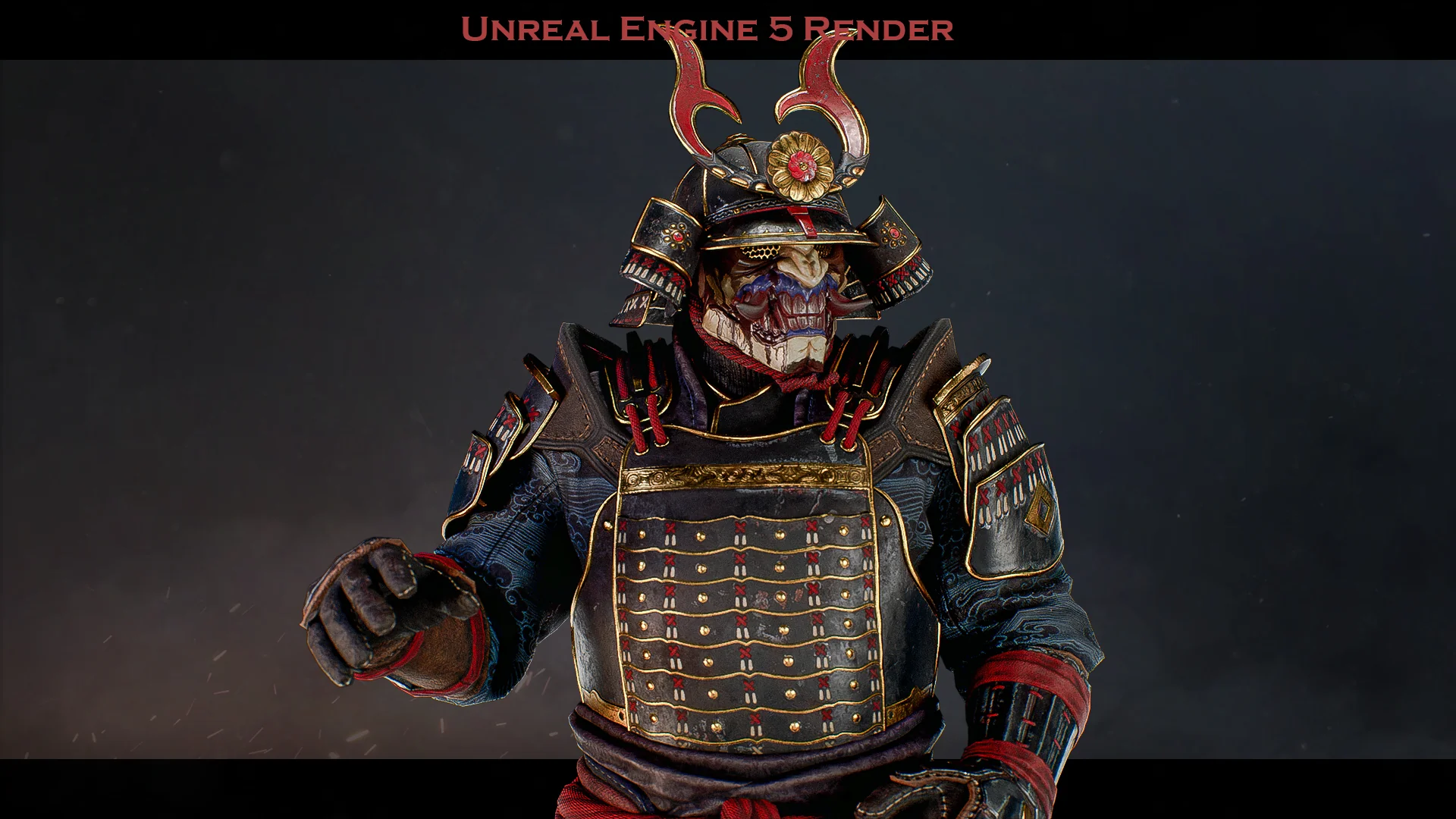
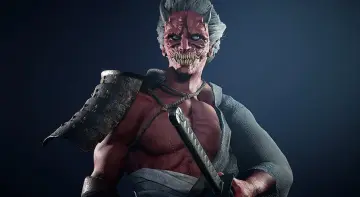
The character's signature bleeding mask anchors the upper body's visual identity. Crafted to communicate an eerie, mystical presence, the mask conceals facial features while hinting at unseen lore. The visual bleed effect pairs naturally with dark fantasy storytelling, letting creators stage unsettling boss reveals or high-stakes confrontations without needing complex decal projectors attached to the head socket.
Facial Morphs, ARKit Tracking, and Engine Visualization
Expressive dialogue scenes and nuanced cutscenes require robust blendshape solutions. Despite wearing a mask, Samurai Ichiro includes a dedicated collection of target morphs governing facial expressions and eye movements. The asset provides a set of custom blanks alongside a fully functional Apple ARKit working set, enabling live-link performance capture and detailed facial tracking.
These morph targets give animators complete control over squinting, brow furrowing, and subtle ocular direction behind or around headwear openings. Production pipelines utilizing ARKit can stream live actor facial data directly onto the rig, capturing performance nuances for narrative dialogue, grunts of exertion, or micro-expressions during cinematic face-offs.
Visual output has been proven in Unreal Engine 4.27 and Unreal Engine 5.0 utilizing Lumen lighting architectures. Real-time global illumination and indirect lighting react cleanly across the metallic sheens of the armor, the matte folds of the simulated cloth, and the blood textures on the mask. Rendering performance remains stable across dynamic daytime scenes and shadowed interior dojos, though lighting results may adjust slightly depending on custom engine exposure and post-processing setups.
Target Project Profiles and Practical Takeaways
Action titles emphasizing deliberate, precise melee combat stand to gain the most from this package. Solo creators and small development teams working on third-person action games, samurai combat sandboxes, or dark fantasy dungeon crawlers receive an immediately deployable character with rich modular depth and zero unnecessary bone bloat.
The package is equally relevant for cinematic animators and virtual production teams who rely on ARKit facial streaming and need a battle-ready Japanese warrior with authentic physics-driven garments. By pairing robust modularity with clear skeletal guidelines, Samurai Ichiro delivers an efficient base for stylized, high-stakes swordsmanship.
 Characters
 Characters
 Characters
 Characters