"7e6fc58c410f2894"{"id":"1001658","slug":"samurai-warriors","title":"Samurai Warriors","category":"Characters \u0026 Creatures","engine":"4.19+,5.0+","assetVersion":"","engineVersion":"Engine Version: 4.19+,5.0+","tag":"Characters","accent":"blue","visual":"character","summary":"Integrate Samurai Warriors with UE mannequin compatibility, NvCloth solver cloth dynamics, and modular material controls for medieval combat projects.","platform":"Unreal Engine","publishedAt":"2026-10-13T08:34:57.969Z","updatedAt":"2026-10-13T08:34:57.969Z","sourceNotes":[],"fileContents":[],"compatibility":["Unreal Engine","Engine Version: 4.19+,5.0+"],"featuredImage":{"alt":"Samurai Warriors","src":"/wp-content/uploads/published/2026/10/86ea906ffa4f-d5fb222a-187f-4a65-9e5f-6bf524e306b5-605f393566.webp"},"hasDownloadLink":true,"downloads":0,"terms":[{"taxonomy":"category","slug":"characters-and-creatures","name":"Characters \u0026 Creatures"}],"galleryImages":[{"src":"/wp-content/uploads/published/2026/10/729d5ec7db41-65136fe7-4bf5-4259-a82d-ae4f4c5cf198-2681d65a57.webp","alt":"Samurai Warriors"},{"src":"/wp-content/uploads/published/2026/10/76ed314d4d57-f8b6550a-bb2c-4557-aac9-9394c08fe34e-06d95c02fd.webp","alt":"Samurai Warriors"},{"src":"/wp-content/uploads/published/2026/10/d4b0d13645a8-1f75bdd7-c70b-44be-b1f6-c62ecad2c002-5898185bf5.webp","alt":"Samurai Warriors"},{"src":"/wp-content/uploads/published/2026/10/86df6c0e470f-03fe503b-efbb-4369-ba7c-fc36fe95a34b-7f6ba130d6.webp","alt":"Samurai Warriors"},{"src":"/wp-content/uploads/published/2026/10/90da8c795211-a85f5160-4f64-4275-bb49-19259ee1f77b-15cba2a0b0.webp","alt":"Samurai Warriors"},{"src":"/wp-content/uploads/published/2026/10/87971cd411c4-fc66290f-03ee-45d1-aead-ce9ef3b17154-aa1f79c133.webp","alt":"Samurai Warriors"},{"src":"/wp-content/uploads/published/2026/10/728773177dcd-3c091550-6ab6-40b5-96b3-4db49ddb9c28-bf9a79e669.webp","alt":"Samurai Warriors"},{"src":"/wp-content/uploads/published/2026/10/dce16d32f361-11abc14a-a4d1-4e7f-9f83-6638d9bb6a45-a6faa24570.webp","alt":"Samurai Warriors"},{"src":"/wp-content/uploads/published/2026/10/95e4f6c71881-325555dc-05ca-4e0e-8d59-7fad17ca3236-acefc89c1c.webp","alt":"Samurai Warriors"},{"src":"/wp-content/uploads/published/2026/10/d6ad51c1f72f-a5cfa8bd-9bd8-42f0-a58a-a8bc0b67245b-8e02cb2e4f.webp","alt":"Samurai Warriors"}],"accessPanel":{"kind":"resource","title":"Download this resource","eyebrow":"Free Download","message":"Log in or create a free account to start your download.","fileName":"Content.7z","safetyNote":"Resources are manually reviewed before listing to improve quality and reduce obvious risks.","actionLabel":"Download Free","resourceType":"Resource archive"},"contentHtml":"\u003ch2\u003eRapid Integration with the UE Mannequin Rig\u003c/h2\u003e\n\u003cp\u003eDeploying a stylized or realistic combat character into an active project often stalls during skeleton retargeting and socket alignment. Samurai Warriors addresses this friction directly by maintaining full structural compatibility with the standard UE mannequin. Because the skeletal hierarchy matches the default mannequin layout, importing the mesh and assigning existing movement states, walk blends, and combat trees takes only seconds to execute.\u003c/p\u003e\n\u003cp\u003eProjects shaped by third-party combat mechanics, such as the Close Combat: Swordsman framework from the Unreal Engine ecosystem, can adopt the character immediately. Motion states, directional dodges, heavy impacts, and precision strikes translate across the bone hierarchy without requiring custom joint remapping or hand-authored retargeting configurations. This native alignment ensures that whether an action game uses root motion attacks or standard in-place locomotion blends, the mesh binds cleanly to the incoming pose data.\u003c/p\u003e\n\u003cp\u003eSetting up the character involves standard assignment inside an Animation Blueprint. Developers working within established gameplay scripts can drop the character model into existing player or non-player character controller classes, wire in the locomotion state machine, and instantly evaluate how the proportions handle high-velocity swordplay.\u003c/p\u003e \u003ch2\u003eNvCloth Solver Setup for Dynamic Samurai Fabrics\u003c/h2\u003e\n\u003cp\u003eCombat animation requires cloth movement that reacts convincingly to sudden acceleration, rotational inertia, and rapid changes of direction. Samurai Warriors incorporates dynamic fabric elements configured directly around the modern NvCloth solver. Rather than relying entirely on static skinning or rigid socket attachments for hanging garments, the cloth parts are fully rigged and pre-configured for dynamic solver simulation.\u003c/p\u003e\n\u003cp\u003eThis implementation ensures that loose garments, robes, and flexible armor sections yield naturally to physical forces during locomotion and heavy weapon swings. When a warrior transitions from an idle stance into an aggressive forward dash, the cloth solver calculates momentum and secondary motion automatically. The rigging underlying these cloth components prevents unnatural stretching while keeping fabric geometry clear of underlying armor plates.\u003c/p\u003e\n\u003cp\u003eOperating on the NvCloth framework also ensures predictable physical simulation across real-time scenarios. The cloth comes pre-bound and ready to go out of the box, removing the tedious stage of painting vertex physics weights, setting backstop constraints, or tuning collision volumes against character limbs from scratch.\u003c/p\u003e \u003ch2\u003eAdvanced Material Customization Across Armor and Body Parts\u003c/h2\u003e\n\u003cp\u003eMaintaining visual diversity across multiple combatants is critical when building encounters involving several allied or enemy warriors. The character setup features an advanced Material system engineered specifically to alter surface identity and distinguish individual fighters across a scene.\u003c/p\u003e\n\u003cp\u003eCustomization is handled by isolating each body and armor part. Developers can adjust individual material parameters across distinct segments of the armor assembly without forcing uniform changes across the entire figure. This separation makes it possible to modify color palettes, surface finishes, and aesthetic details on a helmet, chest plate, or shoulder guard while leaving adjacent undergarments untouched.\u003c/p\u003e\n\u003cp\u003eThis component-by-component material framework supports multiple creative directions, including:\u003c/p\u003e\n\u003cul\u003e\n\u003cli\u003eGenerating high-contrast visual hierarchies between squad leaders, elite warriors, and rank-and-file infantry using targeted material edits.\u003c/li\u003e\n\u003cli\u003eAdapting armor finishes to match grounded historical realism or heightened medieval fantasy settings.\u003c/li\u003e\n\u003cli\u003eDifferentiating duplicated combatants in crowded melee arenas by re-tinting specific body sections.\u003c/li\u003e\n\u003cli\u003eAdjusting material response on select armor pieces to evoke varied stages of wear, polish, or environmental exposure.\u003c/li\u003e\n\u003c/ul\u003e\n\u003cp\u003eBecause the material structure is modularized, adjustments remain lightweight and isolated, preventing unwanted texture bleed or mismatched shading across adjacent panels of the armor assembly.\u003c/p\u003e \u003ch2\u003eEquipping Included Weapon Assets and Animation Blueprints\u003c/h2\u003e\n\u003cp\u003eA combat model requires matching gear to function in an active game environment. The package includes two dedicated weapon assets alongside the core warrior mesh, providing immediate offensive equipment ready for socketing and hand-grip alignment. These weapons match the aesthetic direction of the armor pieces, ensuring that when the character is armed, the entire visual presentation remains cohesive.\u003c/p\u003e\n\u003cp\u003eConnecting the weapons to the character requires assigning them to the standard hand sockets of the UE mannequin skeleton. Because the bone layout conforms to engine conventions, standard weapon attachment nodes in an Animation Blueprint or character setup script locate their targets instantly. Tracing sockets, weapon collision volumes, and trail effects can be configured directly onto the weapon geometry without adjusting the character mesh itself.\u003c/p\u003e\n\u003cp\u003eThe synergy between the rigged character, the animation blueprint readiness, and the dedicated weapons allows complete combat loops to be established rapidly. From sheath draws to full combo sequences, the included items eliminate the need to hunt down external weapon models with mismatched scales or offset origins.\u003c/p\u003e \u003ch2\u003eProduction Readiness for Medieval Combat Projects\u003c/h2\u003e\n\u003cp\u003eWhether targeting realistic historical battles or stylized fantasy encounters, developers building action games require assets that balance technical compliance with aesthetic adaptability. The combination of UE mannequin compatibility, integrated NvCloth solver dynamics, independent material channels, and dedicated melee weapons positions Samurai Warriors as a fully functional character asset ready for production pipelines.\u003c/p\u003e\n\u003cp\u003eBy streamlining implementation steps down to standard blueprint assignments and immediate socketing, the character minimizes preparation time and lets gameplay designers focus directly on combat pacing, hit reactions, and encounter tuning.\u003c/p\u003e\n\n\u003ch2\u003eMore From The Same Workflow\u003c/h2\u003e\n\u003cul\u003e\n\u003cli\u003e\u003ca href=\"https://3dcghub.com/samurai-girl/\" title=\"Samurai Girl\"\u003eSamurai Girl\u003c/a\u003e\u003c/li\u003e\n\u003cli\u003e\u003ca href=\"https://3dcghub.com/asian-armour-metahuman/\" title=\"Asian Armour - Metahuman\"\u003eAsian Armour - Metahuman\u003c/a\u003e\u003c/li\u003e\n\u003cli\u003e\u003ca href=\"https://3dcghub.com/light-warrior/\" title=\"Light Warrior\"\u003eLight Warrior\u003c/a\u003e\u003c/li\u003e\n\u003cli\u003e\u003ca href=\"https://3dcghub.com/amazonian-warrior-girl/\" title=\"Amazonian warrior girl\"\u003eAmazonian warrior girl\u003c/a\u003e\u003c/li\u003e\n\u003cli\u003e\u003ca href=\"https://3dcghub.com/hero-mercenary-warrior/\" title=\"Hero Mercenary Warrior\"\u003eHero Mercenary Warrior\u003c/a\u003e\u003c/li\u003e\n\u003c/ul\u003e","contentTextLength":6238,"navigation":{"current":24,"total":3618,"previous":{"id":"1001659","slug":"sci-fi-space-soldier-female","title":"Sci Fi Space Soldier Female","category":"Characters \u0026 Creatures","platform":"Unreal Engine","updatedAt":"2026-10-13T14:48:21.104Z"},"next":{"id":"1001657","slug":"runesvfx","title":"RunesVFX","category":"Variety","platform":"Unreal Engine","updatedAt":"2026-10-13T08:34:19.182Z"}},"relatedResources":[{"id":"3342","slug":"samurai-girl","title":"Samurai Girl","category":"Characters \u0026 Creatures","engine":"4.26,5.0+","assetVersion":"Engine version: 4.26,5.0+","engineVersion":"4.21","tag":"Characters","accent":"blue","visual":"character","summary":"Enhance your project with this realistic Samurai Girl 3D model. Features 4K PBR textures, Epic Skeleton rigging, and modular meshes for maximum flexibility.","platform":"Unreal Engine","publishedAt":"2026-02-09T06:42:24.000Z","updatedAt":"2026-04-19T15:57:39.000Z","sourceNotes":[],"fileContents":[],"compatibility":["Unreal Engine","Engine version: 4.26,5.0+"],"featuredImage":{"alt":"Samurai Girl","src":"https://3dcghub.com/wp-content/uploads/2026/02/79b7de26-5b71-4d6b-93cc-8ff9cec51529.webp"},"hasDownloadLink":true,"downloads":0},{"id":"1650","slug":"asian-armour-metahuman","title":"Asian Armour - Metahuman","category":"Characters \u0026 Creatures","engine":"5.3+","assetVersion":"Engine version: 5.3+","engineVersion":"5.0","tag":"Characters","accent":"blue","visual":"character","summary":"Enhance your Unreal Engine project with the Asian Armour Pack. Featuring modular Chinese, Mongolian, and Samurai gear compatible with MetaHuman and UE5.","platform":"Unreal Engine","publishedAt":"2026-02-06T20:17:02.000Z","updatedAt":"2026-04-19T15:58:07.000Z","sourceNotes":[],"fileContents":[],"compatibility":["Unreal Engine","Engine version: 5.3+"],"featuredImage":{"alt":"Asian Armour - Metahuman","src":"https://3dcghub.com/wp-content/uploads/2026/02/47250ceb-dbcc-48c4-a64e-85f096544bda.webp"},"hasDownloadLink":true,"downloads":7},{"id":"1001674","slug":"viking-warriors","title":"Viking Warriors","category":"Characters \u0026 Creatures","engine":"4.19+,5.0+","assetVersion":"","engineVersion":"Engine Version: 4.19+,5.0+","tag":"Characters","accent":"blue","visual":"character","summary":"Viking Warriors brings modular material customization, APEX cloth physics, combat weapons, and seamless Unreal Engine mannequin compatibility into real-time pro","platform":"Unreal Engine","publishedAt":"2026-10-13T15:22:48.715Z","updatedAt":"2026-10-13T15:22:48.715Z","sourceNotes":[],"fileContents":[],"compatibility":["Unreal Engine","Engine Version: 4.19+,5.0+"],"featuredImage":{"alt":"Viking Warriors","src":"/wp-content/uploads/published/2026/10/42eef3ea8f03-e62a40b7-e5d1-408b-80e1-bfb7b5904e73-740805dff2.webp"},"hasDownloadLink":true,"downloads":0}]}
Characters
Samurai Warriors
Integrate Samurai Warriors with UE mannequin compatibility, NvCloth solver cloth dynamics, and modular material controls for medieval combat projects.
Deploying a stylized or realistic combat character into an active project often stalls during skeleton retargeting and socket alignment. Samurai Warriors addresses this friction directly by maintaining full structural compatibility with the standard UE mannequin. Because the skeletal hierarchy matches the default mannequin layout, importing the mesh and assigning existing movement states, walk blends, and combat trees takes only seconds to execute.
Projects shaped by third-party combat mechanics, such as the Close Combat: Swordsman framework from the Unreal Engine ecosystem, can adopt the character immediately. Motion states, directional dodges, heavy impacts, and precision strikes translate across the bone hierarchy without requiring custom joint remapping or hand-authored retargeting configurations. This native alignment ensures that whether an action game uses root motion attacks or standard in-place locomotion blends, the mesh binds cleanly to the incoming pose data.
Setting up the character involves standard assignment inside an Animation Blueprint. Developers working within established gameplay scripts can drop the character model into existing player or non-player character controller classes, wire in the locomotion state machine, and instantly evaluate how the proportions handle high-velocity swordplay.
NvCloth Solver Setup for Dynamic Samurai Fabrics
Combat animation requires cloth movement that reacts convincingly to sudden acceleration, rotational inertia, and rapid changes of direction. Samurai Warriors incorporates dynamic fabric elements configured directly around the modern NvCloth solver. Rather than relying entirely on static skinning or rigid socket attachments for hanging garments, the cloth parts are fully rigged and pre-configured for dynamic solver simulation.
This implementation ensures that loose garments, robes, and flexible armor sections yield naturally to physical forces during locomotion and heavy weapon swings. When a warrior transitions from an idle stance into an aggressive forward dash, the cloth solver calculates momentum and secondary motion automatically. The rigging underlying these cloth components prevents unnatural stretching while keeping fabric geometry clear of underlying armor plates.
Operating on the NvCloth framework also ensures predictable physical simulation across real-time scenarios. The cloth comes pre-bound and ready to go out of the box, removing the tedious stage of painting vertex physics weights, setting backstop constraints, or tuning collision volumes against character limbs from scratch.
Advanced Material Customization Across Armor and Body Parts
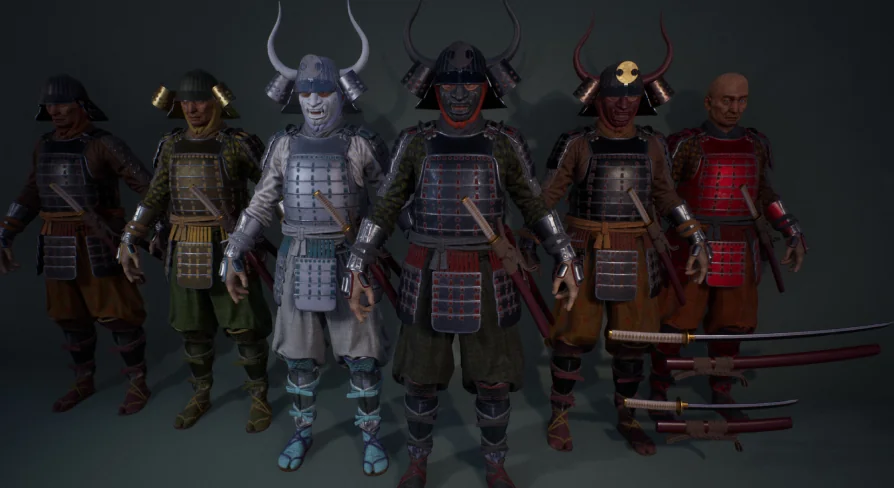
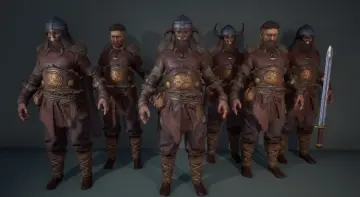
Maintaining visual diversity across multiple combatants is critical when building encounters involving several allied or enemy warriors. The character setup features an advanced Material system engineered specifically to alter surface identity and distinguish individual fighters across a scene.
Customization is handled by isolating each body and armor part. Developers can adjust individual material parameters across distinct segments of the armor assembly without forcing uniform changes across the entire figure. This separation makes it possible to modify color palettes, surface finishes, and aesthetic details on a helmet, chest plate, or shoulder guard while leaving adjacent undergarments untouched.
This component-by-component material framework supports multiple creative directions, including:
Generating high-contrast visual hierarchies between squad leaders, elite warriors, and rank-and-file infantry using targeted material edits.
Adapting armor finishes to match grounded historical realism or heightened medieval fantasy settings.
Differentiating duplicated combatants in crowded melee arenas by re-tinting specific body sections.
Adjusting material response on select armor pieces to evoke varied stages of wear, polish, or environmental exposure.
Because the material structure is modularized, adjustments remain lightweight and isolated, preventing unwanted texture bleed or mismatched shading across adjacent panels of the armor assembly.
Equipping Included Weapon Assets and Animation Blueprints
A combat model requires matching gear to function in an active game environment. The package includes two dedicated weapon assets alongside the core warrior mesh, providing immediate offensive equipment ready for socketing and hand-grip alignment. These weapons match the aesthetic direction of the armor pieces, ensuring that when the character is armed, the entire visual presentation remains cohesive.
Connecting the weapons to the character requires assigning them to the standard hand sockets of the UE mannequin skeleton. Because the bone layout conforms to engine conventions, standard weapon attachment nodes in an Animation Blueprint or character setup script locate their targets instantly. Tracing sockets, weapon collision volumes, and trail effects can be configured directly onto the weapon geometry without adjusting the character mesh itself.
The synergy between the rigged character, the animation blueprint readiness, and the dedicated weapons allows complete combat loops to be established rapidly. From sheath draws to full combo sequences, the included items eliminate the need to hunt down external weapon models with mismatched scales or offset origins.
Production Readiness for Medieval Combat Projects
Whether targeting realistic historical battles or stylized fantasy encounters, developers building action games require assets that balance technical compliance with aesthetic adaptability. The combination of UE mannequin compatibility, integrated NvCloth solver dynamics, independent material channels, and dedicated melee weapons positions Samurai Warriors as a fully functional character asset ready for production pipelines.
By streamlining implementation steps down to standard blueprint assignments and immediate socketing, the character minimizes preparation time and lets gameplay designers focus directly on combat pacing, hit reactions, and encounter tuning.
 Characters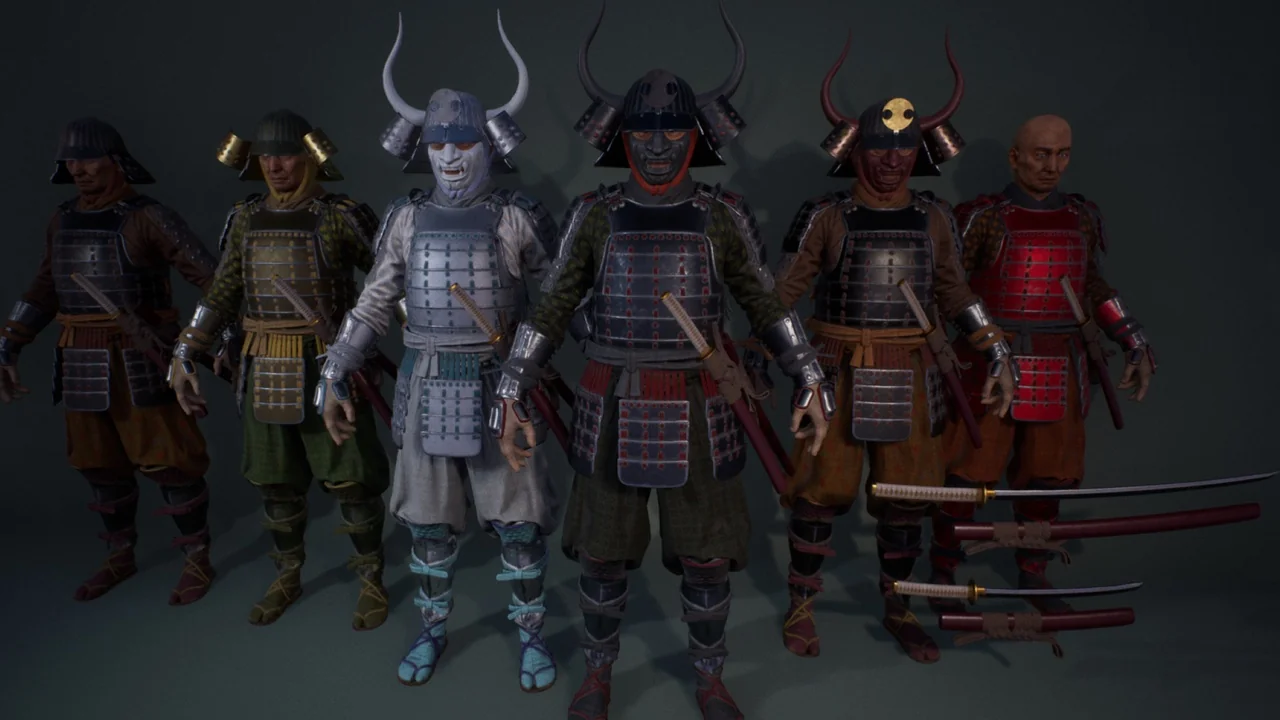
 Characters
 Characters
 Characters