"6989f03aa91a233c"{"id":"1000008","slug":"fps-devices","title":"FPS Devices","category":"Characters \u0026 Creatures","engine":"4.18","assetVersion":"","engineVersion":"4.18","tag":"Characters","accent":"blue","visual":"character","summary":"A technical breakdown of the FPS Devices collection, detailing the 75 in-place animations, 4K PBR texture pipelines, and geometry profiling for first-person rig","platform":"Unreal Engine","publishedAt":"2026-05-19T17:09:09.418Z","updatedAt":"2026-05-19T17:09:09.418Z","sourceNotes":[],"fileContents":[],"compatibility":["Unreal Engine","Engine version: 4.18"],"featuredImage":{"alt":"FPS Devices","src":"/wp-content/uploads/published/2026/05/4409822079ba-6d47b516-50da-4822-8dd1-ed7c0ddb0cf5-c4ebe2cd35.webp"},"hasDownloadLink":true,"downloads":1,"terms":[{"taxonomy":"category","slug":"characters-and-creatures","name":"Characters \u0026 Creatures"}],"galleryImages":[{"src":"/wp-content/uploads/published/2026/05/12770e14a59b-681f455b-6294-489f-a11e-8a2dc8891820-3f05ab1d00.webp","alt":"FPS Devices"},{"src":"/wp-content/uploads/published/2026/05/efebf75e8a78-37b9862e-0e2a-4d9d-88dd-610ec2194410-9709c98ab0.webp","alt":"FPS Devices"},{"src":"/wp-content/uploads/published/2026/05/9919cc164727-9d607e97-c0a0-4e4d-905a-b6b882f2e02c-76a76d0dc5.webp","alt":"FPS Devices"},{"src":"/wp-content/uploads/published/2026/05/8908e2705718-f8f47e05-6b17-4d11-a829-b280b1f12b71-8d354d6b67.webp","alt":"FPS Devices"},{"src":"/wp-content/uploads/published/2026/05/b00bf899d04f-dce7b365-8993-4ad5-b137-8d287c764d61-86479add5f.webp","alt":"FPS Devices"}],"accessPanel":{"kind":"resource","title":"Access this resource","eyebrow":"Free Download","message":"Log in or create a free account to start your download.","fileName":"Content.7z","safetyNote":"Resources are manually reviewed before listing to improve quality and reduce obvious risks.","actionLabel":"Download Free","resourceType":"Resource archive"},"contentHtml":"\u003ch2\u003eFirst-Person Screen Attachment for FPS Devices\u003c/h2\u003e\u003cp\u003eIntegrating the FPS Devices requires a hands-on approach to screen interactivity and material setup. The collection provides a framework of five specific tools—a tablet, camera, phone, listening device, and walkie talkie—built exclusively for first-person viewpoints. The models themselves operate as visual foundations rather than plug-and-play interactive blueprints. The screens on the phone, tablet, and camera do not contain pre-configured interactivity, built-in UI menus, or embedded video playback systems. Developers must manually route their own render targets, widget components, or video player textures to the device screens.\u003c/p\u003e\u003cp\u003eThis blank-slate approach ensures the tools integrate cleanly into existing project architectures, allowing developers testing in Unity or UE4 to treat the device displays as standard material slots tailored to their specific gameplay needs.\u003c/p\u003e\u003ch2\u003eIn-Place Locomotion State Machines\u003c/h2\u003e\u003cp\u003eDriving the movement of these tools is a library of 75 first-person animations. Because these animations are authored entirely in-place, the underlying character controller handles all world-space translation, preventing unwanted root-motion drift during traversal. A core set of locomotion states ensures characters can navigate the environment smoothly while holding any of the five devices.\u003c/p\u003e\u003cp\u003eThe jumping sequence for every item is segmented into three distinct phases: Jump Start, Jump Loop, and Jump End. This modular breakdown allows developers to blend the arm movements precisely with the physics engine’s airborne states. Standard grounded movement is supported by Run and Walk cycles. To prevent repetitive visual patterns during extended travel, the phone, listening device, and walkie talkie include split animations for these states, providing Walk 01, Walk 02, Run 01, and Run 02 variations that can be randomized or tied to different movement speeds.\u003c/p\u003e\u003ch2\u003eDevice-Specific Action and Combat Rigging\u003c/h2\u003e\u003cp\u003eBeyond basic locomotion, the devices carry unique action animations tailored to their mechanical functions. The phone features dedicated media playback states, categorized precisely into Video Start, Video Loop, and Video End, alongside general Action and Action Idle sequences. The camera mirrors this functionality with its own Video, Walk, and Watching Video animations, giving developers the rigging required to build photography or reconnaissance mechanics. For communication scenarios, the walkie talkie is equipped with a specific Talk animation, supported by three distinct idle loops (Idle 01, Idle 02, Idle 03).\u003c/p\u003e\u003cp\u003eThe tablet and listening device introduce aggressive or combat-ready movements into the animation pool. The tablet includes four distinct attack animations (Attack 01, Attack 02, Attack 03, Attack 04), allowing the character to execute melee strikes or forceful interactions without needing to swap to a dedicated weapon. The listening device also includes Attack 01 and Attack 02 states, alongside multiple idle variations including Idle 01, Idle 02, and Idle Other. Across the entire hardware lineup, developers have access to standard handling animations. Every device includes a Get animation for equipping, a Hide animation for holstering, and a Get Hit animation, which provides immediate visual feedback for damage events without forcing the player to unequip the active tool.\u003c/p\u003e\u003ch2\u003e4K PBR Texture Allocation and Emissive Mapping\u003c/h2\u003e\u003cp\u003eVisual fidelity for the hardware is maintained through a strict, high-resolution PBR texture pipeline. Every piece of equipment relies on a core set of maps—Albedo, Ambient Occlusion (AO), Metallic, and Normal—all authored at a 4096x4096 resolution. This 4K standard is particularly critical for first-person meshes, as the geometry sits extremely close to the virtual camera where lower-resolution textures would easily pixelate.\u003c/p\u003e\u003cp\u003eThe phone and tablet offer the highest degree of out-of-the-box visual variety, each including four distinct Albedo maps to support different color schemes or casing styles. The listening device and walkie talkie include three Albedo variations each, while the camera utilizes a single Albedo map.\u003c/p\u003e\u003cp\u003eLighting behavior is further defined by Emissive mapping, which is selectively applied based on the hardware characteristics of the tools. The camera, listening device, and phone include Emissive maps at the standard 4096x4096 size, providing the necessary material glow for indicator lights, active buttons, or illuminated lenses. The tablet and walkie talkie omit Emissive maps entirely, relying strictly on the standard PBR channels to define their surface properties.\u003c/p\u003e\u003ch2\u003eGeometry Profiling for the Walkie Talkie, Camera, and Phones\u003c/h2\u003e\u003cp\u003eThe polygon density of the devices scales directly with their mechanical complexity. The phone and tablet represent the most lightweight assets in the collection. The phone consists of 1,698 polygons, 3,168 triangles, and 1,630 vertices. The tablet maintains a very similar footprint with 1,807 polygons, 3,230 triangles, and 1,642 vertices, making both flat-screen devices highly efficient to render.\u003c/p\u003e\u003cp\u003eThe camera and walkie talkie occupy the mid-range of geometric detail. The camera requires 4,130 polygons, 7,899 triangles, and 4,280 vertices to accurately define its cylindrical lenses and body housing. The walkie talkie sits at a comparable density, featuring 4,319 polygons, 8,035 triangles, and 4,618 vertices.\u003c/p\u003e\u003cp\u003eThe listening device stands out as the most geometrically dense model in the pack, utilizing 9,656 polygons, 18,368 triangles, and 9,663 vertices to support the intricate structural details required for specialized audio hardware.\u003c/p\u003e\n\n\u003ch2\u003eMore From The Same Workflow\u003c/h2\u003e\n\u003cul\u003e\n\u003cli\u003e\u003ca href=\"https://3dcghub.com/first-person-base-arms-vol-1-skinny-male/\" title=\"First Person Base Arms Vol. 1 - Skinny Male\"\u003eFirst Person Base Arms Vol. 1 - Skinny Male\u003c/a\u003e\u003c/li\u003e\n\u003cli\u003e\u003ca href=\"https://3dcghub.com/etasphera17/\" title=\"Etasphera17\"\u003eEtasphera17\u003c/a\u003e\u003c/li\u003e\n\u003cli\u003e\u003ca href=\"https://3dcghub.com/monster-crab/\" title=\"Monster crab\"\u003eMonster crab\u003c/a\u003e\u003c/li\u003e\n\u003cli\u003e\u003ca href=\"https://3dcghub.com/mutant-3/\" title=\"Mutant 3\"\u003eMutant 3\u003c/a\u003e\u003c/li\u003e\n\u003cli\u003e\u003ca href=\"https://3dcghub.com/big-zombie/\" title=\"Big Zombie\"\u003eBig Zombie\u003c/a\u003e\u003c/li\u003e\n\u003c/ul\u003e","contentTextLength":5749,"navigation":{"current":1479,"total":3353,"previous":{"id":"1000009","slug":"fps-sniper-rifle-03-animations","title":"FPS Sniper Rifle 03 (Animations)","category":"Combat","platform":"Unreal Engine","updatedAt":"2026-05-19T17:11:44.078Z"},"next":{"id":"1000007","slug":"foliage-vol-32-dead-forest-nanite","title":"Foliage VOL.32 - Dead Forest (Nanite)","category":"Forest","platform":"Unreal Engine","updatedAt":"2026-05-19T16:59:40.123Z"}},"relatedResources":[{"id":"1001015","slug":"shooterstarter-fps-arm-a","title":"ShooterStarter FPS Arm A","category":"Characters \u0026 Creatures","engine":"5.1+","assetVersion":"","engineVersion":"Engine Version: 5.1+","tag":"Characters","accent":"blue","visual":"character","summary":"A first-person arm and rifle set with 4K textures, LOD-based mobile optimization, and compatibility with Tactical Shooter Framework for FPS and cinematic projec","platform":"Unreal Engine","publishedAt":"2026-08-22T13:57:23.604Z","updatedAt":"2026-08-22T13:57:23.604Z","sourceNotes":[],"fileContents":[],"compatibility":["Unreal Engine","Engine Version: 5.1+"],"featuredImage":{"alt":"ShooterStarter FPS Arm A","src":"/wp-content/uploads/published/2026/08/7319995e5f9f-93732300-fb18-49f2-836a-f9d01c9b4412-69c0d5de01.webp"},"hasDownloadLink":true,"downloads":1},{"id":"1000147","slug":"animalia-leopard-young","title":"Animalia - Leopard (young)","category":"Characters \u0026 Creatures","engine":"4.26+,5.0+","assetVersion":"","engineVersion":"Engine Version: 4.26+,5.0+","tag":"Characters","accent":"blue","visual":"character","summary":"A realistic young leopard with 60 fps animations, 4K textures, root motion options, gFur support, LODs, and ragdoll setup.","platform":"Unreal Engine","publishedAt":"2026-06-18T06:44:20.152Z","updatedAt":"2026-06-18T06:44:20.152Z","sourceNotes":[],"fileContents":[],"compatibility":["Unreal Engine","Engine Version: 4.26+,5.0+"],"featuredImage":{"alt":"Animalia - Leopard (young)","src":"/wp-content/uploads/published/2026/06/840511946ba8-2afc0d62-9b01-4293-b83c-f9b2d7d0101f-81df9aea17.webp"},"hasDownloadLink":true,"downloads":0},{"id":"2296","slug":"etasphera17","title":"Etasphera17","category":"Characters \u0026 Creatures","engine":"4.26+,5.0+","assetVersion":"Engine version: 4.26+,5.0+","engineVersion":"4.18","tag":"Characters","accent":"blue","visual":"character","summary":"Discover Etasphera17, a versatile low poly android character for RPG, FPS, and strategy games. Features 4K textures, rigging, and modular design for developers.","platform":"Unreal Engine","publishedAt":"2026-02-07T08:58:13.000Z","updatedAt":"2026-04-19T15:58:03.000Z","sourceNotes":[],"fileContents":[],"compatibility":["Unreal Engine","Engine version: 4.26+,5.0+"],"featuredImage":{"alt":"Etasphera17","src":"https://3dcghub.com/wp-content/uploads/2026/02/3f0cab86-b767-43af-b749-b371aefa5f92.webp"},"hasDownloadLink":true,"downloads":1}]}
Characters
FPS Devices
A technical breakdown of the FPS Devices collection, detailing the 75 in-place animations, 4K PBR texture pipelines, and geometry profiling for first-person rig
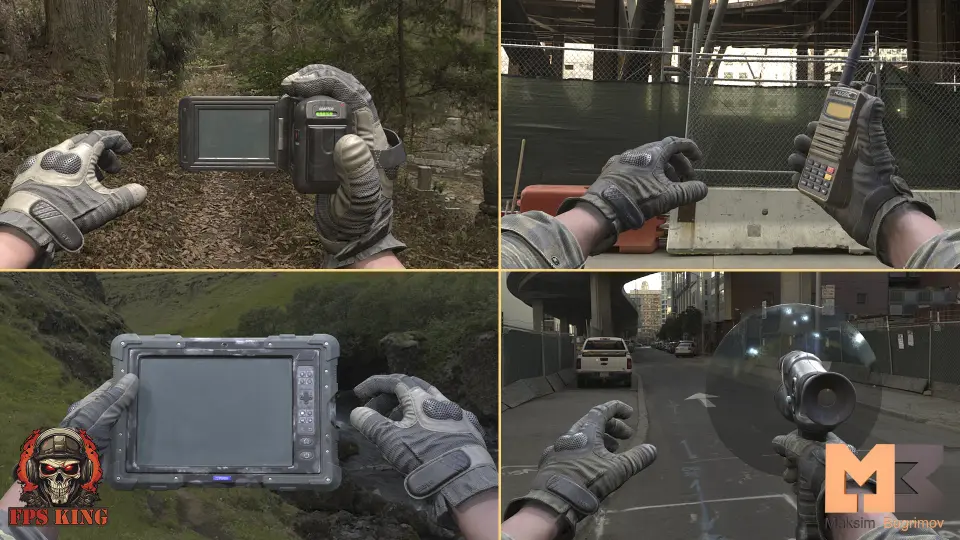
Integrating the FPS Devices requires a hands-on approach to screen interactivity and material setup. The collection provides a framework of five specific tools—a tablet, camera, phone, listening device, and walkie talkie—built exclusively for first-person viewpoints. The models themselves operate as visual foundations rather than plug-and-play interactive blueprints. The screens on the phone, tablet, and camera do not contain pre-configured interactivity, built-in UI menus, or embedded video playback systems. Developers must manually route their own render targets, widget components, or video player textures to the device screens.
This blank-slate approach ensures the tools integrate cleanly into existing project architectures, allowing developers testing in Unity or UE4 to treat the device displays as standard material slots tailored to their specific gameplay needs.
In-Place Locomotion State Machines
Driving the movement of these tools is a library of 75 first-person animations. Because these animations are authored entirely in-place, the underlying character controller handles all world-space translation, preventing unwanted root-motion drift during traversal. A core set of locomotion states ensures characters can navigate the environment smoothly while holding any of the five devices.
The jumping sequence for every item is segmented into three distinct phases: Jump Start, Jump Loop, and Jump End. This modular breakdown allows developers to blend the arm movements precisely with the physics engine’s airborne states. Standard grounded movement is supported by Run and Walk cycles. To prevent repetitive visual patterns during extended travel, the phone, listening device, and walkie talkie include split animations for these states, providing Walk 01, Walk 02, Run 01, and Run 02 variations that can be randomized or tied to different movement speeds.
Device-Specific Action and Combat Rigging
Beyond basic locomotion, the devices carry unique action animations tailored to their mechanical functions. The phone features dedicated media playback states, categorized precisely into Video Start, Video Loop, and Video End, alongside general Action and Action Idle sequences. The camera mirrors this functionality with its own Video, Walk, and Watching Video animations, giving developers the rigging required to build photography or reconnaissance mechanics. For communication scenarios, the walkie talkie is equipped with a specific Talk animation, supported by three distinct idle loops (Idle 01, Idle 02, Idle 03).
The tablet and listening device introduce aggressive or combat-ready movements into the animation pool. The tablet includes four distinct attack animations (Attack 01, Attack 02, Attack 03, Attack 04), allowing the character to execute melee strikes or forceful interactions without needing to swap to a dedicated weapon. The listening device also includes Attack 01 and Attack 02 states, alongside multiple idle variations including Idle 01, Idle 02, and Idle Other. Across the entire hardware lineup, developers have access to standard handling animations. Every device includes a Get animation for equipping, a Hide animation for holstering, and a Get Hit animation, which provides immediate visual feedback for damage events without forcing the player to unequip the active tool.
4K PBR Texture Allocation and Emissive Mapping
Visual fidelity for the hardware is maintained through a strict, high-resolution PBR texture pipeline. Every piece of equipment relies on a core set of maps—Albedo, Ambient Occlusion (AO), Metallic, and Normal—all authored at a 4096x4096 resolution. This 4K standard is particularly critical for first-person meshes, as the geometry sits extremely close to the virtual camera where lower-resolution textures would easily pixelate.
The phone and tablet offer the highest degree of out-of-the-box visual variety, each including four distinct Albedo maps to support different color schemes or casing styles. The listening device and walkie talkie include three Albedo variations each, while the camera utilizes a single Albedo map.
Lighting behavior is further defined by Emissive mapping, which is selectively applied based on the hardware characteristics of the tools. The camera, listening device, and phone include Emissive maps at the standard 4096x4096 size, providing the necessary material glow for indicator lights, active buttons, or illuminated lenses. The tablet and walkie talkie omit Emissive maps entirely, relying strictly on the standard PBR channels to define their surface properties.
Geometry Profiling for the Walkie Talkie, Camera, and Phones
The polygon density of the devices scales directly with their mechanical complexity. The phone and tablet represent the most lightweight assets in the collection. The phone consists of 1,698 polygons, 3,168 triangles, and 1,630 vertices. The tablet maintains a very similar footprint with 1,807 polygons, 3,230 triangles, and 1,642 vertices, making both flat-screen devices highly efficient to render.
The camera and walkie talkie occupy the mid-range of geometric detail. The camera requires 4,130 polygons, 7,899 triangles, and 4,280 vertices to accurately define its cylindrical lenses and body housing. The walkie talkie sits at a comparable density, featuring 4,319 polygons, 8,035 triangles, and 4,618 vertices.
The listening device stands out as the most geometrically dense model in the pack, utilizing 9,656 polygons, 18,368 triangles, and 9,663 vertices to support the intricate structural details required for specialized audio hardware.
 Characters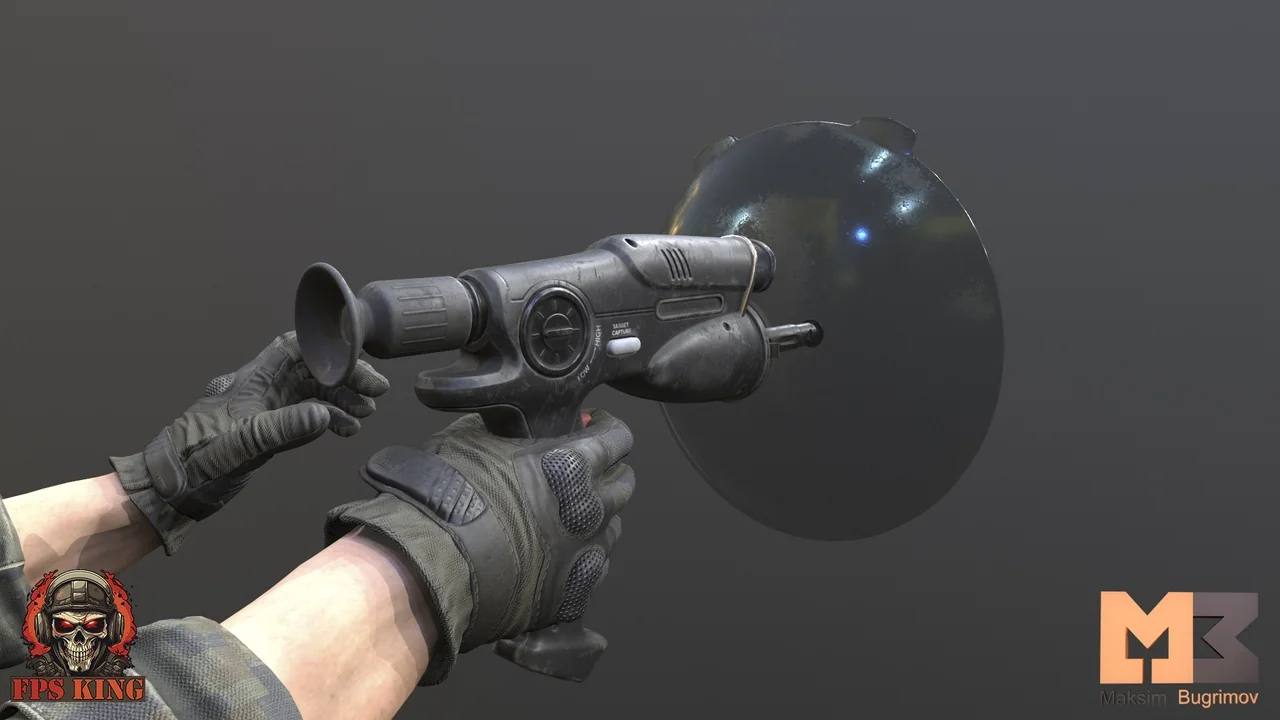
 Characters
 Characters
 Characters