"fb5ea1e7d1b41445"{"id":"1002415","slug":"teacher","title":"Teacher","category":"Characters \u0026 Creatures","engine":"5.1+","assetVersion":"","engineVersion":"Engine Version: 5.1+","tag":"Characters","accent":"blue","visual":"character","summary":"Examine the Teacher 3D anime character asset, featuring modular meshes, Apple AR blendshapes, PBR materials, and complete polycount breakdowns.","platform":"Unreal Engine","indexPolicy":"index","publishedAt":"2026-11-10T13:09:54.962Z","updatedAt":"2026-11-10T13:09:54.962Z","sourceNotes":[],"fileContents":[],"compatibility":["Unreal Engine","Engine Version: 5.1+"],"featuredImage":{"alt":"Teacher","src":"/wp-content/uploads/published/2026/11/82d2f07828f2-9014522c-2c5f-4829-88f6-0b5859008f56-b3e5c5198b.webp"},"hasDownloadLink":true,"downloads":0,"terms":[{"taxonomy":"category","slug":"characters-and-creatures","name":"Characters \u0026 Creatures"}],"galleryImages":[{"src":"/wp-content/uploads/published/2026/11/deb3e11a2383-e1687f10-cac0-495c-ae7e-3d22aee979de-c39cd42f22.webp","alt":"Teacher"},{"src":"/wp-content/uploads/published/2026/11/22a96078d5f9-47247440-234d-4243-9239-5dea96315cf9-5f6eee42e6.webp","alt":"Teacher"},{"src":"/wp-content/uploads/published/2026/11/aaada2f21b2d-3f819006-6acf-4ab7-9e65-4ba8327a0709-8bbdc9c976.webp","alt":"Teacher"},{"src":"/wp-content/uploads/published/2026/11/e899362fc805-e922eb7f-a99b-4dff-bee5-7f074dcdab8d-e2773a482e.webp","alt":"Teacher"},{"src":"/wp-content/uploads/published/2026/11/adcfb9b298ad-d3da44c5-6085-4361-8e55-b04c2f41dfce-bcec22f32c.webp","alt":"Teacher"},{"src":"/wp-content/uploads/published/2026/11/62c226142ec3-c85fefa5-b918-486e-9fa6-d5586a88979e-ae7f6ec0cc.webp","alt":"Teacher"},{"src":"/wp-content/uploads/published/2026/11/1872fe0dedfd-f7565505-5d41-4301-b749-5ca22794f66c-2f32ed49d9.webp","alt":"Teacher"},{"src":"/wp-content/uploads/published/2026/11/58daccef58f6-fd637b6c-7836-4fb5-b54a-71c69c67e77e-f609f7d532.webp","alt":"Teacher"},{"src":"/wp-content/uploads/published/2026/11/aaf821de55c3-7dbfbcc8-621e-4d14-b8e9-019324059c21-ae0cf08d97.webp","alt":"Teacher"},{"src":"/wp-content/uploads/published/2026/11/f1484d1857bc-b59b564f-b498-46ec-9d6e-ac208c20c5dd-3bf1a4f761.webp","alt":"Teacher"}],"accessPanel":{"kind":"resource","title":"Get this resource","eyebrow":"Free resource","message":"Download this resource in your browser.","fileName":"Content.7z","safetyNote":"Resources are manually reviewed before listing to improve quality and reduce obvious risks.","actionLabel":"Get this resource","resourceType":"Resource archive","versions":[]},"contentHtml":"\u003ch2\u003eStaging the Teacher Character in School and Office Environments\u003c/h2\u003e\u003cp\u003eAcademic facilities, modern classrooms, university lecture halls, and administrative offices require character models that clearly reflect their professional context while matching specific visual stylings. The Teacher asset delivers an Asian female character stylized in an anime aesthetic, built directly to populate educational spaces, institutional scenes, and workplace narratives. Whether serving as the central protagonist of a campus-driven story or operating in the background as a reliable non-player character guiding classroom activities, the model fits into scenarios demanding formal or semi-formal academic dress.\u003c/p\u003e\u003cp\u003eBecause the character includes both an office costume and an underlying base structure, it supports narrative scenes that move beyond static lecterns. Cutscenes depicting faculty meetings, private student consultations, or after-hours grading sessions benefit from a figure modeled to blend formal professionalism with expressive character art. Having a dedicated costume suited for instructional roles eliminates the need to adapt generic modern attire to academic requirements, letting developers stage authentic school routines right away.\u003c/p\u003e\u003ch2\u003eMesh Topology and Geometry Across Teacher Variants\u003c/h2\u003e\u003cp\u003eReal-time technical pipelines depend on precise geometric budgets to maintain high frame rates across cutscenes and gameplay. The Teacher model is organized into distinct mesh configurations, allowing developers to optimize geometry based on camera proximity and current scene requirements. When fully assembled, the complete set reaches 60,637 vertices and 90,478 triangles. This density delivers smooth silhouettes across modern rendering engines while capturing the fine folds of tailored clothing and stylized hair strands.\u003c/p\u003e\u003cp\u003eFor modular workflows, the geometry divides cleanly into specialized subsets:\u003c/p\u003e\u003cul\u003e\u003cli\u003e\u003cstrong\u003eClothes Mesh:\u003c/strong\u003e Features 28,696 vertices and 42,392 triangles, detailing the costume independently so it can be enabled, adjusted, or occluded without disrupting underlying structures.\u003c/li\u003e\u003cli\u003e\u003cstrong\u003eBase Body with Hair:\u003c/strong\u003e Measures 31,941 vertices and 48,086 triangles, containing the fully unwrapped anatomical form and hair mesh. This body layer is designed with NSFW body compatibility, ensuring that specialized character modifications or costume swaps maintain consistent geometry underneath.\u003c/li\u003e\u003cli\u003e\u003cstrong\u003eFull Set Combined:\u003c/strong\u003e Totals 60,637 vertices and 90,478 triangles, uniting the entire apparel package, head, base anatomy, and hair into a single coherent mesh hierarchy.\u003c/li\u003e\u003c/ul\u003e\u003cp\u003eSeparating the apparel from the underlying base provides immediate practical advantages for performance management. Developers can selectively cull hidden body polygons beneath the 42,392-triangle costume layer, cutting unnecessary draw calls and preventing mesh clipping during extreme movement. Conversely, access to the standalone 48,086-triangle base body permits external clothing assets to be fitted directly onto the character without fighting embedded wardrobe geometry.\u003c/p\u003e\u003ch2\u003eFacial Rigging with Apple AR Blendshapes\u003c/h2\u003e\u003cp\u003eDialogue-heavy projects, visual novels, and narrative adventures demand responsive facial articulation that conveys nuance without requiring custom shape-key development from scratch. The facial mesh of this character comes pre-configured with the full suite of Apple AR blendshapes, making it immediately viable for live motion capture, ARKit-driven mobile face tracking, and synchronized phoneme mapping.\u003c/p\u003e\u003cp\u003eBy incorporating the standard Apple AR shape library, the model accommodates precise brow movements, subtle squints, wide-eyed anime expressions, jaw deviations, and complex mouth curves. Developers can drive the face directly through mobile facial tracking tools or connect the blendshapes to automated speech analysis tools to produce lip sync for long lectures or classroom dialogues. The stylized anime facial contours preserve their aesthetic charm even during extreme phonetic shapes, preventing distorted vertices across the cheeks or mouth corners during emotional cutscenes.\u003c/p\u003e\u003ch2\u003eColor Customization and PBR Material Management\u003c/h2\u003e\u003cp\u003eVisual variety is critical when deploying human figures across a project, particularly to avoid repetitive character silhouettes in crowded administrative or educational hubs. This asset utilizes a Physically Based Rendering (PBR) material workflow where all parts of the character can be repainted in any color. The separation of material IDs and modular components allows instant palette adjustments directly within game engine material instances.\u003c/p\u003e\u003cp\u003eAltering the color values of the costume allows a single model to serve distinct roles within an institution. Dark navy, gray, or black palettes create a formal professorial tone suitable for principal offices or serious academic departments. Switching the same garments to brighter, softer pastel tones quickly recontextualizes the figure as a homeroom instructor, arts educator, or university teaching assistant. Because the painting system applies across all elements, hair color, wardrobe fabrics, and accessory accents can be harmonized to match the mood of specific narrative chapters without requiring external texture authoring in external 2D software.\u003c/p\u003e\u003ch2\u003eIntegration with Animation Blueprints and NPC Scripts\u003c/h2\u003e\u003cp\u003eMoving a rigged character into active gameplay involves more than just loading geometry; it requires smooth alignment with state machines and logical control systems. The Teacher asset includes compatibility with Animation Blueprints and gameplay scripts, easing its path from a static mesh into a functional entity capable of navigating levels and reacting to players.\u003c/p\u003e\u003cp\u003eThrough an Animation Blueprint, the skeleton can manage complex locomotion trees, blending seated lecture poses, writing at whiteboards, walking through corridors, and resting at office desks. Transition logic can blend smoothly between standard idle variations and responsive gestures when a player approaches to initiate conversation. Coupled with NPC logic scripts, developers can route the character along patrol pathways between classrooms, trigger scripted dialogue events, and tie facial blendshape updates directly to subtitle playback. The balance of high-density expressive rigging and modular mesh management makes the model a versatile addition to interactive school environments.\u003c/p\u003e\n\n\u003ch2\u003eExplore Similar Assets\u003c/h2\u003e\n\u003cul\u003e\n\u003cli\u003e\u003ca href=\"https://3dcghub.com/stellar-girl-celeste/\" rel=\"noopener noreferrer\"\u003eStellar Girl Celeste\u003c/a\u003e\u003c/li\u003e\n\u003cli\u003e\u003ca href=\"https://3dcghub.com/streamer-girl-sci-fi-stylized-toon-webcam-performer/\" rel=\"noopener noreferrer\"\u003eStreamer girl. Sci-fi stylized toon webcam performer\u003c/a\u003e\u003c/li\u003e\n\u003cli\u003e\u003ca href=\"https://3dcghub.com/shooterstarter-fps-arm-a/\" rel=\"noopener noreferrer\"\u003eShooterStarter FPS Arm A\u003c/a\u003e\u003c/li\u003e\n\u003cli\u003e\u003ca href=\"https://3dcghub.com/driveable-mars-rover/\" rel=\"noopener noreferrer\"\u003eDriveable Mars Rover\u003c/a\u003e\u003c/li\u003e\n\u003cli\u003e\u003ca href=\"https://3dcghub.com/dinosaur-brachiosaurus-sauropod/\" rel=\"noopener noreferrer\"\u003eDinosaur Brachiosaurus Sauropod\u003c/a\u003e\u003c/li\u003e\n\u003c/ul\u003e","contentTextLength":6501,"navigation":{"current":4,"total":4340,"previous":{"id":"1002416","slug":"native-american","title":"Native American","category":"Characters \u0026 Creatures","platform":"Unreal Engine","updatedAt":"2026-11-10T13:36:44.305Z"},"next":{"id":"1002414","slug":"g2-cyborg-characters","title":"G2: Cyborg Characters","category":"Mechanical \u0026 Robots","platform":"Unreal Engine","updatedAt":"2026-11-10T12:14:19.479Z"}},"relatedResources":[{"id":"3588","slug":"stellar-girl-celeste","title":"Stellar Girl Celeste","category":"Characters \u0026 Creatures","engine":"5.1+","assetVersion":"Engine version: 5.1+","engineVersion":"4.19","tag":"Characters","accent":"blue","visual":"character","summary":"Discover Stellar Girl Celeste, a fully rigged 3D character for Unreal Engine. Featuring 52 Apple Blendshapes, modular outfits, and 4K textures for your next pro","platform":"Unreal Engine","indexPolicy":"index","publishedAt":"2026-02-09T08:38:26.000Z","updatedAt":"2026-04-19T15:57:36.000Z","sourceNotes":[],"fileContents":[],"compatibility":["Unreal Engine","Engine version: 5.1+"],"featuredImage":{"alt":"Stellar Girl Celeste","src":"https://3dcghub.com/wp-content/uploads/2026/02/9382dc10-560f-41c4-9508-010d6014fd26.webp"},"hasDownloadLink":true,"downloads":3},{"id":"1001368","slug":"streamer-girl-sci-fi-stylized-toon-webcam-performer","title":"Streamer girl. Sci-fi stylized toon webcam performer","category":"Characters \u0026 Creatures","engine":"5.0+","assetVersion":"","engineVersion":"Engine Version: 5.0+","tag":"Characters","accent":"blue","visual":"character","summary":"Explore the stylized Streamer Girl character for Unreal Engine, featuring 52 Apple ARKit blendshapes, modular clothing, UDIM texturing, and custom shaders.","platform":"Unreal Engine","indexPolicy":"index","publishedAt":"2026-10-04T10:36:06.426Z","updatedAt":"2026-10-04T10:36:06.426Z","sourceNotes":[],"fileContents":[],"compatibility":["Unreal Engine","Engine Version: 5.0+"],"featuredImage":{"alt":"Streamer girl. Sci-fi stylized toon webcam performer","src":"/wp-content/uploads/published/2026/10/909150773bfa-d823be5a-de7d-4656-8817-00e85f717de4-1bd2465383.webp"},"hasDownloadLink":true,"downloads":1},{"id":"1001015","slug":"shooterstarter-fps-arm-a","title":"ShooterStarter FPS Arm A","category":"Characters \u0026 Creatures","engine":"5.1+","assetVersion":"","engineVersion":"Engine Version: 5.1+","tag":"Characters","accent":"blue","visual":"character","summary":"A first-person arm and rifle set with 4K textures, LOD-based mobile optimization, and compatibility with Tactical Shooter Framework for FPS and cinematic projec","platform":"Unreal Engine","indexPolicy":"index","publishedAt":"2026-08-22T13:57:23.604Z","updatedAt":"2026-08-22T13:57:23.604Z","sourceNotes":[],"fileContents":[],"compatibility":["Unreal Engine","Engine Version: 5.1+"],"featuredImage":{"alt":"ShooterStarter FPS Arm A","src":"/wp-content/uploads/published/2026/08/7319995e5f9f-93732300-fb18-49f2-836a-f9d01c9b4412-69c0d5de01.webp"},"hasDownloadLink":true,"downloads":2}]}
Characters
Teacher
Examine the Teacher 3D anime character asset, featuring modular meshes, Apple AR blendshapes, PBR materials, and complete polycount breakdowns.
Staging the Teacher Character in School and Office Environments
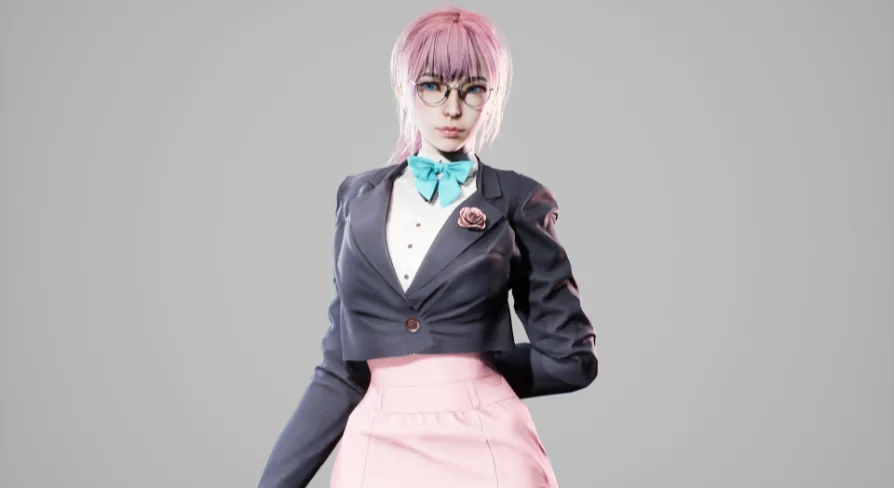
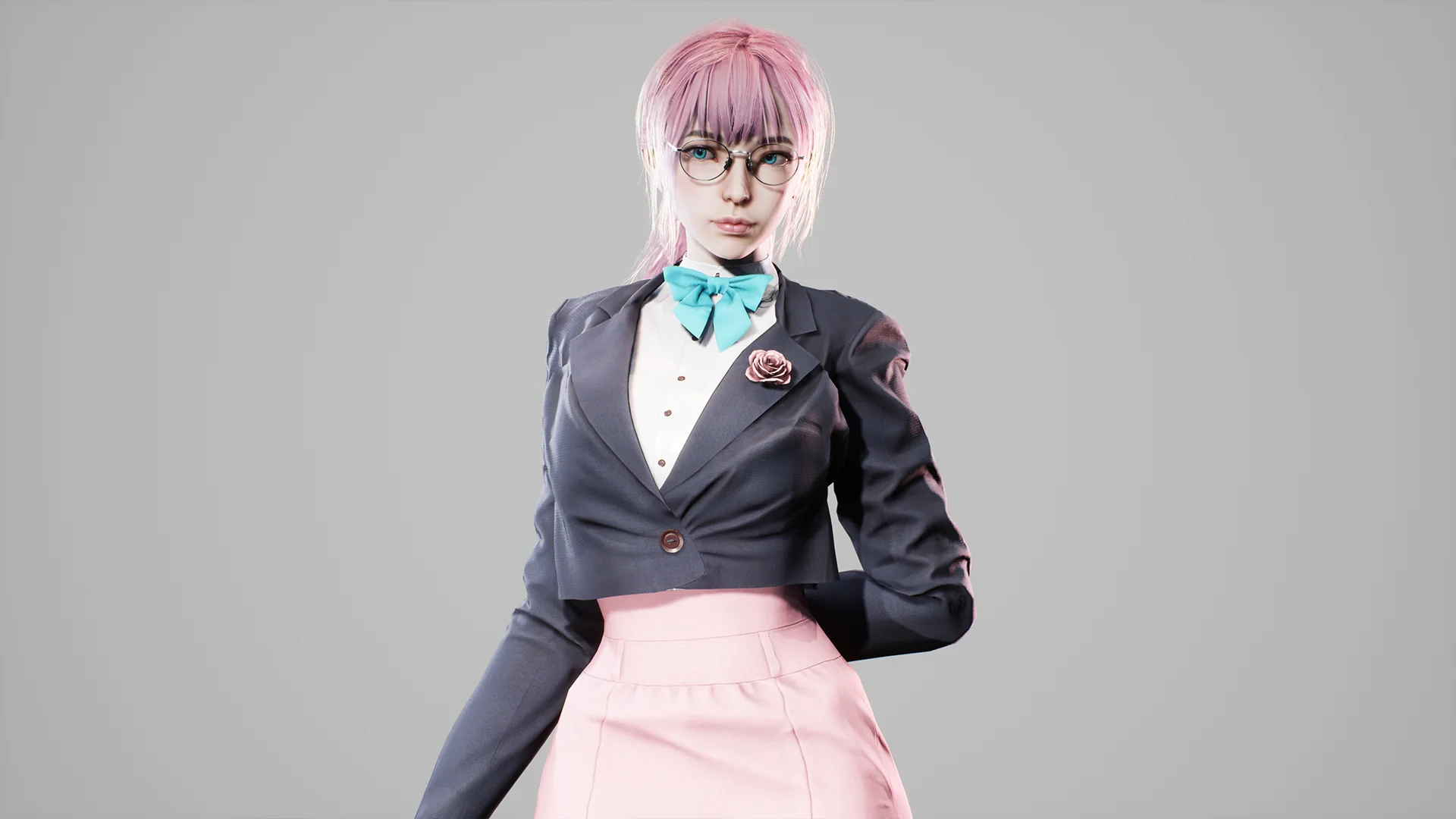
Academic facilities, modern classrooms, university lecture halls, and administrative offices require character models that clearly reflect their professional context while matching specific visual stylings. The Teacher asset delivers an Asian female character stylized in an anime aesthetic, built directly to populate educational spaces, institutional scenes, and workplace narratives. Whether serving as the central protagonist of a campus-driven story or operating in the background as a reliable non-player character guiding classroom activities, the model fits into scenarios demanding formal or semi-formal academic dress.
Because the character includes both an office costume and an underlying base structure, it supports narrative scenes that move beyond static lecterns. Cutscenes depicting faculty meetings, private student consultations, or after-hours grading sessions benefit from a figure modeled to blend formal professionalism with expressive character art. Having a dedicated costume suited for instructional roles eliminates the need to adapt generic modern attire to academic requirements, letting developers stage authentic school routines right away.
Mesh Topology and Geometry Across Teacher Variants
Real-time technical pipelines depend on precise geometric budgets to maintain high frame rates across cutscenes and gameplay. The Teacher model is organized into distinct mesh configurations, allowing developers to optimize geometry based on camera proximity and current scene requirements. When fully assembled, the complete set reaches 60,637 vertices and 90,478 triangles. This density delivers smooth silhouettes across modern rendering engines while capturing the fine folds of tailored clothing and stylized hair strands.
For modular workflows, the geometry divides cleanly into specialized subsets:
Clothes Mesh: Features 28,696 vertices and 42,392 triangles, detailing the costume independently so it can be enabled, adjusted, or occluded without disrupting underlying structures.
Base Body with Hair: Measures 31,941 vertices and 48,086 triangles, containing the fully unwrapped anatomical form and hair mesh. This body layer is designed with NSFW body compatibility, ensuring that specialized character modifications or costume swaps maintain consistent geometry underneath.
Full Set Combined: Totals 60,637 vertices and 90,478 triangles, uniting the entire apparel package, head, base anatomy, and hair into a single coherent mesh hierarchy.
Separating the apparel from the underlying base provides immediate practical advantages for performance management. Developers can selectively cull hidden body polygons beneath the 42,392-triangle costume layer, cutting unnecessary draw calls and preventing mesh clipping during extreme movement. Conversely, access to the standalone 48,086-triangle base body permits external clothing assets to be fitted directly onto the character without fighting embedded wardrobe geometry.
Facial Rigging with Apple AR Blendshapes
Dialogue-heavy projects, visual novels, and narrative adventures demand responsive facial articulation that conveys nuance without requiring custom shape-key development from scratch. The facial mesh of this character comes pre-configured with the full suite of Apple AR blendshapes, making it immediately viable for live motion capture, ARKit-driven mobile face tracking, and synchronized phoneme mapping.
By incorporating the standard Apple AR shape library, the model accommodates precise brow movements, subtle squints, wide-eyed anime expressions, jaw deviations, and complex mouth curves. Developers can drive the face directly through mobile facial tracking tools or connect the blendshapes to automated speech analysis tools to produce lip sync for long lectures or classroom dialogues. The stylized anime facial contours preserve their aesthetic charm even during extreme phonetic shapes, preventing distorted vertices across the cheeks or mouth corners during emotional cutscenes.
Color Customization and PBR Material Management
Visual variety is critical when deploying human figures across a project, particularly to avoid repetitive character silhouettes in crowded administrative or educational hubs. This asset utilizes a Physically Based Rendering (PBR) material workflow where all parts of the character can be repainted in any color. The separation of material IDs and modular components allows instant palette adjustments directly within game engine material instances.
Altering the color values of the costume allows a single model to serve distinct roles within an institution. Dark navy, gray, or black palettes create a formal professorial tone suitable for principal offices or serious academic departments. Switching the same garments to brighter, softer pastel tones quickly recontextualizes the figure as a homeroom instructor, arts educator, or university teaching assistant. Because the painting system applies across all elements, hair color, wardrobe fabrics, and accessory accents can be harmonized to match the mood of specific narrative chapters without requiring external texture authoring in external 2D software.
Integration with Animation Blueprints and NPC Scripts
Moving a rigged character into active gameplay involves more than just loading geometry; it requires smooth alignment with state machines and logical control systems. The Teacher asset includes compatibility with Animation Blueprints and gameplay scripts, easing its path from a static mesh into a functional entity capable of navigating levels and reacting to players.
Through an Animation Blueprint, the skeleton can manage complex locomotion trees, blending seated lecture poses, writing at whiteboards, walking through corridors, and resting at office desks. Transition logic can blend smoothly between standard idle variations and responsive gestures when a player approaches to initiate conversation. Coupled with NPC logic scripts, developers can route the character along patrol pathways between classrooms, trigger scripted dialogue events, and tie facial blendshape updates directly to subtitle playback. The balance of high-density expressive rigging and modular mesh management makes the model a versatile addition to interactive school environments.
 Characters
 Characters
 Characters
 Characters