"fb5ea1e7d1b41445"{"id":"1002396","slug":"rebel","title":"Rebel","category":"Characters \u0026 Creatures","engine":"4.18+,5.0+","assetVersion":"","engineVersion":"Engine Version: 4.18+,5.0+","tag":"Characters","accent":"blue","visual":"character","summary":"A modular, lowpoly character featuring an Epic skeleton, PBR materials, full compatibility with Epic's starter animation pack, and bunker integration.","platform":"Unreal Engine","indexPolicy":"index","publishedAt":"2026-11-10T04:25:09.218Z","updatedAt":"2026-11-10T04:25:09.218Z","sourceNotes":[],"fileContents":[],"compatibility":["Unreal Engine","Engine Version: 4.18+,5.0+"],"featuredImage":{"alt":"Rebel","src":"/wp-content/uploads/published/2026/11/af838f79fb05-5338b567-0fb2-44c8-ace0-520b6ddd835e-038f876b70.webp"},"hasDownloadLink":true,"downloads":0,"terms":[{"taxonomy":"category","slug":"characters-and-creatures","name":"Characters \u0026 Creatures"}],"galleryImages":[{"src":"/wp-content/uploads/published/2026/11/49b54cecf541-741363df-9d55-4d84-b80a-321360b9ba82-5b880aae70.webp","alt":"Rebel"},{"src":"/wp-content/uploads/published/2026/11/ad8abca8ab7f-85af432e-858c-4fc5-bc29-34a9d5f4599b-344a31a4ac.webp","alt":"Rebel"},{"src":"/wp-content/uploads/published/2026/11/445040cde8a2-7f2db79b-0118-418c-9b55-0095bbbd9a83-d2c024c3ab.webp","alt":"Rebel"},{"src":"/wp-content/uploads/published/2026/11/79d0fe665a3f-dba7ecc5-7e04-4ce0-b22a-f7244ef5d9ae-437ea42f2c.webp","alt":"Rebel"}],"accessPanel":{"kind":"resource","title":"Get this resource","eyebrow":"Free resource","message":"Download this resource in your browser.","fileName":"Content.7z","safetyNote":"Resources are manually reviewed before listing to improve quality and reduce obvious risks.","actionLabel":"Get this resource","resourceType":"Resource archive","versions":[]},"contentHtml":"\u003ch2\u003eEpic Skeleton Rigging and Animation Blueprint Setup for Rebel\u003c/h2\u003e\u003cp\u003eIntegrating the Rebel character into an active project pipeline begins at the skeletal hierarchy. Because the asset conforms strictly to the standard Epic skeleton, developers can bypass the tedious bone-mapping and retargeting routines that typically stall third-party character imports. The rig structure matches the standard joint names, orientations, and hierarchy expected by default engine animation systems, allowing instant socket attachment for props and gear.\u003c/p\u003e\u003cp\u003eImmediate compatibility with Epic's starter animation pack provides an operational baseline for locomotion out of the box. Running, walking, crouching, and idle states function without the need for manual weight readjustments or axis correction. Within an Animation Blueprint, the setup process involves referencing the character's movement component velocities and driving the corresponding blend spaces provided by the starter set. State machines transition cleanly between standard traversal stances, utilizing the baseline poses without foot-sliding or joint popping.\u003c/p\u003e\u003cp\u003eScript components hook into this animation framework through standard event dispatchers and character blueprint interfaces. By setting up the character's logic via script, input events such as aiming, moving, and firing can trigger animation notifies directly within the Animation Blueprint. The native compatibility eliminates the translation friction commonly experienced when aligning custom character rigs to industry-standard animation libraries.\u003c/p\u003e\u003ch2\u003eModular Construction of the Rebel Character Mesh\u003c/h2\u003e\u003cp\u003eThe mesh architecture utilizes a lowpoly foundation configured for modular versatility. Modular design permits developers to break down and reassemble various segments of the character, swapping distinct components to support different visual ranks, roles, or team identities. This makes the asset suitable for scaling an encounter from a lone operative to an entire insurgent force without visual stagnation.\u003c/p\u003e\u003cp\u003eVisual markers balance between tactical soldier utility and casual attire. The asset incorporates elements like a protective vest laid over casual garments, presenting an irregular combatant silhouette. The lowpoly budget is allocated strategically to preserve sharp silhouettes around key points of movement: the shoulders, elbows, and knees maintain volume during extreme deformations when cycling through combat animations. Structural accessories, including the tactical vest and gear mounts, sit snugly over the base body to avoid mesh interpenetration during movement loops.\u003c/p\u003e\u003cp\u003eWeapon integration is straightforward thanks to designated socket anchors compatible with firearm assets. Sockets placed on the right and left hand bones follow the standard Epic rig transforms, meaning default weapon attachment offsets line up with minimal hand-IK compensation. Sockets across the torso and back accommodate slung firearms, aligning cleanly with the vest mesh geometry.\u003c/p\u003e\u003ch2\u003ePBR Material Workflow and Surface Realism\u003c/h2\u003e\u003cp\u003eSurface properties across the Rebel mesh rely on physically based rendering (PBR) materials that emphasize realistic material differentiation. Even with an optimized polygon footprint, the visual depth relies heavily on high-fidelity texture maps. Albedo maps communicate the distressed nature of irregular combat gear, showing worn cloth and scuffed synthetic straps, while normal maps carry the fine micro-details of fabric weaves, stitching lines, and rigid vest seams.\u003c/p\u003e\u003cp\u003eRoughness maps govern the distinct light responses of disparate surfaces. Matte textiles absorb broad lighting, dampening specular reflections across casual shirts and trousers, whereas the composite plates and nylon weave of the vest display tighter specular highlights. Metallic maps isolate buckles, zipper teeth, and hard attachment rings, ensuring clear material definition when the character passes beneath shifting scene lights.\u003c/p\u003e\u003cp\u003eBecause the material pipeline adheres to strict PBR conventions, the character responds predictably across diverse lighting environments. Directional sunlight, bouncing indirect light, and sharp point lights all behave realistically against the mesh surfaces without requiring per-scene shader tweaks. This makes the material setup stable under fully dynamic lighting setups as well as baked static light scenarios.\u003c/p\u003e\u003ch2\u003eEnvironmental Deployment Across Jungle, Desert, and Bunker Contexts\u003c/h2\u003e\u003cp\u003eThe blend of tactical and casual styling gives the Rebel model the flexibility to function in starkly different environmental biomes. In desert settings, the dusty, sun-bleached tones of the PBR materials harmonize naturally with arid terrain, rocky outcroppings, and sandy atmospheric haze. The vest geometry reads distinctly against open horizon lines, providing a legible military silhouette at mid-to-long draw distances.\u003c/p\u003e\u003cp\u003eDeploying the model into dense jungle scenes highlights the character's irregular soldier identity. The muted fabric tones blend into deep vegetation cover and heavy foliage shadows, while normal-mapped fabric wrinkles catch fragmented specular highlights slicing through dense forest canopies. The lowpoly density keeps frame times steady when the character must be rendered alongside complex foliage shaders and dense particle systems.\u003c/p\u003e\u003cp\u003eCompatibility with bunker settings introduces another practical operational context. Within tight, concrete corridors illuminated by stark emergency lighting, the PBR materials react accurately to harsh point lights and narrow spotlight cones. The character model moves through restricted bunker interiors without collision snagging, maintaining clear visual contrast against flat industrial walls. Whether positioned as an infiltrating operative or a hardened defender in an underground bunker, the Rebel asset fills tactical roles across both exterior landscapes and claustrophobic interior sets.\u003c/p\u003e\u003ch2\u003eGameplay Logic and Production Deployment\u003c/h2\u003e\u003cp\u003eImplementing the character into production hinges on the combination of modularity, scripting hooks, and lightweight geometry. Lowpoly meshes allow technical directors to populate active combat spaces with multiple simultaneous AI agents without overrunning the geometry budget. This proves vital during high-action sequences where several soldiers equipped with firearms engage the player at once.\u003c/p\u003e\u003cp\u003eThe included script framework coordinates seamlessly with the Animation Blueprint to control state changes, damage reactions, and weapon handling routines. Because the asset maintains strict compatibility with core Epic standards, development teams can avoid custom pipeline tooling. Asset management remains clean: import the mesh, bind the Animation Blueprint driven by the starter animation pack, assign the PBR materials, and deploy the character into combat zones.\u003c/p\u003e\n\n\u003ch2\u003eExplore Similar Assets\u003c/h2\u003e\n\u003cul\u003e\n\u003cli\u003e\u003ca href=\"https://3dcghub.com/medical-worker-01/\" rel=\"noopener noreferrer\"\u003eMedical Worker 01\u003c/a\u003e\u003c/li\u003e\n\u003cli\u003e\u003ca href=\"https://3dcghub.com/animated-stylized-wizard/\" rel=\"noopener noreferrer\"\u003eAnimated Stylized Wizard\u003c/a\u003e\u003c/li\u003e\n\u003cli\u003e\u003ca href=\"https://3dcghub.com/fps-devices/\" rel=\"noopener noreferrer\"\u003eFPS Devices\u003c/a\u003e\u003c/li\u003e\n\u003cli\u003e\u003ca href=\"https://3dcghub.com/l-dark-wizard/\" rel=\"noopener noreferrer\"\u003eL: Dark Wizard\u003c/a\u003e\u003c/li\u003e\n\u003cli\u003e\u003ca href=\"https://3dcghub.com/modular-private-military-contractor/\" rel=\"noopener noreferrer\"\u003eModular Private Military Contractor\u003c/a\u003e\u003c/li\u003e\n\u003c/ul\u003e","contentTextLength":6919,"navigation":{"current":23,"total":4340,"previous":{"id":"1002397","slug":"skeleton-archer","title":"Skeleton Archer","category":"Characters \u0026 Creatures","platform":"Unreal Engine","updatedAt":"2026-11-10T04:25:54.909Z"},"next":{"id":"1002395","slug":"oni-samurai","title":"Oni Samurai","category":"Characters \u0026 Creatures","platform":"Unreal Engine","updatedAt":"2026-11-10T04:21:55.542Z"}},"relatedResources":[{"id":"1002416","slug":"native-american","title":"Native American","category":"Characters \u0026 Creatures","engine":"4.18+,5.0+","assetVersion":"","engineVersion":"Engine Version: 4.18+,5.0+","tag":"Characters","accent":"blue","visual":"character","summary":"Technical breakdown of the Native American lowpoly character model, featuring Epic Skeleton rigging, 44 animations, SSS materials, and physics setups.","platform":"Unreal Engine","indexPolicy":"index","publishedAt":"2026-11-10T13:36:44.305Z","updatedAt":"2026-11-10T13:36:44.305Z","sourceNotes":[],"fileContents":[],"compatibility":["Unreal Engine","Engine Version: 4.18+,5.0+"],"featuredImage":{"alt":"Native American","src":"/wp-content/uploads/published/2026/11/edbc47aac0c7-a2e36e55-bd1f-45fc-8037-7d656ac1de87-2613efbab3.webp"},"hasDownloadLink":true,"downloads":0},{"id":"1001352","slug":"medical-worker-01","title":"Medical Worker 01","category":"Characters \u0026 Creatures","engine":"4.18+,5.0+","assetVersion":"","engineVersion":"Engine Version: 4.18+,5.0+","tag":"Characters","accent":"blue","visual":"character","summary":"Deploy Medical Worker 01 into apocalyptic and quarantine scenes. Features Epic skeleton compatibility, customizable colors, mobile materials, and lowpoly optimi","platform":"Unreal Engine","indexPolicy":"index","publishedAt":"2026-10-04T10:21:26.511Z","updatedAt":"2026-10-04T10:21:26.511Z","sourceNotes":[],"fileContents":[],"compatibility":["Unreal Engine","Engine Version: 4.18+,5.0+"],"featuredImage":{"alt":"Medical Worker 01","src":"/wp-content/uploads/published/2026/10/69c21328187c-883e8750-efa8-4fb2-852c-8deb03de9660-4a37c564cd.webp"},"hasDownloadLink":true,"downloads":0},{"id":"1001425","slug":"animated-stylized-wizard","title":"Animated Stylized Wizard","category":"Characters \u0026 Creatures","engine":"4.18+,5.0+","assetVersion":"","engineVersion":"Engine Version: 4.18+,5.0+","tag":"Characters","accent":"blue","visual":"character","summary":"Explore the Animated Stylized Wizard featuring a handpainted game-ready model, 70 animations, 14 character texture variations, and matched staff weapons.","platform":"Unreal Engine","indexPolicy":"index","publishedAt":"2026-10-07T06:00:07.988Z","updatedAt":"2026-10-07T06:00:07.988Z","sourceNotes":[],"fileContents":[],"compatibility":["Unreal Engine","Engine Version: 4.18+,5.0+"],"featuredImage":{"alt":"Animated Stylized Wizard","src":"/wp-content/uploads/published/2026/10/3509b7d14a4a-ca8d0d8e-9c9c-48f2-b020-6f6572cff412-d78d80b38a.webp"},"hasDownloadLink":true,"downloads":0}]}
Characters
Rebel
A modular, lowpoly character featuring an Epic skeleton, PBR materials, full compatibility with Epic's starter animation pack, and bunker integration.
Epic Skeleton Rigging and Animation Blueprint Setup for Rebel
Integrating the Rebel character into an active project pipeline begins at the skeletal hierarchy. Because the asset conforms strictly to the standard Epic skeleton, developers can bypass the tedious bone-mapping and retargeting routines that typically stall third-party character imports. The rig structure matches the standard joint names, orientations, and hierarchy expected by default engine animation systems, allowing instant socket attachment for props and gear.
Immediate compatibility with Epic's starter animation pack provides an operational baseline for locomotion out of the box. Running, walking, crouching, and idle states function without the need for manual weight readjustments or axis correction. Within an Animation Blueprint, the setup process involves referencing the character's movement component velocities and driving the corresponding blend spaces provided by the starter set. State machines transition cleanly between standard traversal stances, utilizing the baseline poses without foot-sliding or joint popping.
Script components hook into this animation framework through standard event dispatchers and character blueprint interfaces. By setting up the character's logic via script, input events such as aiming, moving, and firing can trigger animation notifies directly within the Animation Blueprint. The native compatibility eliminates the translation friction commonly experienced when aligning custom character rigs to industry-standard animation libraries.
Modular Construction of the Rebel Character Mesh
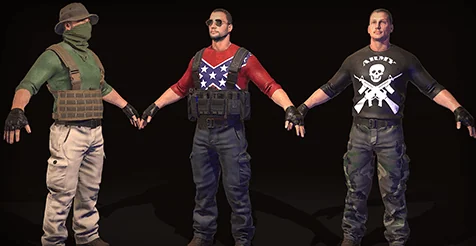
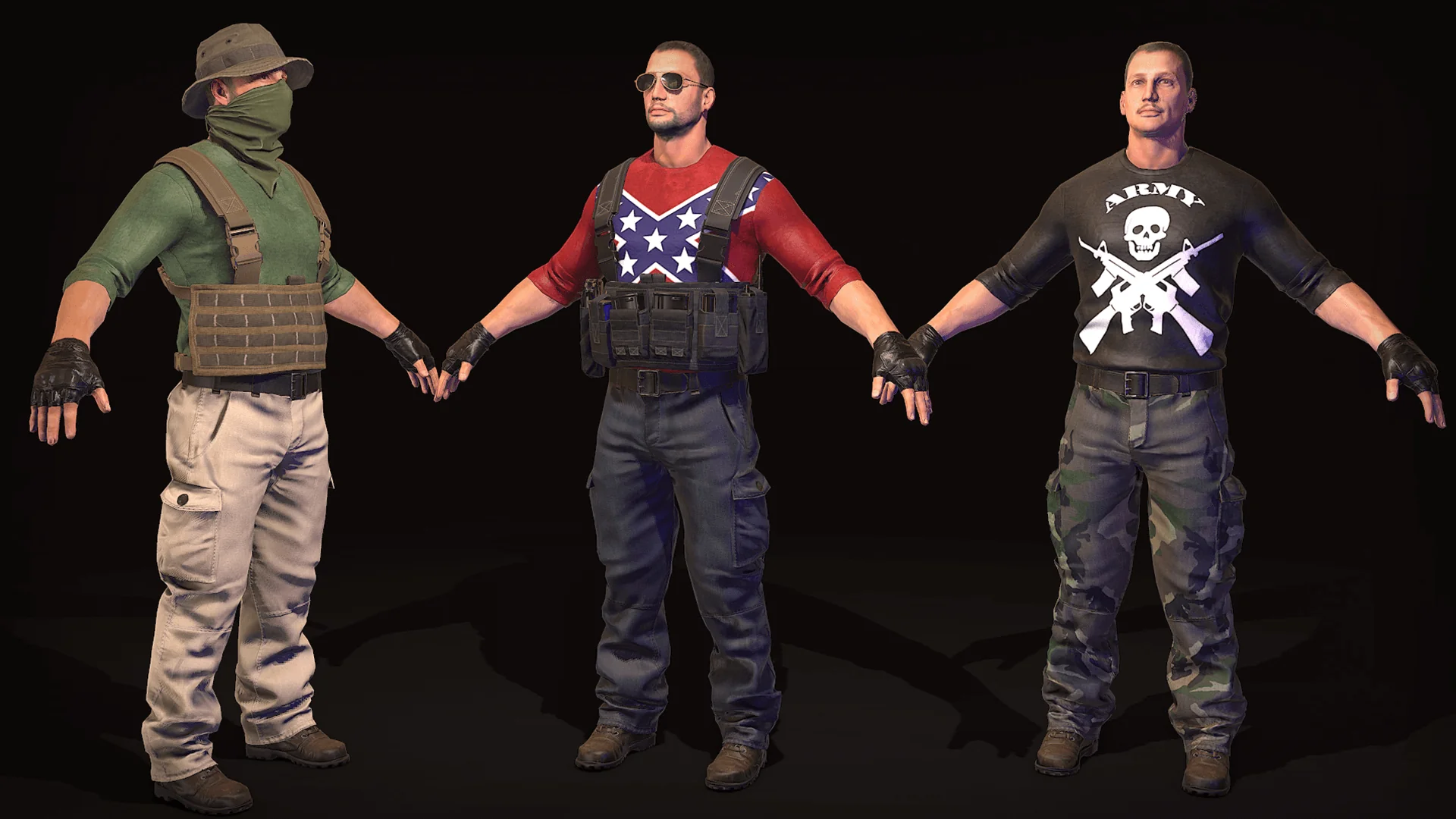
The mesh architecture utilizes a lowpoly foundation configured for modular versatility. Modular design permits developers to break down and reassemble various segments of the character, swapping distinct components to support different visual ranks, roles, or team identities. This makes the asset suitable for scaling an encounter from a lone operative to an entire insurgent force without visual stagnation.
Visual markers balance between tactical soldier utility and casual attire. The asset incorporates elements like a protective vest laid over casual garments, presenting an irregular combatant silhouette. The lowpoly budget is allocated strategically to preserve sharp silhouettes around key points of movement: the shoulders, elbows, and knees maintain volume during extreme deformations when cycling through combat animations. Structural accessories, including the tactical vest and gear mounts, sit snugly over the base body to avoid mesh interpenetration during movement loops.
Weapon integration is straightforward thanks to designated socket anchors compatible with firearm assets. Sockets placed on the right and left hand bones follow the standard Epic rig transforms, meaning default weapon attachment offsets line up with minimal hand-IK compensation. Sockets across the torso and back accommodate slung firearms, aligning cleanly with the vest mesh geometry.
PBR Material Workflow and Surface Realism
Surface properties across the Rebel mesh rely on physically based rendering (PBR) materials that emphasize realistic material differentiation. Even with an optimized polygon footprint, the visual depth relies heavily on high-fidelity texture maps. Albedo maps communicate the distressed nature of irregular combat gear, showing worn cloth and scuffed synthetic straps, while normal maps carry the fine micro-details of fabric weaves, stitching lines, and rigid vest seams.
Roughness maps govern the distinct light responses of disparate surfaces. Matte textiles absorb broad lighting, dampening specular reflections across casual shirts and trousers, whereas the composite plates and nylon weave of the vest display tighter specular highlights. Metallic maps isolate buckles, zipper teeth, and hard attachment rings, ensuring clear material definition when the character passes beneath shifting scene lights.
Because the material pipeline adheres to strict PBR conventions, the character responds predictably across diverse lighting environments. Directional sunlight, bouncing indirect light, and sharp point lights all behave realistically against the mesh surfaces without requiring per-scene shader tweaks. This makes the material setup stable under fully dynamic lighting setups as well as baked static light scenarios.
Environmental Deployment Across Jungle, Desert, and Bunker Contexts
The blend of tactical and casual styling gives the Rebel model the flexibility to function in starkly different environmental biomes. In desert settings, the dusty, sun-bleached tones of the PBR materials harmonize naturally with arid terrain, rocky outcroppings, and sandy atmospheric haze. The vest geometry reads distinctly against open horizon lines, providing a legible military silhouette at mid-to-long draw distances.
Deploying the model into dense jungle scenes highlights the character's irregular soldier identity. The muted fabric tones blend into deep vegetation cover and heavy foliage shadows, while normal-mapped fabric wrinkles catch fragmented specular highlights slicing through dense forest canopies. The lowpoly density keeps frame times steady when the character must be rendered alongside complex foliage shaders and dense particle systems.
Compatibility with bunker settings introduces another practical operational context. Within tight, concrete corridors illuminated by stark emergency lighting, the PBR materials react accurately to harsh point lights and narrow spotlight cones. The character model moves through restricted bunker interiors without collision snagging, maintaining clear visual contrast against flat industrial walls. Whether positioned as an infiltrating operative or a hardened defender in an underground bunker, the Rebel asset fills tactical roles across both exterior landscapes and claustrophobic interior sets.
Gameplay Logic and Production Deployment
Implementing the character into production hinges on the combination of modularity, scripting hooks, and lightweight geometry. Lowpoly meshes allow technical directors to populate active combat spaces with multiple simultaneous AI agents without overrunning the geometry budget. This proves vital during high-action sequences where several soldiers equipped with firearms engage the player at once.
The included script framework coordinates seamlessly with the Animation Blueprint to control state changes, damage reactions, and weapon handling routines. Because the asset maintains strict compatibility with core Epic standards, development teams can avoid custom pipeline tooling. Asset management remains clean: import the mesh, bind the Animation Blueprint driven by the starter animation pack, assign the PBR materials, and deploy the character into combat zones.
 Characters
 Characters
 Characters
 Characters