"031373f479d9561a"{"id":"1000269","slug":"animalia-bluebird","title":"Animalia - Bluebird","category":"Characters \u0026 Creatures","engine":"4.26+,5.0+","assetVersion":"","engineVersion":"Engine Version: 4.26+,5.0+","tag":"Characters","accent":"blue","visual":"character","summary":"A highly detailed bluebird model featuring 4K textures, 60fps animations, LODs, and native Maya and 3ds Max rigs for seamless pipeline integration.","platform":"Unreal Engine","publishedAt":"2026-07-02T16:14:43.171Z","updatedAt":"2026-07-02T16:14:43.171Z","sourceNotes":[],"fileContents":[],"compatibility":["Unreal Engine","Engine Version: 4.26+,5.0+"],"featuredImage":{"alt":"Animalia - Bluebird","src":"/wp-content/uploads/published/2026/07/dac77bc204dd-f18c2222-4dc5-4770-84e0-75ffa7b8e997-d899c3da43.webp"},"hasDownloadLink":true,"downloads":0,"terms":[{"taxonomy":"category","slug":"characters-and-creatures","name":"Characters \u0026 Creatures"}],"galleryImages":[{"src":"/wp-content/uploads/published/2026/07/aeff350b1dc1-19d4a4c2-d3f7-4e3f-bfb1-449d377b3e15-6f7705adad.webp","alt":"Animalia - Bluebird"},{"src":"/wp-content/uploads/published/2026/07/662d47ac9cb9-6f64c2df-6e7d-4512-a8f6-01e1b6fc30df-257a98c62e.webp","alt":"Animalia - Bluebird"},{"src":"/wp-content/uploads/published/2026/07/a51a727cc686-8fc49b55-4296-4d1e-aa76-b92d229b7798-77361a8cd6.webp","alt":"Animalia - Bluebird"},{"src":"/wp-content/uploads/published/2026/07/2fc190b09cde-7496ae07-5d9b-4576-8de8-de52076a9bb8-82fb4c5de1.webp","alt":"Animalia - Bluebird"},{"src":"/wp-content/uploads/published/2026/07/8c1f584371a3-3e741699-0323-4f76-abb4-f81f01cc0669-4cac1ea823.webp","alt":"Animalia - Bluebird"}],"accessPanel":{"kind":"resource","title":"Download this resource","eyebrow":"Free Download","message":"Log in or create a free account to start your download.","fileName":"Content.7z","safetyNote":"Resources are manually reviewed before listing to improve quality and reduce obvious risks.","actionLabel":"Download Free","resourceType":"Resource archive"},"contentHtml":"\u003cp\u003ePopulating a digital environment with believable wildlife often requires balancing visual fidelity with strict performance budgets, particularly when dealing with the rapid, erratic movements of small birds. The Animalia - Bluebird asset addresses this workflow challenge by delivering a realistic creature model equipped with high-resolution textures, a comprehensive animation suite, and native rigging files. Built to function across a variety of project scales, from dense forest ecosystems to tight cinematic close-ups, the asset provides technical animators and developers with the structural components necessary to craft dynamic avian behaviors.\u003c/p\u003e \u003cp\u003eBy providing the foundational model alongside specialized rigging and physics setups, the asset removes the need to build complex avian skeletal structures from scratch. Developers can bypass the initial modeling and weight-painting phases, moving directly into integrating the bird into environmental behavior trees or cinematic sequences.\u003c/p\u003e \u003ch2\u003eStructuring Avian Motion at 60 FPS\u003c/h2\u003e \u003cp\u003eCapturing the specific movements of a bluebird requires precise animation data, as small birds rely on rapid wing beats, sudden head darts, and quick pivots. The animations included with the bluebird are authored specifically at 60 frames per second. This higher framerate authoring provides double the standard motion data found in typical 30 fps assets, resulting in exceptionally smooth playback during fast actions. This is particularly useful for projects that utilize slow-motion mechanics or demand high-fidelity cinematic rendering where dropped animation frames would break immersion.\u003c/p\u003e \u003cp\u003eTo support different programming approaches, all animations are provided in both in-space and in-place variations. This dual availability gives gameplay programmers and AI designers significant flexibility when setting up locomotion systems.\u003c/p\u003e \u003cp\u003eIn-place animations are ideal for standard AI wandering and flight paths where a collision capsule drives the character's translation through the world, while the animation simply plays on top of the moving capsule. Conversely, the in-space animations utilize root motion, allowing the animation itself to drive the bird's precise movement. This is crucial for specific, complex actions like taking off from a branch, landing on a precise perch, or executing a specialized aerial maneuver where capsule-driven movement might look artificial or disconnected from the physics of the environment.\u003c/p\u003e \u003ch2\u003eHigh-Fidelity Rendering with 4K Textures\u003c/h2\u003e \u003cp\u003eApplying 4K textures to a small creature model results in an incredibly dense pixel-to-surface ratio. This level of texture resolution ensures that the bluebird maintains its realistic appearance even under extreme camera scrutiny. Fine details, such as the color gradients across the flight feathers and the subtle variations in the bird's coat, remain sharp and distinct during macro shots or in virtual reality environments where players can examine assets up close.\u003c/p\u003e \u003cp\u003eRendering feathers in real-time engines relies heavily on accurate alpha channels to simulate the soft edges and layered overlaps of a bird's plumage. Version 2.1.0 of the asset specifically addresses rendering refinements, introducing fixes to material opacity alongside various other tweaks. Accurate material opacity prevents sorting errors and harsh polygon edges, ensuring the layered feathers blend naturally against complex environmental backgrounds like dense foliage or bright skies.\u003c/p\u003e \u003ch2\u003ePipeline Integration via Maya and 3ds Max Rigs\u003c/h2\u003e \u003cp\u003eWhile the asset includes a set of pre-authored animations, production pipelines often require custom motions tailored to specific gameplay events or narrative beats. To support this, the bluebird includes native animation rigs for both Maya and 3ds Max. Supplying the source rigs in these industry-standard Digital Content Creation (DCC) applications is a significant workflow advantage.\u003c/p\u003e \u003cp\u003eInstead of attempting to retarget an existing skeleton or manipulate baked animation data within the game engine, technical animators can open the original rigs in their preferred software. This allows animation teams to design highly specific behaviors—such as pecking at a unique prop, reacting to a specific player interaction, or following a complex, pre-determined flight path—and seamlessly export the new sequences back into the project. By bridging the gap between the DCC software and the engine, the asset ensures that developers are never strictly locked into the default animation list.\u003c/p\u003e \u003ch2\u003eScaling Environments with LODs and Ragdoll Physics\u003c/h2\u003e \u003cp\u003ePopulating an expansive outdoor level with wildlife can quickly drain CPU and GPU resources if every creature is rendered at maximum fidelity. The inclusion of Levels of Detail (LODs) mitigates this performance impact. As the camera moves further away from the bluebird, the engine automatically swaps the high-poly 4K model for progressively simpler geometric meshes. This transition allows developers to feature entire flocks of bluebirds in the distant canopy without sacrificing the high framerates required for smooth gameplay, while reserving the highly detailed mesh strictly for foreground interactions.\u003c/p\u003e \u003cp\u003eBeyond visual scaling, the asset includes a pre-configured ragdoll setup. Generating a physics asset for an avian skeleton can be tedious, requiring the manual placement of tiny collision bodies and the precise tuning of hinge limits for delicate wings and legs. The included ragdoll setup means the physical collision properties are already mapped to the skeletal hierarchy.\u003c/p\u003e \u003cp\u003eIf the bluebird intersects with a dynamic physics object, is struck by a projectile, or encounters an environmental hazard, it will react with accurate physical momentum rather than simply playing a static, pre-baked death animation. This integration ensures the creature remains grounded in the physical rules of the game world.\u003c/p\u003e \u003ch2\u003eEngine Compatibility and Volumetric Enhancements\u003c/h2\u003e \u003cp\u003eThe core asset is built to function reliably across multiple engine iterations, specifically optimized for Unreal Engine 4.24 and newer versions. It operates entirely out-of-the-box using standard engine materials and does not inherently require any external plugins to function correctly within a scene.\u003c/p\u003e \u003cp\u003eHowever, for projects pushing for even higher levels of visual fidelity, the bluebird is designed to accommodate volumetric enhancements. While it functions perfectly without it, the model can be paired with the gFur plugin in Unreal Engine 5. Integrating gFur allows developers to push the realistic design further, transitioning from standard texture planes to complex, volumetric feather rendering for projects that demand the highest possible tier of creature realism.\u003c/p\u003e\n\n\u003ch2\u003eRelated Resources Worth Checking\u003c/h2\u003e\n\u003cul\u003e\n\u003cli\u003e\u003ca href=\"https://3dcghub.com/animalia-leopard-young/\" title=\"Animalia - Leopard (young)\"\u003eAnimalia - Leopard (young)\u003c/a\u003e\u003c/li\u003e\n\u003cli\u003e\u003ca href=\"https://3dcghub.com/animalia-meadow-grasshopper/\" title=\"Animalia - Meadow Grasshopper\"\u003eAnimalia - Meadow Grasshopper\u003c/a\u003e\u003c/li\u003e\n\u003cli\u003e\u003ca href=\"https://3dcghub.com/animalia-bald-and-golden-eagle/\" title=\"Animalia - Bald and Golden Eagle\"\u003eAnimalia - Bald and Golden Eagle\u003c/a\u003e\u003c/li\u003e\n\u003cli\u003e\u003ca href=\"https://3dcghub.com/animalia-housefly/\" title=\"Animalia - Housefly\"\u003eAnimalia - Housefly\u003c/a\u003e\u003c/li\u003e\n\u003cli\u003e\u003ca href=\"https://3dcghub.com/animalia-honeybee/\" title=\"Animalia - Honeybee\"\u003eAnimalia - Honeybee\u003c/a\u003e\u003c/li\u003e\n\u003c/ul\u003e","contentTextLength":6856,"navigation":{"current":1081,"total":3223,"previous":{"id":"1000270","slug":"alien-fish-for-school-system-scifi-fantasy-creatures","title":"Alien Fish for School System - Scifi Fantasy Creatures","category":"Characters \u0026 Creatures","platform":"Unreal Engine","updatedAt":"2026-07-02T16:20:03.507Z"},"next":{"id":"1000268","slug":"african-animal-camel-dromedary","title":"African Animal - Camel (Dromedary)","category":"Animals","platform":"Unreal Engine","updatedAt":"2026-07-02T15:37:29.441Z"}},"relatedResources":[{"id":"1000974","slug":"animalia-lion-male","title":"Animalia - Lion (male)","category":"Characters \u0026 Creatures","engine":"4.26+,5.0+","assetVersion":"","engineVersion":"Engine Version: 4.26+,5.0+","tag":"Characters","accent":"blue","visual":"character","summary":"Realistic male lion with 60fps animations, 4K textures, gFur support, Maya/3ds Max rigs, LODs, and ragdoll for Unreal Engine 4.24 and up.","platform":"Unreal Engine","publishedAt":"2026-08-17T16:08:33.242Z","updatedAt":"2026-08-17T16:08:33.242Z","sourceNotes":[],"fileContents":[],"compatibility":["Unreal Engine","Engine Version: 4.26+,5.0+"],"featuredImage":{"alt":"Animalia - Lion (male)","src":"/wp-content/uploads/published/2026/08/799ef29163e0-6c655651-224e-4b8d-9200-2a0d57dbd08f-30295b193d.webp"},"hasDownloadLink":true,"downloads":0},{"id":"1000973","slug":"animalia-gray-wolf-young","title":"Animalia - Gray Wolf (young)","category":"Characters \u0026 Creatures","engine":"4.26+,5.0+","assetVersion":"","engineVersion":"Engine Version: 4.26+,5.0+","tag":"Characters","accent":"blue","visual":"character","summary":"A realistic young Gray Wolf with 60fps animations, 4K textures, gFur support, Maya/3ds Max rigs, LODs, and ragdoll setup for Unreal Engine 5 projects.","platform":"Unreal Engine","publishedAt":"2026-08-17T16:04:58.364Z","updatedAt":"2026-08-17T16:04:58.364Z","sourceNotes":[],"fileContents":[],"compatibility":["Unreal Engine","Engine Version: 4.26+,5.0+"],"featuredImage":{"alt":"Animalia - Gray Wolf (young)","src":"/wp-content/uploads/published/2026/08/9fcd1d0b632e-f6aeddf4-1dc7-45c0-91e5-98a501f9cf7e-0eaf67a9d1.webp"},"hasDownloadLink":true,"downloads":0},{"id":"1000912","slug":"animalia-raccoon","title":"Animalia - Raccoon","category":"Characters \u0026 Creatures","engine":"4.26+,5.0+","assetVersion":"","engineVersion":"Engine Version: 4.26+,5.0+","tag":"Characters","accent":"blue","visual":"character","summary":"Realistic raccoon with 60fps animations, 2K textures, gFur support, LODs, ragdoll setup, and a 3ds Max rig. Works with UE 4.24+ and the Animalia Starter Kit.","platform":"Unreal Engine","publishedAt":"2026-08-07T17:04:40.260Z","updatedAt":"2026-08-07T17:04:40.260Z","sourceNotes":[],"fileContents":[],"compatibility":["Unreal Engine","Engine Version: 4.26+,5.0+"],"featuredImage":{"alt":"Animalia - Raccoon","src":"/wp-content/uploads/published/2026/08/2674d40980b0-8799a4c5-7e67-49ed-88a6-836893685cf5-b83809c831.webp"},"hasDownloadLink":true,"downloads":0}]}
Characters
Animalia - Bluebird
A highly detailed bluebird model featuring 4K textures, 60fps animations, LODs, and native Maya and 3ds Max rigs for seamless pipeline integration.
Populating a digital environment with believable wildlife often requires balancing visual fidelity with strict performance budgets, particularly when dealing with the rapid, erratic movements of small birds. The Animalia - Bluebird asset addresses this workflow challenge by delivering a realistic creature model equipped with high-resolution textures, a comprehensive animation suite, and native rigging files. Built to function across a variety of project scales, from dense forest ecosystems to tight cinematic close-ups, the asset provides technical animators and developers with the structural components necessary to craft dynamic avian behaviors.
By providing the foundational model alongside specialized rigging and physics setups, the asset removes the need to build complex avian skeletal structures from scratch. Developers can bypass the initial modeling and weight-painting phases, moving directly into integrating the bird into environmental behavior trees or cinematic sequences.
Structuring Avian Motion at 60 FPS
Capturing the specific movements of a bluebird requires precise animation data, as small birds rely on rapid wing beats, sudden head darts, and quick pivots. The animations included with the bluebird are authored specifically at 60 frames per second. This higher framerate authoring provides double the standard motion data found in typical 30 fps assets, resulting in exceptionally smooth playback during fast actions. This is particularly useful for projects that utilize slow-motion mechanics or demand high-fidelity cinematic rendering where dropped animation frames would break immersion.
To support different programming approaches, all animations are provided in both in-space and in-place variations. This dual availability gives gameplay programmers and AI designers significant flexibility when setting up locomotion systems.
In-place animations are ideal for standard AI wandering and flight paths where a collision capsule drives the character's translation through the world, while the animation simply plays on top of the moving capsule. Conversely, the in-space animations utilize root motion, allowing the animation itself to drive the bird's precise movement. This is crucial for specific, complex actions like taking off from a branch, landing on a precise perch, or executing a specialized aerial maneuver where capsule-driven movement might look artificial or disconnected from the physics of the environment.
High-Fidelity Rendering with 4K Textures
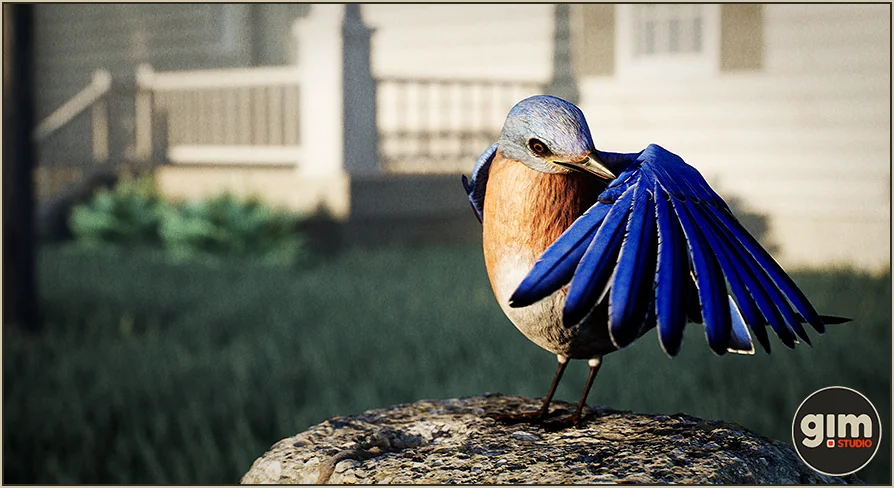
Applying 4K textures to a small creature model results in an incredibly dense pixel-to-surface ratio. This level of texture resolution ensures that the bluebird maintains its realistic appearance even under extreme camera scrutiny. Fine details, such as the color gradients across the flight feathers and the subtle variations in the bird's coat, remain sharp and distinct during macro shots or in virtual reality environments where players can examine assets up close.
Rendering feathers in real-time engines relies heavily on accurate alpha channels to simulate the soft edges and layered overlaps of a bird's plumage. Version 2.1.0 of the asset specifically addresses rendering refinements, introducing fixes to material opacity alongside various other tweaks. Accurate material opacity prevents sorting errors and harsh polygon edges, ensuring the layered feathers blend naturally against complex environmental backgrounds like dense foliage or bright skies.
Pipeline Integration via Maya and 3ds Max Rigs
While the asset includes a set of pre-authored animations, production pipelines often require custom motions tailored to specific gameplay events or narrative beats. To support this, the bluebird includes native animation rigs for both Maya and 3ds Max. Supplying the source rigs in these industry-standard Digital Content Creation (DCC) applications is a significant workflow advantage.
Instead of attempting to retarget an existing skeleton or manipulate baked animation data within the game engine, technical animators can open the original rigs in their preferred software. This allows animation teams to design highly specific behaviors—such as pecking at a unique prop, reacting to a specific player interaction, or following a complex, pre-determined flight path—and seamlessly export the new sequences back into the project. By bridging the gap between the DCC software and the engine, the asset ensures that developers are never strictly locked into the default animation list.
Scaling Environments with LODs and Ragdoll Physics
Populating an expansive outdoor level with wildlife can quickly drain CPU and GPU resources if every creature is rendered at maximum fidelity. The inclusion of Levels of Detail (LODs) mitigates this performance impact. As the camera moves further away from the bluebird, the engine automatically swaps the high-poly 4K model for progressively simpler geometric meshes. This transition allows developers to feature entire flocks of bluebirds in the distant canopy without sacrificing the high framerates required for smooth gameplay, while reserving the highly detailed mesh strictly for foreground interactions.
Beyond visual scaling, the asset includes a pre-configured ragdoll setup. Generating a physics asset for an avian skeleton can be tedious, requiring the manual placement of tiny collision bodies and the precise tuning of hinge limits for delicate wings and legs. The included ragdoll setup means the physical collision properties are already mapped to the skeletal hierarchy.
If the bluebird intersects with a dynamic physics object, is struck by a projectile, or encounters an environmental hazard, it will react with accurate physical momentum rather than simply playing a static, pre-baked death animation. This integration ensures the creature remains grounded in the physical rules of the game world.
Engine Compatibility and Volumetric Enhancements
The core asset is built to function reliably across multiple engine iterations, specifically optimized for Unreal Engine 4.24 and newer versions. It operates entirely out-of-the-box using standard engine materials and does not inherently require any external plugins to function correctly within a scene.
However, for projects pushing for even higher levels of visual fidelity, the bluebird is designed to accommodate volumetric enhancements. While it functions perfectly without it, the model can be paired with the gFur plugin in Unreal Engine 5. Integrating gFur allows developers to push the realistic design further, transitioning from standard texture planes to complex, volumetric feather rendering for projects that demand the highest possible tier of creature realism.
 Characters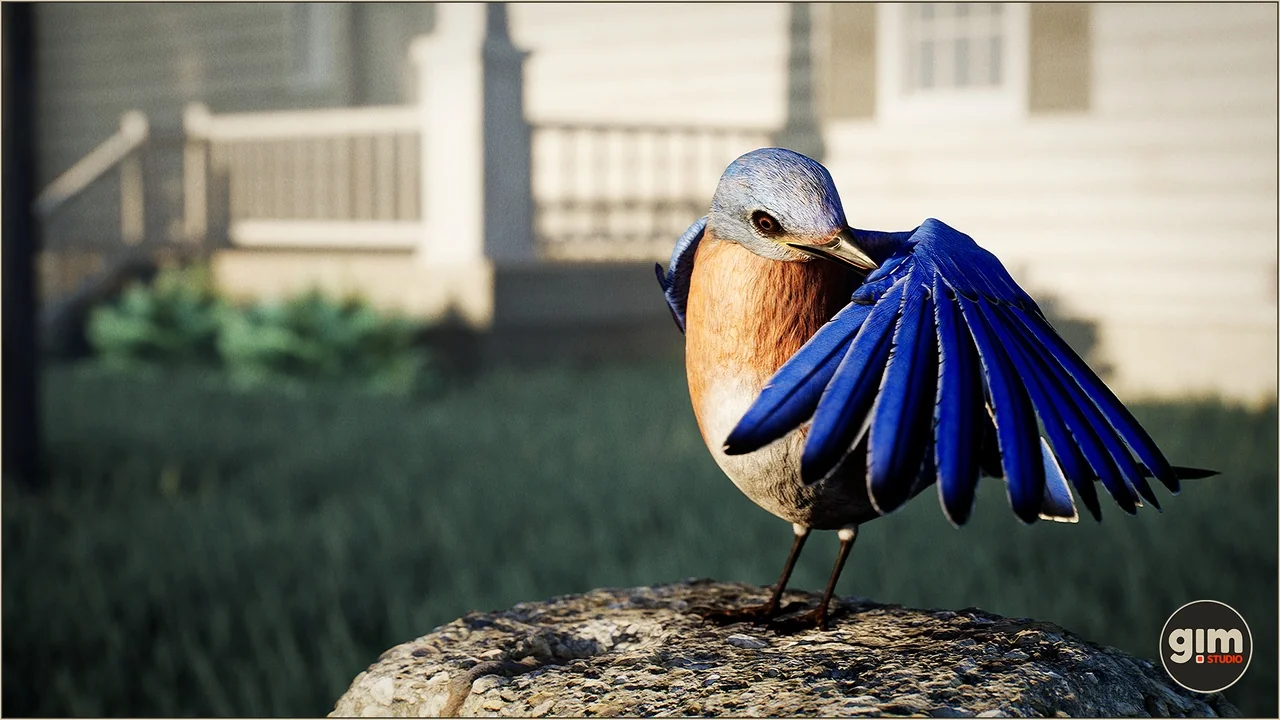
 Characters
 Characters
 Characters