"031373f479d9561a"{"id":"1000270","slug":"alien-fish-for-school-system-scifi-fantasy-creatures","title":"Alien Fish for School System - Scifi Fantasy Creatures","category":"Characters \u0026 Creatures","engine":"4.26+,5.0+","assetVersion":"","engineVersion":"Engine Version: 4.26+,5.0+","tag":"Characters","accent":"blue","visual":"character","summary":"A detailed look at a collection of 11 alien fish models built for sci-fi and fantasy underwater scenes, featuring vertex animations and ragdoll physics.","platform":"Unreal Engine","publishedAt":"2026-07-02T16:20:03.507Z","updatedAt":"2026-07-02T16:20:03.507Z","sourceNotes":[],"fileContents":[],"compatibility":["Unreal Engine","Engine Version: 4.26+,5.0+"],"featuredImage":{"alt":"Alien Fish for School System - Scifi Fantasy Creatures","src":"/wp-content/uploads/published/2026/07/4a2deb272a93-72358cf9-0b31-4504-816a-4c9315511ad8-efad13f3d0.webp"},"hasDownloadLink":true,"downloads":0,"terms":[{"taxonomy":"category","slug":"characters-and-creatures","name":"Characters \u0026 Creatures"}],"galleryImages":[{"src":"/wp-content/uploads/published/2026/07/76368dee9f1f-1e41f3dd-3bf8-497a-bb04-8ff11b9b5612-7b5badc894.webp","alt":"Alien Fish for School System - Scifi Fantasy Creatures"},{"src":"/wp-content/uploads/published/2026/07/a8298daffaac-bcccd767-6171-4899-9174-e0cecea51a25-63918c059c.webp","alt":"Alien Fish for School System - Scifi Fantasy Creatures"},{"src":"/wp-content/uploads/published/2026/07/4c8bef4bfba0-20328808-56d9-4bda-b3df-ea602a439ffd-4f07a37edc.webp","alt":"Alien Fish for School System - Scifi Fantasy Creatures"},{"src":"/wp-content/uploads/published/2026/07/433b0dff3eda-dd9f6322-b6f9-4a39-b2aa-ecfe8770c136-fa6f23b8e8.webp","alt":"Alien Fish for School System - Scifi Fantasy Creatures"},{"src":"/wp-content/uploads/published/2026/07/5c16ce0ebcee-4e1f185c-8f9c-42b3-aff4-ff28a6aaabdd-5507ca6dc5.webp","alt":"Alien Fish for School System - Scifi Fantasy Creatures"},{"src":"/wp-content/uploads/published/2026/07/38eeafdd7b87-e5e1a917-279d-4fb4-a0c9-639cadc16720-a2d3e3662f.webp","alt":"Alien Fish for School System - Scifi Fantasy Creatures"},{"src":"/wp-content/uploads/published/2026/07/055c4cff608e-98e7b44f-4e69-4503-891e-00121feef0f9-abc03965e0.webp","alt":"Alien Fish for School System - Scifi Fantasy Creatures"},{"src":"/wp-content/uploads/published/2026/07/10175b694114-756163be-09d5-4da2-95c7-3002a4fdc9ba-49af2829c2.webp","alt":"Alien Fish for School System - Scifi Fantasy Creatures"},{"src":"/wp-content/uploads/published/2026/07/dd808ff19b9e-de66609e-b6d6-4860-aa49-e708110167c1-1812b7b45f.webp","alt":"Alien Fish for School System - Scifi Fantasy Creatures"},{"src":"/wp-content/uploads/published/2026/07/14e9891ae510-aae83fb6-6c2f-481b-b69d-7393eef85f2f-7416d134b6.webp","alt":"Alien Fish for School System - Scifi Fantasy Creatures"}],"accessPanel":{"kind":"resource","title":"Download this resource","eyebrow":"Free Download","message":"Log in or create a free account to start your download.","fileName":"Content.7z","safetyNote":"Resources are manually reviewed before listing to improve quality and reduce obvious risks.","actionLabel":"Download Free","resourceType":"Resource archive"},"contentHtml":"\u003ch2\u003ePopulating Sci-Fi and Fantasy Underwater Environments\u003c/h2\u003e\n\u003cp\u003eBuilding an immersive underwater environment for a sci-fi or fantasy project requires aquatic life that matches the setting. Dropping standard, earth-like marine biology into an alien ocean or a magical sea immediately breaks the visual consistency of the world. This collection of exotic creatures provides the necessary biodiversity to populate otherworldly submarine environments, ensuring the aquatic life looks just as alien as the landscape itself. Designed to fill out the background and midground of oceanic levels, these models provide the foundation for a vibrant, moving ecosystem.\u003c/p\u003e\n\u003cp\u003eThe asset pack relies heavily on a specialized aesthetic, blending realistic anatomical principles with fantasy and alien concepts. Whether the project is a deep-sea submarine exploration game or a fantasy RPG featuring submerged ruins, having a diverse array of non-traditional fish helps establish the unique identity of the water biome.\u003c/p\u003e\n\u003ch2\u003eThe 11 Alien Fish Species\u003c/h2\u003e\n\u003cp\u003eTo create a convincing ecosystem, developers need variety in the shapes, silhouettes, and implied behaviors of the local fauna. This collection includes an ensemble of 11 distinct alien fish models. The naming conventions of the species hint at a wide variety of morphological designs, allowing level designers to mix and match creature types across different aquatic zones.\u003c/p\u003e\n\u003cp\u003eThe included species are the Hydrospark, Jelly Ray, Magmabarus, Moonmane, Pyropod, Quasareye, Sail Dart, Star Darter, Solarfin, Whitestream, and Yellow Eeloid. By breaking down the species list, developers can plan how to layer their underwater scenes. The Jelly Ray and Yellow Eeloid provide distinct non-standard fish silhouettes, mimicking the shapes of cartilaginous gliders and serpentine swimmers. Species like the Magmabarus and Pyropod suggest a thematic link to underwater volcanic vents or heated thermal zones, while the Moonmane, Solarfin, Quasareye, and Star Darter carry a distinctly cosmic, sci-fi naming convention that fits perfectly into games set on distant oceanic planets. The Hydrospark, Sail Dart, and Whitestream round out the collection, suggesting fast-moving, energetic creatures that dart through the water.\u003c/p\u003e\n\u003ch2\u003eIntegration with the Fish School System\u003c/h2\u003e\n\u003cp\u003ePlacing single, static fish into an ocean environment rarely achieves the desired effect; marine life is defined by movement and group behavior. These 11 exotic models are specifically designed to work seamlessly with both the Fish School System V1 and the Fish School System V2. This compatibility is a critical workflow advantage for developers building large-scale underwater scenes.\u003c/p\u003e\n\u003cp\u003eBy plugging these models directly into the Fish School System, developers can instantly generate complex swarming and schooling behaviors without needing to script custom flocking AI from scratch. The integration ensures that the alien fish can move as a cohesive unit, reacting to their environment and navigating the underwater terrain with movements that feel natural, despite their otherworldly appearance. This allows environment artists to quickly populate massive stretches of ocean with moving, living schools of exotic marine life.\u003c/p\u003e\n\u003ch2\u003eSkeletal Setup and Ragdoll Physics\u003c/h2\u003e\n\u003cp\u003eBeyond simple background movement, the models are fully prepared for dynamic interactions within the game world. Each of the 11 fish comes with its own individual skeleton and a dedicated swimming animation. This skeletal structure allows the creatures to be used as standalone characters or individual AI entities when a specific, up-close interaction is required.\u003c/p\u003e\n\u003cp\u003eMore importantly for gameplay, every fish includes a configured physics asset specifically intended for ragdoll purposes. In a dynamic game environment, creatures may need to react to external forces. If an alien fish is struck by a player's submarine, caught in an underwater explosion, or otherwise killed, the physics asset allows the model to instantly transition from its swimming animation into a physics-driven ragdoll state. This ensures that the creature will tumble and drift realistically according to the underwater physics and collision volumes of the engine, rather than simply playing a canned death animation.\u003c/p\u003e\n\u003ch2\u003eVertex Animation for High-Density Rendering\u003c/h2\u003e\n\u003cp\u003eOne of the most significant technical hurdles when rendering underwater environments is the performance cost of displaying hundreds or thousands of fish simultaneously. Traditional skeletal animations require constant CPU calculations to update bone positions every frame. To solve this bottleneck, each fish in the pack comes with a Vertex Animated static mesh alongside its standard skeletal version.\u003c/p\u003e\n\u003cp\u003eVertex animation bakes the swimming motion directly into the mesh's vertex data, offloading the animation processing from the CPU to the GPU. This is an essential technique for rendering massive, dense schools of fish. By utilizing the Vertex Animated static meshes in conjunction with the Fish School System, developers can maintain high frame rates even when the screen is filled with hundreds of Quasareyes or Star Darters.\u003c/p\u003e\n\u003ch2\u003eOptimized Polygon Counts and Texture Layouts\u003c/h2\u003e\n\u003cp\u003eThe geometric complexity of the models is carefully balanced to support large-scale schooling. Across all 11 species, the models range from roughly 1,000 to 2,000 vertices per fish. This specific vertex range is highly optimized for mid-to-background rendering. It provides enough polygonal detail to clearly define the unique fins, alien eyes, and exotic shapes of the creatures, while remaining lightweight enough to prevent rendering bottlenecks when large numbers of fish are spawned.\u003c/p\u003e\n\u003cp\u003eSupporting this geometry, the models utilize a minimum texture resolution of 2048x1024. This 2:1 rectangular aspect ratio is highly efficient for UV mapping elongated, aquatic creatures like the Yellow Eeloid or the Sail Dart, minimizing wasted texture space. The 2K resolution ensures that the material details remain sharp and distinct, allowing the visual quality of the alien ecosystem to hold up whether the camera is tracking a single fish up close or observing a massive school in the distance.\u003c/p\u003e\n\n\u003ch2\u003eExplore Similar Assets\u003c/h2\u003e\n\u003cul\u003e\n\u003cli\u003e\u003ca href=\"https://3dcghub.com/alien-dog/\" title=\"Alien dog\"\u003eAlien dog\u003c/a\u003e\u003c/li\u003e\n\u003cli\u003e\u003ca href=\"https://3dcghub.com/fantasy-girl/\" title=\"Fantasy girl\"\u003eFantasy girl\u003c/a\u003e\u003c/li\u003e\n\u003cli\u003e\u003ca href=\"https://3dcghub.com/sci-fi-quick-sand-worm/\" title=\"SCI FI: QUICK SAND WORM\"\u003eSCI FI: QUICK SAND WORM\u003c/a\u003e\u003c/li\u003e\n\u003cli\u003e\u003ca href=\"https://3dcghub.com/fantasy-girl-2/\" title=\"FANTASY GIRL\"\u003eFANTASY GIRL\u003c/a\u003e\u003c/li\u003e\n\u003cli\u003e\u003ca href=\"https://3dcghub.com/fantasy-beast-09/\" title=\"Fantasy Beast 09\"\u003eFantasy Beast 09\u003c/a\u003e\u003c/li\u003e\n\u003c/ul\u003e","contentTextLength":6228,"navigation":{"current":1080,"total":3223,"previous":{"id":"1000271","slug":"animals-warrior-pack","title":"Animals Warrior Pack","category":"Characters \u0026 Creatures","platform":"Unreal Engine","updatedAt":"2026-07-02T16:33:01.177Z"},"next":{"id":"1000269","slug":"animalia-bluebird","title":"Animalia - Bluebird","category":"Characters \u0026 Creatures","platform":"Unreal Engine","updatedAt":"2026-07-02T16:14:43.171Z"}},"relatedResources":[{"id":"1000621","slug":"heroic-fantasy-villains-vol-1","title":"Heroic Fantasy Villains Vol 1","category":"Characters \u0026 Creatures","engine":"4.26+,5.0+","assetVersion":"","engineVersion":"Engine Version: 4.26+,5.0+","tag":"Characters","accent":"blue","visual":"character","summary":"Heroic Fantasy Villains Vol 1 provides rigged, lowpoly 3D characters including a Darkness Warlord, Dark Elf, and Cyclops, with animation blueprints for PC and c","platform":"Unreal Engine","publishedAt":"2026-07-21T08:21:40.237Z","updatedAt":"2026-07-21T08:21:40.237Z","sourceNotes":[],"fileContents":[],"compatibility":["Unreal Engine","Engine Version: 4.26+,5.0+"],"featuredImage":{"alt":"Heroic Fantasy Villains Vol 1","src":"/wp-content/uploads/published/2026/07/5615f21dbe99-8ef8be67-b751-4c3e-8034-cf0651eaab64-6d4d89e5cb.webp"},"hasDownloadLink":true,"downloads":1},{"id":"1000601","slug":"fantasy-armour-caster-mage-sorcerer-wizard-metahuman","title":"Fantasy Armour - Caster / Mage / Sorcerer / Wizard - Metahuman","category":"Characters \u0026 Creatures","engine":"4.26+,5.0+","assetVersion":"","engineVersion":"Engine Version: 4.26+,5.0+","tag":"Characters","accent":"blue","visual":"character","summary":"Customizable fantasy caster armor pack for Unreal Engine with ~60 skeletal meshes, Master Material control, UE5 Mannequin rigging, and MetaHuman parametric clot","platform":"Unreal Engine","publishedAt":"2026-07-20T07:27:01.397Z","updatedAt":"2026-07-20T07:27:01.397Z","sourceNotes":[],"fileContents":[],"compatibility":["Unreal Engine","Engine Version: 4.26+,5.0+"],"featuredImage":{"alt":"Fantasy Armour - Caster / Mage / Sorcerer / Wizard - Metahuman","src":"/wp-content/uploads/published/2026/07/d94e74d93cde-a805533d-c1f4-44d5-a295-e5fc68bc62cf-494b58e3ee.webp"},"hasDownloadLink":true,"downloads":1},{"id":"1000875","slug":"rk-fantasy-archer","title":"RK Fantasy Archer","category":"Characters \u0026 Creatures","engine":"4.26+,5.0+","assetVersion":"","engineVersion":"Engine Version: 4.26+,5.0+","tag":"Characters","accent":"blue","visual":"character","summary":"RK Fantasy Archer is a ready-to-use archer character with CharacterBP, AnimBP, and Attack commands for realistic medieval fantasy games. Includes planned free u","platform":"Unreal Engine","publishedAt":"2026-08-05T15:08:23.949Z","updatedAt":"2026-08-05T15:08:23.949Z","sourceNotes":[],"fileContents":[],"compatibility":["Unreal Engine","Engine Version: 4.26+,5.0+"],"featuredImage":{"alt":"RK Fantasy Archer","src":"/wp-content/uploads/published/2026/08/0c2e85565464-dc47c95e-ff6c-4692-aa9a-17f1db95ce4e-4cfe18670b.webp"},"hasDownloadLink":true,"downloads":0}]}
Characters
Alien Fish for School System - Scifi Fantasy Creatures
A detailed look at a collection of 11 alien fish models built for sci-fi and fantasy underwater scenes, featuring vertex animations and ragdoll physics.
Populating Sci-Fi and Fantasy Underwater Environments
Building an immersive underwater environment for a sci-fi or fantasy project requires aquatic life that matches the setting. Dropping standard, earth-like marine biology into an alien ocean or a magical sea immediately breaks the visual consistency of the world. This collection of exotic creatures provides the necessary biodiversity to populate otherworldly submarine environments, ensuring the aquatic life looks just as alien as the landscape itself. Designed to fill out the background and midground of oceanic levels, these models provide the foundation for a vibrant, moving ecosystem.
The asset pack relies heavily on a specialized aesthetic, blending realistic anatomical principles with fantasy and alien concepts. Whether the project is a deep-sea submarine exploration game or a fantasy RPG featuring submerged ruins, having a diverse array of non-traditional fish helps establish the unique identity of the water biome.
The 11 Alien Fish Species
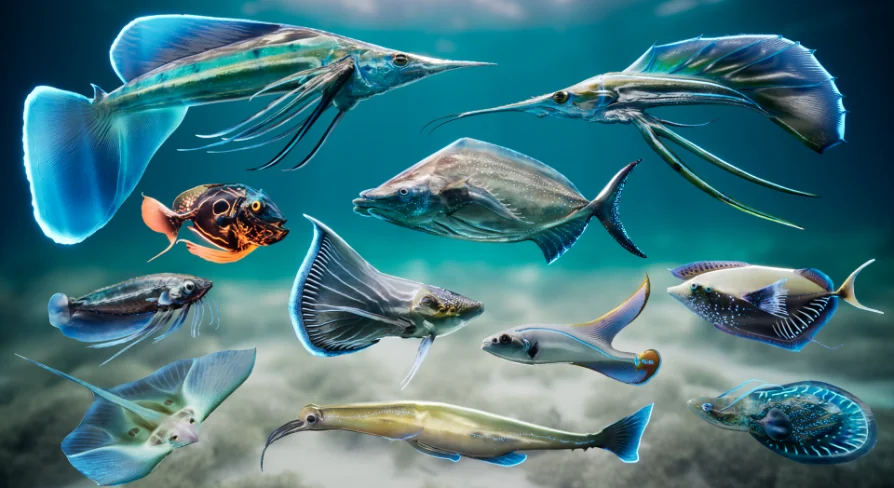
To create a convincing ecosystem, developers need variety in the shapes, silhouettes, and implied behaviors of the local fauna. This collection includes an ensemble of 11 distinct alien fish models. The naming conventions of the species hint at a wide variety of morphological designs, allowing level designers to mix and match creature types across different aquatic zones.
The included species are the Hydrospark, Jelly Ray, Magmabarus, Moonmane, Pyropod, Quasareye, Sail Dart, Star Darter, Solarfin, Whitestream, and Yellow Eeloid. By breaking down the species list, developers can plan how to layer their underwater scenes. The Jelly Ray and Yellow Eeloid provide distinct non-standard fish silhouettes, mimicking the shapes of cartilaginous gliders and serpentine swimmers. Species like the Magmabarus and Pyropod suggest a thematic link to underwater volcanic vents or heated thermal zones, while the Moonmane, Solarfin, Quasareye, and Star Darter carry a distinctly cosmic, sci-fi naming convention that fits perfectly into games set on distant oceanic planets. The Hydrospark, Sail Dart, and Whitestream round out the collection, suggesting fast-moving, energetic creatures that dart through the water.
Integration with the Fish School System
Placing single, static fish into an ocean environment rarely achieves the desired effect; marine life is defined by movement and group behavior. These 11 exotic models are specifically designed to work seamlessly with both the Fish School System V1 and the Fish School System V2. This compatibility is a critical workflow advantage for developers building large-scale underwater scenes.
By plugging these models directly into the Fish School System, developers can instantly generate complex swarming and schooling behaviors without needing to script custom flocking AI from scratch. The integration ensures that the alien fish can move as a cohesive unit, reacting to their environment and navigating the underwater terrain with movements that feel natural, despite their otherworldly appearance. This allows environment artists to quickly populate massive stretches of ocean with moving, living schools of exotic marine life.
Skeletal Setup and Ragdoll Physics
Beyond simple background movement, the models are fully prepared for dynamic interactions within the game world. Each of the 11 fish comes with its own individual skeleton and a dedicated swimming animation. This skeletal structure allows the creatures to be used as standalone characters or individual AI entities when a specific, up-close interaction is required.
More importantly for gameplay, every fish includes a configured physics asset specifically intended for ragdoll purposes. In a dynamic game environment, creatures may need to react to external forces. If an alien fish is struck by a player's submarine, caught in an underwater explosion, or otherwise killed, the physics asset allows the model to instantly transition from its swimming animation into a physics-driven ragdoll state. This ensures that the creature will tumble and drift realistically according to the underwater physics and collision volumes of the engine, rather than simply playing a canned death animation.
Vertex Animation for High-Density Rendering
One of the most significant technical hurdles when rendering underwater environments is the performance cost of displaying hundreds or thousands of fish simultaneously. Traditional skeletal animations require constant CPU calculations to update bone positions every frame. To solve this bottleneck, each fish in the pack comes with a Vertex Animated static mesh alongside its standard skeletal version.
Vertex animation bakes the swimming motion directly into the mesh's vertex data, offloading the animation processing from the CPU to the GPU. This is an essential technique for rendering massive, dense schools of fish. By utilizing the Vertex Animated static meshes in conjunction with the Fish School System, developers can maintain high frame rates even when the screen is filled with hundreds of Quasareyes or Star Darters.
Optimized Polygon Counts and Texture Layouts
The geometric complexity of the models is carefully balanced to support large-scale schooling. Across all 11 species, the models range from roughly 1,000 to 2,000 vertices per fish. This specific vertex range is highly optimized for mid-to-background rendering. It provides enough polygonal detail to clearly define the unique fins, alien eyes, and exotic shapes of the creatures, while remaining lightweight enough to prevent rendering bottlenecks when large numbers of fish are spawned.
Supporting this geometry, the models utilize a minimum texture resolution of 2048x1024. This 2:1 rectangular aspect ratio is highly efficient for UV mapping elongated, aquatic creatures like the Yellow Eeloid or the Sail Dart, minimizing wasted texture space. The 2K resolution ensures that the material details remain sharp and distinct, allowing the visual quality of the alien ecosystem to hold up whether the camera is tracking a single fish up close or observing a massive school in the distance.
 Characters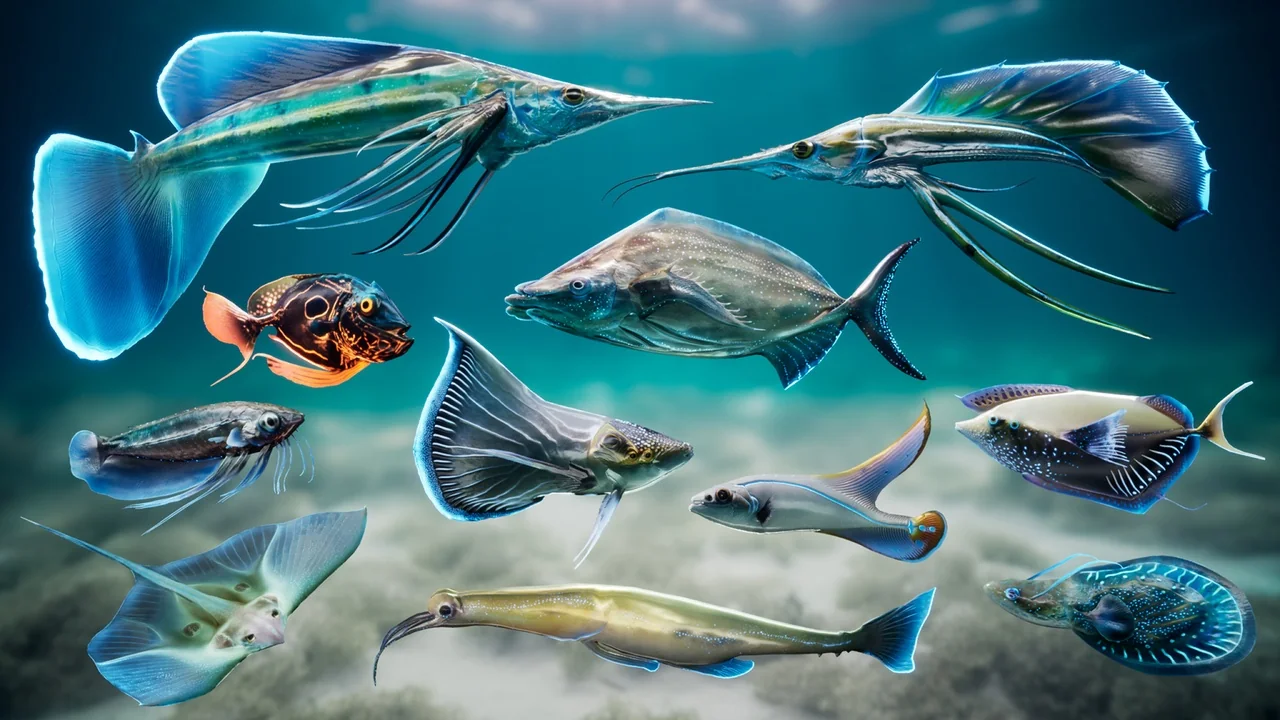
 Characters
 Characters
 Characters