"c14ff6bd758dadb1"{"id":"1000601","slug":"fantasy-armour-caster-mage-sorcerer-wizard-metahuman","title":"Fantasy Armour - Caster / Mage / Sorcerer / Wizard - Metahuman","category":"Characters \u0026 Creatures","engine":"4.26+,5.0+","assetVersion":"","engineVersion":"Engine Version: 4.26+,5.0+","tag":"Characters","accent":"blue","visual":"character","summary":"Customizable fantasy caster armor pack for Unreal Engine with ~60 skeletal meshes, Master Material control, UE5 Mannequin rigging, and MetaHuman parametric clot","platform":"Unreal Engine","publishedAt":"2026-07-20T07:27:01.397Z","updatedAt":"2026-07-20T07:27:01.397Z","sourceNotes":[],"fileContents":[],"compatibility":["Unreal Engine","Engine Version: 4.26+,5.0+"],"featuredImage":{"alt":"Fantasy Armour - Caster / Mage / Sorcerer / Wizard - Metahuman","src":"/wp-content/uploads/published/2026/07/d94e74d93cde-a805533d-c1f4-44d5-a295-e5fc68bc62cf-494b58e3ee.webp"},"hasDownloadLink":true,"downloads":1,"terms":[{"taxonomy":"category","slug":"characters-and-creatures","name":"Characters \u0026 Creatures"}],"galleryImages":[{"src":"/wp-content/uploads/published/2026/07/9e73d7d5d576-1207d97d-d716-4942-b80b-bcafd44cbd63-56f28369fd.webp","alt":"Fantasy Armour - Caster / Mage / Sorcerer / Wizard - Metahuman"},{"src":"/wp-content/uploads/published/2026/07/cd71b3e3ac28-acc95597-37db-4532-a3b9-c87594681bc9-28bedec007.webp","alt":"Fantasy Armour - Caster / Mage / Sorcerer / Wizard - Metahuman"},{"src":"/wp-content/uploads/published/2026/07/1dcb470632c3-3c2d1b0a-bdb2-4145-8cc8-1a9cf1496489-b75dab60da.webp","alt":"Fantasy Armour - Caster / Mage / Sorcerer / Wizard - Metahuman"},{"src":"/wp-content/uploads/published/2026/07/c166da524563-c256363d-52f7-439b-974d-8b215a57b644-52cb2b97b4.webp","alt":"Fantasy Armour - Caster / Mage / Sorcerer / Wizard - Metahuman"},{"src":"/wp-content/uploads/published/2026/07/6403e0045e29-5d451c77-307f-4abd-b8ca-b0f5845c7151-0d4d1b4c0d.webp","alt":"Fantasy Armour - Caster / Mage / Sorcerer / Wizard - Metahuman"},{"src":"/wp-content/uploads/published/2026/07/14af653bee92-f350a931-bc1b-4610-93ec-3d106f11430c-da191e3cec.webp","alt":"Fantasy Armour - Caster / Mage / Sorcerer / Wizard - Metahuman"},{"src":"/wp-content/uploads/published/2026/07/c6d190203d5b-e4183f67-f7af-41f0-9ae2-77abae5d4eef-c1e957cfb3.webp","alt":"Fantasy Armour - Caster / Mage / Sorcerer / Wizard - Metahuman"},{"src":"/wp-content/uploads/published/2026/07/3d47be5367c3-32a3329f-b586-4a14-9d52-d14b8d607ddc-1b00c19578.webp","alt":"Fantasy Armour - Caster / Mage / Sorcerer / Wizard - Metahuman"},{"src":"/wp-content/uploads/published/2026/07/09fe2f54a567-b6501c69-0f86-4cd9-bddb-a726e9790543-7f6c79996a.webp","alt":"Fantasy Armour - Caster / Mage / Sorcerer / Wizard - Metahuman"}],"accessPanel":{"kind":"resource","title":"Download this resource","eyebrow":"Free Download","message":"Log in or create a free account to start your download.","fileName":"Content.7z","safetyNote":"Resources are manually reviewed before listing to improve quality and reduce obvious risks.","actionLabel":"Download Free","resourceType":"Resource archive"},"contentHtml":"\u003cp\u003eWhen a caster character steps into a light fantasy realistic scene, the gear needs to carry both silhouette variety and material depth without forcing a rebuild for every class swap. The Fantasy Armour pack approaches this by handing developers roughly 60 skeletal meshes organized across three base archetypes — mage, wizard, and priest — then layering a Master Material and mask texture system on top so the visual read can be pushed in any direction the scene demands.\u003c/p\u003e \u003ch2\u003eCostume Construction and SK Mesh Groups\u003c/h2\u003e \u003cp\u003eThe pack is based on modular separation rather than monolithic outfits. Skeletal mesh items are stripped down into distinct groups: hats, hairs, heads, upper-body, pants, and shoes. This means a full character assembly pulls from individual part bins not just one locked prefab, which matters when you need to swap a hat or bracers without disturbing the chest piece or pants.\u003c/p\u003e \u003cp\u003eThe base costume set design includes 2x pants per gender, 2x hats, a chest base with variations carrying bags and a tome, and 4x cloth bracers. Multiple skin textures and a skin tint system round out the character foundation, giving the body itself some range before any clothing is applied.\u003c/p\u003e \u003cp\u003ePolycount for a full costume lands between 20,000 and 35,000 triangles, including all gear options. That range accounts for the modular density — a stripped-down mage with a hat and chest base sits at the lower end, while a loaded priest with bags, tome, bracers, and full layers pushes toward the ceiling.\u003c/p\u003e \u003ch3\u003ePredefined Versions Versus Custom Builds\u003c/h3\u003e \u003cp\u003eTwo workflows are available. Developers can pick from a variety of predefined versions for quick deployment, or they can use the individual provided parts to construct their own caster characters. The predefined sets service the mage, wizard, summoner, and priest archetypes directly, while the parts bin approach opens the door to hybrid builds that might mix a wizard hat with priest upper-body gear or whatever combination the scene calls for.\u003c/p\u003e \u003ch2\u003eMaterial Control and Visual Tweaking\u003c/h2\u003e \u003cp\u003eEvery equipment piece routes through a single Master Material paired with a mask texture. This architecture lets developers tweak the visual appearance in detail — adjusting masks, color parameters, and material response — without needing to author new textures for each variant. The mask texture acts as the control layer, directing where material changes apply across a given mesh.\u003c/p\u003e \u003cp\u003eDifferent skin textures and the skin tint system operate on the body mesh itself, separate from the equipment material pipeline. This separation keeps character skin and clothing on independent adjustment tracks.\u003c/p\u003e \u003ch2\u003eRig Structure and Cross-Pack Compatibility\u003c/h2\u003e \u003cp\u003eThe skeletal meshes are skinned to the UE4 skeleton, and the main-hand and off-hand pivots are aligned to the standard hand grip. This alignment is deliberate — it allows the casters to carry items from other asset packs, including firearms or dual pistols, without requiring a re-skin or pivot correction. The same skeleton foundation keeps the door open for mixing this fantasy gear into projects that already use standard UE grip conventions.\u003c/p\u003e \u003cp\u003eAn update in May 2022 converted the base components to the new UE5 Mannequin rig structure. The female MetaHuman target rig is slightly smaller than Quinn but shares the same bone structure, so retargeting across the female and male frameworks stays within the same skeletal lineage. UE4 Mannequin meshes are still included for existing customers, so projects that have not migrated to the UE5 rig structure are not forced into an immediate update.\u003c/p\u003e \u003ch2\u003eMetaHuman Integration and Forward Plans\u003c/h2\u003e \u003cp\u003eAs of August 2024, an example parametric clothing component for experimental MetaHuman Creator outfits has been added. The developer notes that the MetaHuman clothing system will change over time, and they plan to adapt their components to new standards as MetaHuman Creator evolves. This is positioned as an experimental addition rather than a locked production pipeline.\u003c/p\u003e \u003cp\u003eThe broader Fantasy Caster port to MetaHuman is scheduled for a Beta phase after the skeleton and workflows have been established. A current limitation is that only tall-normalweight body types will be supported, unless Epic makes the system flexible enough to retarget skeletal meshes between different bone structures. This keeps the MetaHuman path open but bounded — it is coming, but the scope depends on both the developer's pipeline work and Epic's system flexibility.\u003c/p\u003e \u003ch2\u003eCharacter Editor and Weapon Inclusions\u003c/h2\u003e \u003cp\u003eFor teams needing deeper customization than the modular parts provide, the caster classes can be integrated into the developer's Character Editor base system. This is positioned as an easy integration path, not a rebuild, so existing Character Editor users can fold the mage, wizard, and priest gear into their existing assembly workflow.\u003c/p\u003e \u003cp\u003eThe pack includes 4x weapons alongside the clothing and equipment meshes. The weapons sit on the same UE4 skeleton skinning as the rest of the gear, maintaining consistent hand-grip alignment across the full asset set.\u003c/p\u003e \u003ch3\u003eWho This Serves Best\u003c/h3\u003e \u003cp\u003eTeams building light fantasy realistic games with mage, wizard, summoner, or priest characters get a modular costume system with material-level control, cross-pack item compatibility through standard grip pivots, and a path toward MetaHuman parametric clothing as that system matures. The UE5 Mannequin rig conversion is already handled, UE4 meshes remain available, and the skeletal mesh grouping makes part-swapping direct. Projects that lean on the developer's Character Editor base system can integrate the caster classes without leaving that framework.\u003c/p\u003e\n\n\u003ch2\u003eMore From The Same Workflow\u003c/h2\u003e\n\u003cul\u003e\n\u003cli\u003e\u003ca href=\"https://3dcghub.com/modular-skeleton-mage/\" title=\"Modular Skeleton Mage\"\u003eModular Skeleton Mage\u003c/a\u003e\u003c/li\u003e\n\u003cli\u003e\u003ca href=\"https://3dcghub.com/cultist-warlock-metahuman/\" title=\"Cultist - Warlock - Metahuman\"\u003eCultist - Warlock - Metahuman\u003c/a\u003e\u003c/li\u003e\n\u003cli\u003e\u003ca href=\"https://3dcghub.com/modular-wizard/\" title=\"Modular Wizard\"\u003eModular Wizard\u003c/a\u003e\u003c/li\u003e\n\u003cli\u003e\u003ca href=\"https://3dcghub.com/asian-armour-metahuman/\" title=\"Asian Armour - Metahuman\"\u003eAsian Armour - Metahuman\u003c/a\u003e\u003c/li\u003e\n\u003cli\u003e\u003ca href=\"https://3dcghub.com/medieval-armour-metahuman-male-female/\" title=\"Medieval Armour - Metahuman - Male/Female\"\u003eMedieval Armour - Metahuman - Male/Female\u003c/a\u003e\u003c/li\u003e\n\u003c/ul\u003e","contentTextLength":5773,"navigation":{"current":1260,"total":3719,"previous":{"id":"1000602","slug":"fast-ai-plugin-multiplayer","title":"Fast AI Plugin (Multiplayer)","category":"Artificial Intelligence","platform":"Unreal Engine","updatedAt":"2026-07-20T15:37:11.434Z"},"next":{"id":"1000600","slug":"fantasy-alien-castle","title":"Fantasy Alien Castle","category":"Fantasy","platform":"Unreal Engine","updatedAt":"2026-07-18T15:43:42.616Z"}},"relatedResources":[{"id":"3068","slug":"modular-skeleton-mage","title":"Modular Skeleton Mage","category":"Characters \u0026 Creatures","engine":"4.26+,5.0+","assetVersion":"Engine version: 4.26+,5.0+","engineVersion":"4.18","tag":"Characters","accent":"blue","visual":"character","summary":"Discover the Modular Skeleton Mage for game development. Features 4K PBR textures, Epic Skeleton rigging, and modular parts for ultimate fantasy character custo","platform":"Unreal Engine","publishedAt":"2026-02-07T16:47:43.000Z","updatedAt":"2026-04-19T15:57:43.000Z","sourceNotes":[],"fileContents":[],"compatibility":["Unreal Engine","Engine version: 4.26+,5.0+"],"featuredImage":{"alt":"Modular Skeleton Mage","src":"https://3dcghub.com/wp-content/uploads/2026/02/00116c23-212e-401b-bc9a-7e90437a3d01.webp"},"hasDownloadLink":true,"downloads":1},{"id":"1000583","slug":"cultist-warlock-metahuman","title":"Cultist - Warlock - Metahuman","category":"Characters \u0026 Creatures","engine":"5.0+","assetVersion":"","engineVersion":"Engine Version: 5.0+","tag":"Characters","accent":"blue","visual":"character","summary":"Build dark fantasy cultist crews with customizable MetaHuman-ready armor, ~60 clothing meshes, UE4 skeleton skinning, and Master Material tuning for Unreal Engi","platform":"Unreal Engine","publishedAt":"2026-07-16T23:50:57.809Z","updatedAt":"2026-07-16T23:50:57.809Z","sourceNotes":[],"fileContents":[],"compatibility":["Unreal Engine","Engine Version: 5.0+"],"featuredImage":{"alt":"Cultist - Warlock - Metahuman","src":"/wp-content/uploads/published/2026/07/82e4f26a38ba-9f7623dc-e916-4d3b-a628-b86b73c42e0b-1913e5bf09.webp"},"hasDownloadLink":true,"downloads":3},{"id":"3080","slug":"modular-wizard","title":"Modular Wizard","category":"Characters \u0026 Creatures","engine":"4.26+,5.0+","assetVersion":"Engine version: 4.26+,5.0+","engineVersion":"4.21","tag":"Characters","accent":"blue","visual":"character","summary":"Enhance your RPG with this modular wizard character. Featuring customizable parts, facial expressions, and UE mannequin compatibility for easy integration.","platform":"Unreal Engine","publishedAt":"2026-02-07T16:51:59.000Z","updatedAt":"2026-04-19T15:57:43.000Z","sourceNotes":[],"fileContents":[],"compatibility":["Unreal Engine","Engine version: 4.26+,5.0+"],"featuredImage":{"alt":"Modular Wizard","src":"https://3dcghub.com/wp-content/uploads/2026/02/967d6e30-b781-4770-ba66-1c8dc6cd5e7e.webp"},"hasDownloadLink":true,"downloads":0}]}
Customizable fantasy caster armor pack for Unreal Engine with ~60 skeletal meshes, Master Material control, UE5 Mannequin rigging, and MetaHuman parametric clot
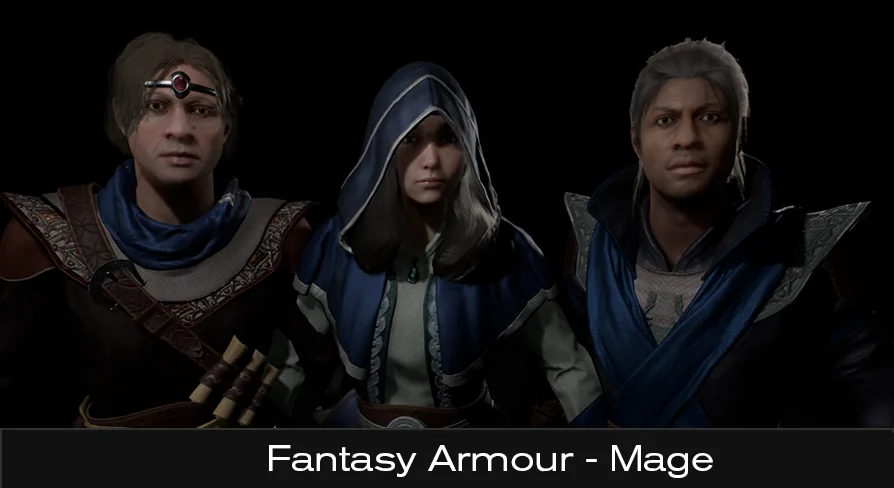
When a caster character steps into a light fantasy realistic scene, the gear needs to carry both silhouette variety and material depth without forcing a rebuild for every class swap. The Fantasy Armour pack approaches this by handing developers roughly 60 skeletal meshes organized across three base archetypes — mage, wizard, and priest — then layering a Master Material and mask texture system on top so the visual read can be pushed in any direction the scene demands.
Costume Construction and SK Mesh Groups
The pack is based on modular separation rather than monolithic outfits. Skeletal mesh items are stripped down into distinct groups: hats, hairs, heads, upper-body, pants, and shoes. This means a full character assembly pulls from individual part bins not just one locked prefab, which matters when you need to swap a hat or bracers without disturbing the chest piece or pants.
The base costume set design includes 2x pants per gender, 2x hats, a chest base with variations carrying bags and a tome, and 4x cloth bracers. Multiple skin textures and a skin tint system round out the character foundation, giving the body itself some range before any clothing is applied.
Polycount for a full costume lands between 20,000 and 35,000 triangles, including all gear options. That range accounts for the modular density — a stripped-down mage with a hat and chest base sits at the lower end, while a loaded priest with bags, tome, bracers, and full layers pushes toward the ceiling.
Predefined Versions Versus Custom Builds
Two workflows are available. Developers can pick from a variety of predefined versions for quick deployment, or they can use the individual provided parts to construct their own caster characters. The predefined sets service the mage, wizard, summoner, and priest archetypes directly, while the parts bin approach opens the door to hybrid builds that might mix a wizard hat with priest upper-body gear or whatever combination the scene calls for.
Material Control and Visual Tweaking
Every equipment piece routes through a single Master Material paired with a mask texture. This architecture lets developers tweak the visual appearance in detail — adjusting masks, color parameters, and material response — without needing to author new textures for each variant. The mask texture acts as the control layer, directing where material changes apply across a given mesh.
Different skin textures and the skin tint system operate on the body mesh itself, separate from the equipment material pipeline. This separation keeps character skin and clothing on independent adjustment tracks.
Rig Structure and Cross-Pack Compatibility
The skeletal meshes are skinned to the UE4 skeleton, and the main-hand and off-hand pivots are aligned to the standard hand grip. This alignment is deliberate — it allows the casters to carry items from other asset packs, including firearms or dual pistols, without requiring a re-skin or pivot correction. The same skeleton foundation keeps the door open for mixing this fantasy gear into projects that already use standard UE grip conventions.
An update in May 2022 converted the base components to the new UE5 Mannequin rig structure. The female MetaHuman target rig is slightly smaller than Quinn but shares the same bone structure, so retargeting across the female and male frameworks stays within the same skeletal lineage. UE4 Mannequin meshes are still included for existing customers, so projects that have not migrated to the UE5 rig structure are not forced into an immediate update.
MetaHuman Integration and Forward Plans
As of August 2024, an example parametric clothing component for experimental MetaHuman Creator outfits has been added. The developer notes that the MetaHuman clothing system will change over time, and they plan to adapt their components to new standards as MetaHuman Creator evolves. This is positioned as an experimental addition rather than a locked production pipeline.
The broader Fantasy Caster port to MetaHuman is scheduled for a Beta phase after the skeleton and workflows have been established. A current limitation is that only tall-normalweight body types will be supported, unless Epic makes the system flexible enough to retarget skeletal meshes between different bone structures. This keeps the MetaHuman path open but bounded — it is coming, but the scope depends on both the developer's pipeline work and Epic's system flexibility.
Character Editor and Weapon Inclusions
For teams needing deeper customization than the modular parts provide, the caster classes can be integrated into the developer's Character Editor base system. This is positioned as an easy integration path, not a rebuild, so existing Character Editor users can fold the mage, wizard, and priest gear into their existing assembly workflow.
The pack includes 4x weapons alongside the clothing and equipment meshes. The weapons sit on the same UE4 skeleton skinning as the rest of the gear, maintaining consistent hand-grip alignment across the full asset set.
Who This Serves Best
Teams building light fantasy realistic games with mage, wizard, summoner, or priest characters get a modular costume system with material-level control, cross-pack item compatibility through standard grip pivots, and a path toward MetaHuman parametric clothing as that system matures. The UE5 Mannequin rig conversion is already handled, UE4 meshes remain available, and the skeletal mesh grouping makes part-swapping direct. Projects that lean on the developer's Character Editor base system can integrate the caster classes without leaving that framework.
 Characters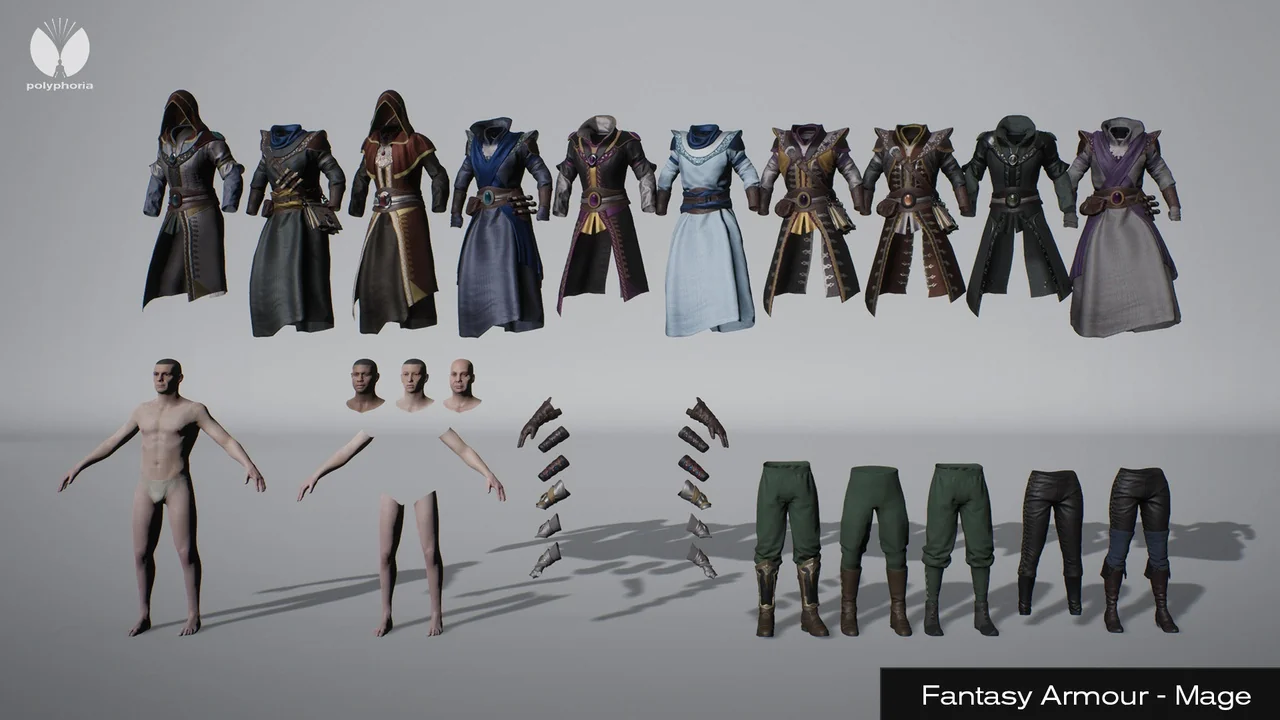
 Characters
 Characters
 Characters