"031373f479d9561a"{"id":"1000268","slug":"african-animal-camel-dromedary","title":"African Animal - Camel (Dromedary)","category":"Animals","engine":"4.27,5.0+","assetVersion":"","engineVersion":"Engine Version: 4.27,5.0+","tag":"Animals","accent":"blue","visual":"mech","summary":"A fully rigged, high-poly Dromedary Camel 3D model featuring 35 bones, 1k/2k textures, and 36 total animations split across In-Place and Root Motion FBX files.","platform":"Unreal Engine","publishedAt":"2026-07-02T15:37:29.441Z","updatedAt":"2026-07-02T15:37:29.441Z","sourceNotes":[],"fileContents":[],"compatibility":["Unreal Engine","Engine Version: 4.27,5.0+"],"featuredImage":{"alt":"African Animal - Camel (Dromedary)","src":"/wp-content/uploads/published/2026/07/230d71b719a9-9a229666-007e-423d-93b2-68c88c60db0f-abb345eefd.webp"},"hasDownloadLink":true,"downloads":0,"terms":[{"taxonomy":"category","slug":"animals","name":"Animals"}],"galleryImages":[{"src":"/wp-content/uploads/published/2026/07/89a9bd6572cb-3cce4d9d-8887-451e-a9fe-73b8d3bb6f7f-903a2b367c.webp","alt":"African Animal - Camel (Dromedary)"},{"src":"/wp-content/uploads/published/2026/07/22febff03e3e-bd890331-ea9d-4df5-aafe-c53f64aa8bdf-b1246777ab.webp","alt":"African Animal - Camel (Dromedary)"},{"src":"/wp-content/uploads/published/2026/07/7fa996e750fd-7c4483b4-9a7e-44b8-b6cc-e9bb01280e3d-b7ae703947.webp","alt":"African Animal - Camel (Dromedary)"},{"src":"/wp-content/uploads/published/2026/07/4d952d7c8e8e-a2597a99-e092-4ad3-aa48-28804bf807de-530d00d820.webp","alt":"African Animal - Camel (Dromedary)"},{"src":"/wp-content/uploads/published/2026/07/e51c8098aaed-c4a1aead-c4d7-467a-9f33-1a5202bb31c5-2fd7ef8202.webp","alt":"African Animal - Camel (Dromedary)"},{"src":"/wp-content/uploads/published/2026/07/5f643336cb24-ca94dd61-f736-499a-ba63-9dbeae25c6f3-874200cddc.webp","alt":"African Animal - Camel (Dromedary)"}],"accessPanel":{"kind":"resource","title":"Download this resource","eyebrow":"Free Download","message":"Log in or create a free account to start your download.","fileName":"Content.7z","safetyNote":"Resources are manually reviewed before listing to improve quality and reduce obvious risks.","actionLabel":"Download Free","resourceType":"Resource archive"},"contentHtml":"\u003cp\u003eDeveloping believable quadruped wildlife for virtual environments requires specific structural setups, particularly when balancing geometric detail with complex locomotion systems. Handling animal movement without immersion-breaking foot sliding is a persistent technical hurdle. The African Animal - Camel (Dromedary) resolves these common workflow issues by providing a fully rigged, highly animated model with a deliberately bifurcated animation setup. Tailored for realistic projects, the asset delivers distinct Root Motion and In-Place animation frameworks directly out of the box, allowing developers to choose the precise movement logic that fits their character controllers.\u003c/p\u003e \u003ch2\u003eGeometry and 35-Bone Rigging for the Dromedary Silhouette\u003c/h2\u003e \u003cp\u003eA Dromedary Camel (Camelus dromedarius) is instantly recognizable by the distinct shape of its single hump, long neck, and elongated legs. Rendering this anatomical structure convincingly requires a careful distribution of polygons. At 8648 triangles, the geometry provides a detailed, high-poly silhouette that captures these defining features smoothly. This specific triangle count strikes an effective balance, offering enough geometric density for close-up interactions or focal-point rendering while remaining optimized enough for real-time engine processing.\u003c/p\u003e \u003cp\u003eDriving this 8648-triangle mesh is a specialized skeletal structure consisting of 35 bones. For a quadruped, a 35-bone rig is highly efficient. It provides the necessary articulation points across the legs, spine, and neck without introducing overly complex weight-painting challenges or bogging down performance. This skeletal framework is specifically designed to support the distinct physical movements of a camel, ensuring that the long neck can bend naturally during grazing and the legs can articulate correctly during complex attacks or uneven terrain traversal.\u003c/p\u003e \u003ch2\u003eTexturing with 1k and 2k Material Maps\u003c/h2\u003e \u003cp\u003eThe visual realism of the animal is supported by a comprehensive texture suite suited to standard rendering pipelines. The package includes a total of five distinct texture maps, available in both 1k and 2k resolutions. This scalability allows developers to adjust the texture memory footprint based on their target platform, utilizing the 2k maps for high-fidelity PC or console environments and stepping down to 1k for mobile or heavily populated scenes.\u003c/p\u003e \u003cp\u003eTo provide visual variety within a project, the asset includes two distinct color textures. This allows for the creation of multiple camels in a single scene—such as a caravan or a small herd—without the animals looking like identical clones. These color maps are augmented by a normal map, a specular map, and an ambient occlusion (AO) map. The normal map handles the micro-surface details of the camel's fur and skin, adding depth without requiring additional polygons. The specular map controls how light catches the animal's coat under harsh lighting conditions, while the ambient occlusion map grounds the model by deepening the shadows in geometric crevices, such as where the legs meet the torso.\u003c/p\u003e \u003ch2\u003eIn-Place vs. Root Motion Animation Pipelines\u003c/h2\u003e \u003cp\u003eA major structural advantage of this package is its approach to animation integration. The Unity project structure explicitly divides the animation data into TWO separate FBX files. This separation prevents the common pipeline friction of manually extracting, trimming, or toggling root motion flags within a single, cluttered source file.\u003c/p\u003e \u003cp\u003eThe first FBX file contains 16 unique In-Place animations. These are essential for developers who prefer to drive the character's speed, rotation, and capsule movement entirely through custom scripts and code. In this setup, the animation plays back in a stationary position while the engine's physics or scripting handles the actual spatial translation.\u003c/p\u003e \u003cp\u003eThe second FBX file contains 20 Root Motion animations. In these files, the actual spatial translation and rotation are baked directly into the animation data itself. For realistic quadruped movement, root motion is often critical. It ensures that the camel's hooves lock perfectly to the ground during complex movements, allowing the animation blueprint to drive the character's exact world-space position. This naturally prevents the foot-sliding effect that often plagues script-driven animal controllers.\u003c/p\u003e \u003ch2\u003eLocomotion and Directional Turning Sequences\u003c/h2\u003e \u003cp\u003eThe locomotion suite covers all necessary forward movement with standard Walk and Run cycles, but it heavily expands on directional adjustments to ensure natural weight transfer. Instead of relying on rigid, programmatic rotation that simply spins the model on a central axis, the package includes dedicated animation data for shifting direction.\u003c/p\u003e \u003cp\u003eThe rig features stationary Turns (L/R) for pivoting in place, alongside specific Turns Walk/Run animations for adjusting trajectory while already in motion. This allows an animation blueprint to blend smoothly from a forward walk into a turning walk without breaking the stride. Additionally, a Walk Back animation rounds out the movement capabilities, giving the character controller complete omnidirectional coverage and preventing the animal from getting stuck in tight geometric spaces.\u003c/p\u003e \u003ch2\u003eCombat, Damage, and Ambient Behavioral States\u003c/h2\u003e \u003cp\u003eBeyond basic wandering, the Dromedary is equipped for interactive gameplay, including defensive encounters and ambient wildlife behaviors. For hostile scenarios, the model utilizes a FightIdle stance. From this stance, the 35-bone rig supports three distinct offensive maneuvers: an Attack Bite, an Attack Head, and an Attack Leg. This variety allows developers to program dynamic combat logic rather than relying on a single repetitive strike.\u003c/p\u003e \u003cp\u003eWhen the animal takes damage, the package provides a highly specific directional reaction system. Developers can trigger Hit Right, Hit Left, Hit Front, or Hit Back animations based on the origin point of the incoming damage, accurately reflecting the impact before transitioning the model into its final Death state.\u003c/p\u003e \u003cp\u003eFor peaceful or ambient scenes, the behavioral animations are equally detailed. The model includes standard Idle and StandUp states, but the grazing logic is particularly robust. The eating sequence is broken into three distinct phases: Eating Start, a looping Eating state, and Eating End. This classic state-machine design allows the animal to smoothly lower its head to the ground, loop the grazing animation for a randomized duration, and then naturally raise its head back to an idle posture.\u003c/p\u003e \u003cp\u003eWith its dual-FBX animation structure and targeted texture variations, this Dromedary model integrates cleanly into projects requiring interactive African or desert wildlife. The strict separation between root motion and in-place animations, combined with the granular behavioral and combat loops, ensures the asset functions flawlessly whether deployed as background scenery or as an active, interactable entity driven by complex animation scripts.\u003c/p\u003e\n\n\u003ch2\u003eContinue Browsing Similar Packs\u003c/h2\u003e\n\u003cul\u003e\n\u003cli\u003e\u003ca href=\"https://3dcghub.com/asian-animal-tiger/\" title=\"Asian Animal - Tiger\"\u003eAsian Animal - Tiger\u003c/a\u003e\u003c/li\u003e\n\u003cli\u003e\u003ca href=\"https://3dcghub.com/panthers-pack/\" title=\"Panthers pack\"\u003ePanthers pack\u003c/a\u003e\u003c/li\u003e\n\u003cli\u003e\u003ca href=\"https://3dcghub.com/bones-vol-1-animal-bones-1-nanite-low-poly/\" title=\"Bones VOL.1 - Animal Bones 1 (Nanite + Low Poly)\"\u003eBones VOL.1 - Animal Bones 1 (Nanite + Low Poly)\u003c/a\u003e\u003c/li\u003e\n\u003cli\u003e\u003ca href=\"https://3dcghub.com/spixs-macaw-ararinha-azul/\" title=\"Spix\u0026#039;s Macaw - Ararinha Azul\"\u003eSpix\u0026#039;s Macaw - Ararinha Azul\u003c/a\u003e\u003c/li\u003e\n\u003cli\u003e\u003ca href=\"https://3dcghub.com/sea-animals-12-meshes/\" title=\"Sea Animals / 12 Meshes\"\u003eSea Animals / 12 Meshes\u003c/a\u003e\u003c/li\u003e\n\u003c/ul\u003e","contentTextLength":7140,"navigation":{"current":1082,"total":3223,"previous":{"id":"1000269","slug":"animalia-bluebird","title":"Animalia - Bluebird","category":"Characters \u0026 Creatures","platform":"Unreal Engine","updatedAt":"2026-07-02T16:14:43.171Z"},"next":{"id":"1000267","slug":"gate-backyard","title":"Gate Backyard","category":"Industrial","platform":"Unreal Engine","updatedAt":"2026-07-01T19:46:17.666Z"}},"relatedResources":[{"id":"1000296","slug":"galapagos-tortoise","title":"Galapagos Tortoise","category":"Animals","engine":"4.27,5.0+","assetVersion":"","engineVersion":"Engine Version: 4.27,5.0+","tag":"Animals","accent":"blue","visual":"mech","summary":"A fully rigged and animated Galapagos Tortoise built for realistic savanna environments, featuring 2K textures, two skin variants, and 9 in-place animations.","platform":"Unreal Engine","publishedAt":"2026-07-03T17:49:30.825Z","updatedAt":"2026-07-03T17:49:30.825Z","sourceNotes":[],"fileContents":[],"compatibility":["Unreal Engine","Engine Version: 4.27,5.0+"],"featuredImage":{"alt":"Galapagos Tortoise","src":"/wp-content/uploads/published/2026/07/a7b1192e2894-e7a4c613-1160-4e14-8d80-a053ff63e151-32f5350a0c.webp"},"hasDownloadLink":true,"downloads":0},{"id":"1000244","slug":"asian-animal-tiger","title":"Asian Animal - Tiger","category":"Animals","engine":"4.26+,5.0+","assetVersion":"","engineVersion":"Engine Version: 4.26+,5.0+","tag":"Animals","accent":"blue","visual":"mech","summary":"A highly detailed 3D tiger model featuring three LOD variations, 4K textures, a 37-bone rig, and 53 unique animations for realistic wildlife environments.","platform":"Unreal Engine","publishedAt":"2026-06-30T19:57:16.638Z","updatedAt":"2026-06-30T19:57:16.638Z","sourceNotes":[],"fileContents":[],"compatibility":["Unreal Engine","Engine Version: 4.26+,5.0+"],"featuredImage":{"alt":"Asian Animal - Tiger","src":"/wp-content/uploads/published/2026/06/88b3fb6ce8d3-9bce027c-37b2-4452-a053-04a73a2eff55-838ca9c79f.webp"},"hasDownloadLink":true,"downloads":0},{"id":"1001065","slug":"raptor-dinosaur-animated","title":"Raptor Dinosaur Animated","category":"Animals","engine":"4.26+,5.0+","assetVersion":"","engineVersion":"Engine Version: 4.26+,5.0+","tag":"Animals","accent":"blue","visual":"mech","summary":"Dromaeosaurus animated model with 150+ animations, 5 LOD stages, 4096-pixel textures, UE4 ragdoll, and HumanIK FBX files for retargeting.","platform":"Unreal Engine","publishedAt":"2026-09-03T16:02:56.829Z","updatedAt":"2026-09-03T16:02:56.829Z","sourceNotes":[],"fileContents":[],"compatibility":["Unreal Engine","Engine Version: 4.26+,5.0+"],"featuredImage":{"alt":"Raptor Dinosaur Animated","src":"/wp-content/uploads/published/2026/09/b2c8cf21982a-6c8db538-21ee-4c01-aed5-6eb7cbbd1ba5-03c2b8519d.webp"},"hasDownloadLink":true,"downloads":1}]}
Animals
African Animal - Camel (Dromedary)
A fully rigged, high-poly Dromedary Camel 3D model featuring 35 bones, 1k/2k textures, and 36 total animations split across In-Place and Root Motion FBX files.
Developing believable quadruped wildlife for virtual environments requires specific structural setups, particularly when balancing geometric detail with complex locomotion systems. Handling animal movement without immersion-breaking foot sliding is a persistent technical hurdle. The African Animal - Camel (Dromedary) resolves these common workflow issues by providing a fully rigged, highly animated model with a deliberately bifurcated animation setup. Tailored for realistic projects, the asset delivers distinct Root Motion and In-Place animation frameworks directly out of the box, allowing developers to choose the precise movement logic that fits their character controllers.
Geometry and 35-Bone Rigging for the Dromedary Silhouette
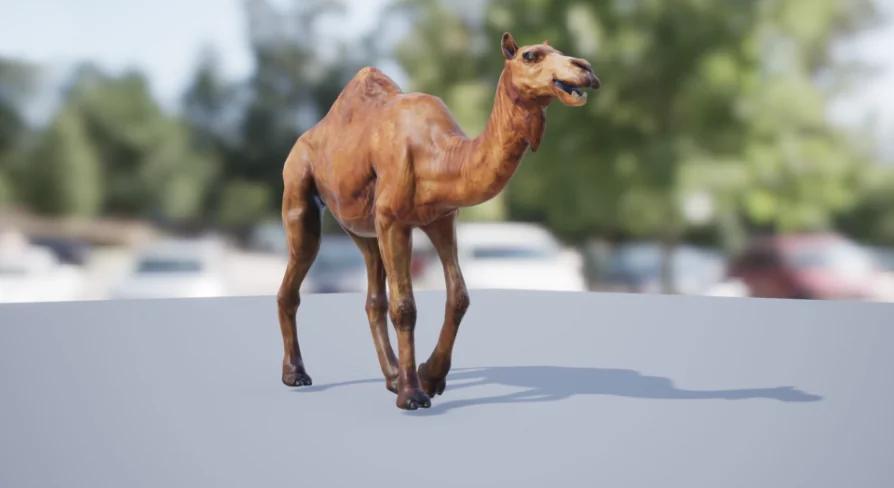
A Dromedary Camel (Camelus dromedarius) is instantly recognizable by the distinct shape of its single hump, long neck, and elongated legs. Rendering this anatomical structure convincingly requires a careful distribution of polygons. At 8648 triangles, the geometry provides a detailed, high-poly silhouette that captures these defining features smoothly. This specific triangle count strikes an effective balance, offering enough geometric density for close-up interactions or focal-point rendering while remaining optimized enough for real-time engine processing.
Driving this 8648-triangle mesh is a specialized skeletal structure consisting of 35 bones. For a quadruped, a 35-bone rig is highly efficient. It provides the necessary articulation points across the legs, spine, and neck without introducing overly complex weight-painting challenges or bogging down performance. This skeletal framework is specifically designed to support the distinct physical movements of a camel, ensuring that the long neck can bend naturally during grazing and the legs can articulate correctly during complex attacks or uneven terrain traversal.
Texturing with 1k and 2k Material Maps
The visual realism of the animal is supported by a comprehensive texture suite suited to standard rendering pipelines. The package includes a total of five distinct texture maps, available in both 1k and 2k resolutions. This scalability allows developers to adjust the texture memory footprint based on their target platform, utilizing the 2k maps for high-fidelity PC or console environments and stepping down to 1k for mobile or heavily populated scenes.
To provide visual variety within a project, the asset includes two distinct color textures. This allows for the creation of multiple camels in a single scene—such as a caravan or a small herd—without the animals looking like identical clones. These color maps are augmented by a normal map, a specular map, and an ambient occlusion (AO) map. The normal map handles the micro-surface details of the camel's fur and skin, adding depth without requiring additional polygons. The specular map controls how light catches the animal's coat under harsh lighting conditions, while the ambient occlusion map grounds the model by deepening the shadows in geometric crevices, such as where the legs meet the torso.
In-Place vs. Root Motion Animation Pipelines
A major structural advantage of this package is its approach to animation integration. The Unity project structure explicitly divides the animation data into TWO separate FBX files. This separation prevents the common pipeline friction of manually extracting, trimming, or toggling root motion flags within a single, cluttered source file.
The first FBX file contains 16 unique In-Place animations. These are essential for developers who prefer to drive the character's speed, rotation, and capsule movement entirely through custom scripts and code. In this setup, the animation plays back in a stationary position while the engine's physics or scripting handles the actual spatial translation.
The second FBX file contains 20 Root Motion animations. In these files, the actual spatial translation and rotation are baked directly into the animation data itself. For realistic quadruped movement, root motion is often critical. It ensures that the camel's hooves lock perfectly to the ground during complex movements, allowing the animation blueprint to drive the character's exact world-space position. This naturally prevents the foot-sliding effect that often plagues script-driven animal controllers.
Locomotion and Directional Turning Sequences
The locomotion suite covers all necessary forward movement with standard Walk and Run cycles, but it heavily expands on directional adjustments to ensure natural weight transfer. Instead of relying on rigid, programmatic rotation that simply spins the model on a central axis, the package includes dedicated animation data for shifting direction.
The rig features stationary Turns (L/R) for pivoting in place, alongside specific Turns Walk/Run animations for adjusting trajectory while already in motion. This allows an animation blueprint to blend smoothly from a forward walk into a turning walk without breaking the stride. Additionally, a Walk Back animation rounds out the movement capabilities, giving the character controller complete omnidirectional coverage and preventing the animal from getting stuck in tight geometric spaces.
Combat, Damage, and Ambient Behavioral States
Beyond basic wandering, the Dromedary is equipped for interactive gameplay, including defensive encounters and ambient wildlife behaviors. For hostile scenarios, the model utilizes a FightIdle stance. From this stance, the 35-bone rig supports three distinct offensive maneuvers: an Attack Bite, an Attack Head, and an Attack Leg. This variety allows developers to program dynamic combat logic rather than relying on a single repetitive strike.
When the animal takes damage, the package provides a highly specific directional reaction system. Developers can trigger Hit Right, Hit Left, Hit Front, or Hit Back animations based on the origin point of the incoming damage, accurately reflecting the impact before transitioning the model into its final Death state.
For peaceful or ambient scenes, the behavioral animations are equally detailed. The model includes standard Idle and StandUp states, but the grazing logic is particularly robust. The eating sequence is broken into three distinct phases: Eating Start, a looping Eating state, and Eating End. This classic state-machine design allows the animal to smoothly lower its head to the ground, loop the grazing animation for a randomized duration, and then naturally raise its head back to an idle posture.
With its dual-FBX animation structure and targeted texture variations, this Dromedary model integrates cleanly into projects requiring interactive African or desert wildlife. The strict separation between root motion and in-place animations, combined with the granular behavioral and combat loops, ensures the asset functions flawlessly whether deployed as background scenery or as an active, interactable entity driven by complex animation scripts.
 Animals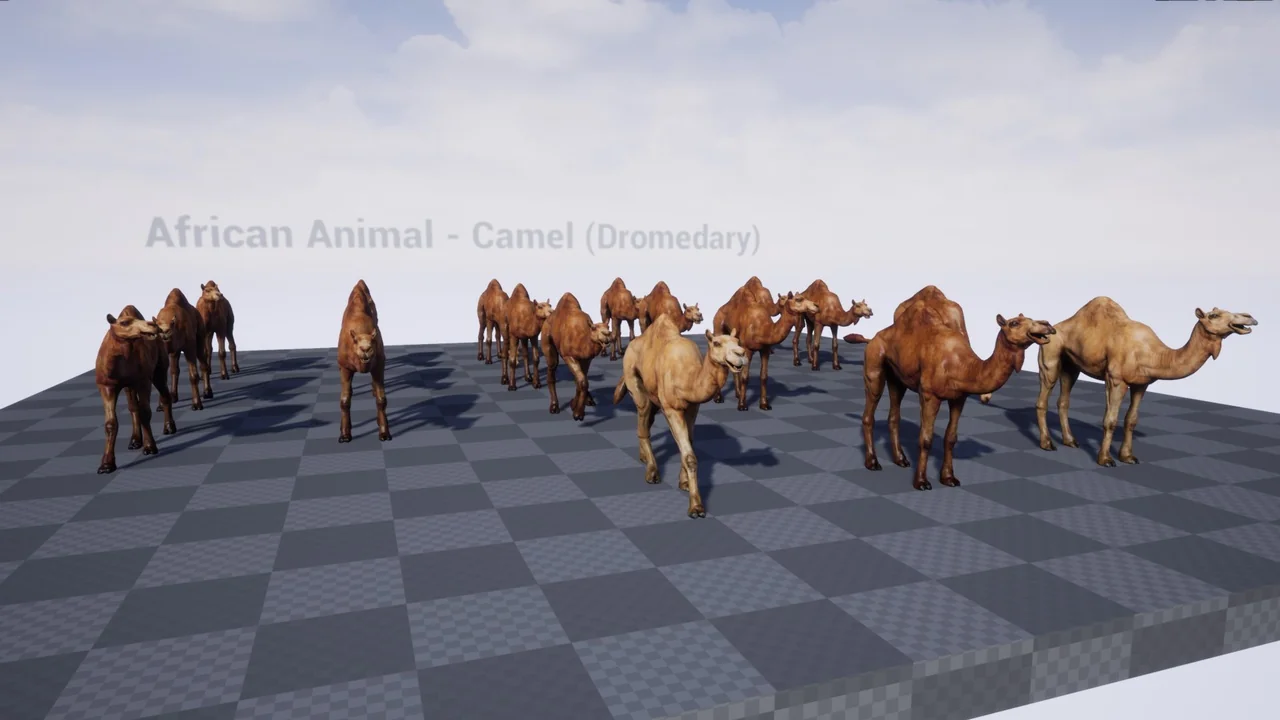
 Animals
 Animals
 Animals