"4481da9c895ef786"{"id":"1000296","slug":"galapagos-tortoise","title":"Galapagos Tortoise","category":"Animals","engine":"4.27,5.0+","assetVersion":"","engineVersion":"Engine Version: 4.27,5.0+","tag":"Animals","accent":"blue","visual":"mech","summary":"A fully rigged and animated Galapagos Tortoise built for realistic savanna environments, featuring 2K textures, two skin variants, and 9 in-place animations.","platform":"Unreal Engine","publishedAt":"2026-07-03T17:49:30.825Z","updatedAt":"2026-07-03T17:49:30.825Z","sourceNotes":[],"fileContents":[],"compatibility":["Unreal Engine","Engine Version: 4.27,5.0+"],"featuredImage":{"alt":"Galapagos Tortoise","src":"/wp-content/uploads/published/2026/07/a7b1192e2894-e7a4c613-1160-4e14-8d80-a053ff63e151-32f5350a0c.webp"},"hasDownloadLink":true,"downloads":0,"terms":[{"taxonomy":"category","slug":"animals","name":"Animals"}],"galleryImages":[{"src":"/wp-content/uploads/published/2026/07/b375978a0c07-790fb162-d07c-41d6-8bdd-13ab22bb9ef2-e35c97e265.webp","alt":"Galapagos Tortoise"},{"src":"/wp-content/uploads/published/2026/07/ea10cfddf7c2-03f0f1e6-9ec4-4d8f-88e4-d19ba0789089-6728d3bdb1.webp","alt":"Galapagos Tortoise"},{"src":"/wp-content/uploads/published/2026/07/32a1d57e580b-4288c8ac-b006-4058-874c-2b861813459d-53ef8bc49e.webp","alt":"Galapagos Tortoise"},{"src":"/wp-content/uploads/published/2026/07/be0d6943842b-69778f20-2e70-495d-98d7-4ba8263afa93-734c8c6889.webp","alt":"Galapagos Tortoise"},{"src":"/wp-content/uploads/published/2026/07/f5e0c5b92f52-d5e6a18e-ca43-4186-ab05-bd9c74860691-1dfc9f4c1b.webp","alt":"Galapagos Tortoise"},{"src":"/wp-content/uploads/published/2026/07/7f843aa9ee30-b86fd1db-483e-4c56-ad67-108056019656-8685ab08b8.webp","alt":"Galapagos Tortoise"}],"accessPanel":{"kind":"resource","title":"Download this resource","eyebrow":"Free Download","message":"Log in or create a free account to start your download.","fileName":"Content.7z","safetyNote":"Resources are manually reviewed before listing to improve quality and reduce obvious risks.","actionLabel":"Download Free","resourceType":"Resource archive"},"contentHtml":"\u003ch2\u003ePopulating Realistic Savanna Environments\u003c/h2\u003e\n\u003cp\u003eBuilding a convincing savanna ecosystem requires wildlife that feels grounded and interacts naturally with the terrain. The Galapagos Tortoise provides a highly specific, realistic reptile asset designed exactly for these types of dry, expansive environments. Rather than requiring extensive manual configuration upon import, the models are provided correctly oriented, sized, and positioned. This out-of-the-box structural accuracy eliminates the common technical friction of importing a character only to find its scale mismatched to the environment or its pivot point facing the wrong directional axis, allowing developers to immediately begin placing the creatures into their scenes.\u003c/p\u003e \u003ch2\u003eVisual Configurations and Texture Resolution\u003c/h2\u003e\n\u003cp\u003eTo ensure variety within a single habitat, the package includes two distinct skin variations: a light skin and a dark skin. Providing multiple skins allows level designers to populate a savanna map with a small group of tortoises without the wildlife appearing as identical, cloned assets. The visual identity of these skins is built upon a Metallic material workflow, utilizing two distinct materials to define the contrasting surface properties of the reptile.\u003c/p\u003e\n\u003cp\u003eThe surface details are driven by a suite of texture maps authored at 2K resolution. This 2K dimension strikes a deliberate balance, providing enough pixel density to cleanly render the deep wrinkles of the tortoise's skin and the heavy geometric scutes of its shell, while maintaining an optimized memory footprint for real-time rendering. The texture package is organized into BC, MRA, and NR maps. By utilizing this combination of base color, metallic/roughness arrays, and normal mapping, the materials accurately react to dynamic lighting conditions, ensuring the tortoise looks authentic whether placed in harsh midday savanna sun or deep shade.\u003c/p\u003e \u003ch2\u003eMesh Geometry and Unreal Engine Scaling\u003c/h2\u003e\n\u003cp\u003eBeneath the 2K textures, the physical structure of the tortoise is built on highly optimized geometry. The entire character consists of a single mesh with a strict vertex count of 2607. This lightweight polygonal footprint is a critical factor for open-world or large-scale savanna environments, as it allows the engine to render multiple animals simultaneously without creating a severe performance bottleneck. Furthermore, the mesh utilizes non-overlapping UV mapping. This specific UV layout prevents any texture stretching or unintentional texture bleeding across the geometry, ensuring the complex shell patterns map perfectly to the 2607 vertices.\u003c/p\u003e\n\u003cp\u003eFor workflows structured through Unreal Engine, the asset takes performance management a step further by supporting Auto LODs (Level of Detail). As the player's camera moves further away from the tortoise across the landscape, Unreal Engine will automatically scale down the geometric complexity of the mesh. Paired with the already low base vertex count, this automated LOD generation ensures excellent performance scaling at long distances. The Unreal Engine integration is officially supported for development on Windows platforms.\u003c/p\u003e \u003ch2\u003eUnity Rendering and Prefab Structure\u003c/h2\u003e\n\u003cp\u003eFor developers operating within the Unity ecosystem, the tortoise is configured to integrate seamlessly across the engine's various rendering methodologies. The asset includes native support for the Built-in Render Pipeline (BIRP), the Universal Render Pipeline (URP), and the High Definition Render Pipeline (HDRP). This cross-pipeline compatibility ensures that the metallic materials and 2K textures will render correctly regardless of whether a project is targeting mobile performance with URP or pursuing maximum visual fidelity with HDRP.\u003c/p\u003e\n\u003cp\u003eTo streamline the setup process within Unity, the package provides two pre-configured prefabs alongside the single base mesh. These prefabs correspond to the light and dark skin variations, allowing developers to simply drag the fully textured and material-assigned tortoises from the project browser directly into their savanna scene without manually reconstructing the material dependencies.\u003c/p\u003e \u003ch2\u003eBehavioral Animations and AI Integration\u003c/h2\u003e\n\u003cp\u003eA realistic wildlife asset is defined by its movement, and the Galapagos Tortoise is fully rigged and animated to support complex AI behaviors. The animation package includes 9 distinct animations, all of which are configured as in-place. In-place animations are the standard requirement for game engines utilizing navigation meshes or custom AI root motion controllers. By keeping the root bone stationary during playback, the engine's AI system can precisely dictate the movement speed and trajectory of the tortoise without fighting against baked-in translation data.\u003c/p\u003e\n\u003cp\u003eThe 9 animations provide a comprehensive state machine for a slow-moving reptile. Basic locomotion is handled by the \"walk\" cycle, while ambient behavior is supported by two distinct \"idle\" animations and an \"eat\" animation, allowing the tortoise to realistically interact with low-lying savanna vegetation. \u003c/p\u003e\n\u003cp\u003eBeyond basic movement, the animation suite includes highly specific defensive and combat reactions. The standout behaviors are the \"hide from shell\" and \"unhide from shell\" animations. These specific sequences allow developers to script authentic proximity reactions, triggering the tortoise to pull its head and limbs inside its shell when a player or predator enters its radius, and cautiously emerge when the threat is gone. The inclusion of an \"attack\" animation, a \"get hit\" reaction, and a \"death\" sequence rounds out the package, providing the necessary states for the tortoise to participate in an active, dynamic ecosystem.\u003c/p\u003e\n\n\u003ch2\u003eMore From The Same Workflow\u003c/h2\u003e\n\u003cul\u003e\n\u003cli\u003e\u003ca href=\"https://3dcghub.com/african-animal-camel-dromedary/\" title=\"African Animal - Camel (Dromedary)\"\u003eAfrican Animal - Camel (Dromedary)\u003c/a\u003e\u003c/li\u003e\n\u003cli\u003e\u003ca href=\"https://3dcghub.com/panthers-pack/\" title=\"Panthers pack\"\u003ePanthers pack\u003c/a\u003e\u003c/li\u003e\n\u003cli\u003e\u003ca href=\"https://3dcghub.com/asian-animal-tiger/\" title=\"Asian Animal - Tiger\"\u003eAsian Animal - Tiger\u003c/a\u003e\u003c/li\u003e\n\u003cli\u003e\u003ca href=\"https://3dcghub.com/bones-vol-1-animal-bones-1-nanite-low-poly/\" title=\"Bones VOL.1 - Animal Bones 1 (Nanite + Low Poly)\"\u003eBones VOL.1 - Animal Bones 1 (Nanite + Low Poly)\u003c/a\u003e\u003c/li\u003e\n\u003cli\u003e\u003ca href=\"https://3dcghub.com/spixs-macaw-ararinha-azul/\" title=\"Spix\u0026#039;s Macaw - Ararinha Azul\"\u003eSpix\u0026#039;s Macaw - Ararinha Azul\u003c/a\u003e\u003c/li\u003e\n\u003c/ul\u003e","contentTextLength":5828,"navigation":{"current":1109,"total":3269,"previous":{"id":"1000297","slug":"hero-for-rpg-modular-pbr","title":"Hero for RPG : Modular PBR","category":"Humans","platform":"Unreal Engine","updatedAt":"2026-07-03T17:52:27.983Z"},"next":{"id":"1000295","slug":"funeral-animations","title":"Funeral Animations","category":"Variety","platform":"Unreal Engine","updatedAt":"2026-07-03T17:46:42.152Z"}},"relatedResources":[{"id":"1000268","slug":"african-animal-camel-dromedary","title":"African Animal - Camel (Dromedary)","category":"Animals","engine":"4.27,5.0+","assetVersion":"","engineVersion":"Engine Version: 4.27,5.0+","tag":"Animals","accent":"blue","visual":"mech","summary":"A fully rigged, high-poly Dromedary Camel 3D model featuring 35 bones, 1k/2k textures, and 36 total animations split across In-Place and Root Motion FBX files.","platform":"Unreal Engine","publishedAt":"2026-07-02T15:37:29.441Z","updatedAt":"2026-07-02T15:37:29.441Z","sourceNotes":[],"fileContents":[],"compatibility":["Unreal Engine","Engine Version: 4.27,5.0+"],"featuredImage":{"alt":"African Animal - Camel (Dromedary)","src":"/wp-content/uploads/published/2026/07/230d71b719a9-9a229666-007e-423d-93b2-68c88c60db0f-abb345eefd.webp"},"hasDownloadLink":true,"downloads":0},{"id":"1001065","slug":"raptor-dinosaur-animated","title":"Raptor Dinosaur Animated","category":"Animals","engine":"4.26+,5.0+","assetVersion":"","engineVersion":"Engine Version: 4.26+,5.0+","tag":"Animals","accent":"blue","visual":"mech","summary":"Dromaeosaurus animated model with 150+ animations, 5 LOD stages, 4096-pixel textures, UE4 ragdoll, and HumanIK FBX files for retargeting.","platform":"Unreal Engine","publishedAt":"2026-09-03T16:02:56.829Z","updatedAt":"2026-09-03T16:02:56.829Z","sourceNotes":[],"fileContents":[],"compatibility":["Unreal Engine","Engine Version: 4.26+,5.0+"],"featuredImage":{"alt":"Raptor Dinosaur Animated","src":"/wp-content/uploads/published/2026/09/b2c8cf21982a-6c8db538-21ee-4c01-aed5-6eb7cbbd1ba5-03c2b8519d.webp"},"hasDownloadLink":true,"downloads":1},{"id":"1000244","slug":"asian-animal-tiger","title":"Asian Animal - Tiger","category":"Animals","engine":"4.26+,5.0+","assetVersion":"","engineVersion":"Engine Version: 4.26+,5.0+","tag":"Animals","accent":"blue","visual":"mech","summary":"A highly detailed 3D tiger model featuring three LOD variations, 4K textures, a 37-bone rig, and 53 unique animations for realistic wildlife environments.","platform":"Unreal Engine","publishedAt":"2026-06-30T19:57:16.638Z","updatedAt":"2026-06-30T19:57:16.638Z","sourceNotes":[],"fileContents":[],"compatibility":["Unreal Engine","Engine Version: 4.26+,5.0+"],"featuredImage":{"alt":"Asian Animal - Tiger","src":"/wp-content/uploads/published/2026/06/88b3fb6ce8d3-9bce027c-37b2-4452-a053-04a73a2eff55-838ca9c79f.webp"},"hasDownloadLink":true,"downloads":0}]}
Animals
Galapagos Tortoise
A fully rigged and animated Galapagos Tortoise built for realistic savanna environments, featuring 2K textures, two skin variants, and 9 in-place animations.
Building a convincing savanna ecosystem requires wildlife that feels grounded and interacts naturally with the terrain. The Galapagos Tortoise provides a highly specific, realistic reptile asset designed exactly for these types of dry, expansive environments. Rather than requiring extensive manual configuration upon import, the models are provided correctly oriented, sized, and positioned. This out-of-the-box structural accuracy eliminates the common technical friction of importing a character only to find its scale mismatched to the environment or its pivot point facing the wrong directional axis, allowing developers to immediately begin placing the creatures into their scenes.
Visual Configurations and Texture Resolution
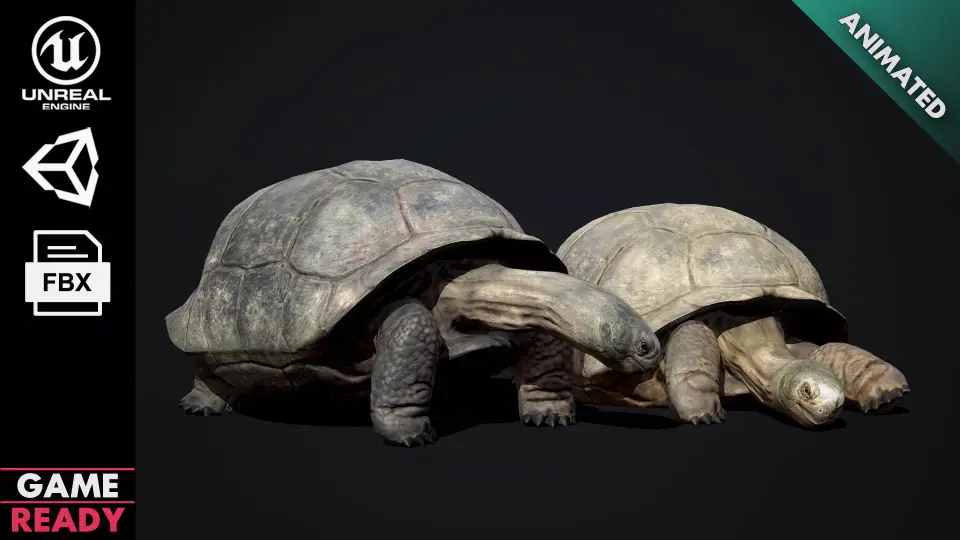
To ensure variety within a single habitat, the package includes two distinct skin variations: a light skin and a dark skin. Providing multiple skins allows level designers to populate a savanna map with a small group of tortoises without the wildlife appearing as identical, cloned assets. The visual identity of these skins is built upon a Metallic material workflow, utilizing two distinct materials to define the contrasting surface properties of the reptile.
The surface details are driven by a suite of texture maps authored at 2K resolution. This 2K dimension strikes a deliberate balance, providing enough pixel density to cleanly render the deep wrinkles of the tortoise's skin and the heavy geometric scutes of its shell, while maintaining an optimized memory footprint for real-time rendering. The texture package is organized into BC, MRA, and NR maps. By utilizing this combination of base color, metallic/roughness arrays, and normal mapping, the materials accurately react to dynamic lighting conditions, ensuring the tortoise looks authentic whether placed in harsh midday savanna sun or deep shade.
Mesh Geometry and Unreal Engine Scaling
Beneath the 2K textures, the physical structure of the tortoise is built on highly optimized geometry. The entire character consists of a single mesh with a strict vertex count of 2607. This lightweight polygonal footprint is a critical factor for open-world or large-scale savanna environments, as it allows the engine to render multiple animals simultaneously without creating a severe performance bottleneck. Furthermore, the mesh utilizes non-overlapping UV mapping. This specific UV layout prevents any texture stretching or unintentional texture bleeding across the geometry, ensuring the complex shell patterns map perfectly to the 2607 vertices.
For workflows structured through Unreal Engine, the asset takes performance management a step further by supporting Auto LODs (Level of Detail). As the player's camera moves further away from the tortoise across the landscape, Unreal Engine will automatically scale down the geometric complexity of the mesh. Paired with the already low base vertex count, this automated LOD generation ensures excellent performance scaling at long distances. The Unreal Engine integration is officially supported for development on Windows platforms.
Unity Rendering and Prefab Structure
For developers operating within the Unity ecosystem, the tortoise is configured to integrate seamlessly across the engine's various rendering methodologies. The asset includes native support for the Built-in Render Pipeline (BIRP), the Universal Render Pipeline (URP), and the High Definition Render Pipeline (HDRP). This cross-pipeline compatibility ensures that the metallic materials and 2K textures will render correctly regardless of whether a project is targeting mobile performance with URP or pursuing maximum visual fidelity with HDRP.
To streamline the setup process within Unity, the package provides two pre-configured prefabs alongside the single base mesh. These prefabs correspond to the light and dark skin variations, allowing developers to simply drag the fully textured and material-assigned tortoises from the project browser directly into their savanna scene without manually reconstructing the material dependencies.
Behavioral Animations and AI Integration
A realistic wildlife asset is defined by its movement, and the Galapagos Tortoise is fully rigged and animated to support complex AI behaviors. The animation package includes 9 distinct animations, all of which are configured as in-place. In-place animations are the standard requirement for game engines utilizing navigation meshes or custom AI root motion controllers. By keeping the root bone stationary during playback, the engine's AI system can precisely dictate the movement speed and trajectory of the tortoise without fighting against baked-in translation data.
The 9 animations provide a comprehensive state machine for a slow-moving reptile. Basic locomotion is handled by the "walk" cycle, while ambient behavior is supported by two distinct "idle" animations and an "eat" animation, allowing the tortoise to realistically interact with low-lying savanna vegetation.
Beyond basic movement, the animation suite includes highly specific defensive and combat reactions. The standout behaviors are the "hide from shell" and "unhide from shell" animations. These specific sequences allow developers to script authentic proximity reactions, triggering the tortoise to pull its head and limbs inside its shell when a player or predator enters its radius, and cautiously emerge when the threat is gone. The inclusion of an "attack" animation, a "get hit" reaction, and a "death" sequence rounds out the package, providing the necessary states for the tortoise to participate in an active, dynamic ecosystem.
 Animals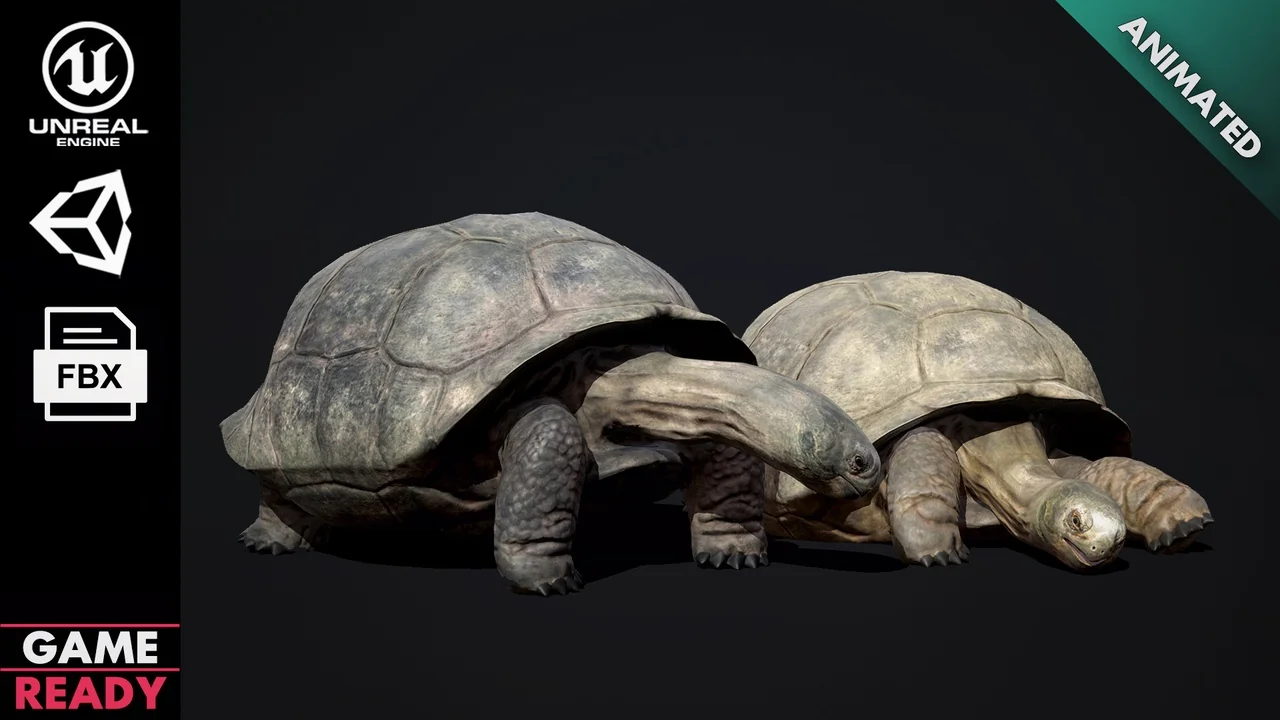
 Animals
 Animals
 Animals